2007 TOYOTA SIENNA display
[x] Cancel search: displayPage 365 of 3000

2GR-FE ENGINE CONTROL SYSTEM – SFI SYSTEMES–47
ES
KNOCK FB VAL Feedback value of knocking -
ACCEL POS #1Absolute Accelerator Pedal Position (APP)
No. 1-
ACCEL POS #2 Absolute APP No. 2 -
THROTTLE POS Throttle positionRead value with ignition switch on (Do not
start engine)
THROTTLE POS Throttle sensor positioningRead value with ignition switch on (Do not
start engine)
THROTTLE POS#2 Throttle sensor positioning #2Read value with ignition switch on (Do not
start engine)
THROTTLE MOT Throttle motor -
O2S B1 S2 Heated oxygen sensor outputPerforming INJ VOL or A/F CONTROL
function of ACTIVE TEST enables technician
to check voltage output of sensor
O2S B2 S2 Heated oxygen sensor outputPerforming INJ VOL or A/F CONTROL
function of ACTIVE TEST enables technician
to check voltage output of sensor
AFS B1 S1 A/F sensor outputPerforming INJ VOL or A/F CONTROL
function of ACTIVE TEST enables technician
to check voltage output of sensor
AFS B2 S1 A/F sensor outputPerforming INJ VOL or A/F CONTROL
function of ACTIVE TEST enables technician
to check voltage output of sensor
TOTAL FT #1 Total fuel trim of bank 1 -
TOTAL FT #2 Total fuel trim of bank 2 -
SHORT FT #1 Short-term fuel trim of bank 1Short-term fuel compensation used to
maintain air-fuel ratio at stoichiometric air-fuel
ratio
LONG FT #1 Long-term fuel trim of bank 1Overall fuel compensation carried out in long-
term to compensate for a continual deviation
of short-term fuel trim from central valve
SHORT FT #2 Short-term fuel trim of bank 2Short-term fuel compensation used to
maintain air-fuel ratio at stoichiometric air-fuel
ratio
LONG FT #2 Long-term fuel trim of bank 2Overall fuel compensation carried out in long-
term to compensate for a continual deviation
of short-term fuel trim from central valve
FUEL SYS #1 Fuel system status (bank 1)• OL (Open Loop): Has not yet satisfied
conditions to go closed loop
• CL (Closed Loop): Using heated oxygen
sensor as feedback for fuel control
• OL DRIVE: Open loop due to driving
conditions (fuel enrichment)
• OL FAULT: Open loop due to detected
system fault
• CL FAULT: Closed loop but heated
oxygen sensor, which used for fuel control
malfunctioning
FUEL SYS #2 Fuel system status (bank 2)• OL (Open Loop): Has not yet satisfied
conditions to go closed loop
• CL (Closed Loop): Using heated oxygen
sensor as feedback for fuel control
• OL DRIVE: Open loop due to driving
conditions (fuel enrichment)
• OL FAULT: Open loop due to detected
system fault
• CL FAULT: Closed loop but heated
oxygen sensor, which used for fuel control
malfunctioning
O2FT B1 S2 Fuel trim at heated oxygen sensor Same as SHORT FT #1LABEL
(Intelligent Tester Display)Measurement Item Diagnostic Note
Page 366 of 3000

ES–482GR-FE ENGINE CONTROL SYSTEM – SFI SYSTEM
ES
O2FT B2 S2 Fuel trim at heated oxygen sensor Same as SHORT FT #2
AF FT B1 S1 Fuel trim at A/F sensor -
AF FT B2 S1 Fuel trim at A/F sensor -
CAT TEMP B1 S1 Catalyst temperature -
CAT TEMP B2 S1 Catalyst temperature -
CAT TEMP B1 S2 Catalyst temperature -
CAT TEMP B2 S2 Catalyst temperature -
S O2S B1 S2 Heated oxygen sensor impedance (Sensor 2) -
S O2S B2 S2 Heated oxygen sensor impedance (Sensor 2) -
INI COOL TEMP Initial engine coolant temperature -
INI INTAKE TEMP Initial intake air temperature -
INJ VOL Injection volume -
STARTER SIG Starter signal -
PS SW Power steering signal -
PS SIGNAL Power steering signal (history)This signal status usually ON until ignition
switch turned off
CTP SW Closed throttle position switch -
A/C SIGNAL A/C signal -
ELECT LOAD SIG Electrical load signal -
STOP LIGHT SW Stop light switch -
BATTERY VOLTAGE Battery voltage -
ATM PRESSURE Atmospheric pressure -
FUEL PMP SP CTL Fuel pump speed control status -
ACIS VSVVSV for Air Intake Control Induction System
(AICS)-
VVT CTRL B2 VVT control (bank 2 Intake side) status -
EVAP (Purge) VSV EVAP purge VSV -
FUEL PUMP/SPD Fuel pump speed statusVSV for EVAP controlled by ECM (ground
side duty control)
VACUUM PUMP Key-off EVAP system pump status -
EVAP VENT VAL Key-off EVAP system vent valve status -
FAN MOTOR Electric fan motor -
TC/TE1 TC and TE1 terminals of DLC3 -
ACM ACM control status -
VVTL AIM ANGL #1 VVT aim angle -
VVT CHNG ANGL #1 VVT change angle -
VVT OCV DUTY B1 VVT OCV operation duty -
VVT EX HOLD B1VVT exhaust hold duty ratio learning value
(bank 1 Exhaust side)-
VVT EX CHG ANG1 VVT change angle (bank 1 Exhaust side) -
VVT EX OCV D B1VVT OCV (bank 1 Exhaust side) operation
duty-
VVTL AIM ANGL#2 VVT aim angle (bank 2 Intake side) -
VVT CHNG ANGL#2 VVT change angle (bank 2 Intake side) -
VVT OCV DUTY B2 VVT OCV (bank 2 Intake side) operation duty -
VVT EX HOLD B2VVT exhaust hold duty ratio learning value
(bank 2 Exhaust side)-
VVT EX CHG ANG2 VVT change angle (bank 2 Exhaust side) -
VVT EX OCV D B2VVT OCV (bank 2 Exhaust side) operation
duty- LABEL
(Intelligent Tester Display)Measurement Item Diagnostic Note
Page 367 of 3000

2GR-FE ENGINE CONTROL SYSTEM – SFI SYSTEMES–49
ES
FC IDL Idle fuel cutON: when throttle valve fully closed and
engine speed over 1500 rpm
FC TAU FC TAUFuel cut initiated under light load to prevent
incomplete combustion
IGNITION Ignition -
CYL #1 Cylinder #1 misfire rate Displayed only during idling
CYL #2 Cylinder #2 misfire rate Displayed only during idling
CYL #3 Cylinder #3 misfire rate Displayed only during idling
CYL #4 Cylinder #4 misfire rate Displayed only during idling
CYL #5 Cylinder #5 misfire rate Displayed only during idling
CYL #6 Cylinder #6 misfire rate Displayed only during idling
CYL ALL All cylinder misfire rate Displayed only during idling
MISFIRE RPM Misfire RPM -
MISFIRE LOAD Misfire load -
MISFIRE MARGIN Misfire monitoring -
ENG RUN TIME Accumulated engine running time -
TIME DTC CLEAR Cumulative time after DTC cleared -
DIST DTC CLEAR Accumulated distance after DTC cleared -
WU CYC DTC CLEAR Warm-up cycle after DTC cleared -LABEL
(Intelligent Tester Display)Measurement Item Diagnostic Note
Page 370 of 3000
ES–642GR-FE ENGINE CONTROL SYSTEM – SFI SYSTEM
ES
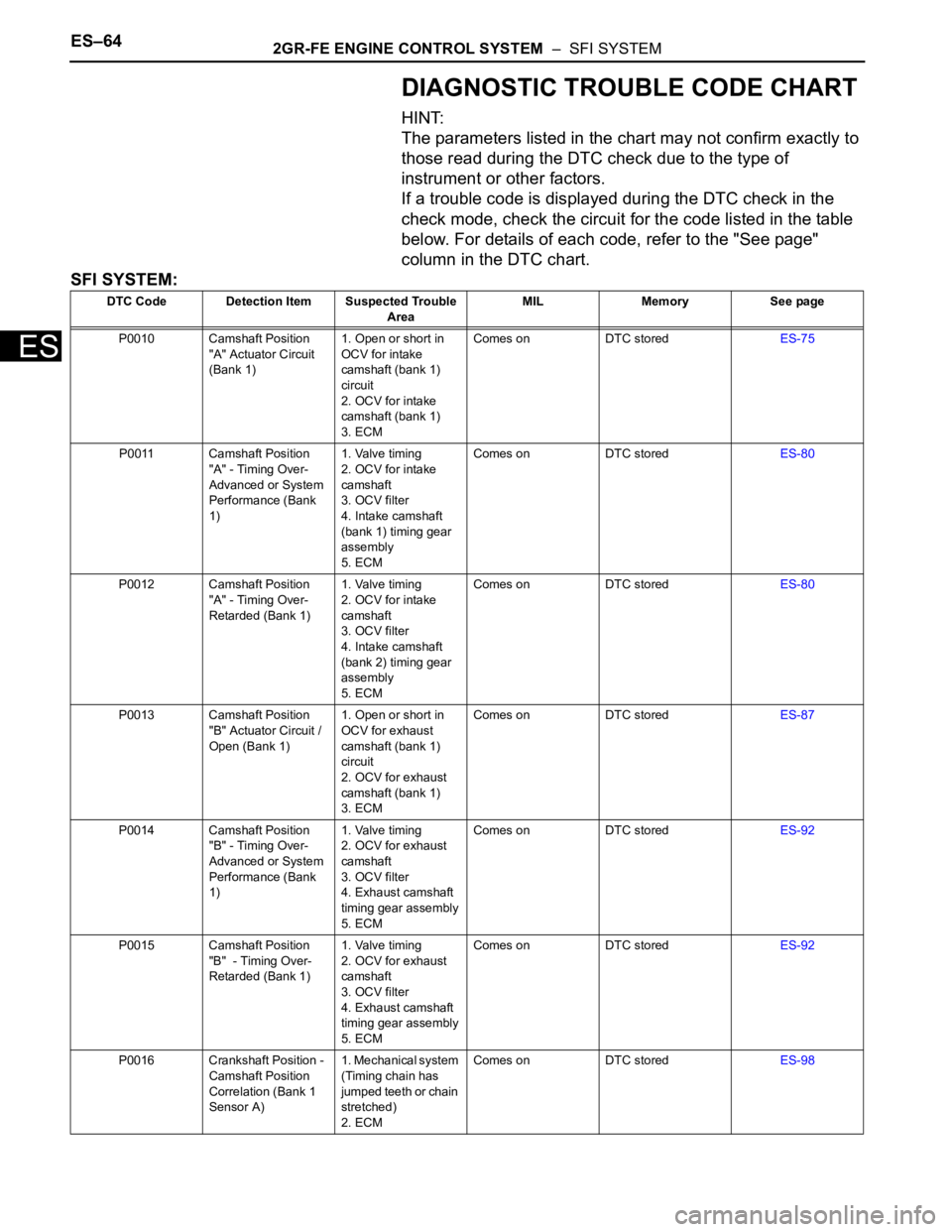
DIAGNOSTIC TROUBLE CODE CHART
HINT:
The parameters listed in the chart may not confirm exactly to
those read during the DTC check due to the type of
instrument or other factors.
If a trouble code is displayed during the DTC check in the
check mode, check the circuit for the code listed in the table
below. For details of each code, refer to the "See page"
column in the DTC chart.
SFI SYSTEM:
DTC Code Detection Item Suspected Trouble
AreaMIL Memory See page
P0010 Camshaft Position
"A" Actuator Circuit
(Bank 1)1. Open or short in
OCV for intake
camshaft (bank 1)
circuit
2. OCV for intake
camshaft (bank 1)
3. ECMComes on DTC storedES-75
P0011 Camshaft Position
"A" - Timing Over-
Advanced or System
Performance (Bank
1)1. Valve timing
2. OCV for intake
camshaft
3. OCV filter
4. Intake camshaft
(bank 1) timing gear
assembly
5. ECMComes on DTC storedES-80
P0012 Camshaft Position
"A" - Timing Over-
Retarded (Bank 1)1. Valve timing
2. OCV for intake
camshaft
3. OCV filter
4. Intake camshaft
(bank 2) timing gear
assembly
5. ECMComes on DTC storedES-80
P0013 Camshaft Position
"B" Actuator Circuit /
Open (Bank 1)1. Open or short in
OCV for exhaust
camshaft (bank 1)
circuit
2. OCV for exhaust
camshaft (bank 1)
3. ECMComes on DTC storedES-87
P0014 Camshaft Position
"B" - Timing Over-
Advanced or System
Performance (Bank
1)1. Valve timing
2. OCV for exhaust
camshaft
3. OCV filter
4. Exhaust camshaft
timing gear assembly
5. ECMComes on DTC storedES-92
P0015 Camshaft Position
"B" - Timing Over-
Retarded (Bank 1)1. Valve timing
2. OCV for exhaust
camshaft
3. OCV filter
4. Exhaust camshaft
timing gear assembly
5. ECMComes on DTC storedES-92
P0016 Crankshaft Position -
Camshaft Position
Correlation (Bank 1
Sensor A)1. Mechanical system
(Timing chain has
jumped teeth or chain
stretched)
2. ECMComes on DTC storedES-98
Page 391 of 3000
2GR-FE ENGINE CONTROL SYSTEM – SFI SYSTEMES–85
ES
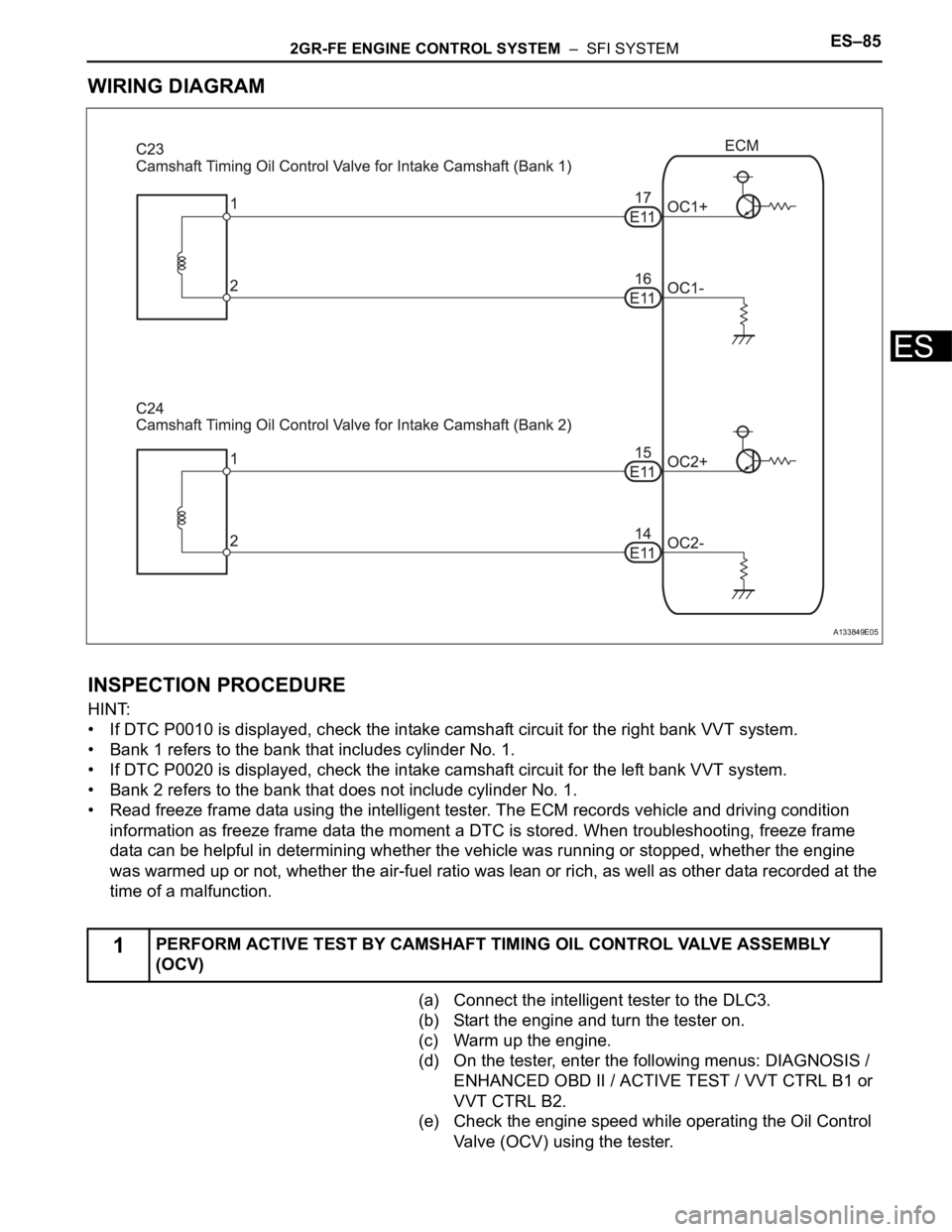
WIRING DIAGRAM
INSPECTION PROCEDURE
HINT:
• If DTC P0010 is displayed, check the intake camshaft circuit for the right bank VVT system.
• Bank 1 refers to the bank that includes cylinder No. 1.
• If DTC P0020 is displayed, check the intake camshaft circuit for the left bank VVT system.
• Bank 2 refers to the bank that does not include cylinder No. 1.
• Read freeze frame data using the intelligent tester. The ECM records vehicle and driving condition
information as freeze frame data the moment a DTC is stored. When troubleshooting, freeze frame
data can be helpful in determining whether the vehicle was running or stopped, whether the engine
was warmed up or not, whether the air-fuel ratio was lean or rich, as well as other data recorded at the
time of a malfunction.
(a) Connect the intelligent tester to the DLC3.
(b) Start the engine and turn the tester on.
(c) Warm up the engine.
(d) On the tester, enter the following menus: DIAGNOSIS /
ENHANCED OBD II / ACTIVE TEST / VVT CTRL B1 or
VVT CTRL B2.
(e) Check the engine speed while operating the Oil Control
Valve (OCV) using the tester.
1PERFORM ACTIVE TEST BY CAMSHAFT TIMING OIL CONTROL VALVE ASSEMBLY
(OCV)
A133849E05
Page 396 of 3000

ES–902GR-FE ENGINE CONTROL SYSTEM – SFI SYSTEM
ES
HINT:
• If DTC P0011 or P0012 is displayed, check the bank 1 VVT system circuit.
• Bank 1 refers to the bank that includes cylinder No. 1.
• If DTC P0021 or P0022 is displayed, check the bank 2 VVT system circuit.
• Bank 2 refers to the bank that does not include cylinder No. 1.
• Read freeze frame data using the intelligent tester. The ECM records vehicle and driving condition
information as freeze frame data the moment a DTC is stored. When troubleshooting, freeze frame
data can be helpful in determining whether the vehicle was running or stopped, whether the engine
was warmed up or not, whether the air-fuel ratio was lean or rich, as well as other data recorded at the
time of a malfunction.
(a) Connect the intelligent tester to the DLC3.
(b) Turn the ignition switch to the ON position and turn the
tester on.
(c) Select the following menu items: DIAGNOSIS /
ENHANCED OBD II / DTC INFO / CURRENT CODES.
(d) Read the DTCs.
Result
HINT:
If any DTCs other than P0011, P0012, P0021 or P0022
are output, troubleshoot those DTCs first.
B
A
(a) Connect the intelligent tester to the DLC3.
(b) Start the engine and turn the tester on.
(c) Warm up the engine.
(d) Select the following menu items on the tester:
DIAGNOSIS / ENHANCED OBD II / ACTIVE TEST /
VVT CTRL B1.
(e) Check the engine speed while operating the Oil Control
Valve (OCV) using the tester.
OK
NG
OK
1CHECK ANY OTHER DTCS OUTPUT (IN ADDITION TO DTC P0011, P0012, P0021 OR
P0022)
Display (DTC Output) Proceed to
P0011, P0012, P0021 or P0022 A
P0011, P0012, P0021 or P0022 and other DTCs B
GO TO DTC CHART (See page ES-56)
2PERFORM ACTIVE TEST BY INTELLIGENT TESTER (OPERATE OCV)
Tester Operation Specified Condition
OCV OFF Normal engine idle speed
OCV ON Engine idles roughly or stalls (soon after OCV switched from OFF to ON)
Go to step 4
Page 403 of 3000
2GR-FE ENGINE CONTROL SYSTEM – SFI SYSTEMES–97
ES
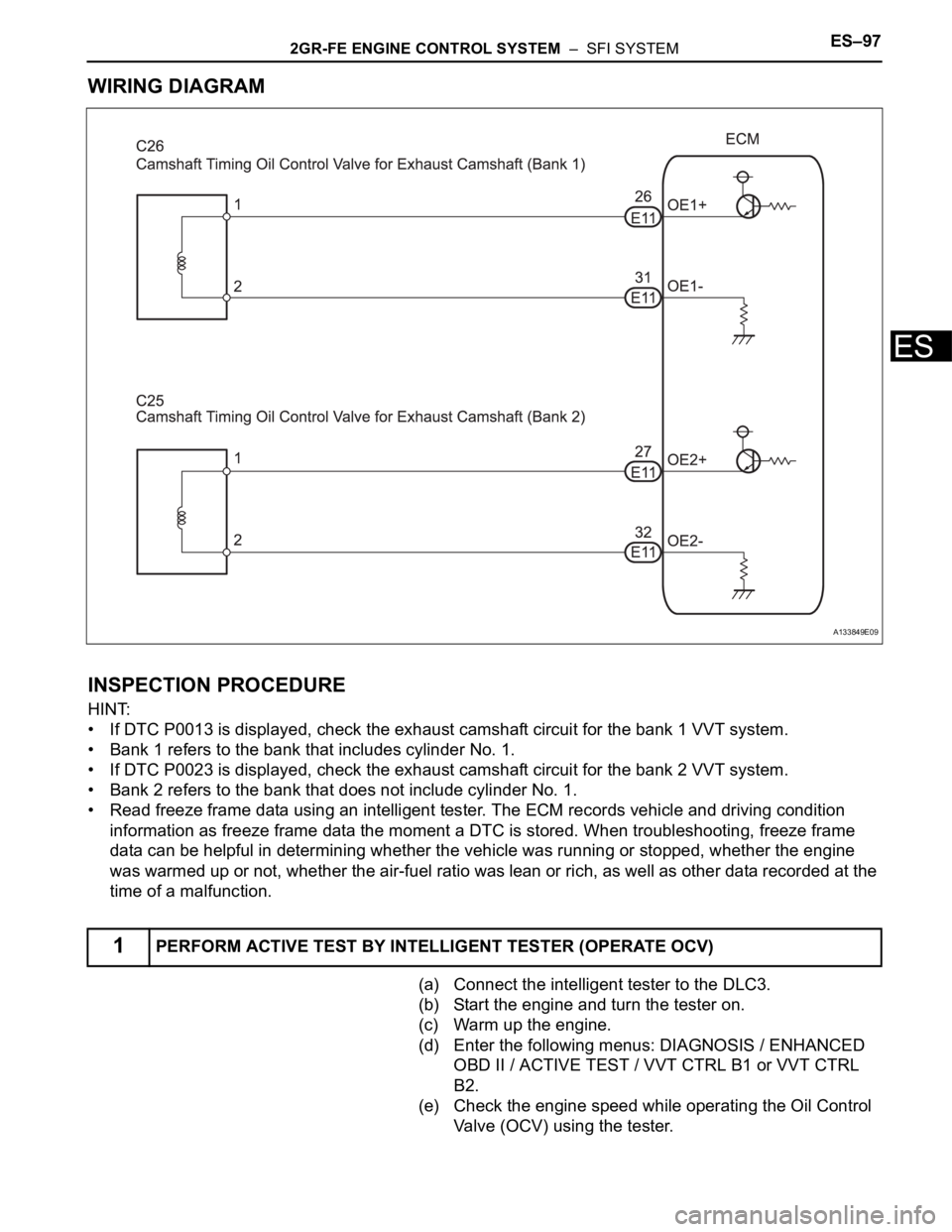
WIRING DIAGRAM
INSPECTION PROCEDURE
HINT:
• If DTC P0013 is displayed, check the exhaust camshaft circuit for the bank 1 VVT system.
• Bank 1 refers to the bank that includes cylinder No. 1.
• If DTC P0023 is displayed, check the exhaust camshaft circuit for the bank 2 VVT system.
• Bank 2 refers to the bank that does not include cylinder No. 1.
• Read freeze frame data using an intelligent tester. The ECM records vehicle and driving condition
information as freeze frame data the moment a DTC is stored. When troubleshooting, freeze frame
data can be helpful in determining whether the vehicle was running or stopped, whether the engine
was warmed up or not, whether the air-fuel ratio was lean or rich, as well as other data recorded at the
time of a malfunction.
(a) Connect the intelligent tester to the DLC3.
(b) Start the engine and turn the tester on.
(c) Warm up the engine.
(d) Enter the following menus: DIAGNOSIS / ENHANCED
OBD II / ACTIVE TEST / VVT CTRL B1 or VVT CTRL
B2.
(e) Check the engine speed while operating the Oil Control
Valve (OCV) using the tester.
1PERFORM ACTIVE TEST BY INTELLIGENT TESTER (OPERATE OCV)
A133849E09
Page 407 of 3000

2GR-FE ENGINE CONTROL SYSTEM – SFI SYSTEMES–101
ES
MONITOR STRATEGY
TYPICAL ENABLING CONDITIONS
TYPICAL MALFUNCTION THRESHOLDS
Advanced camshaft timing:
Retarded camshaft timing:
If the difference between the target and actual camshaft timings is greater than the specified value, the
ECM operates the VVT actuator.
Then, the ECM monitors the camshaft timing change for 5 seconds.
WIRING DIAGRAM
Refer to DTC P0013 (See page ES-89).
INSPECTION PROCEDURE
HINT:
• If DTC P0014 or P0015 is displayed, check the bank 1 VVT system circuit.
• Bank 1 refers to the bank that includes cylinder No. 1.
• If DTC P0024 or P0025 is displayed, check the bank 2 VVT system circuit.
• Bank 2 refers to the bank that does not include cylinder No. 1.
Related DTCsP0014: Advanced exhaust camshaft timing (bank 1)
P0015: Retarded exhaust camshaft timing (bank 1)
P0024: Advanced exhaust camshaft timing (bank 2)
P0025: Retarded exhaust camshaft timing (bank 2)
Required Sensors / Components (Main) VVT OCV and VVT Actuator
Required Sensors / Components (Related)P0014 and P0015:
Exhaust camshaft control actuator bank 1
Exhaust OCV bank 1
P0024 and P0025:
Exhaust camshaft control actuator bank 2
Exhaust OCV bank 2
Frequency of Operation Continuously
Duration Less than 10 seconds
MIL OperationP0014 and P0024: Immediate
P0015 and P0025: 2 driving cycles
Sequence of Operation None
The monitor will run whenever these DTCs are not
presentNone
Battery voltage 11 V or more
Engine RPM 500 to 4000 rpm
Engine coolant temperature 75 to 100
C (167 to 212F)
Valve timing No change
Valve timing Advanced position
Valve timing No change
Valve timing Retarded position
Abnormal bankAdvanced timing over
(Valve timing is out of specified range)Retarded timing over
(Valve timing is out of specified range)
Bank 1 P0014 P0015
Bank 2 P0024 P0025