2007 MITSUBISHI LANCER EVOLUTION light
[x] Cancel search: lightPage 506 of 1449
ENGINE OVERHAUL -Oil Pump and Oil Pan11B-52
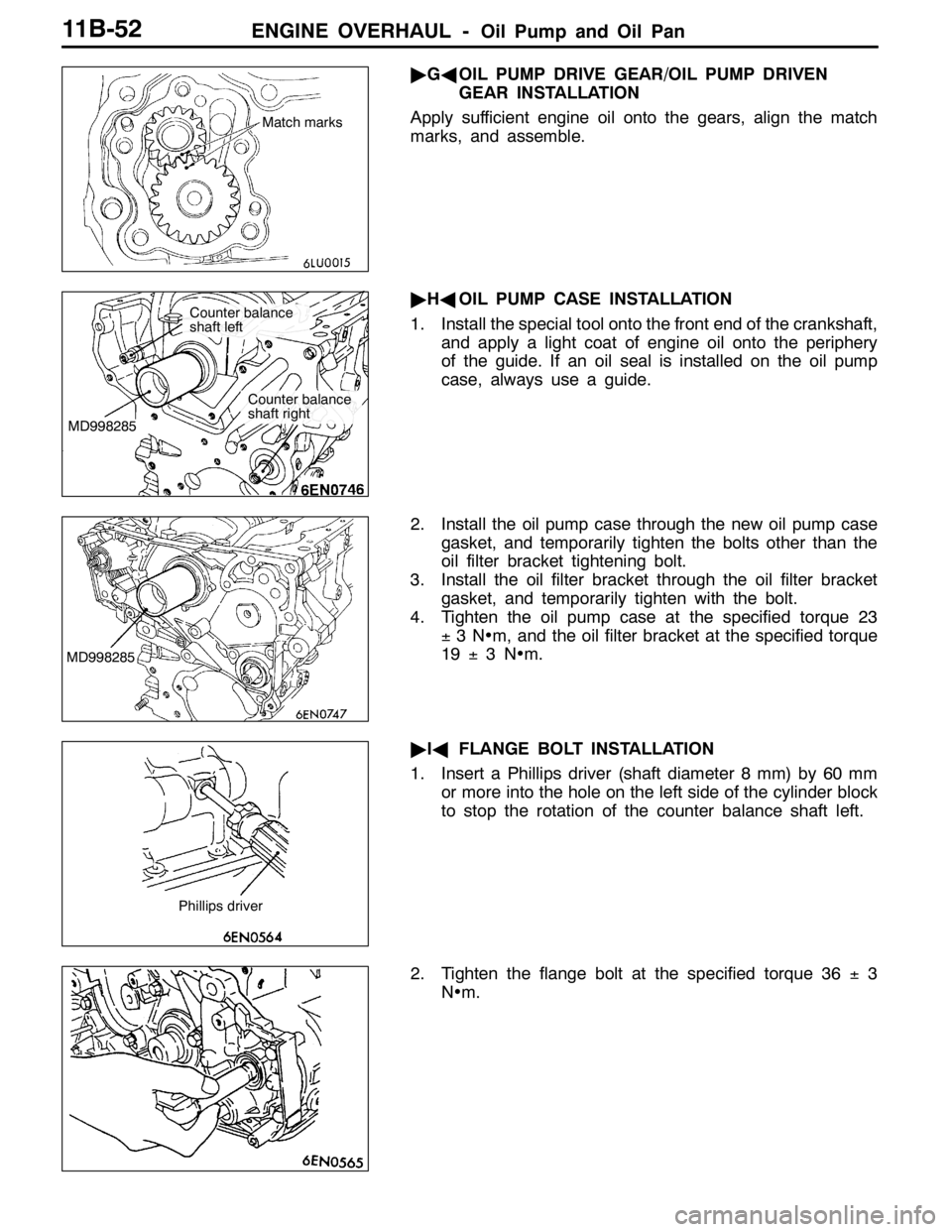
"GAOIL PUMP DRIVE GEAR/OIL PUMP DRIVEN
GEAR INSTALLATION
Apply sufficient engine oil onto the gears, align the match
marks, and assemble.
"HAOIL PUMP CASE INSTALLATION
1. Install the special tool onto the front end of the crankshaft,
and apply a light coat of engine oil onto the periphery
of the guide. If an oil seal is installed on the oil pump
case, always use a guide.
2. Install the oil pump case through the new oil pump case
gasket, and temporarily tighten the bolts other than the
oil filter bracket tightening bolt.
3. Install the oil filter bracket through the oil filter bracket
gasket, and temporarily tighten with the bolt.
4. Tighten the oil pump case at the specified torque 23
±3N•m, and the oil filter bracket at the specified torque
19±3N•m.
"IAFLANGE BOLT INSTALLATION
1. Insert a Phillips driver (shaft diameter 8 mm) by 60 mm
or more into the hole on the left side of the cylinder block
to stop the rotation of the counter balance shaft left.
2. Tighten the flange bolt at the specified torque 36±3
N•m.
Match marks
MD998285
Counter balance
shaft left
Counter balance
shaft right
MD998285
Phillips driver
Page 507 of 1449

ENGINE OVERHAUL -Oil Pump and Oil Pan11B-53
"JAPLUG CAP INSTALLATION
1. Install a new O-ring onto the oil pump case.
2. Lightly tighten the plug cap by hand.
3. As shown in the illustration, fit the special tool (MD998162)
into the notch on the plug cap, and while supporting with
the special tool (MD998783), tighten the plug cap at the
specified torque 23±3N•m.
"KAOIL PRESSURE SWITCH INSTALLATION
Sealant
Specified sealant:
3M
TMAAD Part No. 8672 or equivalent
Caution
(1) Make sure that the sealant does not protrude to the
end of the threads.
(2) Do not tighten too far.
"LAOIL PAN INSTALLATION
1. Clean the surface of the cylinder block and oil pan onto
which gasket is to be applied.
2. Squeeze out form-in-place gasket at a 4 mm width, and
apply onto the entire periphery of the oil pan flange.
Form-in-place gasket
Specified gasket:
Mitsubishi Genuine Part No. MD970389 or
equivalent
3. Note that the lengths of the bolts shown in the illustration
differ, so take care when installing.
MD998162
MD998783
Bolt hole section Groove
Timing belt side
M6×8
Page 634 of 1449
![MITSUBISHI LANCER EVOLUTION 2007 Service Repair Manual MPI -Troubleshooting13A-102
DATA LIST REFERENCE TABLE
NOTE
*1. In a new Vehicle [driven approximately 500 km or less], the air flow sensor output frequency time
is sometimes 10% longer than the standa](/manual-img/19/57084/w960_57084-633.png "MITSUBISHI LANCER EVOLUTION 2007 Service Repair Manual MPI -Troubleshooting13A-102
DATA LIST REFERENCE TABLE
NOTE
*1. In a new Vehicle [driven approximately 500 km or less], the air flow sensor output frequency time
is sometimes 10% longer than the standa")
MPI -Troubleshooting13A-102
DATA LIST REFERENCE TABLE
NOTE
*1. In a new Vehicle [driven approximately 500 km or less], the air flow sensor output frequency time
is sometimes 10% longer than the standard time.
*2. The injector drive time represents the time when the cranking speed is at 250 r/min or below when
the power supply voltage is 11 V.
*3. In a new vehicle [driven approximately 500 km or less], the injector drive time is sometimes 10%
longer than the standard time.
*4. In a new vehicle [driven approximately 500 km or less], the step of the stepper motor is sometimes
30 steps greater than the standard value.
Item
No.Inspection
itemInspection contentsNormal conditionInspection
procedure
No.Reference
page
11Oxygen
sensor
(front)Engine: After having
warmed up
(Air/fuel mixuture is
made leaner whenWhen at 4,000 r/min,
engine is suddenly de-
celerated200 mV or lessCode No.
P013013A-24
madeleanerwhen
decelerating, and is
made richer when rac-
ing.)When engine is sud-
denly raced600 - 1,000 mV
Engine: After having
warmed up
(The oxygen sensor
(front) signal is used
tochecktheair/fuel
Engine is idling400 mV or less↔
600 - 1,000 mV
(Varies)
to check the air/fuel
mixture ratio, and
control condition is
also checked by the
engine-ECU.)2,500 r/min
12Air flow
sensor*1DEngine coolant
temperature:
Idle operation17 - 43 Hz--
sensor*1temperature:
80 - 95_C
DLightningandall
2,500 r/min40 - 100 Hz
DLightning andall
accessories:
OFF
DTransmission:
NeutralAccelerationAccording to ac-
celeration, fre-
quency is ampli-
fied.
13Intake air
temperature
sensor
Ignition switch: “ON”
or engine runningWhen intake air temper-
ature is - 20_C-20_CCode No.
P011013A-13
sensorWhen intake air tem-
perature is 0_C0_C
When intake air tem-
perature is 20_C20_C
When intake air tem-
perature is 40_C40_C
When intake air tem-
perature is 80_C80_C
Page 636 of 1449

MPI -Troubleshooting13A-104
Item
No.Reference
page Inspection
procedure
No. Normal condition Inspection contents Inspection
item
25Barometric
pressure
Ignition switch: ONAltitude: 0 m101 kPaCode No.
P0105
13A-15
pressure
sensor
Altitude: 0 m95 kPa
P0105
Altitude: 0 m88 kPa
Altitude: 0 m81 kPa
27Power
steering
fluidEngine: Idle operationSteering wheel
stationaryOFFCode No.
P055113A-46
fluid
pressure
switchSteering wheel turningON
28A/C switchEngine: Idle operation
(When A/C switch isA/C switch: OFFOFFProcedure
No. 2613A-92
(WhenA/Cswitchis
ON, A/C compressor
should be operating.)A/C switch: ONON
No.26
34Air flow
sensorEngine: After
warm-upIdle operationONCode No.
P010013A-13
sensor
reset
signal
warm up
3,000 r/minOFF
P0100
37Volumetric
efficiency
DEngine coolant
temperature:
Idle operation15 - 35%--
efficiencytemperature:
85 - 95_C
DLightningand
2,500 r/min15 - 35%
DLightning and
accessories:
OFFExcessive
accellerationAccording to ac-
celeration, volu-
metric efficiency
is increased.
41Injectors*1Engine: CrankingWhen engine coolant
temperature is 0_C
(injection is carried out
for all cylinders simulta-
neously)25 - 37 ms--
When engine coolant
temperature is 20_C15 - 22 ms
When engine coolant
temperature is 80_C4.2 - 6.3 ms
Injectors*2DEngine coolant
temperature:
80–95_C
Engine: Idle operation1.5 - 2.7 ms--
80–95_C
DLamps, electric
cooling fan and
allaccessories:
2,500 r/min1.2 - 2.4 ms
allaccessories:
OFF
DTransmission:
Neutral
When engine is sud-
denly racedIncreases
Page 639 of 1449

MPI -Troubleshooting13A-107
ACTUATOR TEST REFERENCE TABLE
Item
No.Inspection
itemDrive contentsInspection contentsNormal conditionInspection
procedure
No.Reference
page
01InjectorsCut fuel to No.
1 injectorEngine: After having warmed
up/Engine is idling
(C tthfllth
Idling condition
becomes different
(becomesunsta
Code No.
P020113A-30
02Cut fuel to No.
2 injector(Cut the fuel supply to each
injector in turn and check
cylinders which don’t affect
idli )
(becomes unsta-
ble).Code No.
P020213A-31
03Cut fuel to No.
3 injector
y
idling.)Code No.
P020313A-32
04Cut fuel to No.
4 injectorCode No.
P020413A-33
07Fuel pumpFuel pump
operates and
fuel is recircu-
lated.DEngine:
Cranking
DFuel
pump:
Forced
driving
Inspect
according
Pinch the
return hose
with fingers
to feel the
pulse of the
fuel being
recirculated.Pulse is felt.Procedure
No. 2313A-85
according
to both
the above
conditions.
Listen near
the fuel tank
for the
sound of
fuel pump
operation.Sound of opera-
tion is heard.
08Purge
control
solenoid
valveSolenoid valve
turns from
OFF to ON.Ignition switch: “ON”Sound of opera-
tion can be heard
when solenoid
valve is driven.Code No.
P044313A-41
09Fuel
pressure
control
solenoid
valveSolenoid valve
turns from
OFF to ON.Ignition switch: “ON”Sound of opera-
tion can be heard
when solenoid
valve is driven.Code No.
P110513A-48
10EGR con-
trol sole-
noid valveSolenoid valve
turns from
OFF to ON.Ignition switch: “ON”Sound of opera-
tion can be heard
when solenoid
valve is driven.Code No.
P040313A-39
12Waste
gate sole-
noid valveSolenoid valve
turns from
OFF to ON.Ignition switch: “ON”Sound of opera-
tion can be heard
when solenoid
valve is driven.Code No.
P110413A-47
13Fuel pump
relay 3Fuel pump
relay 3 turns
from OFF to
ON.DIgnition switch: “ON”
DListen near the fuel tank
for the sound of fuel pump
operation.Sound of opera-
tion is heard.Procedure
No. 2313A-85
17Basic igni-
tion timingSet to ignition
timing
adjustment
modeEngine: Idling
Timing light is set5_BTDC--
Page 641 of 1449

MPI -TroubleshootingMPI -Troubleshooting13A-109
Engine-ECU Connector Terminal Arrangement
Terminal No.Check itemCheck condition (Engine condition)Normal condition
1No. 1 injectorWhile engine is idling after having warmed up,
suddenlydepresstheacceleratorpedal
From 11 - 14 V, momentarily
dropsslightly
14No. 2 injector
suddenlydepressthe accelerator pedal.drops slightly
2No. 3 injector
15No. 4 injector
3Fuel pressure control
solenoidvalve
Ignition switch: “ON”System voltage
solenoidvalve
Engine: Cranking→Idle operation
(within approximately 2 minutes or less)1 V or less→System voltage
4Stepper motor coil
startedSystem voltage↔0-6V
(Changes repeatedly)
17Stepper motor coil
5Stepper motor coil
18Stepper motor coil
6EGR control solenoid
valve
Ignition switch: “ON”System Voltage
valve
While engine is idling, suddenly depress the
accelerator pedal.From system voltage,
momentarily drops
8A/C relayDEngine: Idle operation
DA/Cswitch:OFF→ON(A/Ccompressor
System voltage or momen-
tarily6Vormore→1VorDA/Cswitch:OFF→ON(A/Ccompressor
runs)tarily6Vor more→1Vor
less
9Purge control sole-
noidvalve
Ignition switch: “ON”System voltage
noidvalve
Engine: Idle operation1 V or less
10Ignition coil - No.1,
No.4Engine speed: 3,000 r/min0.3 - 3.0 V
23Ignition coil - No.2,
No.3
11Waste gate solenoid
valve
Ignition switch: “ON”System voltage
valve
Engine: After warm-up, idle operation
(When using premium gasoline)1 V or less
Page 643 of 1449

MPI -Troubleshooting13A-111
Terminal No.Normal condition Check condition (Engine condition) Check item
37Power steering fluid
pressure switchEngine: Idling after
warming upWhen steering wheel
is stationarySystem voltage
When steering wheel
is turned1 V or less
38Engine control relayIgnition switch: “LOCK” (OFF)System voltage
Ignition switch: “ON”1 V or less
39Fuel pump relay 3While engine is idling, suddenly depress the
accelerator pedal.Temporarily rises slightly
from 1 V or less.
41Alternator FR
terminalDEngine: After warm-up, idle operation
DRadiator fan: Not operating
DHead lamp: OFF→ON
DStop lamp: OFF→ON
DRear deffogger switch: OFF→ONVoltage decrease
44Intercooler water
spray switch (Auto)DIgnition switch: “ON”
DIntercooler water spray switch: ON1 V or less
DIgnition switch: “ON”
DIntercooler water spray switch: OFFSystem voltage
45A/C switchEngine: Idle operationTurn the A/C switch
OFF0.5 V or less
DA/C switch: ON
DA/C setting
temperature
When room tem-
perature is 25_C
or more: Max
Cool
When room tem-
perature is 25_C
or less: Max. HotSystem voltage
53Secondary air control
solenoid valveIgnition switch: “ON”System voltage
54Oxygen sensor
heater(Rear)
Engine: Idling after warming up1 V or less
heater(Rear)
Engine speed: 5,000r/minSystem voltage
55Intercooler water
sprayrelay
Ignition switch: “ON”System voltage
spray relay
Ignition switch: “LOCK” (OFF)1 V or less
58Tachometer signalEngine speed: 3,000r/min0.3 - 3.0 V
60Oxygen sensor
heater(front)
Engine: Idling after warming up1 V or less
heater(front)
Engine speed: 5,000r/minSystem voltage
71Ignition switch - STEngine: Cranking8 V or more
Page 654 of 1449

MPI -Troubleshooting13A-122
Wave Pattern Observation Points
Check that the standard wave pattern appears when the stepper motor is operating.
Point A: Presence or absence of induced electromotive force from the motor turning. (Refer to the abnormal
wave pattern.)
Contrast with standard wave patternProbable cause
Induced electromotive force does not appear or is extremely small.Motor is malfunctioning
Point B: Height of coil reverse electromotive force
Contrast with standard wave patternProbable cause
Coil reverse electromotive force does not appear or is extremely small.Short in the coil
Examples of Abnormal Wave Pattern
DExample 1
Cause of problem
Motor is malfunctioning. (Motor is not operating.)
Wave pattern characteristics
Induced electromotive force from the motor turning does
not appear.
DExample 2
Cause of problem
Open circuit in the line between the stepper motor and
the engine-ECU.
Wave pattern characteristics
Current is not supplied to the motor coil on the open
circuit side. (Voltage does not drop to 0 V.)
Furthermore, the induced electromotive force waveform
at the normal side is slightly different from the normal
waveform.
Open
circuit
side
Normal
side