Page 641 of 1449

MPI -TroubleshootingMPI -Troubleshooting13A-109
Engine-ECU Connector Terminal Arrangement
Terminal No.Check itemCheck condition (Engine condition)Normal condition
1No. 1 injectorWhile engine is idling after having warmed up,
suddenlydepresstheacceleratorpedal
From 11 - 14 V, momentarily
dropsslightly
14No. 2 injector
suddenlydepressthe accelerator pedal.drops slightly
2No. 3 injector
15No. 4 injector
3Fuel pressure control
solenoidvalve
Ignition switch: “ON”System voltage
solenoidvalve
Engine: Cranking→Idle operation
(within approximately 2 minutes or less)1 V or less→System voltage
4Stepper motor coil
Engine: Soon after the warmed up engine is
startedSystem voltage↔0-6V
(Changes repeatedly)
17Stepper motor coil
5Stepper motor coil
18Stepper motor coil
6EGR control solenoid
valve
Ignition switch: “ON”System Voltage
valve
While engine is idling, suddenly depress the
accelerator pedal.From system voltage,
momentarily drops
8A/C relayDEngine: Idle operation
DA/Cswitch:OFF→ON(A/Ccompressor
System voltage or momen-
tarily6Vormore→1VorDA/Cswitch:OFF→ON(A/Ccompressor
runs)tarily6Vor more→1Vor
less
9Purge control sole-
noidvalve
Ignition switch: “ON”System voltage
noidvalve
Engine: Idle operation1 V or less
10Ignition coil - No.1,
No.4Engine speed: 3,000 r/min0.3 - 3.0 V
23Ignition coil - No.2,
No.3
11Waste gate solenoid
valve
Ignition switch: “ON”System voltage
valve
Engine: After warm-up, idle operation
(When using premium gasoline)1 V or less
Page 644 of 1449

MPI -Troubleshooting13A-112
Terminal No.Normal condition Check condition (Engine condition) Check item
72Intake air
temperature sensorIgnition switch: “ON”Intake air
temperature: - 20_C3.8 - 4.4 V
Intake air
temperature: 0_C3.2 - 3.8 V
Intake air
temperature: 20_C2.3 - 2.9 V
Intake air
temperature: 40_C1.5 - 2.1 V
Intake air
temperature: 60_C0.8 - 1.4 V
Intake air
temperature: 80_C0.4 - 1.0 V
75Oxygen sensor
(Rear)DTransmission: Second gear
DDriving with the throttle widely open
DEngine: 3,500 r/min or more0.6 - 1.0 V
76Oxygen sensor (front)Engine: Running at 2,500 r/min after warmed
up (Check using a digital type voltmeter)0↔0.8 V
(Changes repeatedly)
80Backup power supplyIgnition switch: “LOCK” (OFF)System voltage
81Sensor impressed
voltageIgnition switch: “ON”4.9 - 5.1 V
82Ignition switch - IGIgnition switch: “ON”System voltage
83Engine coolant
temperature sensorIgnition switch: “ON”Coolant temperature:
-20_C3.9 - 4.5 V
Coolant temperature:
0_C3.2 - 3.8 V
Coolant temperature:
20_C2.3 - 2.9 V
Coolant temperature:
40_C1.3 - 1.9 V
Coolant temperature:
60_C0.7 - 1.3 V
Coolant temperature:
80_C0.3 - 0.9 V
84Throttle position
sensorIgnition switch: “ON”Set throttle valve to
idle position0.535 - 0.735 V
Fully open throttle
valve4.5 - 5.0 V
85Barometric pressure
sensor
Ignition switch: “ON”Altitude: 0 m3.8 - 4.2 V
sensor
Altitude: 600 m3.5 - 3.9 V
Altitude: 1,200 m3.2 - 3.8 V
Altitude: 1,800 m3.0 - 3.4 V
Page 645 of 1449
MPI -Troubleshooting13A-113
Terminal No.Normal condition Check condition (Engine condition) Check item
86Vehicle speed sensorDIgnition switch: “ON”
DMove the vehicle slowly forward0↔5V
(Changes repeatedly)
88Camshaft position
sensor
Engine: Cranking0.4 - 3.0 V
sensor
Engine: Idle operation0.5 - 2.0 V
89Crank angle sensorEngine: Cranking0.4 - 4.0 V
Engine: Idle operation1.5 - 2.5 V
90Air flow sensorEngine: Idle operation2.2 - 3.2 V
Engine speed: 2,500 r/min
91Intercooler water
spray switch (Manual)DIgnition switch: “ON”
DIntercooler water spray switch: ON1 V or less
DIgnition switch: “ON”
DIntercooler water spray switch: OFFSystem voltage
Page 666 of 1449
MPI -On-vehicle Service13A-134
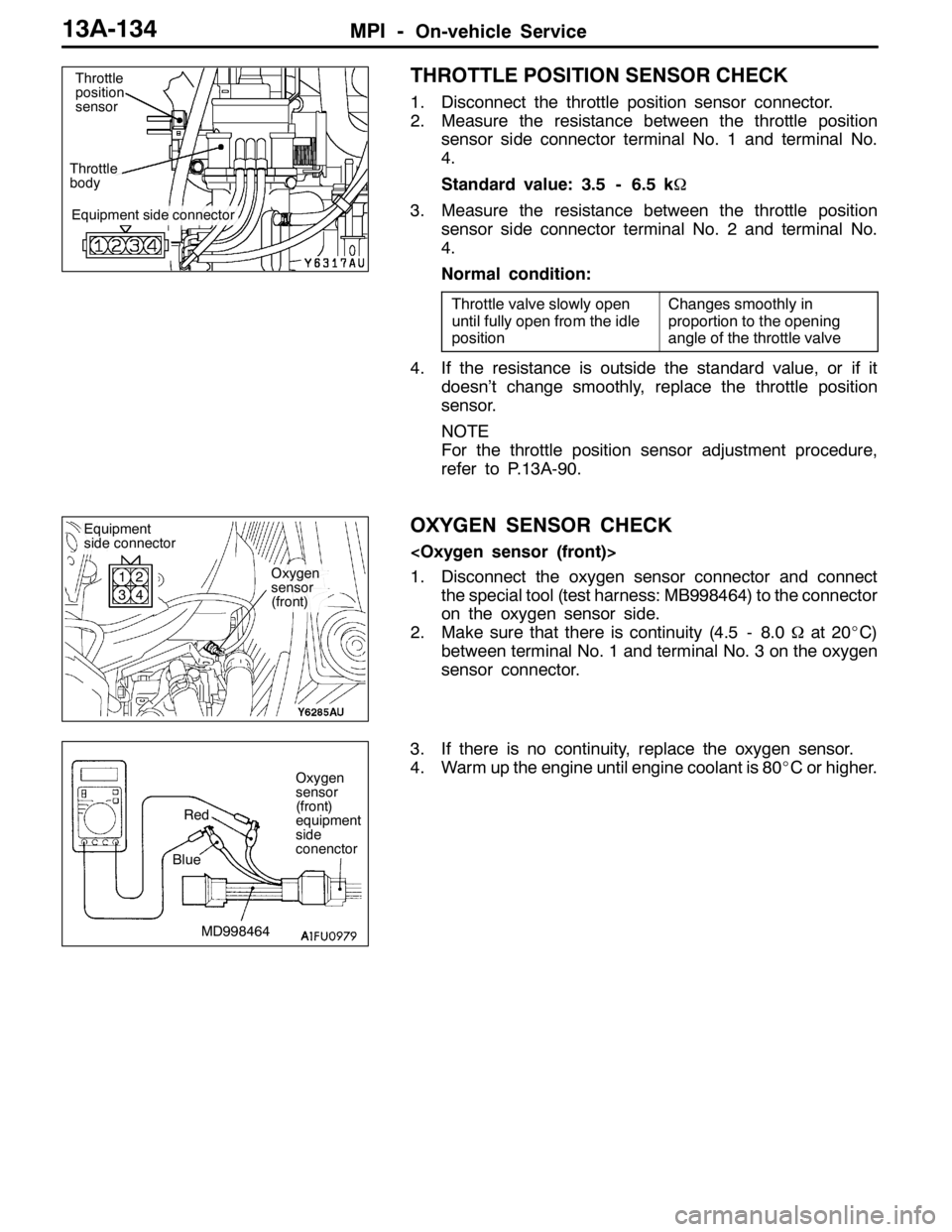
THROTTLE POSITION SENSOR CHECK
1. Disconnect the throttle position sensor connector.
2. Measure the resistance between the throttle position
sensor side connector terminal No. 1 and terminal No.
4.
Standard value: 3.5 - 6.5 kΩ
3. Measure the resistance between the throttle position
sensor side connector terminal No. 2 and terminal No.
4.
Normal condition:
Throttle valve slowly open
until fully open from the idle
positionChanges smoothly in
proportion to the opening
angle of the throttle valve
4. If the resistance is outside the standard value, or if it
doesn’t change smoothly, replace the throttle position
sensor.
NOTE
For the throttle position sensor adjustment procedure,
refer to P.13A-90.
OXYGEN SENSOR CHECK
1. Disconnect the oxygen sensor connector and connect
the special tool (test harness: MB998464) to the connector
on the oxygen sensor side.
2. Make sure that there is continuity (4.5 - 8.0Ωat 20_C)
between terminal No. 1 and terminal No. 3 on the oxygen
sensor connector.
3. If there is no continuity, replace the oxygen sensor.
4. Warm up the engine until engine coolant is 80_C or higher.
Equipment side connector
Throttle
bodyThrottle
position
sensor
Oxygen
sensor
(front)
Equipment
side connector
1
32
4
Oxygen
sensor
(front)
equipment
side
conenctor
MD998464 BlueRed
Page 677 of 1449
MPI -Throttle Body13A-145
3. After installing the Throttle position sensor, check that
the output voltage is at the standard value. If deviated
from the standard value, loosen the screw, readjust to
the standard position, and then fix. Repeat this step until
the output voltage is at the standard value.
4. Connect a circuit tester across terminal No. 1 (Throttle
position sensor power) and terminal No. 2 (Throttle
position sensor output). Check that the resistance
changes smoothly when the throttle valve is slowly moved
to the fully opened position.Throttle position
sensor output
Throttle position
sensor powerEarth
Open
Page 781 of 1449

ENGINE AND EMISSION CONTROL -Emission Control System17-11
PURGE CONTROL SYSTEM CHECK
1. Disconnect the vacuum hose (red stripe) from throttle
body and connect it to a hand vacuum pump.
2. Plug the nipple from which the vacuum hose was removed.
3. When the engine is cold or hot, apply a vacuum of 53
kPa, and check the condition of the vacuum.
When engine is cold
(Engine coolant temperature: 40_C or less)
Engine conditionNormal condition
At idleVacuum is maintained
3,000 r/min
When engine is hot
(Engine coolant temperature: 80_C or higher)
Engine conditionNormal condition
At idleVacuum is maintained
3,000 r/min (within 3
minutes after engine starts)Vacuum will leak.
PURGE PORT VACUUM CHECK
1. Disconnect the vacuum hose (red stripe) from the throttle
body purge vacuum nipple and connect a hand vacuum
pump to the nipple.
2. Confirm that the vacuum is approximately constant
regardless of the engine rotation speed.
NOTE
If vacuum changes, it is possible that the throttle body
purge port maybe clogged and require cleaning.
Red stripe
Plug
Throttle body
Red stripe
Throttle body
Vac-
uum
Engine speed (r/min)
Page 810 of 1449

22A-2
MANUAL
TRANSMISSION
CONTENTS
GENERAL 3.................................
Outline of Changes 3...........................
GENERAL INFORMATION 3..................
SERVICE SPECIFICATION 3..................
LUBRICANTS 3..............................
SPECIAL TOOLS 4...........................
TROUBLESHOOTING 5...............
ON-VEHICLE SERVICE 40....................
Transmission Oil Check 40......................
Transmission Oil Replacement 40................
Transfer Oil Check 40..........................
Transfer Oil Replacement 40....................
Fluid Check
ACD and AYC> 41.............................
Bleeding
ACD and AYC> 42.............................ACD Operation Check
vehicles with ACD and AYC> 42................
Hydraulic Pressure Check
vehicles with ACD and AYC> 43................
Wheel Speed Sensor Output Voltage
Measurement
ACD and AYC> 44.............................
TRANSMISSION CONTROL* 46...............
TRANSFER ASSEMBLY 49...................
TRANSMISSION ASSEMBLY 52...............
4WD-ECU
VEHICLES WITH ACD AND AYC> 55.........
SENSOR, SWITCH AND RELAY
WITH ACD OR VEHICLES WITH ACD AND
AYC> 56.....................................
HYDRAULIC UNIT Refer to GROUP27B.......
WARNING REGARDING SERVICING OF SUPPLEMENTAL RESTRAINT SYSTEM (SRS) EQUIPPED VEHICLES
WARNING!
(1) Improper service or maintenance of any component of the SRS, or any SRS-related component, can lead to personal
injury or death to service personnel (from inadvertent firing of the air bag) or to driver and passenger (from rendering
the SRS inoperative).
(2) Service or maintenance of any SRS component or SRS-related component must be performed only at an authorized
MITSUBISHI dealer.
(3) MITSUBISHI dealer personnel must thoroughly review this manual, and especially its GROUP 52B - Supplemental
Restraint System (SRS) before beginning any service or maintenance of any component of the SRS or any SRS-related
component.
NOTE
The SRS includes the following components: SRS-ECU, SRS warning lamp, air bag module, clock spring, and interconnecting
wiring. Other SRS-related components (that may have to be removed/installed in connection with SRS service or maintenance) are
indicated in the table of contents by an asterisk (*).
Page 817 of 1449
MANUAL TRANSMISSION - Troubleshooting 22A-9
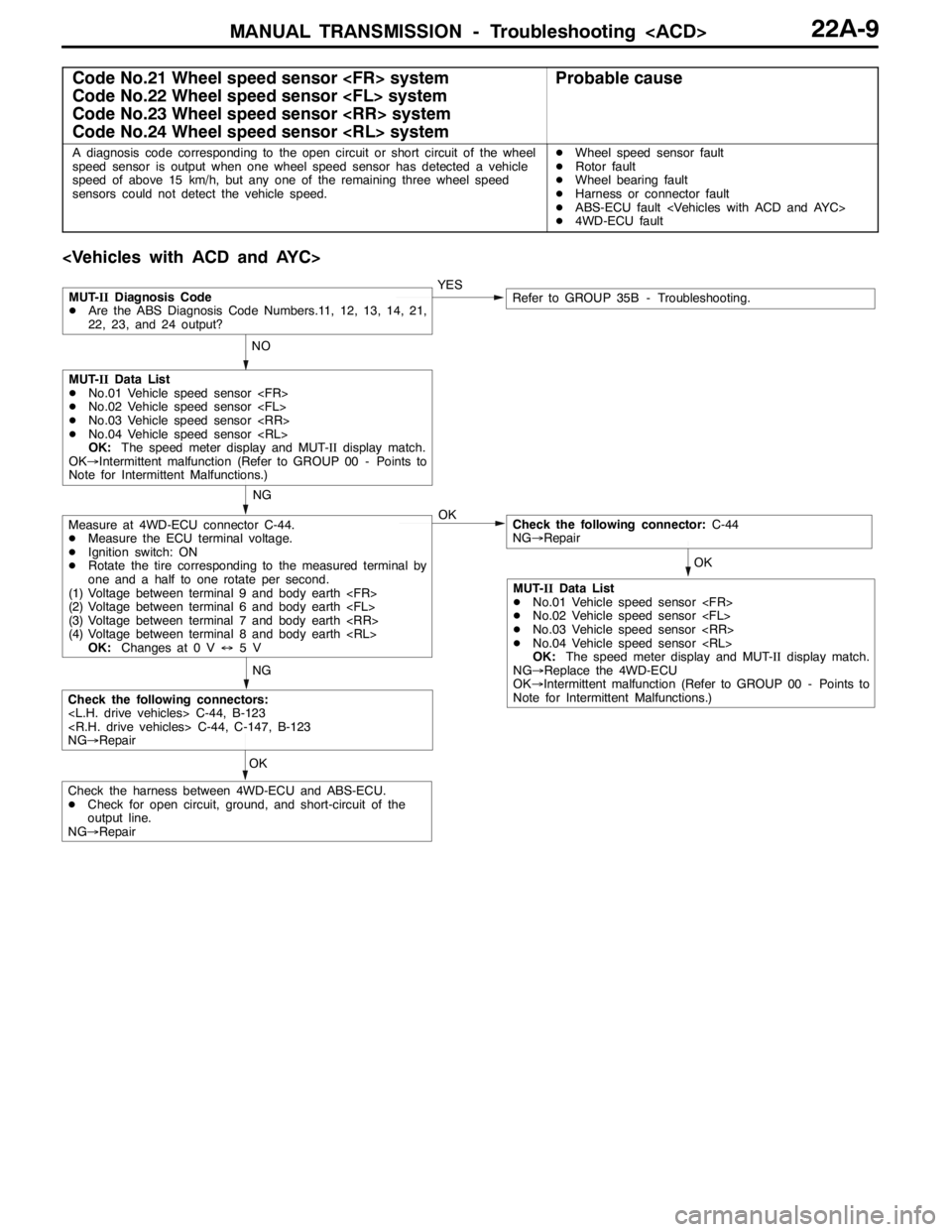
Code No.21 Wheel speed sensor system
Code No.22 Wheel speed sensor system
Code No.23 Wheel speed sensor system
Code No.24 Wheel speed sensor systemProbable cause
A diagnosis code corresponding to the open circuit or short circuit of the wheel
speed sensor is output when one wheel speed sensor has detected a vehicle
speed of above 15 km/h, but any one of the remaining three wheel speed
sensors could not detect the vehicle speed.DWheel speed sensor fault
DRotor fault
DWheel bearing fault
DHarness or connector fault
DABS-ECU fault
D4WD-ECU fault
OKNGYES
NO
OK
Measure at 4WD-ECU connector C-44.
DMeasure the ECU terminal voltage.
DIgnition switch: ON
DRotate the tire corresponding to the measured terminal by
one and a half to one rotate per second.
(1) Voltage between terminal 9 and body earth
(2) Voltage between terminal 6 and body earth
(3) Voltage between terminal 7 and body earth
(4) Voltage between terminal 8 and body earth
OK:Changes at 0 V↔5VCheck the following connector:C-44
NG→Repair
Check the following connectors:
C-44, B-123
C-44, C-147, B-123
NG→Repair
MUT-IIDiagnosis Code
DAre the ABS Diagnosis Code Numbers.11, 12, 13, 14, 21,
22, 23, and 24 output?Refer to GROUP 35B - Troubleshooting.
NG
MUT-IIData List
DNo.01 Vehicle speed sensor
DNo.02 Vehicle speed sensor
DNo.03 Vehicle speed sensor
DNo.04 Vehicle speed sensor
OK:The speed meter display and MUT-IIdisplay match.
OK→Intermittent malfunction (Refer to GROUP 00 - Points to
Note for Intermittent Malfunctions.)
OK
Check the harness between 4WD-ECU and ABS-ECU.
DCheck for open circuit, ground, and short-circuit of the
output line.
NG→Repair
MUT-IIData List
DNo.01 Vehicle speed sensor
DNo.02 Vehicle speed sensor
DNo.03 Vehicle speed sensor
DNo.04 Vehicle speed sensor
OK:The speed meter display and MUT-IIdisplay match.
NG→Replace the 4WD-ECU
OK→Intermittent malfunction (Refer to GROUP 00 - Points to
Note for Intermittent Malfunctions.)