2007 MITSUBISHI LANCER EVOLUTION Changes
[x] Cancel search: ChangesPage 535 of 1449

MPI -General Information13A-3
GENERAL INFORMATION
The Multipoint Fuel Injection System consists
of sensors which detect the engine conditions,
the engine-ECU which controls the system
based on signals from these sensors, and
actuators which operate under the control of
the engine-ECU. The engine-ECU carries outactivities such as fuel injection control, idle
speed control and ignition timing control. In
addition, the engine-ECU is equipped with
several diagnosis modes which simplify
troubleshooting when a problem develops.
FUEL INJECTION CONTROL
The injector drive times and injector timing are
controlled so that the optimum air/fuel mixture
is supplied to the engine to correspond to the
continually-changing engine operation condi-
tions.
A single injector is mounted at the intake port
of each cylinder. Fuel is sent under pressure
from the fuel tank by the fuel pump, with the
pressure being regulated by the fuel pressure
regulator. The fuel thus regulated is distributed
to each of the injectors.
Fuel injection is normally carried out once for
each cylinder for every two rotations of the
crankshaft. The firing order is 1-3-4-2. This iscalled sequential fuel injection. The
engine-ECU provides a richer air/fuel mixture
by carrying out “open-loop” control when the
engine is cold or operating under high load
conditions in order to maintain engine
performance. In addition, when the engine is
warm or operating under normal conditions,
the engine-ECU controls the air/fuel mixture
by using the oxygen sensor signal to carry out
“closed-loop” control in order to obtain the
theoretical air/fuel mixture ratio that provides
the maximum cleaning performance from the
three way catalyst.
IDLE AIR CONTROL
The idle speed is kept at the optimum speed
by controlling the amount of air that bypasses
the throttle valve in accordance with changes
in idling conditions and engine load during
idling. The engine-ECU drives the idle speed
control motor to keep the engine running at
the pre-set idle target speed in accordance
with the engine coolant temperature and airconditioner load. In addition, when the air
conditioner switch is turned off and on while
the engine is idling, the idle speed control motor
operates to adjust the throttle valve bypass
air amount in accordance with the engine load
conditions in order to avoid fluctuations in the
engine speed.
IGNITION TIMING CONTROL
The power transistor located in the ignition
primary circuit turns ON and OFF to control
the primary current flow to the ignition coil. This
controls the ignition timing in order to provide
the optimum ignition timing with respect to theengine operating conditions. The ignition timing
is determined by the engine-ECU from the
engine speed, intake air volume, engine coolant
temperature and barometric pressure.
SELF-DIAGNOSIS FUNCTION
DWhen an abnormality is detected in one
of the sensors or actuators related to
emission control, the engine warning lamp
(check engine lamp) illuminates as a
warning to the driver.
DWhen an abnormality is detected in one
of the sensors or actuators, a diagnosis
code corresponding to the abnormality is
output.DThe RAM data inside the engine-ECU that
is related to the sensors and actuators can
be read by means of the MUT-II. In addition,
the actuators can be force-driven under
certain circumstances.
Page 562 of 1449
MPI -Troubleshooting13A-30
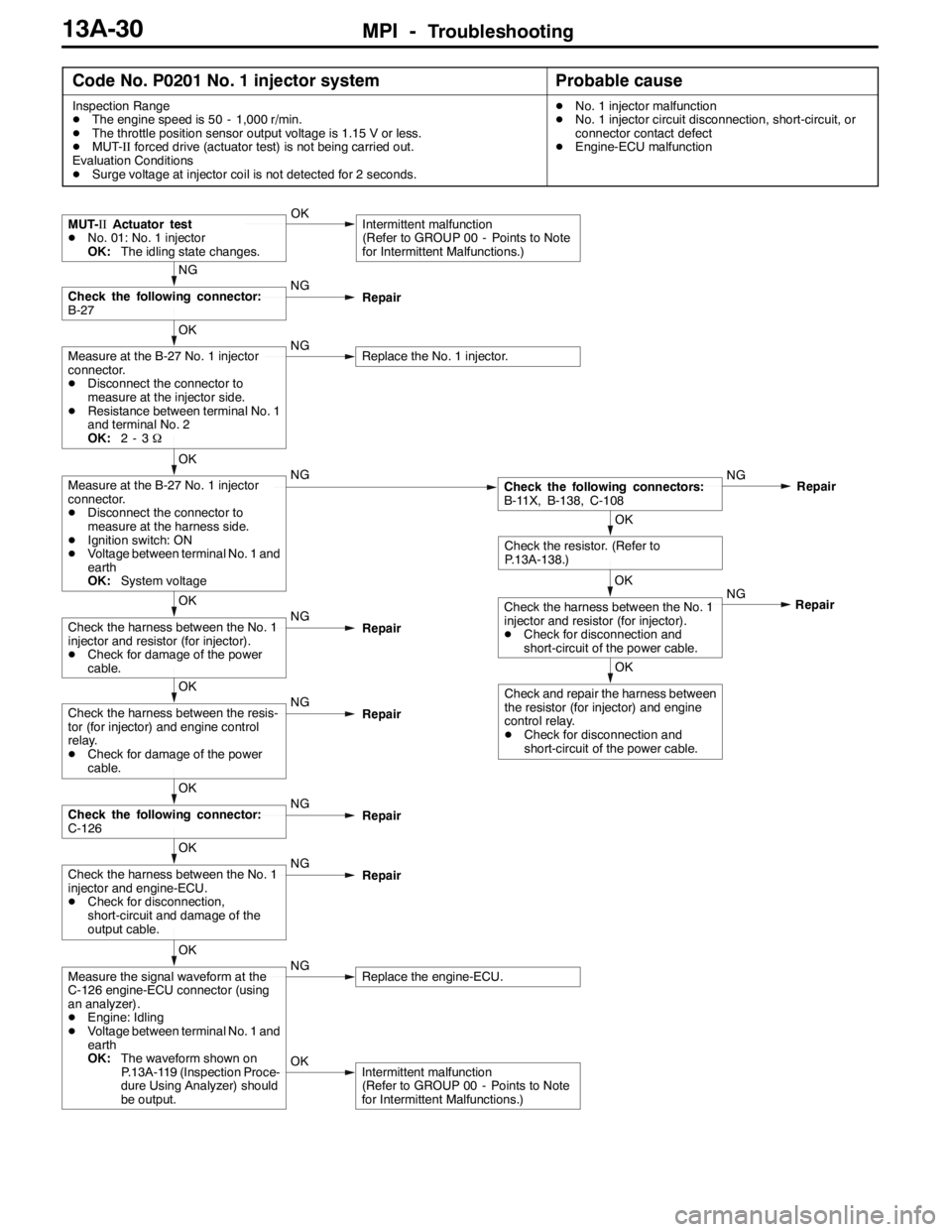
Code No. P0201 No. 1 injector systemProbable cause
Inspection Range
DThe engine speed is 50 - 1,000 r/min.
DThe throttle position sensor output voltage is 1.15 V or less.
DMUT-IIforced drive (actuator test) is not being carried out.
Evaluation Conditions
DSurge voltage at injector coil is not detected for 2 seconds.DNo. 1 injector malfunction
DNo. 1 injector circuit disconnection, short-circuit, or
connector contact defect
DEngine-ECU malfunction
OKIntermittent malfunction
(Refer to GROUP 00 - Points to Note
for Intermittent Malfunctions.)
OK
Measure the signal waveform at the
C-126 engine-ECU connector (using
an analyzer).
DEngine: Idling
DVoltage between terminal No. 1 and
earth
OK:The waveform shown on
P.13A-119 (Inspection Proce-
dure Using Analyzer) should
be output.NGReplace the engine-ECU.
OK
Check the harness between the No. 1
injector and engine-ECU.
DCheck for disconnection,
short-circuit and damage of the
output cable.NG
Repair
OK
Check the following connector:
C-126NG
Repair
OK
Check the harness between the resis-
tor (for injector) and engine control
relay.
DCheck for damage of the power
cable.NG
Repair
OK
Check the harness between the No. 1
injector and resistor (for injector).
DCheck for damage of the power
cable.NG
Repair
OK
Check and repair the harness between
the resistor (for injector) and engine
control relay.
DCheck for disconnection and
short-circuit of the power cable.NG
OK
Check the harness between the No. 1
injector and resistor (for injector).
DCheck for disconnection and
short-circuit of the power cable.Repair
OK
Check the resistor. (Refer to
P.13A-138.)
OK
Measure at the B-27 No. 1 injector
connector.
DDisconnect the connector to
measure at the harness side.
DIgnition switch: ON
DVoltage between terminal No. 1 and
earth
OK:System voltageNGCheck the following connectors:
B-11X, B-138, C-108NG
Repair
OK
Measure at the B-27 No. 1 injector
connector.
DDisconnect the connector to
measure at the injector side.
DResistance between terminal No. 1
and terminal No. 2
OK:2-3ΩNGReplace the No. 1 injector.
NG
Check the following connector:
B-27NG
Repair
MUT-IIActuator test
DNo. 01: No. 1 injector
OK:The idling state changes.OKIntermittent malfunction
(Refer to GROUP 00 - Points to Note
for Intermittent Malfunctions.)
Page 563 of 1449
MPI -Troubleshooting13A-31
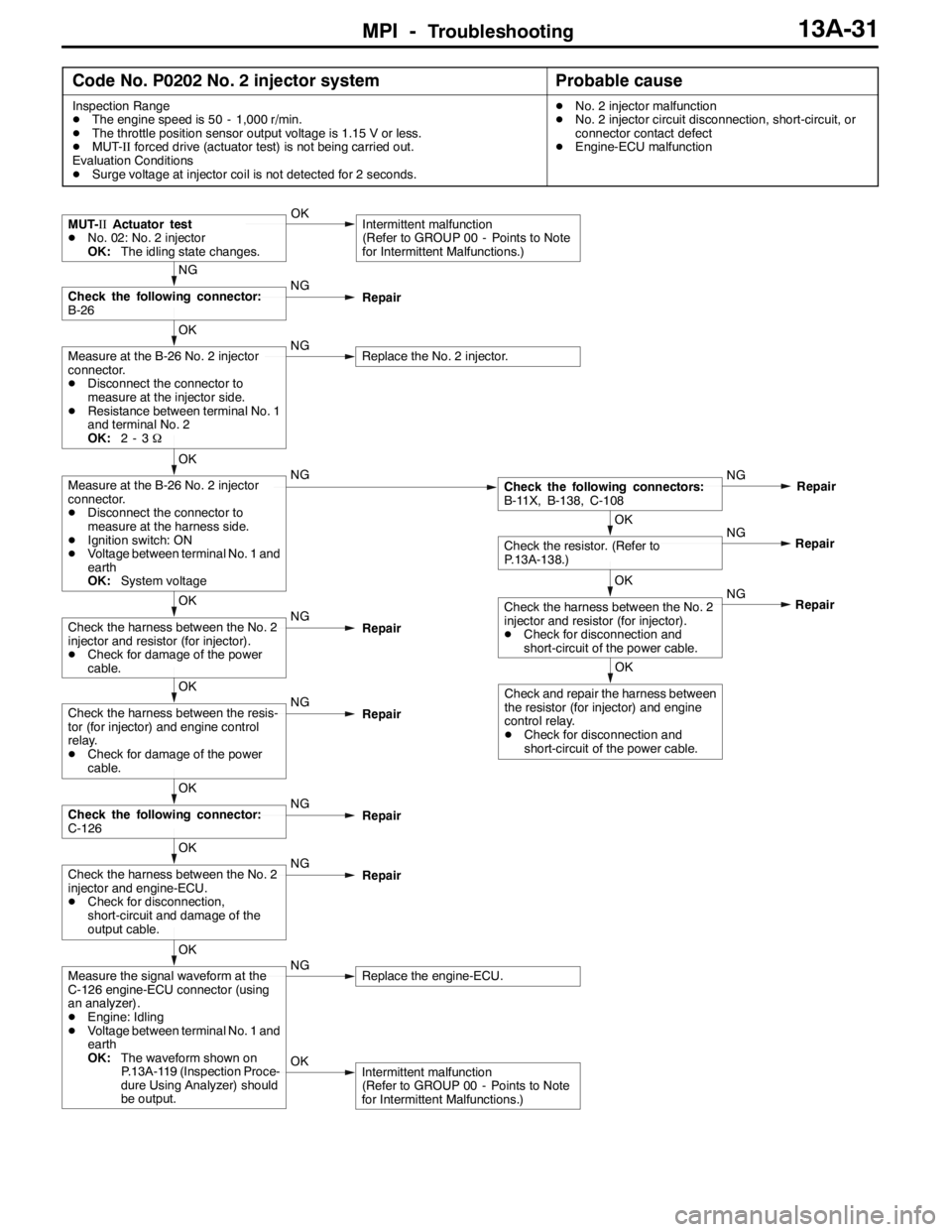
Code No. P0202 No. 2 injector systemProbable cause
Inspection Range
DThe engine speed is 50 - 1,000 r/min.
DThe throttle position sensor output voltage is 1.15 V or less.
DMUT-IIforced drive (actuator test) is not being carried out.
Evaluation Conditions
DSurge voltage at injector coil is not detected for 2 seconds.DNo. 2 injector malfunction
DNo. 2 injector circuit disconnection, short-circuit, or
connector contact defect
DEngine-ECU malfunction
OKIntermittent malfunction
(Refer to GROUP 00 - Points to Note
for Intermittent Malfunctions.)
OK
Measure the signal waveform at the
C-126 engine-ECU connector (using
an analyzer).
DEngine: Idling
DVoltage between terminal No. 1 and
earth
OK:The waveform shown on
P.13A-119 (Inspection Proce-
dure Using Analyzer) should
be output.NGReplace the engine-ECU.
OK
Check the harness between the No. 2
injector and engine-ECU.
DCheck for disconnection,
short-circuit and damage of the
output cable.NG
Repair
OK
Check the following connector:
C-126NG
Repair
OK
Check the harness between the resis-
tor (for injector) and engine control
relay.
DCheck for damage of the power
cable.NG
Repair
OK
Check and repair the harness between
the resistor (for injector) and engine
control relay.
DCheck for disconnection and
short-circuit of the power cable.NG
OK
Check the harness between the No. 2
injector and resistor (for injector).
DCheck for disconnection and
short-circuit of the power cable.Repair NG
OK
Check the resistor. (Refer to
P.13A-138.)Repair
OK
Check the harness between the No. 2
injector and resistor (for injector).
DCheck for damage of the power
cable.NG
Repair
OK
Measure at the B-26 No. 2 injector
connector.
DDisconnect the connector to
measure at the harness side.
DIgnition switch: ON
DVoltage between terminal No. 1 and
earth
OK:System voltageNGCheck the following connectors:
B-11X, B-138, C-108NG
Repair
OK
Measure at the B-26 No. 2 injector
connector.
DDisconnect the connector to
measure at the injector side.
DResistance between terminal No. 1
and terminal No. 2
OK:2-3ΩNGReplace the No. 2 injector.
NG
Check the following connector:
B-26NG
Repair
MUT-IIActuator test
DNo. 02: No. 2 injector
OK:The idling state changes.OKIntermittent malfunction
(Refer to GROUP 00 - Points to Note
for Intermittent Malfunctions.)
Page 564 of 1449
MPI -Troubleshooting13A-32
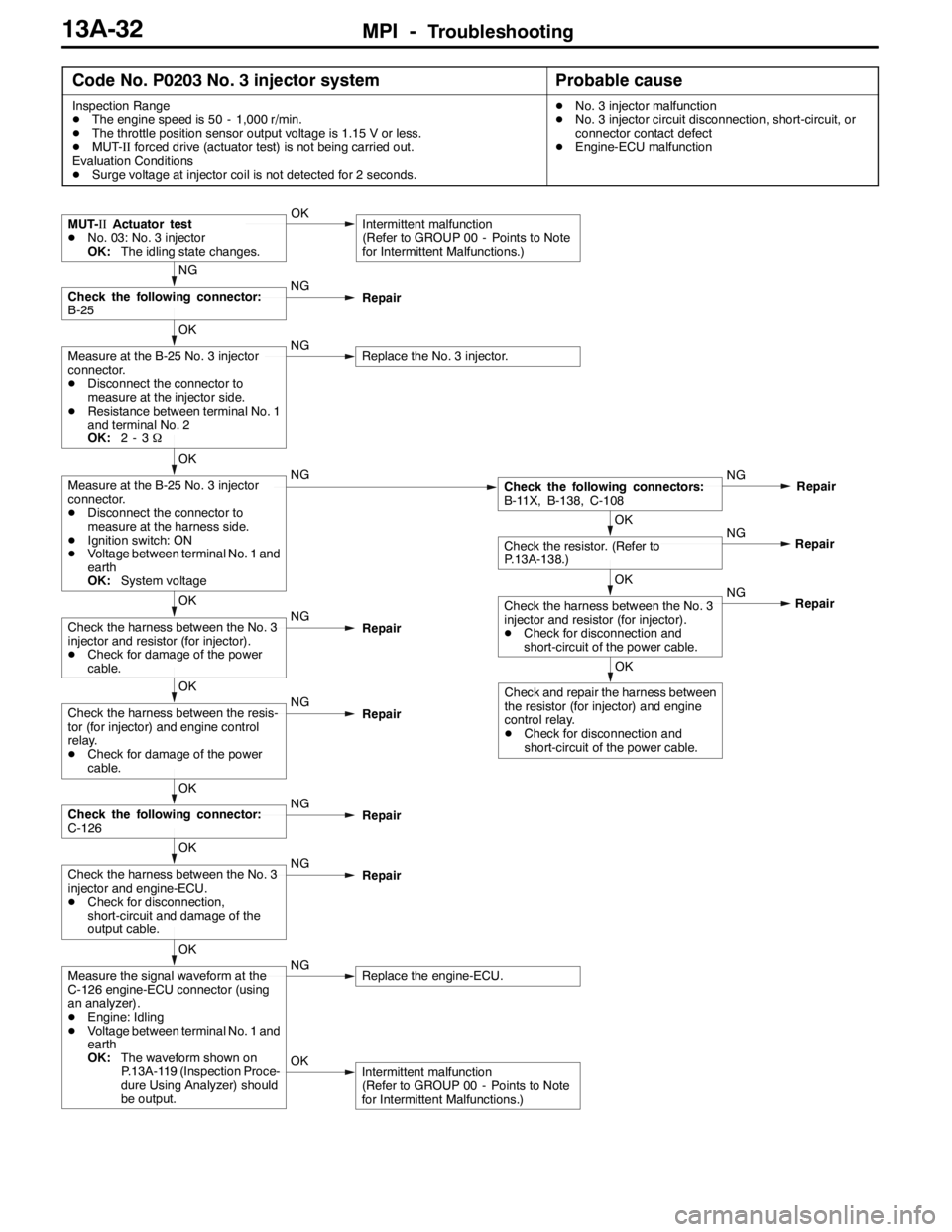
Code No. P0203 No. 3 injector systemProbable cause
Inspection Range
DThe engine speed is 50 - 1,000 r/min.
DThe throttle position sensor output voltage is 1.15 V or less.
DMUT-IIforced drive (actuator test) is not being carried out.
Evaluation Conditions
DSurge voltage at injector coil is not detected for 2 seconds.DNo. 3 injector malfunction
DNo. 3 injector circuit disconnection, short-circuit, or
connector contact defect
DEngine-ECU malfunction
OKIntermittent malfunction
(Refer to GROUP 00 - Points to Note
for Intermittent Malfunctions.)
OK
Measure the signal waveform at the
C-126 engine-ECU connector (using
an analyzer).
DEngine: Idling
DVoltage between terminal No. 1 and
earth
OK:The waveform shown on
P.13A-119 (Inspection Proce-
dure Using Analyzer) should
be output.NGReplace the engine-ECU.
OK
Check the harness between the No. 3
injector and engine-ECU.
DCheck for disconnection,
short-circuit and damage of the
output cable.NG
Repair
OK
Check the following connector:
C-126NG
Repair
OK
Check the harness between the resis-
tor (for injector) and engine control
relay.
DCheck for damage of the power
cable.NG
Repair
OK
Check and repair the harness between
the resistor (for injector) and engine
control relay.
DCheck for disconnection and
short-circuit of the power cable.NG
OK
Check the harness between the No. 3
injector and resistor (for injector).
DCheck for disconnection and
short-circuit of the power cable.Repair NG
OK
Check the resistor. (Refer to
P.13A-138.)Repair
OK
Check the harness between the No. 3
injector and resistor (for injector).
DCheck for damage of the power
cable.NG
Repair
OK
Measure at the B-25 No. 3 injector
connector.
DDisconnect the connector to
measure at the harness side.
DIgnition switch: ON
DVoltage between terminal No. 1 and
earth
OK:System voltageNGCheck the following connectors:
B-11X, B-138, C-108NG
Repair
OK
Measure at the B-25 No. 3 injector
connector.
DDisconnect the connector to
measure at the injector side.
DResistance between terminal No. 1
and terminal No. 2
OK:2-3ΩNGReplace the No. 3 injector.
NG
Check the following connector:
B-25NG
Repair
MUT-IIActuator test
DNo. 03: No. 3 injector
OK:The idling state changes.OKIntermittent malfunction
(Refer to GROUP 00 - Points to Note
for Intermittent Malfunctions.)
Page 565 of 1449
MPI -Troubleshooting13A-33
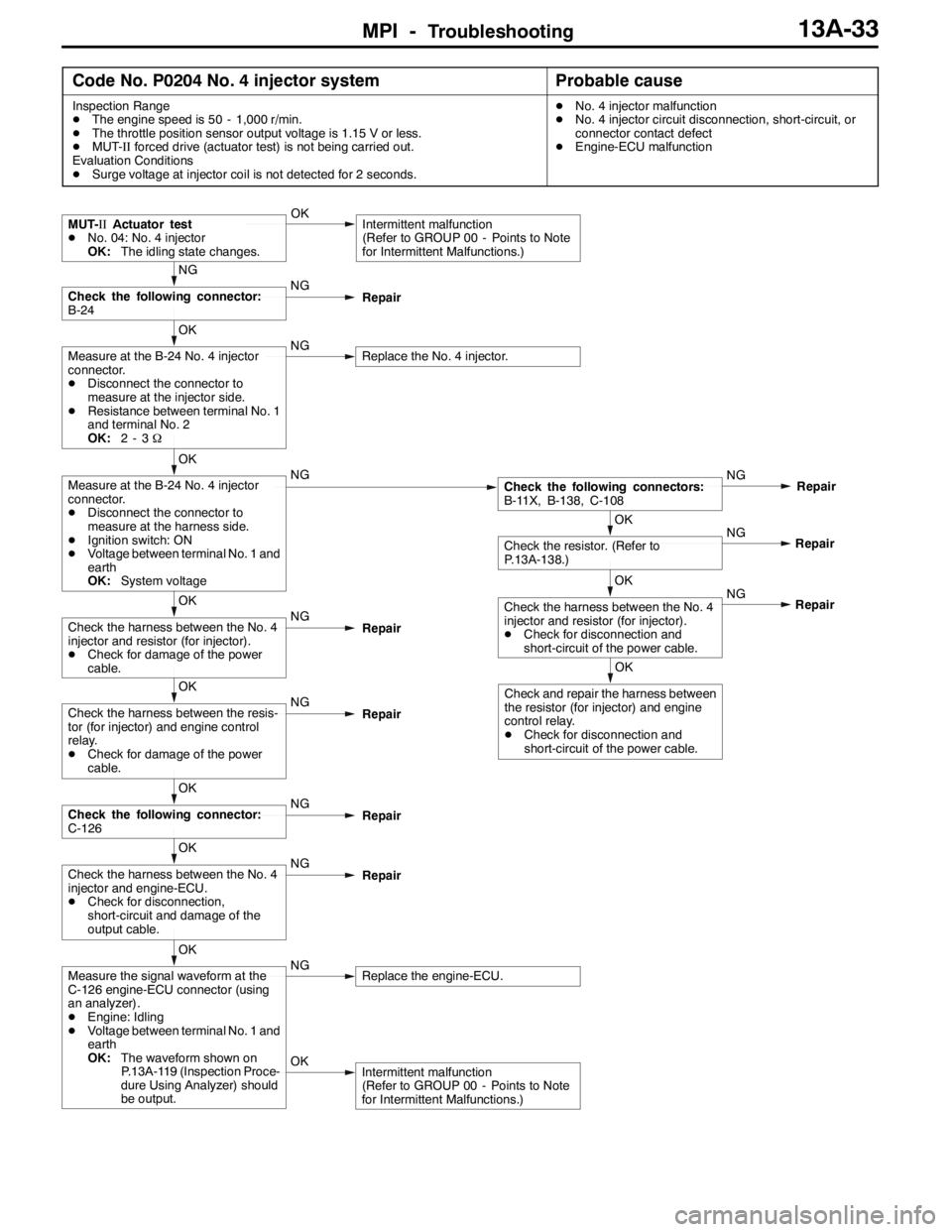
Code No. P0204 No. 4 injector systemProbable cause
Inspection Range
DThe engine speed is 50 - 1,000 r/min.
DThe throttle position sensor output voltage is 1.15 V or less.
DMUT-IIforced drive (actuator test) is not being carried out.
Evaluation Conditions
DSurge voltage at injector coil is not detected for 2 seconds.DNo. 4 injector malfunction
DNo. 4 injector circuit disconnection, short-circuit, or
connector contact defect
DEngine-ECU malfunction
OKIntermittent malfunction
(Refer to GROUP 00 - Points to Note
for Intermittent Malfunctions.)
OK
Measure the signal waveform at the
C-126 engine-ECU connector (using
an analyzer).
DEngine: Idling
DVoltage between terminal No. 1 and
earth
OK:The waveform shown on
P.13A-119 (Inspection Proce-
dure Using Analyzer) should
be output.NGReplace the engine-ECU.
OK
Check the harness between the No. 4
injector and engine-ECU.
DCheck for disconnection,
short-circuit and damage of the
output cable.NG
Repair
OK
Check the following connector:
C-126NG
Repair
OK
Check the harness between the resis-
tor (for injector) and engine control
relay.
DCheck for damage of the power
cable.NG
Repair
OK
Check and repair the harness between
the resistor (for injector) and engine
control relay.
DCheck for disconnection and
short-circuit of the power cable.NG
OK
Check the harness between the No. 4
injector and resistor (for injector).
DCheck for disconnection and
short-circuit of the power cable.Repair NG
OK
Check the resistor. (Refer to
P.13A-138.)Repair
OK
Check the harness between the No. 4
injector and resistor (for injector).
DCheck for damage of the power
cable.NG
Repair
OK
Measure at the B-24 No. 4 injector
connector.
DDisconnect the connector to
measure at the harness side.
DIgnition switch: ON
DVoltage between terminal No. 1 and
earth
OK:System voltageNGCheck the following connectors:
B-11X, B-138, C-108NG
Repair
OK
Measure at the B-24 No. 4 injector
connector.
DDisconnect the connector to
measure at the injector side.
DResistance between terminal No. 1
and terminal No. 2
OK:2-3ΩNGReplace the No. 4 injector.
NG
Check the following connector:
B-24NG
Repair
MUT-IIActuator test
DNo. 04: No. 4 injector
OK:The idling state changes.OKIntermittent malfunction
(Refer to GROUP 00 - Points to Note
for Intermittent Malfunctions.)
Page 566 of 1449
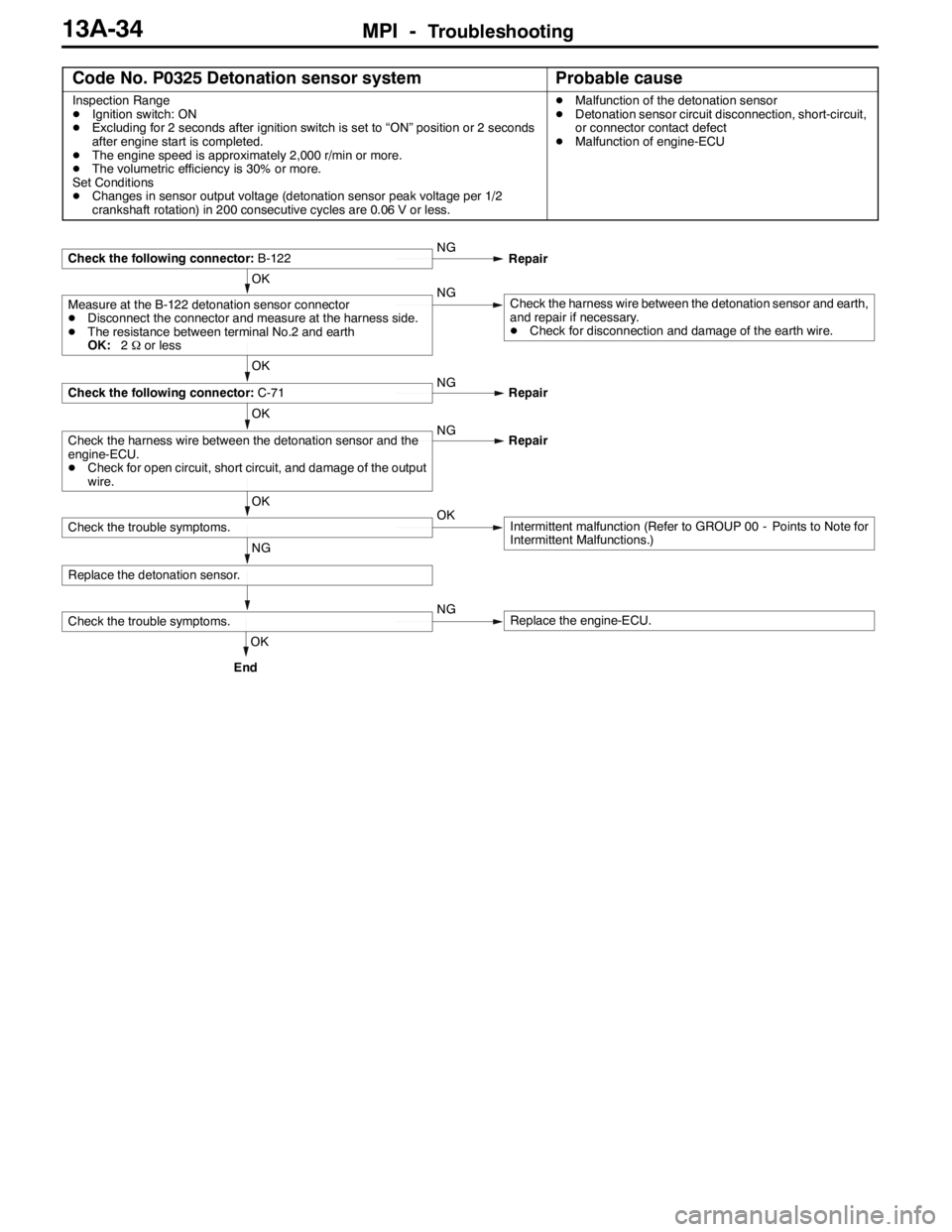
MPI -Troubleshooting13A-34
Code No. P0325 Detonation sensor systemProbable cause
Inspection Range
DIgnition switch: ON
DExcluding for 2 seconds after ignition switch is set to “ON” position or 2 seconds
after engine start is completed.
DThe engine speed is approximately 2,000 r/min or more.
DThe volumetric efficiency is 30% or more.
Set Conditions
DChanges in sensor output voltage (detonation sensor peak voltage per 1/2
crankshaft rotation) in 200 consecutive cycles are 0.06 V or less.DMalfunction of the detonation sensor
DDetonation sensor circuit disconnection, short-circuit,
or connector contact defect
DMalfunction of engine-ECU
OK
Check the trouble symptoms.NGReplace the engine-ECU.
NG
Replace the detonation sensor.
OK
Check the trouble symptoms.OKIntermittent malfunction (Refer to GROUP 00 - Points to Note for
Intermittent Malfunctions.)
OK
Check the harness wire between the detonation sensor and the
engine-ECU.
DCheck for open circuit, short circuit, and damage of the output
wire.NG
Repair
OK
Check the following connector:C-71NG
Repair
OK
Measure at the B-122 detonation sensor connector
DDisconnect the connector and measure at the harness side.
DThe resistance between terminal No.2 and earth
OK:2Ωor lessNGCheck the harness wire between the detonation sensor and earth,
and repair if necessary.
DCheck for disconnection and damage of the earth wire.
Check the following connector:B-122NG
Repair
End
Page 585 of 1449

MPI -Troubleshooting
Fig. 1
Vehicle
speedInitial ac-
celerator
pedal de-
pressionNormalHesitation
Sag
TimeFig. 2
Normal
Initial ac-
celerator
pedal de-
pression
IdlingStumble
Time Vehicle
speed
13A-53
PROBLEM SYMPTOMS TABLE (FOR YOUR INFORMATION)
ItemsSymptom
StartingWon’t startThe starter is used to crank the engine, but there is no combustion within the
cylinders, and the engine won’t start.
Fires up and diesThere is combustion within the cylinders, but then the engine soon stalls.
Hard startingEngine starts after cranking a while.
Idling
stability
HuntingEngine speed doesn’t remain constant; changes at idle.
stability
Rough idleUsually, a judgement can be based upon the movement of the tachometer
pointer, and the vibration transmitted to the steering wheel, shift lever, body, etc.
This is called rough idle.
Incorrect idle speedThe engine doesn’t idle at the usual correct speed.
Engine stall
(Die out)The engine stalls when the foot is taken from the accelerator pedal, regardless
of whether the vehicles is moving or not.
Engine stall
(Pass out)The engine stalls when the accelerator pedal is depressed or while it is being
used.
DrivingHesitation Sag“Hesitation” is the delay in response of the vehicle speed (engine speed) that
occurs when the accelerator is depressed in order to accelerate from the speed
at which the vehicle is now traveling, or a temporary drop in vehicle speed
(engine speed) during such acceleration.
Serious hesitation is called “sag”. (Refer to Fig. 1)
Poor accelerationPoor acceleration is inability to obtain an acceleration corresponding to the
degree of throttle opening, even though acceleration is smooth, or the inability
to reach maximum speed.
StumbleEngine speed increase is delayed when the accelerator pedal is initially
depressed for acceleration. (Refer to Fig. 2)
ShockThe feeling of a comparatively large impact or vibration when the engine is
accelerated or decelerated.
SurgeThis is repeated surging ahead during constant speed travel or during variable
speed travel.
KnockingA sharp sound like a hammer striking the cylinder walls during driving and which
adversely affects driving.
StoppingRun on
(“Dieseling”)The condition in which the engine continues to run after the ignition switch is
turned to “LOCK” (OFF) position. Also called “Dieseling”.
Page 607 of 1449

MPI -Troubleshooting13A-75
Inspection Procedure 17
Abnormal odor, white smoke, black smoke, high CO or HC
concentration when idling
Probable cause
Causes shown on right are suspected.DAir/fuel ratio control system malfunction
DIgnition system malfunction
DFuel system malfunction
DIntake and exhaust system malfunction
DExhaust gas purifier system malfunction
DImproper compression pressure
DCatalyst defect
DEngine-ECU malfunction
OK
To the next page
OK
Check the fuel pressure. (Refer to P.13A-128.)
OK
MUT-IIData list
DNo. 59: Oxygen sensor (rear)
(Refer to P.13A-105.)NGCheck the Code No. P0136: Oxygen sensor (rear) system.
(Refer to P.13A-27.)
OK
MUT-IIData list
DNo. 11: Oxygen sensor (front) (Refer to P.13A-102.)NGCheck the Code No. P0130: Oxygen sensor (front) system.
(Refer to P.13A-24.)
OK
Check for exhaust gas leaks from exhaust manifold.NG
Repair
OK
Check the air intake from the intake hose and intake manifold.NG
Repair
OK
MUT-IIData list
DNo. 12: Air flow sensor
DNo. 13: Intake air temperature sensor
DNo. 21: Engien coolant temperature sensor
DNo. 25: Barometric pressure sensor
(Refer to P.13A-102.)
Proceed to OK if all service data values are correct.
Proceed to NG if there is even one abnormal service data value.NGRefer to inspections for diagnosis code of sensor showing
abnormal service data. (Refer to P.13A-102.)
OK
Check the ignition timing.
(Refer to GROUP 11 - Engine Adjustment.)NGCheck the Inspection Procedure 15: Deviation of ignition interval
(Refer to P.13A-73.)
NO
MUT-IIActuator test
DNo. 01: No. 1 injector
DNo. 02: No. 2 injector
DNo. 03: No. 3 injector
DNo. 04: No. 4 injector
OK:The idling state changes.
DProceed to NG if the cylinder (NG cylinder) for which the idling
state did not change when injector was stopped is pinpointed.
DProceed to OK if all cylinders are OK, or if the NG cylinder
cannot be pinpointed.NGCheck the Code No. P0201: No. 1 injector system, P0202: No. 2
injector system, P0203: No. 3 injector system and P0204: No. 4
injector system. (Refer to P.13A-30, 31, 32, 33.)
MUT-IISelf-Diag code
DIs a diagnosis code output?YESINSPECTION CHART FOR DIAGNOSIS CODE
(Refer to P.13A-12.)