2006 MERCEDES-BENZ SPRINTER ABS
[x] Cancel search: ABSPage 328 of 2305

display does not match the state of the pedal,
perform the proper test. For a problem with the
ªABSº warning indicator, refer to the proper test.
6. If no other problems are found, it will be neces-
sary to road test the vehicle.THE DRBIIIt
MUST NOT BE CONNECTED TO THE
DATA LINK CONNECTOR WHEN ROAD
TESTING FOR PROPER ANTILOCK OP-
ERATION. THE SYSTEM IS DISABLED
WHILE IN DIAGNOSTIC MODE.Perform
several antilock stops from above 50 Km/h (30
mph) and then repeat steps 2, 3, and 4. If any
diagnostic trouble codes are present, proceed to
the appropriate test.
7. The following conditions should be considered
``NORMAL'' operation, and no repairs should be
attempted to correct them.
± Brake pedal feedback during an ABS stop
(clicking, vibrating)
± Clicking, groaning or buzzing at 12 Km/h (8
mph) (drive off self test)
± Groaning noise during an ABS stop
± Slight brake pedal drop and pop noise when
ignition is initially turned on
± Brake pedal ratcheting down at the end of an
ABS stop
8. If the complaint is ABS ``cycling'' at the end of a
stop at low speeds, it may be caused by a
marginal wheel speed sensor signal. The sensor
air gap, tone wheel condition, and/or brakes
hanging up are possible causes of this condition.
9. After a road test in which no problems were
found, refer to any Technical Service Bulletins
that may apply.
5.0 REQUIRED TOOLS AND
EQUIPMENT
DRBIIIt(diagnostic read-out box)
jumper wires
ohmmeter
voltmeter
test light
oscilloscope
6.0 GLOSSARY OF TERMS
ABSantilock brake system
ACalternating current
BCMbody control module
BSbrake switch
BLSbrake lamp switch
CABcontroller antilock brakeDCdirect current
DLCdata link connector
DRBIIItdiagnostic read-out box
DTCdiagnostic test code
EBDelectronic brake distribution
ECMelectronic control module
HCUhydraulic control unit
HZHertz
ICinstrument cluster
LFleft front
LRleft rear
PMpump motor
RFright front
RRright rear
SOLsolenoid
TCStraction control system
TCSStraction control system switch
VSSvehicle speed signal
WSSwheel speed sensor
7
GENERAL INFORMATION
Page 332 of 2305
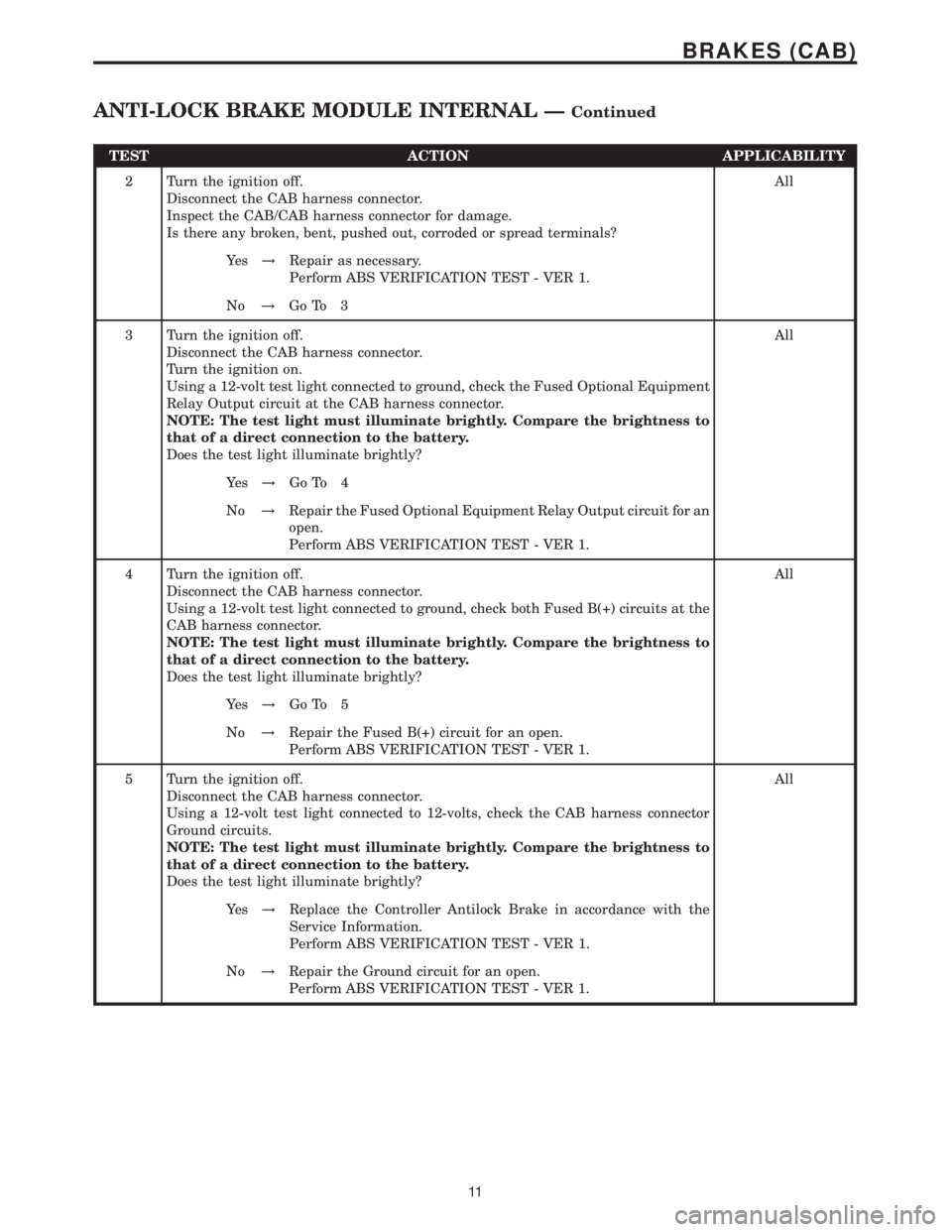
TEST ACTION APPLICABILITY
2 Turn the ignition off.
Disconnect the CAB harness connector.
Inspect the CAB/CAB harness connector for damage.
Is there any broken, bent, pushed out, corroded or spread terminals?All
Ye s!Repair as necessary.
Perform ABS VERIFICATION TEST - VER 1.
No!Go To 3
3 Turn the ignition off.
Disconnect the CAB harness connector.
Turn the ignition on.
Using a 12-volt test light connected to ground, check the Fused Optional Equipment
Relay Output circuit at the CAB harness connector.
NOTE: The test light must illuminate brightly. Compare the brightness to
that of a direct connection to the battery.
Does the test light illuminate brightly?All
Ye s!Go To 4
No!Repair the Fused Optional Equipment Relay Output circuit for an
open.
Perform ABS VERIFICATION TEST - VER 1.
4 Turn the ignition off.
Disconnect the CAB harness connector.
Using a 12-volt test light connected to ground, check both Fused B(+) circuits at the
CAB harness connector.
NOTE: The test light must illuminate brightly. Compare the brightness to
that of a direct connection to the battery.
Does the test light illuminate brightly?All
Ye s!Go To 5
No!Repair the Fused B(+) circuit for an open.
Perform ABS VERIFICATION TEST - VER 1.
5 Turn the ignition off.
Disconnect the CAB harness connector.
Using a 12-volt test light connected to 12-volts, check the CAB harness connector
Ground circuits.
NOTE: The test light must illuminate brightly. Compare the brightness to
that of a direct connection to the battery.
Does the test light illuminate brightly?All
Ye s!Replace the Controller Antilock Brake in accordance with the
Service Information.
Perform ABS VERIFICATION TEST - VER 1.
No!Repair the Ground circuit for an open.
Perform ABS VERIFICATION TEST - VER 1.
11
BRAKES (CAB)
ANTI-LOCK BRAKE MODULE INTERNAL ÐContinued
Page 333 of 2305
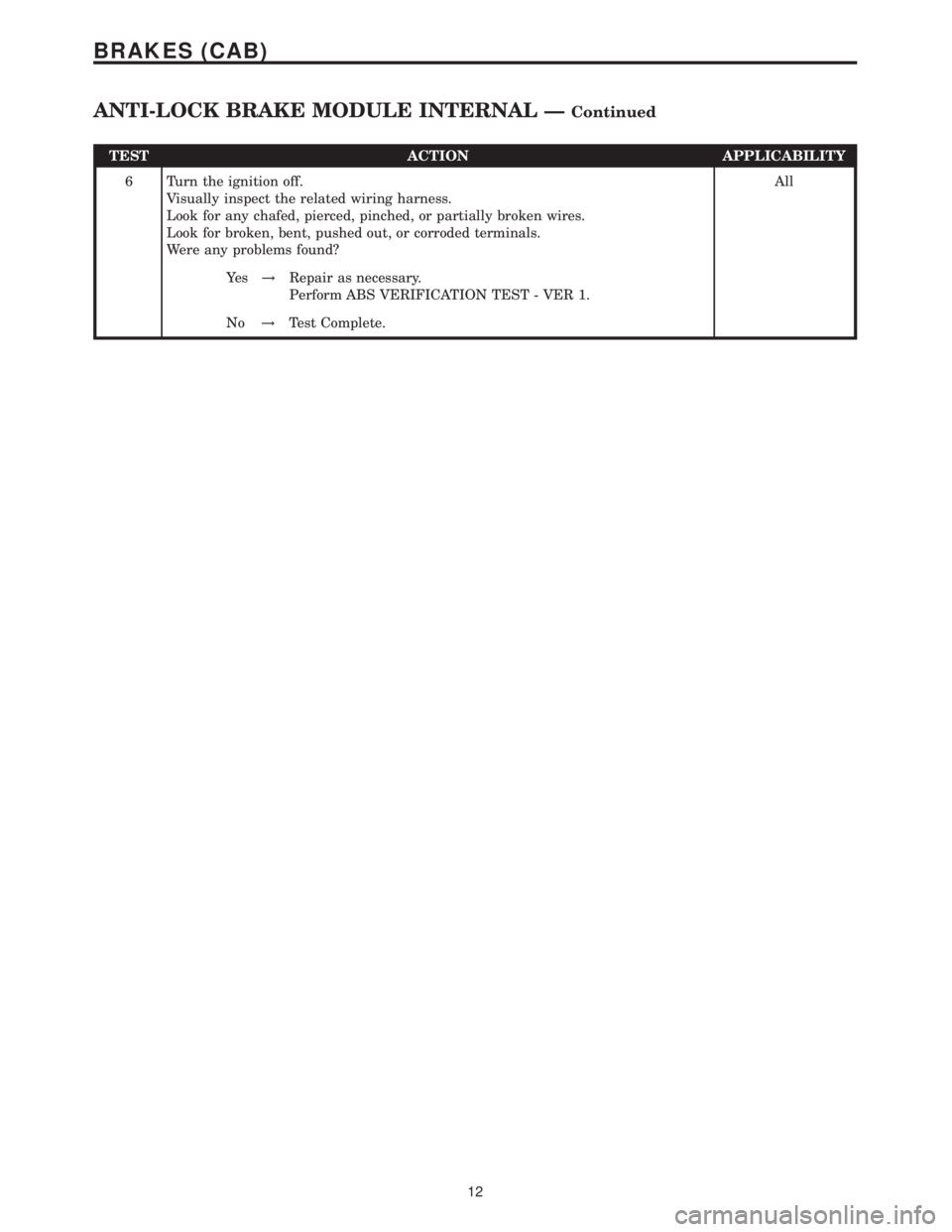
TEST ACTION APPLICABILITY
6 Turn the ignition off.
Visually inspect the related wiring harness.
Look for any chafed, pierced, pinched, or partially broken wires.
Look for broken, bent, pushed out, or corroded terminals.
Were any problems found?All
Ye s!Repair as necessary.
Perform ABS VERIFICATION TEST - VER 1.
No!Test Complete.
12
BRAKES (CAB)
ANTI-LOCK BRAKE MODULE INTERNAL ÐContinued
Page 339 of 2305
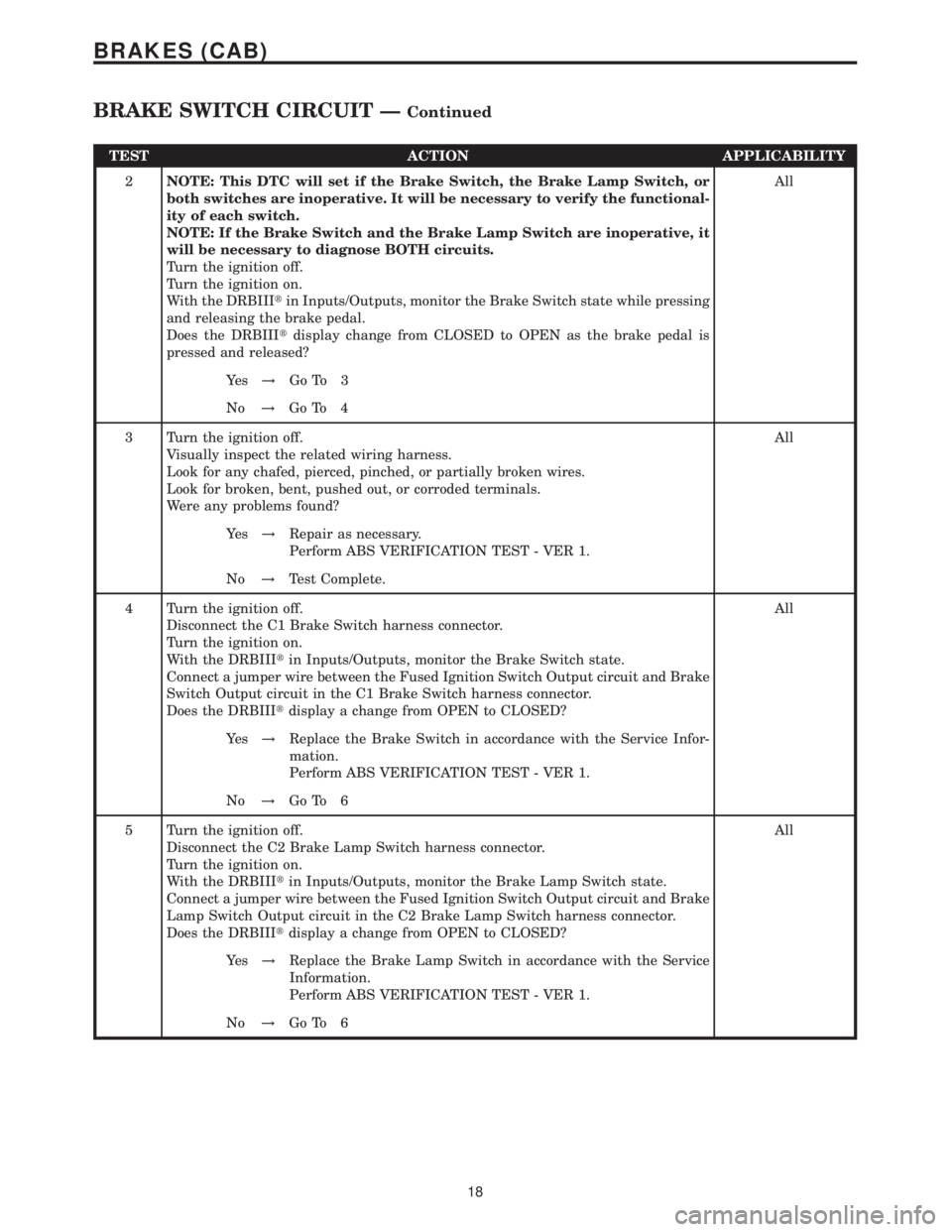
TEST ACTION APPLICABILITY
2NOTE: This DTC will set if the Brake Switch, the Brake Lamp Switch, or
both switches are inoperative. It will be necessary to verify the functional-
ity of each switch.
NOTE: If the Brake Switch and the Brake Lamp Switch are inoperative, it
will be necessary to diagnose BOTH circuits.
Turn the ignition off.
Turn the ignition on.
With the DRBIIItin Inputs/Outputs, monitor the Brake Switch state while pressing
and releasing the brake pedal.
Does the DRBIIItdisplay change from CLOSED to OPEN as the brake pedal is
pressed and released?All
Ye s!Go To 3
No!Go To 4
3 Turn the ignition off.
Visually inspect the related wiring harness.
Look for any chafed, pierced, pinched, or partially broken wires.
Look for broken, bent, pushed out, or corroded terminals.
Were any problems found?All
Ye s!Repair as necessary.
Perform ABS VERIFICATION TEST - VER 1.
No!Test Complete.
4 Turn the ignition off.
Disconnect the C1 Brake Switch harness connector.
Turn the ignition on.
With the DRBIIItin Inputs/Outputs, monitor the Brake Switch state.
Connect a jumper wire between the Fused Ignition Switch Output circuit and Brake
Switch Output circuit in the C1 Brake Switch harness connector.
Does the DRBIIItdisplay a change from OPEN to CLOSED?All
Ye s!Replace the Brake Switch in accordance with the Service Infor-
mation.
Perform ABS VERIFICATION TEST - VER 1.
No!Go To 6
5 Turn the ignition off.
Disconnect the C2 Brake Lamp Switch harness connector.
Turn the ignition on.
With the DRBIIItin Inputs/Outputs, monitor the Brake Lamp Switch state.
Connect a jumper wire between the Fused Ignition Switch Output circuit and Brake
Lamp Switch Output circuit in the C2 Brake Lamp Switch harness connector.
Does the DRBIIItdisplay a change from OPEN to CLOSED?All
Ye s!Replace the Brake Lamp Switch in accordance with the Service
Information.
Perform ABS VERIFICATION TEST - VER 1.
No!Go To 6
18
BRAKES (CAB)
BRAKE SWITCH CIRCUIT ÐContinued
Page 340 of 2305
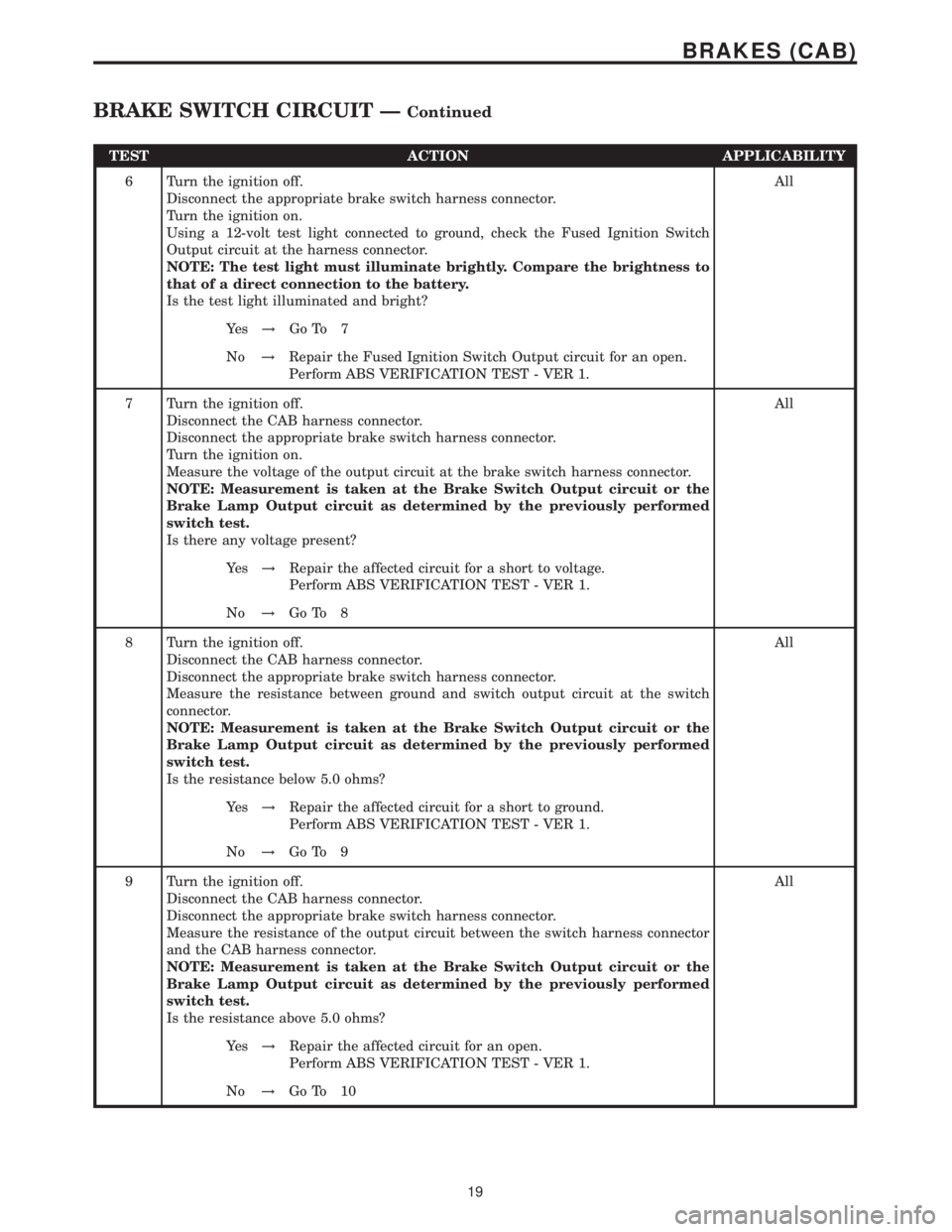
TEST ACTION APPLICABILITY
6 Turn the ignition off.
Disconnect the appropriate brake switch harness connector.
Turn the ignition on.
Using a 12-volt test light connected to ground, check the Fused Ignition Switch
Output circuit at the harness connector.
NOTE: The test light must illuminate brightly. Compare the brightness to
that of a direct connection to the battery.
Is the test light illuminated and bright?All
Ye s!Go To 7
No!Repair the Fused Ignition Switch Output circuit for an open.
Perform ABS VERIFICATION TEST - VER 1.
7 Turn the ignition off.
Disconnect the CAB harness connector.
Disconnect the appropriate brake switch harness connector.
Turn the ignition on.
Measure the voltage of the output circuit at the brake switch harness connector.
NOTE: Measurement is taken at the Brake Switch Output circuit or the
Brake Lamp Output circuit as determined by the previously performed
switch test.
Is there any voltage present?All
Ye s!Repair the affected circuit for a short to voltage.
Perform ABS VERIFICATION TEST - VER 1.
No!Go To 8
8 Turn the ignition off.
Disconnect the CAB harness connector.
Disconnect the appropriate brake switch harness connector.
Measure the resistance between ground and switch output circuit at the switch
connector.
NOTE: Measurement is taken at the Brake Switch Output circuit or the
Brake Lamp Output circuit as determined by the previously performed
switch test.
Is the resistance below 5.0 ohms?All
Ye s!Repair the affected circuit for a short to ground.
Perform ABS VERIFICATION TEST - VER 1.
No!Go To 9
9 Turn the ignition off.
Disconnect the CAB harness connector.
Disconnect the appropriate brake switch harness connector.
Measure the resistance of the output circuit between the switch harness connector
and the CAB harness connector.
NOTE: Measurement is taken at the Brake Switch Output circuit or the
Brake Lamp Output circuit as determined by the previously performed
switch test.
Is the resistance above 5.0 ohms?All
Ye s!Repair the affected circuit for an open.
Perform ABS VERIFICATION TEST - VER 1.
No!Go To 10
19
BRAKES (CAB)
BRAKE SWITCH CIRCUIT ÐContinued
Page 341 of 2305
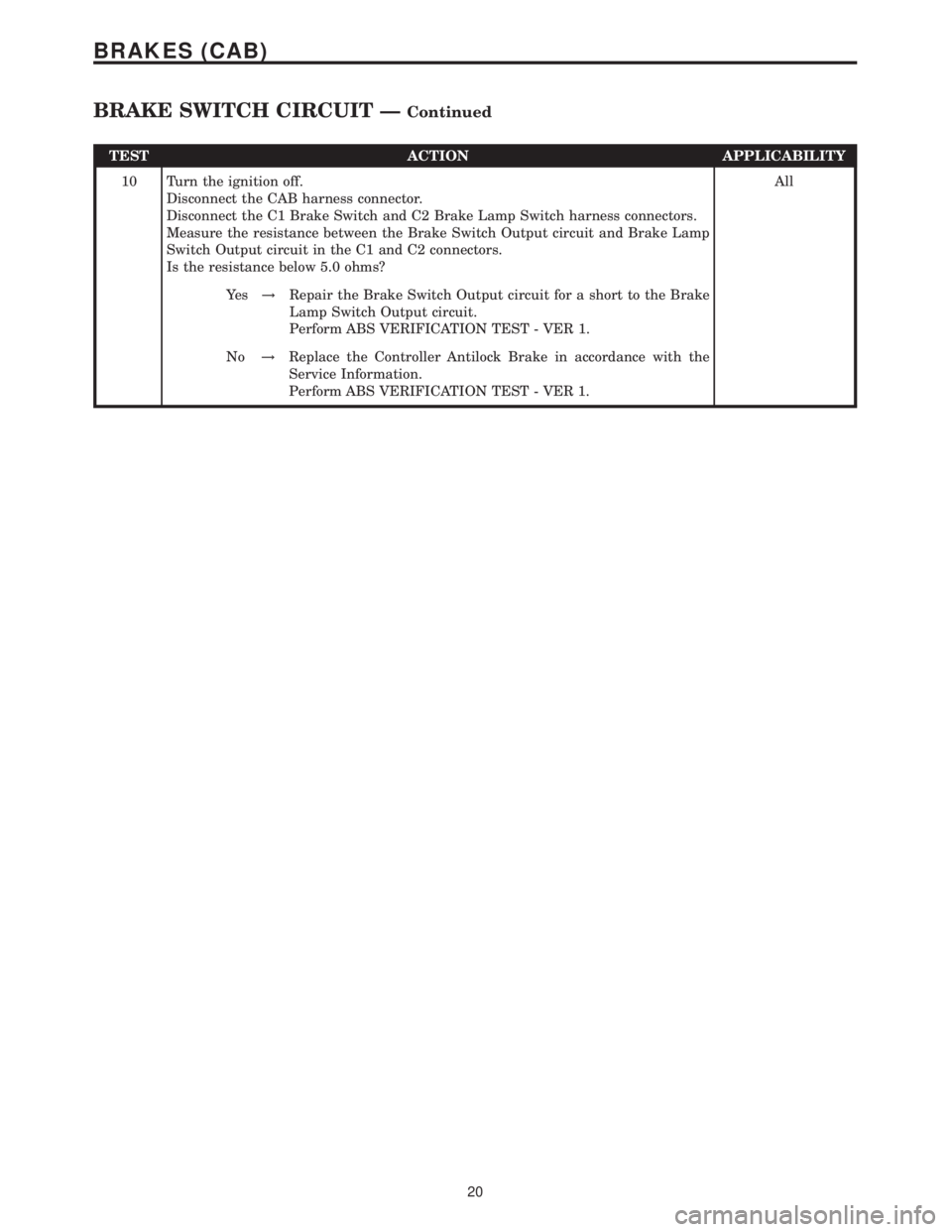
TEST ACTION APPLICABILITY
10 Turn the ignition off.
Disconnect the CAB harness connector.
Disconnect the C1 Brake Switch and C2 Brake Lamp Switch harness connectors.
Measure the resistance between the Brake Switch Output circuit and Brake Lamp
Switch Output circuit in the C1 and C2 connectors.
Is the resistance below 5.0 ohms?All
Ye s!Repair the Brake Switch Output circuit for a short to the Brake
Lamp Switch Output circuit.
Perform ABS VERIFICATION TEST - VER 1.
No!Replace the Controller Antilock Brake in accordance with the
Service Information.
Perform ABS VERIFICATION TEST - VER 1.
20
BRAKES (CAB)
BRAKE SWITCH CIRCUIT ÐContinued
Page 342 of 2305
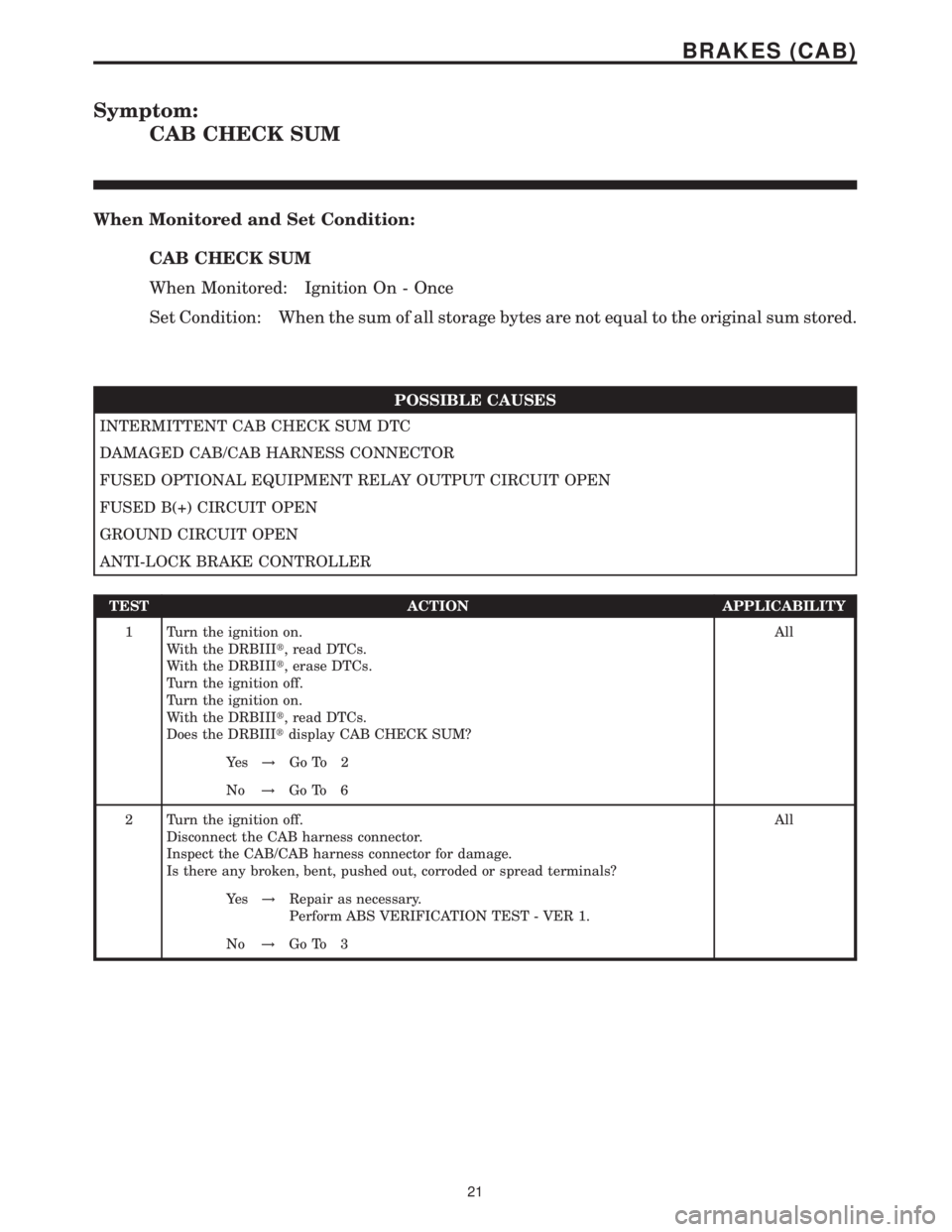
Symptom:
CAB CHECK SUM
When Monitored and Set Condition:
CAB CHECK SUM
When Monitored: Ignition On - Once
Set Condition: When the sum of all storage bytes are not equal to the original sum stored.
POSSIBLE CAUSES
INTERMITTENT CAB CHECK SUM DTC
DAMAGED CAB/CAB HARNESS CONNECTOR
FUSED OPTIONAL EQUIPMENT RELAY OUTPUT CIRCUIT OPEN
FUSED B(+) CIRCUIT OPEN
GROUND CIRCUIT OPEN
ANTI-LOCK BRAKE CONTROLLER
TEST ACTION APPLICABILITY
1 Turn the ignition on.
With the DRBIIIt, read DTCs.
With the DRBIIIt, erase DTCs.
Turn the ignition off.
Turn the ignition on.
With the DRBIIIt, read DTCs.
Does the DRBIIItdisplay CAB CHECK SUM?All
Ye s!Go To 2
No!Go To 6
2 Turn the ignition off.
Disconnect the CAB harness connector.
Inspect the CAB/CAB harness connector for damage.
Is there any broken, bent, pushed out, corroded or spread terminals?All
Ye s!Repair as necessary.
Perform ABS VERIFICATION TEST - VER 1.
No!Go To 3
21
BRAKES (CAB)
Page 343 of 2305

TEST ACTION APPLICABILITY
3 Turn the ignition off.
Disconnect the CAB harness connector.
Turn the ignition on.
Using a 12-volt test light connected to ground, check the Fused Optional Equipment
Relay Output circuit at the CAB harness connector.
NOTE: The test light must illuminate brightly. Compare the brightness to
that of a direct connection to the battery.
Does the test light illuminate brightly?All
Ye s!Go To 4
No!Repair the Fused Optional Equipment Relay Output circuit for an
open.
Perform ABS VERIFICATION TEST - VER 1.
4 Turn the ignition off.
Disconnect the CAB harness connector.
Using a 12-volt test light connected to ground, check both Fused B(+) circuits at the
CAB harness connector.
NOTE: The test light must illuminate brightly. Compare the brightness to
that of a direct connection to the battery.
Does the test light illuminate brightly?All
Ye s!Go To 5
No!Repair the Fused B(+) circuit for an open.
Perform ABS VERIFICATION TEST - VER 1.
5 Turn the ignition off.
Disconnect the CAB harness connector.
Using a 12-volt test light connected to 12-volts, check the CAB harness connector
Ground circuits.
NOTE: The test light must illuminate brightly. Compare the brightness to
that of a direct connection to the battery.
Does the test light illuminate brightly?All
Ye s!Replace the Controller Antilock Brake in accordance with the
Service Information.
Perform ABS VERIFICATION TEST - VER 1.
No!Repair the Ground circuit for an open.
Perform ABS VERIFICATION TEST - VER 1.
6 Turn the ignition off.
Visually inspect the related wiring harness.
Look for any chafed, pierced, pinched, or partially broken wires.
Look for broken, bent, pushed out, or corroded terminals.
Were any problems found?All
Ye s!Repair as necessary.
Perform ABS VERIFICATION TEST - VER 1.
No!Test Complete.
22
BRAKES (CAB)
CAB CHECK SUM ÐContinued