2006 LAND ROVER FRELANDER 2 engine
[x] Cancel search: enginePage 415 of 3229
1
1
2
3
4
5
6
1
1
2
3
4
5
1
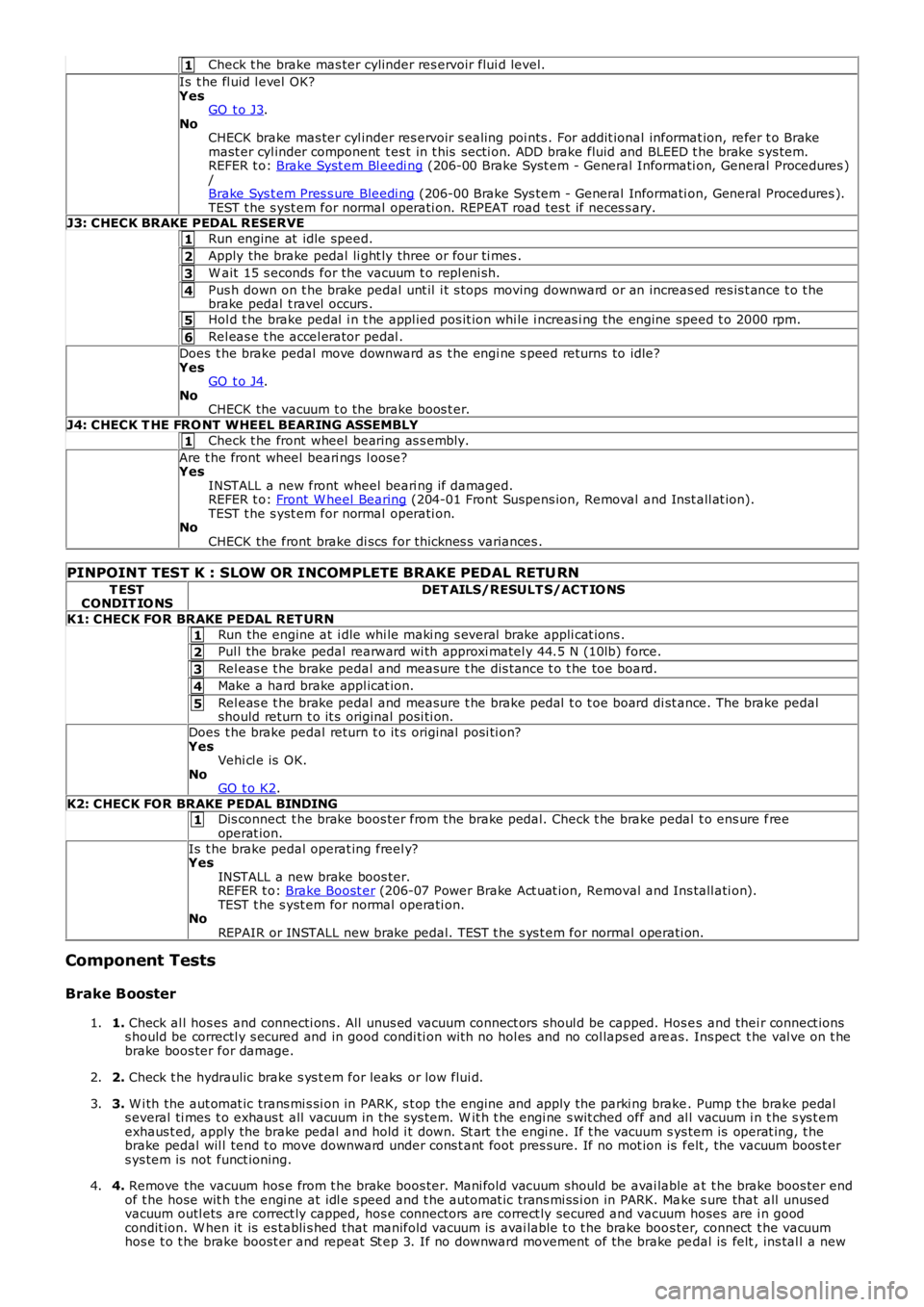
Check t he brake mas ter cylinder res ervoir flui d level.
Is t he fl uid l evel OK?YesGO t o J3.NoCHECK brake mas ter cyl inder res ervoir s ealing poi nts . For addit ional informat ion, refer t o Brakemast er cyl inder component t es t in t his secti on. ADD brake fluid and BLEED t he brake s ys tem.REFER t o: Brake Syst em Bl eedi ng (206-00 Brake Syst em - General Informati on, General Procedures )/Brake Sys t em Pres s ure Bleedi ng (206-00 Brake Sys tem - General Informati on, General Procedures ).TEST t he s yst em for normal operati on. REPEAT road tes t if neces s ary.J3: CHECK BRAKE PEDAL RESERVE
Run engine at idle speed.
Apply the brake pedal li ght ly three or four ti mes .
W ait 15 s econds for the vacuum t o repl eni sh.
Pus h down on t he brake pedal unt il i t s tops moving downward or an increas ed res is t ance t o t hebrake pedal t ravel occurs .
Hol d t he brake pedal i n t he appl ied pos it ion whi le i ncreas i ng the engine speed t o 2000 rpm.
Rel eas e t he accel erator pedal .
Does t he brake pedal move downward as t he engi ne s peed returns to idle?YesGO t o J4.NoCHECK the vacuum t o the brake boos t er.
J4: CHECK T HE FRO NT WHEEL BEARING ASSEMBLY
Check t he front wheel bearing as s embly.
Are t he front wheel beari ngs l oose?YesINSTALL a new front wheel beari ng if damaged.REFER t o: Front W heel Bearing (204-01 Front Suspens ion, Removal and Inst all at ion).TEST t he s yst em for normal operati on.NoCHECK the front brake di scs for thicknes s variances .
PINPOINT TEST K : SLOW OR INCOMPLETE BRAKE PEDAL RETU RN
T ESTCONDIT IO NSDET AILS/RESULT S/ACT IO NS
K1: CHECK FOR BRAKE PEDAL RET URN
Run the engine at i dle whi le maki ng s everal brake appli cat ions .
Pul l the brake pedal rearward wi th approxi matel y 44.5 N (10lb) force.
Rel eas e t he brake pedal and measure t he dis tance t o t he toe board.
Make a hard brake appl icat ion.
Rel eas e t he brake pedal and measure t he brake pedal t o t oe board di st ance. The brake pedalshould return t o it s original posi ti on.
Does t he brake pedal return t o it s original posi ti on?YesVehi cl e is OK.NoGO t o K2.
K2: CHECK FOR BRAKE PEDAL BINDINGDis connect t he brake boos ter from the brake pedal. Check t he brake pedal t o ens ure freeoperat ion.
Is t he brake pedal operat ing freel y?YesINSTALL a new brake boos ter.REFER t o: Brake Boost er (206-07 Power Brake Act uat ion, Removal and Ins tall ati on).TEST t he s yst em for normal operati on.NoREPAIR or INSTALL new brake pedal. TEST t he s ys t em for normal operati on.
Component Tests
Brake Booster
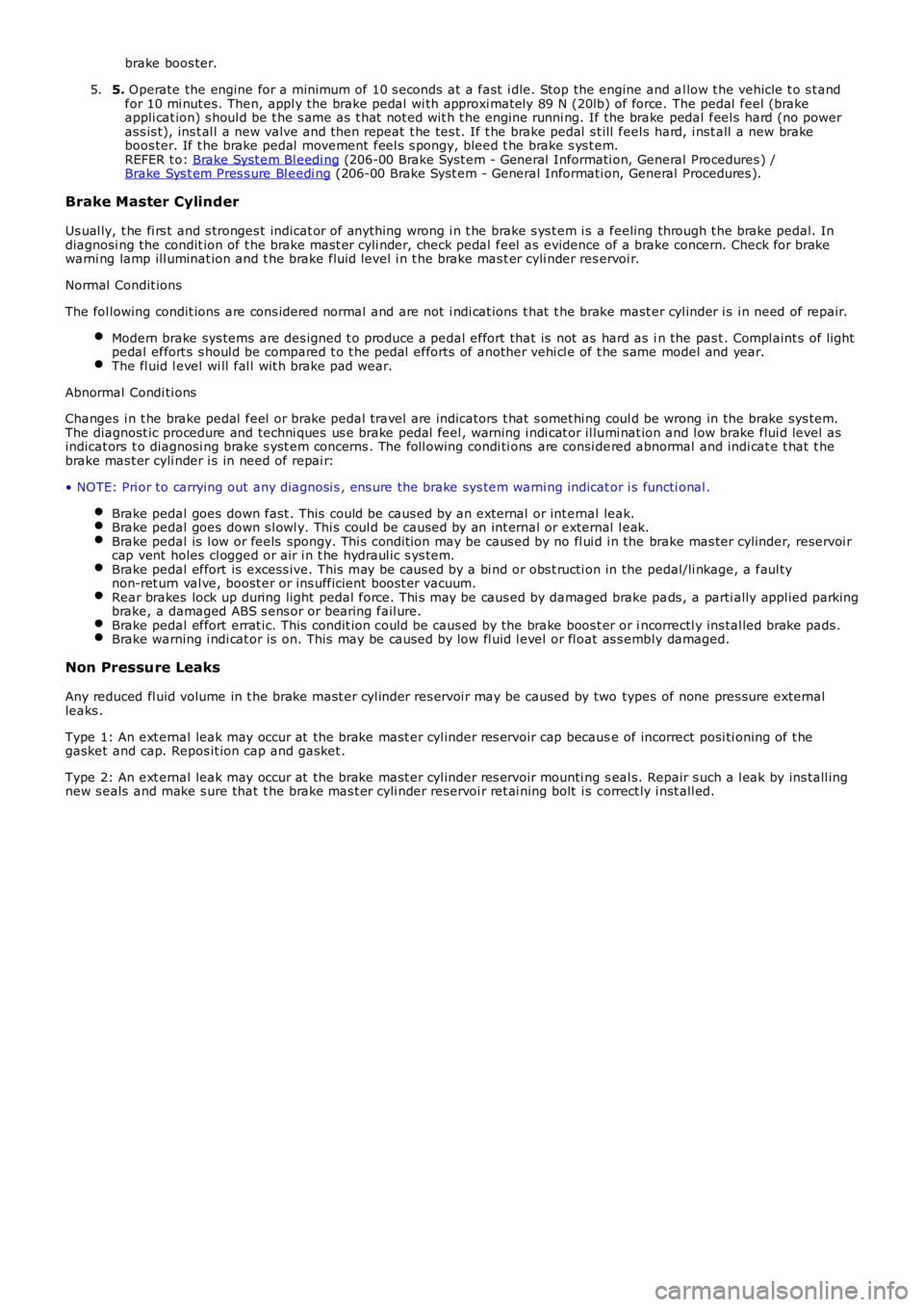
1. Check al l hos es and connecti ons . All unus ed vacuum connect ors s houl d be capped. Hos es and thei r connect ionss hould be correctl y s ecured and in good condi ti on wit h no hol es and no col laps ed areas. Ins pect t he val ve on t hebrake boos ter for damage.
1.
2. Check t he hydraulic brake s ys t em for leaks or low flui d.2.
3. W i th the aut omat ic trans mi s si on in PARK, s t op the engine and apply the parki ng brake. Pump t he brake pedals everal ti mes t o exhaus t all vacuum in the s ys tem. W it h t he engi ne s wit ched off and al l vacuum i n t he s ys t emexhaus t ed, apply the brake pedal and hold i t down. St art t he engi ne. If t he vacuum sys tem is operat ing, t hebrake pedal wil l tend t o move downward under cons t ant foot pres sure. If no mot ion is felt , the vacuum boos t ers ys tem is not funct ioning.
3.
4. Remove the vacuum hos e from t he brake boos ter. Mani fol d vacuum should be avai lable at t he brake boos ter endof t he hose wit h t he engi ne at idl e s peed and t he automat ic trans mi ss i on in PARK. Make s ure that all unusedvacuum outl ets are correct ly capped, hos e connectors are correct ly secured and vacuum hoses are i n goodcondit ion. W hen it is es tabli s hed that manifold vacuum is avai lable t o t he brake boos ter, connect t he vacuumhos e t o t he brake boost er and repeat St ep 3. If no downward movement of the brake pedal is felt , ins tal l a new
4.
Page 416 of 3229
brake boos ter.
5. Operate the engine for a minimum of 10 s econds at a fast i dle. Stop the engine and al low t he vehicle t o s t andfor 10 mi nut es. Then, appl y the brake pedal wi th approxi mately 89 N (20lb) of force. The pedal feel (brakeappli cat ion) s houl d be t he s ame as t hat not ed wit h t he engine runni ng. If the brake pedal feel s hard (no poweras s is t), ins t al l a new valve and t hen repeat t he tes t. If t he brake pedal s t ill feels hard, i ns t all a new brakeboos ter. If t he brake pedal movement feel s s pongy, bleed t he brake s ys t em.REFER t o: Brake Syst em Bl eedi ng (206-00 Brake Syst em - General Informati on, General Procedures ) /Brake Sys t em Pres s ure Bl eedi ng (206-00 Brake Syst em - General Informati on, General Procedures ).
5.
Brake Master Cylinder
Us ual ly, t he fi rs t and s tronges t indicat or of anything wrong i n t he brake s ys t em i s a feeling through t he brake pedal. Indiagnosi ng the condit ion of t he brake mas t er cyli nder, check pedal feel as evidence of a brake concern. Check for brakewarni ng lamp ill uminat ion and t he brake fluid level i n t he brake mas t er cyli nder reservoi r.
Normal Condit ions
The fol lowing condit ions are cons idered normal and are not i ndi cat ions t hat t he brake mast er cyl inder i s i n need of repair.
Modern brake sys tems are des igned t o produce a pedal effort that is not as hard as in the pas t . Compl aint s of lightpedal effort s s houl d be compared t o t he pedal efforts of another vehi cl e of t he s ame model and year.The fl uid l evel wi ll fal l wit h brake pad wear.
Abnormal Condi ti ons
Changes i n t he brake pedal feel or brake pedal travel are indicators t hat s omet hi ng coul d be wrong in the brake sys tem.The diagnost ic procedure and techni ques us e brake pedal feel , warning i ndi cat or il lumi nat ion and l ow brake flui d level asindicat ors t o diagnosi ng brake s yst em concerns . The foll owing condi ti ons are consi dered abnormal and indi cat e t hat t hebrake mas t er cyli nder i s in need of repai r:
• NOTE: Pri or to carrying out any diagnosi s , ens ure the brake sys tem warni ng indicator i s functi onal .
Brake pedal goes down fast . This could be caus ed by an external or int ernal leak.Brake pedal goes down s l owl y. Thi s coul d be caused by an int ernal or external l eak.Brake pedal is l ow or feels spongy. Thi s condit ion may be caus ed by no fl ui d i n the brake mas ter cylinder, reservoi rcap vent holes cl ogged or air i n t he hydraul ic s ys tem.Brake pedal effort is excess ive. This may be caus ed by a bi nd or obs t ructi on in the pedal/li nkage, a faul tynon-ret urn val ve, boost er or ins ufficient boos t er vacuum.Rear brakes lock up during light pedal force. Thi s may be caus ed by damaged brake pads , a parti ally appl ied parkingbrake, a damaged ABS s ens or or bearing fail ure.Brake pedal effort errat ic. This condit ion could be caus ed by the brake boos t er or incorrectl y ins tal led brake pads .Brake warning i ndi cat or is on. This may be caus ed by low fl uid l evel or fl oat as s embly damaged.
Non Pressure Leaks
Any reduced fl uid volume in t he brake mast er cyl inder res ervoi r may be caused by two types of none pres sure externalleaks .
Type 1: An ext ernal leak may occur at the brake mast er cyl inder res ervoir cap because of incorrect posi ti oning of t hegasket and cap. Repos it ion cap and gasket .
Type 2: An ext ernal leak may occur at the brake mast er cyl inder res ervoir mounti ng seal s. Repair s uch a l eak by ins tall ingnew s eals and make s ure that t he brake mas t er cyli nder reservoi r ret ai ning bolt i s correct ly i nst all ed.
Page 420 of 3229
Publi s hed: 11-May-2011
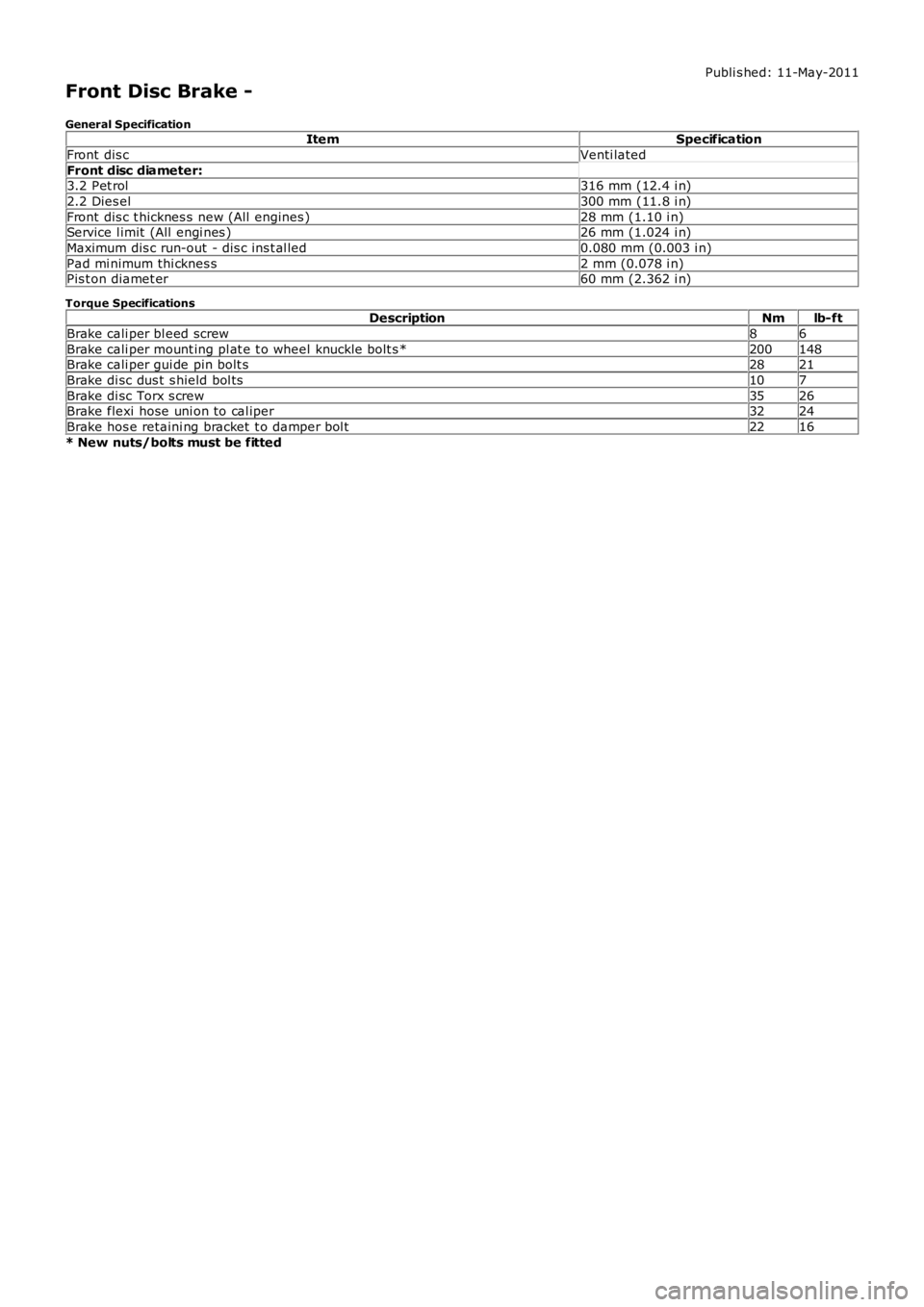
Front Disc Brake -
General SpecificationItemSpecification
Front dis cVenti lated
Front disc diameter:3.2 Pet rol316 mm (12.4 i n)
2.2 Dies el300 mm (11.8 i n)
Front dis c t hicknes s new (All engines )28 mm (1.10 i n)Service l imit (All engi nes )26 mm (1.024 i n)
Maximum dis c run-out - dis c ins t al led0.080 mm (0.003 i n)
Pad mi nimum thi cknes s2 mm (0.078 i n)Pis t on diamet er60 mm (2.362 i n)
Torque SpecificationsDescriptionNmlb-ft
Brake cali per bl eed screw86
Brake cali per mount ing pl at e t o wheel knuckle bolt s *200148Brake cali per gui de pin bolt s2821
Brake di sc dus t s hield bol ts107
Brake di sc Torx s crew3526Brake flexi hose uni on to cal iper3224
Brake hos e retaini ng bracket t o damper bol t2216
* New nuts/bolts must be fitted
Page 433 of 3229
Publi s hed: 11-May-2011
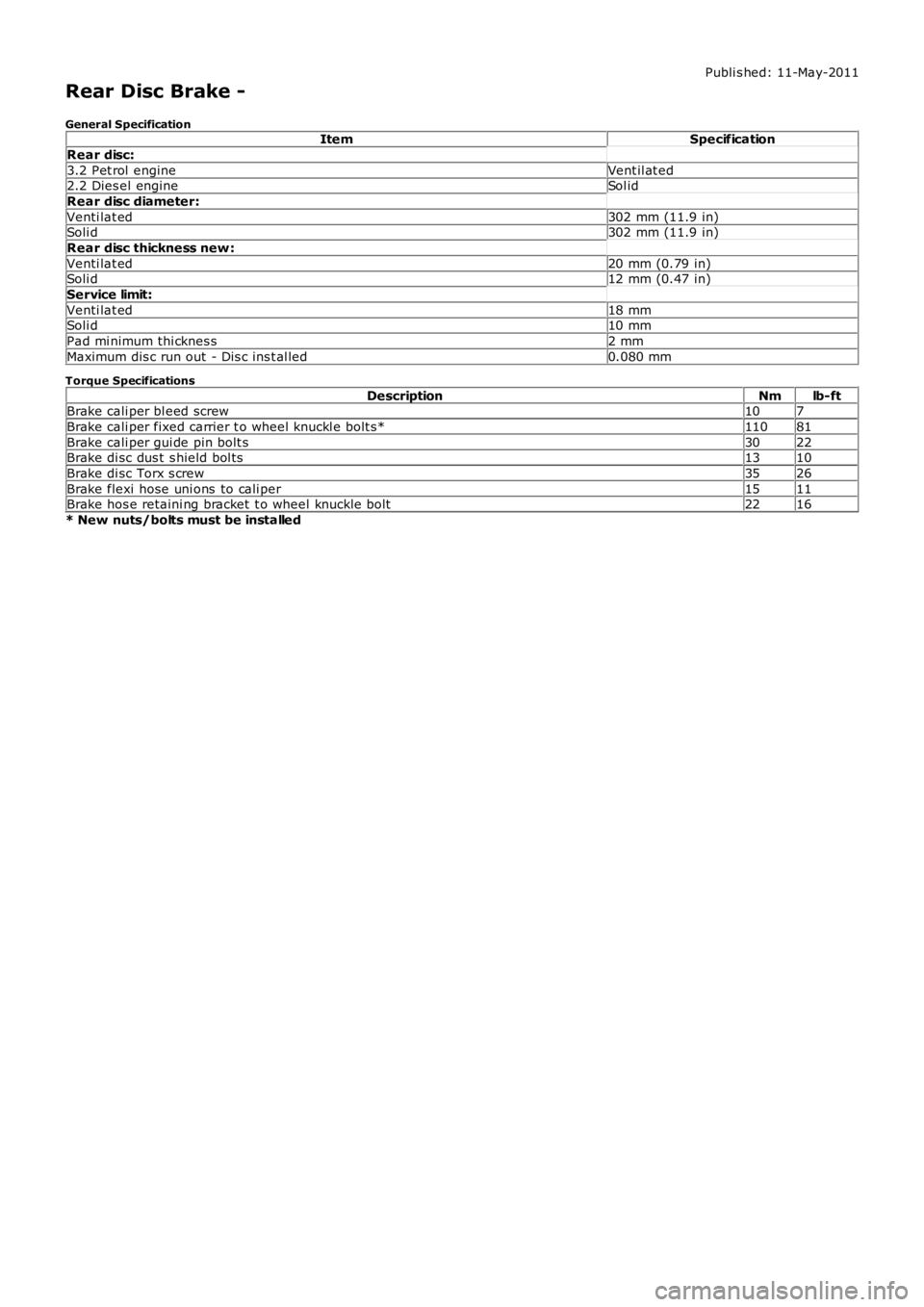
Rear Disc Brake -
General SpecificationItemSpecification
Rear disc:
3.2 Pet rol engineVent il at ed2.2 Dies el engineSol id
Rear disc diameter:
Venti lat ed302 mm (11.9 in)Soli d302 mm (11.9 in)
Rear disc thickness new :
Venti lat ed20 mm (0.79 in)Soli d12 mm (0.47 in)
Service limit:
Venti lat ed18 mmSoli d10 mm
Pad mi nimum thi cknes s2 mm
Maximum dis c run out - Dis c ins t al led0.080 mm
Torque Specifications
DescriptionNmlb-ftBrake cali per bl eed screw107
Brake cali per fixed carrier t o wheel knuckl e bolt s*11081
Brake cali per gui de pin bolt s3022Brake di sc dus t s hield bol ts1310
Brake di sc Torx s crew3526
Brake flexi hose uni ons to cali per1511Brake hos e retaini ng bracket t o wheel knuckle bolt2216
* New nuts/bolts must be installed
Page 470 of 3229
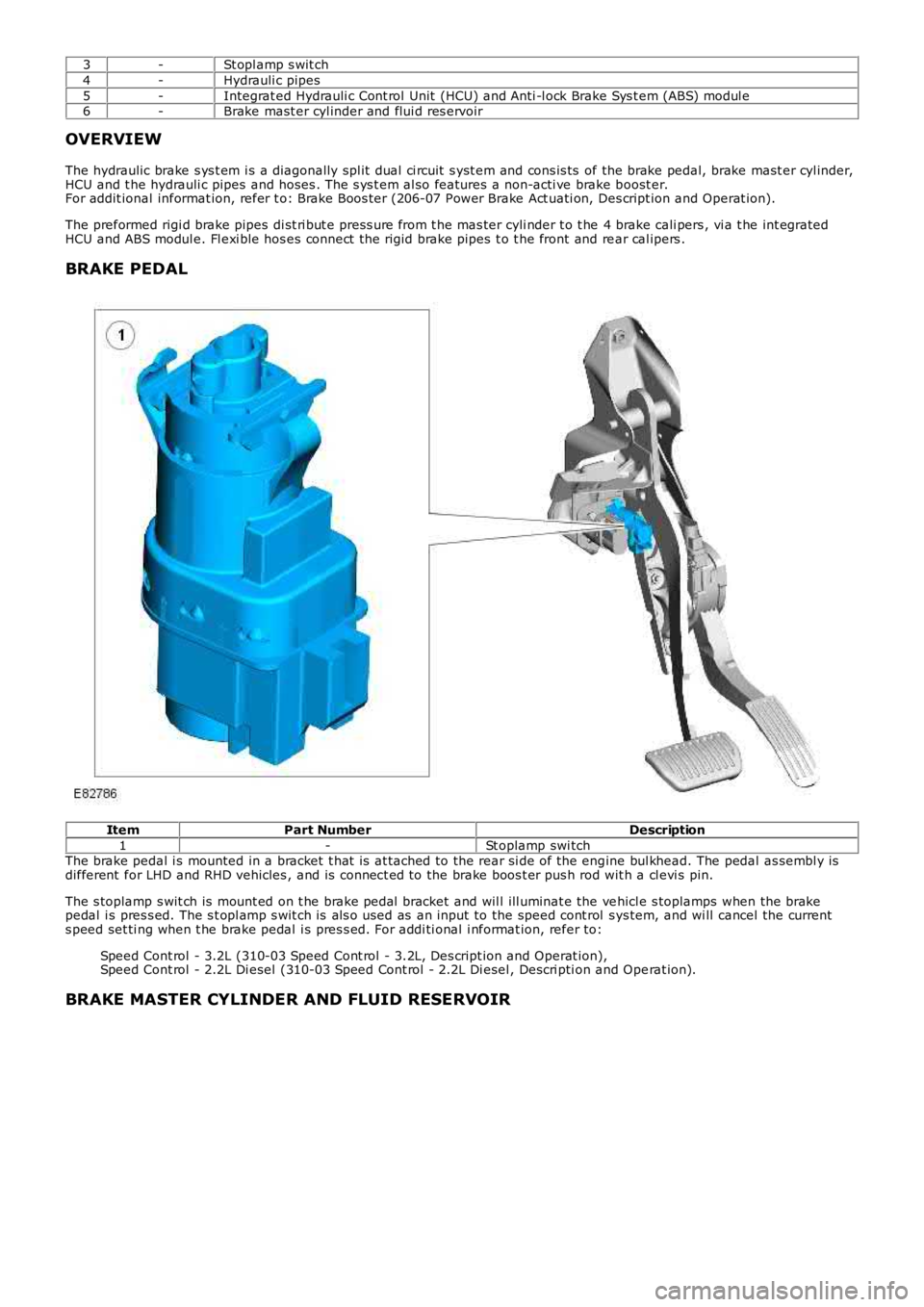
3-St opl amp s wit ch
4-Hydrauli c pipes
5-Integrat ed Hydrauli c Cont rol Unit (HCU) and Anti -l ock Brake Sys t em (ABS) modul e6-Brake mast er cyl inder and flui d res ervoir
OVERVIEW
The hydraulic brake s ys t em i s a diagonally spl it dual ci rcuit s yst em and cons is ts of the brake pedal, brake mast er cyl inder,HCU and t he hydrauli c pipes and hoses . The s ys t em al so features a non-acti ve brake boost er.For addit ional informat ion, refer t o: Brake Boos ter (206-07 Power Brake Act uati on, Des cript ion and Operat ion).
The preformed rigi d brake pipes di st ri but e press ure from t he mas ter cyli nder t o t he 4 brake cali pers , vi a t he int egratedHCU and ABS modul e. Fl exi ble hos es connect the rigid brake pipes t o t he front and rear cal ipers .
BRAKE PEDAL
ItemPart NumberDescription
1-St oplamp swi tchThe brake pedal i s mounted in a bracket t hat is at tached to the rear si de of the engine bul khead. The pedal as sembl y isdifferent for LHD and RHD vehicles , and is connect ed to the brake boos t er pus h rod wit h a cl evi s pin.
The s toplamp s wit ch is mount ed on t he brake pedal bracket and wil l ill uminat e the vehicl e s toplamps when the brakepedal i s pres s ed. The s t opl amp s wit ch is al s o used as an input to the speed cont rol s ys tem, and wi ll cancel the currents peed set ti ng when t he brake pedal i s pres s ed. For addi ti onal i nformat ion, refer to:
Speed Cont rol - 3.2L (310-03 Speed Cont rol - 3.2L, Des cript ion and Operat ion),Speed Cont rol - 2.2L Di esel (310-03 Speed Cont rol - 2.2L Di esel , Descri pti on and Operat ion).
BRAKE MASTER CYLINDER AND FLUID RESERVOIR
Page 471 of 3229
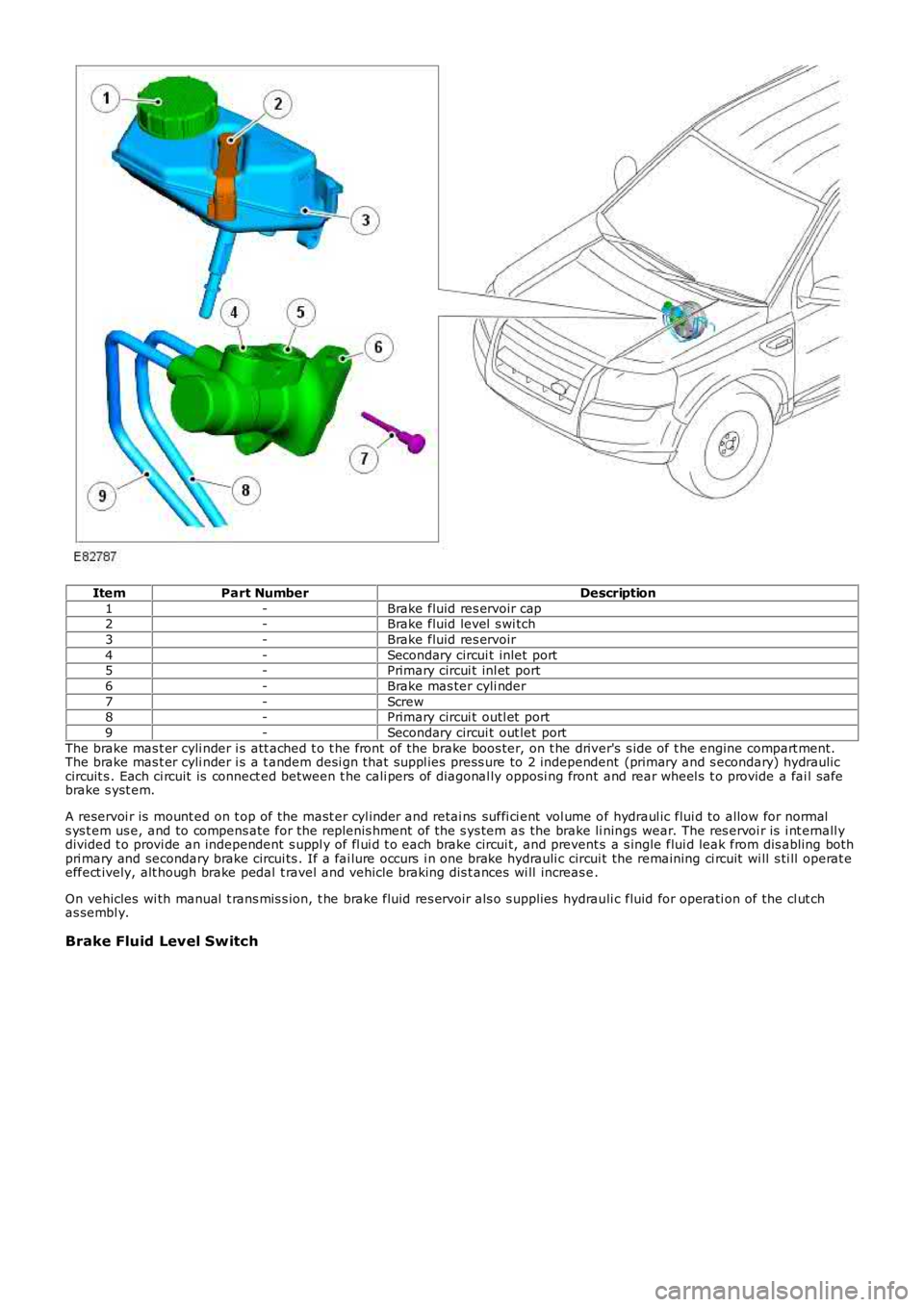
ItemPart NumberDescription
1-Brake fluid res ervoir cap2-Brake fluid level s wi tch
3-Brake fluid res ervoir
4-Secondary circui t inlet port5-Primary circui t inl et port
6-Brake mas ter cyli nder
7-Screw8-Primary circui t outl et port
9-Secondary circui t out let port
The brake mas t er cyli nder i s att ached t o t he front of the brake boos ter, on t he driver's s ide of t he engine compart ment.The brake mas t er cyli nder i s a t andem desi gn that s uppl ies press ure to 2 independent (primary and s econdary) hydrauliccircuit s . Each ci rcuit is connect ed between t he cali pers of diagonal ly opposi ng front and rear wheel s t o provide a fai l safebrake s yst em.
A reservoi r is mount ed on t op of the mast er cyl inder and retai ns suffi ci ent vol ume of hydraul ic flui d to allow for normals ys t em us e, and to compens ate for the replenis hment of the s ys tem as the brake li nings wear. The res ervoi r is i nt ernall ydivided t o provi de an independent s uppl y of fl ui d t o each brake circui t, and prevents a s ingle flui d leak from dis abling bot hpri mary and secondary brake circui ts . If a fai lure occurs i n one brake hydrauli c circui t the remaining ci rcuit wi ll s ti ll operat eeffect ively, alt hough brake pedal t ravel and vehicle braking dis t ances wi ll increas e.
On vehicles wi th manual t rans mis s ion, t he brake fluid res ervoir als o s upplies hydrauli c fluid for operati on of the cl ut chas sembl y.
Brake Fluid Level Switch
Page 485 of 3229
Publi s hed: 11-May-2011
Power Brake Actuation - Brake Booster
Des cript ion and Operat ion
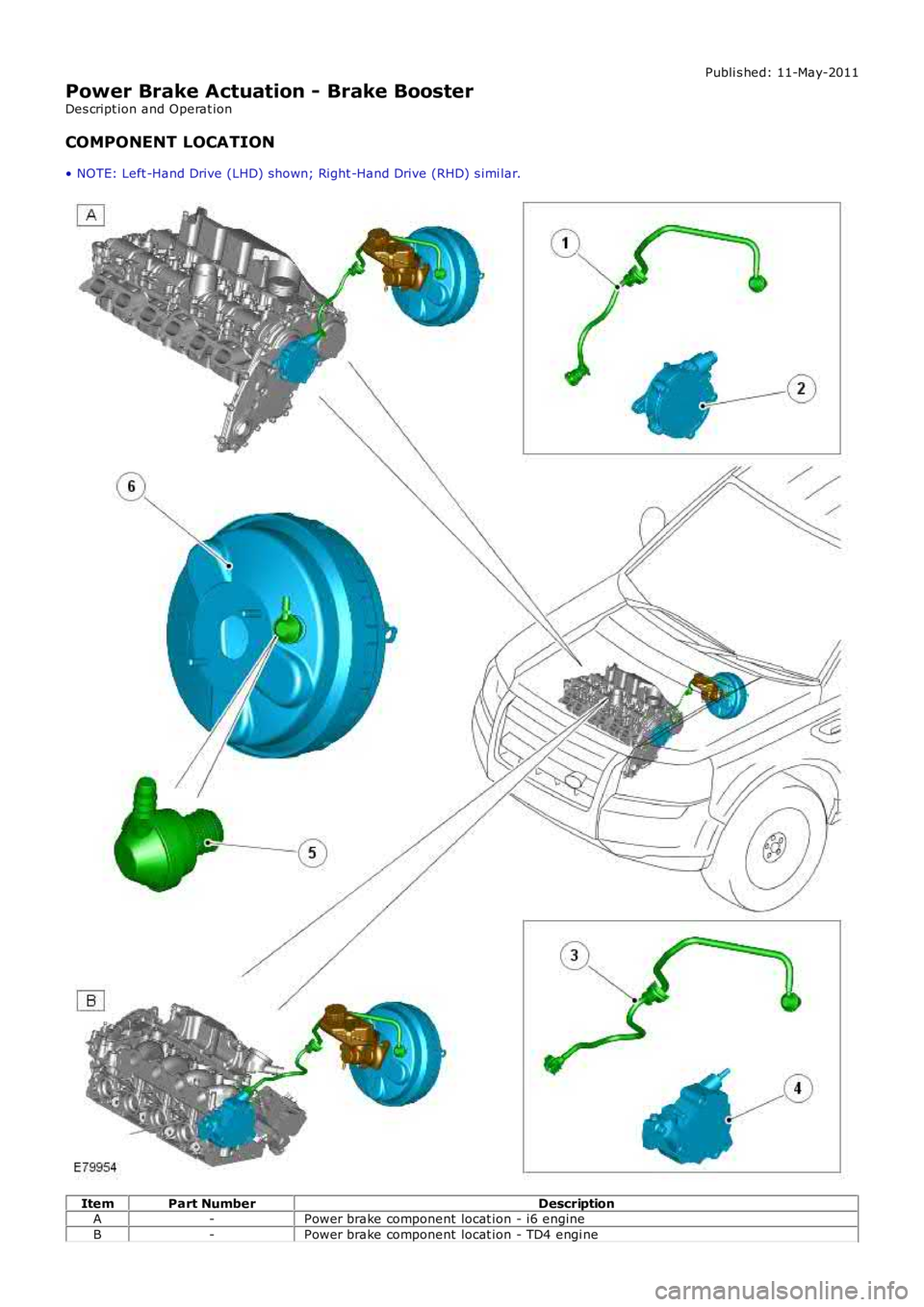
COMPONENT LOCATION
• NOTE: Left -Hand Drive (LHD) shown; Right -Hand Drive (RHD) s imi lar.
ItemPart NumberDescriptionA-Power brake component locat ion - i6 engine
B-Power brake component locat ion - TD4 engi ne
Page 486 of 3229
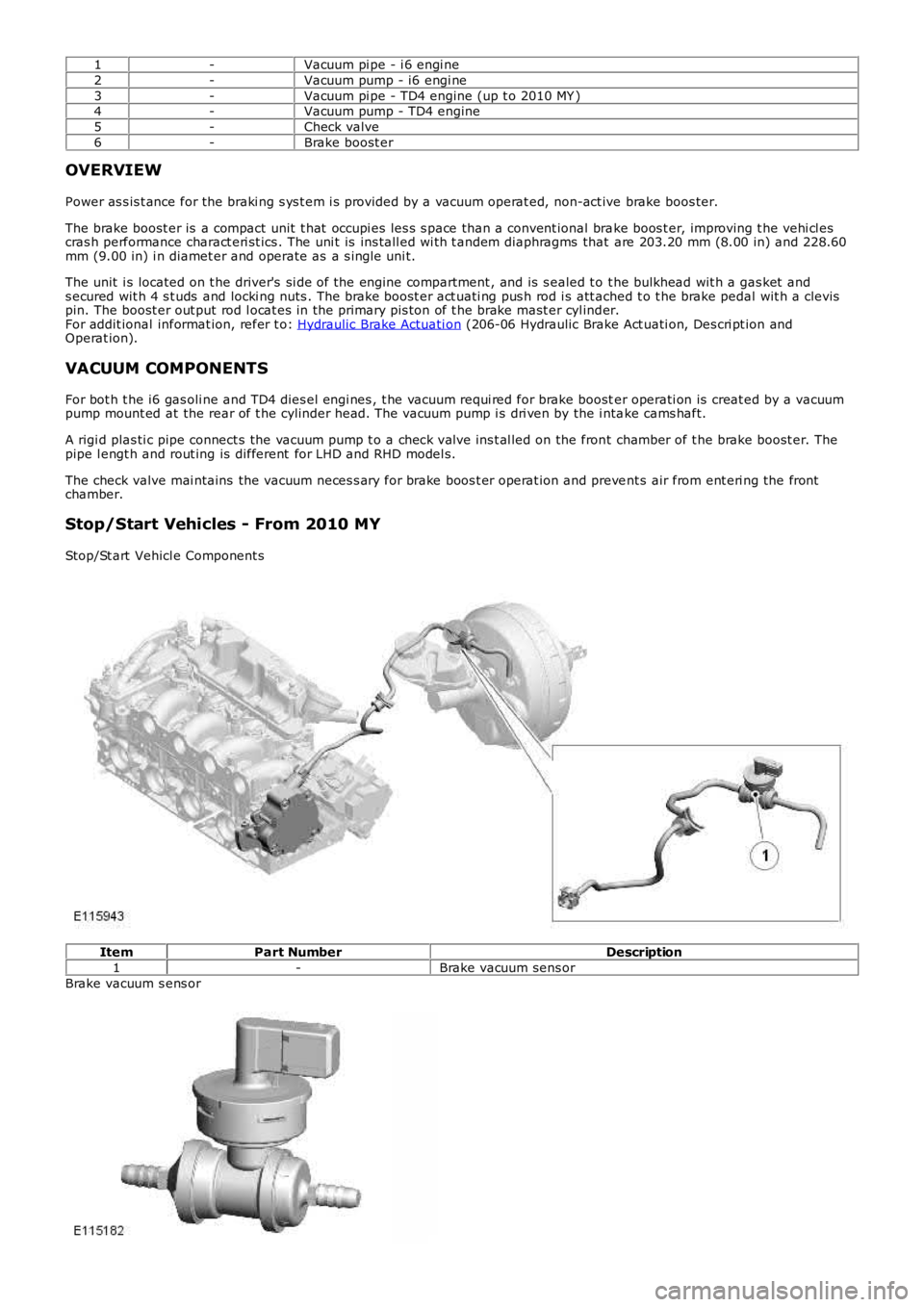
1-Vacuum pi pe - i 6 engi ne
2-Vacuum pump - i6 engi ne
3-Vacuum pi pe - TD4 engine (up t o 2010 MY )4-Vacuum pump - TD4 engine
5-Check valve
6-Brake boost er
OVERVIEW
Power as s is t ance for the braki ng s ys t em i s provided by a vacuum operat ed, non-act ive brake boos ter.
The brake boost er is a compact unit t hat occupi es les s s pace than a convent ional brake boos t er, improving t he vehi cl escras h performance charact eri st ics . The uni t is ins tall ed wi th t andem diaphragms that are 203.20 mm (8.00 in) and 228.60mm (9.00 in) i n diamet er and operate as a s ingle uni t.
The unit i s located on t he driver's si de of the engine compartment , and is s ealed t o t he bulkhead wit h a gas ket ands ecured wit h 4 s t uds and locki ng nuts . The brake boost er act uati ng pus h rod i s att ached t o t he brake pedal wit h a clevispin. The boost er out put rod l ocat es in the primary pis ton of t he brake mast er cyl inder.For addit ional informat ion, refer t o: Hydraulic Brake Actuati on (206-06 Hydraulic Brake Act uati on, Des cri pt ion andOperat ion).
VACUUM COMPONENTS
For bot h t he i6 gas oli ne and TD4 dies el engi nes , t he vacuum requi red for brake booster operati on is creat ed by a vacuumpump mount ed at the rear of t he cylinder head. The vacuum pump i s dri ven by the i ntake cams haft.
A rigi d plas ti c pipe connect s the vacuum pump t o a check valve ins t al led on the front chamber of t he brake boost er. Thepipe l engt h and rout ing is different for LHD and RHD model s.
The check valve mai ntains the vacuum neces s ary for brake boos t er operat ion and prevent s air from ent eri ng the frontchamber.
Stop/Start Vehicles - From 2010 MY
Stop/St art Vehicl e Component s
ItemPart NumberDescription
1-Brake vacuum sens or
Brake vacuum s ens or