Page 2470 of 5267
INSTALLATION - OUTER TIE ROD END
NOTE: Do not twist the boot at anytime during
removal or installation.
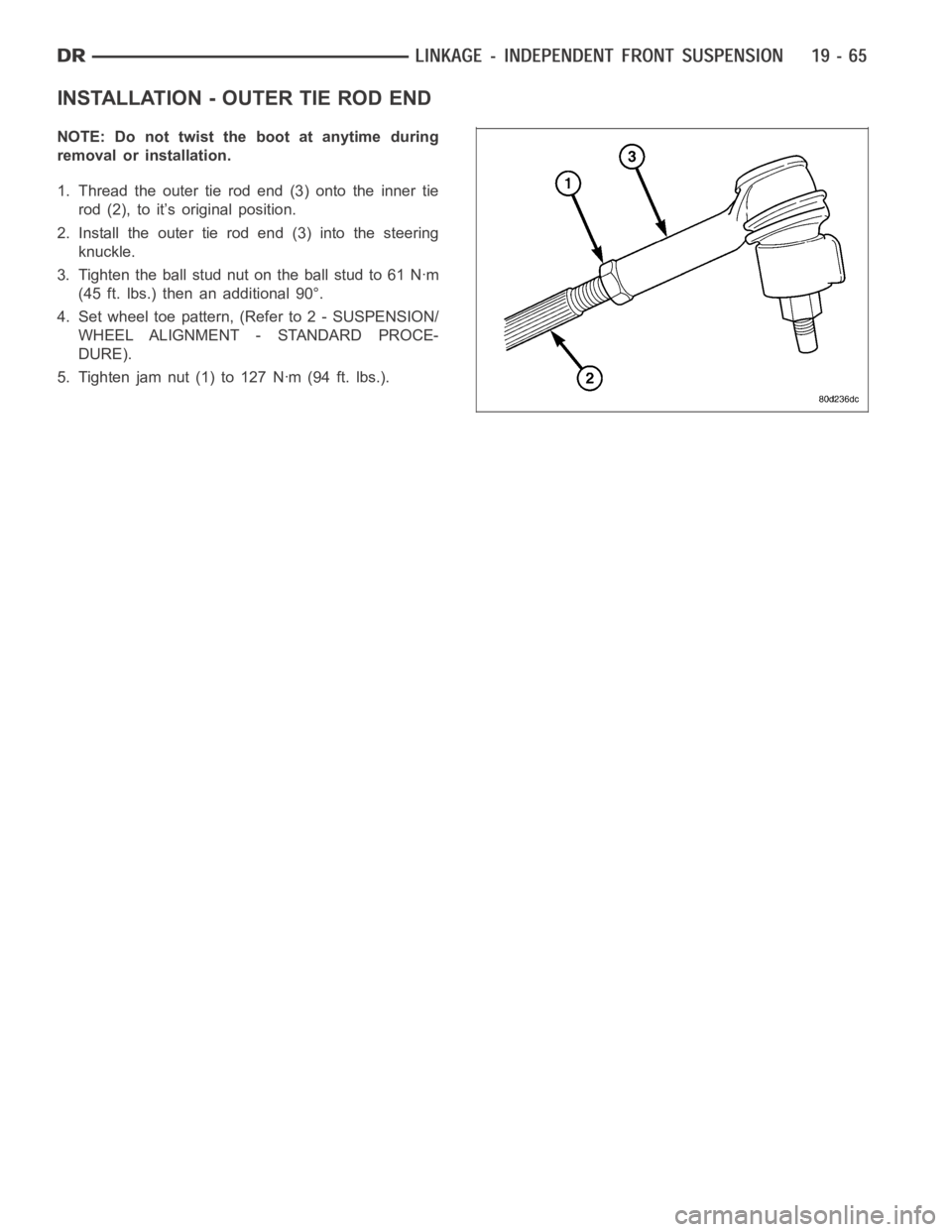
1. Thread the outer tie rod end (3) onto the inner tie
rod (2), to it’s original position.
2. Install the outer tie rod end (3) into the steering
knuckle.
3. Tighten the ball stud nut on the ball stud to 61 Nꞏm
(45 ft. lbs.) then an additional 90°.
4. Set wheel toe pattern, (Refer to 2 - SUSPENSION/
WHEEL ALIGNMENT - STANDARD PROCE-
DURE).
5. Tighten jam nut (1) to 127 Nꞏm (94 ft. lbs.).
Page 2476 of 5267
DRAG LINK
REMOVAL
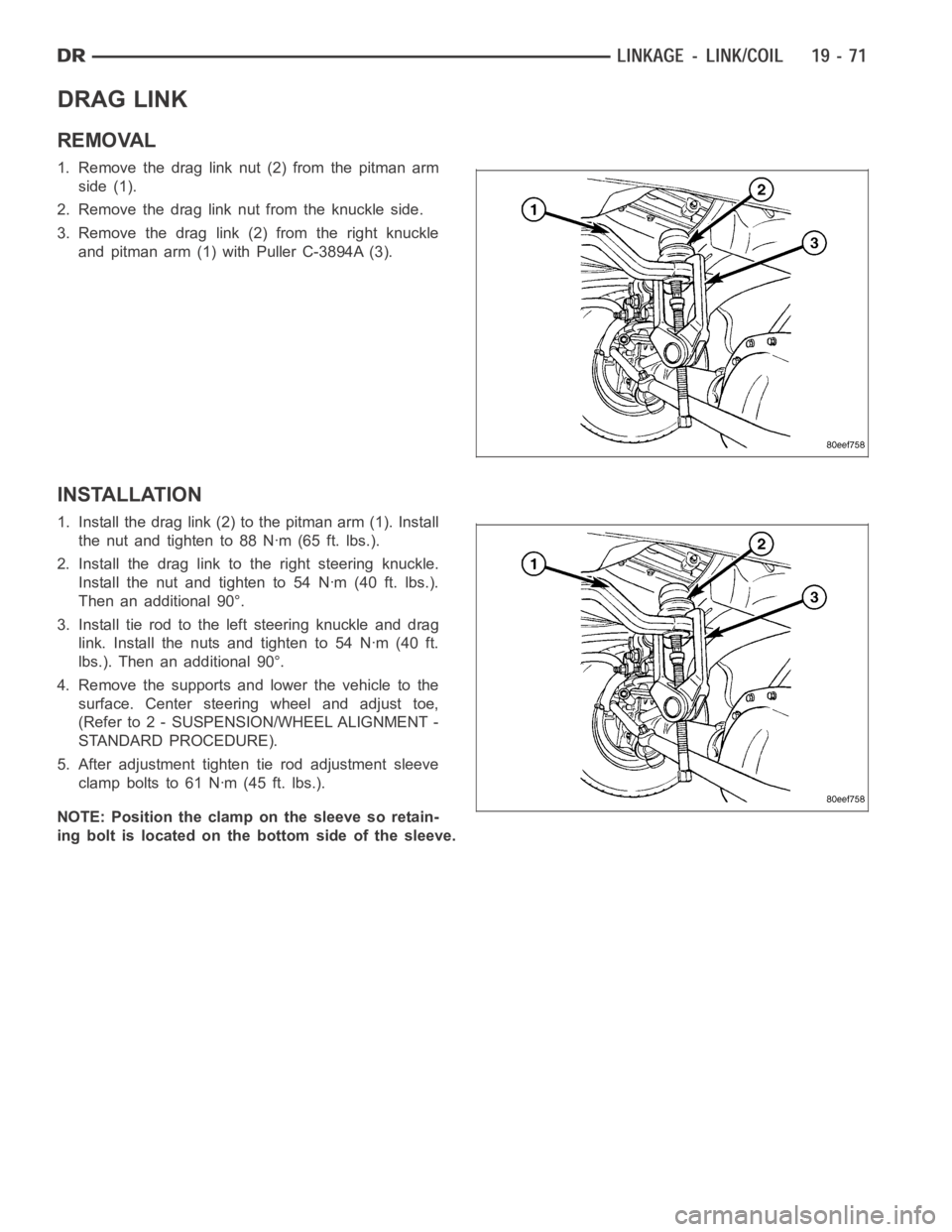
1. Remove the drag link nut (2) from the pitman arm
side (1).
2. Remove the drag link nut from the knuckle side.
3. Remove the drag link (2) from the right knuckle
and pitman arm (1) with Puller C-3894A (3).
INSTALLATION
1. Install the drag link (2) to the pitman arm (1). Install
the nut and tighten to 88 Nꞏm (65 ft. lbs.).
2. Install the drag link to the right steering knuckle.
Install the nut and tighten to 54 Nꞏm (40 ft. lbs.).
Then an additional 90°.
3. Install tie rod to the left steering knuckle and drag
link. Install the nuts and tighten to 54 Nꞏm (40 ft.
lbs.). Then an additional 90°.
4. Remove the supports and lower the vehicle to the
surface. Center steering wheel and adjust toe,
(Refer to 2 - SUSPENSION/WHEEL ALIGNMENT -
STANDARD PROCEDURE).
5. After adjustment tighten tie rod adjustment sleeve
clamp bolts to 61 Nꞏm (45 ft. lbs.).
NOTE:Positiontheclamponthesleevesoretain-
ing bolt is located on the bottom side of the sleeve.
Page 2478 of 5267
INSTALLATION
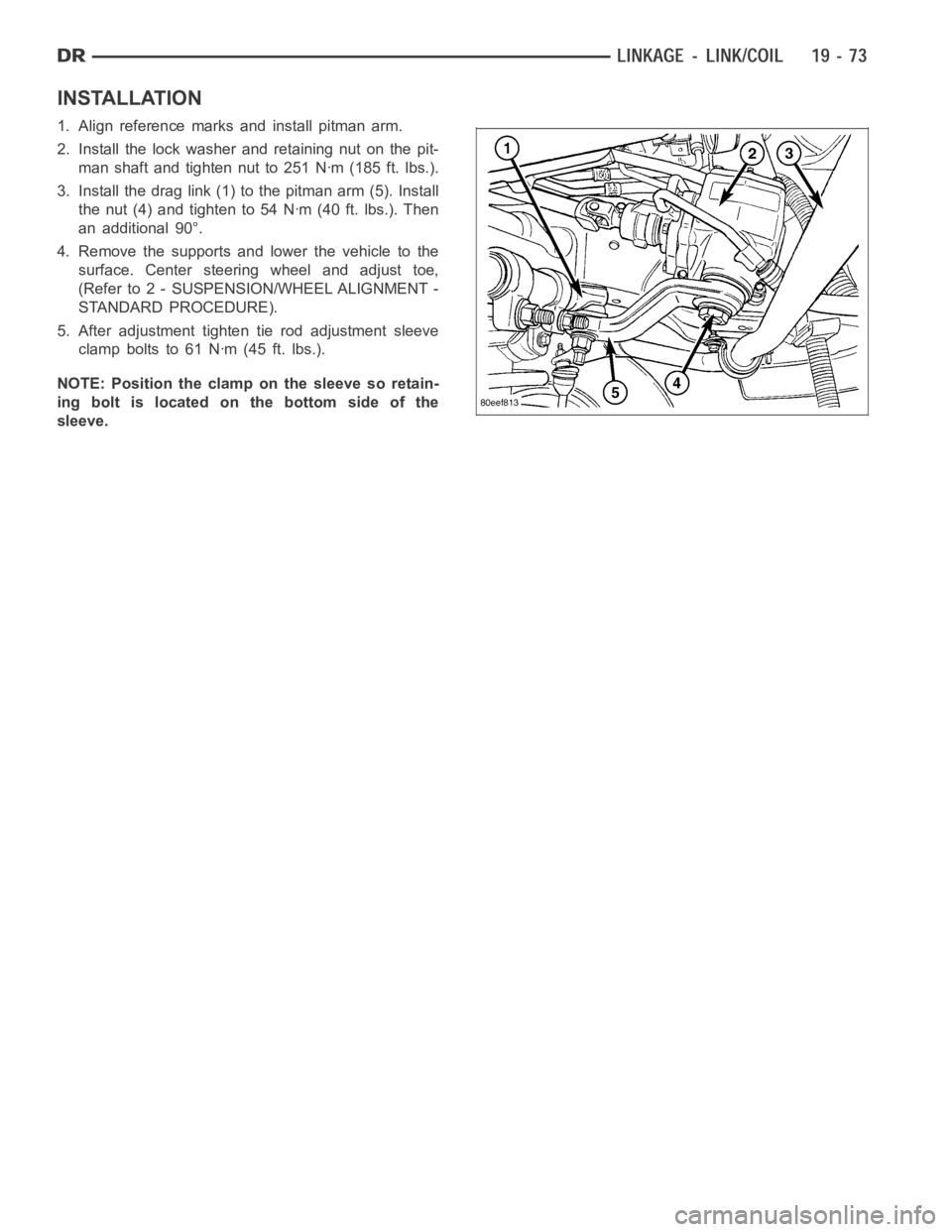
1. Align reference marks and install pitman arm.
2. Install the lock washer and retaining nut on the pit-
man shaft and tighten nut to 251 Nꞏm (185 ft. lbs.).
3. Install the drag link (1) to the pitman arm (5). Install
thenut(4)andtightento54Nꞏm(40ft.lbs.).Then
an additional 90°.
4. Remove the supports and lower the vehicle to the
surface. Center steering wheel and adjust toe,
(Refer to 2 - SUSPENSION/WHEEL ALIGNMENT -
STANDARD PROCEDURE).
5. After adjustment tighten tie rod adjustment sleeve
clamp bolts to 61 Nꞏm (45 ft. lbs.).
NOTE:Positiontheclamponthesleevesoretain-
ing bolt is located on the bottom side of the
sleeve.
Page 2479 of 5267
TIE ROD END
REMOVAL
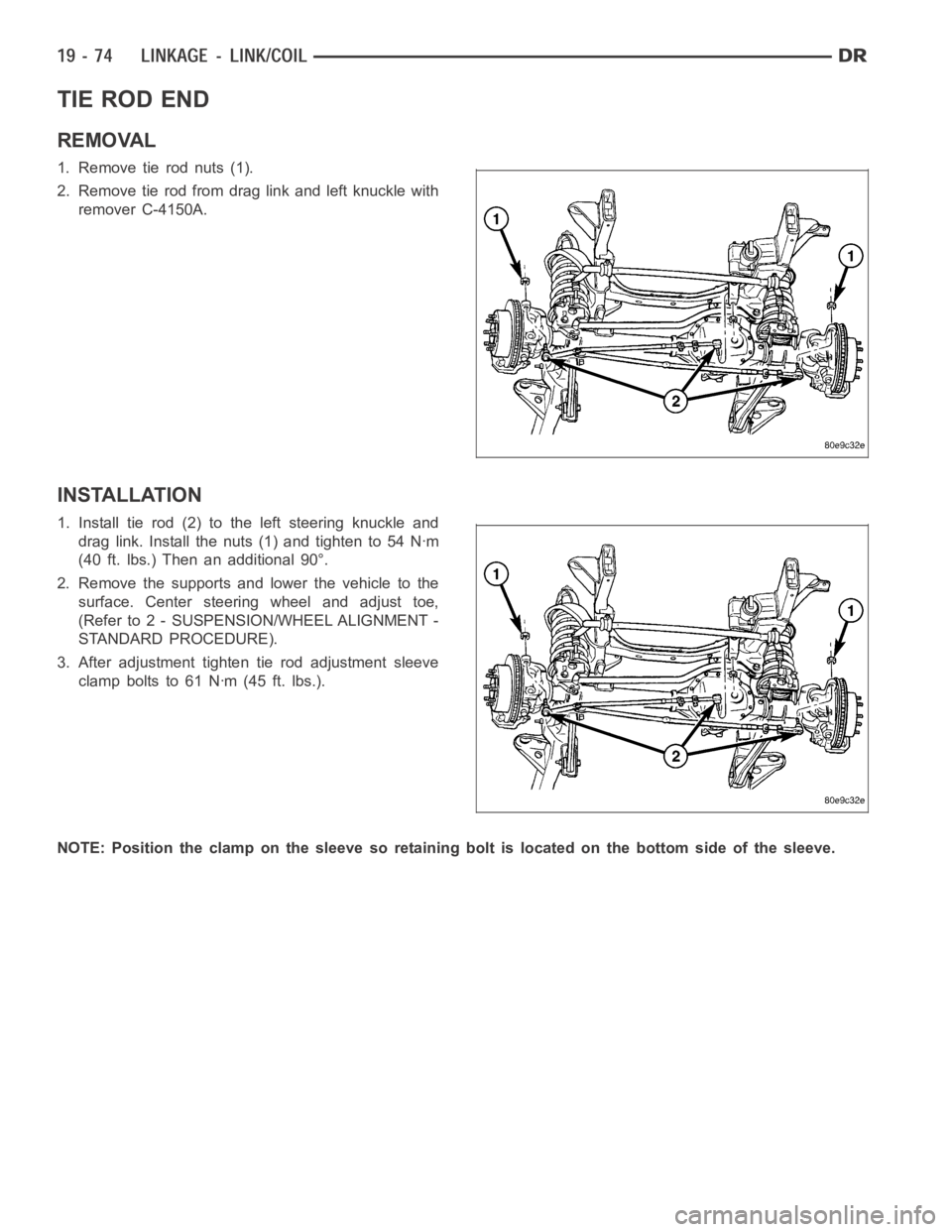
1. Remove tie rod nuts (1).
2. Remove tie rod from drag link and left knuckle with
remover C-4150A.
INSTALLATION
1. Install tie rod (2) to the left steering knuckle and
drag link. Install the nuts (1) and tighten to 54 Nꞏm
(40 ft. lbs.) Then an additional 90°.
2. Remove the supports and lower the vehicle to the
surface. Center steering wheel and adjust toe,
(Refer to 2 - SUSPENSION/WHEEL ALIGNMENT -
STANDARD PROCEDURE).
3. After adjustment tighten tie rod adjustment sleeve
clamp bolts to 61 Nꞏm (45 ft. lbs.).
NOTE: Position the clamp on the sleeve so retaining bolt is located on the bottom side of the sleeve.
Page 3389 of 5267
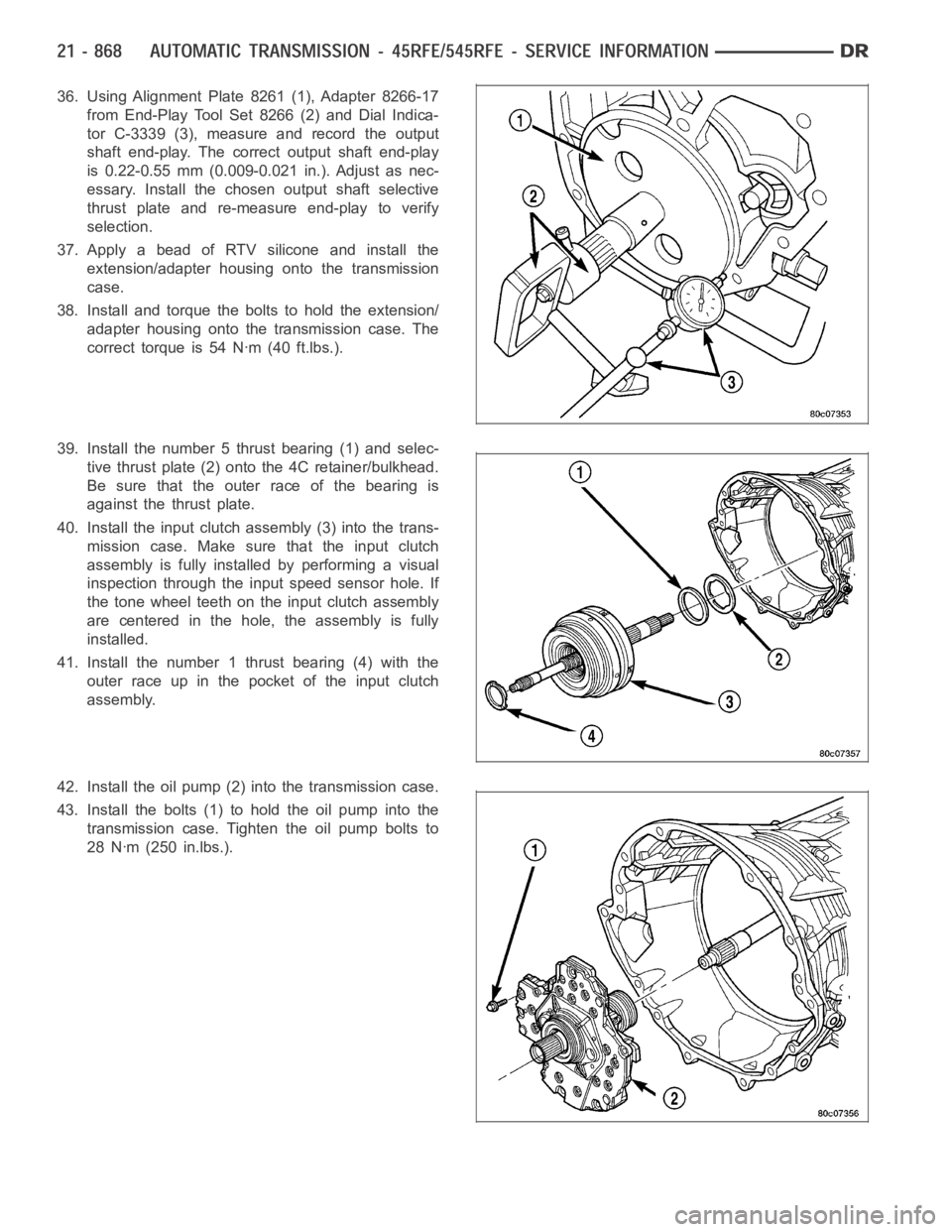
36. Using Alignment Plate 8261 (1), Adapter 8266-17
from End-Play Tool Set 8266 (2) and Dial Indica-
tor C-3339 (3), measure and record the output
shaft end-play. The correct output shaft end-play
is 0.22-0.55 mm (0.009-0.021 in.). Adjust as nec-
essary. Install the chosen output shaft selective
thrust plate and re-measure end-play to verify
selection.
37. Apply a bead of RTV silicone and install the
extension/adapter housing onto the transmission
case.
38. Install and torque the bolts to hold the extension/
adapter housing onto the transmission case. The
correct torque is 54 Nꞏm (40 ft.lbs.).
39. Install the number 5 thrust bearing (1) and selec-
tive thrust plate (2) onto the 4C retainer/bulkhead.
Be sure that the outer race of the bearing is
against the thrust plate.
40. Install the input clutch assembly (3) into the trans-
mission case. Make sure that the input clutch
assembly is fully installedbyperformingavisual
inspection through the input speed sensor hole. If
the tone wheel teeth on the input clutch assembly
are centered in the hole, the assembly is fully
installed.
41. Install the number 1 thrust bearing (4) with the
outer race up in the pocket of the input clutch
assembly.
42. Install the oil pump (2) into the transmission case.
43. Install the bolts (1) to hold the oil pump into the
transmission case. Tighten the oil pump bolts to
28 Nꞏm (250 in.lbs.).
Page 4317 of 5267
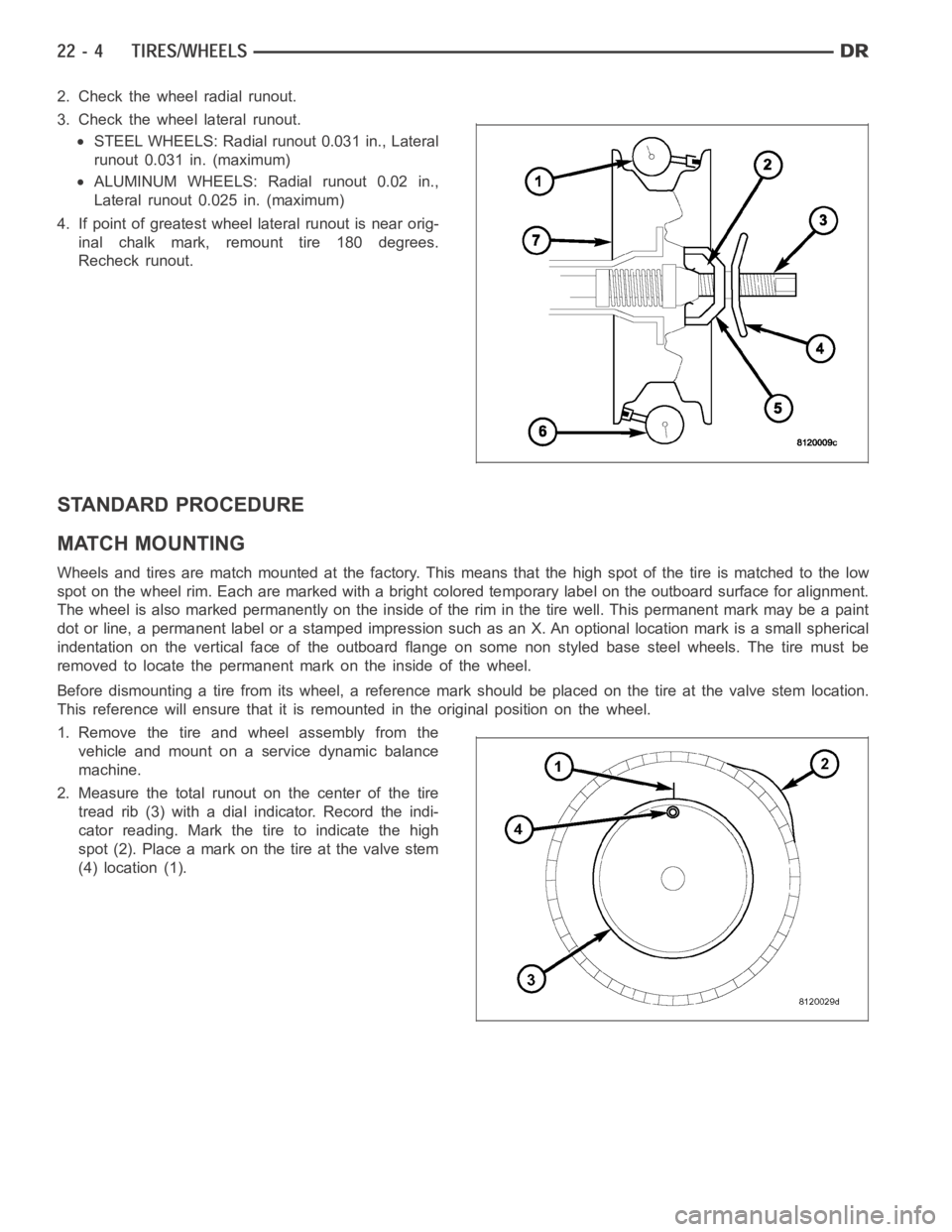
2. Check the wheel radial runout.
3. Check the wheel lateral runout.
STEEL WHEELS: Radial runout 0.031 in., Lateral
runout 0.031 in. (maximum)
ALUMINUM WHEELS: Radial runout 0.02 in.,
Lateral runout 0.025 in. (maximum)
4. If point of greatest wheel lateral runout is near orig-
inal chalk mark, remount tire 180 degrees.
Recheck runout.
STANDARD PROCEDURE
MATCH MOUNTING
Wheels and tires are match mounted at the factory. This means that the high spot of the tire is matched to the low
spot on the wheel rim. Each are marked with a bright colored temporary labelon the outboard surface for alignment.
The wheel is also marked permanently on the inside of the rim in the tire well. This permanent mark may be a paint
dot or line, a permanent label or a stamped impression such as an X. An optional location mark is a small spherical
indentation on the vertical face of the outboard flange on some non styled base steel wheels. The tire must be
removed to locate the permanent mark on the inside of the wheel.
Before dismounting a tire from its wheel, a reference mark should be placedon the tire at the valve stem location.
This reference will ensure that it is remounted in the original position onthe wheel.
1. Remove the tire and wheel assembly from the
vehicle and mount on a service dynamic balance
machine.
2. Measure the total runout on the center of the tire
tread rib (3) with a dial indicator. Record the indi-
cator reading. Mark the tire to indicate the high
spot (2). Place a mark on the tire at the valve stem
(4) location (1).
Page 4318 of 5267
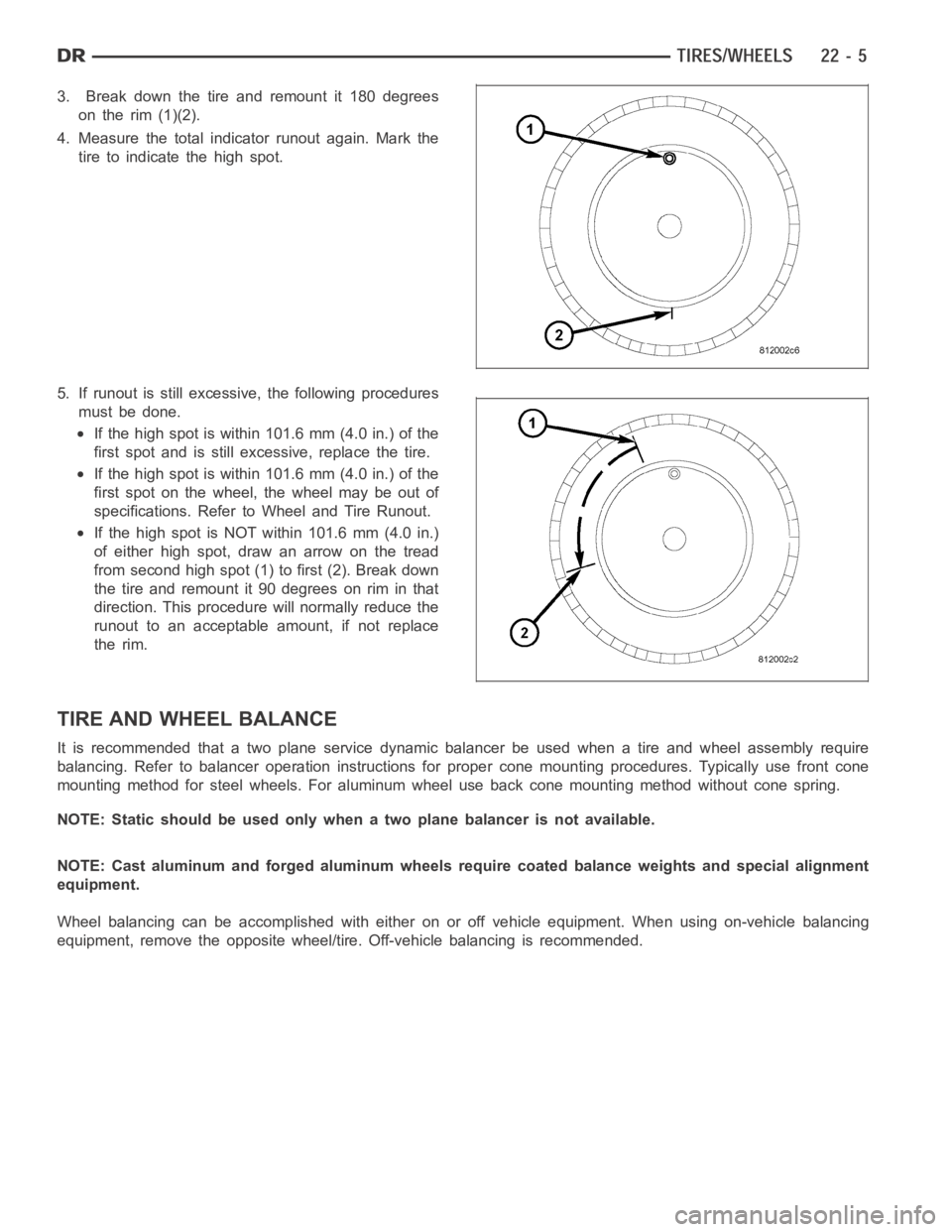
3. Break down the tire and remount it 180 degrees
on the rim (1)(2).
4. Measure the total indicator runout again. Mark the
tire to indicate the high spot.
5. If runout is still excessive, the following procedures
must be done.
If the high spot is within 101.6 mm (4.0 in.) of the
first spot and is still excessive, replace the tire.
If the high spot is within 101.6 mm (4.0 in.) of the
first spot on the wheel, the wheel may be out of
specifications. Refer to Wheel and Tire Runout.
IfthehighspotisNOTwithin101.6mm(4.0in.)
of either high spot, draw an arrow on the tread
from second high spot (1) to first (2). Break down
the tire and remount it 90 degrees on rim in that
direction. This procedure will normally reduce the
runout to an acceptable amount, if not replace
the rim.
TIRE AND WHEEL BALANCE
It is recommended that a two plane service dynamic balancer be used when a tire and wheel assembly require
balancing. Refer to balancer operation instructions for proper cone mounting procedures. Typically use front cone
mounting method for steel wheels. For aluminum wheel use back cone mounting method without cone spring.
NOTE: Static should be used only when a two plane balancer is not available.
NOTE: Cast aluminum and forged aluminum wheels require coated balance weights and special alignment
equipment.
Wheel balancing can be accomplished with either on or off vehicle equipment. When using on-vehicle balancing
equipment, remove the opposite wheel/tire. Off-vehicle balancing is recommended.
Page 4328 of 5267
WHEELS
DESCRIPTION
DESCRIPTION
Original equipment wheels are designed for the specified Maximum VehicleCapacity.
All models use steel or aluminum drop center wheels.
Aluminum wheels require special balance weights and alignment equipment.
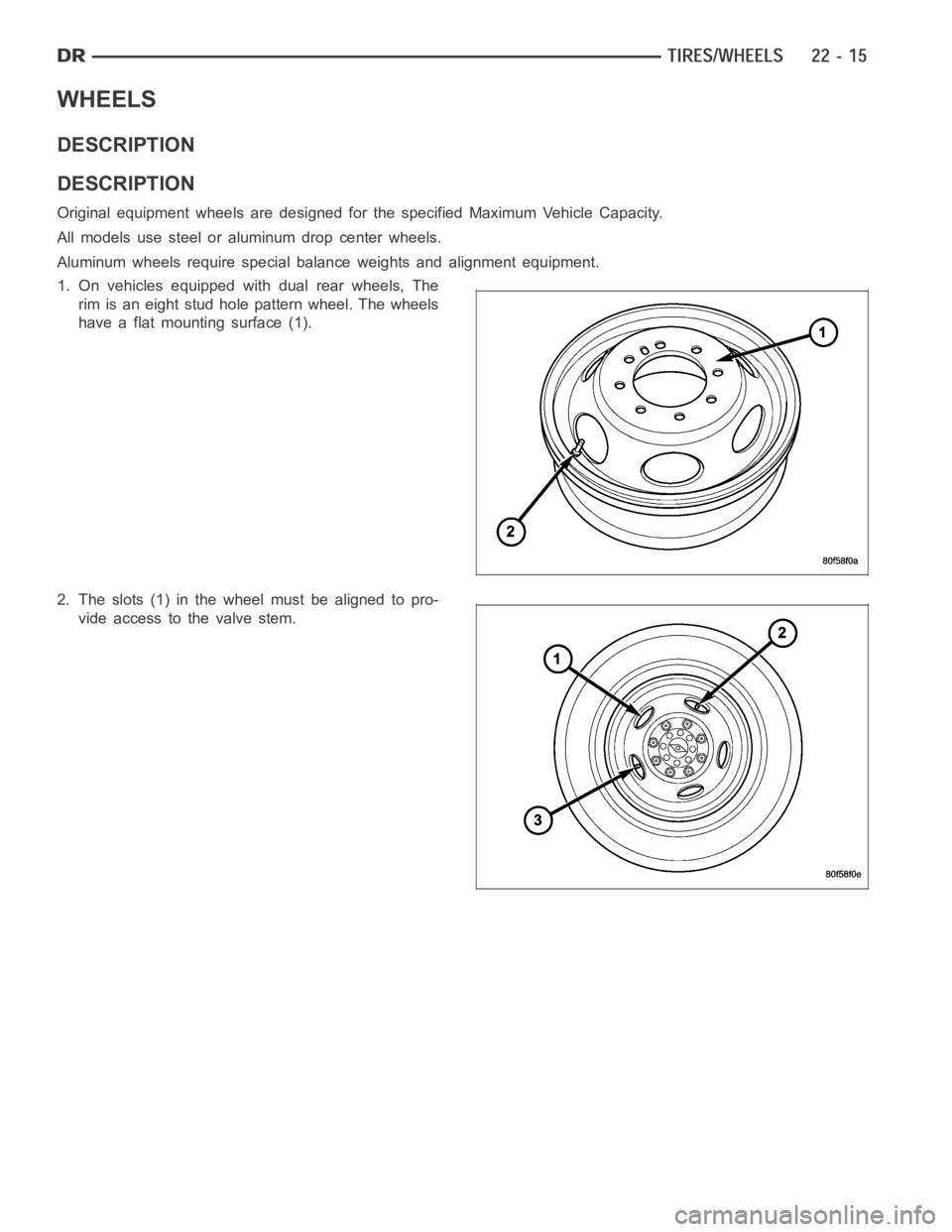
1. On vehicles equipped with dual rear wheels, The
rim is an eight stud hole pattern wheel. The wheels
have a flat mounting surface (1).
2. Theslots(1)inthewheelmustbealignedtopro-
vide access to the valve stem.
Page:
< prev 1-8 9-16 17-24