2006 DODGE RAM SRT-10 tire type
[x] Cancel search: tire typePage 4350 of 5267
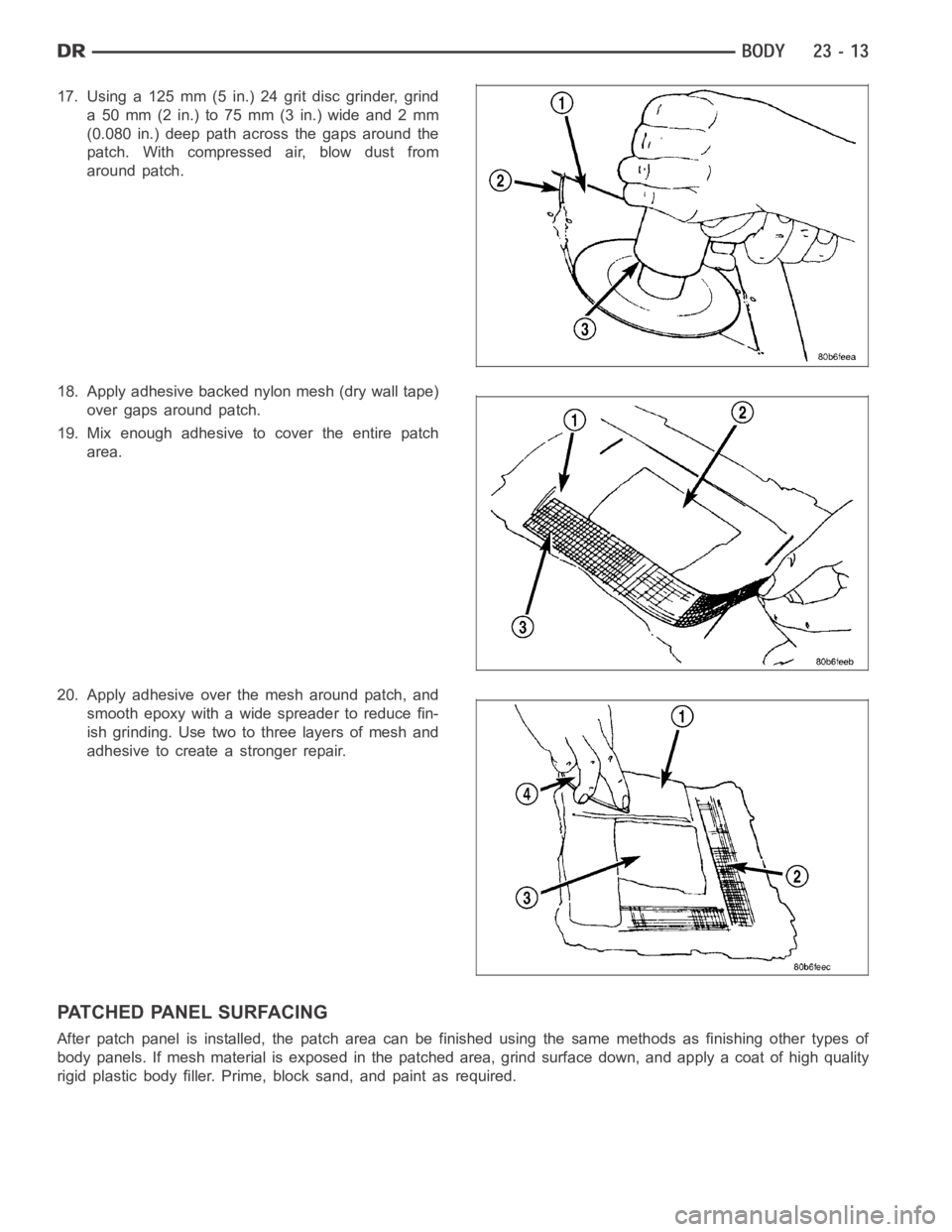
17. Using a 125 mm (5 in.) 24 grit disc grinder, grind
a50mm(2in.)to75mm(3in.)wideand2mm
(0.080 in.) deep path across the gaps around the
patch. With compressed air, blow dust from
around patch.
18. Apply adhesive backed nylon mesh (dry wall tape)
over gaps around patch.
19. Mix enough adhesive to cover the entire patch
area.
20. Apply adhesive over the mesh around patch, and
smooth epoxy with a wide spreader to reduce fin-
ish grinding. Use two to three layers of mesh and
adhesive to create a stronger repair.
PATCHED PANEL SURFACING
After patch panel is installed, the patch area can be finished using the same methods as finishing other types of
body panels. If mesh material is exposed in the patched area, grind surfacedown, and apply a coat of high quality
rigid plastic body filler. Prime, block sand, and paint as required.
Page 5052 of 5267
DIAGNOSIS AND TESTING
HEATING-A/C SYSTEM DIAGNOSTICS
CAUTION: Do not exchange A/C Heater Controls from vehicle to vehicle. Software versions differ between
models and model years. Installing an A/C Heater Control with software that is incompatible for a given
vehicle can result in either improper or failed HVAC system operation.
ON-BOARD DIAGNOSTICS
The A/C-heater control communicates on the controller area network (CAN)B bus and is fully addressable with a
scan tool.
The A/C-heater control’s primary means of fault detection is through active and stored diagnostic trouble codes
(DTCs). Active DTCs are those which currently exist in the system. The condition causing the fault must be repaired
in order to clear this type of DTC. Stored DTCs are those which occurred in the system since the A/C-heater control
received the last clear diagnostic info message. DTCs must be read with a scan tool. Refer to 24 - HVAC - Elec-
trical Diagnostics for HVAC DTC diagnostic test procedures.
The A/C-heater control’s secondary means of fault detection is through system tests. These tests include the HVAC
System Test, the A/C Cooldown Test, Actuator Calibration, and Actuator DTC Detection. Refer to System Tests in
this Section for a detailed description of each test.
SYSTEM TESTS
HVAC System Test
The HVAC System Test, found in 24 - HVAC - Electrical Diagnostics, providesa starting point in the diagnostic
process by identifying the appropriate diagnostic procedure or system test to perform when diagnosing a given
symptom, condition, or DTC. It also provides a means for testing the entireHVAC system by utilizing the A/C-heater
control’s On-Board System Tests. The On-Board System Tests can also assistindiagnosingstoredDTCs.
A/CCOOLDOWNTEST
The A/C Cooldown Test:
is actuated with a scan tool.
tests A/C system performance based on evaporator temperature sensor input.
will fail if evaporator temperature isbelow 13°C (55°F) when initiating the test.
will pass if the evaporator temperature drops 11°C (20°F).
indicates an outcome by displaying one or more test status messages on the scan tool. These test status
messages will clear after paging back out of this test function. Therefore, is it important to note all of the mes-
sages before doing so.
will cause the A/C status indicator to flash while the test is running.
ACTUATOR CALIBRATION FUNCTION
The Actuator Calibration function:
is actuated with a scan tool.
clears all actuator related DTCs when the test is actuated.
homes and repositions door actuators.
monitors for door span faults. Door span faults (XXX Door Travel Range Too Large or XXX Door Travel Range
Too Small) will only display after calibration.
will cause the electric backlight (EBL) status indicator (if equipped) toflash while the test is running.
Page 5084 of 5267
CONTROL-A/C HEATER
DESCRIPTION
MANUAL SINGLE ZONE
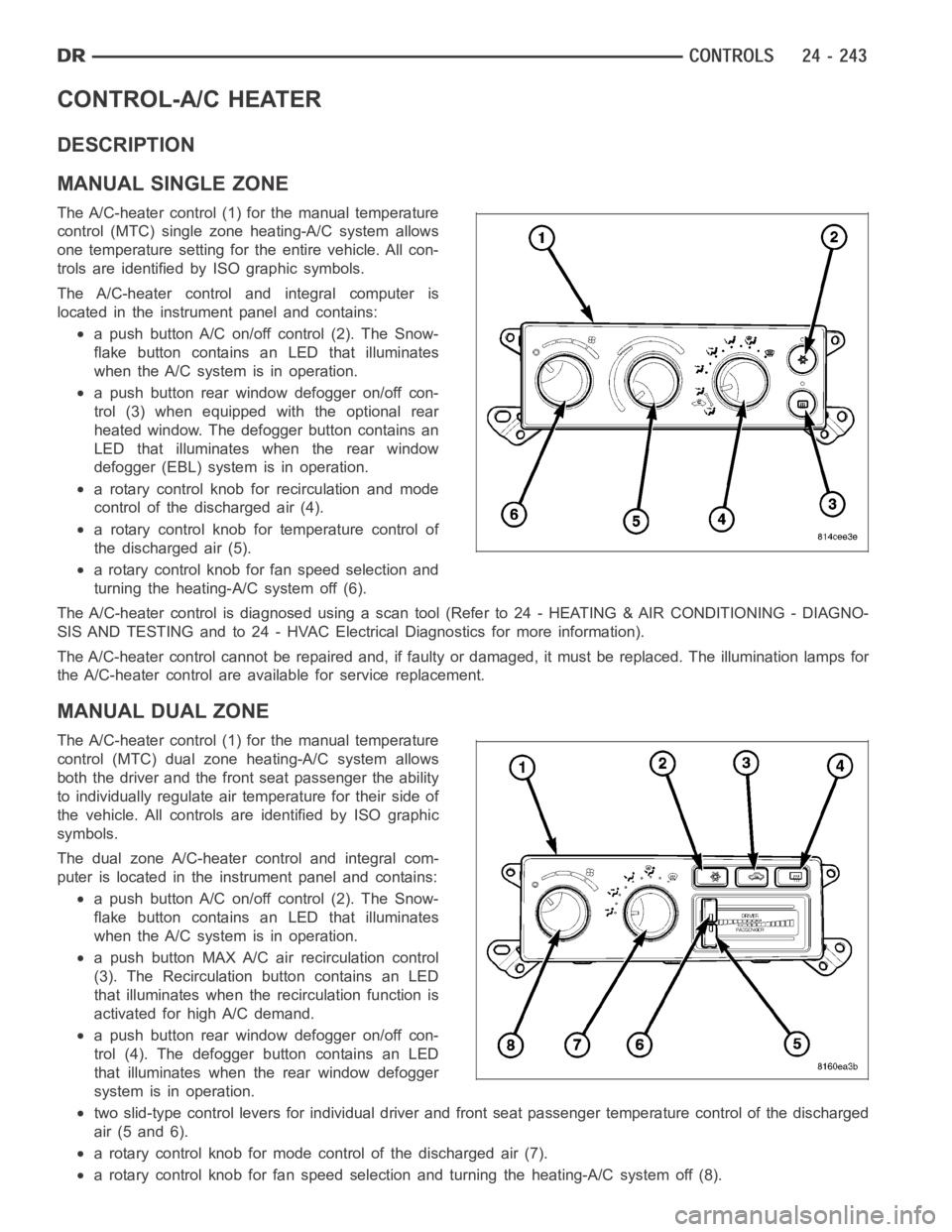
The A/C-heater control (1) for the manual temperature
control (MTC) single zoneheating-A/C system allows
one temperature setting for the entire vehicle. All con-
trols are identified by ISO graphic symbols.
The A/C-heater control and integral computer is
located in the instrument panel and contains:
a push button A/C on/off control (2). The Snow-
flake button contains an LED that illuminates
when the A/C system is in operation.
a push button rear window defogger on/off con-
trol (3) when equipped with the optional rear
heated window. The defogger button contains an
LED that illuminates when the rear window
defogger (EBL) system is in operation.
a rotary control knob for recirculation and mode
control of the discharged air (4).
a rotary control knob for temperature control of
thedischargedair(5).
a rotary control knob for fan speed selection and
turning the heating-A/C system off (6).
The A/C-heater control is diagnosed using a scan tool (Refer to 24 - HEATING& AIR CONDITIONING - DIAGNO-
SIS AND TESTING and to 24 - HVAC Electrical Diagnostics for more information).
The A/C-heater control cannot be repaired and, if faulty or damaged, it must be replaced. The illumination lamps for
the A/C-heater control are available for service replacement.
MANUAL DUAL ZONE
The A/C-heater control (1) for the manual temperature
control (MTC) dual zone heating-A/C system allows
both the driver and the front seat passenger the ability
to individually regulate air temperature for their side of
the vehicle. All controls are identified by ISO graphic
symbols.
The dual zone A/C-heater control and integral com-
puter is located in the instrument panel and contains:
a push button A/C on/off control (2). The Snow-
flake button contains an LED that illuminates
when the A/C system is in operation.
a push button MAX A/C air recirculation control
(3). The Recirculation button contains an LED
that illuminates when the recirculation function is
activated for high A/C demand.
a push button rear window defogger on/off con-
trol (4). The defogger button contains an LED
that illuminates when the rear window defogger
system is in operation.
two slid-type control levers for individual driver and front seat passenger temperature control of the discharged
air (5 and 6).
a rotary control knob for mode control of the discharged air (7).
a rotary control knob for fan speed selection and turning the heating-A/C system off (8).
Page 5127 of 5267
PLUMBING
DESCRIPTION
The A/C refrigerant lines and hoses are used to carry the refrigerant between the various A/C system components.
The refrigerant lines and hoses for the R-134a system on this vehicle consist of a barrier-hose design with a nylon
tube sandwiched between rubber layers. The nylon tube helps to contain theR-134a refrigerant, which has a
smaller molecular structure than R-12 refrigerant. The ends of the refrigerant lines are made from lightweight alu-
minum or steel, and commonly use braze-less fittings.
Any kinks or sharp bends in the refrigerant lines and hoses will reduce the capacity of the entire A/C system and
can reduce the flow of refrigerant in the system. The radius of all bends in the flexible hose refrigerant lines should
be at least ten times the diameter of the hose and the refrigerant lines should be routed so they are at least 80
millimeters (3 inches) away from the exhaust manifold(s) and exhaust pipe(s).
OPERATION
High pressures are produced in the refrigerant system when the A/C compressor is operating. Extreme care must
be exercised to make sure that each of the refrigerant system connections is pressure-tight and leak free. It is a
good practice to inspect all flexible hose refrigerant lines at least oncea year to make sure they are in good con-
dition and properly routed.
The refrigerant lines and hoses are coupled to other A/C system componentswith block-type fittings. An O-ring seal,
or a flat steel gasket with an integral O-ring (dual plane seal), is used to mate the refrigerant line fittings with A/C
system components to ensure the integrity of the refrigerant system.
The refrigerant lines and hoses cannot be repaired and, if faulty or damaged, they must be replaced.
WARNING
WARNING: The A/C system contains refrigerant under high pressure. Repairs should only be performed by
qualified service personnel. Severe personal injury or death may result from improper service procedures.
WARNING: Avoid breathing the refrigerant and refrigerant oil vapor or mist. Exposure may irritate the eyes,
nose, and/or throat. Wear eye protection when servicing the A/C refrigerant system. Serious eye injury can
result from direct contact with the refrigerant. If eye contact occurs, seek medical attention immediately.
WARNING: Do not expose the refrigerant to open flame. Poisonous gas is createdwhenrefrigerantis
burned. An electronic leak detector is recommended. Severe personal injury or death may result from
improper service procedures.
WARNING: If accidental system discharge occurs, ventilate the work area before resuming service. Large
amounts of refrigerant released in a closed work area will displace the oxygen and cause suffocation and
death.
WARNING: The evaporation rate of R-134a refrigerant at average temperature and altitude is extremely high.
As a result, anything that comes in contact with the refrigerant will freeze. Always protect the skin or del-
icate objects from direct contact with the refrigerant.
WARNING: The R-134a service equipment or the vehicle refrigerant system should not be pressure tested or
leak tested with compressed air. Some mixtures of air and R-134a have been shown to be combustible at
elevated pressures. These mixtures are potentially dangerous, and may result in fire or explosion causing
property damage, personal injury or death.