2004 SUBARU FORESTER fuse
[x] Cancel search: fusePage 2599 of 2870
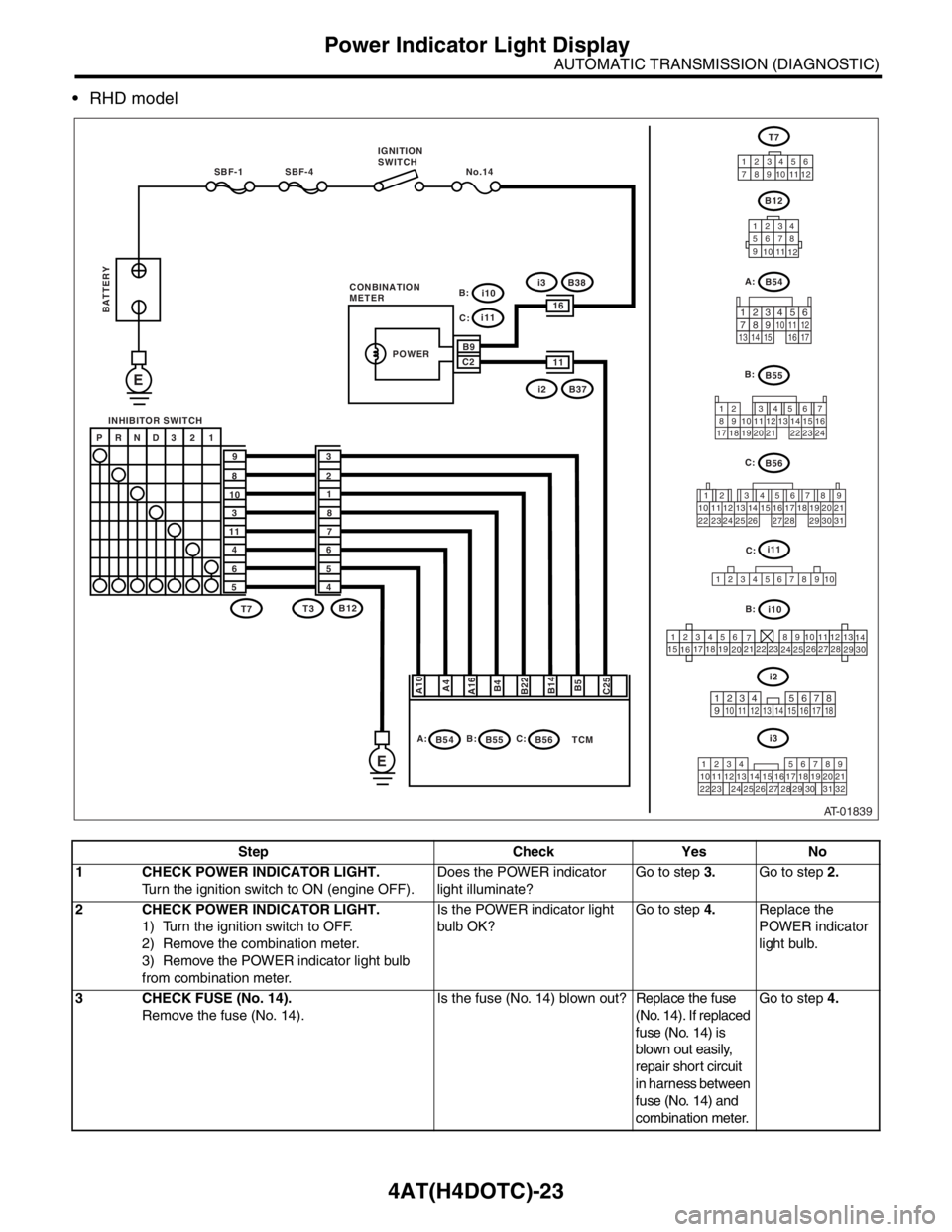
4AT(H4DOTC)-23
AUTOMATIC TRANSMISSION (DIAGNOSTIC)
Power Indicator Light Display
RHD model
Step Check Yes No
1 CHECK POWER INDICATOR LIGHT.
Turn the ignition switch to ON (engine OFF).Does the POWER indicator
light illuminate?Go to step 3.Go to step 2.
2 CHECK POWER INDICATOR LIGHT.
1) Turn the ignition switch to OFF.
2) Remove the combination meter.
3) Remove the POWER indicator light bulb
from combination meter.Is the POWER indicator light
bulb OK?Go to step 4.Replace the
POWER indicator
light bulb.
3 CHECK FUSE (No. 14).
Remove the fuse (No. 14).Is the fuse (No. 14) blown out? Replace the fuse
(No. 14). If replaced
fuse (No. 14) is
blown out easily,
repair short circuit
in harness between
fuse (No. 14) and
combination meter.Go to step 4.
AT-01839
TCM
SBF-4 No.14 SBF-1
E
E
A10
A4
A16
B4
B22
B5 B14
C25
P RND3 2 1
9
8
10
3
11
4
6
53
2
1
8
7
6
5
4
T7T7
B12
B55 T3B12
12 34
56 78
9
10
11
12
12 3456
789101112
i10
i11
B9
1116
C2
i2B37
i3B38
POWER
B:
B54 A:B56 C: B:
123456
78 9 10 1112
13
14
15
1617
1819
2021
2223
24
2526
2728
29
30
i10 B: C:
i11
C:
1234
5678910
B56
12 78 956 34
10 11 12 19 20 21
29 30 31 13 14 15 16 17
27 2818
22 23 24 25 26
C:
B55
12 7
8956 34
10 11 12
19 20 2113 14 15 16
17 18 22 23 24
B:
i3
219
32 1234 56
10 11 12 13 14 157
16
23 3019 20
22 26 27 28 298
17
24 3118
25
IGNITION
SWITCH
INHIBITOR SWITCH
BATTERY
CONBINATION
METERB54 A:
123
8910411 12
13 14 15 1656
7
17
i2
123 8
910411 12 13 14 15 165671718
Page 2602 of 2870

4AT(H4DOTC)-26
AUTOMATIC TRANSMISSION (DIAGNOSTIC)
Power Indicator Light Display
2 CHECK POWER SUPPLY OF TCM.
1) Disconnect the connector from TCM.
2) Turn the ignition switch to ON.
3) Measure the voltage between TCM con-
nector and chassis ground.
Connector & terminal
(B56) No. 27 (+) — Chassis ground (
−):
(B56) No. 28 (+) — Chassis ground (
−):
(B56) No. 29 (+) — Chassis ground (
−):Is the voltage 10 — 13 V? Go to step 4.Go to step 3.
3 CHECK FUSE (No. 4).
1) Turn the ignition switch to OFF.
2) Remove the fuse (No. 4).Is the fuse (No. 4) blown out? Replace the fuse
(No. 4). If replaced
fuse (No. 4) has
blown out easily,
repair short circuit
in harness between
fuse (No. 4) and
TCM.Repair the open
circuit in harness
between fuse (No.
4) and TCM, or
fuse (No. 4) and
battery, and poor
contact in cou-
pling connector.
4 CHECK IGNITION POWER SUPPLY CIR-
CUIT.
1) Turn the ignition switch to ON (engine OFF).
2) Measure the ignition power supply voltage
between TCM connector and chassis ground.
Connector & terminal
(B56) No. 21 (+) — Chassis ground (–):
(B56) No. 31 (+) — Chassis ground (–):Is the voltage 10 — 13 V? Go to step 6.Go to step 5.
5 CHECK FUSE (No. 11).
Remove the fuse (No. 11).Is the fuse (No. 11) blown out? Replace the fuse
(No. 11). If
replaced fuse (No.
11) has blown out
easily, repair short
circuit in harness
between fuse (No.
11) and TCM.Repair the open
circuit in harness
between fuse (No.
11) and TCM, or
fuse (No. 11) and
battery, and poor
contact in cou-
pling connector.
6 CHECK HARNESS CONNECTOR BETWEEN
TCM AND TRANSMISSION.
1) Turn the ignition switch to OFF.
2) Disconnect the connector from TCM and
transmission.
3) Measure the resistance of harness
between TCM and transmission connector.
Connector & terminal
(B55) No. 8 — (B11) No. 19:
(B55) No. 17 — (B11) No. 19:
(B56) No. 2 — (B11) No. 20:
(B56) No. 3 — (B11) No. 20:Is the resistance less than 1
Ω?Go to step 7.Repair the open
circuit in harness
between TCM,
transmission har-
ness connector,
and poor contact
in coupling con-
nector.
7 CHECK HARNESS CONNECTOR BETWEEN
TRANSMISSION AND TRANSMISSION
GROUND.
Measure the resistance of harness between
transmission and transmission ground.
Connector & terminal
(T4) No. 19 — Transmission ground:
(T4) No. 20 — Transmission ground:Is the resistance less than 1
Ω?Go to step 8.Repair the open
circuit in harness
between transmis-
sion and transmis-
sion ground.
8 CHECK POOR CONTACT IN CONNECTORS.Is there poor contact in TCM
power supply, ground line and
data link connector?Repair the con-
nector.Replace the TCM.
trol Module
(TCM).> Step Check Yes No
Page 2690 of 2870

4AT(H4DOTC)-114
AUTOMATIC TRANSMISSION (DIAGNOSTIC)
Diagnostic Procedure without Diagnostic Trouble Code (DTC)
Step Check Yes No
1 CHECK FWD SWITCH.When the fuse is inserted to
FWD switch, does LED light
up?Go to step CHECK
POWER SWITCH.
116, CHECK
POWER SWITCH,
Diagnostic Proce-
dure without Diag-
nostic Trouble
Code (DTC).>Go to step 2.
2 CHECK FWD INDICATOR LIGHT.
1) Turn the ignition switch to OFF.
2) Remove the combination meter.Is the FWD indicator light bulb
OK?Go to step 3.Check the combi-
nation meter.
Meter Assembly.>
3 CHECK HARNESS CONNECTOR BETWEEN
TCM AND FWD SWITCH.
1) Turn the ignition switch to OFF.
2) Disconnect the connector from TCM and
FWD switch.
3) Measure the resistance of harness
between TCM and FWD switch connector.
Connector & terminal
(B56) No. 17 — (F27) No. 36:Is the resistance less than 1
Ω?Go to step 4.Repair the open
circuit in harness
between TCM and
FWD switch con-
nector.
4 CHECK HARNESS CONNECTOR BETWEEN
TCM AND FWD SWITCH.
Measure the resistance of harness connector
between TCM and body to make sure that cir-
cuit does not short.
Connector & terminal
(B56) No. 17 — Chassis ground:Is the resistance more than 1
MΩ?Go to step 5.Repair the short
circuit in harness
between TCM and
FWD switch con-
nector.
5 CHECK HARNESS CONNECTOR BETWEEN
FWD SWITCH AND CHASSIS GROUND.
Measure the resistance of harness between
FWD switch and chassis ground.
Connector & terminal
(F27) No. 35 — Chassis ground:Is the resistance less than 1
Ω?Go to step 6.Repair the open
circuit in harness
between FWD
switch connector
and chassis
ground.
6 CHECK INPUT SIGNAL FOR TCM.
1) Turn the ignition switch to OFF.
2) Connect the connector to FWD switch and
TCM.
3) Turn the ignition switch to ON.
4) Measure the signal voltage for TCM while
installing the fuse to FWD switch connector.
Connector & terminal
(B56) No. 17 (+) — Chassis ground (
−):Is the voltage less than 1 V? Go to step 7.Go to step 11.
7 CHECK INPUT SIGNAL FOR TCM.
Measure the signal voltage for TCM while
removing the fuse from FWD switch connector.
Connector & terminal
(B56) No. 17 (+) — Chassis ground (
−):Is the voltage more than 10.5
V?Go to step 8.Replace the TCM.
trol Module
(TCM).>
8 CHECK HARNESS CONNECTOR BETWEEN
TCM AND COMBINATION METER.
1) Turn the ignition switch to OFF.
2) Disconnect the connector from TCM and
combination meter.
3) Measure the resistance of harness between
TCM and combination meter connector.
Connector & terminal
(B56) No. 14 — (i10) No. 22:Is the resistance less than 1
Ω?Go to step 9.Repair the open
circuit in harness
between TCM and
combination meter
and poor contact
in coupling con-
nector.
Page 2691 of 2870

4AT(H4DOTC)-115
AUTOMATIC TRANSMISSION (DIAGNOSTIC)
Diagnostic Procedure without Diagnostic Trouble Code (DTC)
9 CHECK HARNESS CONNECTOR BETWEEN
TCM AND COMBINATION METER.
Measure the resistance of harness connector
between TCM and chassis ground to make
sure that circuit does not short.
Connector & terminal
(B56) No. 14 — Chassis ground:Is the resistance more than 1
MΩ?Go to step 10.Repair the short
circuit in harness
between TCM and
combination meter
connector.
10 CHECK OUTPUT SIGNAL EMITTED FROM
TCM.
1) Turn the ignition switch to OFF.
2) Connect the connector to TCM and combi-
nation meter.
3) Turn the ignition switch to ON.
4) Measure the signal voltage for TCM while
installing and removing the fuse to FWD switch
connector.
Connector & terminal
(B56) No. 14 (+) — Chassis ground (
−):Is the voltage less than 1 V? Go to step 11.Go to step 12.
11 CHECK OUTPUT SIGNAL EMITTED FROM
TCM.
Measure the signal voltage for TCM while
removing the fuse from FWD switch connector.
Connector & terminal
(B56) No. 14 (+) — Chassis ground (
−):Is the voltage more than 10.5
V?Go to step 12.Replace the TCM.
trol Module
(TCM).>
12 CHECK POOR CONTACT.Is there poor contact in FWD
switch circuit?Repair the poor
contact.Replace the TCM.
trol Module
(TCM).> Step Check Yes No
Page 2775 of 2870
5MT-62
MANUAL TRANSMISSION AND DIFFERENTIAL
Transmission Case
16.Transmission Case
A: REMOVAL
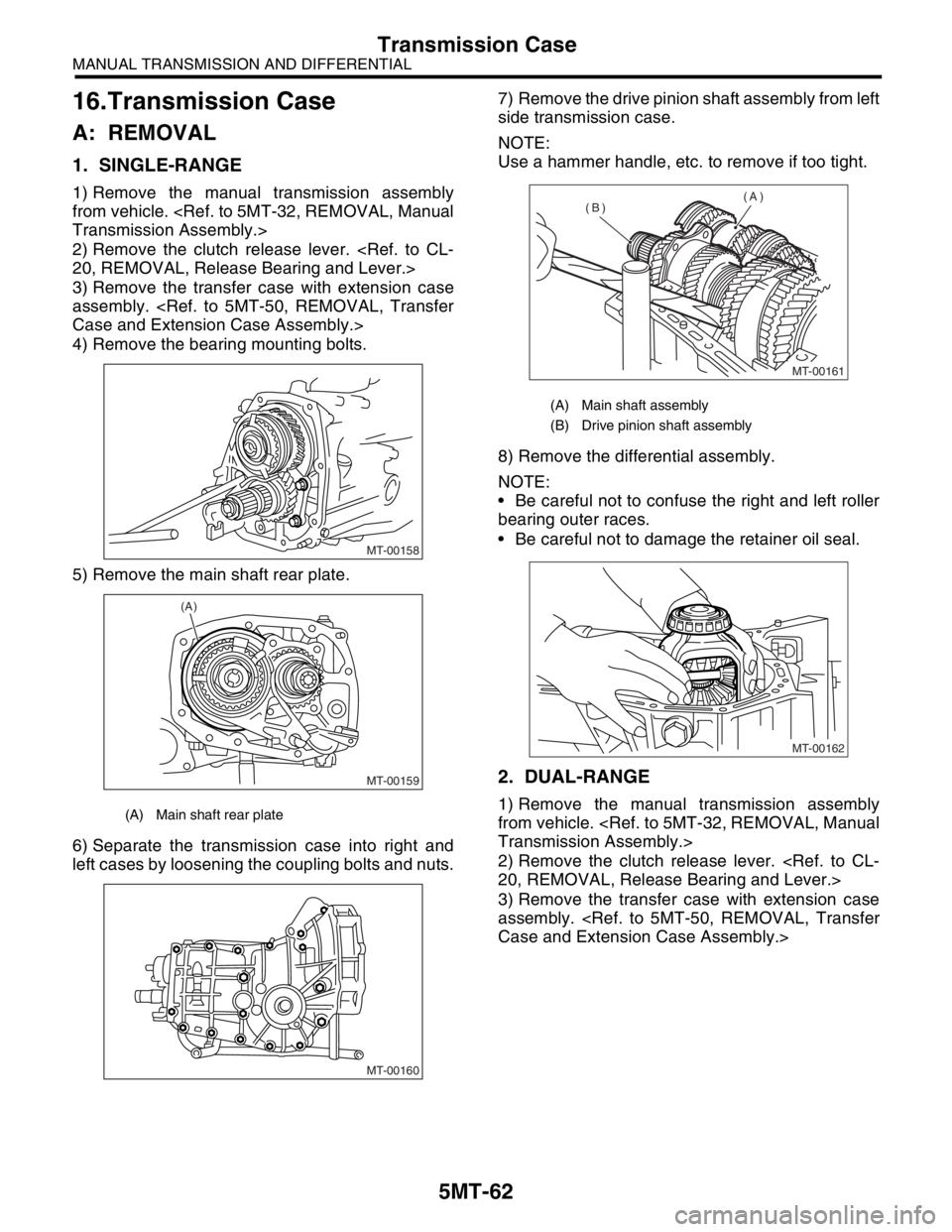
1. SINGLE-RANGE
1) Remove the manual transmission assembly
from vehicle.
2) Remove the clutch release lever.
3) Remove the transfer case with extension case
assembly.
4) Remove the bearing mounting bolts.
5) Remove the main shaft rear plate.
6) Separate the transmission case into right and
left cases by loosening the coupling bolts and nuts.7) Remove the drive pinion shaft assembly from left
side transmission case.
NOTE:
Use a hammer handle, etc. to remove if too tight.
8) Remove the differential assembly.
NOTE:
Be careful not to confuse the right and left roller
bearing outer races.
Be careful not to damage the retainer oil seal.
2. DUAL-RANGE
1) Remove the manual transmission assembly
from vehicle.
2) Remove the clutch release lever.
3) Remove the transfer case with extension case
assembly.
MT-00158
MT-00159
(A)
MT-00160
(A) Main shaft assembly
(B) Drive pinion shaft assembly
MT-00161
(A)
(B)
MT-00162
Page 2777 of 2870
5MT-64
MANUAL TRANSMISSION AND DIFFERENTIAL
Transmission Case
11) Remove the main shaft assembly and input
shaft assembly.
NOTE:
Be careful not to drop the input shaft and main shaft
as they are separable.
12) Remove the differential assembly.
NOTE:
Be careful not to confuse the right and left roller
bearing outer races.
Be careful not to damage the retainer oil seal.
B: INSTALLATION
1. SINGLE-RANGE
1) Wipe off grease, oil and dust on the mating sur-
faces of transmission cases with white gasoline.
2) Install the front differential assembly.
3) Install the main shaft assembly.
Install the needle bearing knock pin hole into trans-
mission case knock pin.
4) Install the drive pinion shaft assembly.
Install the roller bearing knock pin hole into trans-
mission case knock pin.
5) Apply liquid gasket, and then put the case right
side and left side together.
Liquid gasket:
THREE BOND 1215 (Part No. : 004403007) or
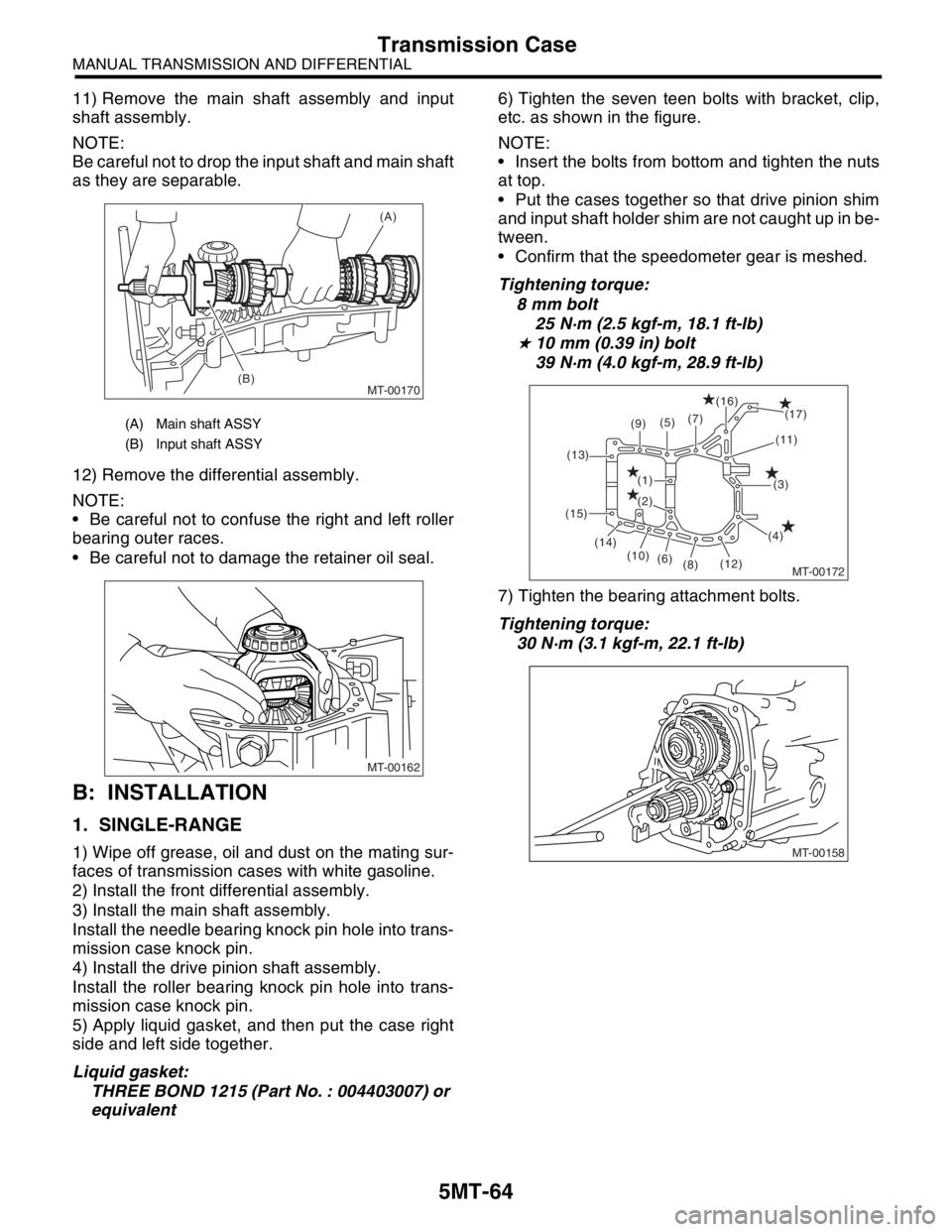
equivalent6) Tighten the seven teen bolts with bracket, clip,
etc. as shown in the figure.
NOTE:
Insert the bolts from bottom and tighten the nuts
at top.
Put the cases together so that drive pinion shim
and input shaft holder shim are not caught up in be-
tween.
Confirm that the speedometer gear is meshed.
Tightening torque:
8 mm bolt
25 N·m (2.5 kgf-m, 18.1 ft-lb)
★ 10 mm (0.39 in) bolt
39 N·m (4.0 kgf-m, 28.9 ft-lb)
7) Tighten the bearing attachment bolts.
Tightening torque:
30 N·m (3.1 kgf-m, 22.1 ft-lb)
(A) Main shaft ASSY
(B) Input shaft ASSY
MT-00170
(A)
(B)
MT-00162
(9)(7)
(5)
(1)
(2)(16)
(17)
(11)
(3)
(4)
(12)
(8) (6) (10) (14) (15)(13)
MT-00172
MT-00158
Page 2809 of 2870

5MT-96
MANUAL TRANSMISSION AND DIFFERENTIAL
Front Differential Assembly
21.Front Differential Assembly
A: REMOVAL
1) Remove the manual transmission assembly
from vehicle.
2) Remove the transfer case with extension case
assembly.
3) Remove the transmission case.
4) Remove the drive pinion shaft assembly.
bly.>
5) Remove the main shaft assembly.
Single-range model
Dual-range model
6) Remove the differential assembly.
NOTE:
Be careful not to confuse the right and left roller
bearing outer races.
Be careful not to damage the retainer oil seal.
7) Remove the differential side retainers using ST.
ST 499787000 WRENCH ASSY
8) Remove the bearing outer race from transmis-
sion case.
ST 398527700 PULLER ASSY
B: INSTALLATION
1) Insert the bearing outer race to transmission
case.
NOTE:
Apply the transmission gear oil to outer surface of
bearing outer race.
2) Install the differential side retainers using ST.
ST 499787000 WRENCH ASSY
3) Install the differential assembly.
NOTE:
Be careful not to fold the sealing lip of oil seal.
Wrap the right and left spline sections of axle
shaft with vinyl tape to prevent scratches.
4) Install the main shaft assembly.
gle-Range.>
5) Install the drive pinion assembly.
gle-Range.>
6) Install the transmission case.
7) Install the transfer case with extension case as-
sembly.
8) Install the manual transmission assembly to ve-
hicle.
MT-00162
MT-00176
ST
MT-00162
Page 2825 of 2870

5MT-112
MANUAL TRANSMISSION AND DIFFERENTIAL
General Diagnostic
2. DIFFERENTIAL
Symptom Possible cause Remedy
1. Broken differential (case, gear, bear-
ing, etc.)
N
OTE:
Noise will develop and finally it will be-
come impossible to continue to run due to
broken pieces obstructing the gear revo-
lution. (a) Insufficient or improper oil Disassemble the differential and replace
broken components and at the same time
check other components for any trouble,
and replace if necessary.
(b) Use of vehicle under severe condi-
tions such as excessive load and
improper use of clutch Readjust the bearing preload and back-
lash and face contact of gears.
(c) Improper adjustment of taper roller
bearingAdjust.
(d) Improper adjustment of drive pinion
and hypoid driven gear Adjust.
(e) Excessive backlash due to worn dif-
ferential side gear, washer or differential
pinion vehicle under severe operating
conditions. Add recommended oil to specified level.
Do not use the vehicle under severe oper-
ating conditions.
(f) Loose hypoid driven gear clamping
boltsTighten.
2. Differential and hypoid gear noises
Troubles of the differential and hypoid
gear always appear as noise problems.
Therefore noise is the first indication of
the trouble. However noises from the
engine, muffler, tire, exhaust gas, bear-
ing, body, etc. are easily mistaken for the
differential noise. Pay special attention to
the hypoid gear noise because it is easily
confused with other gear noises. There
are the following four kinds of noises.
Gear noise when driving: If noise
increases as vehicle speed increases it
may be due to insufficient gear oil, incor-
rect gear engagement, damaged gears,
etc.
Gear noise when coasting: Damaged
gears due to maladjusted bearings and
incorrect shim adjustment
Bearing noise when driving or when
coasting: Cracked, broken or damaged
bearings
Noise which mainly occurs when turn-
ing: Unusual noise from differential side
gear, differential pinion, differential pinion
shaft, etc. (a) Insufficient oil Lubricate.
(b) Improper adjustment of hypoid driven
gear and drive pinionCheck tooth contact.
(c) Worn teeth of hypoid driven gear and
drive pinionReplace as a set.
Readjust the bearing preload.
(d) Loose roller bearing Readjust the hypoid driven gear to drive
pinion backlash and check tooth contact.
(e) Distorted hypoid driven gear or differ-
ential caseReplace.
(f) Worn washer and differential pinion
shaftReplace.