2004 SUBARU FORESTER fuse
[x] Cancel search: fusePage 726 of 2870

PI-3
PRE-DELIVERY INSPECTION
Pre-delivery Inspection
B: PDI PROCEDURE
Follow the procedures shown in the table below.
Static Checks Just After Vehicle Receipt
Step Check point
1. Appearance check (1) If the vehicle is covered with protective coating, visually check the vehicle
body for damage and dents. If the protective coating has been removed,
visually check the body paints for small areas of damage or stains.
(2) Visually check the glass and light lenses for any damage and cracks or
excessive gaps to the body sheet metal.
(3) Visually check the plated parts for any damage.
2. Tire check (1) Check the tires for damage, abnormal conditions, and dents on the
wheels.
(2) Check the tire air pressure.
3. Fuse installation If the vehicle is about to be delivered to the customer, attach a room light
fuse.
4. Connection of air conditioner harness If the vehicle is about to be delivered to the customer, connect the air condi-
tioner harness.
5. Check the doors for lock/unlock and open/close
operations.(1) Using the key, check if the door can be locked and unlocked normally.
(2) Open and close all doors to see that there are no abnormal conditions.
6. Operation check of double lock Check that the double lock operates normally.
7. Operation check of the child safety lock system. Check the child safety lock system operates normally.
8. Check the rear gate for lock/unlock and open/
close operations.(1) Check if the rear gate can be unlocked normally from the emergency
door.
(2) Open and close the rear gate to see that there are no abnormal condi-
tions.
(3) Operate the power door locking switch to check that the rear gate is
locked and unlocked normally.
9. Operation check of fuel lid opener lock release
leverOperate the fuel lid opener to check that the fuel lid is unlocked normally.
10. Accessory check Check that the following accessories are provided:
Owner’s manual
Warranty booklet
Service booklet
Spare key
Jack
Tool set
Spare tire
11. Operation check of hood lock release system Operate the hood lock release lever to check that the hood opens normally.
12. Battery Check the battery for any abnormal conditions such as rust and trace of bat-
tery fluid leaks.
13. Brake fluid Check the fluid amount.
14. Engine oil Check the oil amount.
15. Transmission fluid (1) Check the fluid amount.
(2) For AT, check the front differential oil.
16. AT front differential oil Check the AT front differential oil amount.
17. Coolant Check the coolant amount.
18. Clutch fluid Check the clutch fluid amount.
19. Window washer fluid Check the window washer fluid amount.
20. Hood latch check Check that the hood is closed and latched securely.
21. Keyless entry system Check that the keyless entry system operates normally.
22. Security system Check that the security system operates normally.
23. Seat (1) Check the seat surfaces for smears or dirt.
(2) Check the seat installation conditions and functionality.
24. Seat belt Check the seat belt installation conditions and functionality.
25. Wheel alignment Check that the wheel alignments are properly adjusted.
Page 728 of 2870
PI-5
PRE-DELIVERY INSPECTION
Pre-delivery Inspection
1. APPEARANCE CHECK
1) If the vehicle is covered with protective coating,
visually check the vehicle body for damage and
dents.
2) If there is no protective coating, check the body
paints for small areas of damage or stains and re-
pair as necessary.
3) Check the window glass, door glass, and lights
for any cracks or damage and repair or replace the
parts as necessary.
4) Check the plated parts, such as the grilles and
door knobs, for damage or loss of gloss and repair
or replace the parts as necessary.
2. TIRE CHECK
Check the tire outer faces for any damage.
Check the tire air pressure by referring to the fol-
lowing table.
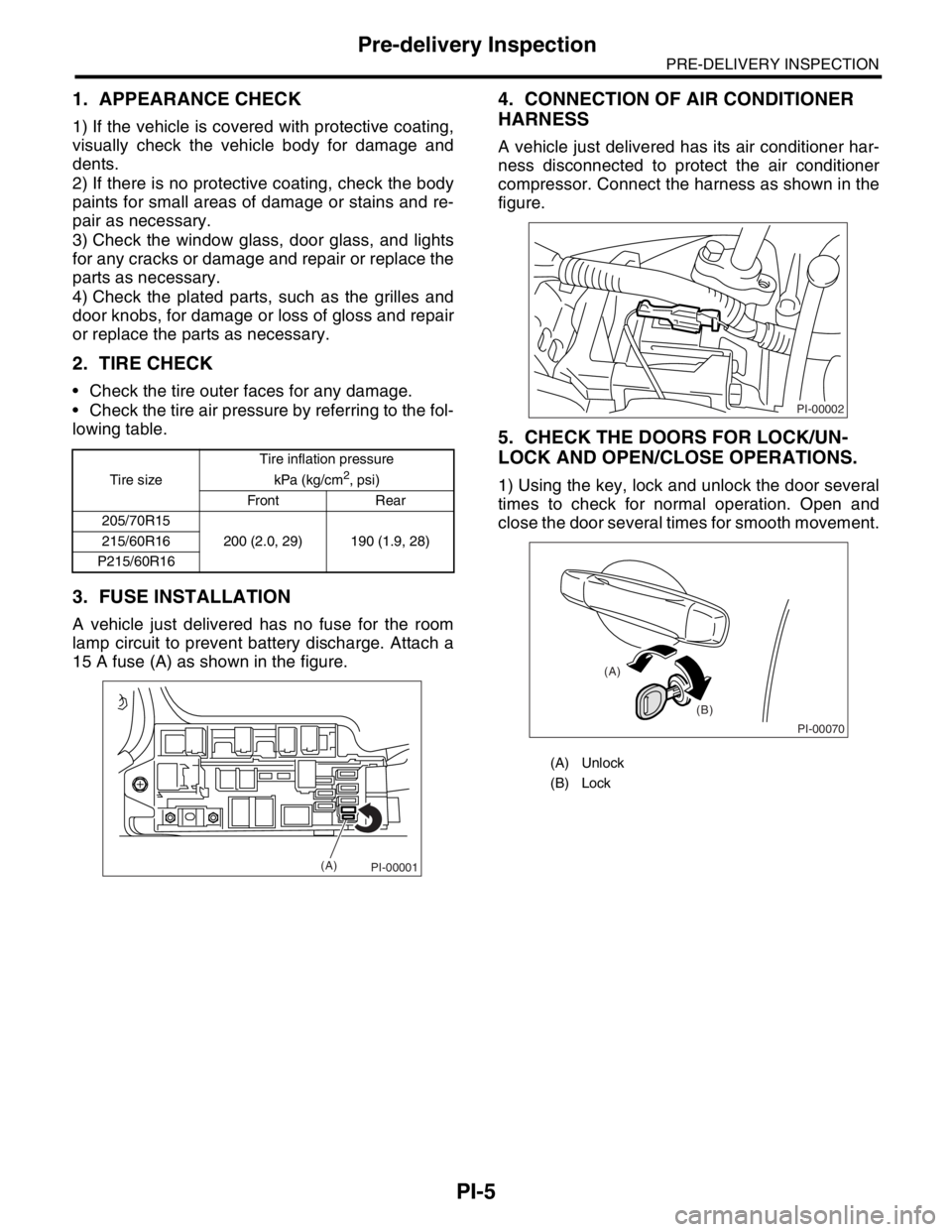
3. FUSE INSTALLATION
A vehicle just delivered has no fuse for the room
lamp circuit to prevent battery discharge. Attach a
15 A fuse (A) as shown in the figure.
4. CONNECTION OF AIR CONDITIONER
HARNESS
A vehicle just delivered has its air conditioner har-
ness disconnected to protect the air conditioner
compressor. Connect the harness as shown in the
figure.
5. CHECK THE DOORS FOR LOCK/UN-
LOCK AND OPEN/CLOSE OPERATIONS.
1) Using the key, lock and unlock the door several
times to check for normal operation. Open and
close the door several times for smooth movement.Tire sizeTire inflation pressure
kPa (kg/cm2, psi)
Front Rear
205/70R15
200 (2.0, 29) 190 (1.9, 28) 215/60R16
P215/60R16
PI-00001(A)
(A) Unlock
(B) Lock
PI-00002
PI-00070
(A)
(B)
Page 924 of 2870
ME(H4SO)-53
MECHANICAL
Cam Sprocket
16.Cam Sprocket
A: REMOVAL
1. REMOVAL
1) Remove the V-belt.
2) Remove the crank pulley.
3) Remove the belt cover.
4) Remove the timing belt assembly.
5) Remove the camshaft position sensor.
Sensor.>
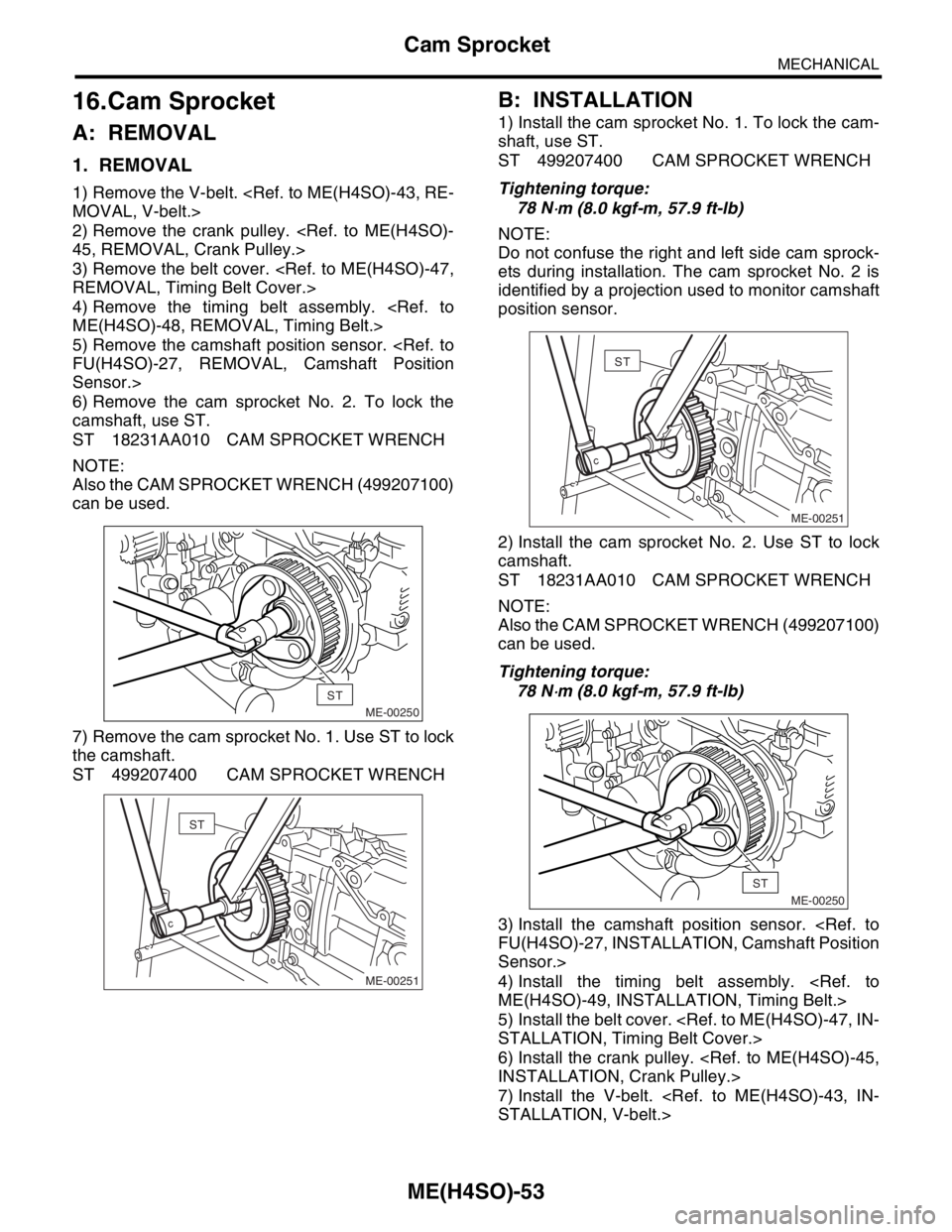
6) Remove the cam sprocket No. 2. To lock the
camshaft, use ST.
ST 18231AA010 CAM SPROCKET WRENCH
NOTE:
Also the CAM SPROCKET WRENCH (499207100)
can be used.
7) Remove the cam sprocket No. 1. Use ST to lock
the camshaft.
ST 499207400 CAM SPROCKET WRENCH
B: INSTALLATION
1) Install the cam sprocket No. 1. To lock the cam-
shaft, use ST.
ST 499207400 CAM SPROCKET WRENCH
Tightening torque:
78 N
⋅m (8.0 kgf-m, 57.9 ft-lb)
NOTE:
Do not confuse the right and left side cam sprock-
ets during installation. The cam sprocket No. 2 is
identified by a projection used to monitor camshaft
position sensor.
2) Install the cam sprocket No. 2. Use ST to lock
camshaft.
ST 18231AA010 CAM SPROCKET WRENCH
NOTE:
Also the CAM SPROCKET WRENCH (499207100)
can be used.
Tightening torque:
78 N
⋅m (8.0 kgf-m, 57.9 ft-lb)
3) Install the camshaft position sensor.
Sensor.>
4) Install the timing belt assembly.
5) Install the belt cover.
6) Install the crank pulley.
7) Install the V-belt.
ME-00250
ST
ME-00251
ST
ME-00251
ST
ME-00250
ST
Page 943 of 2870
ME(H4SO)-72
MECHANICAL
Cylinder Block
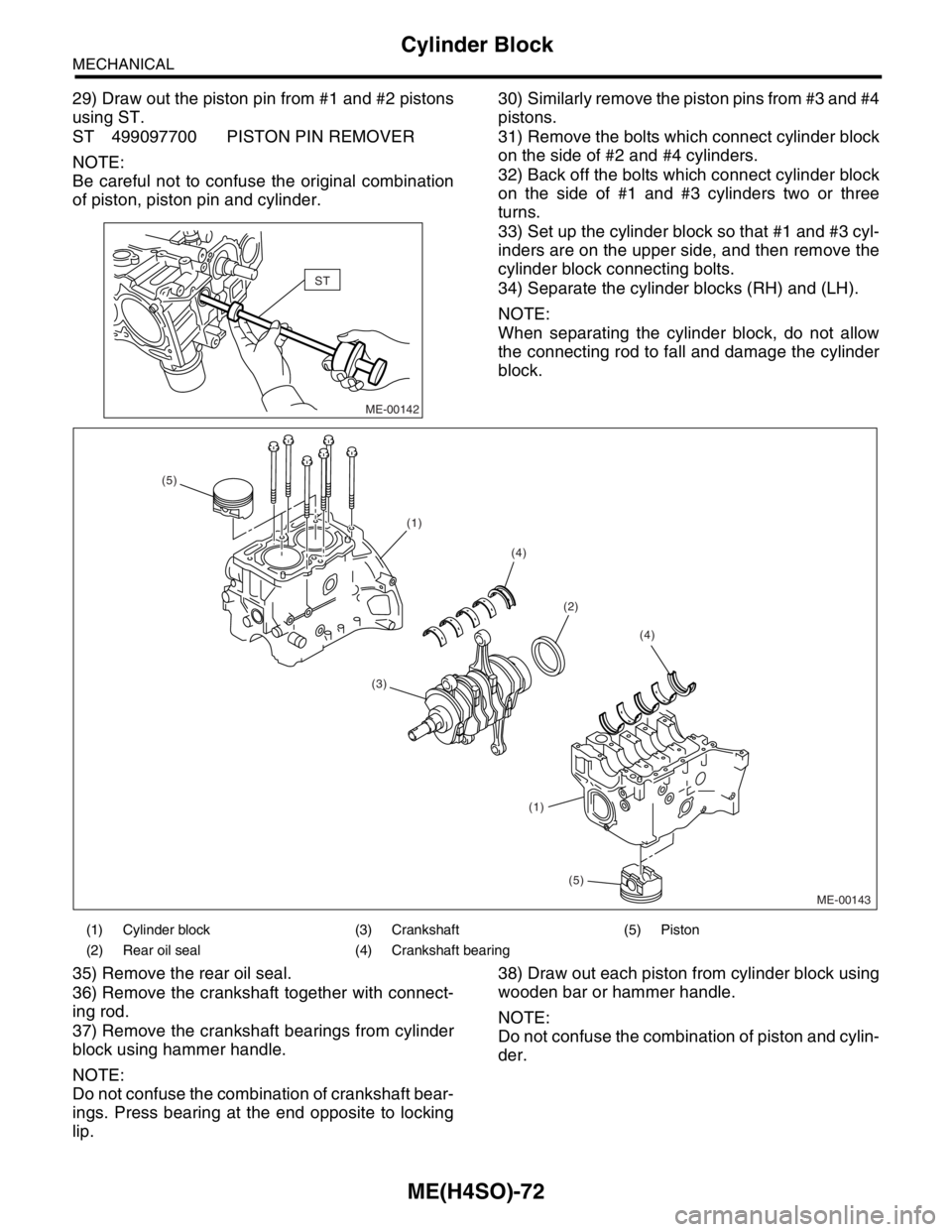
29) Draw out the piston pin from #1 and #2 pistons
using ST.
ST 499097700 PISTON PIN REMOVER
NOTE:
Be careful not to confuse the original combination
of piston, piston pin and cylinder.30) Similarly remove the piston pins from #3 and #4
pistons.
31) Remove the bolts which connect cylinder block
on the side of #2 and #4 cylinders.
32) Back off the bolts which connect cylinder block
on the side of #1 and #3 cylinders two or three
turns.
33) Set up the cylinder block so that #1 and #3 cyl-
inders are on the upper side, and then remove the
cylinder block connecting bolts.
34) Separate the cylinder blocks (RH) and (LH).
NOTE:
When separating the cylinder block, do not allow
the connecting rod to fall and damage the cylinder
block.
35) Remove the rear oil seal.
36) Remove the crankshaft together with connect-
ing rod.
37) Remove the crankshaft bearings from cylinder
block using hammer handle.
NOTE:
Do not confuse the combination of crankshaft bear-
ings. Press bearing at the end opposite to locking
lip.38) Draw out each piston from cylinder block using
wooden bar or hammer handle.
NOTE:
Do not confuse the combination of piston and cylin-
der.
ME-00142
ST
(1) Cylinder block (3) Crankshaft (5) Piston
(2) Rear oil seal (4) Crankshaft bearing
ME-00143
(2)
(3)(4)
(4) (5)
(5) (1) (1)
Page 997 of 2870

CO(H4SO)-14
COOLING
Radiator Fan System
B: INSPECTION
DETECTING CONDITION:
Engine coolant temperature is above 95°C (203°F).
Vehicle speed is below 19 km/h (12 MPH).
TROUBLE SYMPTOM:
Radiator main fan and sub fan does not rotate under the above conditions.
Step Check Yes No
1 CHECK OPERATION OF RADIATOR FAN.
1) Connect the test mode connector.
2) Turn the ignition switch to ON.
3) Using Subaru Select Monitor, check the
compulsory operation of radiator fan relay.
N
OTE:
With Subaru Select Monitor
When checking the compulsory operation of
radiator fan, the radiator main and sub fan
repeat the rotation in order of following: low
speed rotation → high speed rotation → off.
Subaru Select Monitor
Refer to Compulsory Valve Operation Check
Mode for detail procedures.
Check Mode.>Do the radiator main and sub
fan rotate at low speed?Go to step 2.Go to step 3.
2 CHECK OPERATION OF RADIATOR FAN.
1) Connect the test mode connector.
2) Turn the ignition switch to ON.
3) Using Subaru Select Monitor, check the
compulsory operation of radiator fan relay.
N
OTE:
With Subaru Select Monitor
When checking the compulsory operation of
radiator fan, the radiator main and sub fan
repeat the rotation in order of following: low
speed rotation → high speed rotation → off.
Subaru Select Monitor
Refer to Compulsory Valve Operation Check
Mode for detail procedures.
Check Mode.>Do the radiator main and sub
fan rotate at high speed?Radiator main fan
system is okay.Go to step 32.
3 CHECK POWER SUPPLY TO MAIN FAN RE-
LAY.
1) Turn the ignition switch to OFF.
2) Remove the fan relay 1 from A/C relay
holder.
3) Measure the voltage between main fan
relay terminal and chassis ground.
Connector & terminal
(F27) No. 31 (+) — Chassis ground (
−):Is the voltage more than 10 V? Go to step 4.Go to step 5.
4 CHECK POWER SUPPLY TO MAIN FAN RE-
LAY.
1) Turn the ignition switch to ON.
2) Measure the voltage between main fan
relay terminal and chassis ground.
Connector & terminal
(F27) No. 34 (+) — Chassis ground (
−):Is the voltage more than 10 V? Go to step 8.Go to step 7.
5 CHECK FUSE.
1) Remove the fuse from A/C relay holder.
2) Check the condition of fuse.Is the fuse blown out? Replace the fuse. Go to step 6.
Page 998 of 2870

CO(H4SO)-15
COOLING
Radiator Fan System
6 CHECK HARNESS OF FUSE TERMINAL
AND MAIN FAN RELAY TERMINAL.
1) Turn the ignition switch to OFF.
2) Measure the resistance between 20 A fuse
terminal and main fan relay terminal.
Te r m i n a l
No. 2 — No. 31:Is the resistance less than 1
Ω?Repair the power
supply line.Repair the open
harness.
7 CHECK FUSE.
1) Turn the ignition switch to OFF
2) Remove the fuse No. 18.
3) Check the condition of fuse.Is the fuse blown out? Replace the fuse. Repair the power
supply line.
8 CHECK MAIN FAN RELAY.
1) Turn the ignition switch to OFF.
2) Measure the resistance between main fan
relay terminals.
Te r m i n a l
No. 30 — No. 31:Is the resistance more than 1
MΩ?Go to step 9.Replace the main
fan relay.
9 CHECK MAIN FAN RELAY.
1) Connect the battery to main fan relay termi-
nals No. 32 and No. 34.
2) Measure the resistance between main fan
relay terminals.
Te r m i n a l
No. 30 — No. 31:Is the resistance less than 1
Ω?Go to step 10.Replace the main
fan relay.
10 CHECK HARNESS BETWEEN MAIN FAN
RELAY TERMINAL AND MAIN FAN MOTOR
CONNECTOR.
1) Disconnect the connector from main fan
motor.
2) Measure the resistance between main fan
relay terminal and main fan motor connector.
Connector & terminal
Turbo AT model
(F17) No. 1 — (F27) No. 30:
Except turbo AT model
(F17) No. 2 — (F27) No. 30:Is the resistance less than 1
Ω?Go to step 11.Repair the open
harness between
main fan relay ter-
minal and main fan
motor connector.
11 CHECK HARNESS BETWEEN MAIN FAN
MOTOR CONNECTOR AND FAN MODE RE-
LAY CONNECTOR.
1) Remove the fan mode relay from A/C relay
holder.
2) Measure the resistance between main fan
motor connector and fan mode relay connec-
tor.
Connector & terminal
Turbo AT model
(F17) No. 2 — (F27) No. 9:
Except turbo AT model
(F17) No. 1 — (F27) No. 9:Is the resistance less than 1
Ω?Go to step 12.Repair the open
harness between
main fan motor
connector and fan
mode relay con-
nector.
12 CHECK POOR CONTACT.
Check poor contact in main fan motor connec-
tor.Is there poor contact in main
fan motor connector?Repair poor con-
tact in main fan
motor connector.Go to step 13.
13 CHECK MAIN FAN MOTOR.
Connect the battery positive (+) terminal to ter-
minal No. 2 (except turbo AT model), No. 1
(turbo AT model), and ground (−) terminal to
terminal No. 1 (except turbo AT model), No. 2
(turbo AT model) of main fan motor.Does the main fan rotate? Go to step 14.Replace the main
fan motor with new
one. Step Check Yes No
Page 1000 of 2870

CO(H4SO)-17
COOLING
Radiator Fan System
22 CHECK POWER SUPPLY TO SUB FAN RE-
LAY.
1) Turn the ignition switch to ON.
2) Measure the voltage between sub fan relay
terminal and chassis ground.
Connector & terminal
(F27) No. 25 (+) — Chassis ground (
−):Is the voltage more than 10 V? Go to step 26.Go to step 25.
23 CHECK FUSE.
1) Remove the fuse from A/C relay holder.
2) Check the condition of fuse.Is the fuse blown out? Replace the fuse. Go to step 24.
24 CHECK HARNESS BETWEEN FUSE TERMI-
NAL AND SUB FAN RELAY TERMINAL.
1) Turn the ignition switch to OFF.
2) Measure the resistance between fuse ter-
minal and sub fan relay terminal.
Te r m i n a l
No. 4 — No. 28:Is the resistance less than 1
Ω?Repair the power
supply line.Repair the open
harness.
25 CHECK FUSE.
1) Turn the ignition switch to OFF.
2) Remove the fuse No. 17.
3) Check the condition of fuse.Is the fuse blown out? Replace the fuse. Repair the power
supply line.
26 CHECK SUB FAN RELAY.
1) Turn the ignition switch to OFF.
2) Remove the sub fan relay from A/C relay
holder.
3) Measure the resistance of sub fan relay.
Te r m i n a l
No. 28 — No. 29:Is the resistance more than 1
MΩ?Go to step 27.Replace the sub
fan relay.
27 CHECK SUB FAN RELAY.
1) Connect the battery to terminals No. 25 and
No. 27 of sub fan relay.
2) Measure the resistance of sub fan relay.
Te r m i n a l
No. 28 — No. 29:Is the resistance less than 1
Ω?Go to step 28.Replace the sub
fan relay.
28 CHECK HARNESS BETWEEN SUB FAN RE-
LAY TERMINAL AND SUB FAN MOTOR
CONNECTOR.
1) Disconnect the connector from sub fan
motor.
2) Measure the resistance between sub fan
relay terminal and sub fan motor connector.
Connector & terminal
Turbo AT model
(F16) No. 1 — (F27) No. 29:
Except turbo AT model
(F16) No. 2 — (F27) No. 29:Is the resistance less than 1
Ω?Go to step 30.Repair the open
harness between
sub fan relay ter-
minal and sub fan
motor connector.
29 CHECK HARNESS BETWEEN SUB FAN RE-
LAY AND ECM.
1) Disconnect the connector from ECM.
2) Measure the resistance between sub fan
relay terminal and ECM connector.
Connector & terminal
Non-turbo model: (B134) No. 13 — (F27)
No. 27:
Turbo model: (B135) No. 24 — (F27) No.
27:Is the resistance less than 1
Ω?Go to step 30.Repair the open
harness between
sub fan relay ter-
minal and ECM. Step Check Yes No
Page 1105 of 2870
EN(H4SO)-7
ENGINE (DIAGNOSTIC)
General Description
The antenna feeder must be placed as far
apart as possible from the ECM and MFI har-
ness.
Carefully adjust the antenna for correct
matching.
When mounting a large power type radio, pay
special attention to the three items above men-
tioned.
Incorrect installation of the radio may affect
the operation of the ECM.
13) Before disconnecting the fuel hose, disconnect
the fuel pump connector and crank the engine for
more than five seconds to release pressure in the
fuel system. If engine starts during this operation,
run it until it stops.
14) Problems in the electronic-controlled automatic
transmission may be caused by failure of the en-
gine, the electronic control system, the transmis-
sion proper, or by a combination of these. These
three causes must be distinguished clearly when
performing diagnostics.
15) Diagnostics should be conducted by rotating
with simple, easy operations and proceeding to
complicated, difficult operations. The most impor-
tant thing in diagnostics is to understand the cus-
tomer’s complaint, and distinguish between the
three causes.
16) In AT models, do not continue the stall for more
than five seconds. (from closed throttle, fully open
throttle to stall engine speed.)
17) On the model with ABS, when performing driv-
ing test in jacked-up or lifted-up position, some-
times the warning light may be lit, but this is not a
malfunction of the system. The reason for this is the
speed difference between the front and rear
wheels. After diagnosis of engine control system,
perform the ABS memory clearance procedure of
self-diagnosis function.
B: INSPECTION
Before performing diagnostics, check the following
items which might affect engine problems:
1. BATTERY
1) Measure battery voltage and specific gravity of
electrolyte.
Standard voltage: 12 V
Specific gravity: Above 1.260
2) Check the condition of the main and other fuses,
and harnesses and connectors. Also check for
proper grounding.
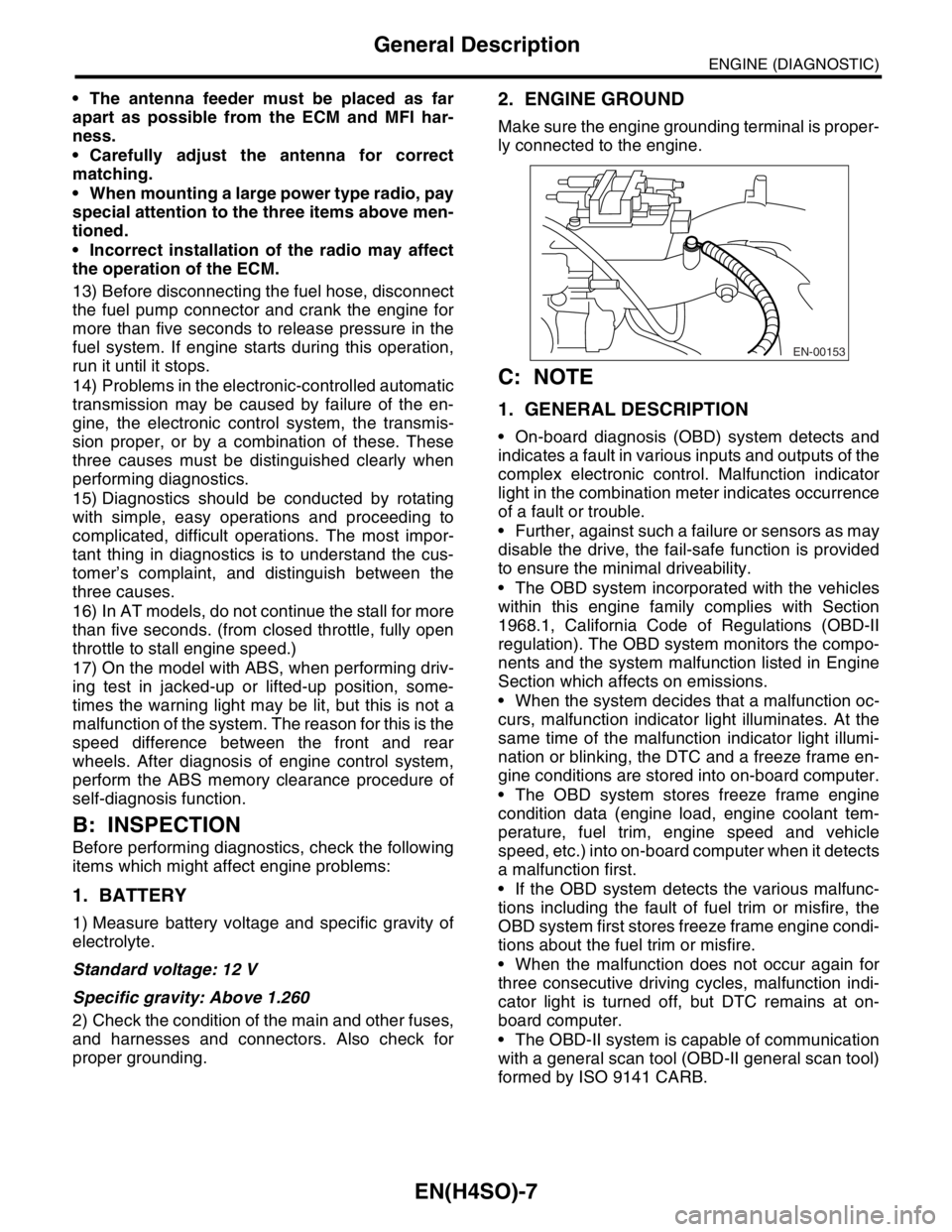
2. ENGINE GROUND
Make sure the engine grounding terminal is proper-
ly connected to the engine.
C: NOTE
1. GENERAL DESCRIPTION
On-board diagnosis (OBD) system detects and
indicates a fault in various inputs and outputs of the
complex electronic control. Malfunction indicator
light in the combination meter indicates occurrence
of a fault or trouble.
Further, against such a failure or sensors as may
disable the drive, the fail-safe function is provided
to ensure the minimal driveability.
The OBD system incorporated with the vehicles
within this engine family complies with Section
1968.1, California Code of Regulations (OBD-II
regulation). The OBD system monitors the compo-
nents and the system malfunction listed in Engine
Section which affects on emissions.
When the system decides that a malfunction oc-
curs, malfunction indicator light illuminates. At the
same time of the malfunction indicator light illumi-
nation or blinking, the DTC and a freeze frame en-
gine conditions are stored into on-board computer.
The OBD system stores freeze frame engine
condition data (engine load, engine coolant tem-
perature, fuel trim, engine speed and vehicle
speed, etc.) into on-board computer when it detects
a malfunction first.
If the OBD system detects the various malfunc-
tions including the fault of fuel trim or misfire, the
OBD system first stores freeze frame engine condi-
tions about the fuel trim or misfire.
When the malfunction does not occur again for
three consecutive driving cycles, malfunction indi-
cator light is turned off, but DTC remains at on-
board computer.
The OBD-II system is capable of communication
with a general scan tool (OBD-II general scan tool)
formed by ISO 9141 CARB.
EN-00153