2004 SUBARU FORESTER fuse
[x] Cancel search: fusePage 1149 of 2870

EN(H4SO)-51
ENGINE (DIAGNOSTIC)
Malfunction Indicator Light
6 CHECK HARNESS BETWEEN COMBINA-
TION METER AND IGNITION SWITCH CON-
NECTOR.
1) Turn the ignition switch to ON.
2) Measure the voltage between combination
meter connector and chassis ground.
Connector & terminal
(i12) No. 9 (+) — Chassis ground (
−):Is the voltage more than 10 V? Go to step 7.Check the follow-
ing and repair if
necessary.
N
OTE:
Broken down
ignition relay.
Blown out fuse
(No. 5)
If replaced fuse
(No. 5) blows eas-
ily, check the har-
ness for short
circuit of harness
between fuse (No.
5) and ignition
relay connector.
Open or short
circuit in harness
between fuse (No.
5) and battery ter-
minal
Open circuit in
harness between
fuse (No. 5) and
ignition relay con-
nector
Poor contact in
ignition relay con-
nector
Poor contact in
ignition switch con-
nector
7 CHECK BULB.Is the malfunction indicator
light bulb OK?Repair combina-
tion meter connec-
tor.Replace the bulb. Step Check Yes No
Page 1157 of 2870

EN(H4SO)-59
ENGINE (DIAGNOSTIC)
Diagnostics for Engine Starting Failure
Step Check Yes No
1 CHECK BATTERY.
Check the battery voltage.Is the voltage more than 12 V? Go to step 2.Charge or replace
the battery.
2 CHECK INPUT SIGNAL FOR STARTER MO-
TOR.
1) Turn the ignition switch to OFF.
2) Disconnect the connector from starter
motor.
3) Turn the ignition switch to START.
4) Measure the power supply voltage between
starter motor connector terminal and engine
ground.
Connector & terminal
(B14) No. 1 (+) — Engine ground (
−):
N
OTE:
For AT model, shift the select lever to “P” or
“N” range.
For MT model, depress the clutch pedal.Is the voltage more than 10 V? Go to step 3.Go to step 4.
3 CHECK GROUND CIRCUIT OF STARTER
MOTOR.
1) Turn the ignition switch to OFF.
2) Disconnect the ground cable terminal from
starter motor.
3) Measure the resistance of ground cable
between ground cable terminal and engine
ground.Is the resistance less than 5
Ω?Check the starter
motor.
Starter.>Repair open circuit
of ground cable.
4 CHECK HARNESS BETWEEN BATTERY
AND IGNITION SWITCH CONNECTOR.
1) Disconnect the connector from ignition
switch.
2) Measure the power supply voltage between
ignition switch connector and chassis ground.
Connector & terminal
(B72) No. 1 (+) — Chassis ground (
−):Is the voltage more than 10 V? Go to step 5.Repair open circuit
in harness
between ignition
switch and bat-
tery, and check
fuse SBF No. 4
and SBF No. 1.
5 CHECK IGNITION SWITCH.
1) Disconnect the connector from ignition
switch.
2) Measure the resistance between ignition
switch terminals while turning the ignition
switch to START position.
Te r m i n a l s
No. 1 — No. 3:Is the resistance less than 5
Ω?Go to step 6.Replace the igni-
tion switch.
6 CHECK TRANSMISSION TYPE.Is the transmission type AT? Go to step 7.Temporary poor
contact occurs.
Check poor con-
tact in each con-
nectors.
7 CHECK INHIBITOR SWITCH INPUT VOLT-
AGE.
1) Turn the ignition switch to OFF.
2) Disconnect the connector from inhibitor
switch.
3) Connect the connector to ignition switch.
4) Measure the input voltage between inhibitor
switch connector terminal and engine ground
while turning the ignition switch to START posi-
tion.
Connector & terminal
(B12) No. 12 (+) — Engine ground (
−):Is the voltage more than 10 V? Go to step 8.Repair open or
ground short cir-
cuit in harness
between inhibitor
switch and ignition
switch.
N
OTE:
Check security sys-
tem (if equipped).
Page 1163 of 2870

EN(H4SO)-65
ENGINE (DIAGNOSTIC)
Diagnostics for Engine Starting Failure
Step Check Yes No
1 CHECK IGNITION SYSTEM FOR SPARKS.
1) Remove the plug cord cap from each spark
plug.
2) Install the new spark plug on plug cord cap.
CAUTION:
Do not remove the spark plug from engine.
3) Contact the spark plug’s thread portion on
engine.
4) While opening the throttle valve fully, crank
the engine to check that spark occurs at each
cylinder.Does spark occur at each cyl-
inder?Check fuel pump
system.
FUEL PUMP CIR-
CUIT, Diagnostics
for Engine Start-
ing Failure.>Go to step 2.
2 CHECK POWER SUPPLY CIRCUIT FOR IG-
NITION COIL & IGNITOR ASSY.
1) Turn the ignition switch to OFF.
2) Disconnect the connector from ignition coil
& ignitor ASSY.
3) Turn the ignition switch to ON.
4) Measure the power supply voltage between
ignition coil & ignitor ASSY connector and
engine ground.
Connector & terminal
(E12) No. 2 (+) — Engine ground (
−):Is the voltage more than 10 V? Go to step 3.Repair harness
and connector.
N
OTE:
In this case repair
the following:
Open circuit in
harness between
ignition coil & igni-
tor ASSY, and
main relay connec-
tor
Poor contact in
coupling connector
Blown out fuse
3 CHECK HARNESS OF IGNITION COIL & IG-
NITOR ASSY GROUND CIRCUIT.
1) Turn the ignition switch to OFF.
2) Measure the resistance between ignition
coil & ignitor ASSY connector and engine
ground.
Connector & terminal
(E12) No. 3 — Engine ground:Is the resistance less than 5
Ω?Go to step 4.Repair harness
and connector.
N
OTE:
In this case repair
the following:
Open circuit in
harness between
ignition coil & igni-
tor ASSY connec-
tor and engine
ground terminal
4 CHECK IGNITION COIL & IGNITOR ASSY.
1) Remove the spark plug cords.
2) Measure the resistance between spark
plug cord contact portions to check secondary
coil.
Te r m i n a l s
No. 1 — No. 2:
No. 3 — No. 4:Is the resistance 10 — 15 kΩ? Go to step 5.Replace the igni-
tion coil & ignitor
ASSY.
tion Coil & Ignitor
Assembly.>
5 CHECK INPUT SIGNAL FOR IGNITION COIL
& IGNITOR ASSY.
1) Connect the connector to ignition coil &
ignitor ASSY.
2) Check if voltage varies synchronously with
engine speed when cranking, while monitoring
voltage between ignition coil & ignitor ASSY
connector and engine ground.
Connector & terminal
(E12) No. 1 (+) — Engine ground (
−):
(E12) No. 4 (+) — Engine ground (
−):Does the voltage vary more
than 10 V?Go to step 6.Replace the igni-
tion coil & ignitor
ASSY.
tion Coil & Ignitor
Assembly.>
Page 1300 of 2870

EN(H4SO)-202
ENGINE (DIAGNOSTIC)
Diagnostic Procedure with Diagnostic Trouble Code (DTC)
Step Check Yes No
1 CHECK OUTPUT SIGNAL FROM ECM.
1) Turn the ignition switch to OFF.
2) Connect the test mode connector at the
lower portion of instrument panel (on the
driver’s side).
3) Turn the ignition switch to ON.
4) While operating the radiator fan relay, mea-
sure the voltage between ECM and chassis
ground.
N
OTE:
Radiator fan relay operation can be executed
using Subaru Select Monitor. For procedure,
refer to “Compulsory Valve Operation Check
Mode”.
Connector & terminal
(B134) No. 14 (+) — Chassis ground (
−):Is the voltage 0 — 10 V? Repair the poor
contact in ECM
connector.Go to step 2.
2 CHECK GROUND SHORT CIRCUIT IN RADI-
ATOR MAIN FAN RELAY CONTROL CIR-
CUIT.
1) Turn the ignition switch to OFF.
2) Disconnect the connector from ECM.
3) Measure the resistance of harness
between ECM connector and chassis ground.
Connector & terminal
(B134) No. 14 — Chassis ground:Is the resistance less than 10
Ω?Repair the ground
short circuit in
radiator main fan
relay control cir-
cuit.Go to step 3.
3 CHECK POWER SUPPLY FOR RELAY.
1) Remove the main fan relay from A/C relay
holder.
2) Turn the ignition switch to ON.
3) Measure the voltage between fuse and
relay box (F/B) connector and chassis ground.
Connector & terminal
(F27) No. 34 (+) — Chassis ground (
−):Is the voltage more than 10 V? Go to step 4.Repair open circuit
in harness
between ignition
switch and fuse
and relay box (F/B)
connector.
4 CHECK MAIN FAN RELAY.
1) Turn the ignition switch to OFF.
2) Measure the resistance between main fan
relay terminals.
Te r m i n a l s
No. 32 — No. 34:Is the resistance 87 — 107 Ω? Go to step 5.Replace the main
fan relay.
5 CHECK OPEN CIRCUIT IN MAIN FAN RE-
LAY CONTROL CIRCUIT.
Measure the resistance of harness between
ECM and main fan relay connector.
Connector & terminal
(B134) No. 14 — (F27) No. 32:Is the resistance less than 1
Ω?Go to step 6.Repair harness
and connector.
NOTE:
In this case repair
the following:
Open circuit in
harness between
ECM and main fan
relay connector
Poor contact in
coupling connector
6 CHECK POOR CONTACT.
Check poor contact in ECM or main fan relay
connector. Is there poor contact in ECM or
main fan relay connector?Repair the poor
contact in ECM or
main fan relay con-
nector.Contact the SUB-
ARU dealer.
Page 1344 of 2870

EN(H4SO)-246
ENGINE (DIAGNOSTIC)
Diagnostic Procedure with Diagnostic Trouble Code (DTC)
Step Check Yes No
1 CHECK INPUT SIGNAL FROM ECM.
1) Turn the ignition switch to OFF.
2) Measure the voltage between ECM and
chassis ground.
Connector & terminal
(B134) No. 9 (+) — Chassis ground (
−):Is the voltage more than 10 V? Repair the poor
contact in ECM
connector.Go to step 2.
2 CHECK HARNESS BETWEEN ECM AND
MAIN FUSE BOX CONNECTOR.
1) Disconnect the connector from ECM.
2) Measure the resistance of harness
between ECM and chassis ground.
Connector & terminal
(B135) No. 9 — Chassis ground:Is the resistance less than 10
Ω?Repair ground
short circuit in har-
ness between
ECM connector
and battery termi-
nal.Go to step 3.
3 CHECK FUSE SBF-5.Is the fuse blown out? Replace the fuse. Repair harness
and connector.
N
OTE:
In this case repair
the following:
Open circuit in
harness between
ECM and battery
Poor contact in
ECM connector.
Poor contact in
battery terminal
Page 1545 of 2870
![SUBARU FORESTER 2004 Service Repair Manual ME(H4DOTC)-85
MECHANICAL
Cylinder Block
24) Remove the service hole cover and service
hole plugs using hexagon wrench [14 mm (0.55
in)].
25) Rotate the crankshaft to bring #1 and #2 pis-
tons to botto](/manual-img/17/57426/w960_57426-1544.png "SUBARU FORESTER 2004 Service Repair Manual ME(H4DOTC)-85
MECHANICAL
Cylinder Block
24) Remove the service hole cover and service
hole plugs using hexagon wrench [14 mm (0.55
in)].
25) Rotate the crankshaft to bring #1 and #2 pis-
tons to botto")
ME(H4DOTC)-85
MECHANICAL
Cylinder Block
24) Remove the service hole cover and service
hole plugs using hexagon wrench [14 mm (0.55
in)].
25) Rotate the crankshaft to bring #1 and #2 pis-
tons to bottom dead center position, and then re-
move the piston circlip through service hole of #1
and #2 cylinders.
26) Draw out the piston pin from #1 and #2 pistons
using ST.
ST 499097600 PISTON PIN REMOVER (2.0
L model)
ST 499097700 PISTON PIN REMOVER (2.5
L model)
NOTE:
Be careful not to confuse the original combination
of piston, piston pin and cylinder.
27) Similarly remove the piston pins from #3 and #4
pistons.
28) Remove the bolts which connect the cylinder
block on the side of #2 and #4 cylinders.29) Back off the bolts which connect the cylinder
block on the side of #1 and #3 cylinders two or
three turns.
30) Set up the cylinder block so that #1 and #3 cyl-
inders are on the upper side, then remove the cyl-
inder block connecting bolts.
31) Separate the cylinder blocks (LH) and (RH).
ME-00140
ME-00141
ME-00142
ST
Page 1546 of 2870
ME(H4DOTC)-86
MECHANICAL
Cylinder Block
NOTE:
When separating the cylinder block, do not allow
the connecting rod to fall and damage the cylinder
block.
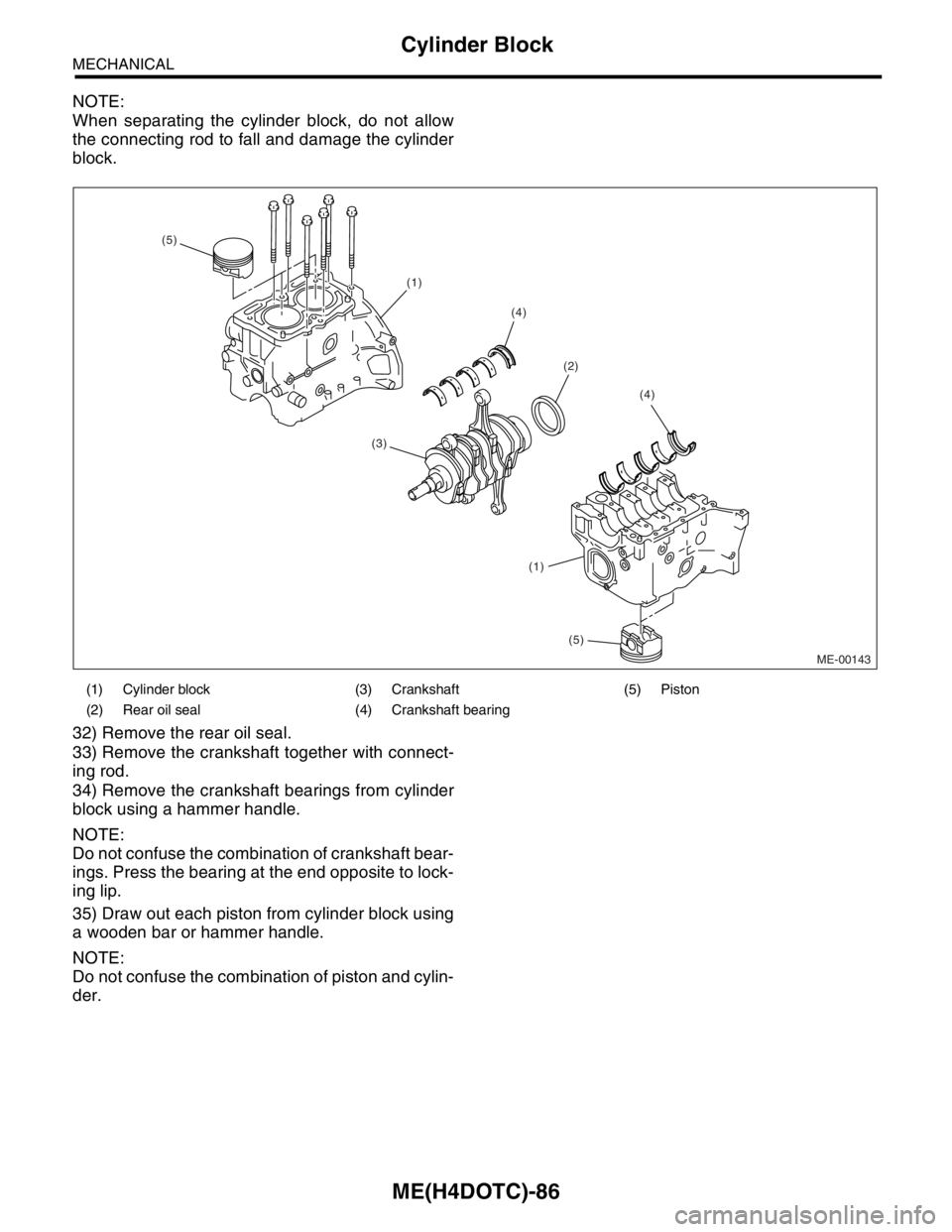
32) Remove the rear oil seal.
33) Remove the crankshaft together with connect-
ing rod.
34) Remove the crankshaft bearings from cylinder
block using a hammer handle.
NOTE:
Do not confuse the combination of crankshaft bear-
ings. Press the bearing at the end opposite to lock-
ing lip.
35) Draw out each piston from cylinder block using
a wooden bar or hammer handle.
NOTE:
Do not confuse the combination of piston and cylin-
der.
(1) Cylinder block (3) Crankshaft (5) Piston
(2) Rear oil seal (4) Crankshaft bearing
ME-00143
(2)
(3)(4)
(4) (5)
(5) (1) (1)
Page 1637 of 2870
EN(H4DOTC)-7
ENGINE (DIAGNOSTIC)
General Description
12) Observe the following cautions when installing
a radio in MFI equipped models.
CAUTION:
The antenna must be kept as far apart as pos-
sible from the control unit. (The ECM is located
under the steering column, inside of the instru-
ment panel lower trim panel.)
The antenna feeder must be placed as far
apart as possible from the ECM and MFI har-
ness.
Carefully adjust the antenna for correct
matching.
When mounting a large power type radio, pay
special attention to the three items above men-
tioned.
Incorrect installation of the radio may affect
the operation of the ECM.
13) Before disconnecting the fuel hose, disconnect
the fuel pump connector and crank the engine for
more than five seconds to release pressure in the
fuel system.If engine starts during this operation,
run it until it stops.
14) Problems in the electronic-controlled automatic
transmission may be caused by failure of the en-
gine, the electronic control system, the transmis-
sion proper, or by a combination of these.These
three causes (engine, electronic control system,
transmission) must be distinguished clearly when
performing diagnostics.
15) Diagnostics should be conducted by rotating
with simple, easy operations and proceeding to
complicated, difficult operations.The most impor-
tant thing in diagnostics is to understand the cus-
tomer’s complaint, and distinguish between the
three causes.
16) On the model with ABS, when performing driv-
ing test in jacked-up or lifted-up position, some-
times the warning light may be lit, but this is not a
malfunction of the system.The reason for this is the
speed difference between the front and rear
wheels.After diagnosis of engine control system,
perform the ABS memory clearance procedure of
self-diagnosis function.
B: INSPECTION
Before performing diagnostics, check the following
items which might affect engine problems:
1. BATTERY
1) Measure battery voltage and specific gravity of
electrolyte.
Standard voltage: 12 V
Specific gravity: Above 1.2602) Check the condition of the main and other fuses,
and harnesses and connectors.Also check for
proper grounding.
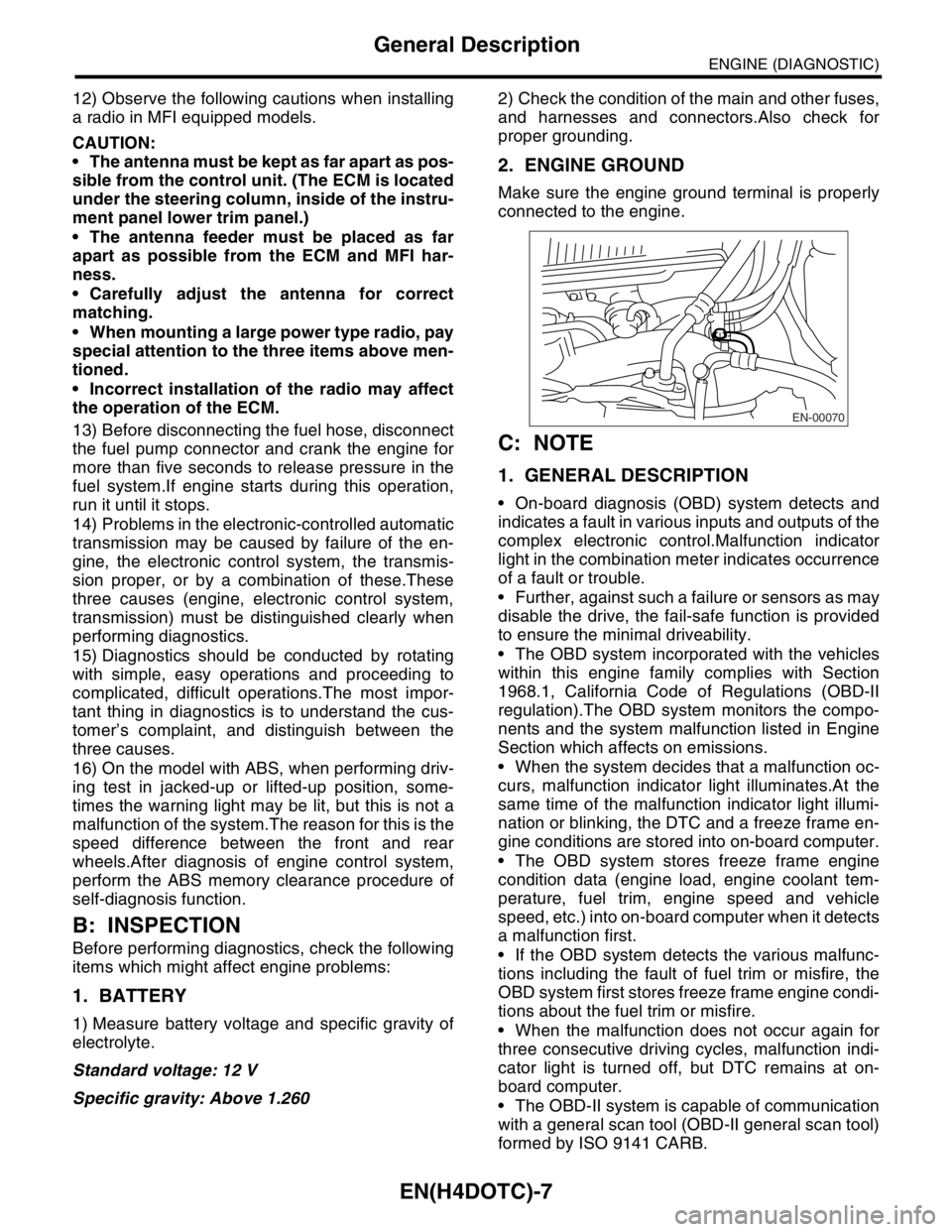
2. ENGINE GROUND
Make sure the engine ground terminal is properly
connected to the engine.
C: NOTE
1. GENERAL DESCRIPTION
On-board diagnosis (OBD) system detects and
indicates a fault in various inputs and outputs of the
complex electronic control.Malfunction indicator
light in the combination meter indicates occurrence
of a fault or trouble.
Further, against such a failure or sensors as may
disable the drive, the fail-safe function is provided
to ensure the minimal driveability.
The OBD system incorporated with the vehicles
within this engine family complies with Section
1968.1, California Code of Regulations (OBD-II
regulation).The OBD system monitors the compo-
nents and the system malfunction listed in Engine
Section which affects on emissions.
When the system decides that a malfunction oc-
curs, malfunction indicator light illuminates.At the
same time of the malfunction indicator light illumi-
nation or blinking, the DTC and a freeze frame en-
gine conditions are stored into on-board computer.
The OBD system stores freeze frame engine
condition data (engine load, engine coolant tem-
perature, fuel trim, engine speed and vehicle
speed, etc.) into on-board computer when it detects
a malfunction first.
If the OBD system detects the various malfunc-
tions including the fault of fuel trim or misfire, the
OBD system first stores freeze frame engine condi-
tions about the fuel trim or misfire.
When the malfunction does not occur again for
three consecutive driving cycles, malfunction indi-
cator light is turned off, but DTC remains at on-
board computer.
The OBD-II system is capable of communication
with a general scan tool (OBD-II general scan tool)
formed by ISO 9141 CARB.
EN-00070