Page 460 of 4323

DI±258
± DIAGNOSTICSENGINE
452 Author�: Date�:
2005 SEQUOIA (RM1146U)
MONITOR DESCRIPTION
The two monitors, Key±Off and Purge Flow, are used to detect malfunctions relating to DTC P0441. The
Key±Off monitor is initiated by the ECM internal timer, known as the soak timer, 5 hours* after the ignition
switch is turned to OFF. The purge flow monitor runs while the engine is running.
1. KEY±OFF MONITOR
5 hours* after the ignition switch is turned OFF, the electric vacuum pump creates negative pressure (vacu-
um) in the EVAP (Evaporative Emission) system. The ECM monitors for leaks and actuator malfunctions
based on the EVAP pressure.
HINT:
*: If the engine coolant temperature is not below 35�C (95�F) 5 hours after the ignition switch is turned off,
the monitor check starts 2 hours later. If it is still not below 35�C (95�F) 7 hours after the ignition switch is
turned off, the monitor check starts 2.5 hours later.
SequenceOperationsDescriptionsDuration
±ECM activationActivated by soak timer, 5 hours (7 or 9.5 hours) after ignition switch turned to OFF.±
AAtmospheric pressure
measurement
Vent valve turned OFF (vent) and EVAP system pressure measured by ECM in order to
register atmospheric pressure.
If EVAP pressure is not between 70 kPa and 110 kPa (525 mmHg and 825 mmHg), ECM
cancels EVAP system monitor.
10 seconds
B
First 0.02 inch leak
pressure measure-
mentIn order to determine 0.02 inch leak pressure standard, vacuum pump creates negative pres-
sure (vacuum) through 0.02 inch orifice and then ECM checks if vacuum pump and vent
valve operate normally.
60 seconds
CEVAP system pres-
sure measurement
Vent valve turned ON (closed) to shut EVAP system.
Negative pressure (vacuum) created in EVAP system, and EVAP system pressure then
measured.
Write down the measured value as it will be used in the leak check.
If EVAP pressure does not stabilize within 15 minutes, ECM cancels EVAP system monitor.
15 minutes*
DPurge VSV monitorPurge VSV opened and then EVAP system pressure measured by ECM.
Large increase indicates normal.10 seconds
E
Second 0.02 inch leak
pressure measure-
mentLeak check is performed after second 0.02 inch leak pressure standard is measured.
If stabilized system pressure higher than second 0.02 inch leak pressure standard, ECM
determines that EVAP system leaking.
60 seconds
FFinal checkAtmospheric pressure measured and then monitoring result recorded by ECM.±
* If only a small amount of fuel is in the fuel tank, it takes longer for the EVAP pressure to stabilize.
Page 462 of 4323
A23484
Purge VSV
Vent Valve
Vacuum Pump
EVAP Pressure
Positive
Leak Pressure
sec NegativeONON
Sequence
TimeA
10
sec60
Within 15 minutesON
First 0.02 inch
BCD
OK
Malfunction
ON: Open
OFF: Closed
OFF: Vent ON: Closed
10
Standard
sec60
E EVAP Pressure when Purge VSV Stuck Closed:
A23485
EVAP Pressure
During Purge Flow Monitor:
VSV
EVAP
PressureOpen
1st
Monitor2nd
Monitor
ON (closed)
Purge
Valve Vent
OK
OK
Malfunction
0.1 kPa
0.5 kPa
DI±260
± DIAGNOSTICSENGINE
454 Author�: Date�:
2005 SEQUOIA (RM1146U)
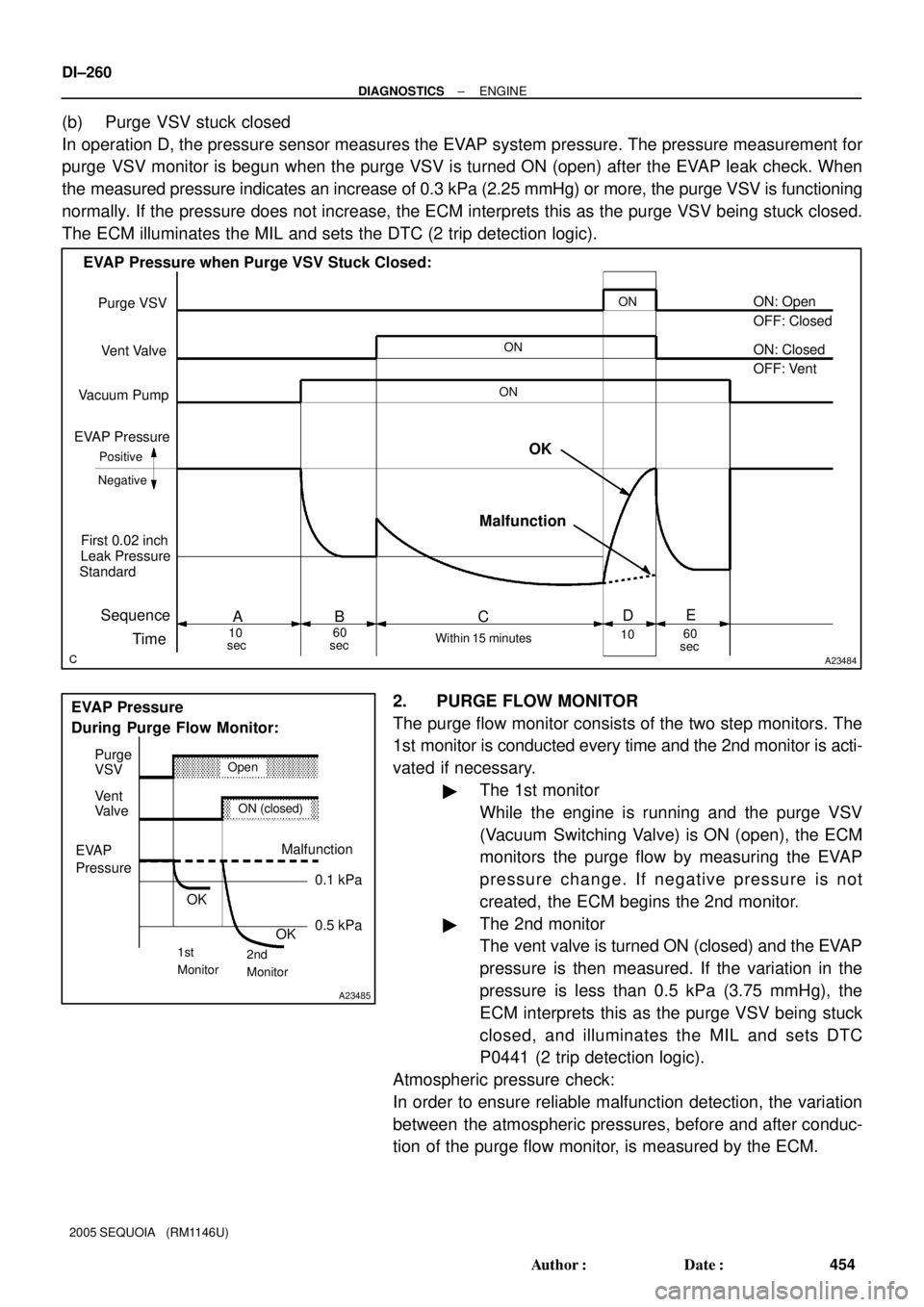
(b) Purge VSV stuck closed
In operation D, the pressure sensor measures the EVAP system pressure. The pressure measurement for
purge VSV monitor is begun when the purge VSV is turned ON (open) after the EVAP leak check. When
the measured pressure indicates an increase of 0.3 kPa (2.25 mmHg) or more, the purge VSV is functioning
normally. If the pressure does not increase, the ECM interprets this as the purge VSV being stuck closed.
The ECM illuminates the MIL and sets the DTC (2 trip detection logic).
2. PURGE FLOW MONITOR
The purge flow monitor consists of the two step monitors. The
1st monitor is conducted every time and the 2nd monitor is acti-
vated if necessary.
�The 1st monitor
While the engine is running and the purge VSV
(Vacuum Switching Valve) is ON (open), the ECM
monitors the purge flow by measuring the EVAP
pressure change. If negative pressure is not
created, the ECM begins the 2nd monitor.
�The 2nd monitor
The vent valve is turned ON (closed) and the EVAP
pressure is then measured. If the variation in the
pressure is less than 0.5 kPa (3.75 mmHg), the
ECM interprets this as the purge VSV being stuck
closed, and illuminates the MIL and sets DTC
P0441 (2 trip detection logic).
Atmospheric pressure check:
In order to ensure reliable malfunction detection, the variation
between the atmospheric pressures, before and after conduc-
tion of the purge flow monitor, is measured by the ECM.
Page 464 of 4323

DI±262
± DIAGNOSTICSENGINE
456 Author�: Date�:
2005 SEQUOIA (RM1146U) Next sequence is run if all of following
conditions set
Condition 1, 2 and 3
1. FTP when 4 sec. after reference pres-
sure measurement±±7.5 mmHg (±1 kPa)
2. Reference pressure±36.38 to ±7.93 mmHg (±4.85 to ±1057 kPa)
3. Reference pressureSaturated
3. Vent valve stuck closed check±
Next sequence is run if following condition
set±
FTP change for 10 sec. after vent valve
ON (closed)2.25 mmHg (0.3 kPa)±
4. Vacuum introduction and leak±
Next sequence is run if both of following
conditions setCondition 1 and 2
1. Vacuum introduction time±15 min.
2. FTPFTP was saturated
5. Purge VSV stuck closed check±
Next sequence is run if following condition
set±
FTP change for 10 sec. after purge VSV
ON (open)2.25 mmHg (0.3 kPa)±
6. Second reference pressure measure-
ment±
Next sequence is run if all of following
conditions setCondition 1, 2, 3 and 4
1. FTP when 4 sec. after reference pres-
sure measurement±±7.5 mmHg (±1 kPa)
2. Reference pressure±36.38 to ±7.93 mmHg (±4.85 to ±1057 kPa)
3. Reference pressureSaturated
4. Reference pressure difference between
first and second±5.25 mmHg (0.7 kPa)
7. Leak check±
Next sequence is run if following condition
set±
FTP when vacuum introduction was com-
plete±Second reference pressure
8. Atmospheric pressure±
Monitor is complete if following±
Atmospheric pressure difference between
sequence 1 and 8±2.25 mmHg (0.3 kPa)
Purge flow:
Engine conditionRunning
ECT4.4°C (40°F)±
IAT4.4°C (40°F)±
FTP sensor malfunctionNot detected
Purge VSVNot operated by scan tool
EVAP system checkNot operated by scan tool
Page 470 of 4323

DI±268
± DIAGNOSTICSENGINE
462 Author�: Date�:
2005 SEQUOIA (RM1146U)
INSPECTION PROCEDURE
NOTICE:
�When a vehicle is brought into the workshop, leave it as it is. Do not change the vehicle condi-
tion. For example, do not tighten the fuel tank cap.
�Do not disassemble the pump module.
�A hand±held tester is required to conduct the following diagnostic troubleshooting procedure.
1 Confirm DTC and EVAP pressure.
PREPARATION:
(a) Connect a hand±held tester to the DLC3.
(b) Turn the ignition switch to ON (do not start the engine).
(c) Turn the tester ON.
CHECK:
(a) Select the following menu items: DIAGNOSIS / ENHANCED OBD II / DTC INFO / CURRENT CODES.
(b) Read DTCs.
(c) Select the following menu items: DIAGNOSIS / ENHANCED OBD II / DATA LIST / ALL / VAPOR
PRESS.
(d) Read the EVAP (Evaporative Emission) pressure displayed on the tester.
RESULT:
Display (DTC Output)Test ResultsSuspected Trouble AreasProceed To
P0451'�Pressure sensorC
P0452Less than 45 kpa (430 mmHg)
�Wire harness/connector (ECM ± pressure
sensor)
�Pressure sensor
�Short in ECM circuit
A
P0453More than 120 kPa (900 mmHg)
�Wire harness/connector (ECM ± pressure
sensor)
�Pressure sensor
�Open in ECM circuit
B
B Go to step 4.
C Go to EVAP inspection procedure
(See page DI±460).
A
Page 471 of 4323
B17417
E4
PPMP
± DIAGNOSTICSENGINE
DI±269
463 Author�: Date�:
2005 SEQUOIA (RM1146U)
2 Measure resistance between terminal PPMP of ECM and body ground.
PREPARATION:
(a) Turn the ignition switch to OFF.
(b) Disconnect the E4 ECM connector.
CHECK:
Measure the resistance between PPMP terminal of the ECM
connector and the body ground.
RESULT:
Test ResultsSuspected Trouble AreasProceed To
10 W or less�Wire harness/connector (ECM ± pressure sensor)
�Short in pressure sensor circuitA
10 kW or more�Wire harness/connector (ECM ± pressure sensor)
�Short in ECM circuitB
B Go to step 7.
A
Page 472 of 4323
B17417
E4
PPMP
A23446
L5
DI±270
± DIAGNOSTICSENGINE
464 Author�: Date�:
2005 SEQUOIA (RM1146U)
3 Measure resistance between terminal PPMP of ECM and body ground.
PREPARATION:
(a) Disconnect the L5 canister connector.
(b) Disconnect the E4 ECM connector.
CHECK:
Check the resistance between PPMP terminal of the ECM con-
nector and the body ground.
Result:
Test ResultsSuspected Trouble AreasProceed To
10 kW or more�Short in pressure sensor circuitA
10 W or less�Short in wire harness/connector (ECM ± pressure sensor)B
A Go to step 5.
B Go to step 6.
Page 473 of 4323

A23508
Wire Harness Side:
Canister Connector
Front View
L5
A23446
L5
± DIAGNOSTICSENGINE
DI±271
465 Author�: Date�:
2005 SEQUOIA (RM1146U)
4 Measure voltage and resistance of pump module connector.
PREPARATION:
(a) Disconnect the L5 canister connector.
(b) Turn the ignition switch to ON.
CHECK:
Measure the voltage and resistance of the L5 connector.
OK:
Standard:
Tester ConnectionsSpecified Conditions
L5±4 ± Body groundBetween 4.5 V and 5.5 V
L5±3 ± Body groundBetween 4.5 V and 5.5 V
L5±2 ± Body ground100 W or less
RESULT:
Test ResultsSuspected Trouble AreasProceed To
Voltage and resistance within standard ranges�Open in pressure sensor circuitA
Voltage and resistance outside standard ranges�Open in wire harness/connector (ECM ± pressure sensor)B
B Go to step 6.
A
5 Replace charcoal canister assembly.
NEXT Go to step 8.
6 Repair or replace wire harness and connectors.
HINT:
If the exhaust tail pipe has been removed, go to the next step before reinstalling it.
NEXT Go to step 8.
Page 474 of 4323
DI±272
± DIAGNOSTICSENGINE
466 Author�: Date�:
2005 SEQUOIA (RM1146U)
7 Replace ECM (See page SF±80).
NEXT
8 Check whether DTC output recurs.
PREPARATION:
(a) Connect the hand±held tester to the DLC3.
(b) Turn the ignition switch to ON and turn the tester ON.
(c) Wait for at least 60 seconds.
CHECK:
(a) On the tester, select the following menu items: DIAGNOSIS/ENHANCED OBD II/DTC INFO/PEND-
ING CODES.
HINT:
If no pending DTC is displayed on the tester, the repair has been successfully completed.
NEXT
Completed