Page 139 of 363

When the interior has cooled down
to a more comf ortable temperature,
close the windows and set the
controls as described f or normal
cooling.Air conditioning places an extra load
on the engine. Watch the engine
coolant temperature gauge (see page
) when driving in stop-and-go
traf f ic or climbing a long, steep hill.
If it moves near the red zone, turn
of f the A/C until the gauge reads
normally.
If the interior is very warm f rom
beingparkedinthesun,youcancool
it down more rapidly by setting up
the controls this way:
Start the engine.
Turn on the A/C by pressing the
button. Make sure the tempera-
ture control dial is turned all the
way to the left.
Set the f an to maximum speed.
Open the windows partially. Select and Fresh Air mode.
Turn on the A/C by pressing the
button. The light above the button
comesonwhenafanspeedis
selected.
Make sure the temperature
control dial is all the way to the left.
Select .
If the outside air is humid, select
Recirculation mode. If the outside
air is dry, select Fresh Air mode.
Set the f an to the desired speed.
1.2. 3. 4.
1. 2. 3. 4. 5.
67
Comf ort and Convenience Feat ures
Heating and Cooling
T o Cool wit h A /C
140
FFAANNCCOONNTTRROOLLDDIIAALLMMOODDEEBBUUTTTTOONNSSTTEEMMPPEERRAATTUURREECCOONNTTRROOLLDDIIAALL
RREECCIIRRCCUULLAATTIIOONNBBUUTTTTOONNAAIIRRCCOONNDDIITTIIOONNIINNGGBBUUTTTTOONN
Page 145 of 363
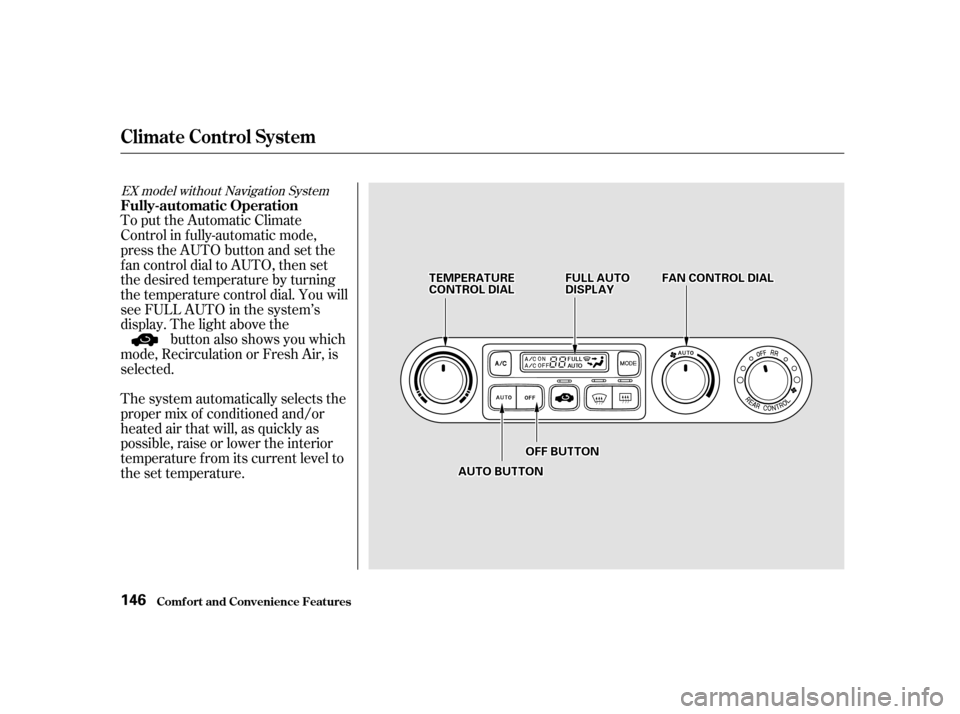
The system automatically selects the
proper mix of conditioned and/or
heated air that will, as quickly as
possible, raise or lower the interior
temperature f rom its current level to
the set temperature.
To put the Automatic Climate
Control in f ully-automatic mode,
press the AUTO button and set the
f an control dial to AUTO, then set
the desired temperature by turning
the temperature control dial. You will
see FULL AUTO in the system’s
display. The light above the
buttonalsoshowsyouwhich
mode, Recirculation or Fresh Air, is
selected.
EX model without Navigation System
Climat e Cont rol Syst em
Comf ort and Convenience Feat ures
Fully-automatic Operation 146
AAUUTTOOBBUUTTTTOONN
OOFFFFBBUUTTTTOONN
TTEEMMPPEERRAATTUURREECCOONNTTRROOLLDDIIAALLFFUULLLLAAUUTTOODDIISSPPLLAAYYFFAANNCCOONNTTRROOLLDDIIAALL
Page 156 of 363
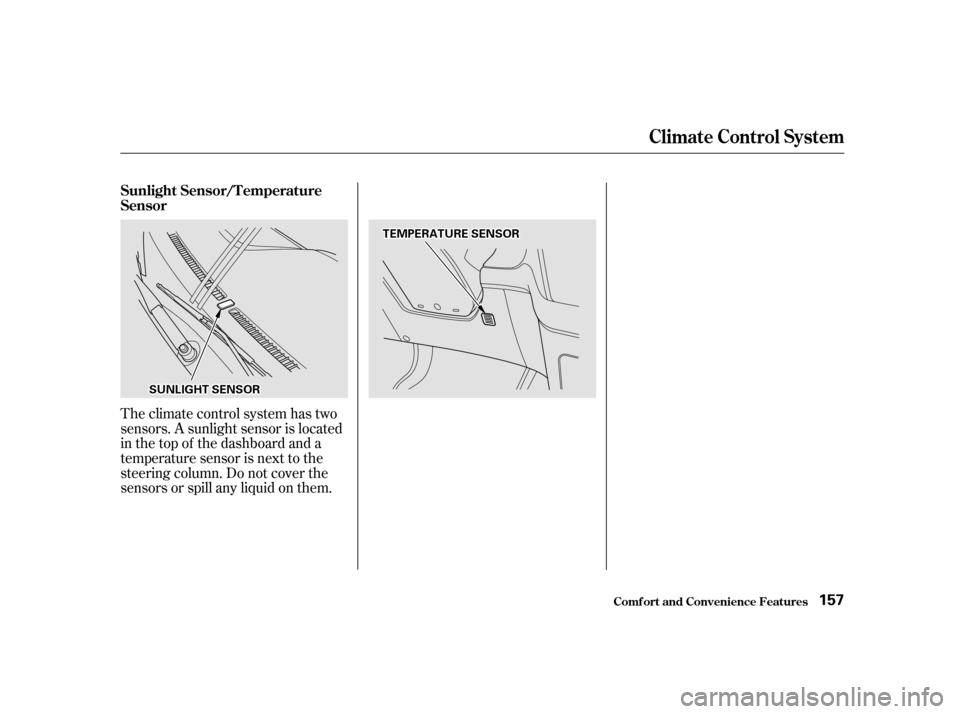
Theclimatecontrolsystemhastwo
sensors. A sunlight sensor is located
in the top of the dashboard and a
temperature sensor is next to the
steering column. Do not cover the
sensors or spill any liquid on them.
Sunlight Sensor/T emperature
Sensor
Climat e Cont rol Syst em
Comf ort and Convenience Feat ures
157
TTEEMMPPEERRAATTUURREESSEENNSSOORR
SSUUNNLLIIGGHHTTSSEENNSSOORR
Page 164 of 363
�µ�µ
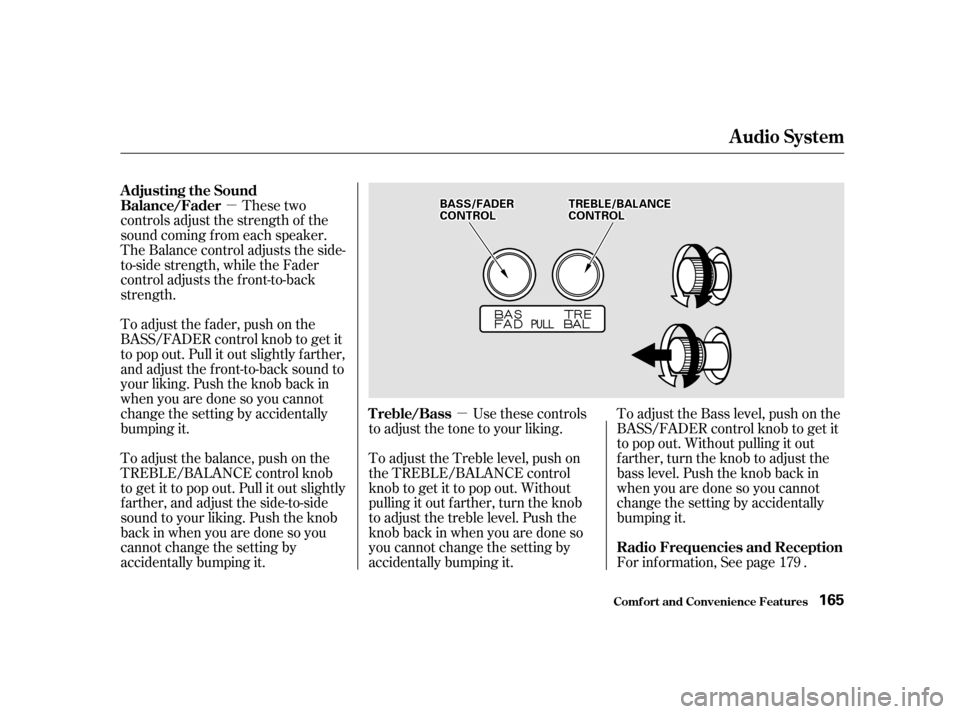
These two
controls adjust the strength of the
sound coming f rom each speaker.
The Balance control adjusts the side-
to-side strength, while the Fader
control adjusts the f ront-to-back
strength.
To adjust the fader, push on the
BASS/FADER control knob to get it
to pop out. Pull it out slightly f arther,
and adjust the f ront-to-back sound to
your liking. Push the knob back in
when you are done so you cannot
change the setting by accidentally
bumping it.
To adjust the balance, push on the
TREBLE/BALANCE control knob
to get it to pop out. Pull it out slightly
f arther, and adjust the side-to-side
sound to your liking. Push the knob
back in when you are done so you
cannot change the setting by
accidentally bumping it. Use these controls
to adjust the tone to your liking. To adjust the Bass level, push on the
BASS/FADER control knob to get it
to pop out. Without pulling it out
f arther, turn the knob to adjust the
bass level. Push the knob back in
when you are done so you cannot
change the setting by accidentally
bumping it.
For inf ormation, See page .
To adjust the Treble level, push on
the TREBLE/BALANCE control
knob to get it to pop out. Without
pulling it out f arther, turn the knob
to adjust the treble level. Push the
knob back in when you are done so
you cannot change the setting by
accidentally bumping it.
179
Adjusting the Sound
Balance/Fader
Treble/BassRadio Frequencies and Reception
Audio System
Comf ort and Convenience Feat ures165
BBAASSSS//FFAADDEERRCCOONNTTRROOLLTTRREEBBLLEE//BBAALLAANNCCEECCOONNTTRROOLL
Page 165 of 363

�Û�µ�µ
Dolby B noise reduction turns on
when you insert a cassette. If the
tape was not recorded with Dolby B
noise reduction, turn it of f by
pressing the button.
When the system reaches the end of
the tape, it will automatically reverse
direction and play the other side. If
you want to remove the cassette
f rom the drive, press the EJECT
button.
You can use the instrument panel
brightness control knob to adjust the
illumination of the audio system (see
page ). The audio system
illuminates when the parking lights
are on, even if the radio is turned of f .
Turn the audio system ON. Make
sure the tape opening on the cassette
is f acing to the right, then insert the
cassette most of the way into the slot.
The system will pull it in the rest of
the way, and begin to play.
The tape direction indicator will light
to show you which side of the
cassette is playing. The indicates
thesideyouinsertedfacingupward
is now playing. If you want to play
the other side, press the PROG
button.
With a cassette playing, you can use
the FF, REW, SKIP, or REPEAT
f unction to f ind a desired program.
Fast Forward and Re-
wind move the tape rapidly. To re-
wind the tape, push the REW button.
You will see REW in the display. To
fast forward the tape, push the FF
button. You will see FF displayed.
Press the PLAY button to take the
system out of rewind or f ast f orward. If the system reaches the end of the
tape while in f ast f orward or rewind,
it automatically stops that function,
reverses direction, and begins to play.
The Skip Function allows
you to f ind the beginning of a song
or passage. To f ind the beginning of
the song or passage currently
playing, push the SKIP switch down.
You will see REW f lashing in the
display as the tape rewinds. To f ind
the beginning of the next song, push
the SKIP switch up. You will see FF
flashing in the display as the tape
f ast f orwards. When the system
f inds the beginning of a song or
passage, it goes back to PLAY mode.
71
Audio System
Comf ort and Convenience Feat ures
A udio System L ighting
Operating the Cassette Player
T ape Search Functions
FF/REWSK IP
166
Page 177 of 363
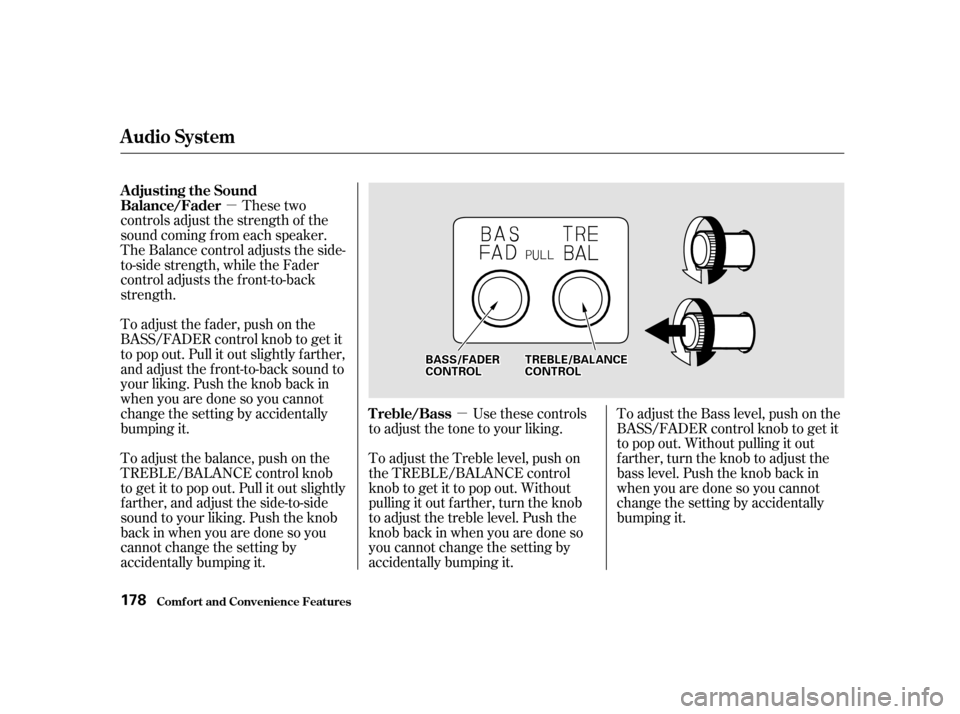
�µ�µ
These two
controls adjust the strength of the
sound coming f rom each speaker.
The Balance control adjusts the side-
to-side strength, while the Fader
control adjusts the f ront-to-back
strength.
To adjust the fader, push on the
BASS/FADER control knob to get it
to pop out. Pull it out slightly f arther,
and adjust the f ront-to-back sound to
your liking. Push the knob back in
when you are done so you cannot
change the setting by accidentally
bumping it.
To adjust the balance, push on the
TREBLE/BALANCE control knob
to get it to pop out. Pull it out slightly
f arther, and adjust the side-to-side
sound to your liking. Push the knob
back in when you are done so you
cannot change the setting by
accidentally bumping it. Use these controls
to adjust the tone to your liking.
To adjust the Treble level, push on
the TREBLE/BALANCE control
knob to get it to pop out. Without
pulling it out f arther, turn the knob
to adjust the treble level. Push the
knob back in when you are done so
you cannot change the setting by
accidentally bumping it. To adjust the Bass level, push on the
BASS/FADER control knob to get it
to pop out. Without pulling it out
f arther, turn the knob to adjust the
bass level. Push the knob back in
when you are done so you cannot
change the setting by accidentally
bumping it.
Comf ort and Convenience Feat ures
Audio System
Adjusting the Sound
Balance/Fader
Treble/Bass
178
BBAASSSS//FFAADDEERRCCOONNTTRROOLLTTRREEBBLLEE//BBAALLAANNCCEECCOONNTTRROOLL
Page 178 of 363
CONT INUED
You can use the instrument panel
brightness control knob to adjust the
illumination of the audio system (see
page ). The audio system
illuminates when the parking lights
are on, even if the radio is turned of f .
Your Honda’s radio can receive the
complete AM and FM bands.
Those bands cover these f requen-
cies:
AM band:
530 to 1,710 kilohertz
FM band:
87.7 to 107.9 megahertz
Radio stations on the AM band are
assigned f requencies at least ten
kilohertz apart (530, 540, 550).
Stations on the FM band are
assigned f requencies at least 0.2
megahertz apart (87.9, 88.1, 88.3).Stations must use these exact
f requencies. It is f airly common f or
stations to round-of f the f requency in
their advertising, so your radio could
display a f requency of 100.9 even
though the announcer may identif y
the station as ‘‘FM101.’’
How well your Honda’s radio
receives stations is dependent on
many f actors, such as the distance
from the station’s transmitter,
nearby large objects, and atmos-
pheric conditions.
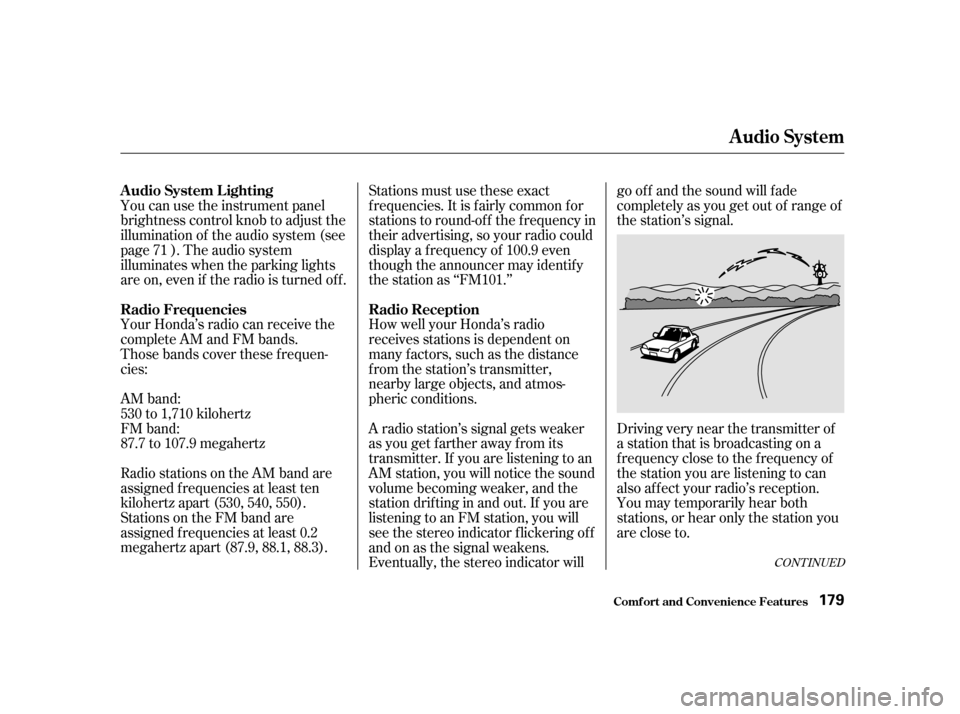
A radio station’s signal gets weaker
as you get f arther away f rom its
transmitter. If you are listening to an
AM station, you will notice the sound
volume becoming weaker, and the
stationdriftinginandout.If youare
listening to an FM station, you will
see the stereo indicator f lickering of f
and on as the signal weakens.
Eventually, the stereo indicator willgo of f and the sound will f ade
completely as you get out of range of
the station’s signal.
Driving very near the transmitter of
a station that is broadcasting on a
f requency close to the f requency of
the station you are listening to can
also af f ect your radio’s reception.
You may temporarily hear both
stations,orhearonlythestationyou
are close to.
71
Audio System
Comf ort and Convenience Feat ures
A udio System L ighting
Radio Frequencies Radio Reception
179
Page 183 of 363
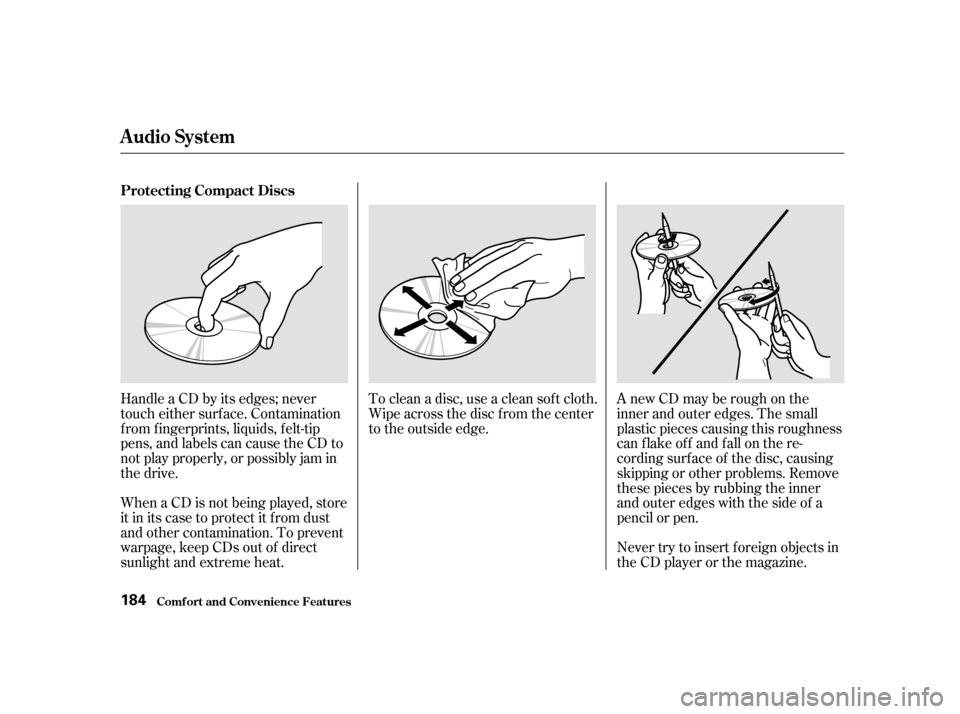
When a CD is not being played, store
it in its case to protect it f rom dust
and other contamination. To prevent
warpage, keep CDs out of direct
sunlight and extreme heat.
Handle a CD by its edges; never
touch either surf ace. Contamination
f rom f ingerprints, liquids, f elt-tip
pens, and labels can cause the CD to
not play properly, or possibly jam in
the drive.
To clean a disc, use a clean sof t cloth.
Wipe across the disc f rom the center
to the outside edge.
AnewCDmayberoughonthe
inner and outer edges. The small
plastic pieces causing this roughness
can f lake of f and f all on the re-
cording surf ace of the disc, causing
skipping or other problems. Remove
these pieces by rubbing the inner
and outer edges with the side of a
pencil or pen.
Never try to insert f oreign objects in
the CD player or the magazine.
Protecting Compact Discs
Audio System
Comf ort and Convenience Feat ures
184