Page 242 of 363

�Ø �Ø�Ø�Ø�Ø�Ø�Ø�Ø �Ø �Ø �Ø �Ø�Ø�Ø�Ø
�Ø �Ø
�Ì�Ì
CONT INUED
Maint enance 243
A, B, C, D
Severe Conditions:
A B C
Use this schedule if your vehicle is MAINLY driven in any of the following Severe Conditions, o
r normally driven in Canada; otherwise use the Normal
Schedule. Service at the indicated distance or time, whichever comes first. Do the items in as required for each distance/time.
Driving less than 5 miles (8 km) per trip or, in freezing temperatures, driving less than 10 miles (16 km) p er trip.
Driving in extremely hot (over 90°F/32°C) conditions.
Extensive idling or long periods of stop-and-go driving.
Trailer towing, driving with a roof rack, or driving in mountainous conditions.
Driving on muddy, dusty, or de-iced roads.
3,750 mi/6,000 km/-
7,500 mi/12,000 km/6 mos
11,250 mi/18,000 km/-
15,000 mi/24,000 km/1 yr
18,750 mi/30,000 km/-
22,500 mi/36,000 km/1½ yrs
26,250 mi/42,000 km/-
30,000 mi/48,000 km/2 yrs
33,750 mi/54,000 km/-
37,500 mi/60,000 km/2½ yrs
41,250 mi/66,000 km/-
45,000 mi/72,000 km/3 yrs
48,750 mi/78,000 km/-
52,500 mi/84,000 km/3½ yrs Replace engine oil and filter.
Inspect front and rear brakes.
Rotate tires (follow pattern on page 276 ).
Inspect tie rod ends, steering gearbox and boots.
Inspect suspension components.
Inspect driveshaft boots.
Check parking brake adjustment.
Lubricate all hinges, locks and latches, with
multipurpose grease.
Inspect brake hoses and lines (including ABS).
Check all fluid levels, condition of fluids, and check
for leaks.
Inspect cooling system hoses and connections.
Inspect exhaust system .
Inspect fuel lines and connections .
Check all lights.
Inspect the underbody.
Do items in A.
Do items in A, B.
Do items in A.
Clean air cleaner element. Do items in A, B, C.
Do items in A.
Do items in A, B.
Do items in A.
DoitemsinA,B,C,D.
Do items in A.
Do items in A, B.
Do items in A. Clean air cleaner element.
DoitemsinA,B,C,E.
Do items in A.
Do items in A, B.
·····
Maintenance Schedule for Severe Conditions (listed by distance/time)
Page 246 of 363
�µ�µ �µ
�µ
�µ
�µ �µ
Youshouldcheckthefollowing
items at the specif ied intervals. If
you are unsure of how to perf orm
any check, turn to the page given.
Engine oil level Check every
time you fill the fuel tank. See
page .
Engine coolant level Check the
radiator reserve tank every time
youfillthefueltank.Seepage .Tires Check the tire pressure
monthly. Examine the tread f or
wear and foreign objects. See page
.
Windshield washer f luid Check
the level in the reservoir monthly.
If weather conditions cause you to
use the washers f requently, check
the reservoir each time you stop
f or f uel. See page .
Automatic transmission Check
the f luid level monthly. See page .
Brakes Check the f luid level
monthly. See page . Lights Check the operation of
the headlights, parking lights,
taillights, high-mount brake light,
turn signals, brake lights, and
license plate light monthly. See
page .
200
201
258
259 260 273
280
Owner Maintenance Checks
Maint enance 247
Page 251 of 363
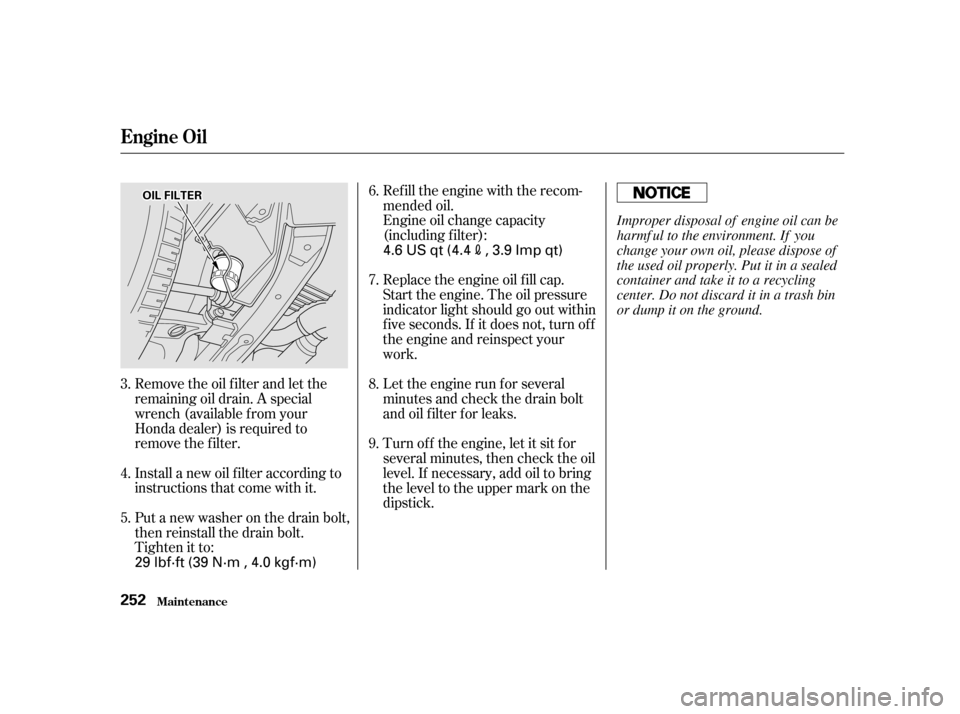
Remove the oil f ilter and let the
remaining oil drain. A special
wrench (available f rom your
Honda dealer) is required to
remove the f ilter.
Install a new oil f ilter according to
instructions that come with it.
Put a new washer on the drain bolt,
then reinstall the drain bolt.
Tighten it to:Refill the engine with the recom-
mended oil.
Engine oil change capacity
(including f ilter):
Replace the engine oil f ill cap.
Start the engine. The oil pressure
indicator light should go out within
f ive seconds. If it does not, turn of f
the engine and reinspect your
work.
Let the engine run f or several
minutes and check the drain bolt
and oil f ilter f or leaks.
Turn of f the engine, let it sit f or
several minutes, then check the oil
level. If necessary, add oil to bring
the level to the upper mark on the
dipstick.
9.
8.
7.
6.
4. 5.
3.
Engine Oil
Maint enance
252
OOIILLFFIILLTTEERR
29 lbf·ft (39 N·m , 4.0 kgf·m) 4.6 US qt (4.4
, 3.9 Imp qt)
Improper disposal of engine oil can be
harmf ul to the environment. If you
change your own oil, please dispose of
the used oil properly. Put it in a sealed
container and take it to a recycling
center. Do not discard it in a trash bin
or dump it on the ground.
Page 257 of 363
Fill the reservoir with a good-quality
windshield washer f luid. This
increases the cleaning capability and
prevents f reezing in cold weather.
When you ref ill the reservoir, clean
the edges of the windshield wiper
blades with windshield washer f luid
on a clean cloth. This will help to
condition the blade edges.
Check the level in the windshield
washer reservoir at least monthly
during normal usage. In bad weather,
when you use the washers of ten,
check the level every time you stop
f or f uel. This reservoir supplies the
windshield and rear window washers.
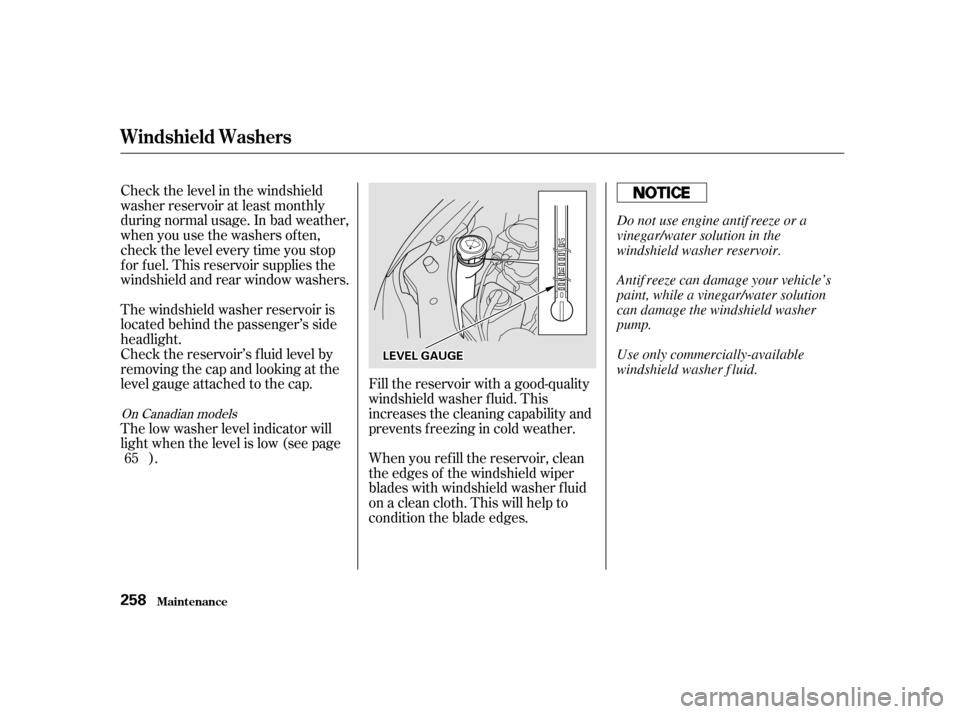
The windshield washer reservoir is
located behind the passenger’s side
headlight.
Check the reservoir’s f luid level by
removing the cap and looking at the
level gauge attached to the cap.
The low washer level indicator will
light when the level is low (see page
).
65
On Canadian models
Windshield Washers
Maint enance
258
LLEEVVEELLGGAAUUGGEE Do not use engine antif reeze or a
vinegar/water solution in the
windshield washer reservoir.
Antif reeze can damage your vehicle’s
paint, while a vinegar/water solution
can damage the windshield washerpump.
Use only commercially-available
windshield washer f luid.
Page 270 of 363
Run the air conditioning at least once
a week during the cold weather
months. Run it f or at least ten
minutes while you are driving at a
steady speed with the engine at
normal operating temperature. This
circulates the lubricating oil con-
tained in the ref rigerant.If the air conditioning does not get as
cold as before, have your dealer
check the system. Recharge the
system with Ref rigerant HFC-134a
(R-134a). (See Specif ications on page
.)
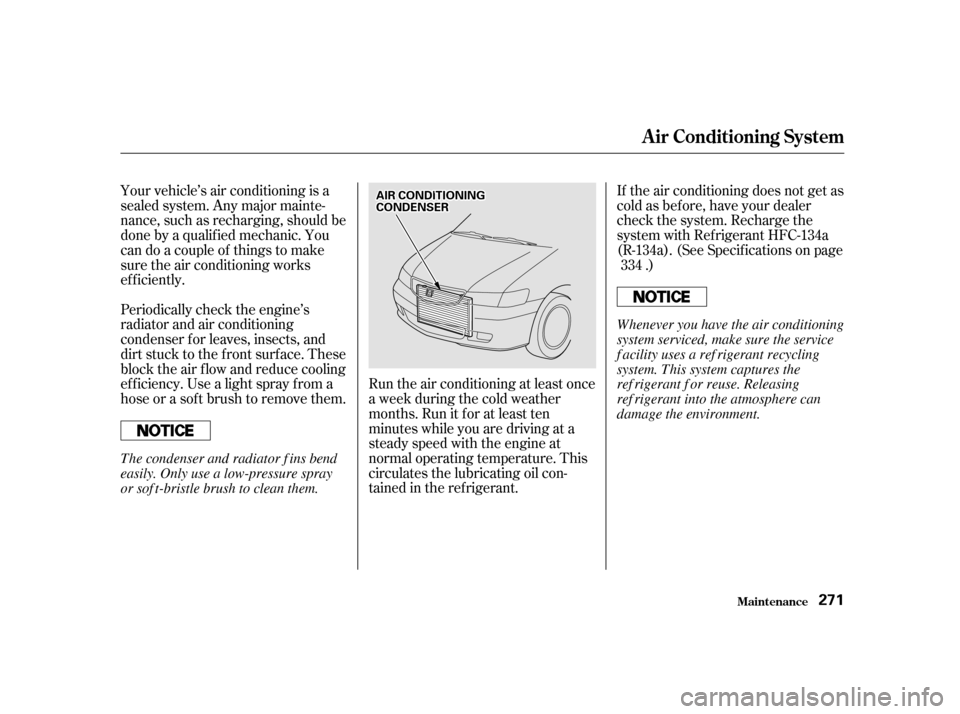
Your vehicle’s air conditioning is a
sealed system. Any major mainte-
nance, such as recharging, should be
done by a qualif ied mechanic. You
can do a couple of things to make
sure the air conditioning works
ef f iciently.
Periodically check the engine’s
radiator and air conditioning
condenser f or leaves, insects, and
dirt stuck to the f ront surf ace. These
block the air f low and reduce cooling
ef f iciency. Use a light spray f rom a
hose or a sof t brush to remove them. 334
Maint enance
A ir Condit ioning Syst em
271
AAIIRRCCOONNDDIITTIIOONNIINNGGCCOONNDDEENNSSEERR Whenever you have the air conditioning
system serviced, make sure the service
f acility uses a ref rigerant recycling
system. This system captures the
ref rigerant f or reuse. Releasing
ref rigerant into the atmosphere can
damage the environment.
The condenser and radiator f ins bend
easily. Only use a low-pressure spray
or sof t-bristle brush to clean them.
Page 279 of 363
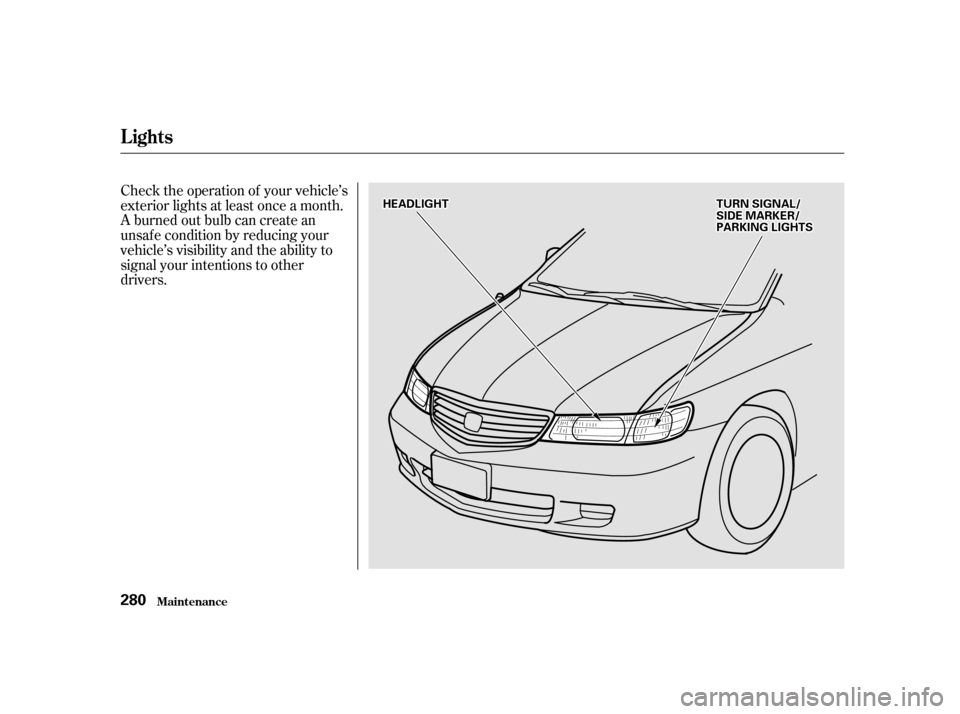
Check the operation of your vehicle’s
exterior lights at least once a month.
A burned out bulb can create an
unsaf e condition by reducing your
vehicle’s visibility and the ability to
signal your intentions to other
drivers.
Lights
Maint enance
280
HHEEAADDLLIIGGHHTTTTUURRNNSSIIGGNNAALL//SSIIDDEEMMAARRKKEERR//PPAARRKKIINNGGLLIIGGHHTTSS
Page 280 of 363
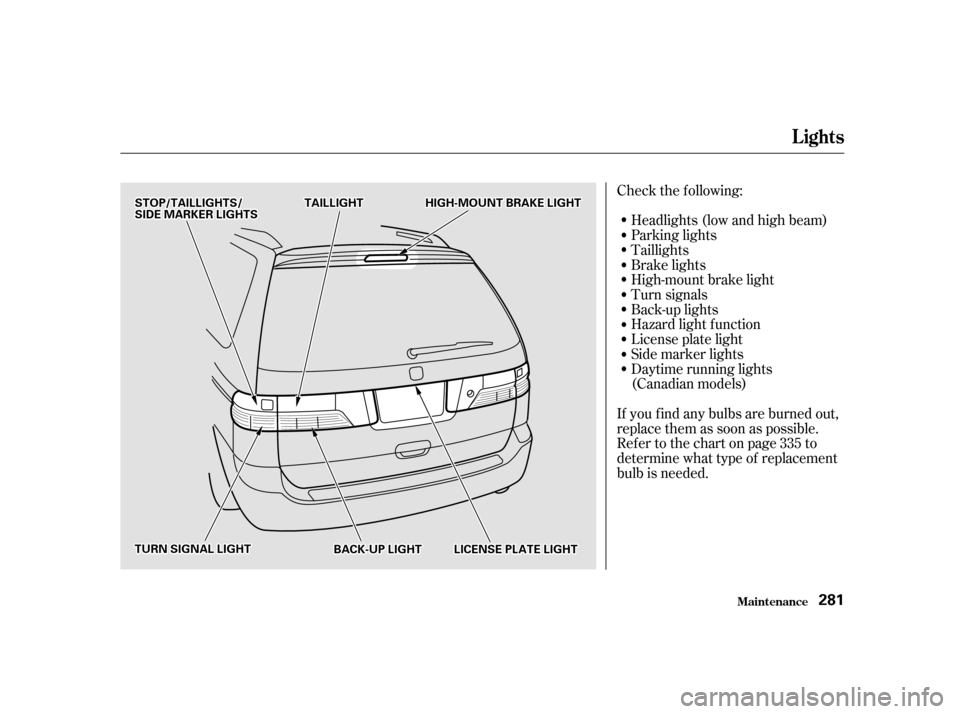
Check the f ollowing:Headlights (low and high beam)
Parking lights
Taillights
Brake lights
High-mount brake light
Turn signals
Back-up lights
Hazard light f unction
License plate light
Side marker lights
Daytime running lights
(Canadian models)
If youfindanybulbsareburnedout,
replace them as soon as possible.
Refer to the chart on page to
determinewhattypeof replacement
bulb is needed. 335
Lights
Maint enance
281
HHIIGGHH--MMOOUUNNTTBBRRAAKKEELLIIGGHHTTSSTTOOPP//TTAAIILLLLIIGGHHTTSS//SSIIDDEEMMAARRKKEERRLLIIGGHHTTSS
BBAACCKK--UUPPLLIIGGHHTTTTUURRNNSSIIGGNNAALLLLIIGGHHTT
TTAAIILLLLIIGGHHTT
LLIICCEENNSSEEPPLLAATTEELLIIGGHHTT
Page 281 of 363
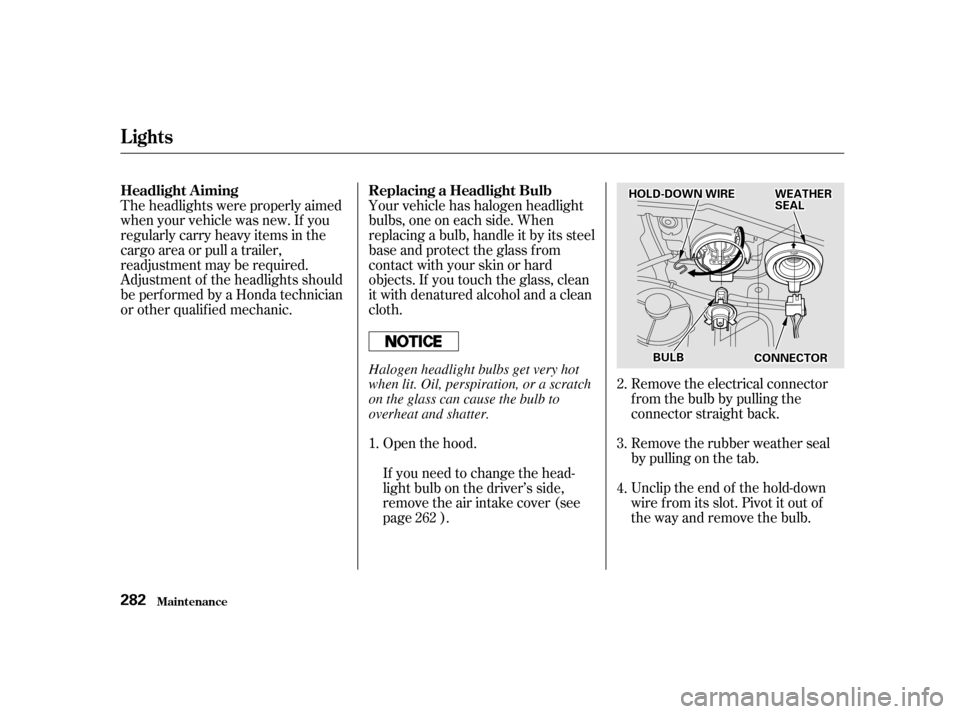
Unclip the end of the hold-down
wire f rom its slot. Pivot it out of
the way and remove the bulb.
Remove the rubber weather seal
by pulling on the tab.
Remove the electrical connector
f rom the bulb by pulling the
connector straight back.
Your vehicle has halogen headlight
bulbs, one on each side. When
replacing a bulb, handle it by its steel
base and protect the glass from
contactwithyourskinorhard
objects. If you touch the glass, clean
it with denatured alcohol and a clean
cloth.
Open the hood.
If you need to change the head-
light bulb on the driver’s side,
remove the air intake cover (see
page ).
Theheadlightswereproperlyaimed
when your vehicle was new. If you
regularly carry heavy items in the
cargo area or pull a trailer,
readjustment may be required.
Adjustment of the headlights should
be perf ormed by a Honda technician
or other qualif ied mechanic.
1.2. 3. 4.
262
Lights
Maint enance Replacing a Headlight Bulb
Headlight A iming 282
HHOOLLDD--DDOOWWNNWWIIRREEWWEEAATTHHEERRSSEEAALL
CCOONNNNEECCTTOORRBBUULLBB
Halogen headlight bulbs get very hot
when lit. Oil, perspiration, or a scratch
on the glass can cause the bulb to
overheat and shatter.