2001 HONDA ODYSSEY ignition
[x] Cancel search: ignitionPage 26 of 363

Using this f eature will
prevent children f rom opening the
doors and accidentally f alling out
(see page ). Leaving children without
adult supervision is illegal in most
states and Canadian provinces,
and can be very hazardous. For
example, inf ants and small
childrenleftinavehicleonahot
day can die f rom heatstroke. And
children lef t alone with the key in
the ignition can accidentally set
the vehicle in motion, possibly
injuring themselves or others.
89
Protecting Children
Driver and Passenger Saf ety
Additional Saf ety Precautions
Use childproof door locks t o
prevent children f rom opening t hedoors. Do not leave children alone in your
vehicle.
27
Page 48 of 363
CONT INUED
To unlock the belt, push the red
PRESSbuttononthebuckle.
To fasten the belt, insert the latch
plate into the buckle, then tug on the
belt to make sure the buckle is
latched.
Guide the belt across your body so
that it retracts completely. After
exiting the vehicle, be sure the belt
is out of the way and will not get
closed in the door.
All seat belts have an emergency
locking retractor. In normal driving,
the retractor lets you move f reely in
your seat while it keeps some
tension on the belt. During a collision
or sudden stop, the retractor
automatically locks the belt to help
restrain your body.
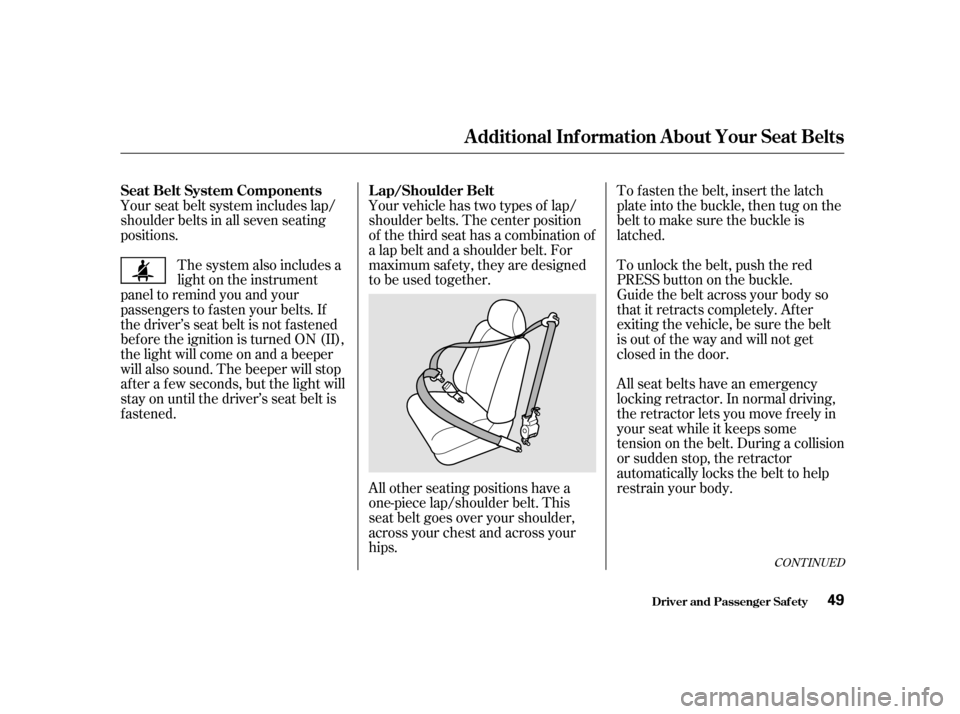
Your vehicle has two types of lap/
shoulder belts. The center position
of the third seat has a combination of
a lap belt and a shoulder belt. For
maximum saf ety, they are designed
to be used together.
All other seating positions have a
one-piece lap/shoulder belt. This
seat belt goes over your shoulder,
across your chest and across yourhips.
Your seat belt system includes lap/
shoulder belts in all seven seating
positions.
The system also includes a
light on the instrument
panel to remind you and your
passengers to f asten your belts. If
the driver’s seat belt is not f astened
before the ignition is turned ON (II),
the light will come on and a beeper
will also sound. The beeper will stop
af ter a f ew seconds, but the light will
stay on until the driver’s seat belt is
f astened.
Seat Belt System Components L ap/Shoulder Belt
Additional Inf ormation About Your Seat Belts
Driver and Passenger Saf ety
49
Page 51 of 363
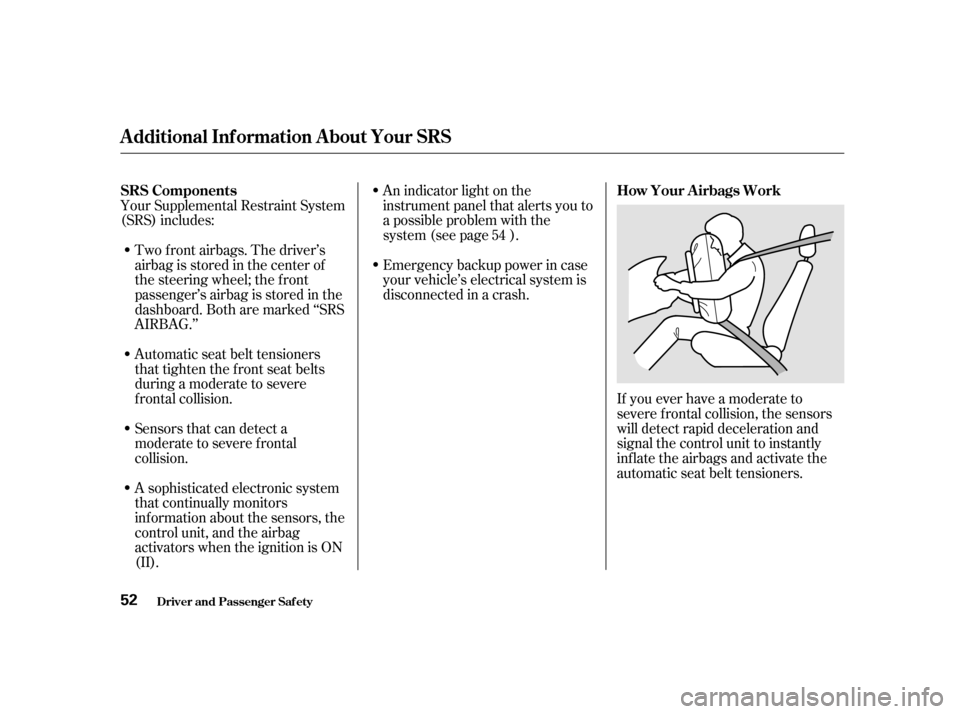
Your Supplemental Restraint System
(SRS) includes:Two f ront airbags. The driver’s
airbag is stored in the center of
the steering wheel; the f ront
passenger’sairbagisstoredinthe
dashboard. Both are marked ‘‘SRS
AIRBAG.’’
If you ever have a moderate to
severe f rontal collision, the sensors
will detect rapid deceleration and
signal the control unit to instantly
inflate the airbags and activate the
automatic seat belt tensioners.
Automatic seat belt tensioners
that tighten the front seat belts
during a moderate to severe
f rontal collision.
Sensors that can detect a
moderate to severe frontal
collision.
A sophisticated electronic system
that continually monitors
inf ormation about the sensors, the
control unit, and the airbag
activators when the ignition is ON
(II). An indicator light on the
instrument panel that alerts you to
a possible problem with the
system (see page ).
Emergency backup power in case
your vehicle’s electrical system is
disconnected in a crash.
54
SRS Components
How Your A irbags Work
Additional Inf ormation About Your SRS
Driver and Passenger Saf ety
52
Page 53 of 363

Thepurposeof theSRS
light is to alert you to a
potential problem with your
Supplemental Restraint System.
This light will also alert you to a
potential problem with your
automatic seat belt tensioners.
When you turn the ignition ON (II),
this indicator will light brief ly then
go out. This tells you that the system
is working properly.
If the light comes on at any other
time, or does not come on at all, you
should have the system checked by
your dealer. For example:
If the SRS indicator light does not
come on after you turn the ignition
ON (II).
If the light stays on after the
engine starts.
If your airbags inf late, the tensioners
immediately tighten the f ront seat
belts to help hold the occupants in
place. The belts will remain tight
until you unbuckle them in the
normal way.
Your Honda has automatic seat belt
tensioners f or added protection
during a moderate to severe frontal
collision. How the SRS Indicator L ight
Works
How the Automatic Seat Belt
T ensioners Work
Additional Inf ormation About Your SRS
Driver and Passenger Saf ety
54
Page 58 of 363

This section gives inf ormation about
the controls and displays that
contribute to the daily operation of
your Honda. All the essential
controls are within easy reach............................
Control Locations . 60
...............................
Indicator Lights . 61
.............................................
Gauges . 66
Controls Near the Steering
.......................................
Wheel . 69
...................................
Headlights . 70
Automatic Lighting Off
.....................................
Feature . 71
............
Daytime Running Lights . 71
....
Instrument Panel Brightness . 71
................................
Turn Signals . 72
.....................
Windshield Wipers . 72
..................
Windshield Washers . 74 Rear Window Wiper and
.....................................
Washer . 74
..........................
Hazard Warning . 75
.............
Rear Window Def ogger . 75
......
Steering Wheel Adjustment . 76
...............
Steering Wheel Controls . 77
.............................
Cruise Control . 77
.............
Remote Audio Controls . 80
...............................
Keys and Locks . 80
..............................................
Keys . 80
....................
Immobilizer System . 81
............................
Ignition Switch . 82
......................
Power Door Locks . 83
...................
Remote Transmitter . 85
..............
Childproof Door Locks . 89
........................................
Tailgate . 89
....................................
Glove Box . 91
.....................
Manual Sliding Doors . 92
.......................
Power Sliding Doors . 93
HomeLink Universal
.................................
Transmitter . 99
...............................................
Seats . 104
....................
Passenger Seating . 104
......................
Seat Adjustments . 105
Driver’s Seat Manual Height
............................
Adjustment . 107 Driver’s Seat Power
..........................
Adjustments . 108
....................................
Armrests . 109
........................
Head Restraints . 110
.....................
Third Seat Access . 111
Moving the Second Row
...........................
Bucket Seat . 112
Removing the Bucket Seats ................
in the Second Row . 114
.............
Folding the Third Seat . 115
............................
Power Windows . 118
...........................................
Mirrors . 121
...............................
Parking Brake . 122
..................................
Digital Clock . 123
..................................
Center Table . 123
...........................
Beverage Holder . 124
........................
Sunglasses Holder . 126
........................................
Sun Visor . 127
................................
Vanity Mirror . 127
.......................
Rear Compartment . 128
...............................
Center Pocket . 128
...................................
Coin Holder . 128
...................................
Storage Box . 129
......................................
Coat Hook . 129
............
Accessory Power Sockets . 130
...............................
Interior Lights . 131
Instruments and Controls
Inst rument s and Cont rols 59
Page 61 of 363

This light has two f unctions:This indicator comes on when you
turn the ignition switch ON (II). It
is a reminder to check the parking
brake. Driving with the parking
brake not f ully released can
damage the brakes and tires.
This indicator lights when you turn
the ignition switch ON (II). If it
comes on at any other time, it
indicates a problem in the
supplemental restraint system. For
complete inf ormation, see page .
If this light comes on when the
engine is running, the battery is not
being charged. For complete
inf ormation, see page .
The engine can be severely damaged
if this light f lashes or stays on when
the engine is running. For complete
inf ormation, see page .
See page .
The instrument panel has many
indicators to give you important
inf ormation about your vehicle.
This indicator lights when you turn
the ignition switch ON (II). It is a
reminder to you and your passengers
to protect yourselves by f astening
the seat belts. A beeper also sounds
if you have not fastened your seat
belt.
If you do not f asten your seat belt,
the beeper will stop af ter a f ew
seconds but the light stays on until
you do. Both the light and the beeper
stay of f if you f asten your seat belt
bef ore turning on the ignition. If the indicator remains lit af ter
you have fully released the
parking brake while the engine is
running, or if it comes on while
driving, it can indicate a problem
in the brake system. For complete
information, see page .
1. 2.
320
318
319
54 322
Indicator L ights
Inst rument s and Cont rols Parking Brake
and Brake
System
Indicator
Supplemental Restraint
System Indicator
Charging System
Indicator
L ow Oil Pressure
Indicator
Malf unction Indicator
Lamp
Seat Belt Reminder L ight
62 U.S. Canada
Page 62 of 363

This light normally comes on f or a
f ew seconds when you turn the
ignition switch ON (II), and when
the ignition switch is turned to
START (III). If this light comes on at
any other time, there is a problem in
theABS.If thishappens,takethe
vehicle to your dealer to have it
checked. With the light on, your
vehicle still has normal braking
ability but no anti-lock. For complete
inf ormation, see page .This indicator comes on f or a f ew
seconds when you turn the ignition
switch ON (II). It will then go of f if
you have inserted a properly-coded
ignition key. If it is not a properly-
coded key, the indicator will blink
and the engine will not start (see
page ).
This indicator also blinks several
times when you turn the ignition
switch f rom ON (II) to ACCESSORY
(I) or LOCK (0).
This indicator has three f unctions:
Itcomesonasareminderthatyou
have turned off the Traction
Control System.
It f lashes when the TCS is
regulating wheelspin.
If itcomesonandstaysonwhen
the Traction Control System is on,
it indicates that there is a problem
in the TCS.
This light also comes on when you
turn the ignition ON (II) and goes off
af ter the engine starts. See page f or more inf ormation on the
TCS.
1. 2. 3.
219 81
221
Indicator L ights
Inst rument s and Cont rols
Traction Control System
(T CS) Indicator
Anti-lock Brake System
(A BS) Indicator Immobilizer System
Indicator
63
U.S. Canada
Page 63 of 363

The lef t or right turn signal light
blinks when you signal a lane change
or turn. If the light does not blink or
blinks rapidly, it usually means one
of the turn signal bulbs is burned out
(see page ). Replace the bulb as
soon as possible, since other drivers
cannot see that you are signalling.
WhenyouturnontheHazard
Warning switch, both turn signal
lights blink. All turn signals on the
outside of the vehicle should f lash.
This indicator comes on f or a f ew
seconds when you turn the ignition
switch ON (II). If it comes on at any
other time, there is a problem in the
power sliding door system. With this
light on, move the main switch on
the dashboard to the OFF position,
and have the system checked by
your Honda dealer as soon as
possible. You can still open or close
each sliding door manually. For
more inf ormation on the power
sliding doors, see page .
All the lights in the monitor display
come on when you turn the ignition
switch ON (II). The lights go of f
after the engine starts and the
tailgate and all doors are closed
tightly.
A burned out brake light is a hazard
when drivers behind you cannot tell
you are braking. Have your brake
lights repaired right away.
The appropriate light comes on in
this display if the tailgate or any door
is not closed tightly. If a brake light
does not work, the
indicator comes on when you push
the brake pedal with the ignition
switch ON (II).
94 283
EX model only
Door and Brake L amp Monitor
Turn Signal and
Hazard Warning
Indicators
Power Sliding Door
Indicator
Indicator L ights
Inst rument s and Cont rols
64 BRAKE LAMP