2001 CHRYSLER VOYAGER warning
[x] Cancel search: warningPage 3986 of 4284
TEST ACTION APPLICABILITY
14WARNING: WHEN THE ENGINE IS OPERATING, DO NOT STAND IN A
DIRECT LINE WITH THE FAN. DO NOT PUT YOUR HANDS NEAR THE
PULLEYS, BELTS OR FAN. DO NOT WEAR LOOSE CLOTHING.
NOTE: The conditions that set the DTC are not present at this time. The
following list may help in identifying the intermittent condition.
NOTE: Remove the MAP Sensor and inspect the MAP and vacuum passage
for restrictions and foriegn material
With the engine running at normal operating temperature, monitor the DRB
parameters related to the DTC while wiggling the wiring harness. Look for param-
eter values to change and/or a DTC to set.
Review the DRB Freeze Frame information. If possible, try to duplicate the
conditions under which the DTC was set.
Refer to any Technical Service Bulletins (TSB) that may apply.
Visually inspect the related wiring harness. Look for any chafed, pierced, pinched, or
partially broken wires.
Visually inspect the related wiring harness connectors. Look for broken, bent, pushed
out, or corroded terminals.
Were any of the above conditions present?All
Ye s®Repair as necessary
Perform POWERTRAIN VERIFICATION TEST VER - 5.
No®Test Complete.
192
DRIVEABILITY - GAS
P1297-NO CHANGE IN MAP FROM START TO RUN ÐContinued
Page 3988 of 4284
TEST ACTION APPLICABILITY
4 Turn the ignition off.
Connect a vacuum gauge to manifold vacuum.
Start the engine and allow it to reach operating temperature.
NOTE: If the engine will not idle, maintain a constant RPM above idle.
With the DRBIIIt, read the MAP Sensor vacuum value.
Is the DRB reading within 19of the vacuum gauge?All
Ye s®Go To 5
No®Replace the MAP Sensor
Perform POWERTRAIN VERIFICATION TEST VER - 5.
5WARNING: WHEN THE ENGINE IS OPERATING, DO NOT STAND IN A
DIRECT LINE WITH THE FAN. DO NOT PUT YOUR HANDS NEAR THE
PULLEYS, BELTS OR FAN. DO NOT WEAR LOOSE CLOTHING.
NOTE: The conditions that set the DTC are not present at this time. The
following list may help in identifying the intermittent condition.
With the engine running at normal operating temperature, monitor the DRB
parameters related to the DTC while wiggling the wiring harness. Look for param-
eter values to change and/or a DTC to set.
Review the DRB Freeze Frame information. If possible, try to duplicate the
conditions under which the DTC was set.
Refer to any Technical Service Bulletins (TSB) that may apply.
Visually inspect the related wiring harness. Look for any chafed, pierced, pinched, or
partially broken wires.
Visually inspect the related wiring harness connectors. Look for broken, bent, pushed
out, or corroded terminals.
Were any of the above conditions present?All
Ye s®Repair as necessary
Perform POWERTRAIN VERIFICATION TEST VER - 5.
No®Test Complete.
194
DRIVEABILITY - GAS
P1299-VACUUM LEAK FOUND (IAC FULLY SEATED) ÐContinued
Page 3990 of 4284
TEST ACTION APPLICABILITY
3WARNING: WHEN THE ENGINE IS OPERATING, DO NOT STAND IN A
DIRECT LINE WITH THE FAN. DO NOT PUT YOUR HANDS NEAR THE
PULLEYS, BELTS OR FAN. DO NOT WEAR LOOSE CLOTHING.
NOTE: The conditions that set the DTC are not present at this time. The
following list may help in identifying the intermittent condition.
With the engine running at normal operating temperature, monitor the DRB
parameters related to the DTC while wiggling the wiring harness. Look for param-
eter values to change and/or a DTC to set.
Review the DRB Freeze Frame information. If possible, try to duplicate the
conditions under which the DTC was set.
Refer to any Technical Service Bulletins (TSB) that may apply.
Visually inspect the related wiring harness. Look for any chafed, pierced, pinched, or
partially broken wires.
Visually inspect the related wiring harness connectors. Look for broken, bent, pushed
out, or corroded terminals.
Were any of the above conditions present?All
Ye s®Repair as necessary
Perform POWERTRAIN VERIFICATION TEST VER - 5.
No®Test Complete.
4NOTE: Inspect the ASD Relay fuse located in the IPM. If the ASD Relay fuse
is open, repair the cause of the open first before continuing. Inspect the ASD
Relay Output circuit for a short to ground for the cause of the open fuse.
Turn the ignition off.
Remove the ASD Relay from the IPM.
Turn the ignition on.
Using a 12-volt test light connected to ground, probe the Fused B+ circuit in the IPM.
Does the test light illuminate?All
Ye s®Go To 5
No®Replace the IPM Fuse & Relay Center.
Perform POWERTRAIN VERIFICATION TEST VER - 5.
5 Turn the ignition off.
Remove the ASD Relay from the IPM.
Turn the ignition on.
Using a 12-volt test light connected to 12-volts, probe the ASD Relay Control circuit
in the IPM.
With the DRBIIIt, actuate the ASD Relay.
Does the test light flash on and off?All
Ye s®Replace the ASD Relay.
Perform POWERTRAIN VERIFICATION TEST VER - 5.
No®Go To 6
6 Turn the ignition off.
Disconnect the Intelligent Power Module C3 harness connector.
Turn the ignition on.
Using a 12-volt test light connected to 12-volts, probe the ASD Relay Control circuit
in the IPM harness connector.
With the DRBIIIt, actuate the ASD Relay.
Does the test light flash on and off?All
Ye s®Replace the IPM Fused & Relay Center.
Perform POWERTRAIN VERIFICATION TEST VER - 5.
No®Go To 7
196
DRIVEABILITY - GAS
P1388-AUTO SHUTDOWN RELAY CONTROL CIRCUIT ÐContinued
Page 3994 of 4284
TEST ACTION APPLICABILITY
8NOTE: Ensure the IPM C4 harness connector is connected to the IPM.
Turn the ignition off.
Disconnect the PCM harness connector.
Measure the resistance of the ASD Relay Output circuit between the IPM and the
PCM harness connector.
Is the resistance below 5.0 ohms?All
Ye s®Replace and program the Powertrain Control Module in accor-
dance with the Service Information.
Perform POWERTRAIN VERIFICATION TEST VER - 5.
No®Replace the IPM Fuse & Relay Center.
Perform POWERTRAIN VERIFICATION TEST VER - 5.
9WARNING: WHEN THE ENGINE IS OPERATING, DO NOT STAND IN A
DIRECT LINE WITH THE FAN. DO NOT PUT YOUR HANDS NEAR THE
PULLEYS, BELTS OR FAN. DO NOT WEAR LOOSE CLOTHING.
NOTE: The conditions that set the DTC are not present at this time. The
following list may help in identifying the intermittent condition.
With the engine running at normal operating temperature, monitor the DRB
parameters related to the DTC while wiggling the wiring harness. Check for the
engine stumble, stall or quite running.
Refer to any Technical Service Bulletins (TSB) that may apply.
Visually inspect the related wiring harness. Look for any chafed, pierced, pinched, or
partially broken wires.
Visually inspect the related wiring harness connectors. Look for broken, bent, pushed
out, or corroded terminals.
Were any of the above conditions present?All
Ye s®Repair as necessary
Perform POWERTRAIN VERIFICATION TEST VER - 5.
No®Test Complete.
200
DRIVEABILITY - GAS
P1389-NO ASD RELAY OUTPUT VOLTAGE AT PCM ÐContinued
Page 3995 of 4284
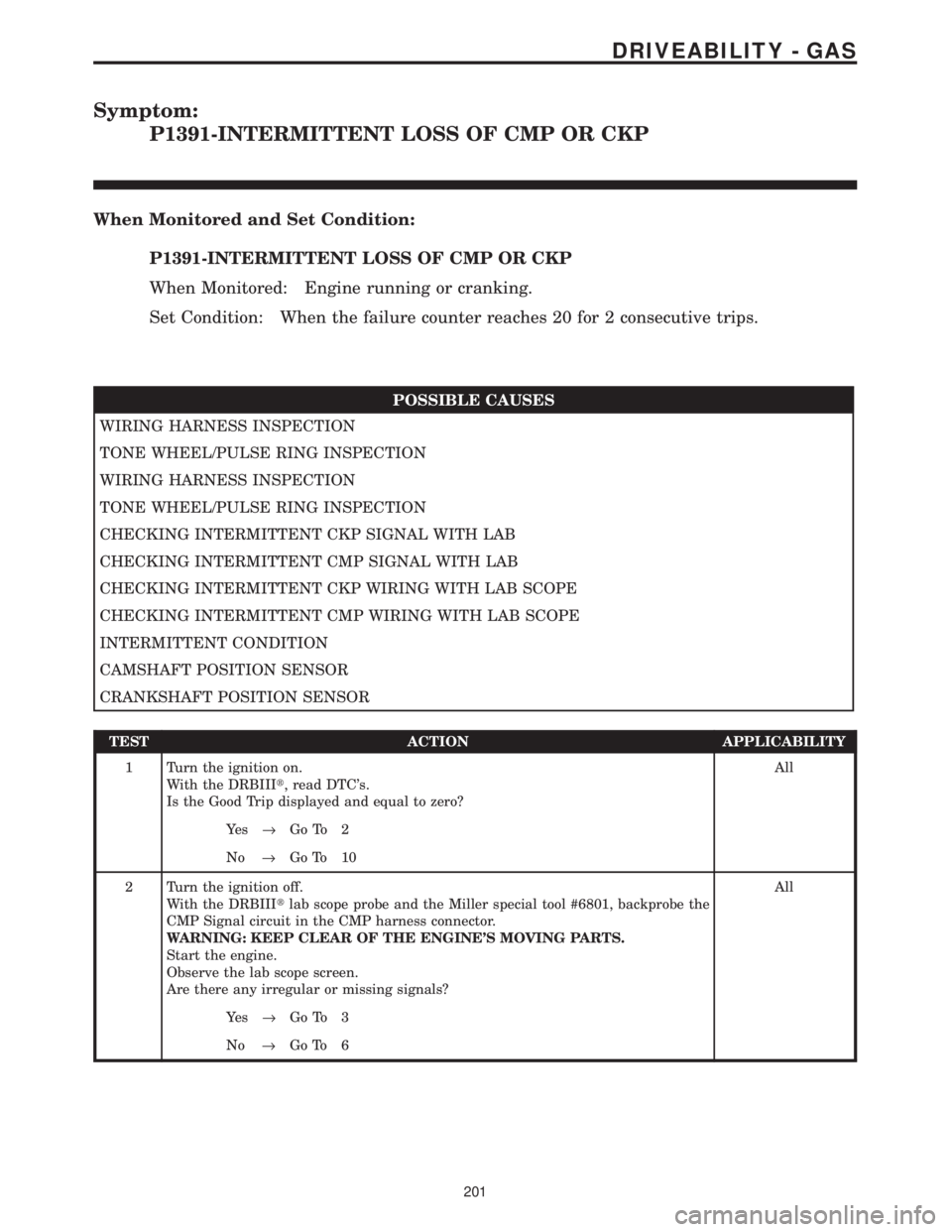
Symptom:
P1391-INTERMITTENT LOSS OF CMP OR CKP
When Monitored and Set Condition:
P1391-INTERMITTENT LOSS OF CMP OR CKP
When Monitored: Engine running or cranking.
Set Condition: When the failure counter reaches 20 for 2 consecutive trips.
POSSIBLE CAUSES
WIRING HARNESS INSPECTION
TONE WHEEL/PULSE RING INSPECTION
WIRING HARNESS INSPECTION
TONE WHEEL/PULSE RING INSPECTION
CHECKING INTERMITTENT CKP SIGNAL WITH LAB
CHECKING INTERMITTENT CMP SIGNAL WITH LAB
CHECKING INTERMITTENT CKP WIRING WITH LAB SCOPE
CHECKING INTERMITTENT CMP WIRING WITH LAB SCOPE
INTERMITTENT CONDITION
CAMSHAFT POSITION SENSOR
CRANKSHAFT POSITION SENSOR
TEST ACTION APPLICABILITY
1 Turn the ignition on.
With the DRBIIIt, read DTC's.
Is the Good Trip displayed and equal to zero?All
Ye s®Go To 2
No®Go To 10
2 Turn the ignition off.
With the DRBIIItlab scope probe and the Miller special tool #6801, backprobe the
CMP Signal circuit in the CMP harness connector.
WARNING: KEEP CLEAR OF THE ENGINE'S MOVING PARTS.
Start the engine.
Observe the lab scope screen.
Are there any irregular or missing signals?All
Ye s®Go To 3
No®Go To 6
201
DRIVEABILITY - GAS
Page 3996 of 4284
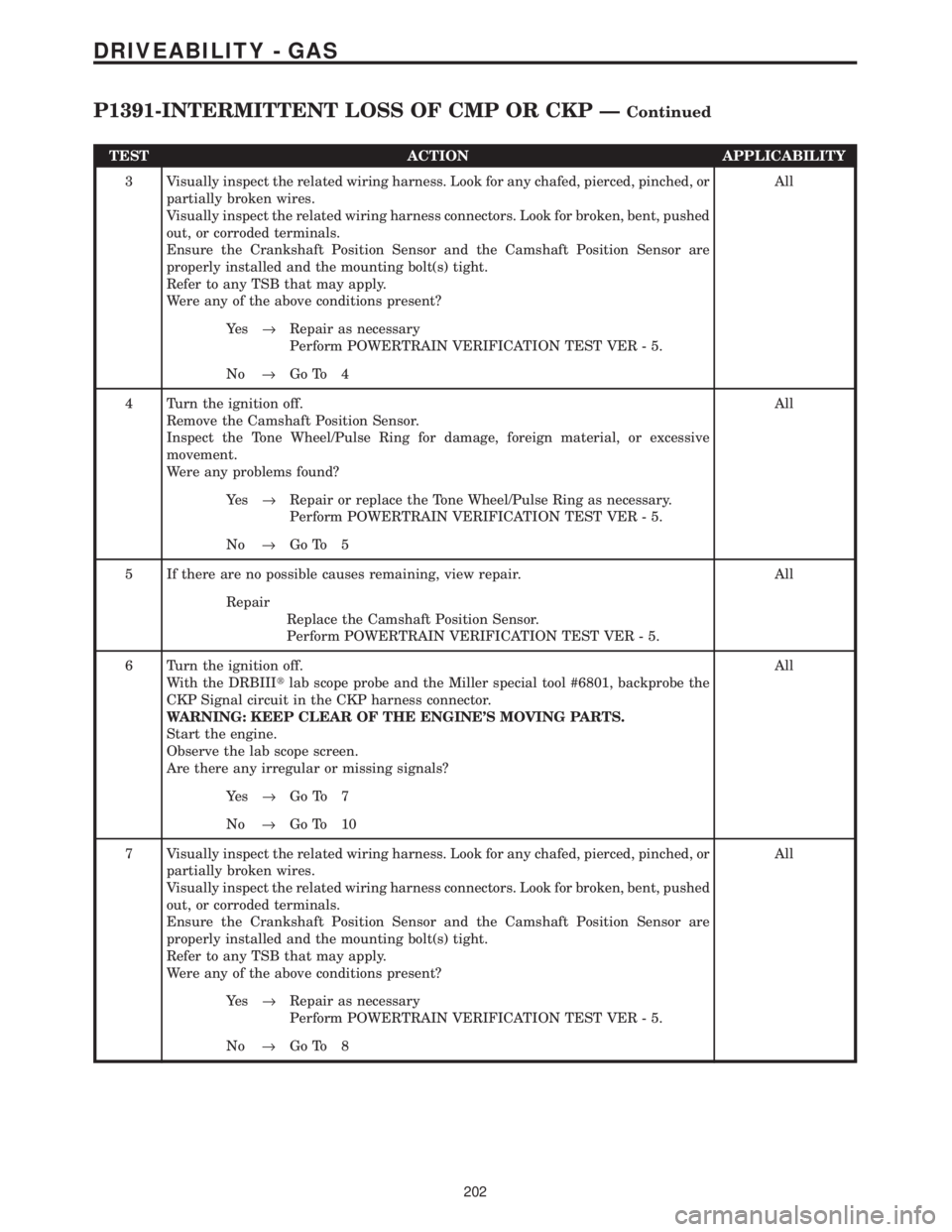
TEST ACTION APPLICABILITY
3 Visually inspect the related wiring harness. Look for any chafed, pierced, pinched, or
partially broken wires.
Visually inspect the related wiring harness connectors. Look for broken, bent, pushed
out, or corroded terminals.
Ensure the Crankshaft Position Sensor and the Camshaft Position Sensor are
properly installed and the mounting bolt(s) tight.
Refer to any TSB that may apply.
Were any of the above conditions present?All
Ye s®Repair as necessary
Perform POWERTRAIN VERIFICATION TEST VER - 5.
No®Go To 4
4 Turn the ignition off.
Remove the Camshaft Position Sensor.
Inspect the Tone Wheel/Pulse Ring for damage, foreign material, or excessive
movement.
Were any problems found?All
Ye s®Repair or replace the Tone Wheel/Pulse Ring as necessary.
Perform POWERTRAIN VERIFICATION TEST VER - 5.
No®Go To 5
5 If there are no possible causes remaining, view repair. All
Repair
Replace the Camshaft Position Sensor.
Perform POWERTRAIN VERIFICATION TEST VER - 5.
6 Turn the ignition off.
With the DRBIIItlab scope probe and the Miller special tool #6801, backprobe the
CKP Signal circuit in the CKP harness connector.
WARNING: KEEP CLEAR OF THE ENGINE'S MOVING PARTS.
Start the engine.
Observe the lab scope screen.
Are there any irregular or missing signals?All
Ye s®Go To 7
No®Go To 10
7 Visually inspect the related wiring harness. Look for any chafed, pierced, pinched, or
partially broken wires.
Visually inspect the related wiring harness connectors. Look for broken, bent, pushed
out, or corroded terminals.
Ensure the Crankshaft Position Sensor and the Camshaft Position Sensor are
properly installed and the mounting bolt(s) tight.
Refer to any TSB that may apply.
Were any of the above conditions present?All
Ye s®Repair as necessary
Perform POWERTRAIN VERIFICATION TEST VER - 5.
No®Go To 8
202
DRIVEABILITY - GAS
P1391-INTERMITTENT LOSS OF CMP OR CKP ÐContinued
Page 3997 of 4284
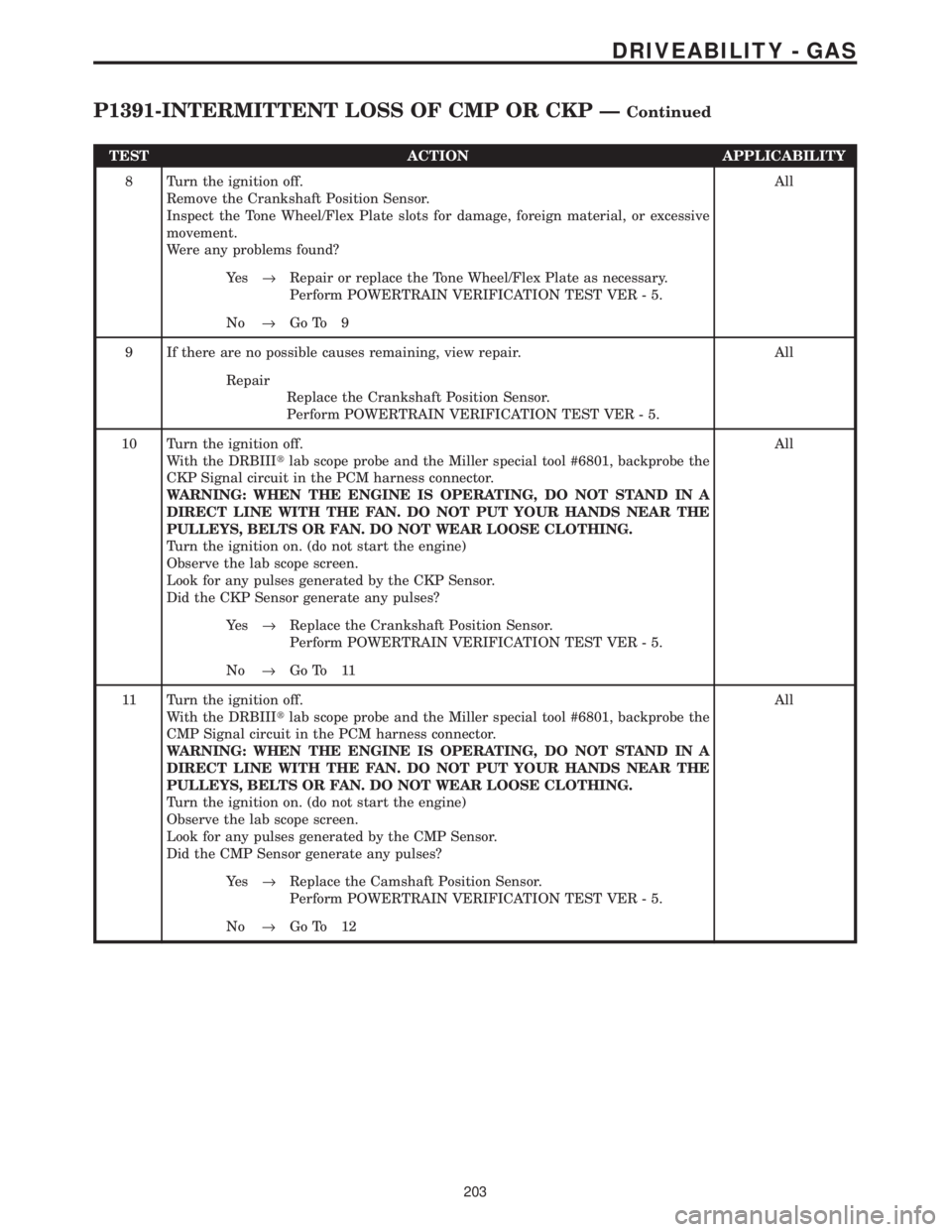
TEST ACTION APPLICABILITY
8 Turn the ignition off.
Remove the Crankshaft Position Sensor.
Inspect the Tone Wheel/Flex Plate slots for damage, foreign material, or excessive
movement.
Were any problems found?All
Ye s®Repair or replace the Tone Wheel/Flex Plate as necessary.
Perform POWERTRAIN VERIFICATION TEST VER - 5.
No®Go To 9
9 If there are no possible causes remaining, view repair. All
Repair
Replace the Crankshaft Position Sensor.
Perform POWERTRAIN VERIFICATION TEST VER - 5.
10 Turn the ignition off.
With the DRBIIItlab scope probe and the Miller special tool #6801, backprobe the
CKP Signal circuit in the PCM harness connector.
WARNING: WHEN THE ENGINE IS OPERATING, DO NOT STAND IN A
DIRECT LINE WITH THE FAN. DO NOT PUT YOUR HANDS NEAR THE
PULLEYS, BELTS OR FAN. DO NOT WEAR LOOSE CLOTHING.
Turn the ignition on. (do not start the engine)
Observe the lab scope screen.
Look for any pulses generated by the CKP Sensor.
Did the CKP Sensor generate any pulses?All
Ye s®Replace the Crankshaft Position Sensor.
Perform POWERTRAIN VERIFICATION TEST VER - 5.
No®Go To 11
11 Turn the ignition off.
With the DRBIIItlab scope probe and the Miller special tool #6801, backprobe the
CMP Signal circuit in the PCM harness connector.
WARNING: WHEN THE ENGINE IS OPERATING, DO NOT STAND IN A
DIRECT LINE WITH THE FAN. DO NOT PUT YOUR HANDS NEAR THE
PULLEYS, BELTS OR FAN. DO NOT WEAR LOOSE CLOTHING.
Turn the ignition on. (do not start the engine)
Observe the lab scope screen.
Look for any pulses generated by the CMP Sensor.
Did the CMP Sensor generate any pulses?All
Ye s®Replace the Camshaft Position Sensor.
Perform POWERTRAIN VERIFICATION TEST VER - 5.
No®Go To 12
203
DRIVEABILITY - GAS
P1391-INTERMITTENT LOSS OF CMP OR CKP ÐContinued
Page 3998 of 4284
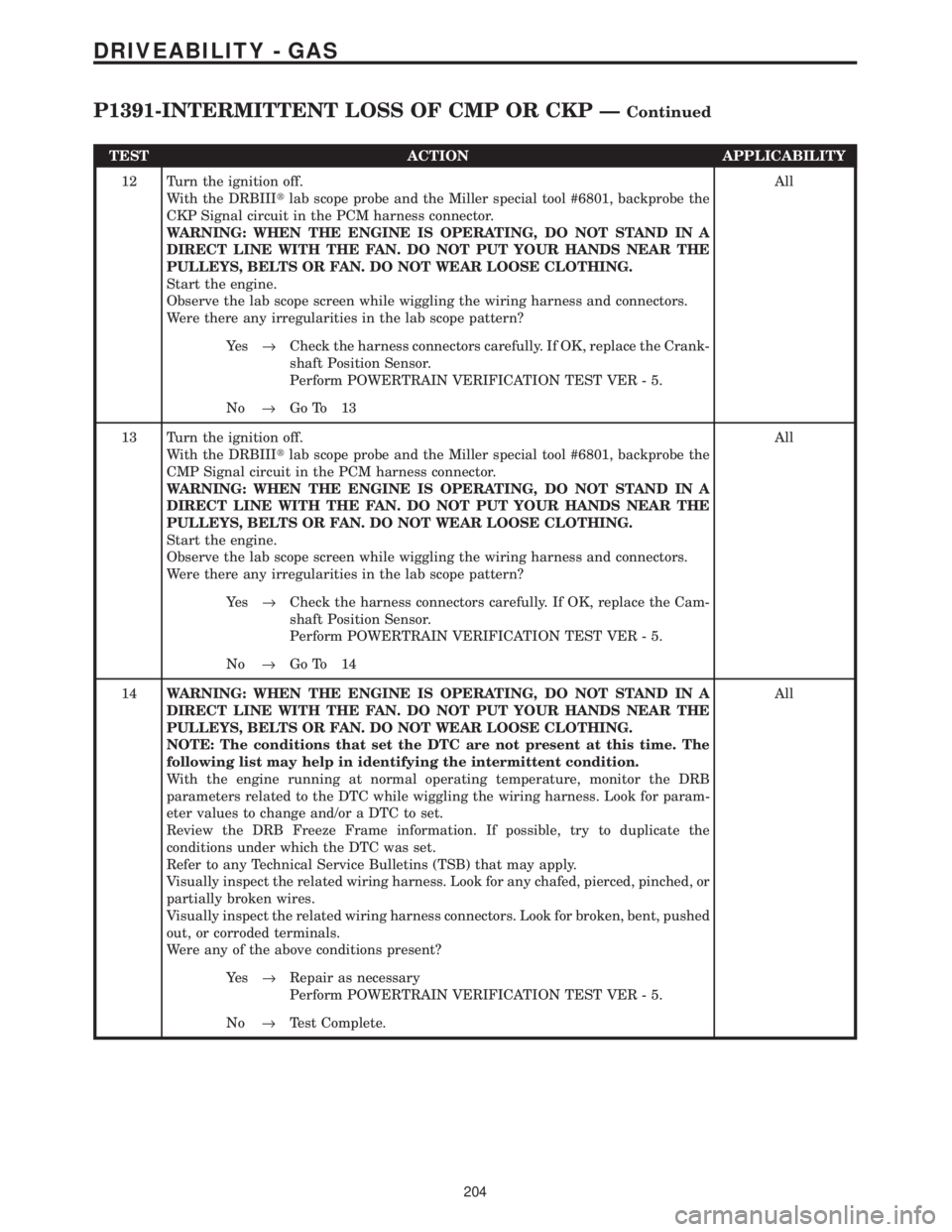
TEST ACTION APPLICABILITY
12 Turn the ignition off.
With the DRBIIItlab scope probe and the Miller special tool #6801, backprobe the
CKP Signal circuit in the PCM harness connector.
WARNING: WHEN THE ENGINE IS OPERATING, DO NOT STAND IN A
DIRECT LINE WITH THE FAN. DO NOT PUT YOUR HANDS NEAR THE
PULLEYS, BELTS OR FAN. DO NOT WEAR LOOSE CLOTHING.
Start the engine.
Observe the lab scope screen while wiggling the wiring harness and connectors.
Were there any irregularities in the lab scope pattern?All
Ye s®Check the harness connectors carefully. If OK, replace the Crank-
shaft Position Sensor.
Perform POWERTRAIN VERIFICATION TEST VER - 5.
No®Go To 13
13 Turn the ignition off.
With the DRBIIItlab scope probe and the Miller special tool #6801, backprobe the
CMP Signal circuit in the PCM harness connector.
WARNING: WHEN THE ENGINE IS OPERATING, DO NOT STAND IN A
DIRECT LINE WITH THE FAN. DO NOT PUT YOUR HANDS NEAR THE
PULLEYS, BELTS OR FAN. DO NOT WEAR LOOSE CLOTHING.
Start the engine.
Observe the lab scope screen while wiggling the wiring harness and connectors.
Were there any irregularities in the lab scope pattern?All
Ye s®Check the harness connectors carefully. If OK, replace the Cam-
shaft Position Sensor.
Perform POWERTRAIN VERIFICATION TEST VER - 5.
No®Go To 14
14WARNING: WHEN THE ENGINE IS OPERATING, DO NOT STAND IN A
DIRECT LINE WITH THE FAN. DO NOT PUT YOUR HANDS NEAR THE
PULLEYS, BELTS OR FAN. DO NOT WEAR LOOSE CLOTHING.
NOTE: The conditions that set the DTC are not present at this time. The
following list may help in identifying the intermittent condition.
With the engine running at normal operating temperature, monitor the DRB
parameters related to the DTC while wiggling the wiring harness. Look for param-
eter values to change and/or a DTC to set.
Review the DRB Freeze Frame information. If possible, try to duplicate the
conditions under which the DTC was set.
Refer to any Technical Service Bulletins (TSB) that may apply.
Visually inspect the related wiring harness. Look for any chafed, pierced, pinched, or
partially broken wires.
Visually inspect the related wiring harness connectors. Look for broken, bent, pushed
out, or corroded terminals.
Were any of the above conditions present?All
Ye s®Repair as necessary
Perform POWERTRAIN VERIFICATION TEST VER - 5.
No®Test Complete.
204
DRIVEABILITY - GAS
P1391-INTERMITTENT LOSS OF CMP OR CKP ÐContinued