2001 CHRYSLER VOYAGER battery
[x] Cancel search: batteryPage 4036 of 4284
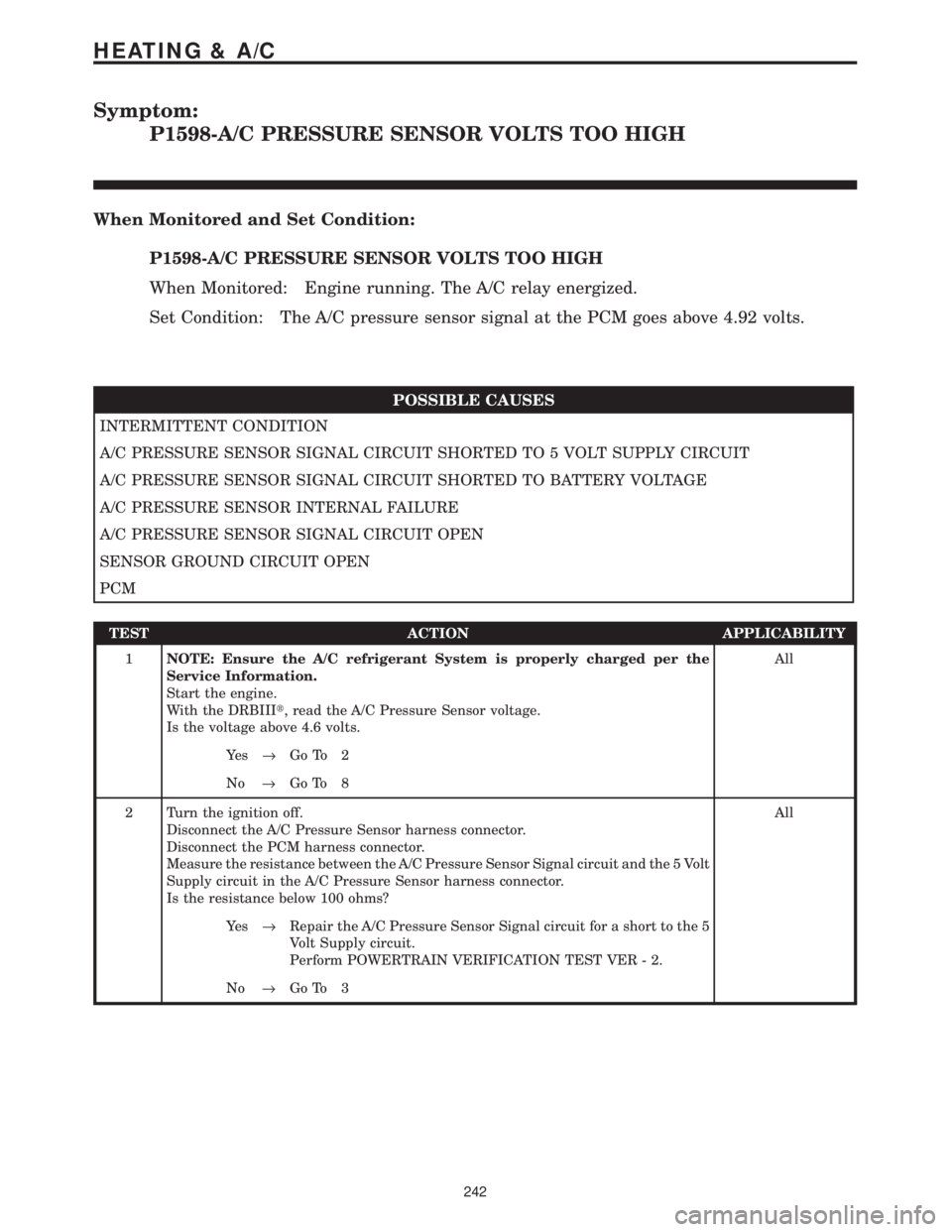
Symptom:
P1598-A/C PRESSURE SENSOR VOLTS TOO HIGH
When Monitored and Set Condition:
P1598-A/C PRESSURE SENSOR VOLTS TOO HIGH
When Monitored: Engine running. The A/C relay energized.
Set Condition: The A/C pressure sensor signal at the PCM goes above 4.92 volts.
POSSIBLE CAUSES
INTERMITTENT CONDITION
A/C PRESSURE SENSOR SIGNAL CIRCUIT SHORTED TO 5 VOLT SUPPLY CIRCUIT
A/C PRESSURE SENSOR SIGNAL CIRCUIT SHORTED TO BATTERY VOLTAGE
A/C PRESSURE SENSOR INTERNAL FAILURE
A/C PRESSURE SENSOR SIGNAL CIRCUIT OPEN
SENSOR GROUND CIRCUIT OPEN
PCM
TEST ACTION APPLICABILITY
1NOTE: Ensure the A/C refrigerant System is properly charged per the
Service Information.
Start the engine.
With the DRBIIIt, read the A/C Pressure Sensor voltage.
Is the voltage above 4.6 volts.All
Ye s®Go To 2
No®Go To 8
2 Turn the ignition off.
Disconnect the A/C Pressure Sensor harness connector.
Disconnect the PCM harness connector.
Measure the resistance between the A/C Pressure Sensor Signal circuit and the 5 Volt
Supply circuit in the A/C Pressure Sensor harness connector.
Is the resistance below 100 ohms?All
Ye s®Repair the A/C Pressure Sensor Signal circuit for a short to the 5
Volt Supply circuit.
Perform POWERTRAIN VERIFICATION TEST VER - 2.
No®Go To 3
242
HEATING & A/C
Page 4037 of 4284
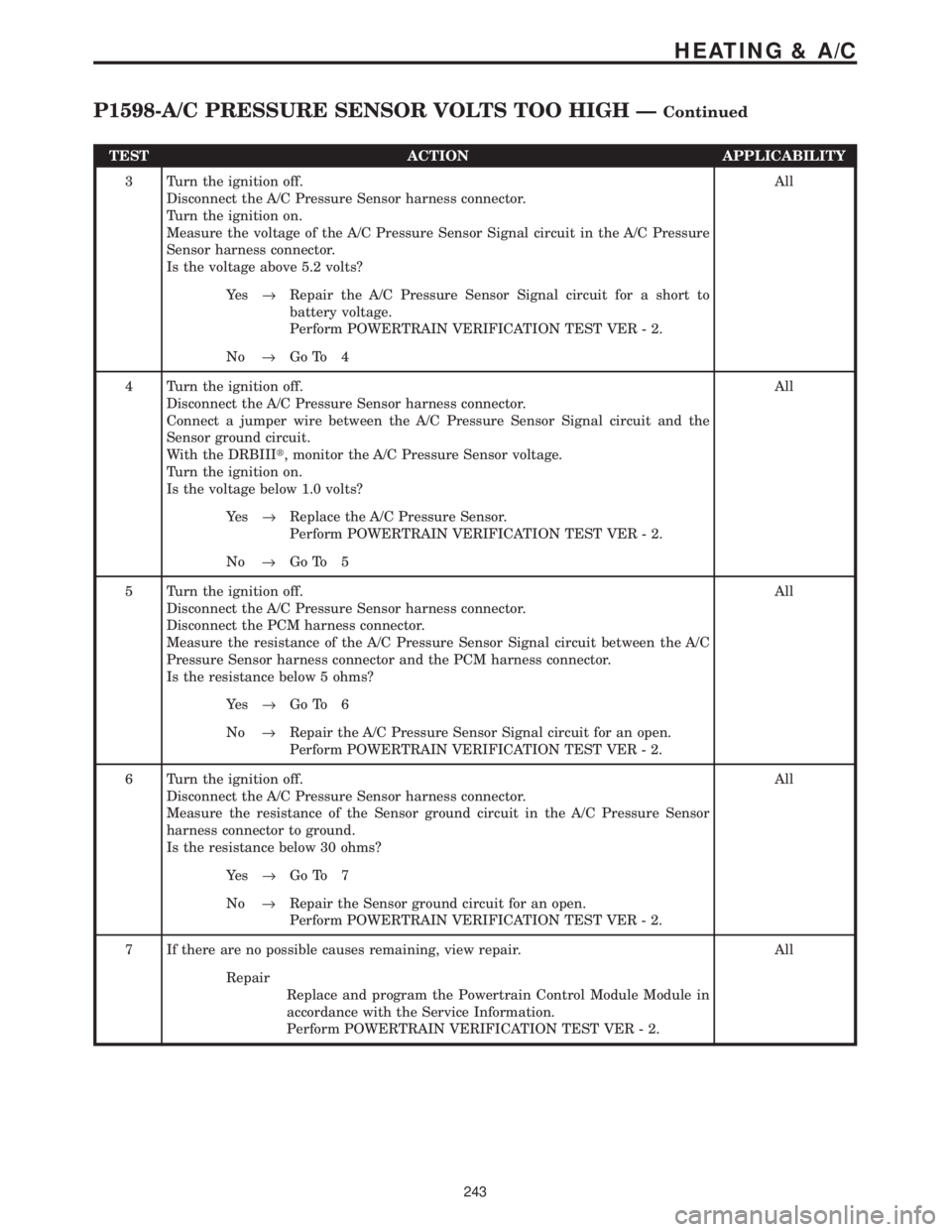
TEST ACTION APPLICABILITY
3 Turn the ignition off.
Disconnect the A/C Pressure Sensor harness connector.
Turn the ignition on.
Measure the voltage of the A/C Pressure Sensor Signal circuit in the A/C Pressure
Sensor harness connector.
Is the voltage above 5.2 volts?All
Ye s®Repair the A/C Pressure Sensor Signal circuit for a short to
battery voltage.
Perform POWERTRAIN VERIFICATION TEST VER - 2.
No®Go To 4
4 Turn the ignition off.
Disconnect the A/C Pressure Sensor harness connector.
Connect a jumper wire between the A/C Pressure Sensor Signal circuit and the
Sensor ground circuit.
With the DRBIIIt, monitor the A/C Pressure Sensor voltage.
Turn the ignition on.
Is the voltage below 1.0 volts?All
Ye s®Replace the A/C Pressure Sensor.
Perform POWERTRAIN VERIFICATION TEST VER - 2.
No®Go To 5
5 Turn the ignition off.
Disconnect the A/C Pressure Sensor harness connector.
Disconnect the PCM harness connector.
Measure the resistance of the A/C Pressure Sensor Signal circuit between the A/C
Pressure Sensor harness connector and the PCM harness connector.
Is the resistance below 5 ohms?All
Ye s®Go To 6
No®Repair the A/C Pressure Sensor Signal circuit for an open.
Perform POWERTRAIN VERIFICATION TEST VER - 2.
6 Turn the ignition off.
Disconnect the A/C Pressure Sensor harness connector.
Measure the resistance of the Sensor ground circuit in the A/C Pressure Sensor
harness connector to ground.
Is the resistance below 30 ohms?All
Ye s®Go To 7
No®Repair the Sensor ground circuit for an open.
Perform POWERTRAIN VERIFICATION TEST VER - 2.
7 If there are no possible causes remaining, view repair. All
Repair
Replace and program the Powertrain Control Module Module in
accordance with the Service Information.
Perform POWERTRAIN VERIFICATION TEST VER - 2.
243
HEATING & A/C
P1598-A/C PRESSURE SENSOR VOLTS TOO HIGH ÐContinued
Page 4042 of 4284
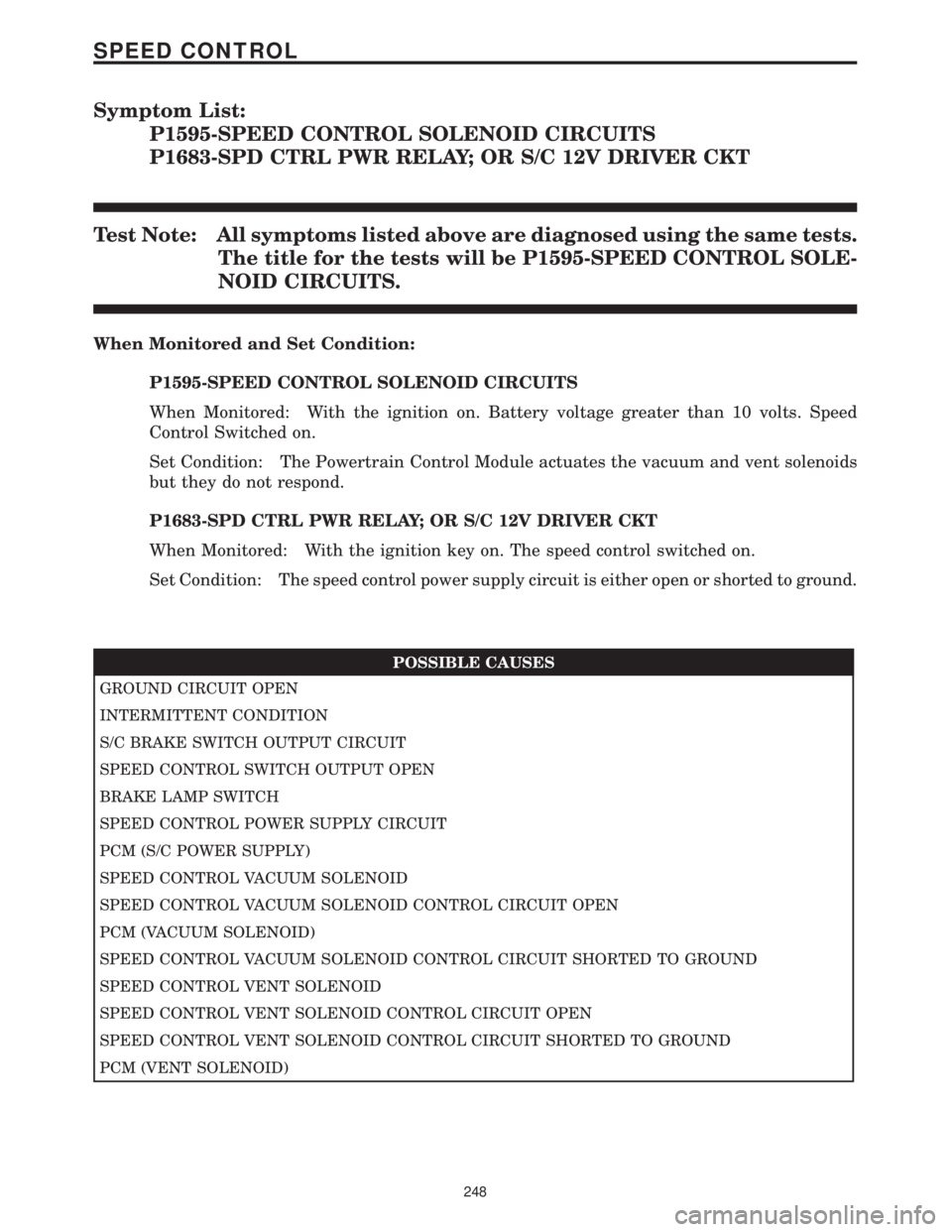
Symptom List:
P1595-SPEED CONTROL SOLENOID CIRCUITS
P1683-SPD CTRL PWR RELAY; OR S/C 12V DRIVER CKT
Test Note: All symptoms listed above are diagnosed using the same tests.
The title for the tests will be P1595-SPEED CONTROL SOLE-
NOID CIRCUITS.
When Monitored and Set Condition:
P1595-SPEED CONTROL SOLENOID CIRCUITS
When Monitored: With the ignition on. Battery voltage greater than 10 volts. Speed
Control Switched on.
Set Condition: The Powertrain Control Module actuates the vacuum and vent solenoids
but they do not respond.
P1683-SPD CTRL PWR RELAY; OR S/C 12V DRIVER CKT
When Monitored: With the ignition key on. The speed control switched on.
Set Condition: The speed control power supply circuit is either open or shorted to ground.
POSSIBLE CAUSES
GROUND CIRCUIT OPEN
INTERMITTENT CONDITION
S/C BRAKE SWITCH OUTPUT CIRCUIT
SPEED CONTROL SWITCH OUTPUT OPEN
BRAKE LAMP SWITCH
SPEED CONTROL POWER SUPPLY CIRCUIT
PCM (S/C POWER SUPPLY)
SPEED CONTROL VACUUM SOLENOID
SPEED CONTROL VACUUM SOLENOID CONTROL CIRCUIT OPEN
PCM (VACUUM SOLENOID)
SPEED CONTROL VACUUM SOLENOID CONTROL CIRCUIT SHORTED TO GROUND
SPEED CONTROL VENT SOLENOID
SPEED CONTROL VENT SOLENOID CONTROL CIRCUIT OPEN
SPEED CONTROL VENT SOLENOID CONTROL CIRCUIT SHORTED TO GROUND
PCM (VENT SOLENOID)
248
SPEED CONTROL
Page 4047 of 4284
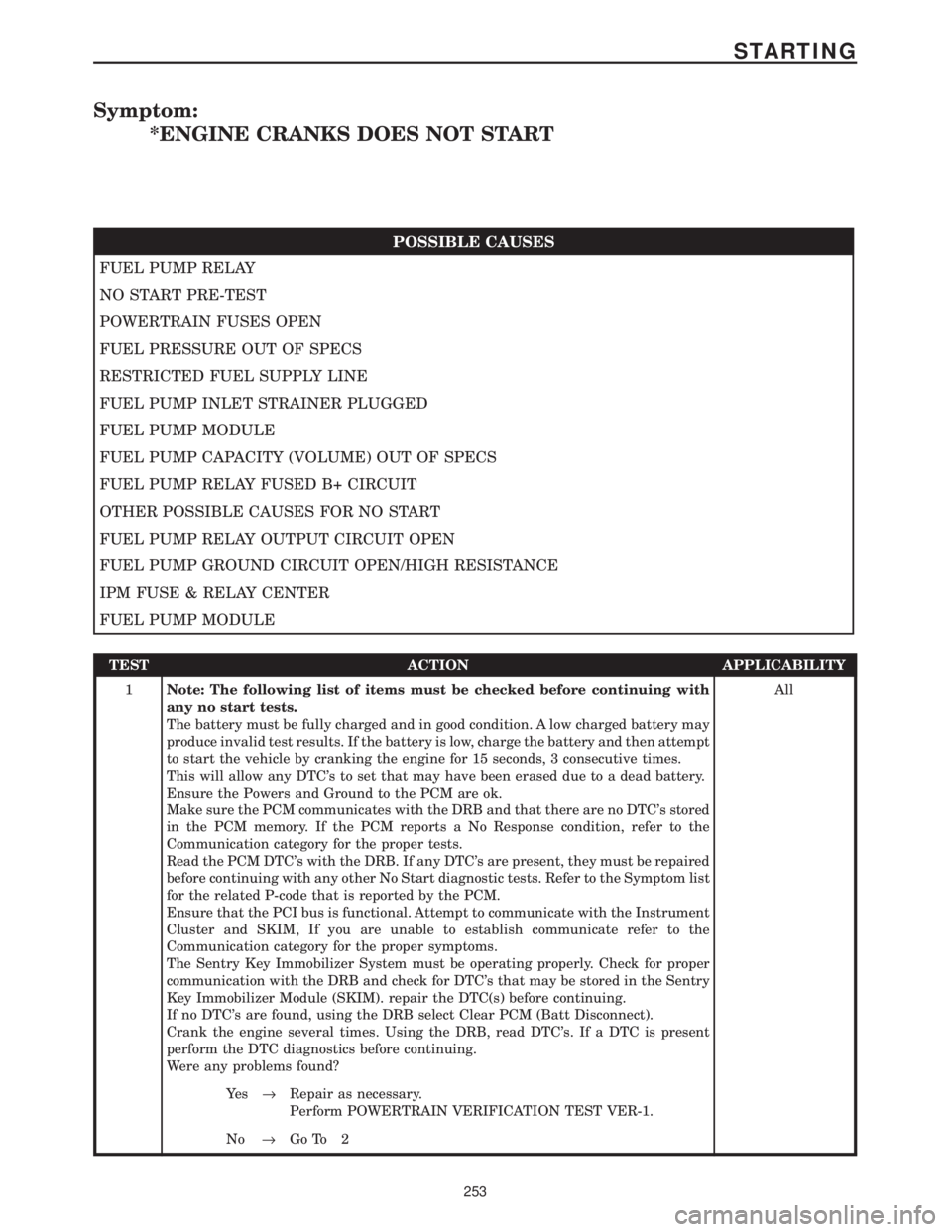
Symptom:
*ENGINE CRANKS DOES NOT START
POSSIBLE CAUSES
FUEL PUMP RELAY
NO START PRE-TEST
POWERTRAIN FUSES OPEN
FUEL PRESSURE OUT OF SPECS
RESTRICTED FUEL SUPPLY LINE
FUEL PUMP INLET STRAINER PLUGGED
FUEL PUMP MODULE
FUEL PUMP CAPACITY (VOLUME) OUT OF SPECS
FUEL PUMP RELAY FUSED B+ CIRCUIT
OTHER POSSIBLE CAUSES FOR NO START
FUEL PUMP RELAY OUTPUT CIRCUIT OPEN
FUEL PUMP GROUND CIRCUIT OPEN/HIGH RESISTANCE
IPM FUSE & RELAY CENTER
FUEL PUMP MODULE
TEST ACTION APPLICABILITY
1Note: The following list of items must be checked before continuing with
any no start tests.
The battery must be fully charged and in good condition. A low charged battery may
produce invalid test results. If the battery is low, charge the battery and then attempt
to start the vehicle by cranking the engine for 15 seconds, 3 consecutive times.
This will allow any DTC's to set that may have been erased due to a dead battery.
Ensure the Powers and Ground to the PCM are ok.
Make sure the PCM communicates with the DRB and that there are no DTC's stored
in the PCM memory. If the PCM reports a No Response condition, refer to the
Communication category for the proper tests.
Read the PCM DTC's with the DRB. If any DTC's are present, they must be repaired
before continuing with any other No Start diagnostic tests. Refer to the Symptom list
for the related P-code that is reported by the PCM.
Ensure that the PCI bus is functional. Attempt to communicate with the Instrument
Cluster and SKIM, If you are unable to establish communicate refer to the
Communication category for the proper symptoms.
The Sentry Key Immobilizer System must be operating properly. Check for proper
communication with the DRB and check for DTC's that may be stored in the Sentry
Key Immobilizer Module (SKIM). repair the DTC(s) before continuing.
If no DTC's are found, using the DRB select Clear PCM (Batt Disconnect).
Crank the engine several times. Using the DRB, read DTC's. If a DTC is present
perform the DTC diagnostics before continuing.
Were any problems found?All
Ye s®Repair as necessary.
Perform POWERTRAIN VERIFICATION TEST VER-1.
No®Go To 2
253
STARTING
Page 4050 of 4284
TEST ACTION APPLICABILITY
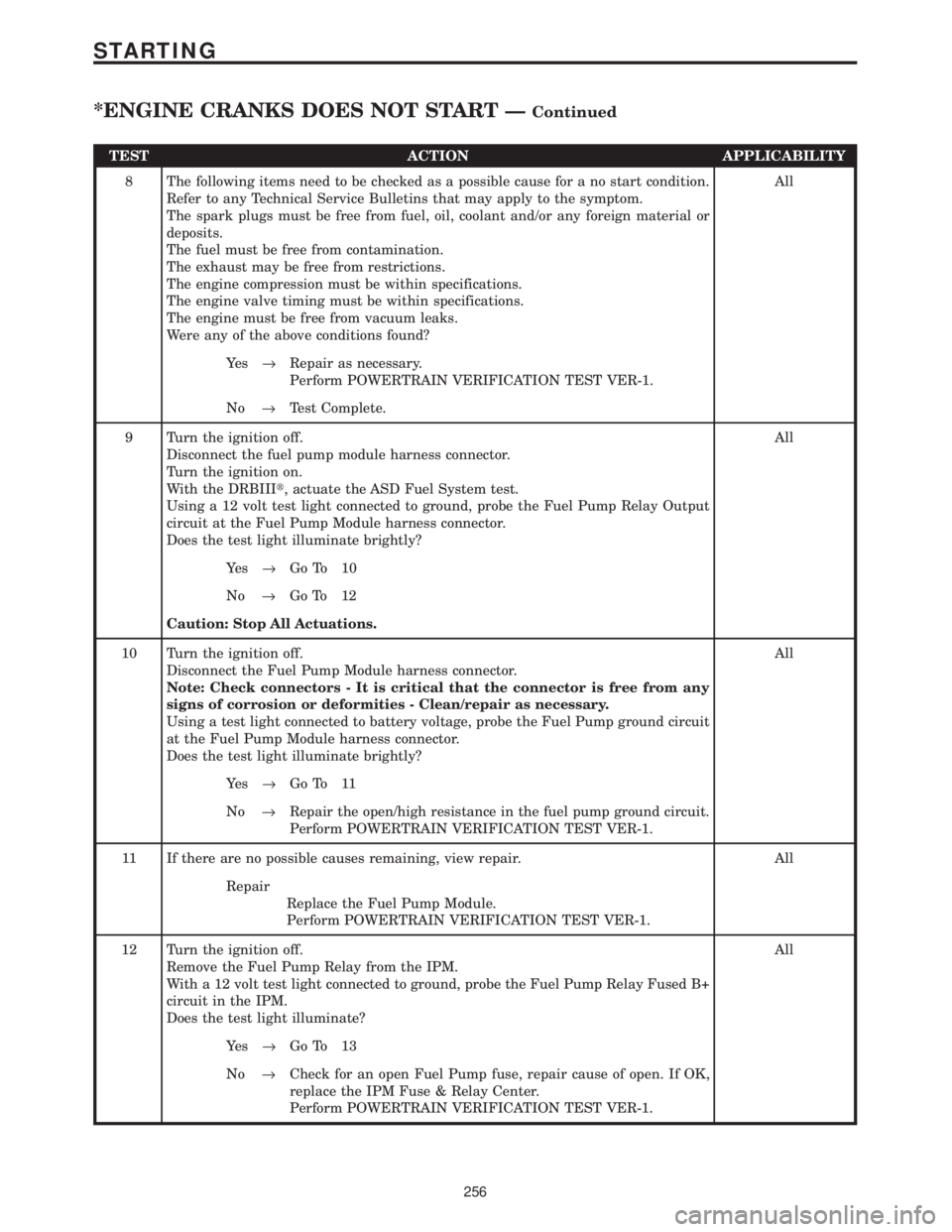
8 The following items need to be checked as a possible cause for a no start condition.
Refer to any Technical Service Bulletins that may apply to the symptom.
The spark plugs must be free from fuel, oil, coolant and/or any foreign material or
deposits.
The fuel must be free from contamination.
The exhaust may be free from restrictions.
The engine compression must be within specifications.
The engine valve timing must be within specifications.
The engine must be free from vacuum leaks.
Were any of the above conditions found?All
Ye s®Repair as necessary.
Perform POWERTRAIN VERIFICATION TEST VER-1.
No®Test Complete.
9 Turn the ignition off.
Disconnect the fuel pump module harness connector.
Turn the ignition on.
With the DRBIIIt, actuate the ASD Fuel System test.
Using a 12 volt test light connected to ground, probe the Fuel Pump Relay Output
circuit at the Fuel Pump Module harness connector.
Does the test light illuminate brightly?All
Ye s®Go To 10
No®Go To 12
Caution: Stop All Actuations.
10 Turn the ignition off.
Disconnect the Fuel Pump Module harness connector.
Note: Check connectors - It is critical that the connector is free from any
signs of corrosion or deformities - Clean/repair as necessary.
Using a test light connected to battery voltage, probe the Fuel Pump ground circuit
at the Fuel Pump Module harness connector.
Does the test light illuminate brightly?All
Ye s®Go To 11
No®Repair the open/high resistance in the fuel pump ground circuit.
Perform POWERTRAIN VERIFICATION TEST VER-1.
11 If there are no possible causes remaining, view repair. All
Repair
Replace the Fuel Pump Module.
Perform POWERTRAIN VERIFICATION TEST VER-1.
12 Turn the ignition off.
Remove the Fuel Pump Relay from the IPM.
With a 12 volt test light connected to ground, probe the Fuel Pump Relay Fused B+
circuit in the IPM.
Does the test light illuminate?All
Ye s®Go To 13
No®Check for an open Fuel Pump fuse, repair cause of open. If OK,
replace the IPM Fuse & Relay Center.
Perform POWERTRAIN VERIFICATION TEST VER-1.
256
STARTING
*ENGINE CRANKS DOES NOT START ÐContinued
Page 4052 of 4284
Symptom:
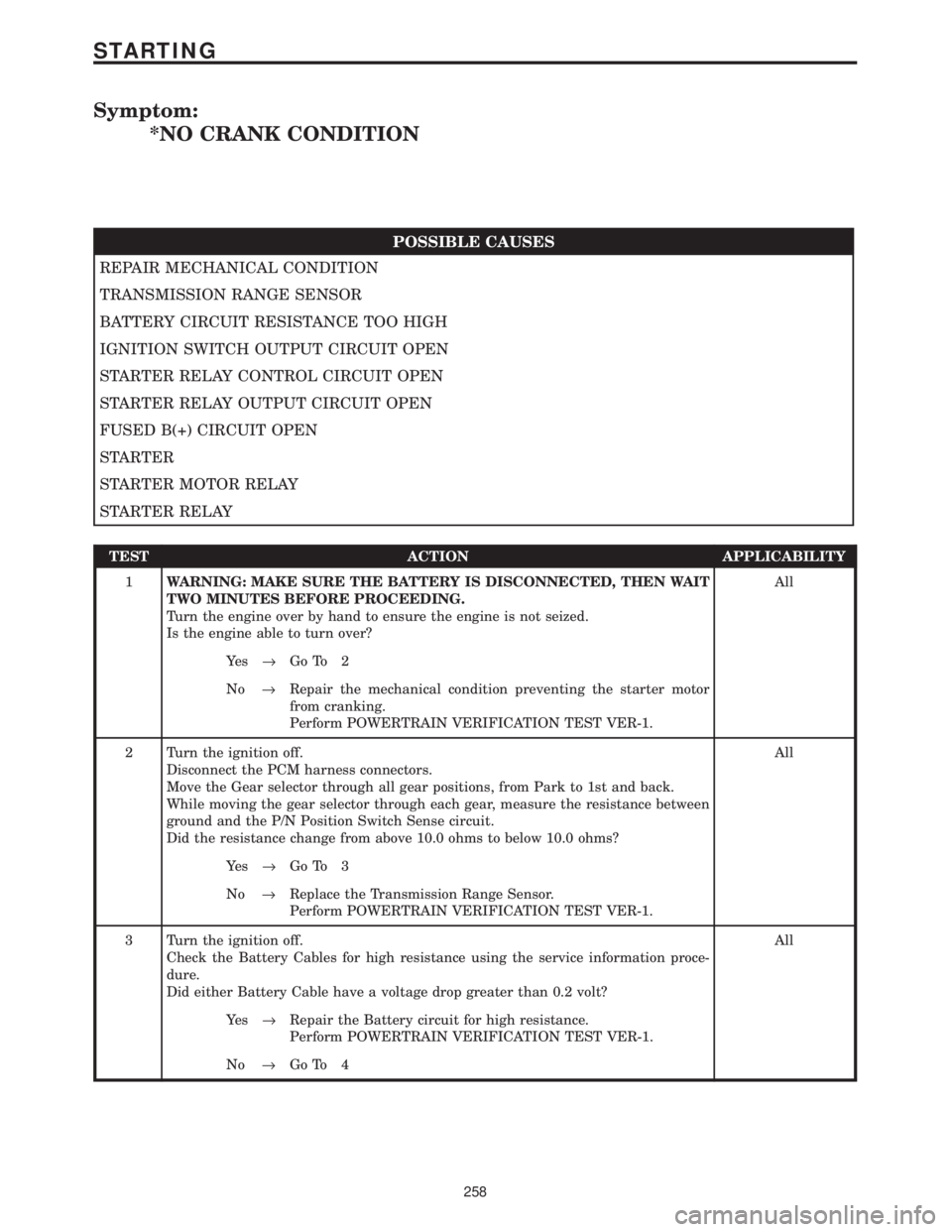
*NO CRANK CONDITION
POSSIBLE CAUSES
REPAIR MECHANICAL CONDITION
TRANSMISSION RANGE SENSOR
BATTERY CIRCUIT RESISTANCE TOO HIGH
IGNITION SWITCH OUTPUT CIRCUIT OPEN
STARTER RELAY CONTROL CIRCUIT OPEN
STARTER RELAY OUTPUT CIRCUIT OPEN
FUSED B(+) CIRCUIT OPEN
STARTER
STARTER MOTOR RELAY
STARTER RELAY
TEST ACTION APPLICABILITY
1WARNING: MAKE SURE THE BATTERY IS DISCONNECTED, THEN WAIT
TWO MINUTES BEFORE PROCEEDING.
Turn the engine over by hand to ensure the engine is not seized.
Is the engine able to turn over?All
Ye s®Go To 2
No®Repair the mechanical condition preventing the starter motor
from cranking.
Perform POWERTRAIN VERIFICATION TEST VER-1.
2 Turn the ignition off.
Disconnect the PCM harness connectors.
Move the Gear selector through all gear positions, from Park to 1st and back.
While moving the gear selector through each gear, measure the resistance between
ground and the P/N Position Switch Sense circuit.
Did the resistance change from above 10.0 ohms to below 10.0 ohms?All
Ye s®Go To 3
No®Replace the Transmission Range Sensor.
Perform POWERTRAIN VERIFICATION TEST VER-1.
3 Turn the ignition off.
Check the Battery Cables for high resistance using the service information proce-
dure.
Did either Battery Cable have a voltage drop greater than 0.2 volt?All
Ye s®Repair the Battery circuit for high resistance.
Perform POWERTRAIN VERIFICATION TEST VER-1.
No®Go To 4
258
STARTING
Page 4055 of 4284
Symptom:
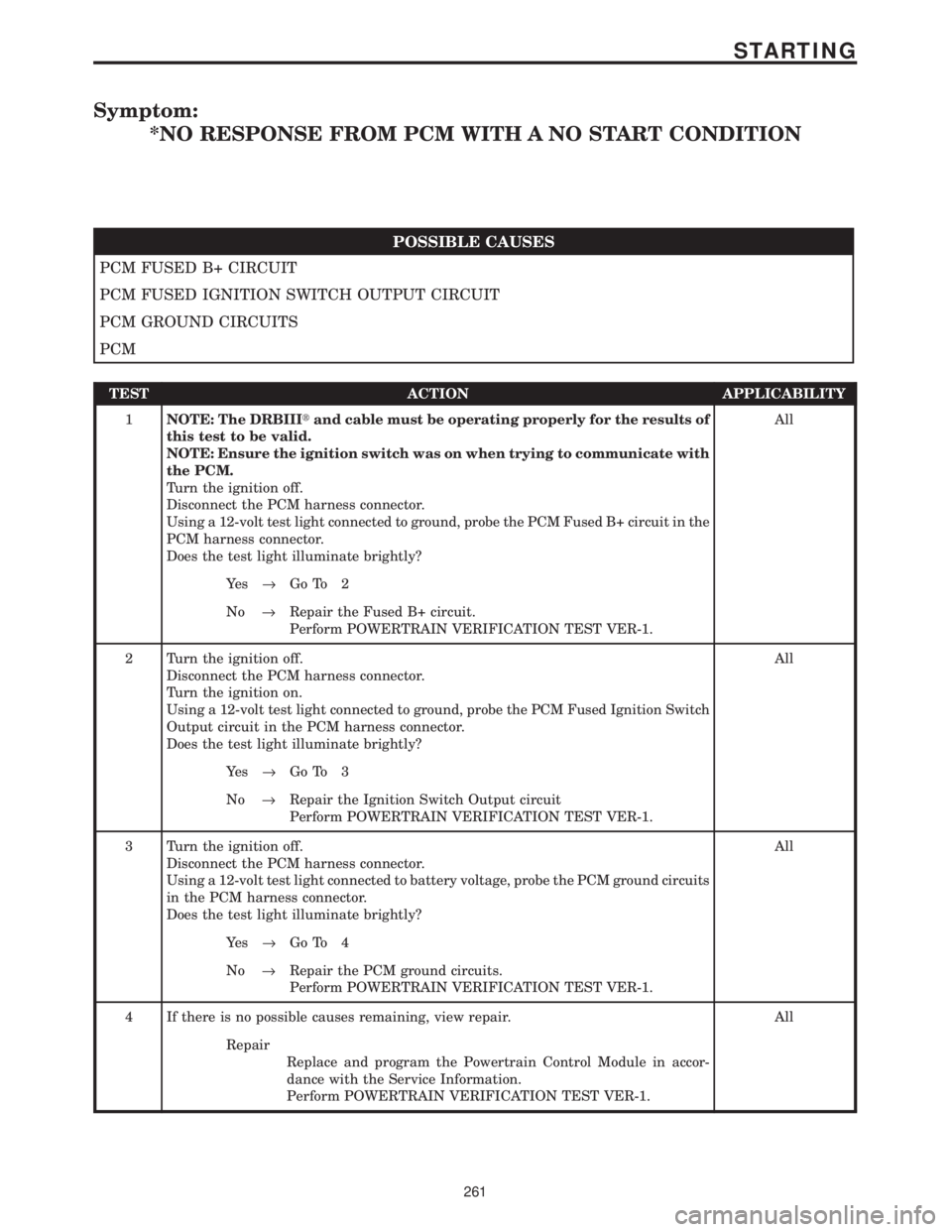
*NO RESPONSE FROM PCM WITH A NO START CONDITION
POSSIBLE CAUSES
PCM FUSED B+ CIRCUIT
PCM FUSED IGNITION SWITCH OUTPUT CIRCUIT
PCM GROUND CIRCUITS
PCM
TEST ACTION APPLICABILITY
1NOTE: The DRBIIItand cable must be operating properly for the results of
this test to be valid.
NOTE: Ensure the ignition switch was on when trying to communicate with
the PCM.
Turn the ignition off.
Disconnect the PCM harness connector.
Using a 12-volt test light connected to ground, probe the PCM Fused B+ circuit in the
PCM harness connector.
Does the test light illuminate brightly?All
Ye s®Go To 2
No®Repair the Fused B+ circuit.
Perform POWERTRAIN VERIFICATION TEST VER-1.
2 Turn the ignition off.
Disconnect the PCM harness connector.
Turn the ignition on.
Using a 12-volt test light connected to ground, probe the PCM Fused Ignition Switch
Output circuit in the PCM harness connector.
Does the test light illuminate brightly?All
Ye s®Go To 3
No®Repair the Ignition Switch Output circuit
Perform POWERTRAIN VERIFICATION TEST VER-1.
3 Turn the ignition off.
Disconnect the PCM harness connector.
Using a 12-volt test light connected to battery voltage, probe the PCM ground circuits
in the PCM harness connector.
Does the test light illuminate brightly?All
Ye s®Go To 4
No®Repair the PCM ground circuits.
Perform POWERTRAIN VERIFICATION TEST VER-1.
4 If there is no possible causes remaining, view repair. All
Repair
Replace and program the Powertrain Control Module in accor-
dance with the Service Information.
Perform POWERTRAIN VERIFICATION TEST VER-1.
261
STARTING
Page 4070 of 4284
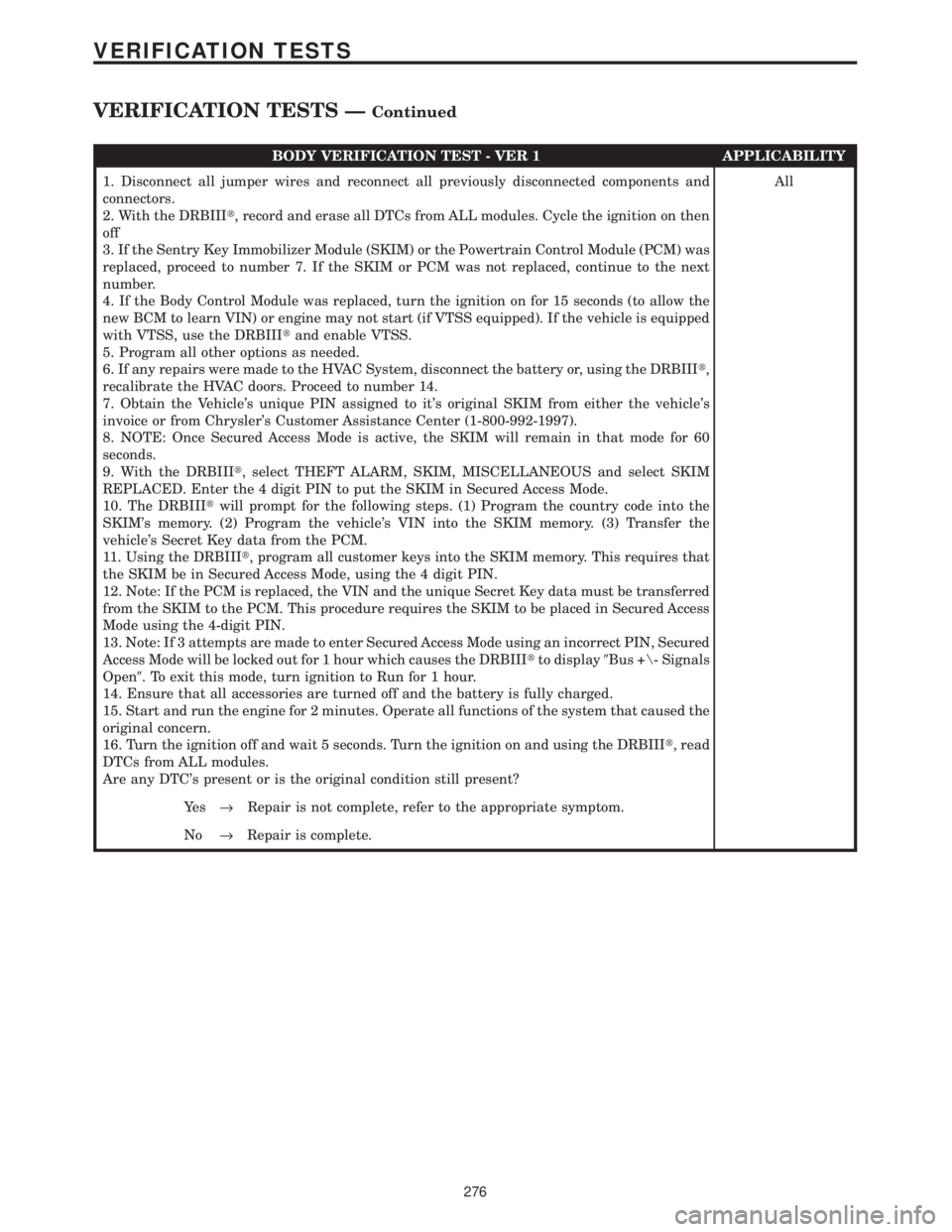
BODY VERIFICATION TEST - VER 1 APPLICABILITY
1. Disconnect all jumper wires and reconnect all previously disconnected components and
connectors.
2. With the DRBIIIt, record and erase all DTCs from ALL modules. Cycle the ignition on then
off
3. If the Sentry Key Immobilizer Module (SKIM) or the Powertrain Control Module (PCM) was
replaced, proceed to number 7. If the SKIM or PCM was not replaced, continue to the next
number.
4. If the Body Control Module was replaced, turn the ignition on for 15 seconds (to allow the
new BCM to learn VIN) or engine may not start (if VTSS equipped). If the vehicle is equipped
with VTSS, use the DRBIIItand enable VTSS.
5. Program all other options as needed.
6. If any repairs were made to the HVAC System, disconnect the battery or, using the DRBIIIt,
recalibrate the HVAC doors. Proceed to number 14.
7. Obtain the Vehicle's unique PIN assigned to it's original SKIM from either the vehicle's
invoice or from Chrysler's Customer Assistance Center (1-800-992-1997).
8. NOTE: Once Secured Access Mode is active, the SKIM will remain in that mode for 60
seconds.
9. With the DRBIIIt, select THEFT ALARM, SKIM, MISCELLANEOUS and select SKIM
REPLACED. Enter the 4 digit PIN to put the SKIM in Secured Access Mode.
10. The DRBIIItwill prompt for the following steps. (1) Program the country code into the
SKIM's memory. (2) Program the vehicle's VIN into the SKIM memory. (3) Transfer the
vehicle's Secret Key data from the PCM.
11. Using the DRBIIIt, program all customer keys into the SKIM memory. This requires that
the SKIM be in Secured Access Mode, using the 4 digit PIN.
12. Note: If the PCM is replaced, the VIN and the unique Secret Key data must be transferred
from the SKIM to the PCM. This procedure requires the SKIM to be placed in Secured Access
Mode using the 4-digit PIN.
13. Note: If 3 attempts are made to enter Secured Access Mode using an incorrect PIN, Secured
Access Mode will be locked out for 1 hour which causes the DRBIIItto display9Bus +\- Signals
Open9. To exit this mode, turn ignition to Run for 1 hour.
14. Ensure that all accessories are turned off and the battery is fully charged.
15. Start and run the engine for 2 minutes. Operate all functions of the system that caused the
original concern.
16. Turn the ignition off and wait 5 seconds. Turn the ignition on and using the DRBIIIt, read
DTCs from ALL modules.
Are any DTC's present or is the original condition still present?All
Ye s®Repair is not complete, refer to the appropriate symptom.
No®Repair is complete.
276
VERIFICATION TESTS
VERIFICATION TESTS ÐContinued