2001 CHRYSLER VOYAGER battery
[x] Cancel search: batteryPage 4111 of 4284
Name of code:P1781(21) - OD Pressure Switch
Sense Circuit
When monitored:Whenever the engine is run-
ning.
Set condition:This code is set if the OD pressure
switch is open or closed at the wrong time in a given
gear (see chart below).
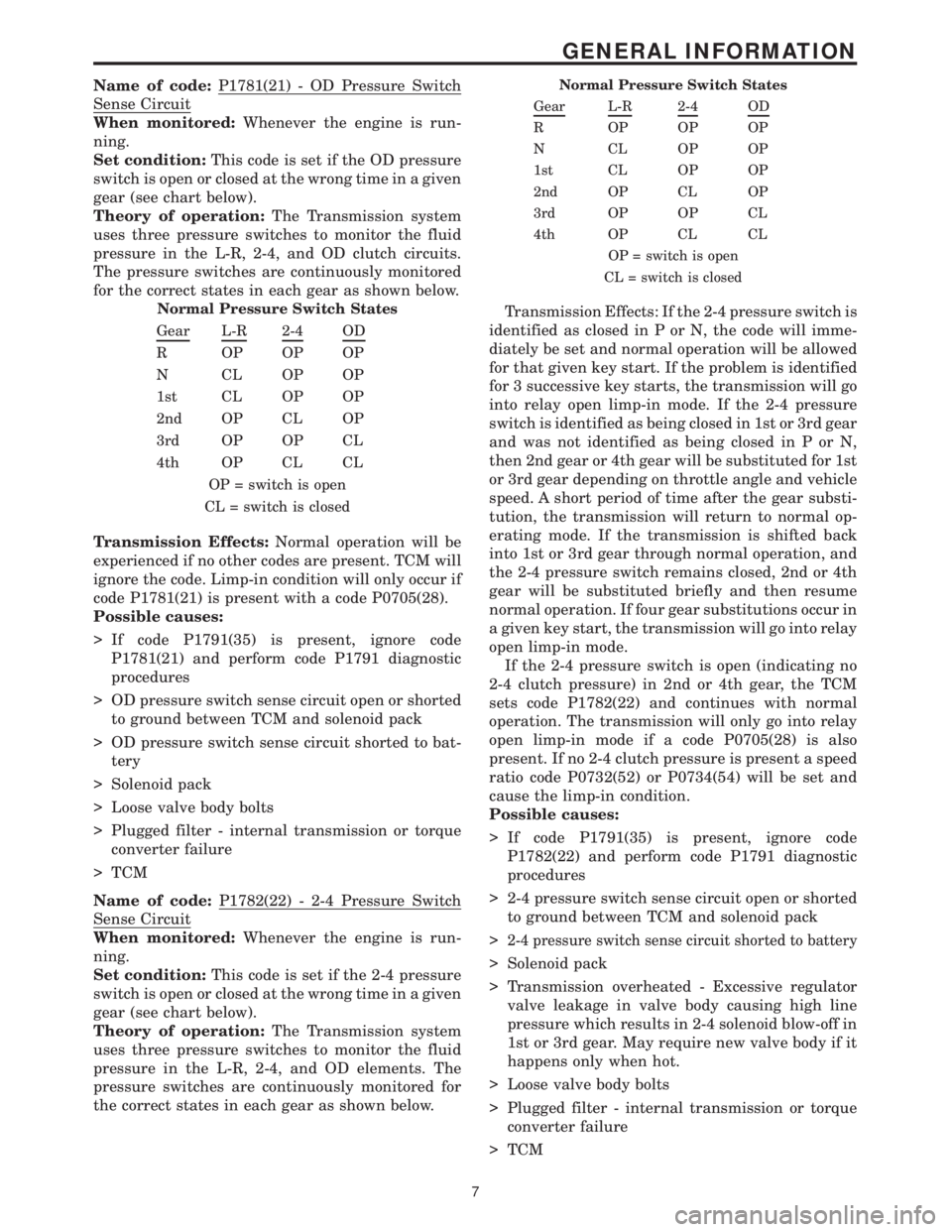
Theory of operation:The Transmission system
uses three pressure switches to monitor the fluid
pressure in the L-R, 2-4, and OD clutch circuits.
The pressure switches are continuously monitored
for the correct states in each gear as shown below.
Normal Pressure Switch States
Gear
L-R2-4OD
R OPOPOP
NCLOPOP
1st CL OP OP
2nd OP CL OP
3rd OP OP CL
4th OP CL CL
OP = switch is open
CL = switch is closed
Transmission Effects:Normal operation will be
experienced if no other codes are present. TCM will
ignore the code. Limp-in condition will only occur if
code P1781(21) is present with a code P0705(28).
Possible causes:
> If code P1791(35) is present, ignore code
P1781(21) and perform code P1791 diagnostic
procedures
> OD pressure switch sense circuit open or shorted
to ground between TCM and solenoid pack
> OD pressure switch sense circuit shorted to bat-
tery
> Solenoid pack
> Loose valve body bolts
> Plugged filter - internal transmission or torque
converter failure
> TCM
Name of code:P1782(22) - 2-4 Pressure Switch
Sense Circuit
When monitored:Whenever the engine is run-
ning.
Set condition:This code is set if the 2-4 pressure
switch is open or closed at the wrong time in a given
gear (see chart below).
Theory of operation:The Transmission system
uses three pressure switches to monitor the fluid
pressure in the L-R, 2-4, and OD elements. The
pressure switches are continuously monitored for
the correct states in each gear as shown below.
Normal Pressure Switch States
Gear
L-R2-4OD
R OPOPOP
NCLOPOP
1st CL OP OP
2nd OP CL OP
3rd OP OP CL
4th OP CL CL
OP = switch is open
CL = switch is closed
Transmission Effects: If the 2-4 pressure switch is
identified as closed in P or N, the code will imme-
diately be set and normal operation will be allowed
for that given key start. If the problem is identified
for 3 successive key starts, the transmission will go
into relay open limp-in mode. If the 2-4 pressure
switch is identified as being closed in 1st or 3rd gear
and was not identified as being closed in P or N,
then 2nd gear or 4th gear will be substituted for 1st
or 3rd gear depending on throttle angle and vehicle
speed. A short period of time after the gear substi-
tution, the transmission will return to normal op-
erating mode. If the transmission is shifted back
into 1st or 3rd gear through normal operation, and
the 2-4 pressure switch remains closed, 2nd or 4th
gear will be substituted briefly and then resume
normal operation. If four gear substitutions occur in
a given key start, the transmission will go into relay
open limp-in mode.
If the 2-4 pressure switch is open (indicating no
2-4 clutch pressure) in 2nd or 4th gear, the TCM
sets code P1782(22) and continues with normal
operation. The transmission will only go into relay
open limp-in mode if a code P0705(28) is also
present. If no 2-4 clutch pressure is present a speed
ratio code P0732(52) or P0734(54) will be set and
cause the limp-in condition.
Possible causes:
> If code P1791(35) is present, ignore code
P1782(22) and perform code P1791 diagnostic
procedures
> 2-4 pressure switch sense circuit open or shorted
to ground between TCM and solenoid pack
>
2-4 pressure switch sense circuit shorted to battery
> Solenoid pack
> Transmission overheated - Excessive regulator
valve leakage in valve body causing high line
pressure which results in 2-4 solenoid blow-off in
1st or 3rd gear. May require new valve body if it
happens only when hot.
> Loose valve body bolts
> Plugged filter - internal transmission or torque
converter failure
> TCM
7
GENERAL INFORMATION
Page 4112 of 4284
Name of code:P1784(24) - L/R Pressure Switch
Sense Circuit
When monitored:Whenever the engine is run-
ning.
Set condition:This code is set if the L-R pressure
switch is either open or closed at the wrong time in
a given gear.
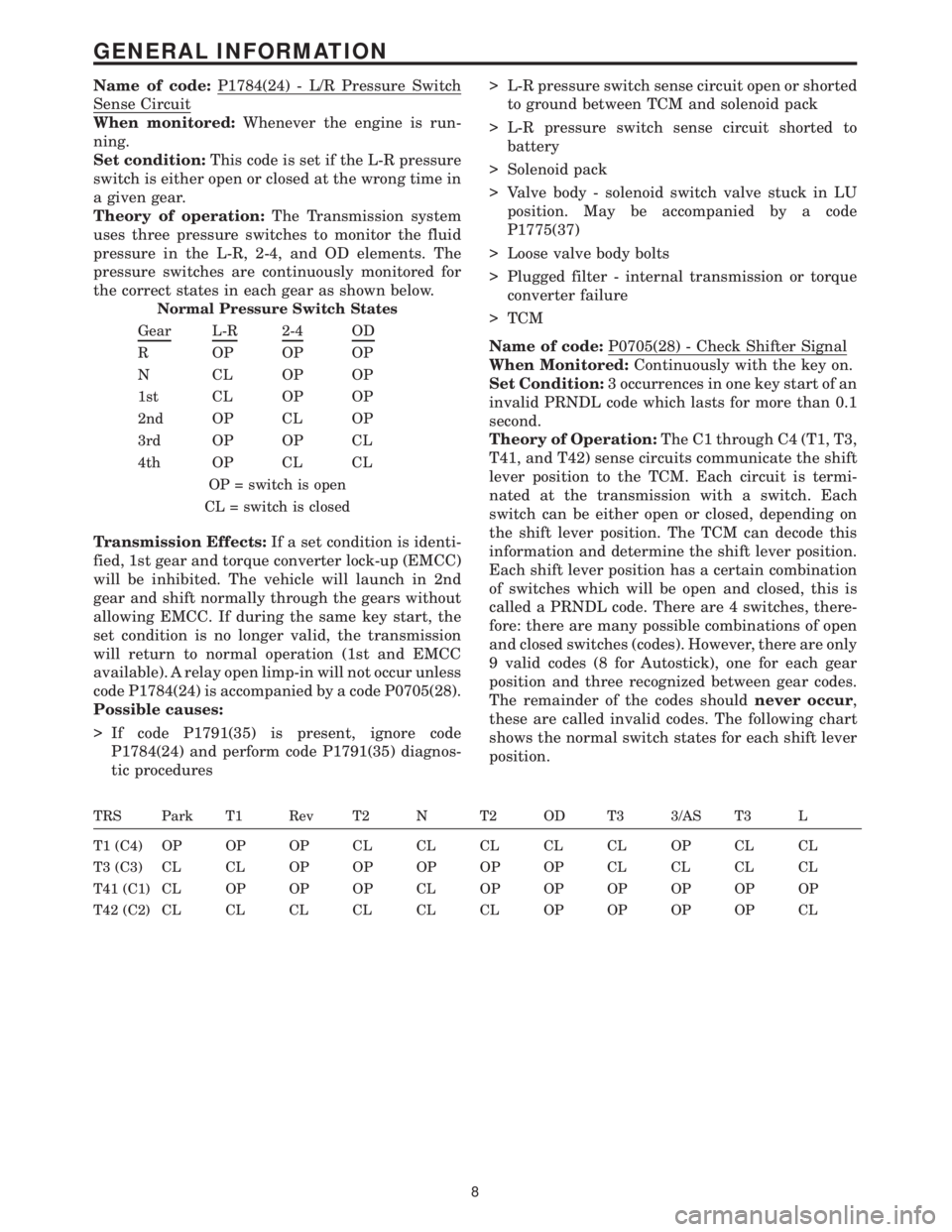
Theory of operation:The Transmission system
uses three pressure switches to monitor the fluid
pressure in the L-R, 2-4, and OD elements. The
pressure switches are continuously monitored for
the correct states in each gear as shown below.
Normal Pressure Switch States
Gear
L-R2-4OD
R OPOPOP
NCLOPOP
1st CL OP OP
2nd OP CL OP
3rd OP OP CL
4th OP CL CL
OP = switch is open
CL = switch is closed
Transmission Effects:If a set condition is identi-
fied, 1st gear and torque converter lock-up (EMCC)
will be inhibited. The vehicle will launch in 2nd
gear and shift normally through the gears without
allowing EMCC. If during the same key start, the
set condition is no longer valid, the transmission
will return to normal operation (1st and EMCC
available). A relay open limp-in will not occur unless
code P1784(24) is accompanied by a code P0705(28).
Possible causes:
> If code P1791(35) is present, ignore code
P1784(24) and perform code P1791(35) diagnos-
tic procedures> L-R pressure switch sense circuit open or shorted
to ground between TCM and solenoid pack
> L-R pressure switch sense circuit shorted to
battery
> Solenoid pack
> Valve body - solenoid switch valve stuck in LU
position. May be accompanied by a code
P1775(37)
> Loose valve body bolts
> Plugged filter - internal transmission or torque
converter failure
> TCM
Name of code:P0705(28) - Check Shifter Signal
When Monitored:Continuously with the key on.
Set Condition:3 occurrences in one key start of an
invalid PRNDL code which lasts for more than 0.1
second.
Theory of Operation:The C1 through C4 (T1, T3,
T41, and T42) sense circuits communicate the shift
lever position to the TCM. Each circuit is termi-
nated at the transmission with a switch. Each
switch can be either open or closed, depending on
the shift lever position. The TCM can decode this
information and determine the shift lever position.
Each shift lever position has a certain combination
of switches which will be open and closed, this is
called a PRNDL code. There are 4 switches, there-
fore: there are many possible combinations of open
and closed switches (codes). However, there are only
9 valid codes (8 for Autostick), one for each gear
position and three recognized between gear codes.
The remainder of the codes shouldnever occur,
these are called invalid codes. The following chart
shows the normal switch states for each shift lever
position.
TRS Park T1 Rev T2 N T2 OD T3 3/AS T3 L
T1 (C4) OP OP OP CL CL CL CL CL OP CL CL
T3 (C3) CL CL OP OP OP OP OP CL CL CL CL
T41 (C1) CL OP OP OP CL OP OP OP OP OP OP
T42 (C2) CL CL CL CL CL CL OP OP OP OP CL
8
GENERAL INFORMATION
Page 4114 of 4284
responding element is applied. If a switch fails to
close, it is retested, If it fails the second test, the
code is set.
Transmission Effects:The MIL illuminates and
the transmission system defaults to Relay Open
limp-in mode.
Possible causes:
> Pressure switch sense circuit shorted to battery
between TCM and solenoid pack.
> Low line pressure
> Solenoid Pack
Name of code:P1791(35) - Loss Of Prime
When monitored:If the transmission is slipping
in any forward gear and the pressure switches are
not indicating pressure, a loss of prime test is run.
Set condition:If the transmission begins to slip in
any forward gear, and the pressure switch or
switches that should be closed for a given gear are
open, a loss of prime test begins. All available
elements (in 1st gear L-R, 2-4 and OD, in 2nd, 3rd,
and 4th gear 2-4 and OD) are turned on by the
Transmission Control Module (TCM) to see if pump
prime exists. The code is set if none of the pressure
switches respond. The TCM will continue to run the
loss of prime test until pump pressure returns.
Theory of operation:The loss of prime test is
used to prevent transmission defaults which can be
caused by a lack of pump prime.
Transmission Effects:Vehicle will not move or
transmission slips. Normal operation will continue
if pump prime returns.
Possible causes:
> Low transmission fluid level
> PRNDL indicates a valid OD code in the hydrau-
lic reverse position
> Transmission fluid filter clogged or damaged
> Transmission fluid filter improperly installed
(Bolts loose or O-ring missing)
> Oil pump - If a customer has a problem when the
transmission is cold whereby he shifts to reverse,
gets reverse, and then shifts to OD and does not
get OD (gets a neutral condition), and then can
not get reverse or OD for between 3-20 seconds,
replace the oil pump. High side clearance in the
oil pump will set a code 35. The pump will prime
upon start-up, but as the torque converter purges
air (drain down) the air will leak across the inner
rotor into the pump suction port and cause a loss
of prime right after the shift into OD. After 3- 20
seconds, pump prime will return and normal
operation will continue. The pump should be
replaced only after all other possible causes
above have been checked and verified.Name of code:P1790(36) - Fault Immediately
After Shift
When monitored:After a gear ratio error is
stored.
Set condition:This code is set if the associated
gear ratio code is stored within 1.3 seconds after a
shift.
Theory of operation:This code will only be stored
along with a 50 series code. If this code is set, it
indicates the problem is mechanical in nature.
When this code exists, diagnosing the transmission
should be based on the associated gear ratio code
and primarily mechanical causes should be consid-
ered.
Transmission Effects:None
Possible causes:
> Mechanical causes as listed under associated
gear ratio code.
Name of code:P1775(37) - Solenoid Switch Valve
Latched in TCC Position
When monitored:During an attempted shift into
1st gear.
Set condition:This code is set if three unsuccess-
ful attempts are made to get into 1st gear in one
given key start.
Theory of operation:The solenoid switch valve
(SSV) controls the direction of the transmission
fluid when the L-R/TCC solenoid is energized. The
SSV will be in the downshifted position in 1st gear,
thus directing the fluid to the L-R clutch circuit. In
2nd, 3rd, and 4th, it will be in the upshifted position
and directs the fluid into the torque converter
clutch (TCC).
When shifting into 1st gear, a special hydraulic
sequence is performed to ensure SSV movement
into the downshifted position. The L-R pressure
switch is monitored to confirm SSV movement. If
movement is not confirmed (the L-R pressure
switch does not close), 2nd gear is substituted for
1st.
Transmission Effects:Transmission will have no
1st gear (2nd gear will be substituted), and no
EMCC operation.
Possible causes:
> PRNDL indicates a valid OD code in the hydrau-
lic reverse position
> Valve body- - Solenoid valve stuck in TCC posi-
tion
> High idle speed
> Solenoid malfunction - L-R pressure switch will
not close
> L-R Pressure Switch Sense circuit shorted to
battery
10
GENERAL INFORMATION
Page 4119 of 4284
then notice harsh bumps when the A/C clutch is
being cycled, but vehicle shudder will be elimi-
nated. After 35 OBDII (EURO STAGE III OBD)
warm-up starts or if the code is cleared, PEMCC
will be reactivated to see if shudder is still present.
If one shudder event occurs, the code will be reset.
Clearing the code and running battery disconnect
with the DRBIIItis the only way to reset the
shudder counter from 20 back to zero.
Transmission Effects:This code does not cause
the transmission to go into limp-in mode. However,
once the code is set, FEMCC to PEMCC operation
before the A/C clutch engagement will be disabled
for 35 OBDII (EURO STAGE III OBD) warm up
starts.
Possible causes:
> Degraded transmission fluid
> Wheels severely out of alignment
> Internal torque converter problem
Name of Code:P1799(74) - Calculated Oil Temper-
ature in Use
When Monitored:When ever the Engine is run-
ning.
Set condition:The code is set if any of the follow-
ing conditions exist for three consecutive key starts:
> The Temperature Sensor voltage is out of range
(below 0.07 volts or greater than 4.94 volts)
> If continuous erratic Temperature Sensor voltage
is sensed.
> The Temperature Sensor temperature stays be-
low 27C (80ÉF) for an extended period of time.
Theory of Operation:The TCM uses a Tempera-
ture Sensor to monitor the transmission sump tem-
perature. This temperature is used to determine
which shift schedule the TCM is to use. (See Trans-
mission Operation and Shift Scheduling at Various
Sump Temperatures in this diagnostic manual) If
the Temperature Sensor circuit fails to operate
properly the TCM will use the calculated oil tem-
perature routine found in prior model year TCM. If
this occurs for three consecutive key starts, the code
will be set. The TCM will then test the Temperature
Sensor circuit after every 35 OBDII (EURO STAGE
III OBD) warm-up starts. If the Temperature Sen-
sor circuit is OK, the Temperature Sensor data is
used in place of the Calculated Oil Temperature
data.
Transmission Effects:If the Temperature Sensor
indicates a temperature below -18C (0É F) or above
115C (240É F) at start up, The TCM compares the
calculated oil temperature to the indicated Temper-
ature Sensor oil temperature. If the calculated oil
temperature differs significantly from the Temper-
ature Sensor value, the calculated oil temperature
will be used for that key start.Possible Causes:
> Wiring or Connector problems in the transmis-
sion temperature sensor signal circuit.
> TRS
> TCM
Name of Code:P1738(75) - High Temperature
Operation Activated.
When Monitored:Whenever the engine is running.
Set Condition:Immediately once the Overheat
Shift Schedule is activated.
Theory of Operation:If the transmission oil tem-
perature rises above 115C (240ÉF), the overheat
shift schedule is activated refer to Transmission
Operation as a function of Transmission Oil Tem-
perature and the code is set. The DTC is an infor-
mation code only and is being set to aid the techni-
cian in determining root cause of a customer
driveability issue. The code is also intended to alert
the technician to determine if a cooling system
malfunction has occurred or if an additional trans-
mission air to oil cooler should be added to the
vehicle if the customer regularly drives in a manner
that overheats the transmission. Extended opera-
tion above 115C (240ÉF) will reduce the durability of
the transmission and should be avoided. Correcting
the cooling system malfunction or installing an
additional transmission oil cooler will improve
transmission durability especially for customers
who operate in city/construction stop and go traffic,
tow trailers regularly, drive aggressively in low gear
or drive regularly in mountainous areas.
Transmission Effects:Information only code. -
Overheat shift schedule was activated, no limp-in
condition occurs. 2nd gear partial EMCC above 40
Km/h (25 MPH), 3rd gear EMCC from 45-69 Km/h
(28-43 MPH), delayed 3-4 upshift at 69 Km/h (43
MPH), early 4-3 coastdown at 66 Km/h (41 MPH),
EMCC operation under all conditions above 40
Km/h (25 MPH) except at closed throttle or 1st gear.
Possible Causes:
± Transmission Overfilled with Oil
± Engine cooling fan failure
± Engine thermostat stuck closed
± Radiator corroded or packed with dirt
± Transmission Oil Cooler Plugged
± Customer driving pattern requires additional
transmission cooling
Name Of Code:P1739(76) - Power-Up at Speed
When Monitored:When TCM (transmission con-
trol module) initially powers-up.
Set Condition:If the TCM powers up while in the
9Drive9position and the vehicle is going above 32
Km/h (20 MPH), the code is set.
Theory of Operation:If a vehicle loses power to
the TCM, the vehicle will go to the 2nd gear mode
15
GENERAL INFORMATION
Page 4120 of 4284
since there is no power available to control the
transmission solenoids. However if power is re-
stored, the TCM will power-up and normal opera-
tion will be restored. This DTC identifies that
power to the TCM was restored when the gear
selector was in a9Drive9position while the vehicle
was moving at speeds above 32 Km/h (20 MPH). If
a person shifts to Neutral and cycles the ignition
key and quickly shifts to9Drive9while moving
before the TCM comes out of its START ROUTINE,
the DTC can be set. Therefore it is critical that this
DTC diagnosis repair procedure should only be used
if the vehicle is experiencing intermittent 2nd gear
operation and subsequently a return to normal
operation during normal driving.
Transmission Effects:No limp-in condition. The
DTC is for information only when trying to diagno-
sis intermittent 2nd gear operation and subse-
quently a return to normal operation.
Possible Causes:
± No Problem if vehicle is started in9neutral9at
speeds above 32 Km/h (20 MPH) and shifted
quickly to9Drive9before TCM comes out of the
START ROUTINE.
FOR INTERMITTENT 2ND GEAR OPER-
ATION AND THEN A SUBSEQUENT RE-
TURN TO NORMAL OPERATION WITH-
OUT CYCLING THE IGNITION KEY
± Intermittent Direct Battery connection be-
tween TCM (60-way pin 56) and battery.
± Intermittent Fused Ignition Switch Output
between TCM (60-way pin 11) and ignition
switch.
± Intermittent Ground to TCM (60 way pins 53
and 57).
Name of code:P1717(77) - No Communication
with Mechanical Instrument Cluster (MIC)
When monitored:Continuously with key on.
Set condition:If no PCI bus messages are received
from the Mechanical Instrument Cluster (MIC) for
25 seconds.
Theory of operation:The TCM communicates
with the MIC using the PCI bus. It relies on certain
information to function properly. The TCM contin-
uously monitors the PCI bus to check for messages
broadcast from the PCM.
Transmission Effects:Possible improper TCM
AutoStick configuration.
Possible causes:
> Open or shorted PCI bus circuit from MIC
> MIC
> TCM (If other communications codes are stored
in the TCM only)
Name of code:P0600(78) - Serial Communication
Link Malfunction
When monitored:Continuously with key on.
Set condition:If no PCI bus messages are received
by the Transmission Control Module (TCM) for 10
seconds.
Theory of operation:The TCM communicates
with the other modules in the vehicle using the PCI
bus. It relies on certain information to function
properly. The TCM continuously monitors the PCI
bus to check for messages broadcast from the cer-
tain modules.
Transmission Effects:Possible improper TCM
AutoStick configuration and delayed 3-4 shifts. No
EMCC and early 3-4 shifts for a few minutes after
engine is started.
Possible causes:
> Open or shorted PCI bus circuit from BCM
> TCM
Name of code:P1714(79) Low Battery Voltage
When monitored:Continuously with engine run-
ning and Transmission Relay energized.
Set condition:If the voltage sensed at the Trans-
mission Control Relay Output circuit (pins 16 and
17 at TCM) for 15 seconds.
Theory of operation:The Transmission system
requires sufficient battery voltage in order to ener-
gize the transmission solenoids. The TCM continu-
ously monitors the voltage available to the sole-
noids.
Transmission Effects:At speeds above 72 Km/h
(45 MPH) the transmission system will default to
neutral. Below 72 Km/h (45 MPH) the transmission
system will default to relay open limp-in mode.
Park, Reverse, and Neutral are still available.
Possible causes:
> Charging system problem
> Poor/High resistance connection between TCM
and Battery/Alternator
> TCM pin 16 and 17 high resistance or poor
connection
> TCM ground pins 53 and 57 high resistance or
poor connection
> High resistance in Transmission Control Relay
contacts
> TCM
3.3.8 QUICK LEARN
The Quick Learn function customizes adaptive
parameters of the TCM to the transmission charac-
teristics of a vehicle. This gives the customer im-
proved9as received9shift quality compared to the
initial parameters stored in the TCM.
Notes about Quick Learn Features
The nature of the Quick Learn function requires
that certain features must be taken into consider-
ation.
16
GENERAL INFORMATION
Page 4122 of 4284
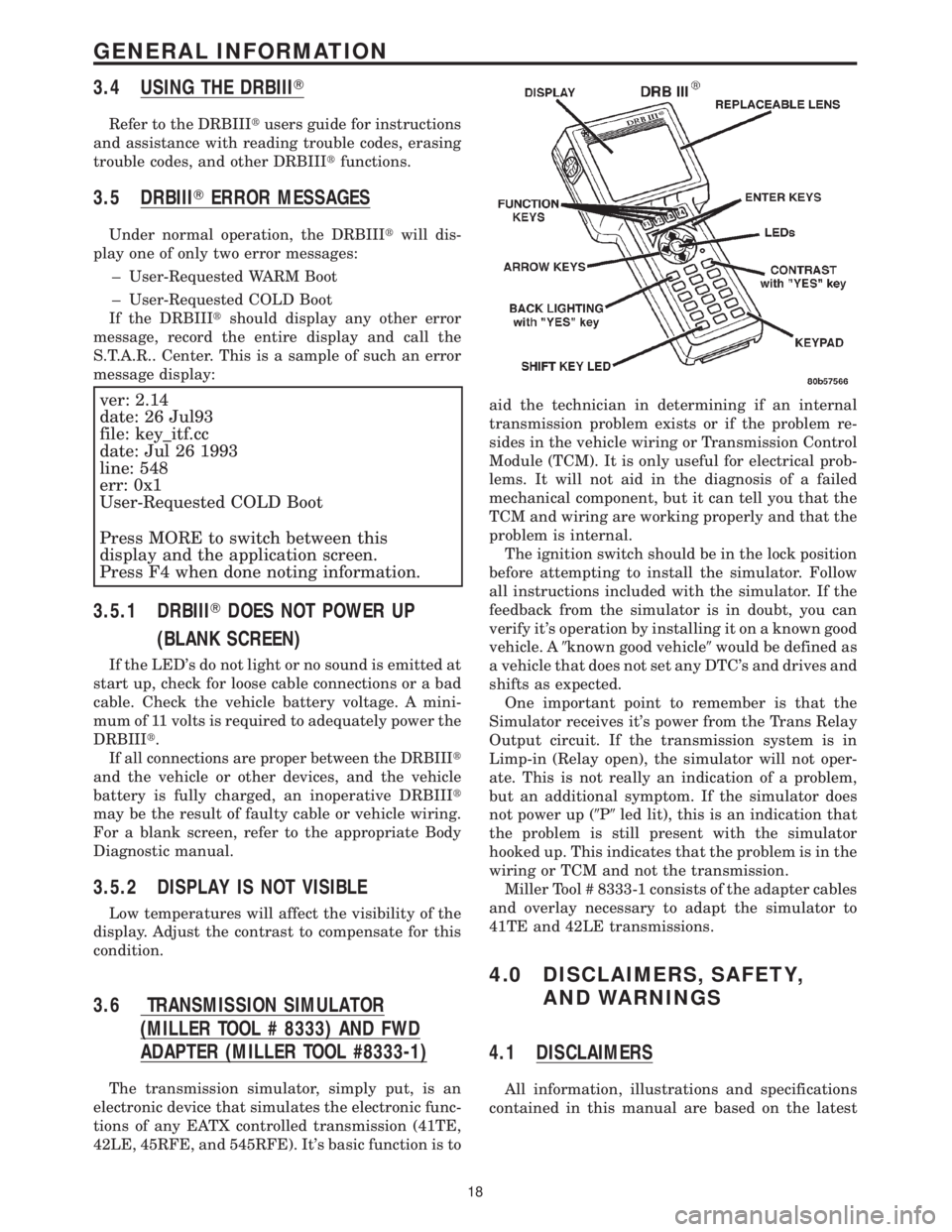
3.4 USING THE DRBIIIT
Refer to the DRBIIItusers guide for instructions
and assistance with reading trouble codes, erasing
trouble codes, and other DRBIIItfunctions.
3.5 DRBIIITERROR MESSAGES
Under normal operation, the DRBIIItwill dis-
play one of only two error messages:
± User-Requested WARM Boot
± User-Requested COLD Boot
If the DRBIIItshould display any other error
message, record the entire display and call the
S.T.A.R.. Center. This is a sample of such an error
message display:
ver: 2.14
date: 26 Jul93
file: key_itf.cc
date: Jul 26 1993
line: 548
err: 0x1
User-Requested COLD Boot
Press MORE to switch between this
display and the application screen.
Press F4 when done noting information.
3.5.1 DRBIIITDOES NOT POWER UP
(BLANK SCREEN)
If the LED's do not light or no sound is emitted at
start up, check for loose cable connections or a bad
cable. Check the vehicle battery voltage. A mini-
mum of 11 volts is required to adequately power the
DRBIIIt.
If all connections are proper between the DRBIIIt
and the vehicle or other devices, and the vehicle
battery is fully charged, an inoperative DRBIIIt
may be the result of faulty cable or vehicle wiring.
For a blank screen, refer to the appropriate Body
Diagnostic manual.
3.5.2 DISPLAY IS NOT VISIBLE
Low temperatures will affect the visibility of the
display. Adjust the contrast to compensate for this
condition.
3.6 TRANSMISSION SIMULATOR
(MILLER TOOL # 8333) AND FWD
ADAPTER (MILLER TOOL #8333-1)
The transmission simulator, simply put, is an
electronic device that simulates the electronic func-
tions of any EATX controlled transmission (41TE,
42LE, 45RFE, and 545RFE). It's basic function is toaid the technician in determining if an internal
transmission problem exists or if the problem re-
sides in the vehicle wiring or Transmission Control
Module (TCM). It is only useful for electrical prob-
lems. It will not aid in the diagnosis of a failed
mechanical component, but it can tell you that the
TCM and wiring are working properly and that the
problem is internal.
The ignition switch should be in the lock position
before attempting to install the simulator. Follow
all instructions included with the simulator. If the
feedback from the simulator is in doubt, you can
verify it's operation by installing it on a known good
vehicle. A9known good vehicle9would be defined as
a vehicle that does not set any DTC's and drives and
shifts as expected.
One important point to remember is that the
Simulator receives it's power from the Trans Relay
Output circuit. If the transmission system is in
Limp-in (Relay open), the simulator will not oper-
ate. This is not really an indication of a problem,
but an additional symptom. If the simulator does
not power up (9P9led lit), this is an indication that
the problem is still present with the simulator
hooked up. This indicates that the problem is in the
wiring or TCM and not the transmission.
Miller Tool # 8333-1 consists of the adapter cables
and overlay necessary to adapt the simulator to
41TE and 42LE transmissions.
4.0 DISCLAIMERS, SAFETY,
AND WARNINGS
4.1 DISCLAIMERS
All information, illustrations and specifications
contained in this manual are based on the latest
18
GENERAL INFORMATION
Page 4123 of 4284
information at the time of publication. The right is
reserved to make changes at any time without
notice.
4.2.1 TECHNICIAN SAFETY INFORMATION
WARNING: ENGINES PRODUCE CARBON
MONOXIDE THAT IS ODORLESS, CAUSES
SLOWER REACTION TIMES AND CAN LEAD
TO SERIOUS INJURY. WHEN THE ENGINE IS
OPERATING, KEEP SERVICE AREAS WELL
VENTILATED OR ATTACH THE VEHICLE
EXHAUST SYSTEM TO THE SHOP EXHAUST
REMOVAL SYSTEM.
Some operations in this manual require that
hydraulic tubes, hoses, and fittings, disconnected
for inspection or testing purposes. These systems,
when fully charged contains fluid at high pressure.
Before disconnecting any hydraulic tubes, hoses or
fittings, be sure that the system is fully depressur-
ized.
When servicing a vehicle, always wear eye pro-
tection and remove any metal jewelry such as
watchbands or bracelets that might make an inad-
vertent electrical contact.
When diagnosing a transmission system problem,
it is important to follow approved procedures where
applicable. Following these procedures is very im-
portant to the safety of individuals performing
diagnostic tests.
4.2.2 VEHICLE PREPARATION FOR
TESTING
Make sure the vehicle being tested has a fully
charged battery. If it does not, false diagnostic codes
or error messages may occur. It is extremely impor-
tant that accurate shift lever position data be avail-
able to the TCM. The accuracy of any diagnostic
trouble code found in memory is doubtful unless the
Shift Lever Test, performed on the DRBtScan Tool,
passes.
4.2.3 SERVICING SUB-ASSEMBLIES
Some components of the powertrain system are
intended to be serviced in assembly only. Attempt-
ing to remove or repair certain system subcompo-
nents may result in personal injury and/or im-
proper system operation. Only those components
with approved repair and installation procedures in
the service instructions should be serviced.
4.2.4 DRBIIITSAFETY INSTRUCTIONS
WARNING: EXCEEDING THE LIMITS OF THE
DRBTMULTIMETER IS DANGEROUS. IT CAN
EXPOSE YOU TO SERIOUS OR POSSIBLY
FATAL INJURY. CAREFULLY READ AND
UNDERSTAND THE CAUTIONS AND THE
SPECIFICATION LIMITS.
²Follow the vehicle manufacturer 's service speci-
fications at all times.
²Do not use the DRBtif it has been damaged.
²Do not use the test leads if the insulation is
damaged or if metal is exposed.
²To avoid electrical shock, do not touch the test
leads, tips, or the circuit being tested.
²Choose the proper range and function for the
measurement. Do not try voltage or current mea-
surements that may exceed the rated capacity.
²Do not exceed the limits shown in the table.
FUNCTION INPUT LIMIT
Volts 0 - 500 peak volts AC
0 - 500 volts DC
Ohms (resistance)* 0 - 1.12 megohms
Frequency Measured
Frequency Generated0-10kHz
Temperature -58 - 1100ÉF
-50 - 600ÉC
*Ohms cannot be measured if voltage is present.
Ohms can be measured only in a non-powered
circuit.
²Voltage between any terminal and ground must
not exceed 500v peak AC.
²Use caution when measuring voltage above 25v
DC or 25v AC.
²The circuit being tested must be protected by a
10A fuse or circuit breaker.
²Use the low current shunt to measure circuits up
to 10A. Use the high current clamp to measure
circuits exceeds 10A.
²When testing for the presence of voltage or cur-
rent, make sure the meter is functioning cor-
rectly. Take a reading of a known voltage or
current before attempting a zero reading.
²When measuring current, connect the meter in
series with the load.
²Disconnect the live test lead before disconnecting
the common test lead.
²When using the meter function, keep the DRBt
away from spark plug or coil wires to avoid
measuring error from outside interference.
19
GENERAL INFORMATION
Page 4128 of 4284
Symptom:
P0120-THROTTLE POSITION SENSOR SIGNAL CIRCUIT
When Monitored and Set Condition:
P0120-THROTTLE POSITION SENSOR SIGNAL CIRCUIT
When Monitored: Whenever the engine is running.
Set Condition: This code is set if the throttle angle goes out of range or if throttle angle
changes abruptly (i.e.: faster than the throttle body motion could occur).
POSSIBLE CAUSES
RELATED PCM DTC'S PRESENT
INTERMITTENT WIRING & CONNECTORS
SENSOR GROUND CIRCUIT OPEN TO TCM
TPS SIGNAL CIRCUIT OPEN TO TCM
TPS VOLTAGE CHANGE NOT SMOOTH
TCM - TPS SIGNAL CIRCUIT
TEST ACTION APPLICABILITY
1NOTE: Low fluid level can be the cause of many Transmission problems. If
the fluid level is low locate and repair the leak then check and adjust the
fluid level per the Service Information.
NOTE: Always perform diagnostics with a fully charged battery to avoid
false symptoms.
With the DRBIIIt, read the engine DTC's. Check and repair all engine DTC's prior
to performing Transmission Symptom Diagnostics.
With the DRBIIIt, read Transmission DTC's. Record all DTC's and 1 Trip Failures.
NOTE: Diagnose 1 Trip Failures as a fully matured DTC.
Using the wiring diagram/schematic as a guide, inspect the wiring and connectors.
Repair as necessary.
Perform the Shift Lever Position Test. If the test does not pass, refer to Symptom test
for P0705 Check Shifter Signal.
For Gear Ratio DTC's, check and record all CVI's.
Most DTC's set on start up but some must be set by driving the vehicle such that all
diagnostic monitors have run.
NOTE: Verify flash level of Transmission Control Module. Some problems
are corrected by software upgrades to the Transmission Control Module.
NOTE: Check for applicable TSB's related to the symptom.
Perform this procedure prior to Symptom diagnosis.All
Continue
Go To 2
2 With the DRBIIIt, check Powertrain Control Module DTC's.
Are any of the following P-codes P0122, P0123, P0121 stored in the PCM?All
Ye s®Refer to the Driveability category for the related symptom(s).
Perform 41TE TRANSMISSION VERIFICATION TEST - VER 1.
No®Go To 3
24
TRANSMISSION