Page 402 of 4770

CIRCUIT DESCRIPTION
To obtain a high purification rate for the C0, HC and NOx components of the exhaust gas, a three±
way catalytic converter is used, but for most efficient use of the three±way catalytic converter, the
air±fuel ratio must be precisely controlled so that it is always close to the stoichiometric air±fuel ra-
tio. The oxygen sensor has the characteristic whereby its output voltage changes suddenly in the
vicinity of the stoichiometric air±fuel ratio. This characteristic is used to detect the oxygen con-
centration in the exhaust gas and provide feedback to the computer for control of the air±fuel ratio.
When the air±fuel ratio becomes LEAN, the oxygen concentration in the exhaust increases and the
oxygen sensor informs the ECM of the LEAN condition (small electromotive force; 0 V).
When the air±fuel ratio is RICHER than the stoichiometric air±fuel ratio the oxygen concentration in
the exhaust gas is reduced and the oxygen sensor informs the ECM of the RICH condition (large
electromotive force: 1 V). The ECM judges by the electromotive force from the oxygen sensor
whether the air±fuel ratio is RICH or LEAN and controls the injection time accordingly. However, if
malfunction of the oxygen sensor causes output of abnormal electromotive force, the ECM is un-
able to perform accurate air±fuel ratio control.
Main oxygen sensor signal voltage is reduced to
between 0.35 V and 0.70 V for 60 sec. under
conditions (a) ± (d).
(2 trip detection logic) *
(a) Engine coolant temp. : 80�C (176�F) or more.
(b) Engine speed : 1,500 rpm or more.
(c) Load driving (EX. A/T in overdrive (5th for
M/T), A/C ON, Flat road, 50 mph (80km/h)).
(d) Main oxygen sensor signal voltage :
Alternating above and below 0.45 V.Diagnostic Trouble Code Detecting Condition
wMain oxygen sensor circuit.
wMain oxygen sensor.
*See page EG1±307Trouble Area
DTC 21 Main Oxygen Sensor Circuit
DTC No.
± 5S±FE ENGINECIRCUIT INSPECTIONEG1±352
Page 406 of 4770

CIRCUIT DESCRIPTION
The engine coolant temperature sensor senses the
engine coolant temperature. A thermistor built in the
sensor changes its resistance value according to the
engine coolant temperature. The lower the engine
coolant temperature, the greater the thermistor resis±
tance value, and the higher the engine coolant tem±
perature, the lower the thermistor resistance value
(See Fig. 1.).
The engine coolant temperature sensor is connected
to the ECM (See next page). The 5 V power source
voltage in the ECM is applied to the engine coolant
temperature sensor from the terminal THW via a resis-
tor R. That is, resistor R and the engine coolant tem±
perature sensor are connected in series. When the
resistance value of the engine coolant temperature
sensor changes in accordance with changes in the
engine coolant temperature, the potential at the ter±
minal THW also changes. Based on this signal, the
ECM increases the fuel injection volume to improve
driveability during cold engine operation. If the ECM
detects the diagnostic trouble code 22, it operates the
fail safe function in which the engine coolant temper±
ature is assumed to be 80�C (176�F).
w
Open or short in engine coolant temp,
sensor circuit
wEngine coolant temp. sensor
wECM Open or short in engine coolant temp. sensor
circuit for 0.5 sec. or more.Diagnostic Trouble Code Detecting Condition
Engine coolant
Temp. �C (�F)Resistance
(k�)
( Reference )
Voltage
(V)
Trouble Area 100 (212)
DTC 22 Engine coolant Temp. Sensor Circuit
60 (140) 40 (104)
80 (176) ±20 (±4)
DTC No.20 (68)0 (32)16.0
0.9
0.3 0.6
0.20.3 0.54.3
2.53.4
5.9
2.4
± 5S±FE ENGINECIRCUIT INSPECTIONEG1±356
Page 407 of 4770
DIAGNOSTIC CHART
HINT If diagnostic trouble codes ª22º (engine coolant temperature sensor circuit), ª24º (intake air temperature sensor cir-
cuit), ª31º (manifold absolute pressure sensor circuit) and ª41º (throttle position sensor circuit) are output simultaneously, E2
(sensor ground) may be open, OK Check for momentary interruption
Check for open and short in harness and connector
between ECM and engine coolant temp. sensor.Check for momentary interruption
(See page EG1±309).
Repair or replace harness or
connector.Replace engine coolant temp. sensor.
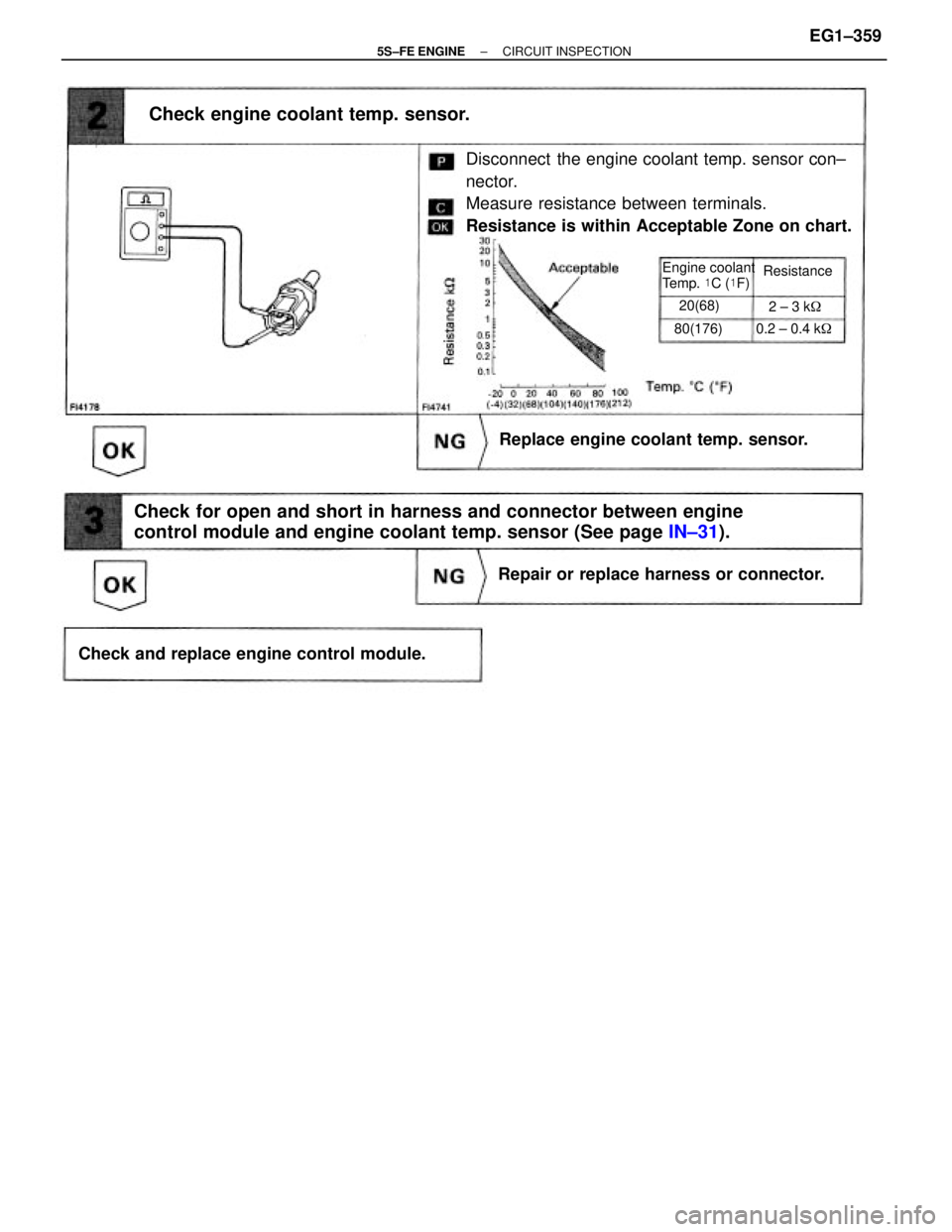
WIRING DIAGRAM
Check resistance of sensor.
Check and replace ECM.Check voltage of sensor.
± 5S±FE ENGINECIRCUIT INSPECTIONEG1±357
Page 408 of 4770
INSPECTION PROCEDURE
HINT: If diagnostic trouble codes ª22º (engine coolant temperature sensor circuit), ª24º (intake air
temperature sensor circuit), ª31º (manifold absolute pressure sensor circuit) and ª41 ª (throttle
position sensor circuit) are output simultaneously, E2 (sensor ground) may be open,
(1) Remove glove compartment
(See page EG1±234)
(2) Turn ignition switch on.
Measure voltage between terminals THW and E2 of engine
control module connector.
Check voltage between terminals THW and E2 of engine control
module connector.
Check for momentary interruption
(See page EG1±309)
Engine Coolant Temp. �C (�F)
20 (68)
( Engine is cool )
80 (176)
(Engine is hot)0.2 ~1.0 v 0.5 ~ 3.4 V Voltage
± 5S±FE ENGINECIRCUIT INSPECTIONEG1±358
Page 409 of 4770
Check for open and short in harness and connector between engine
control module and engine coolant temp. sensor (See page IN±31).
Disconnect the engine coolant temp. sensor con±
nector.
Measure resistance between terminals.
Resistance is within Acceptable Zone on chart.
Check engine coolant temp. sensor.
Check and replace engine control module.Repair or replace harness or connector.Replace engine coolant temp. sensor.
Engine coolant
Temp. �C (�F)
0.2 ± 0.4 k� Resistance
80(176)20(68)
2 ± 3 k�
± 5S±FE ENGINECIRCUIT INSPECTIONEG1±359
Page 410 of 4770
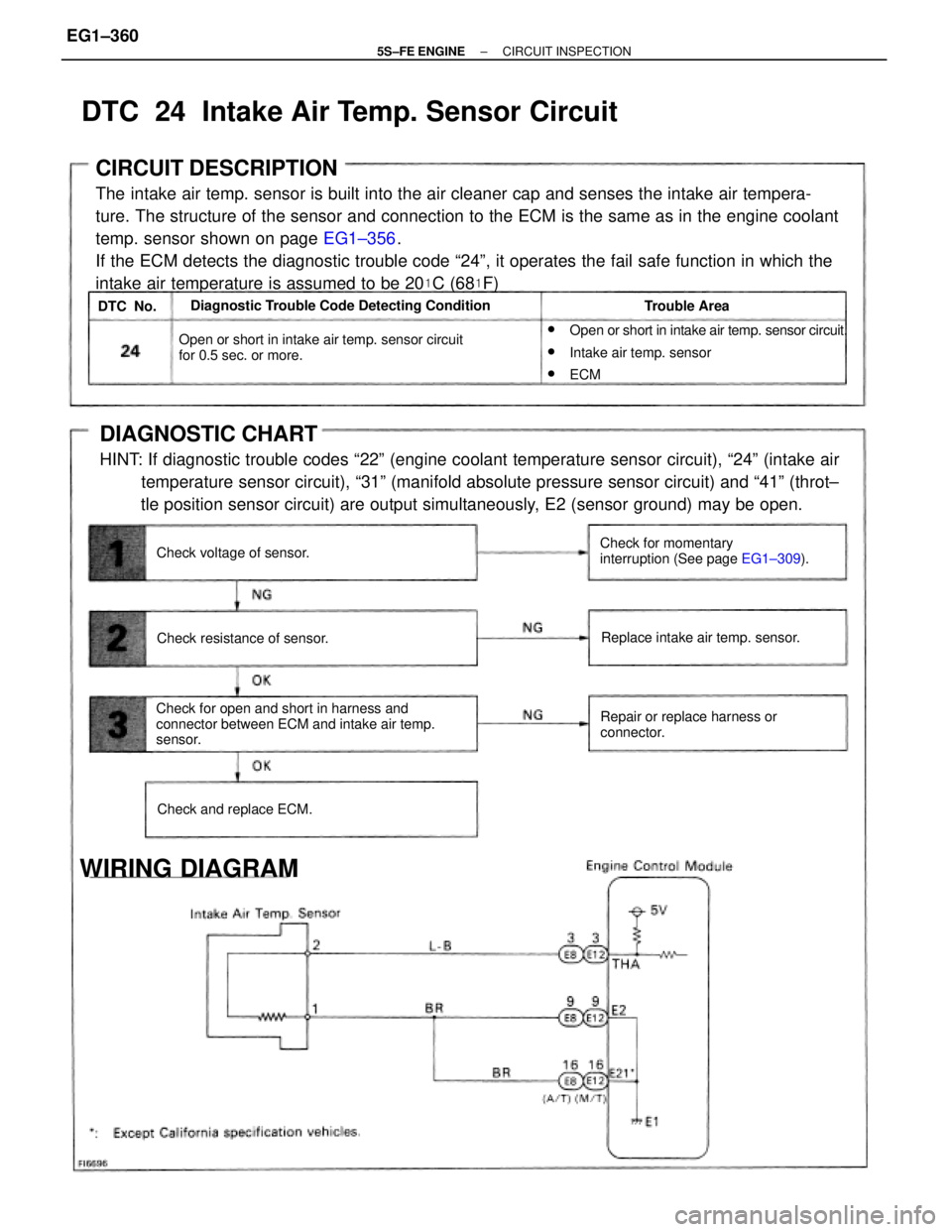
DIAGNOSTIC CHART
HINT: If diagnostic trouble codes ª22º (engine coolant temperature sensor circuit), ª24º (intake air
temperature sensor circuit), ª31º (manifold absolute pressure sensor circuit) and ª41º (throt±
tle position sensor circuit) are output simultaneously, E2 (sensor ground) may be open.
CIRCUIT DESCRIPTION
The intake air temp. sensor is built into the air cleaner cap and senses the intake air tempera-
ture. The structure of the sensor and connection to the ECM is the same as in the engine coolant
temp. sensor shown on page EG1±356.
If the ECM detects the diagnostic trouble code ª24º, it operates the fail safe function in which the
intake air temperature is assumed to be 20
�C (68�F)
w
Open or short in intake air temp. sensor circuit.
wIntake air temp. sensor
wECM
Check for open and short in harness and
connector between ECM and intake air temp.
sensor.Open or short in intake air temp. sensor circuit
for 0.5 sec. or more.
Check for momentary
interruption (See page EG1±309). Diagnostic Trouble Code Detecting Condition
Repair or replace harness or
connector.Replace intake air temp. sensor.
WIRING DIAGRAM
Check resistance of sensor.
Check and replace ECM. Check voltage of sensor.Trouble Area
DTC 24 Intake Air Temp. Sensor Circuit
DTC No.
± 5S±FE ENGINECIRCUIT INSPECTIONEG1±360
Page 413 of 4770
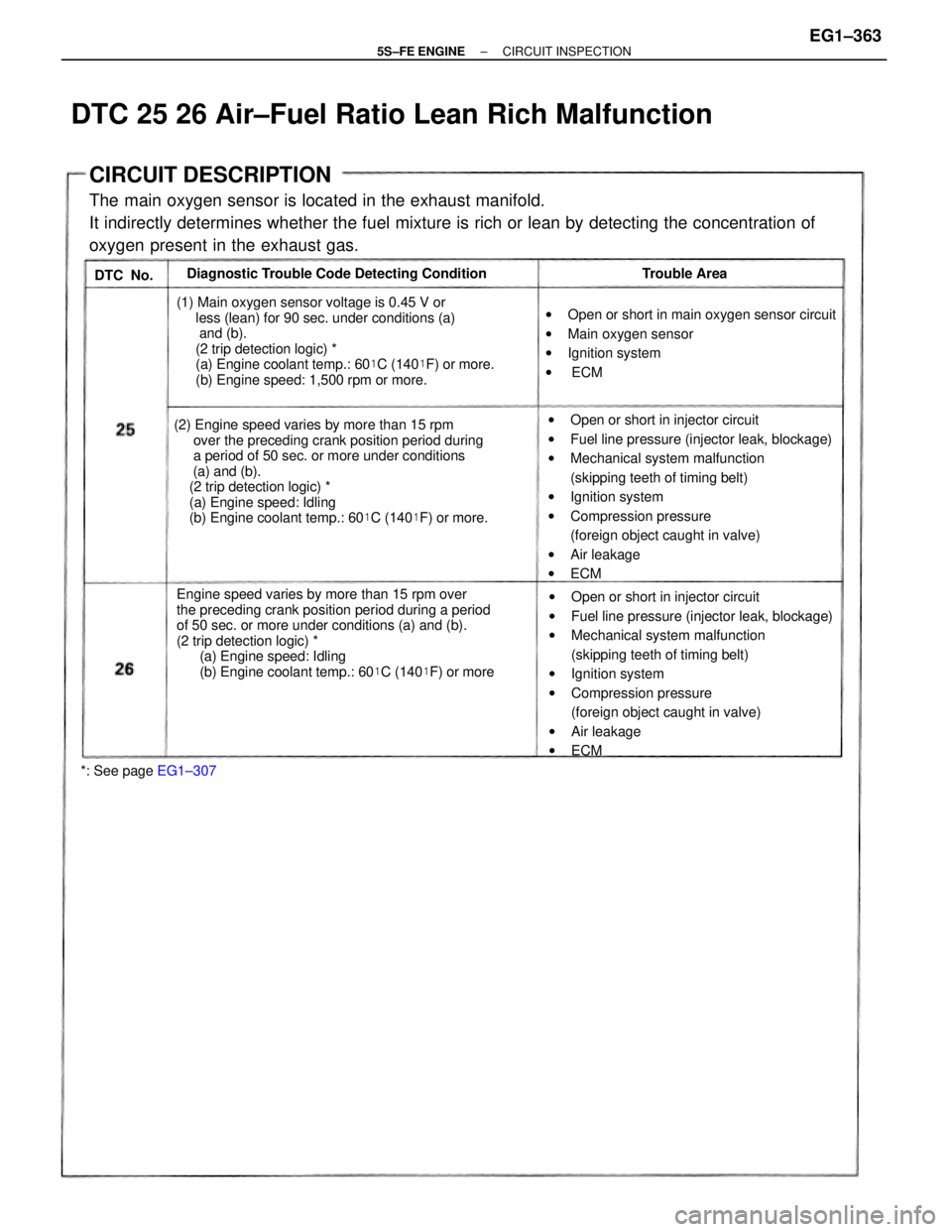
CIRCUIT DESCRIPTION
The main oxygen sensor is located in the exhaust manifold.
It indirectly determines whether the fuel mixture is rich or lean by detecting the concentration of
oxygen present in the exhaust gas.
Engine speed varies by more than 15 rpm over
the preceding crank position period during a period
of 50 sec. or more under conditions (a) and (b).
(2 trip detection logic) *
(a) Engine speed: Idling
(b) Engine coolant temp.: 60�C (140�F) or more (2) Engine speed varies by more than 15 rpm
over the preceding crank position period during
a period of 50 sec. or more under conditions
(a) and (b).
(2 trip detection logic) *
(a) Engine speed: Idling
(b) Engine coolant temp.: 60�C (140�F) or more.wOpen or short in injector circuit
wFuel line pressure (injector leak, blockage)
wMechanical system malfunction
(skipping teeth of timing belt)
wIgnition system
wCompression pressure
(foreign object caught in valve)
wAir leakage
wECM
wOpen or short in injector circuit
wFuel line pressure (injector leak, blockage)
wMechanical system malfunction
(skipping teeth of timing belt)
wIgnition system
wCompression pressure
(foreign object caught in valve)
wAir leakage
wECM (1) Main oxygen sensor voltage is 0.45 V or
less (lean) for 90 sec. under conditions (a)
and (b).
(2 trip detection logic) *
(a) Engine coolant temp.: 60�C (140�F) or more.
(b) Engine speed: 1,500 rpm or more.wOpen or short in main oxygen sensor circuit
wMain oxygen sensor
wIgnition system
w ECM Diagnostic Trouble Code Detecting Condition
*: See page EG1±307Trouble Area
DTC 25 26 Air±Fuel Ratio Lean Rich Malfunction
DTC No.
± 5S±FE ENGINECIRCUIT INSPECTIONEG1±363
Page 417 of 4770

Check each circuit found to be a possible cause of trouble according to the results of the check in
or . The numbers in the table below show the order in which the checks should be performed.Check for open and short in harness and connector between engine control module and
main oxygen sensor, engine control module and data link connector 1 (See page
IN±31).
Does malfunction disappear when a good main oxygen sensor is
installed?Check each item found to be a possible cause of problem.
Check compression (See page EG1±23).
Repair or replace harness or connector.
Check and replace engine control module.
Characteristics deviation in
manifold absolute pressure sensor.
Characteristics deviation
in engine coolant temp. sensor.
Replace main oxygen sensor.
*: Except California specification vehicles.Characteristics deviation
in intake air temp. sensor. Main oxygen sensor
signal continue at OV.
Repair or replace.
Repair or replace.
Faulty sensor installation.Possible Cause
Injector circuit
Valve timing
Fuel system Air leakageSee page
IG±6, 26*
YES
EG1±410
EG1±360 EG1±419
EG1±372 EG1±173
EG1±356 Misfire
EG1±36
± 5S±FE ENGINECIRCUIT INSPECTIONEG1±367