Page 356 of 4770

*1; ªONº displayed in the diagnosis mode column indicates that the Malfunction Indicator Lamp is lighted up when a
malfunction is detected. ªOFFº indicates that the ªCHECKº does not light up during malfunction diagnosis, even if a
malfunction is detected. ªN.A.º indicates that the item is not included in malfunction diagnosis.
*2; ªOº in the memory column indicates that a diagnostic trouble code is recorded in the ECM memory when a malfunction
occurs. ªXº indicates that a diagnostic trouble code is not recorded in the ECM memory even if a malfunction occurs.
Accordingly, output of diagnostic results in normal or test mode is performed with the IG switch ON.
*3; Only for California specification vehicles.
*4; Only vehicles with A/T.EGR gas temp. is 70�C (158�F) or below for 50 sec. under
conditions (a) and (b).
(2 trip detection logic)*�
(a) Engine coolant temp.: 80�C (176�F) or more.
(b) EGR operation possible (Ex. A/T in 3rd speed (5th for
M/T), 55 ± 60 mph (88 ± 96 km/h), Flat road).
(1) 3 sec. or more after engine starts with closed throttle position
switch OFF (IDL).
(2) *� Park/Neutral switch OFF (PNP).
(Shift position in ªRº, ªDº, ª2º, or ªLº positions).
(3) A/C switch ON. Open or short in knock sensor circuit with engine speed
between 1,200 rpm and 6,000 rpm.Diagnostic trouble Code
Detecting Condition
Switch Condition
SignalNo starter signal to ECM.
Knock Sensor
Signal
EG R System
Malfunction Number of
MIL Blinks
Starter Signal DTC
No.Circuit
± 5S±FE ENGINEDIAGNOSTIC TROUBLE CODE CHARTEG1±306
Page 359 of 4770
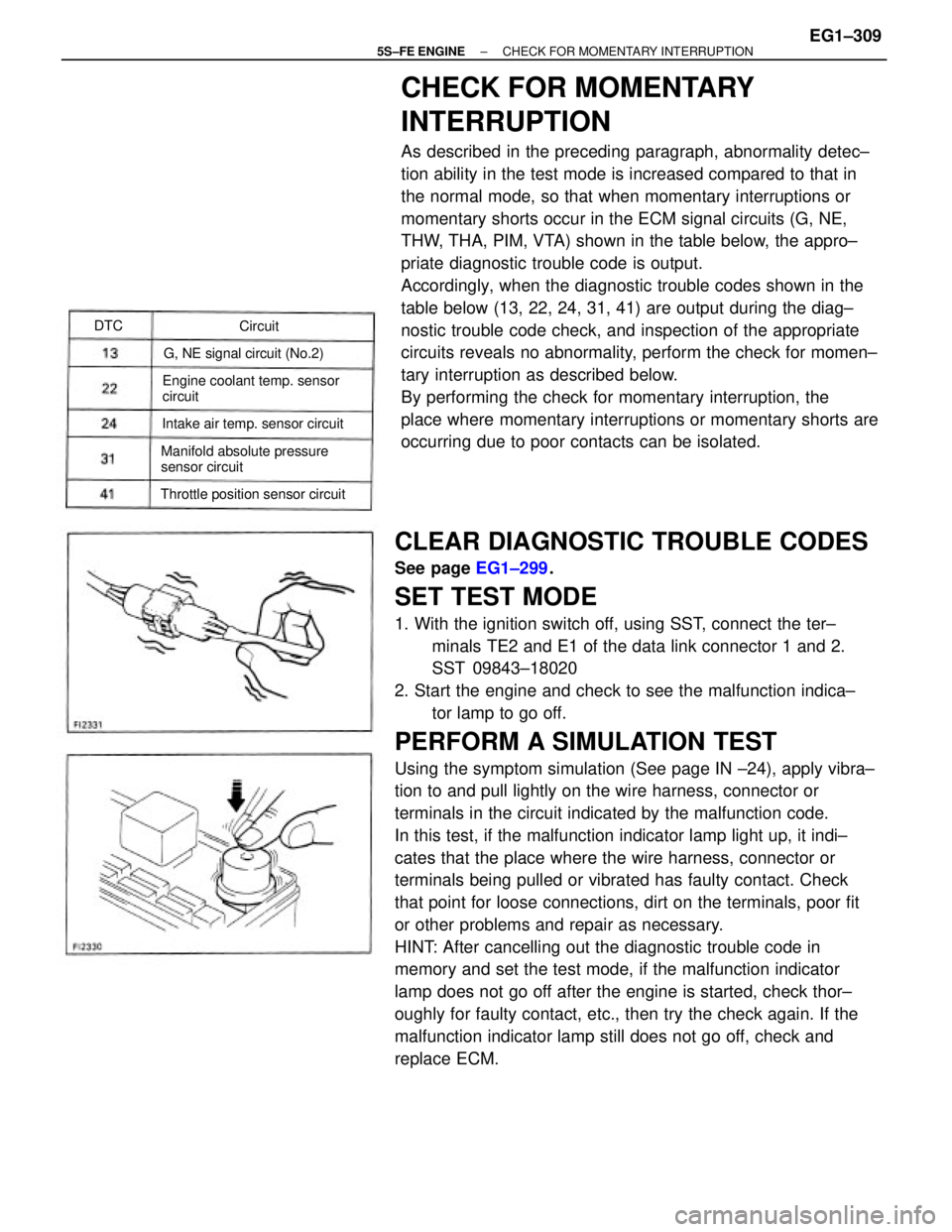
CLEAR DIAGNOSTIC TROUBLE CODES
See page EG1±299.
SET TEST MODE
1. With the ignition switch off, using SST, connect the ter±
minals TE2 and E1 of the data link connector 1 and 2.
SST 09843±18020
2. Start the engine and check to see the malfunction indica±
tor lamp to go off.
PERFORM A SIMULATION TEST
Using the symptom simulation (See page IN ±24), apply vibra±
tion to and pull lightly on the wire harness, connector or
terminals in the circuit indicated by the malfunction code.
In this test, if the malfunction indicator lamp light up, it indi±
cates that the place where the wire harness, connector or
terminals being pulled or vibrated has faulty contact. Check
that point for loose connections, dirt on the terminals, poor fit
or other problems and repair as necessary.
HINT: After cancelling out the diagnostic trouble code in
memory and set the test mode, if the malfunction indicator
lamp does not go off after the engine is started, check thor±
oughly for faulty contact, etc., then try the check again. If the
malfunction indicator lamp still does not go off, check and
replace ECM.
CHECK FOR MOMENTARY
INTERRUPTION
As described in the preceding paragraph, abnormality detec±
tion ability in the test mode is increased compared to that in
the normal mode, so that when momentary interruptions or
momentary shorts occur in the ECM signal circuits (G, NE,
THW, THA, PIM, VTA) shown in the table below, the appro±
priate diagnostic trouble code is output.
Accordingly, when the diagnostic trouble codes shown in the
table below (13, 22, 24, 31, 41) are output during the diag±
nostic trouble code check, and inspection of the appropriate
circuits reveals no abnormality, perform the check for momen±
tary interruption as described below.
By performing the check for momentary interruption, the
place where momentary interruptions or momentary shorts are
occurring due to poor contacts can be isolated.
Engine coolant temp. sensor
circuit
Manifold absolute pressure
sensor circuit
Throttle position sensor circuitIntake air temp. sensor circuitG, NE signal circuit (No.2)Circuit DTC
± 5S±FE ENGINECHECK FOR MOMENTARY INTERRUPTIONEG1±309
Page 369 of 4770
wManifold absolute pressure sensor
wThrottle position sensor Manifold absolute pressure sensor
wDefogger relay
wTaillight relay Engine coolant temp. sensorData link connector 1 and 2
Data link connector 1 and 2Malfunction indicator lamp Injectors (No.2 and No.4)
No.1 vehicle speed sensorThrottle position sensor
Throttle position sensorIntake air temp. sensorEG R gas temp. sensor
Circuit opening relay
Main oxygen sensor
Data link connector 1Sub oxygen sensor Terminal
No.Terminal
No.
A/C amplifier
EFI main relayEFI main relay Sensor ground
Sensor groundA/C amplifier
Power ground
ECM groundConnection Connection
VSV for EG R
Knock sensorSymbol Symbol
Battery Igniter
± 5S±FE ENGINETERMINALS OF ECMEG1±319
Page 370 of 4770
ECM (California specification vehicles and except California specification vehicles with A/T)
*�: Only for California specification vehicles.
*�: Except California specification vehicles with A/T.wManifold absolute pressure sensor
wThrottle position sensor
TERMINAL OF ECM (Cont'd)
Manifold absolute pressure sensor VSV for fuel pressure control
Engine coolant temp. sensor No.2 and No.4 injectors
No.1 and No.3 injectors
Intake air temp. sensor VSV for A/C Idle up
Main oxygen sensor Sub oxygen sensor A/T No.1 solenoid
A/T No,2 solenoid Terminal
No.*�
A/T SL solenoid
Power ground
Power ground No.2 injector
No.1 injectorNo.4 injector
No.3 injector
ECM groundVSV for EG RConnection Connection
DistributorDistributor
Distributor Distributor
IAC valve IAC valveSymbol Symbol
Igniter IgniterTerminal
No.*�
± 5S±FE ENGINETERMINALS OF ECMEG1±320
Page 372 of 4770
IG switch ON and apply vacuum to the
throttle opener. Throttle valve fully closed. ECM (Except California specification vehicles with M/T)
STANDARD VALUE OF EC
Idling, Engine coolant temp, 80�C (176�F) IG switch 0 N
Throttle valve fully closed
IG switch ON
Throttle valve fully openIG switch ON
Throttle valve fully open
Idling, Intake air temp. 20�C (68�F)
Pulse generation
(See page EG1±347)
Pulse generation
(See page EG1±336)
Pulse generation
(See page EG1±336) Pulse generation
(See page EG1±347)
TERMINALS
Symbols (Terminals No.)
STD Voltage (V)
Pulse generation Wiring Color
IG switch ON IG switch ON
IG switch ONIG switch ON
IG switch ONCondition
Below 2.0Always
Idling IdlingIdling
IdlingIdlingIdling
± 5S±FE ENGINESTANDARD VALUE OF ECM TERMINALSEG1±322
Page 374 of 4770

ECM (California specification vehicles and except California specification vehicles with A/T)
STANDARD VALUE OF ECM TERMINALS (Cont'd)
*�: Only for California specification vehicles.
*�: Except California specification vehicles with A/T.IG switch ON and apply vacuum to the
throttle opener. Throttle valve fully closed.
Idling, Engine coolant temp. 80�C (176�F) IG switch ON
Throttle valve fully closedIG switch ON
Throttle valve fully open
IG switch ON
Throttle valve fully open
Idling, Intake air temp. 20�C (68�F)
Pulse generation
(See page EG1±410)
Pulse generation
(See page EG1±341)
Pulse generation
(See page EG1±336) Pulse generation
(See page EG1±341) Pulse generation
(See page EG1±347) Pulse generation
(See page EG1±347)
Pulse generation
(See page EG1±336) Symbols (Terminals No.)*3
STD Voltage (V) Wiring Color
IG switch ON IG switch ONIG switch ON
IG switch ONlG switch ONCondition
Below 2.0Always
Idling Idling
Idling Idling
Idling Idling
Idling
Idling
± 5S±FE ENGINESTANDARD VALUE OF ECM TERMINALSEG1±324
Page 375 of 4770
Maintain engine speed at 2,500 rpm for
2 minutes after warming up then return
to idling
*�: Only for California specification vehicles.Maintain engine speed at 2,500 rpm for
2 minutes after warming up
IG switch ON
Other shift position in ªPº, ªNº position
IG switch ON
Shift position in ªPº, ªNº position
IG switch ON
0/D main switch pushed out
Restarting at high engine coolant temp.
IG switch ON
O/D main switch pushed inIG switch ON
Rotate driving wheel slowly Pulse generation
(See page EG1±389)
Pulse generation
(See page EG1±380) Pulse generation
(See page EG1±355) Symbols (Terminals No.)*�
A/C switch ON (At idling)
Idling, A/C switch OFFIdling, A/C switch ON STD Voltage (V)
A/C switch OFF Wiring Color
IG switch ON IG switch ONIG switch O NIG switch ON
IG switch ON
IG switch ONIG switch ONCondition
IdlingIdling
*�:
± 5S±FE ENGINESTANDARD VALUE OF ECM TERMINALSEG1±325
Page 376 of 4770

REFERENCE VALUE OF ECM DATA
*1: If the engine coolant temp, sensor circuit is open or shorted, the ECM assumes an engine coolant temp, value of 80�C (176�F).
*2: When feedback control is forbidden, 0 V is displayed,
*3: A/T only.Closed throttle position
Wide open throttle
From closed throttle position to wide open throttle
When shifting from ªPº or ªNº position into a position
other than ªPº or ªNºEngine idling at normal operating temp.
increase engine loadEngine cold to hot
Engine idling at normal operating temp.
RPM stable at 2,500 rpm with normal operating temp.
PRM stable at 2,500 rpm with normal operating temp.RPM kept stable (Comparison with tachometer)
During driving (Comparison with speedometer)Below 5�
Above 70�
Gradually increases Approx. 180 ~ 280 mm Hg
Gradually increases
Engine idling at normal operating temp.Engine idling at normal operating temp.Gradually decreases
Approx. 2 ~ 5 msecs
REFERENCE VALUE
Engine at normal operating temp. 75 ± 95�C (185 ± 203�F) *1
Closed throttle position
RICH LEAN is repeated Increase engine speed
No large differences Inspection condition
Gradually increases
No great changes
2.50+ 1.25 V *2
During cranking
PNP SIGNAL *3A/C switch ON ENGINE SPEEDReference value
TARGET A/F LVEHICLE SPD
A/F FB LEFT
A/C SIGNALSTA SIGNAL
CTP SIGNAL30~60% INJECTOR
THROTTLEIAC DUTYIGNITION
G EAR MAPItem
OxLECT
HINT: ECM data can be monitored by TOYOTA hand±held
tester.
1. Hook up the TOYOTA hand±held tester to the DLC2.
2. Monitor ECM data by following the prompts on the tester
screen.
Please refer to the TOYOTA hand±held tester operator's
manual for further details.
± 5S±FE ENGINEREFERENCE VALUE OF ECM DATAEG1±326


