2000 AUDI ALLROAD warning
[x] Cancel search: warningPage 236 of 306
Engine
oil consumption
The rate of the oil consumption depends on
the quality and viscosity of oil, the speed at
which the engine is operated, the climate,
and road conditions as well as amount of
dilution and oxidation of the lubricant.
Because of these variables, no standard
rate of oil consumption can be established,
but drivers should expect higher oil con
sumption at high speeds and when the en
gine is new.
Therefore, we recommend that you check
the oil level at regular intervals (for example,
each time you are refuelling, or before going
on a long trip).
If the oil level should go below the minimal
level, the check engine oil level warn
ing light* in the instrument cluster will
come on. See page 144. You should check
the oil level using the oil dip stick as soon as
possible, and then top off the oil as neces
sary. Notes
• The engine in your vehicle de
pends on oil to lubricate and cool all
of its moving parts. Therefore the
engine oil should be checked regu
larly and kept at the required level.
• Lack of sufficient engine oil may
lead to severe engine damage.
• The oil pressure warning light is
not an oil level indicator.
A Always
heed all WAR NINGS
� on page 232.
Checking the engine oil level
The best time to check the engine oil level
is when the oil is warm.
To get a true reading, the vehicle must be on
level ground.
A Always heed all WAR NINGS
� on page 232.
• After turning off the engine, wait a few
minu tes for the oil to return to the oil pan. VE
HICLE CARE
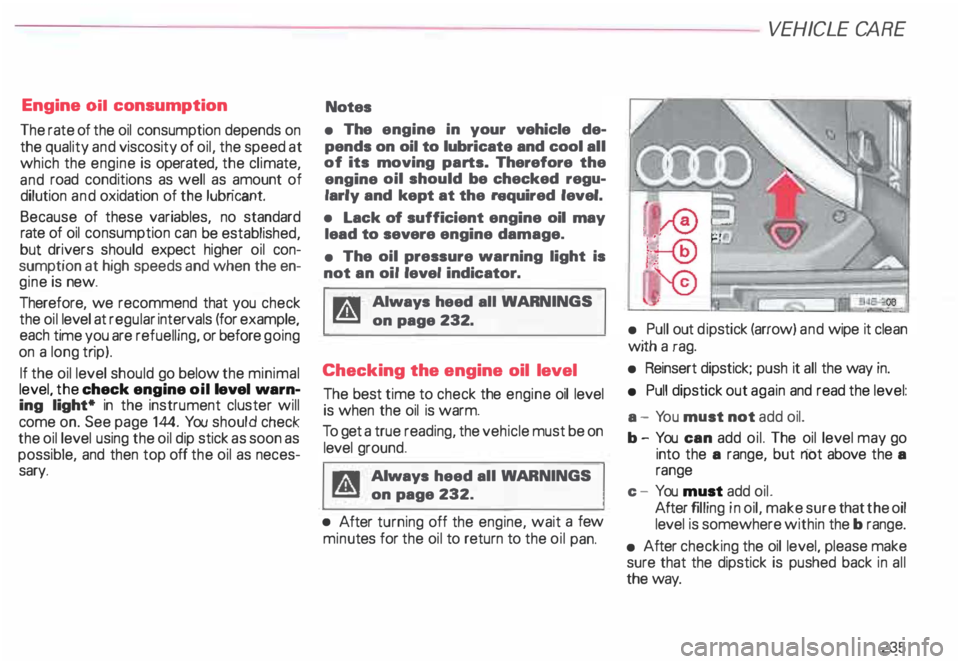
• Pull out dipstick (arrow) and wipe it clean
with a rag.
• Reinsert dipstick; push it all the way in.
• Pull dipstick out again and read the level:
a - Yo u must not add oil.
b- You can add oil. The oil level may go
into the a range, but riot above the a
range
c - You must add oil.
After filling in oil, make sure that the oil
level is somewhere within the b range.
• After checking the oil level, please make
sure that the dipstick is pushed back in all
the way.
235
Page 237 of 306
VEHICLE CA
RE---------------------------------------------------
Adding engine oil
A Always heed all WA RNINGS
r!!J on page 232.
• Turn off the engine.
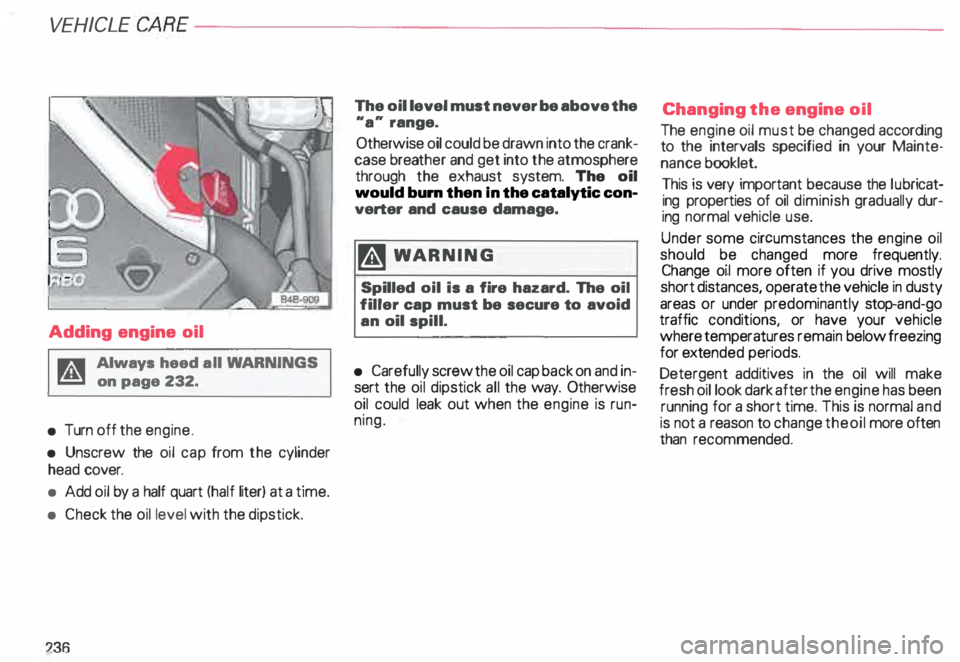
• Unscrew the oil cap from the cylinder
head cover.
• Add oil by a half quart (half liter) at a time.
• Check the oil level with the dipstick.
:236 The
oil level must never be above the
"a .. range.
Otherwise oil could be drawn into the crank
case breather and get into the atmosphere
through the exhaust system. The oil
would bum then In the catalytic con
verter and cause damage.
� WARNING
Spilled oil is a fire hazard. The oil
filler cap must be secure to avoid
an oil spill.
• Carefully screw the oil cap back on and in
sert the oil dipstick all the way. Otherwise
oil could leak out when the engine is run
ning. Changing
the engine oil
The engine oil must be changed according
to the intervals specified in your Mainte
nance booklet.
This is very important because the lubricat
ing properties of oil diminish gradually dur
ing normal vehicle use.
Under some circumstances the engine oil
should be changed more frequently.
Change oil more often if you drive mostly
short distances, operate the vehicle in dusty
areas or under predominantly stop-and-go
traffic conditions, or have your vehicle
where temperatures remain below freezing
for exte nded periods.
Detergent additives in the oil will make
fresh oil look dark after the engine has been
running for a short time. This is normal and
is not a reason to change the oil more often
than recommended.
Page 238 of 306
---------------------------------------------------VEHICLE CA
RE
�W ARNING
• If you must change the engine
oil in your vehicle:
• Wear eye protection.
• To reduce the risk of burns from
hot engine oil let the engine cool
down to the touch.
• When removing the oil drain
plug with your fingers, stay as far
away as possible. Always keep
your forearm parallel to the
ground to help prevent hot oil
from running down your arm.
• Drain the oil into a container de�
signed for this purpose, one large
enough to hold at least the total
amount of oil in your engine. ,A
WARNING continued
• Engine oil is poisonous. Keep it
well out of the reach of children.
• Continuous contact with used
engine oil is harmful to your skin.
Always protect your skin by wash
ing thoroughly with soap and wa
ter. �
BefoN changing your oil, first
make sure you know where you
can properly dispose of the old oil.
Always dispose of used engine oil
proper ly. Do not dump it on garden
soil, wooded areas, Into open
streams or down sewage drains.
Recycle used engine oi l by taking it
to a used engine oil collection facil
ity in your area, or contact a service
station.
Because of the problem of proper
disposal, along with the special
tools and necessary expertise re
quired, we strongly recommend that
you have your oil changed by an au
thorized Audi Dealer or a qualified
workshop.
Always heed all WA RNINGS
on page 232.
237
Page 241 of 306
VE
HICLE CARE
Adding coolant
� WARNING
The cooling system is under pres
sura and can get very hot. Reduce
the risk of scalding from hot cool
ant by following these steps.
• Turn off the engine and allow it
to cool down.
• Protect face, hands and arms es
caping fluid and steam by covering
the cap with a large, thick rag.
• Turn the cap slowly and very
care fully in a counter--clockwise di
rection while applying light, down
ward pressure on the top of the
cap.
• To help avoid being burned, do
not spill antifreeze or coolant on
the exhaust system or hot engine
parts. Under some conditions, the
ethylene glycol in engine coolant
can catch fire.
240 If,
in an emergency, only water can be add
ed, the correct ratio between water and an
tifreeze (see page 238) must be restored as
soon as possible.
If you have lost a considerable amount of
coolant. then you should add cold antifreeze
and cold water only when the engine is cold.
Do not fill coolant above the "MAX"
mark.
Note
Coolant pollutes the environment
and could cause an engine fire. Ex
cess coolant will be forced out
through the pressure relief valve in
the cap when the engine becomes
hot. Screw cap
on again tightly.
� WARNING
Antifreeze is poisonous. Always
store antifreeze in its original con
tainer and well out of the reach of
children. If you drain the coolant,
it must be caught and safely
stored in a proper container
clearly marked "poison ...
<£> Drained coolant should not be
reused. Always dispose of used
coolant observing all env ironmen
tal regulations.
Always heed all WARNINGS
on page 232.
Page 242 of 306
Radiator
fan
The radiator fan is driven by the engine via
the V-belt. The viscous clutch regulates the
speed of the fan according to the tempera
ture of the coolant.
An auxiliary electric radiator fan switches on
and off depending on coolant temperature
and other vehicle operation conditions.
� WARNING
• Always use extreme caution to
prevent clothing. jewelry, or long
hair from getting caught in the en
gine driven radiator fan, V-belt or
other moving parts.
• Never touch the auxiliary elec
tric radiator fan. The fan can
switch on suddenly and injure you.
Always heed all WA RNINGS
on page 232. Power
steering
Yo ur vehicle is equipped with a Servotro
nic power steering. The degree of
power assistance is regulated electronically
according to road speed.
The fluid reservoir is in the engine compart
ment near the windshield washer container.
The correct fluid level in the reserv oir is im
portant for the proper functioning of power
steer ing.
The power steering fluid level is checked
during the scheduled Maintenance ser
vices.
If the electronic regulating system is not
working properly, this is most noticeable
when turning the steering wheel at low
speeds (for example when parking) -more
effort will be required than usual. The fault
should be rectified by an Audi Dealer as
soon as possible. VEH
ICLE CARE
Note
• When the engine is running, never hold
the steering wheel turned all the way to the
right or to the left for longer than 15 sec
onds. The power steering pump will over
heat the hydraulic fluid if you hold the steer
ing wheel all the way turned.
This will damage the power steering
system.
Each time the steering wheel is turned all
the way to the right or left when stopped,
you will hear noises caused by the severe
stress placed on the power steering pump.
At the same time, engine idle speed drops.
• If the power steering system
should fail, or if the engine is not
running (for example, while being
towed). you will still be able to steer
the vehicle, however. more effort
will be required.
• If the power steering system should
have a leak, or is not functioning properly,
contact your authorized Audi Dealer imme
diately.
241
Page 243 of 306
VE
HICLE CA
RE----------------------------------------------------
Brake fluid
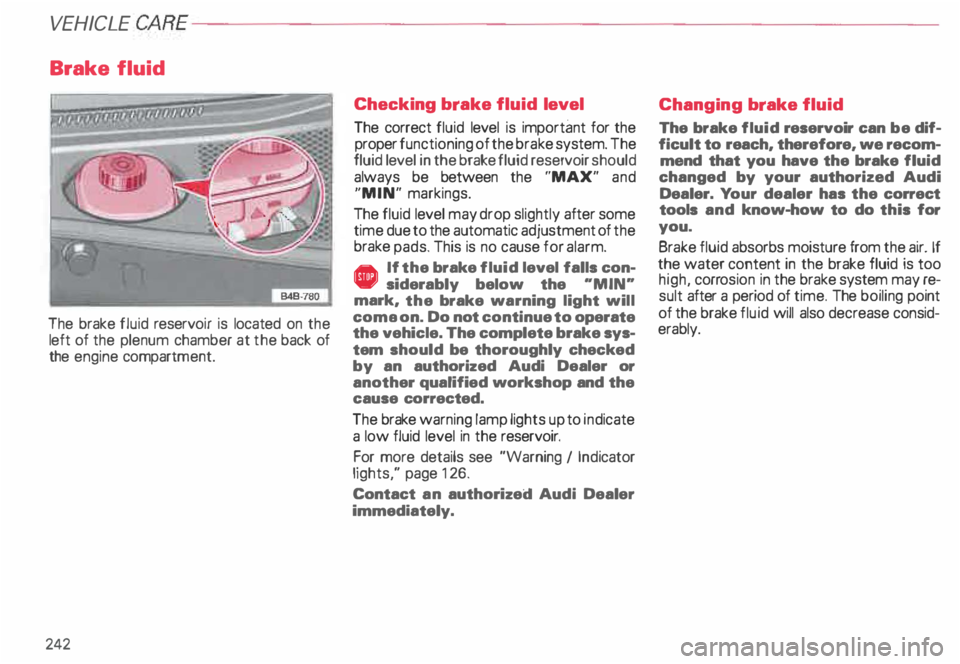
The brake fluid reservo ir is located on the
left of the plenum chamber at the back of
the engine compartm ent.
242 Checking
brake fluid level
The correct fluid level is important for the
proper functioning of the brake system. The
fluid level in the brake fluid reservoir should
always be between the "MAX" and
"MIN" markings.
The fluid level may drop slightly after some
time due to the automatic adjustment of the
brake pads. This is no cause for alarm.
• If the brake fluid level falls con
siderably below the "MIN"
mark, the brake warning light will
coma on. Do not continue to operate
the vehicle. The complete brake sys
tem should be thoroughly checked
by an authorized Audi Dealer or
another qualified workshop and the
cause corrected.
The brake warning lamp lights up to indicate
a low fluid level in the reservoir.
For more details see "Warning I Ind icator
lights," page 126.
Contact an authorized Audi Dealer
immediately. Changing
brake fluid
The brake fluid reservoir can be dif
ficult to reach, therefore, we recom
mend that you have the brake fluid
changed by your authorized Audi
Dealer. Your dealer has the correct
tools and know-how to do this for
you.
Brake fluid absorbs moisture from the air. If
the water content in the brake fluid is too
high, corrosion in the brake system may re
sult after a period of time. The boiling point
of the brake fluid will also decrease consid
erably.
Page 247 of 306
VEHICLE CA
RE---------------------------------------------------
Battery acid level
g Always heed all WA RNINGS
� on page 232.
Under normal operating conditions, the
battery in your Audi does not need any
maintenance.
At high outside temperatures it is advisable,
however, to check the fluid level at regular
intervals through the transparent battery
housing. Also check the fluid level each
time you charge the battery.
The fluid level should always be between
the "min" and "max" marks in each cell.
If the fluid level has reached the "min"
marks, let your authorized Audi Dealer cor
rect the condition.
�W ARNIN G
• Always shield your eyes and
avoid leaning over the battery
whenever possible.
• Do not let battery acid come in
contact with skin, eyes, fabric, or
painted surfaces.
246 ��
WARNING continued
• If you get battery acid in your
eyes or on your skin, immediately
rinse with cold water for several
minu tes and call a doctor.
• Do not expose the battery to an
open flame or electric spark.
Hydrogen gas generated by the
battery can explode and cause per
sonal injury.
Note Do not overfill the battery. Other
wise battery acid will overflow
through the vent opening. This will
damage the paint and cause corro
sion.
�W ARNIN G
Battery posts, terminals and re
lated accessories contain lead and
lead compounds. Wash hands af
ter handling. Charging
of battery
�W ARNING
• The battery contains sulfuric
acid. Therefore, keep battery out
of reach of children.
• Charge the battery in a well ven
tilated area. Keep away from open
flame or electrical spark. Do not
smoke. Hydrogen gas generated
by the battery is explosive.
• Always shield your eyes and
avoid leaning over the battery
whenever possible.
• If you gat battery acid in your
eyes or on your skin, immediately
rinse with cold water for several
minu tes and call a doctor.
• Fast charging a battery is dan
gerous and should only be at
tempted by a competent mechanic
with the proper equipment.
Page 248 of 306

f4 WARNING
continued
• Never charge a frozen battery. It
may explode because of gas
trapped in the ice. Allow a frozen
battery to thaw out first.
• Do not reuse batteries which
have fr ozen. The baUery housing
may have cracked and weakened
when the battery froze.
Always heed all WA RNINGS
on page 232.
• Battery acid that may spill during
charging should be washed off with
a solution of warm water and baking
soda to neutralize the acid.
• Never use a fast charger as a boo
ster to start the engine. This will se
riously damage sensitive electronic
components, such as control units,
relays, radio, etc., as well as the bat
tery charger. Slow
battery charging
�W ARNING
Heed all WA RNINGS and follow in
structions that come with your
battery charger.
• Before charging the battery, switch off
the ignition and all electrical consumers.
• Make sure the area is well ventilated
when you charge the battery.
• It is not necessary to remove the battery
from the engine compartment, and it is also
not necessary to disconn ect the cables.
• Make sure the electrolyte level in each
cell is between the .. min" and "max ..
marks. If the fluid level is below the "min"
mark, let your authorized Audi Dealer cor
rect the condition. VE
HICLE CARE
• Conne ct charger cables.
Charger cables must be connected
POSITIVE (+ ) to POSITIVE (+ ) and
NEGATIVE (-) to NEGATIVE (-).
�W ARNING
To reduce the danger of explosion,
never connect or disconnect char
ger cables while the charger is op
erating.
• Switch on charger.
• Charging rate not over 6 amps.
Normal ly, a battery should be charged at no
more than 1 0 percent of its rated capacity.
For example, a charging current of 4.5 amps
would be used on a battery rated at 45 Ah.
Rated capacity of the battery in your vehicle
is listed on the battery housing.
• After charging, first turn off the charger
and then disconnect charger cables. g Always heed all WARNINGS
� on page 232.
247