2000 AUDI ALLROAD warning
[x] Cancel search: warningPage 194 of 306

The
first 1,000 miles (1 500 km)
and afterwards
Break-in period
During the first few hours of driving, the en
gine's internal friction is higher than later
when all the moving parts have been broken
in. How well this break-in process is done
depends to a considerable extent on the
way the vehicle is driven during the first
1, 000 miles (1 500 kilometres").
For the first 600 miles
(1 000 kilometres):
As a rule of thumb:
• Do not use full throttle.
• Do not drive faster than 3/4 of top
speed shown on the speedometer.
• Avoid high engine speeds.
• If possible, avoid towing a trailer. �
WARNING
• New tires tend to be slippery
and must also be "broken-ln." Be
sure to remember this during the
first 300 miles (500 kilometres).
Brake gently. Avoid following
closely behind other vehicles or
other situations that might require
sudden, hard braking.
• New brake pads don't have the
best stopp ing power and must be
.. brok en-in" during the initial 100
to 150 miles (150 to 200 kilo
metres) of normal city driving. You
can compensate for this by press
ing the brake pedal more firmly.
This also applies later when new
pads are installed.
From 600 to 1,000 miles
(1 000 to 1 500 kilometres):
Speeds can gradually be increased to maxi
mum permissible road or engine speed. VE
HICL E OPER ATION
During and after break-in
period
• Do not rev the engine up to high speeds
when it is cold. This applies whether the
transmission is in N (Neutral) or in gear. dib Do not drive with unnece ssarily C!1'5 high engine speeds -upshifting
early saves fuel, reduces noise and
protects the environmeht -see also
page 195.
After the break-in period
Do not exceed maximum engine
speed under any circumstances. Up
shift into the next higher gear before reach
ing the red area at the end of the tachome
ter scale -see page 117.
Excessive engine speeds are automatically
reduced.
193
Page 195 of 306
VEHICLE OPERA
TION-----------------------
Operate your vehicle safely
The condition of the vehicle is es
sential for driving safety.
Therefore, always be sure to observe the
following points before you drive off:
• Check lights and turn signals.
• Check fuel level.
• Adjust the mirrors.
• Make sure that all lights and all
windows are clean.
• Make sure the air Intake slot be
tween the engine hood and the
windshield is free of leaves, snow
and ice.
• Check warning and indicator
lights when starting the engine.
For driving safety, always follow the speci
fied maintenance intervals in your Mainte
nance booklet -especially for changing
the brake fluid, see page 242.
Yo ur personal driving style and your
attitude affect driving safety to a
very great extent.
19 4 Therefore,
for your own safety:
• Wear your safety belts and wear
them properly, even if you're just
driving in the city or to the corner
store -see page 14.
• Make sure that all passengers are
wearing their safety belts properly,
even those sitting in the rear -
see page 14.
Passengers not wearing safety belts endan
ger not only themselves in case of an acci
dent, but also the driver and other passen
gers.
• Make sure that children always sit
on the rear seat properly restrained
by a res traint system appropriate
for their size and age.
• Never transport a child in a rear
facing child or infant seat on the
front passenger seat.
• Adjust your seat so that you can
easily reach all controls as far away
from the airbag as possible but no
closer than 10 in. (25 em) -
see page 76. •
The seating position is very im
portant for the airbag performance
- see page 29.
• Always adjust the head restra ints
to the correct height.
For maximum protection, the upper edge of
the head restraints should be at least at
eye level, or higher .
• Always make sure that the move
ment of the pedals is not restricted
In any way-see page 102.
• Store luggage and light items
properly
in the luggage compartment
see page 88.
of the roof - see page 191.
• If you drink, do not drive.
The use of alcohol, drugs and certain medi
cations will seriously impair perception,
reactions and driving ability, and substan
tially increase the risk of an accident and
personal injury.
Page 199 of 306
VE
HICL E OPER ATION ------------------------
• Tu rning off the ignition while the
vehicle is movin g-sea page 115 -or
• Other unusual operating condi
tions.
Do not continue to operate your ve
hicle under these conditions, as
otherwise fuel can reach the catalyt
ic converter. This could result in
overheating of the converter, requir
ing its replacement.
To assure eHiciant operation of the
Emission Control System:
• Have your vehicle maintained
properly and in accordance with the
service recommendations in your
Maintenance booklet.
Lack of proper maintenance as well
as improper usa of the vehicle will
impair the function of the emission
control system and could lead to
damage.
19 8 Cl
Do not alter or remove any com
ponent of the Emission Control Sys
ta.m unless approved by the
manufacturer.
• Do not alter or remove any device,
such as heat shields, switches, igni
tion wires, valves, which are de
signed to protect your vehicle 's
Emission Control System and other
important vehicle components.
Nota
Do not leave engine idling unat
tended after starting. If warning
lights should come on to indicate
improper operation, they would go
unheeded. Extended idling also pro
duces heat, which could result in
overheat ing or other damage to the
vehicle or other property. �W
ARNING
• Parking
Do not park or operate the vehicle
in areas where the hot exhaust sys
tem may coma in contact with dry
grass, brush, fuel spill or other ma
terial which can causa a fire.
• Undercoating
Do not apply additional undercoat
ing or rustproofing on or near the
exhaust manifold, exhaust pipes,
cata lytic converter or heat shields.
During driving, the substance
used for undercoating could over
heat and causa a fire.
Page 204 of 306
�W
ARNING
Although the ABS is very effec
tive, always remember that brak
ing capability is lim ited by tire
tracti on.
Always adjust your driving speed
accor ding to the road and traffic
conditions. Do not let the extra
safety afforded by the ABS tempt
you into taking extra risks. The
ABS cannot overcome the laws of
physics.
If ABS is not functioning properly, a warning
light will come on. See page 125 for addi
tional details. Conditions
affecting
braking efficiency
Moisture or road salt
�W ARNING
• Under certain climatic and oper
ating conditions such as passing
through water, driving in heavy
rain or after washing the vehicle,
the effectiveness of the brakes
can be reduced. In winter, ice can
accumulate on the brake pads, lin
ings, discs and drums. Cautiously
apply brakes for a test. Brakes will
dry and ice coatings will be
cleaned off after a few cautious
brake applications. VE
HICLE OPERATION
� WARNING continued
• Driving for an extended period
of time on salt-covered roads with
out using your brakes can also af
fect braking efficiency. Clean off
accumulated salt coating from
brake discs and pads with a few
cautious brake applications.
Overhea ting the brakes
�W ARNIN G
• Do not "ride the brakes" by rest
ing your foot on the pedal when
you do not intend to brake. This
may cause the brakes to overheat,
premature wear and Increased
stopping distance.
Always heed all WAR NINGS
on next page.
203
Page 205 of 306

VE
HICL E OPERA TION-----------------------
'4 WARN ING continued
• Before descending a steep
grade, reduce speed and shift
transmission into a lower gear or
lower driving position. Do not ride
the brakes or hold the pedal down
too long or too often. This could
cause the brakes to get hot and di
minish braking efficiency.
• If you damage the front spoiler,
or if you install a different spoiler,
be sure the air flow to the front
brakes is not obstructed. Other
wise the brake system could over
heat reducing the effective ness of
the entire brake system.
• Failure of one brake circuit will
impair the braking capability re
sulting in an increased stopping
distance.
Avoid driving the vehicle and have
it towed to the nearest Audi Dealer
or qualified workshop.
204 Electronic differential lock
(EDL)
The EDL operates in conjunction with the
ABS. The EDL acts automatically, i.e. with
out the driver's intervention.
With the aid of the ABS sensors, this sy
stem monitors the speed of the driven
wheels up to about 50 mph, 80 km/h .
Within the speed range at which this sy
stem operates, if the wheels spin (e.g. on
slippery surfaces) they are braked in a con
trolled manner , and more of the engine's
power is directed to whiche ver wheels
achieve greater traction.
Please note:
• When driving off, always be sure to keep
road conditions in mind as you accelerate.
If a drive wheel spins because it's on a slip
perier surface, gradually increase the pres
sure on the accelerator pedal until the car
starts to move. •
When accelerating on slippery surfaces,
such as on ice or snow, always be careful
when depressing the accelerator pedal.
Even with the EDL working, the drive
wheels can spin and reduce your ability to
control your car.
• To prevent the disc brake of the braked
wheel from overheating, if subjected to ex
cessive loads the EDL cuts out temporarily.
The vehicle remains operational and be
haves in the same way as a vehicle without
EDL
If a fault occurs in the ABS the EDL is also
not functioning. This is ind icated by the ABS
warning light-see page 125.
ftl WARNING
The increased safety afforded by
EDL does not mean that you can
take safety risks. Always adapt
your driving style to the road con
ditions and traffic situation.
Page 206 of 306
Electronic
Stability Program (ESP)
The Electronic Stability Program helps to
control the vehicle in critical maneuvers like
curves.
When the vehicle starts up and accelerates,
the wheels are prevented from spinning by
adjusting the engine power to conform to all
road conditions. This improves vehicle sta
bil ity.
The system operates across the entire
speed range in combination with the ABS
syst em. If the Anti-Lock Brake System
(ABS) malfunctions, the ESP will also shut
down.
When you turn on the engine, the ESP will
automatically be activated and will perform
a self-test. The
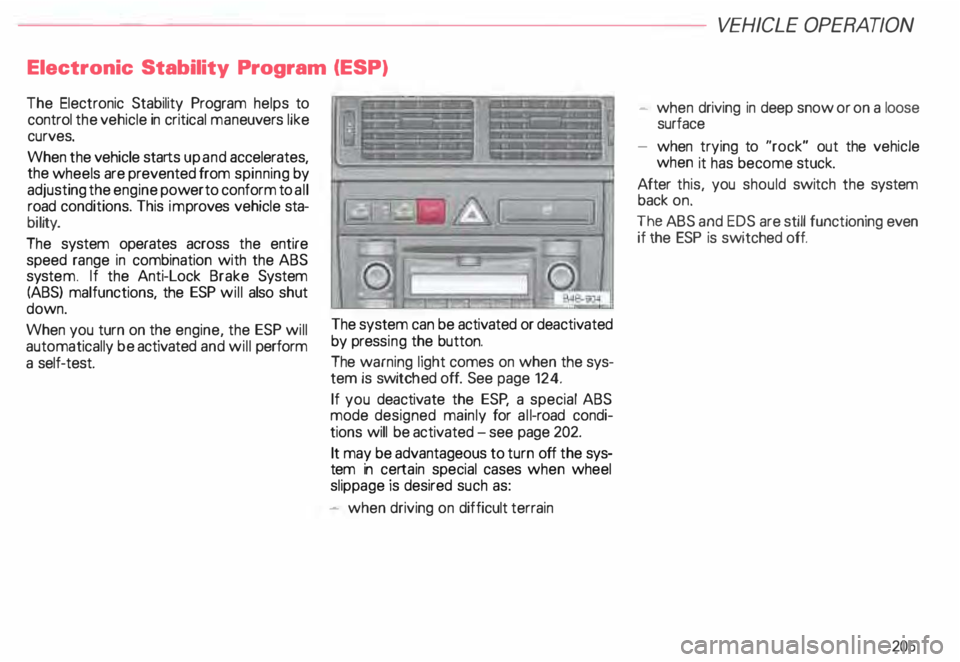
system can be activated or deactivated
by press ing the button.
The warning light comes on when the sys
tem is switch ed off. See page 124.
If you deactivate the ESP, a special ABS
mode designed mainly for all-road condi
tions will be activated - see page 202.
It may be advantageous to turn off the sys
tem in certain special cases when wheel
slippage is desired such as:
- when driving on difficult terrain VE
HICL E OPER ATION
- when driving in deep snow or on a loose
surface
- when trying to "rock" out the vehicle
when it has become stuck.
After this, you should switch the system
back on.
The ABS and EDS are still functioning even
if the ESP is switched off.
205
Page 208 of 306

Driving
with your quattro ®
The All Wheel Drive system has no operat
ing controls that require attention.
The engine power is distributed automati
cally to all four wheels for optimum effi
ciency in all situations and road conditions.
The All Wheel Drive concept is perfectly
matched to the engine power of your
Audi all road. This combination gives the ve
hicle excep tional handling and performance
capabilities, both on normal roads and in ex
treme conditions of ice and snow.
However, it is vital to observe the following
safety notes:
�W ARNIN G
Always adjust your driving to road
and traffic conditions. Do not let
the extra safety afforded by All
Wheel Drive tempt you into taking
extra risks.
Although the All Wheel Drive is
very effective, always remember
that braking capacity is limited by
tire traction. You should therefore
not drive at excessive speeds on
icy or slippery road surfaces. ftl
WARNING continued
On wet road surfaces, be careful
not to drive too fast because the
front wheels could begin to slide
on top of the water (hydroplaning).
If this should occur, you will have
no warning from a sudden in
crease in engine speed as with a
front-wheel drive vehicle. Always
drive at speeds which are suitable
to the road conditions.
Replacing wheels I tires
All four wheels must always have the same
rol ling radius. Different tires on the front and
rear wheels may impair vehicle control and
will damage the All Wheel Drive because of
the constantly different wheel speeds. The
proper function of the system is not af
fected by unevenly worn tires.
For more information, see page 255. VEH
ICLE OPER ATION
Using winter tires
When driving in the winter, your vehicle
with All Wheel Drive has an advantage,
even with regular tires.
You should promptly install wheels
equipped with winter or all-season tires to
better handling and braking characteristics.
See also "Winter tires", page 260.
207
Page 211 of 306
VEHICLE OPER
ATION-----------------------
Driving Instructions
To obtain the best possible handling of ve
hicle and trailer , please note the following:
• A "balanced" rig is easier to operate and
control. This means that the tow vehicle
should be loaded to the extent possible and
permissible while keeping the trailer as light
as possible under the circumstances.
Whenever possible, transfer some cargo to
the luggage compartment of the tow ve
hicle while observing tongue load require
ments and vehicle loading considerations.
• The higher the speed, the more difficult
it becomes for the driver to control the rig.
Do not drive at the maximum per
missible speed. Reduce your speed even
more under unfavorable load, weather or
wind conditions - particularly when going
dow nhill.
210 Be
especially careful when passing other
vehicles.
Reduce vehicle speed immediately if the
trailer shows the slightest sign of swaying.
Do not try to stop the sway ing by accel erat
ing.
Observe speed limits. In some areas
speeds for vehicles towing trailers are low
er than for regular vehicles.
• Always apply brakes early.
When driving downhill, shift into lower gear
to use the engine braking effect to slow
down the vehicle. Use of the brakes alone
can cause them to overheat and fail. •
The coolant temperatura gauge
must be observed carefully. H the
needle nears the upper end of the
scale, reduce speed immediately
and/or switch off the air condi
tioner.
If the coolant temperature warning
light in the instrument cluster starts
flashing in red, pull off the road,
stop and let the engine idle for about
2 minutes to prevent a heat build-up.