1999 NISSAN PRIMERA wheel alignment
[x] Cancel search: wheel alignmentPage 281 of 2267
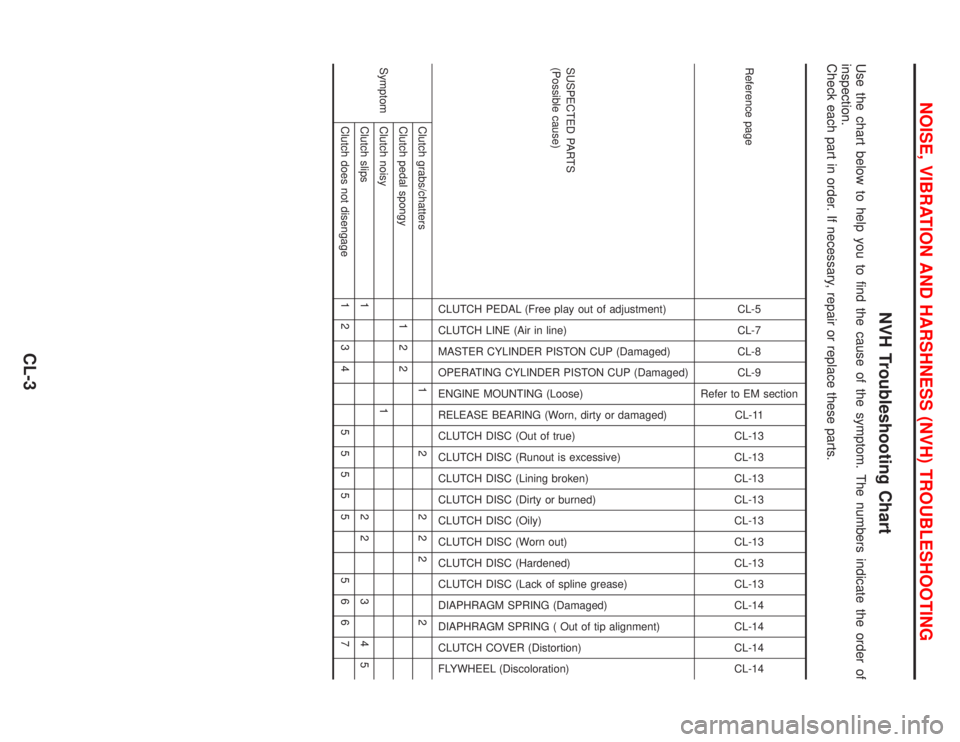
NVH Troubleshooting Chart
Use the chart below to help you to find the cause of the symptom. The numbers indicate the order of
inspection.
Check each part in order. If necessary, repair or replace these parts.
Reference pageCL-5
CL-7
CL-8
CL-9
Refer to EM section
CL-11
CL-13
CL-13
CL-13
CL-13
CL-13
CL-13
CL-13
CL-13
CL-14
CL-14
CL-14
CL-14
SUSPECTED PARTS
(Possible cause)
CLUTCH PEDAL (Free play out of adjustment)
CLUTCH LINE (Air in line)
MASTER CYLINDER PISTON CUP (Damaged)
OPERATING CYLINDER PISTON CUP (Damaged)
ENGINE MOUNTING (Loose)
RELEASE BEARING (Worn, dirty or damaged)
CLUTCH DISC (Out of true)
CLUTCH DISC (Runout is excessive)
CLUTCH DISC (Lining broken)
CLUTCH DISC (Dirty or burned)
CLUTCH DISC (Oily)
CLUTCH DISC (Worn out)
CLUTCH DISC (Hardened)
CLUTCH DISC (Lack of spline grease)
DIAPHRAGM SPRING (Damaged)
DIAPHRAGM SPRING ( Out of tip alignment)
CLUTCH COVER (Distortion)
FLYWHEEL (Discoloration)
SymptomClutch grabs/chatters 1 2 2 2 2 2
Clutch pedal spongy 1 2 2
Clutch noisy 1
Clutch slips 1 2 2 3 4 5
Clutch does not disengage 1 2 3 4 5 5 5 5 5 5 6 6 7
NOISE, VIBRATION AND HARSHNESS (NVH) TROUBLESHOOTING
CL-3
Page 1743 of 2267
FRONT AXLE &
FRONT SUSPENSION
SECTION
FA
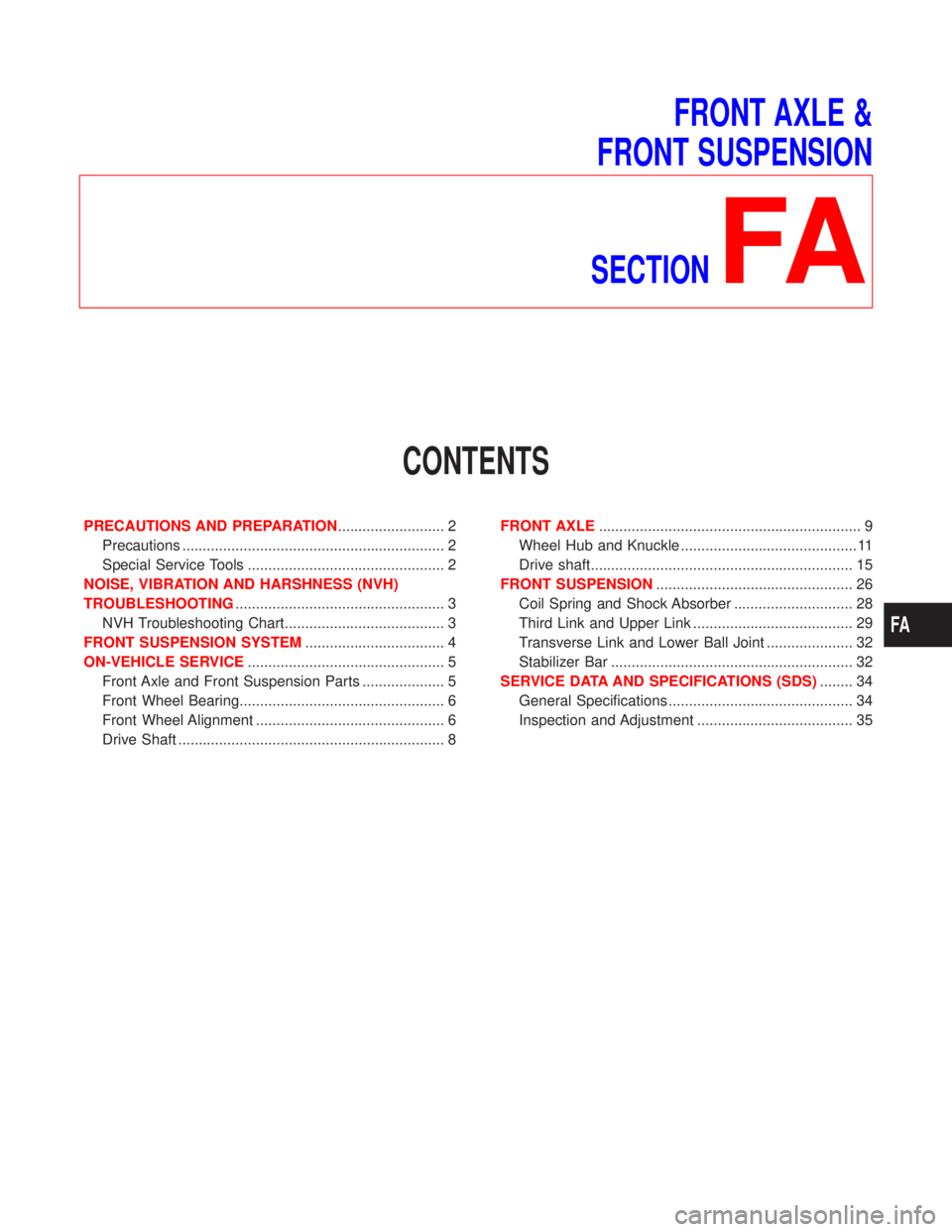
CONTENTS
PRECAUTIONS AND PREPARATION.......................... 2
Precautions ................................................................ 2
Special Service Tools ................................................ 2
NOISE, VIBRATION AND HARSHNESS (NVH)
TROUBLESHOOTING................................................... 3
NVH Troubleshooting Chart....................................... 3
FRONT SUSPENSION SYSTEM.................................. 4
ON-VEHICLE SERVICE................................................ 5
Front Axle and Front Suspension Parts .................... 5
Front Wheel Bearing.................................................. 6
Front Wheel Alignment .............................................. 6
Drive Shaft ................................................................. 8FRONT AXLE................................................................ 9
Wheel Hub and Knuckle ........................................... 11
Drive shaft................................................................ 15
FRONT SUSPENSION................................................ 26
Coil Spring and Shock Absorber ............................. 28
Third Link and Upper Link ....................................... 29
Transverse Link and Lower Ball Joint ..................... 32
Stabilizer Bar ........................................................... 32
SERVICE DATA AND SPECIFICATIONS (SDS)........ 34
General Specifications ............................................. 34
Inspection and Adjustment ...................................... 35
FA
Page 1744 of 2267
Precautions
lWhen installing each rubber part, final tightening must
be carried out under unladen condition* with tires on
ground.
*: Fuel, radiator coolant and engine oil full. Spare tire,
jack, hand tools and mats in designated positions.
lWhen removing each suspension part, check wheel
alignment and adjust if necessary.
lUse Tool when removing or installing brake tubes.
lAlways torque brake lines when installing.
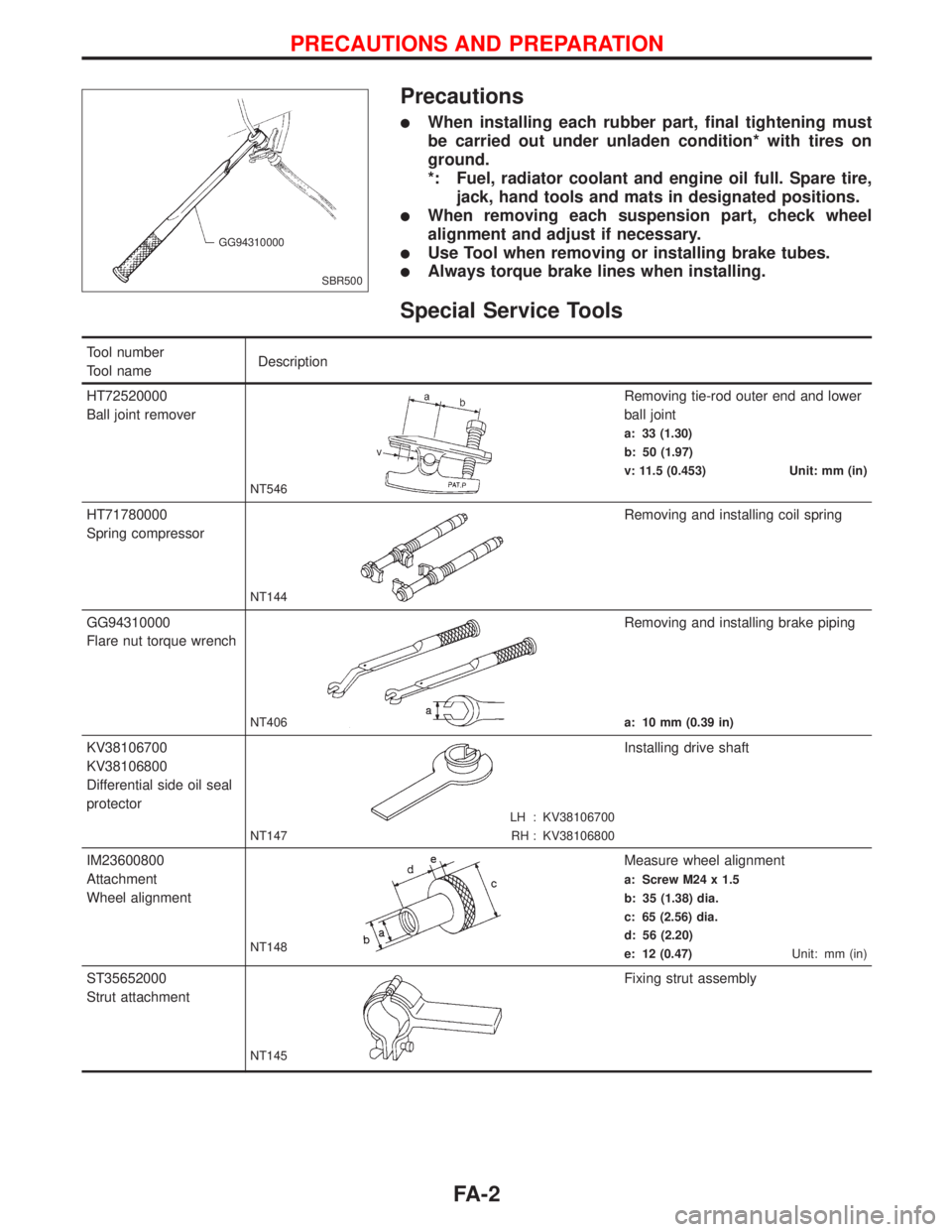
Special Service Tools
Tool number
Tool nameDescription
HT72520000
Ball joint remover
NT546
Removing tie-rod outer end and lower
ball joint
a: 33 (1.30)
b: 50 (1.97)
v: 11.5 (0.453) Unit: mm (in)
HT71780000
Spring compressor
NT144
Removing and installing coil spring
GG94310000
Flare nut torque wrench
NT406
Removing and installing brake piping
a: 10 mm (0.39 in)
KV38106700
KV38106800
Differential side oil seal
protector
LH : KV38106700
RH : KV38106800 NT147
Installing drive shaft
IM23600800
Attachment
Wheel alignment
NT148
Measure wheel alignment
a: Screw M24 x 1.5
b: 35 (1.38) dia.
c: 65 (2.56) dia.
d: 56 (2.20)
e: 12 (0.47)Unit: mm (in)
ST35652000
Strut attachment
NT145
Fixing strut assembly
SBR500 GG94310000
PRECAUTIONS AND PREPARATION
FA-2
Page 1745 of 2267
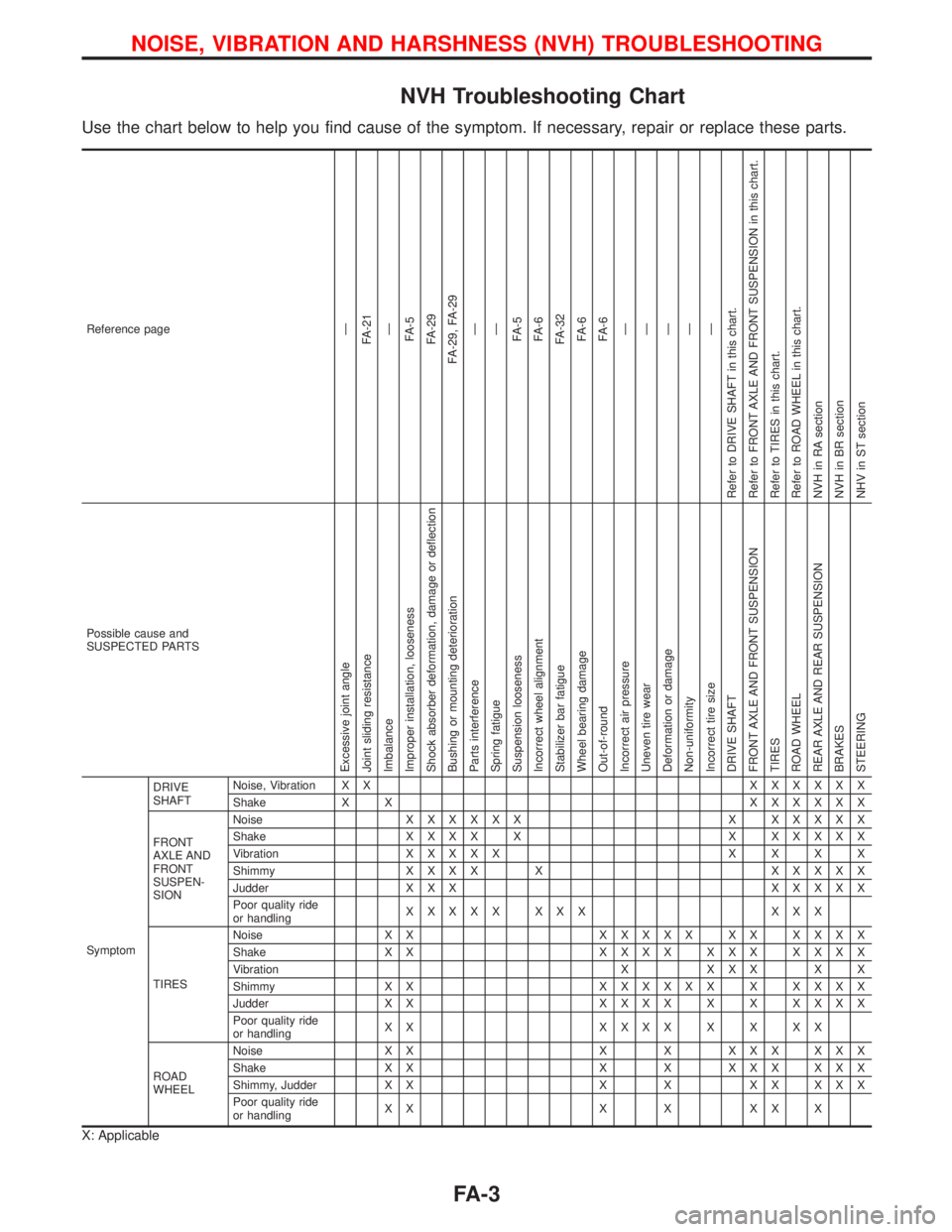
NVH Troubleshooting Chart
Use the chart below to help you find cause of the symptom. If necessary, repair or replace these parts.
Reference pageÐ
FA-21
Ð
FA-5
FA-29
FA-29, FA-29
Ð
Ð
FA-5
FA-6
FA-32
FA-6
FA-6
Ð
Ð
Ð
Ð
Ð
Refer to DRIVE SHAFT in this chart.
Refer to FRONT AXLE AND FRONT SUSPENSION in this chart.
Refer to TIRES in this chart.
Refer to ROAD WHEEL in this chart.
NVH in RA section
NVH in BR section
NHV in ST section
Possible cause and
SUSPECTED PARTS
Excessive joint angle
Joint sliding resistance
Imbalance
Improper installation, looseness
Shock absorber deformation, damage or deflection
Bushing or mounting deterioration
Parts interference
Spring fatigue
Suspension looseness
Incorrect wheel alignment
Stabilizer bar fatigue
Wheel bearing damage
Out-of-round
Incorrect air pressure
Uneven tire wear
Deformation or damage
Non-uniformity
Incorrect tire size
DRIVE SHAFT
FRONT AXLE AND FRONT SUSPENSION
TIRES
ROAD WHEEL
REAR AXLE AND REAR SUSPENSION
BRAKES
STEERING
SymptomDRIVE
SHAFTNoise, Vibration X XXXXXXX
Shake X XXXXXXX
FRONT
AXLE AND
FRONT
SUSPEN-
SIONNoiseXXXXXX X XXXXX
ShakeXXXX X X XXXXX
VibrationXXXXXXXXX
ShimmyXXXX X XXXXX
Judder X X XXXXXX
Poor quality ride
or handlingXXXXX XXX XXX
TIRESNoise X XXXXXX XX XXXX
Shake X XXXXX XXX XXXX
Vibration X X X X X X
Shimmy X XXXXXXX X XXXX
Judder X XXXXX X X XXXX
Poor quality ride
or handlingXX XXXXXXXX
ROAD
WHEELNoise X X X X X X X X X X
Shake X X X X X X X X X X
Shimmy, Judder X X X X X X X X X
Poor quality ride
or handlingXX X X XX X
X: Applicable
NOISE, VIBRATION AND HARSHNESS (NVH) TROUBLESHOOTING
FA-3
Page 1748 of 2267
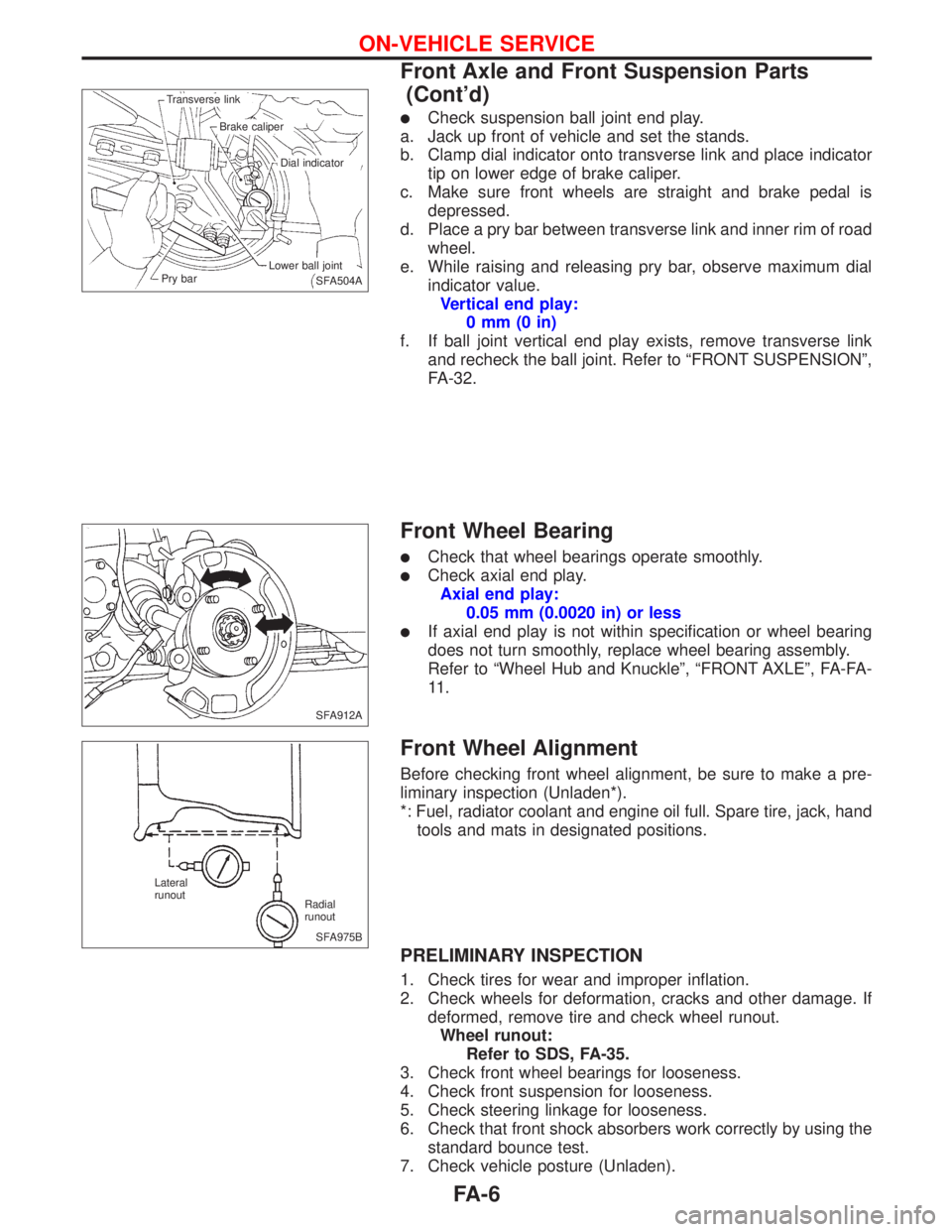
lCheck suspension ball joint end play.
a. Jack up front of vehicle and set the stands.
b. Clamp dial indicator onto transverse link and place indicator
tip on lower edge of brake caliper.
c. Make sure front wheels are straight and brake pedal is
depressed.
d. Place a pry bar between transverse link and inner rim of road
wheel.
e. While raising and releasing pry bar, observe maximum dial
indicator value.
Vertical end play:
0mm(0in)
f. If ball joint vertical end play exists, remove transverse link
and recheck the ball joint. Refer to ªFRONT SUSPENSIONº,
FA-32.
Front Wheel Bearing
lCheck that wheel bearings operate smoothly.
lCheck axial end play.
Axial end play:
0.05 mm (0.0020 in) or less
lIf axial end play is not within specification or wheel bearing
does not turn smoothly, replace wheel bearing assembly.
Refer to ªWheel Hub and Knuckleº, ªFRONT AXLEº, FA-FA-
11 .
Front Wheel Alignment
Before checking front wheel alignment, be sure to make a pre-
liminary inspection (Unladen*).
*: Fuel, radiator coolant and engine oil full. Spare tire, jack, hand
tools and mats in designated positions.
PRELIMINARY INSPECTION
1. Check tires for wear and improper inflation.
2. Check wheels for deformation, cracks and other damage. If
deformed, remove tire and check wheel runout.
Wheel runout:
Refer to SDS, FA-35.
3. Check front wheel bearings for looseness.
4. Check front suspension for looseness.
5. Check steering linkage for looseness.
6. Check that front shock absorbers work correctly by using the
standard bounce test.
7. Check vehicle posture (Unladen).
SFA504A Transverse link
Brake caliper
Dial indicator
Lower ball joint
Pry bar
SFA912A
SFA975B Lateral
runout
Radial
runout
ON-VEHICLE SERVICE
Front Axle and Front Suspension Parts
(Cont'd)
FA-6
Page 1749 of 2267
CAMBER, CASTER AND KINGPIN INCLINATION
Camber, caster and kingpin inclination are preset at factory
and cannot be adjusted.
1. Measure camber, caster and kingpin inclination of both right
and left wheels with a suitable alignment gauge.
Camber, Caster and Kingpin inclination:
Refer to SDS, FA-35.
2. If camber, caster and kingpin inclination are not within
specification, inspect front suspension parts. Replace any
damaged or worn out parts.
TOE-IN
Measure toe-in using following procedure:
WARNING:
lAlways perform following procedure on a flat surface.
lEnsure the way in front of the vehicle is clear before
pushing it.
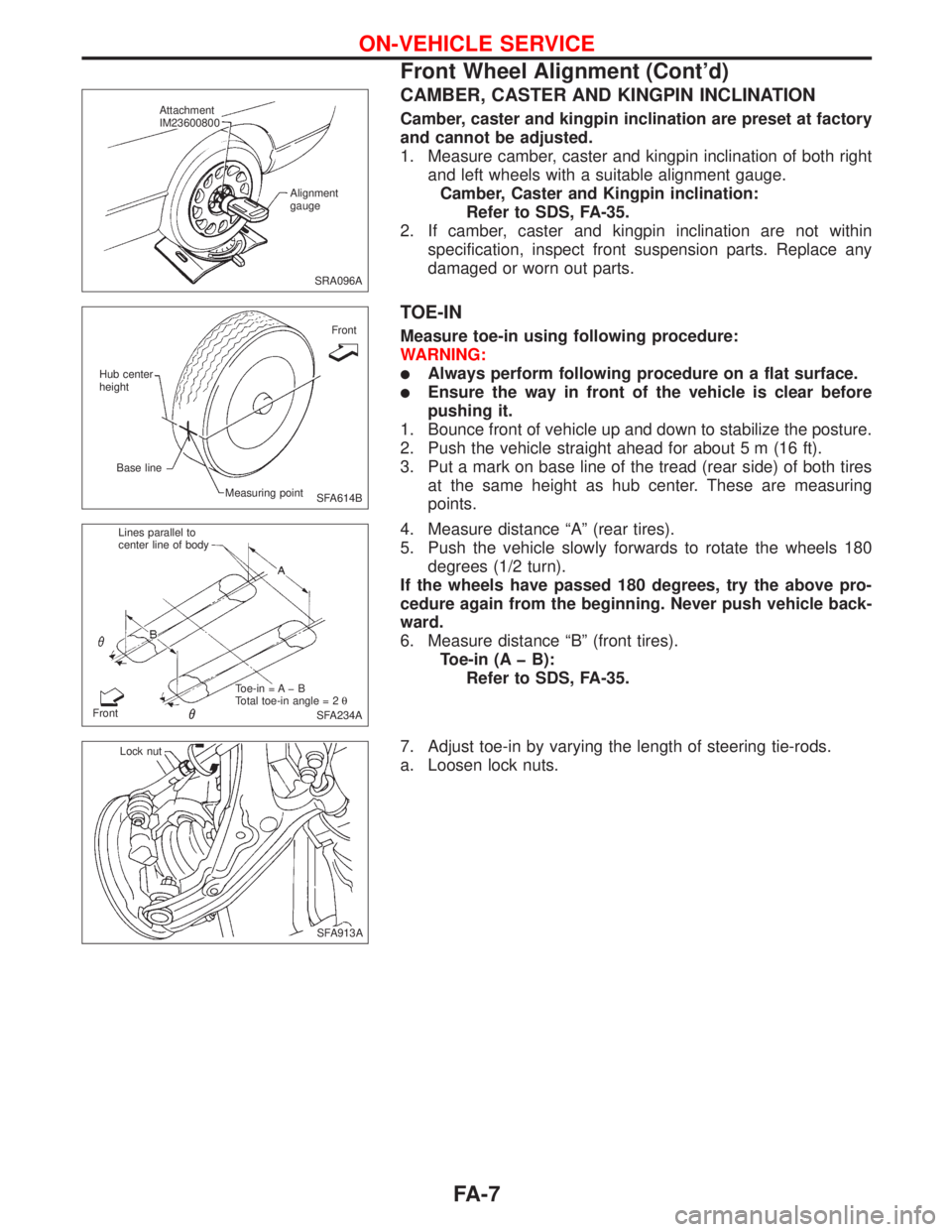
1. Bounce front of vehicle up and down to stabilize the posture.
2. Push the vehicle straight ahead for about 5 m (16 ft).
3. Put a mark on base line of the tread (rear side) of both tires
at the same height as hub center. These are measuring
points.
4. Measure distance ªAº (rear tires).
5. Push the vehicle slowly forwards to rotate the wheels 180
degrees (1/2 turn).
If the wheels have passed 180 degrees, try the above pro-
cedure again from the beginning. Never push vehicle back-
ward.
6. Measure distance ªBº (front tires).
Toe-in (A þ B):
Refer to SDS, FA-35.
7. Adjust toe-in by varying the length of steering tie-rods.
a. Loosen lock nuts.
SRA096A Attachment
IM23600800
Alignment
gauge
SFA614B Hub center
height
Base line
Measuring pointFront
SFA234A FrontLines parallel to
center line of body
Toe-in = A þ B
Total toe-in angle = 2q
.SFA913A Lock nut
ON-VEHICLE SERVICE
Front Wheel Alignment (Cont'd)
FA-7
Page 1750 of 2267
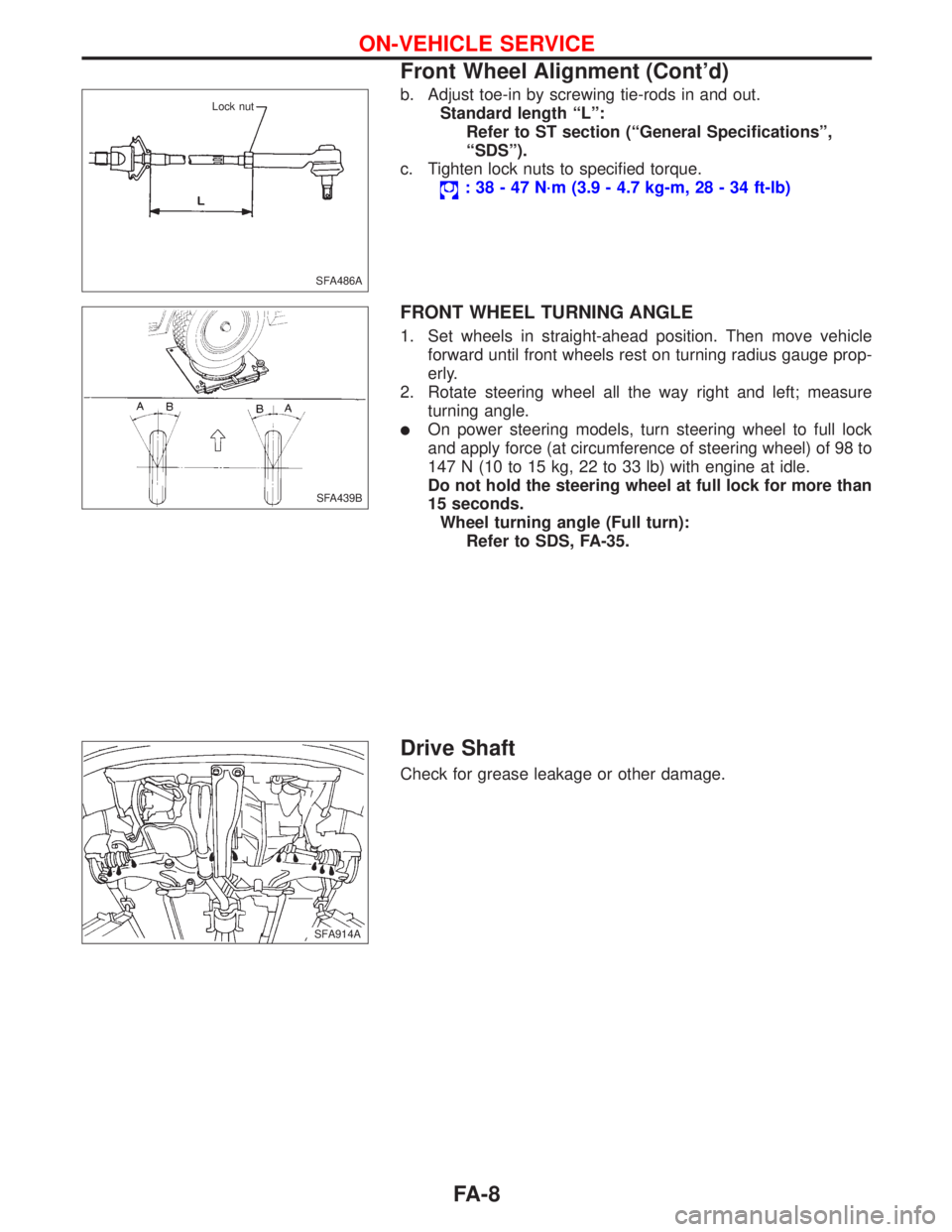
b. Adjust toe-in by screwing tie-rods in and out.
Standard length ªLº:
Refer to ST section (ªGeneral Specificationsº,
ªSDSº).
c. Tighten lock nuts to specified torque.
: 38 - 47 N´m (3.9 - 4.7 kg-m, 28 - 34 ft-lb)
FRONT WHEEL TURNING ANGLE
1. Set wheels in straight-ahead position. Then move vehicle
forward until front wheels rest on turning radius gauge prop-
erly.
2. Rotate steering wheel all the way right and left; measure
turning angle.
lOn power steering models, turn steering wheel to full lock
and apply force (at circumference of steering wheel) of 98 to
147 N (10 to 15 kg, 22 to 33 lb) with engine at idle.
Do not hold the steering wheel at full lock for more than
15 seconds.
Wheel turning angle (Full turn):
Refer to SDS, FA-35.
Drive Shaft
Check for grease leakage or other damage.
SFA486A Lock nut
SFA439B
.SFA914A
ON-VEHICLE SERVICE
Front Wheel Alignment (Cont'd)
FA-8
Page 1774 of 2267

Transverse Link and Lower Ball Joint
REMOVAL AND INSTALLATION
lRemove tension rod, ball joint and transverse link assembly.
lDuring installation, final tightening must be done at curb
weight with tires on ground.
lAfter installation, check wheel alignment.
Refer to ªFront Wheel Alignmentº, ªON-VEHICLE SER-
VICEº, FA-6.
INSPECTION
Transverse link
lCheck transverse link for damage, cracks or deformation.
Replace it if necessary.
lCheck rubber bushing for damage, cracks and deformation.
Replace transverse link if necessary.
Lower ball joint
lCheck ball joint for excessive play. Replace transverse link
assembly if any of the following exists:
lBall stud is worn.
lJoint is hard to swing.
lPlay in axial direction is excessive.
Before checking, turn ball joint at least 10 revolutions so that
ball joint is properly broken in.
Swinging force ªAº:
(measuring point: cotter pin hole of ball stud)
7.8 - 57.9 N (0.8 - 5.9 kg, 1.8 - 13.0 lb)
Turning torque ªBº:
0.5 - 3.4 (5 - 35 kg-cm, 4.3 - 30.4 in-lb)
Vertical end play ªCº:
0mm(0in)
lCheck dust cover for damage. Replace it and cover clamp if
necessary.
Stabilizer Bar
REMOVAL AND INSTALLATION
CAUTION:
Ð For models with xenon headlamps only
lWhen removing or installing stabilizer bar, take care not
to damage headlamp leveling sensor.
lAfter installation of the stabilizer bar, the headlamp sen-
sor has to be recalibrated. Refer to EL-section.
lRemove stabilizer bar.
NFA036
SFA858A A
B
C
.SFA925A
FRONT SUSPENSION
FA-32