1999 NISSAN PRIMERA wheel alignment
[x] Cancel search: wheel alignmentPage 2171 of 2267
Precautions
lWhen installing each rubber part, final tightening must
be carried out under unladen condition* with tires on
ground.
*: Fuel, radiator coolant and engine oil full. Spare tire,
jack, hand tools and mats in designated positions.
lUse flare nut wrench when removing or installing brake
tubes.
lAfter installing removed suspension parts, check wheel
alignment.
lDo not jack up at the trailing arm and lateral link.
lAlways torque brake lines when installing.
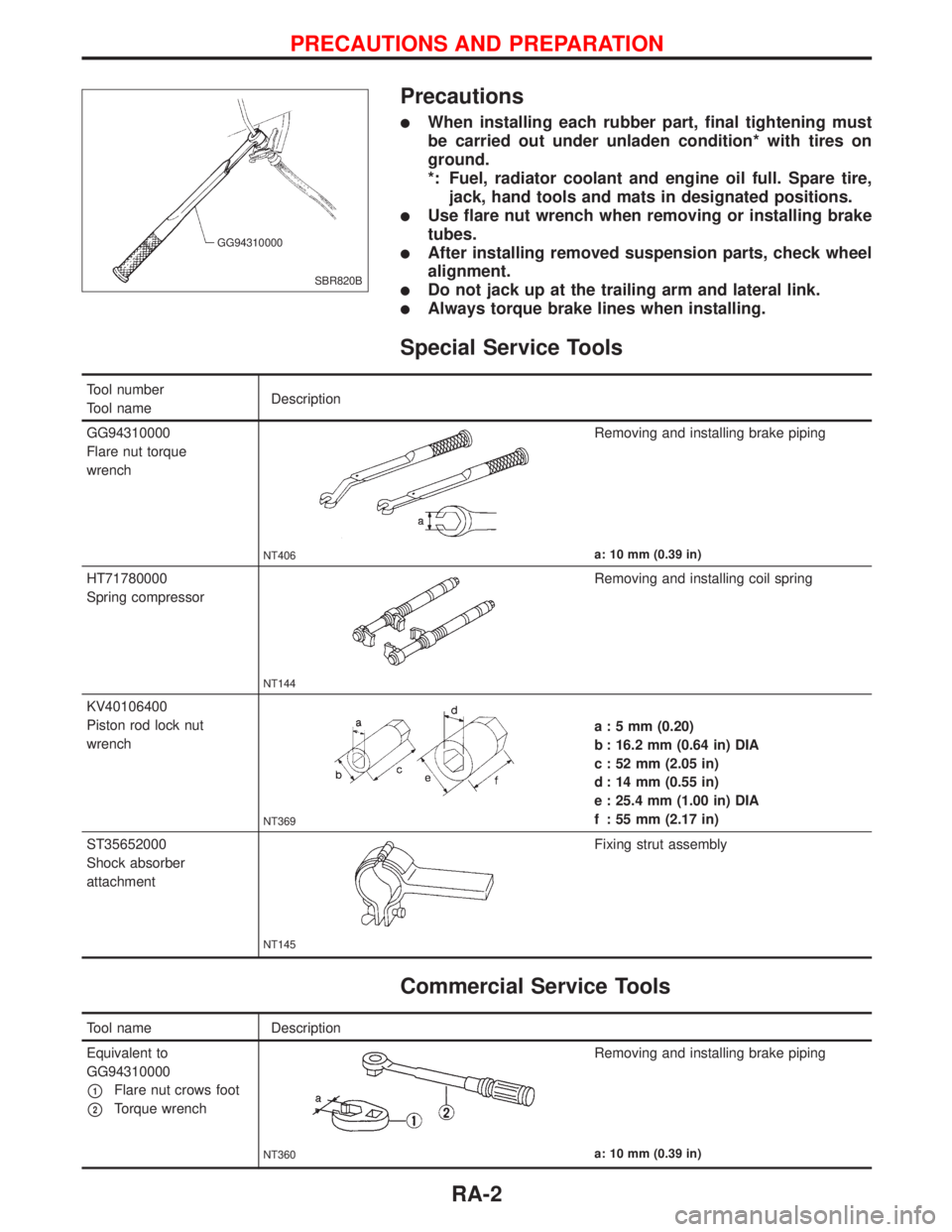
Special Service Tools
Tool number
Tool nameDescription
GG94310000
Flare nut torque
wrench
NT406
Removing and installing brake piping
a: 10 mm (0.39 in)
HT71780000
Spring compressor
NT144
Removing and installing coil spring
KV40106400
Piston rod lock nut
wrench
NT369
a : 5 mm (0.20)
b : 16.2 mm (0.64 in) DIA
c : 52 mm (2.05 in)
d : 14 mm (0.55 in)
e : 25.4 mm (1.00 in) DIA
f : 55 mm (2.17 in)
ST35652000
Shock absorber
attachment
NT145
Fixing strut assembly
Commercial Service Tools
Tool name Description
Equivalent to
GG94310000
p1Flare nut crows foot
p2Torque wrench
NT360
Removing and installing brake piping
a: 10 mm (0.39 in)
SBR820B GG94310000
PRECAUTIONS AND PREPARATION
RA-2
Page 2172 of 2267
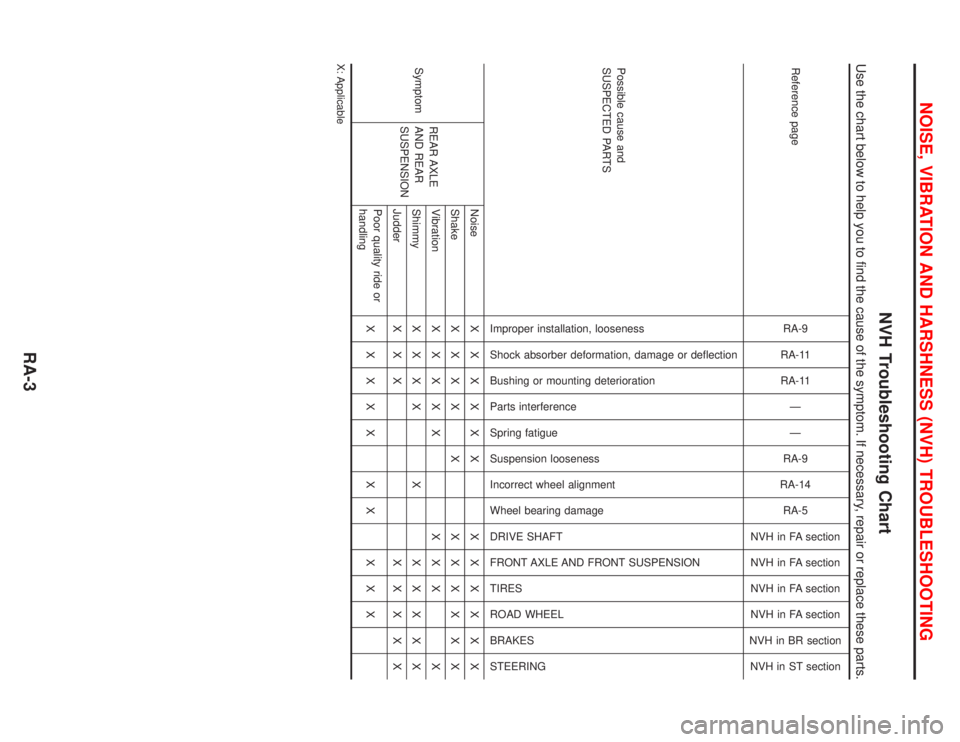
NVH Troubleshooting Chart
Use the chart below to help you to find the cause of the symptom. If necessary, repair or replace these parts.
Reference pageRA-9
RA-11
RA-11
Ð
Ð
RA-9
RA-14
RA-5
NVH in FA section
NVH in FA section
NVH in FA section
NVH in FA section
NVH in BR section
NVH in ST section
Possible cause and
SUSPECTED PARTS
Improper installation, looseness
Shock absorber deformation, damage or deflection
Bushing or mounting deterioration
Parts interference
Spring fatigue
Suspension looseness
Incorrect wheel alignment
Wheel bearing damage
DRIVE SHAFT
FRONT AXLE AND FRONT SUSPENSION
TIRES
ROAD WHEEL
BRAKES
STEERING
SymptomREAR AXLE
AND REAR
SUSPENSIONNoiseXXXXXX XXXXXX
ShakeXXXX X XXXXXX
VibrationXXXXX XXX X
ShimmyXXXX X XXXXX
Judder X X XXXXXX
Poor quality ride or
handlingXXXXX XX XXX
X: Applicable
NOISE, VIBRATION AND HARSHNESS (NVH) TROUBLESHOOTING
RA-3
Page 2175 of 2267
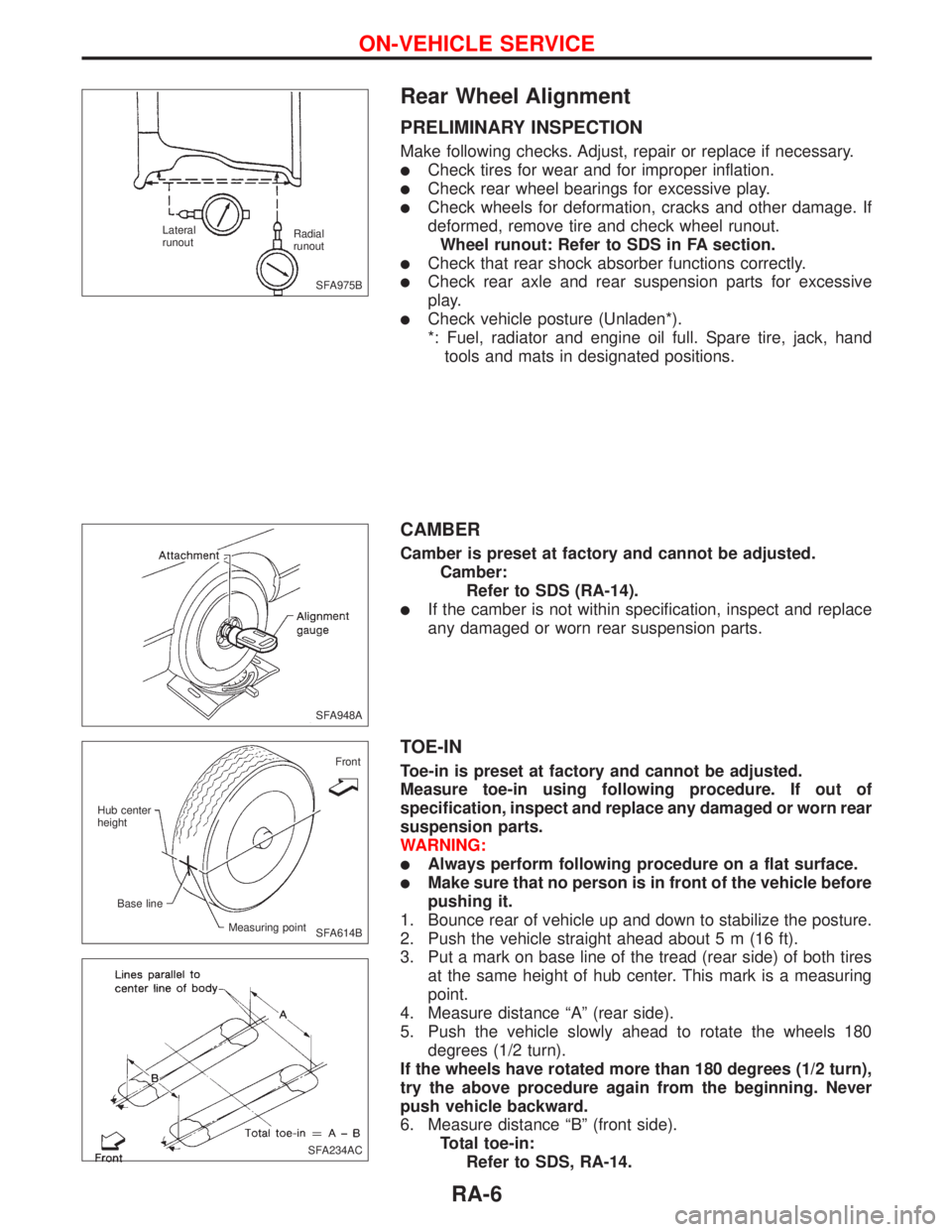
Rear Wheel Alignment
PRELIMINARY INSPECTION
Make following checks. Adjust, repair or replace if necessary.
lCheck tires for wear and for improper inflation.
lCheck rear wheel bearings for excessive play.
lCheck wheels for deformation, cracks and other damage. If
deformed, remove tire and check wheel runout.
Wheel runout: Refer to SDS in FA section.
lCheck that rear shock absorber functions correctly.
lCheck rear axle and rear suspension parts for excessive
play.
lCheck vehicle posture (Unladen*).
*: Fuel, radiator and engine oil full. Spare tire, jack, hand
tools and mats in designated positions.
CAMBER
Camber is preset at factory and cannot be adjusted.
Camber:
Refer to SDS (RA-14).
lIf the camber is not within specification, inspect and replace
any damaged or worn rear suspension parts.
TOE-IN
Toe-in is preset at factory and cannot be adjusted.
Measure toe-in using following procedure. If out of
specification, inspect and replace any damaged or worn rear
suspension parts.
WARNING:
lAlways perform following procedure on a flat surface.
lMake sure that no person is in front of the vehicle before
pushing it.
1. Bounce rear of vehicle up and down to stabilize the posture.
2. Push the vehicle straight ahead about 5 m (16 ft).
3. Put a mark on base line of the tread (rear side) of both tires
at the same height of hub center. This mark is a measuring
point.
4. Measure distance ªAº (rear side).
5. Push the vehicle slowly ahead to rotate the wheels 180
degrees (1/2 turn).
If the wheels have rotated more than 180 degrees (1/2 turn),
try the above procedure again from the beginning. Never
push vehicle backward.
6. Measure distance ªBº (front side).
Total toe-in:
Refer to SDS, RA-14.
SFA975B Radial
runout Lateral
runout
SFA948A
SFA614BFront
Hub center
height
Base line
Measuring point
SFA234AC
ON-VEHICLE SERVICE
RA-6
Page 2183 of 2267
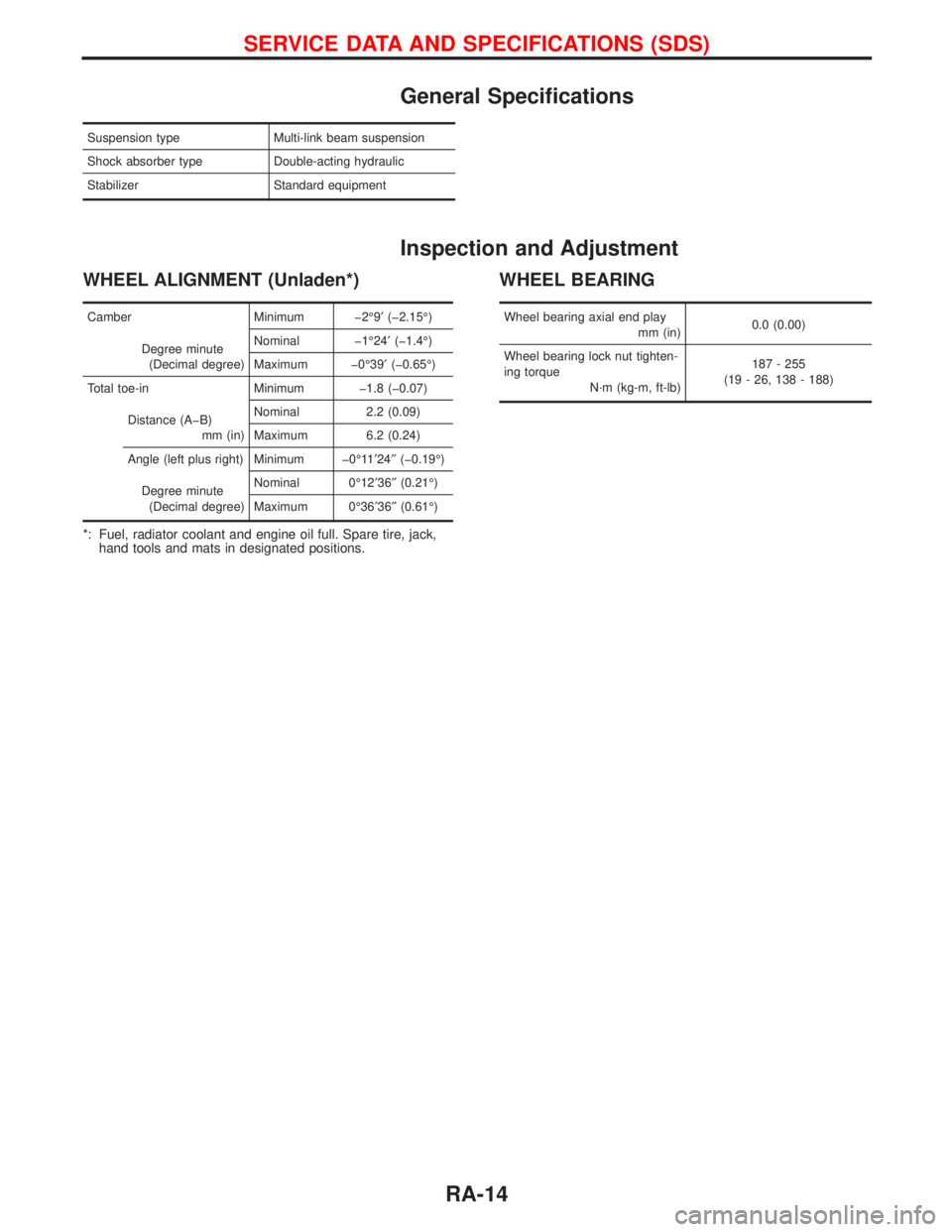
General Specifications
Suspension type Multi-link beam suspension
Shock absorber type Double-acting hydraulic
Stabilizer Standard equipment
Inspection and Adjustment
WHEEL ALIGNMENT (Unladen*)
Camber Minimum þ2É9¢(þ2.15É)
Degree minute
(Decimal degree)Nominal þ1É24¢(þ1.4É)
Maximum þ0É39¢(þ0.65É)
Total toe-in Minimum þ1.8 (þ0.07)
Distance (AþB)
mm (in)Nominal 2.2 (0.09)
Maximum 6.2 (0.24)
Angle (left plus right) Minimum þ0É11¢24²(þ0.19É)
Degree minute
(Decimal degree)Nominal 0É12¢36²(0.21É)
Maximum 0É36¢36²(0.61É)
*: Fuel, radiator coolant and engine oil full. Spare tire, jack,
hand tools and mats in designated positions.
WHEEL BEARING
Wheel bearing axial end play
mm (in)0.0 (0.00)
Wheel bearing lock nut tighten-
ing torque
N´m (kg-m, ft-lb)187 - 255
(19 - 26, 138 - 188)
SERVICE DATA AND SPECIFICATIONS (SDS)
RA-14
Page 2195 of 2267
Maintenance Items
CAUTION:
Do not use electrical test equipment to check SRS circuit.
1. Check operation of ªAIR BAGº warning lamp.
After turning ignition key to ªONº position, the ªAIR BAGº
warning lamp illuminates. The ªAIR BAGº warning lamp will
go off after about 7 seconds if no malfunction is detected.
If any of the following warning lamp conditions occur, imme-
diately check the air bag system. Refer to ªSRS-Operation
Checkº for details. (RS-37)
lThe ªAIR BAGº warning lamp does not come on when the
ignition switch is turned ªONº.
lThe ªAIR BAGº warning lamp does not go off about 7 sec-
onds after the ignition switch is turned ªONº.
lThe ªAIR BAGº warning lamp blinks about 7 seconds after
the ignition switch is turned ªONº.
2. Visually check SRS components.
(1) Diagnosis sensor unit
lCheck diagnosis sensor unit and bracket for dents, cracks or
deformities.
lCheck connectors for damage, and terminals for deformities.
(2) Air bag module and steering wheel
lRemove air bag module from steering wheel, instrument
panel or seat back. Check harness cover and connectors for
damage, terminals for deformities, and harness for binding.
lInstall driver's air bag module to steering wheel to check fit
or alignment with the wheel.
lCheck steering wheel for excessive free play.
lInstall passenger's air bag module to instrument panel to
check fit or alignment with the instrument panel.
lInstall side air bag module to seatback to check fit and align-
ment with the seat.
(3) Spiral cable
lCheck spiral cable for dents, cracks, or deformities.
lCheck connectors and protective tape for damage.
lCheck steering wheel for noise, binding or heavy operation.
(4) Main harness, body harness and air bag harness
lCheck connectors for poor connections, damage, and termi-
nals for deformities.
lCheck harnesses for binding, chafing or cuts.
(5) Seat belt pre-tensioner
lCheck harness cover and connectors for damage, terminals
for deformities, and harness for binding.
lCheck belts for damage and anchors for loose mounting.
lCheck retractor for smooth operation.
lPerform self-diagnosis for seat belt pre-tensioner using ªAIR
BAGº warning lamp or CONSULT-II. Refer to ªSRS Operation
Checkº for details. (RS-37)
(6) Side airbag (Satellite) sensor
lCheck Side airbag (Satellite) sensor (including bracket por-
tion) for dents, cracks or deformities.
lCheck connectors for damage, and terminals for deformities.
SRS797-A
SUPPLEMENTAL RESTRAINT SYSTEM (SRS)
RS-12
Page 2240 of 2267
FOR FRONTAL COLLISION
To repair the SRS for a frontal collision, perform the following steps.
When SRS (except the side airbag) is activated in a collision:
p1Replace the diagnosis sensor unit.
p2Remove the air bag modules (except the side airbag module) and seat belt pre-tensioner assemblies.
p3Check the SRS components using the table shown below:
lReplace any SRS components showing visible signs of damage (dents, cracks, deformation).
p4Install new air bag modules (except the side airbag module) and seat belt pre-tensioner assemblies.
p5Conduct self-diagnosis using CONSULT-II, and ªAIR BAGº warning lamp. Refer to ªSRS Operation
Checkº for details (RS-37). Ensure entire SRS operates properly.
When SRS is not activated in a collision:
p1Check the SRS components using the table shown below:
lReplace any SRS components showing visible signs of damage (dents, cracks, deformation).
p2Conduct self-diagnosis using CONSULT-II, and ªAIR BAGº warning lamp. Refer to ªSRS Operation
Checkº for details (RS-37). Ensure entire SRS operates properly.
SRS inspection
Part SRS (except the side
air bag) is activatedSRS is NOT activated
Air bag module (driv-
er's and passenger's
side)REPLACE
Install air bag module
with new bolts coated
with bonding agent.1. Remove air bag module. Check harness cover and connectors for damage, terminals
for deformities, and harness for binding.
2-1. Install driver's air bag module into the steering wheel to check fit and alignment with
the wheel.
2-2. Install passenger's air bag module into the instrument panel to check fit with the
instrument panel.
3. No damage found, reinstall with new bolts coated with bonding agent.
4. If damagedÐREPLACE. Install airbag modules with new special bolt coated with
bonding agent. Air bag must be deployed before discarding.
Seat belt pre-ten-
sioner assemblyREPLACE
Install seat belt pre-
tensioner with new
bolts coated with
bonding agent.1. Remove seat belt pre-tensioners.
Check harness cover and connectors for damage, terminals for deformities, and har-
ness for binding.
2. Check belts for damage and anchors for loose mounting.
3. Check retractor for smooth operation.
4. If no damage is found, reinstall with new bolts coated with bonding agent.
5. If damagedÐREPLACE. Install the seat belt pre-tensioners with new bolts coated with
bonding agent. Seat belt pre-tensioners must be deployed before discarding.
Diagnosis sensor unit REPLACE
Install diagnosis sen-
sor unit with new bolts
coated with bonding
agent.1. Check case and bracket for dents, cracks or deformities.
2. Check connectors for damage, and terminals for deformities.
3. If no damage is found, reinstall with new special bolts and ground bolt coated with
bonding agent.
4. If damagedÐREPLACE. Install diagnosis sensor unit with new bolts and ground bolt
coated with bonding agent.
Steering wheel 1. Visually check steering wheel for deformities.
2. Check harness (built into steering wheel) and connectors for damage, and terminals for deformities.
3. Install driver's air bag module to check fit or alignment with steering wheel.
4. Check steering wheel for excessive free play.
5. If no damage is found, reinstall the steering wheel.
6. If damagedÐREPLACE.
Spiral cable 1. Visually check spiral cable and combination switch for damage.
2. Check connectors, flat cable and protective tape for damage.
3. Check steering wheel for noise, binding or heavy operation.
4. If no damage is found, reinstall the spiral cable.
5. If damagedÐREPLACE.
Harness and Connec-
tors1. Check connectors for poor connection, damage, and terminals for deformities.
2. Check harness for binding, chafing, cuts, or deformities.
3. If no damage is found, reinstall harness and connectors.
4. DamagedÐREPLACE damaged section of harness. Do not attempt to repair, splice or modify any SRS har-
ness.
Instrument panel Refer to the table on the next page.
COLLISION DIAGNOSIS
RS-57
Page 2248 of 2267
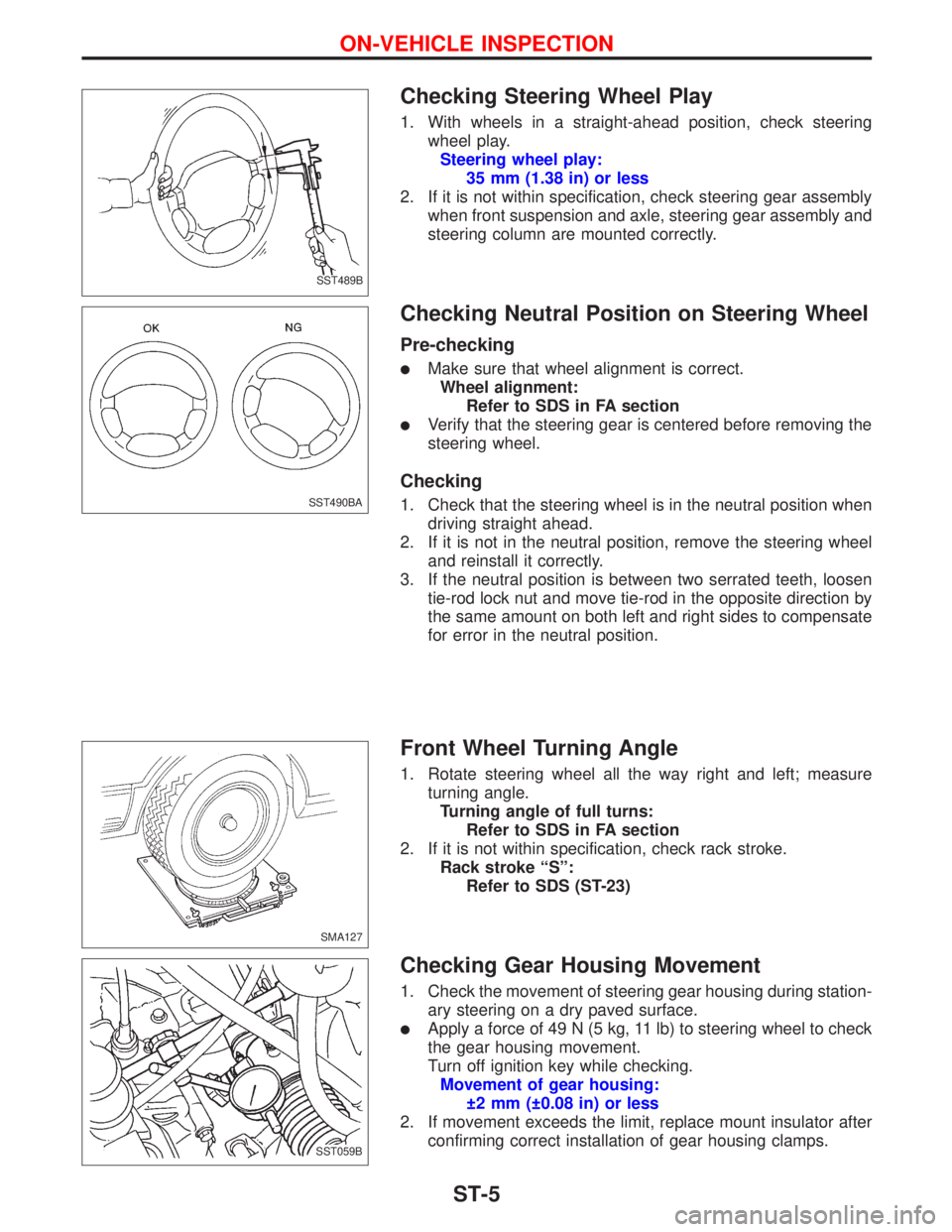
Checking Steering Wheel Play
1. With wheels in a straight-ahead position, check steering
wheel play.
Steering wheel play:
35 mm (1.38 in) or less
2. If it is not within specification, check steering gear assembly
when front suspension and axle, steering gear assembly and
steering column are mounted correctly.
Checking Neutral Position on Steering Wheel
Pre-checking
lMake sure that wheel alignment is correct.
Wheel alignment:
Refer to SDS in FA section
lVerify that the steering gear is centered before removing the
steering wheel.
Checking
1. Check that the steering wheel is in the neutral position when
driving straight ahead.
2. If it is not in the neutral position, remove the steering wheel
and reinstall it correctly.
3. If the neutral position is between two serrated teeth, loosen
tie-rod lock nut and move tie-rod in the opposite direction by
the same amount on both left and right sides to compensate
for error in the neutral position.
Front Wheel Turning Angle
1. Rotate steering wheel all the way right and left; measure
turning angle.
Turning angle of full turns:
Refer to SDS in FA section
2. If it is not within specification, check rack stroke.
Rack stroke ªSº:
Refer to SDS (ST-23)
Checking Gear Housing Movement
1. Check the movement of steering gear housing during station-
ary steering on a dry paved surface.
lApply a force of 49 N (5 kg, 11 lb) to steering wheel to check
the gear housing movement.
Turn off ignition key while checking.
Movement of gear housing:
2 mm ( 0.08 in) or less
2. If movement exceeds the limit, replace mount insulator after
confirming correct installation of gear housing clamps.
.SST489B
SST490BA
SMA127
.SST059B
ON-VEHICLE INSPECTION
ST-5