Page 273 of 348
Downloaded from www.Manualslib.com manuals search engine Propeller Shaft Slip Splines/Universal Joints
Refer to the Maintenance Schedule to determine how often the slip and
universal joints must be lubricated and what type of lubricant to use.
Body
Normal use of your vehicle will cause metal to metal wear at some points on
the cab and body if they are not lubricated.
For exposed surfaces, such as door checks, door lock bolts, lock s\
triker plates,
dovetail bumper wedges, etc., a
thin film of engine oil should be applied.
Where oil holes are provided
in the body or cab, a dripless oil can be used.
The seat adjusters and seat track should be lubricated with chassis grease.
Door weatherstrips and rubber hood bumpers should be wiped clean with a
wet cloth and lightly coated with a rubber lubricant.
Never use too much of any lubricant and be sure to wipe up any extra
lubricant when
you are finished.
Window regulators and controls are inside the doors. They are lubricated
with a long lasting grease.
If lubrication is required your dealer should
perform this service.
Refer to the Maintenance Schedule to determine how often to lubricate
these items and what type of lubricant to use.
Lock Cylinders
To be sure your locks operate properly, they must be lubricated.
Refer to the Maintenance Schedule to determine how often
to lubricate them
and what type of lubricant to
use.
You should not use penetrating oils because they could wash out the factory
installed lubricant and cause
the lock to bind. De-icers which contain
alcohol could also wash away the lubricant,
so be sure to lubricate the lock
after using a de-icer of this type.
Endgate Handle
The endgate handle pivot points on your vehicle should be lubricated to
keep the handle working smoothly.
Refer to the Maintenance Schedule
to determine how often to lubricate them
and what type of lubricant to use.
6-37
Page 275 of 348
Downloaded from www.Manualslib.com manuals search engine Loading Your Vehicle
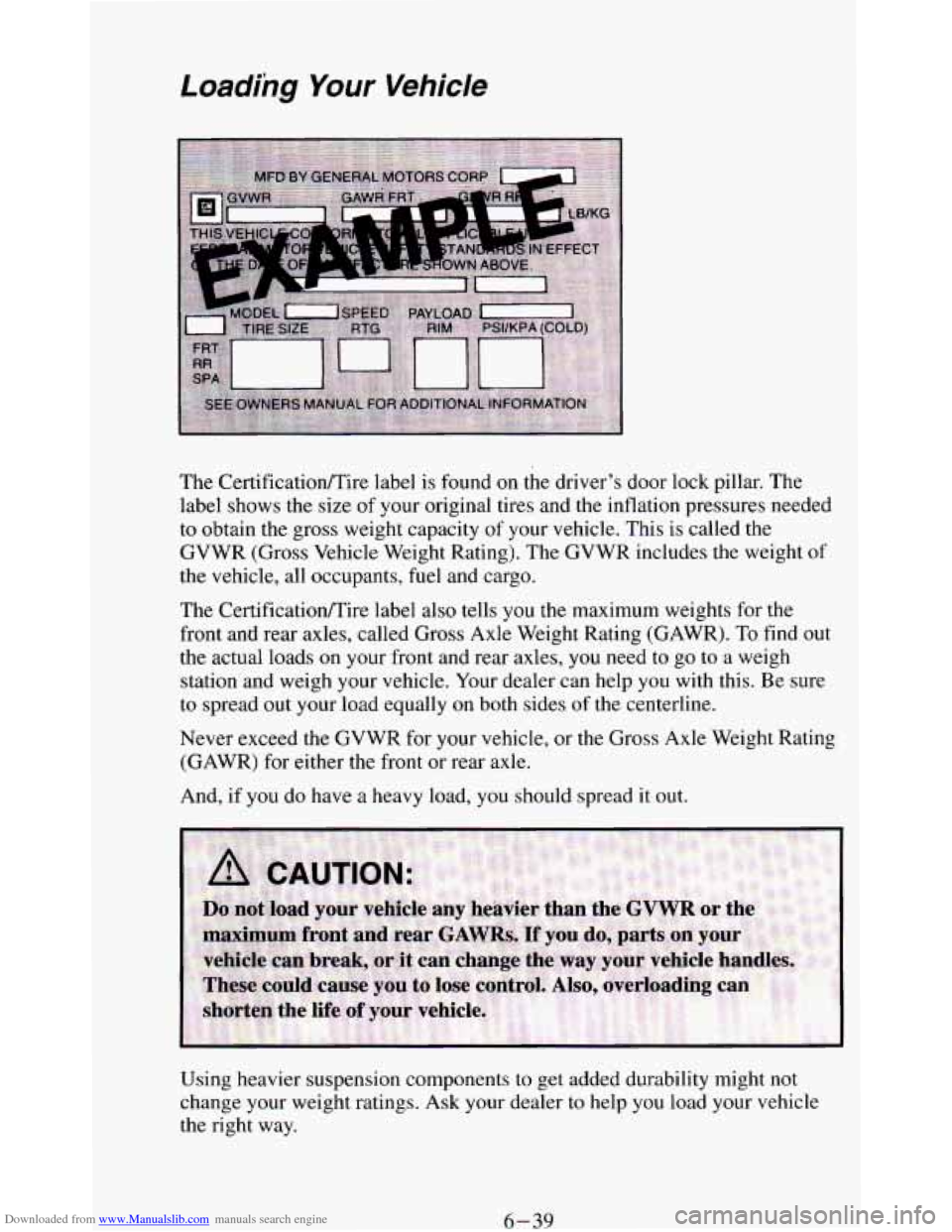
The CertificatiodTire label is found on the driver’s door lock pillar. The
label shows
the size of your original tires and the inflation pressures needed
to obtain the gross weight capacity
of your vehicle. This is called the
GVWR (Gross Vehicle Weight Rating). The GVWR includes the weight
of
the vehicle, all occupants, fuel and cargo.
The Certificationnire label
also tells you the maximum weights for the
front and rear axles, called Gross Axle Weight Rating (GAWR). To find
out
the actual loads on your front and rear axles, you need to go to a weigh
station and weigh your vehicle. Your dealer can help you with this. Be sure
to spread out your load equally on both sides
of the centerline.
Never exceed the GVWR for your vehicle, or the Gross Axle Weight Rating
(GAWR) for either the front or rear axle.
And, if you do have a heavy load, you should spread it out.
Using heavier suspension components to get added durability might not
change your weight ratings.
Ask your dealer to help you load your vehicle
the right way.
6-39
Page 278 of 348
Downloaded from www.Manualslib.com manuals search engine Tires
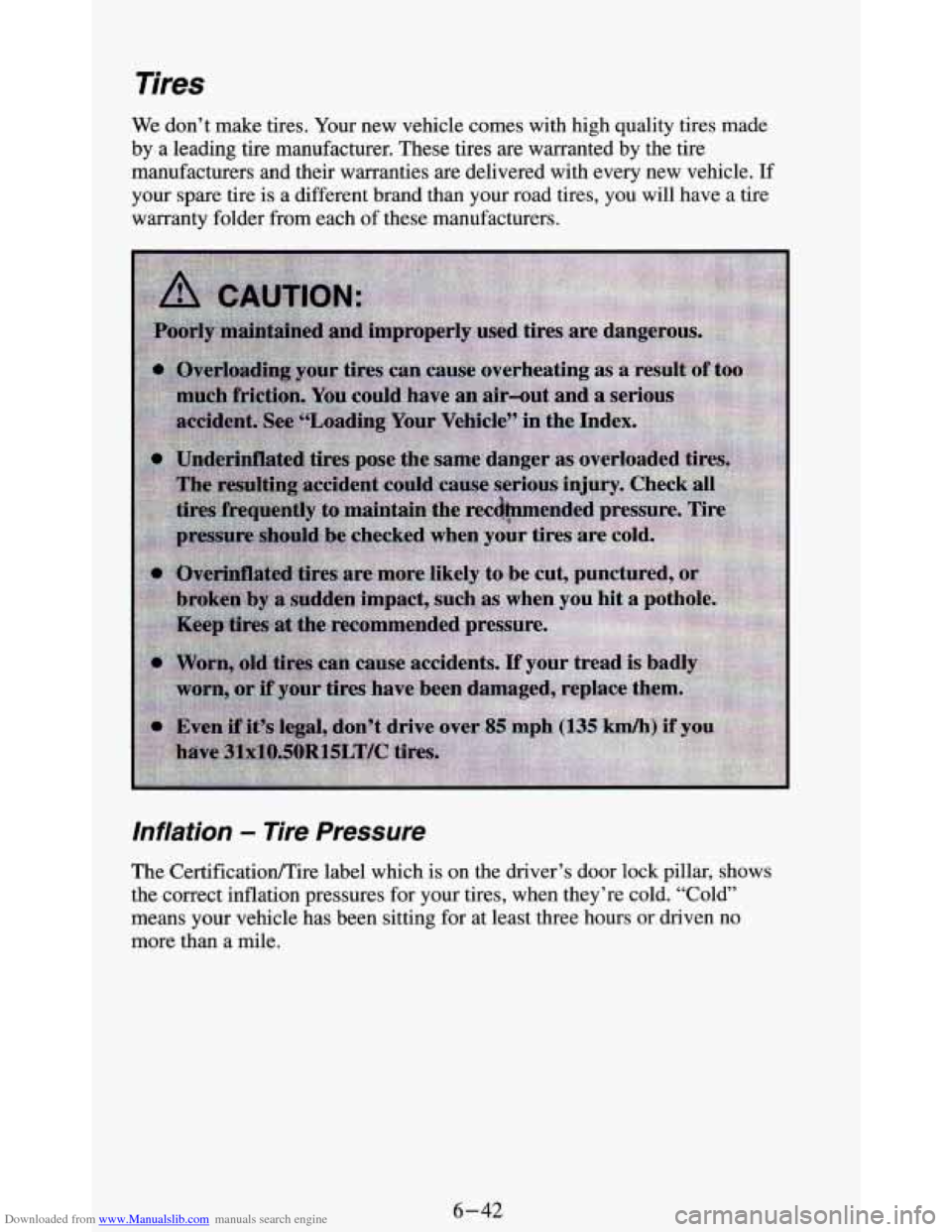
We don’t make tires. Your new vehicle comes with high quality tires made
by a leading tire manufacturer. These tires are warranted by the tire
manufacturers and their warranties are delivered with every new vehicle.
If
your spare tire is a different brand than your road tires, you will have a tire
warranty folder from each of these manufacturers.
Inflation - Tire Pressure
The Certificatioflire label which is on the driver’s door lock pillar, shows
the correct inflation pressures for your tires, when they’re cold. “Cold”
means your vehicle has been sitting for at least three hours or driven no
more than
a mile.
6-42
Page 297 of 348
Downloaded from www.Manualslib.com manuals search engine Headlights
The headlight wiring is protected by a circuit breaker in the light switch. An
electrical overload will cause the lights to go on and off. If this happens,
have your headlight wiring checked right away.
Windshield Wipers
The windshield wiper motor is protected by a circuit breaker and a fuse. If
the motor overheats due to heavy snow, etc., the wiper will stop until the
motor cools. If the overload is caused by some electrical problem and not
snow, etc., be sure to get it fixed.
Power Windows and Other Power Options
Circuit breakers in the fuse panel protect the power windows and other
power accessories. When the current load is too heavy, the circuit breaker
opens and closes, protecting the circuit until the problem
is fixed.
Trailer Wiring Harness
The optional seven-wire trailer wiring harness is protected by an in-line
fuse in the battery feed wire. This fuse is near the junction block. See
“Trailer Wiring Harness” in the
Features & Controls section.
Fuse Block
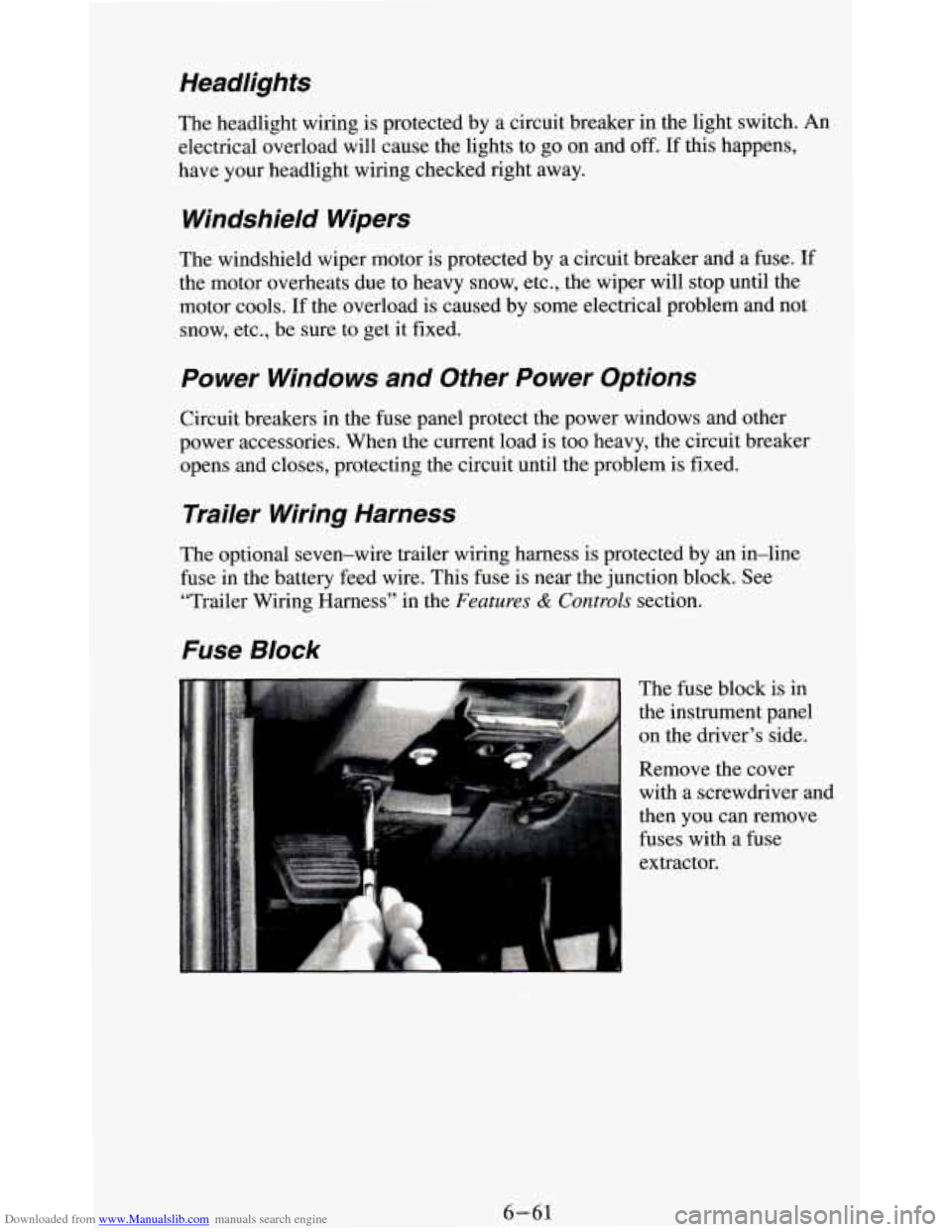
The fuse block is in
the instrument panel
on the driver’s side.
Remove the cover
with a screwdriver and
then you
can remove
fuses with a fuse
extractor.
6-61
Page 300 of 348
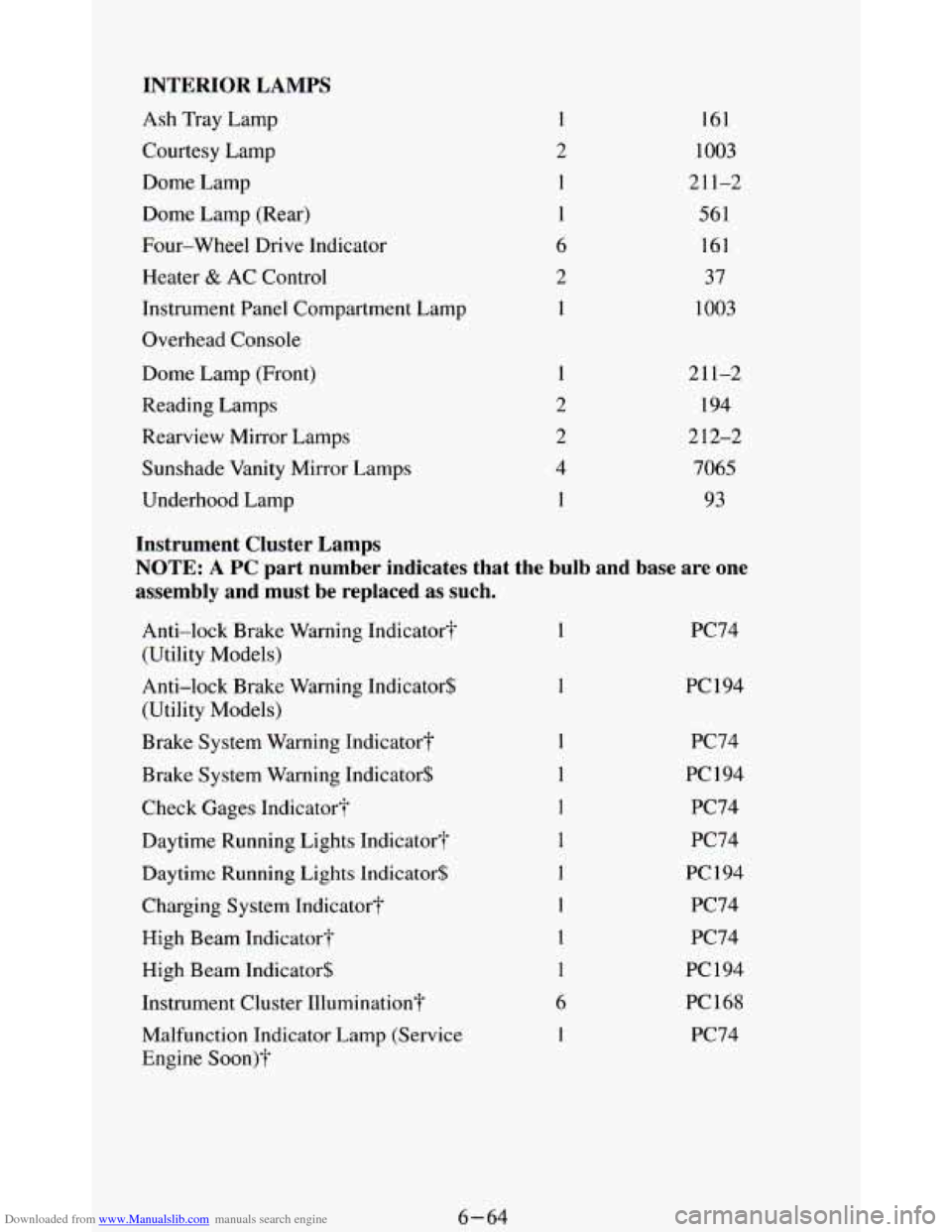
Downloaded from www.Manualslib.com manuals search engine INTERIOR LAMPS
Ash Tray Lamp
Courtesy Lamp
Dome Lamp Dome Lamp (Rear)
Four-wheel Drive Indicator
Heater
& AC Control
Instrument Panel Compartment Lamp
Overhead Console
Dome Lamp (Front)
Reading Lamps
Rearview Mirror Lamps
Sunshade Vanity Mirror Lamps
Underhood Lamp
161
1003
21 1-2
561
161
37
1003
211-2 194
2 12-2
7065 93
Instrument Cluster Lamps
NOTE:
A PC part number indicates that the bulb and base are one
assembly and must be replaced as
such.
Anti-lock Brake Warning Indicator?
(Utility Models)
Anti-lock Brake Warning Indicator$
(Utility Models)
Brake System Warning Indicator?
Brake System Warning Indicator$
Check Gages Indicator?
Daytime Running Lights Indicator’f
Daytime Running Lights Indicator$
Charging System Indicator?
High Beam Indicator?
High Beam Indicator$
Instrument Cluster Illumination?
Malfunction Indicator Lamp (Service
Engine Soon)?
1
1
1
1
1
I
1
1
1
6
1
PC74
PC 194
PC74
PC 194
PC74
PC74
PC 194
PC74
PC74
PC 194
PC168 PC74
6-64
Page 303 of 348
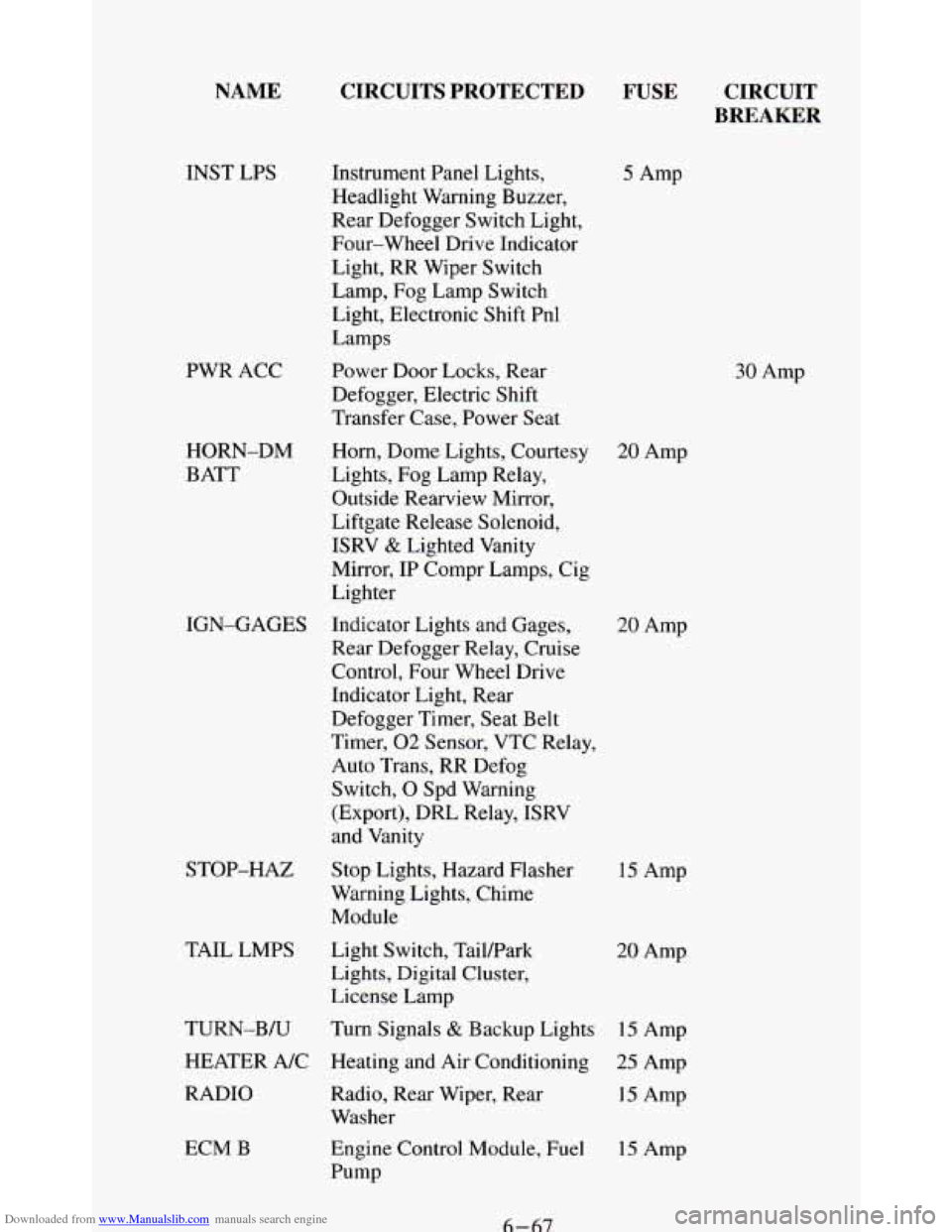
Downloaded from www.Manualslib.com manuals search engine NAME
INST LPS
PWR ACC
HORN-DM
BATT
STOP-HAZ
TAIL LMPS
ECM B
CIRCUITS PROTECTED
FUSE CIRCUIT
BREAKER
Instrument Panel Lights,
Headlight Warning Buzzer,
Rear Defogger Switch Light,
Four-wheel Drive Indicator
Light, RR Wiper Switch
Lamp, Fog Lamp Switch
Light, Electronic Shift Pnl
Lamps
Power Door Locks, Rear
Defogger, Electric Shift
Transfer Case, Power Seat
Horn, Dome Lights, Courtesy
20 Amp
Lights, Fog Lamp Relay,
Outside Rearview Mirror,
Liftgate Release Solenoid,
ISRV
& Lighted Vanity
Mirror, IP Compr Lamps, Cig
Lighter
IGN-GAGES Indicator Lights and Gages,
Rear Defogger Relay, Cruise
Control, Four Wheel Drive
Indicator Light, Rear
Defogger Timer, Seat Belt
Timer,
02 Sensor, VTC Relay,
Auto Trans, RR Defog
Switch,
0 Spd Warning
(Export),
DRL Relay, ISRV
and Vanity
Stop Lights, Hazard Flasher
Warning Lights, Chime
Module
Light Switch, Tailpark
Lights, Digital Cluster,
License Lamp
TURN-B/U Turn Signals
& Backup Lights 15 Amp
HEATER A/C Heating and Air Conditioning
25 Amp
RADIO Radio, Rear Wiper, Rear
15 Amp
Washer
Engine Control Module, Fuel
15 Amp
Pump
5 Amp
30 Amp
20 Amp
15 Amp
20 Amp
6-67
Page 304 of 348
Downloaded from www.Manualslib.com manuals search engine NAME
ECM I
PWR
WINDOW
WIPER
BRAKE DRL
CIRCUITS PROTECTED FUSE
Engine Control Module Power Windows 10 Amp
Windshield Wipers and
25 Amp
Washers
Four-wheel Anti-lock Brake 15 Amp
Module, Digital Ratio Adapter
Module, Speedometer, Auto
Transmission Converter
Clutch
Daytime Running Light
(Canada Only)
Trailer Wiring
Harness
CD PlayedRadio
TRAILER*
CD
PLAYER**
TCCM
Electric Shift Transfer Case
Module
AUX PWR** Aux. Pwr. Outlet
10 Amp
30 Amp
10 Amp
5 Amp
10 Amp
*In-line fuse
**Fuse is attached
to fuse block.
Service Replacement Part and Filter
Recommendafons
ENGINE (VIN)
OIL FILTER
AIR CLEANER
FILTER PCV VALVE
SPARK PLUGS
FUEL FILTER
RADIATOR CAP 4.3L (2)
PF52
A773C
CV789C
.CR43TSM
GF48 1
RC36
CIRCUIT
BREAKER
30 Amp
4.3L(W)
PF52
A1163C
cv774c
.CR43TSM
GF48 1
RC36
*Use copper-cored resistor type spark plugs.
6-68
Page 315 of 348
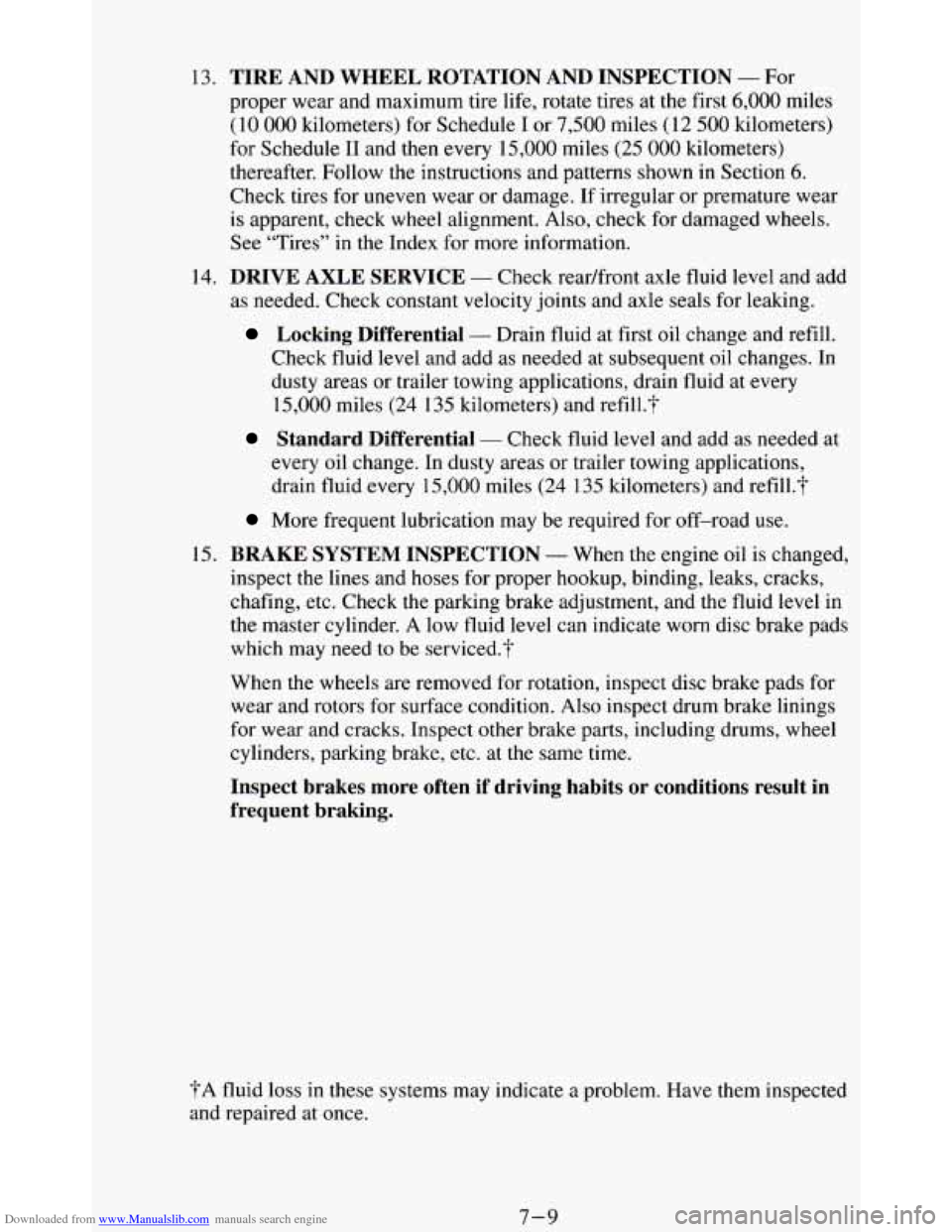
Downloaded from www.Manualslib.com manuals search engine 13. TIRE AND WHEEL ROTATION AND INSPECTION - For
proper wear and maximum tire life, rotate tires at the first
6,000 miles
(10
000 kilometers) for Schedule I or 7,500 miles (12 500 kilometers)
for Schedule I1 and then every 15,000 miles
(25 000 kilometers)
thereafter. Follow the instructions and patterns shown in Section
6.
Check tires for uneven wear or damage. If irregular or premature wear
is apparent, check wheel alignment. Also, check for damaged wheels.
See “Tires” in the Index for more information.
14.
DRIVE AXLE SERVICE - Check readfront axle fluid level and add
as needed. Check constant velocity joints and axle seals for leaking.
Locking Differential - Drain fluid at first oil change and refill.
Check fluid
level and add as needed at subsequent oil changes. In
dusty areas or trailer towing applications, drain fluid at every
15,000 miles (24 135 kilometers) and refill.?
Standard Differential - Check fluid level and add as needed at
every oil change. In dusty areas or trailer towing applications,
drain fluid every
15,000 miles (24 135 kilometers) and refill.?
More frequent lubrication may be required for off-road use.
15. BRAKE SYSTEM INSPECTION - When the engine oil is changed,
inspect the lines and hoses for proper hookup, binding, leaks, cracks,
chafing, etc. Check the parking brake adjustment, and the fluid level in
the master cylinder. A low fluid level can indicate worn disc brake pads
which may need
to be serviced.?
When the wheels are removed for rotation, inspect disc brake pads for
wear and rotors for surface condition. Also inspect drum brake linings
for wear and cracks. Inspect other brake parts, including drums, wheel
cylinders, parking brake, etc. at the same time.
Inspect brakes more often if driving habits or conditions resul\
t in
frequent braking.
.L t A fluid loss in these systems may indicate a problem. Have them inspected
and repaired at once.
7-9