Page 227 of 348
Downloaded from www.Manualslib.com manuals search engine Changing the Tire
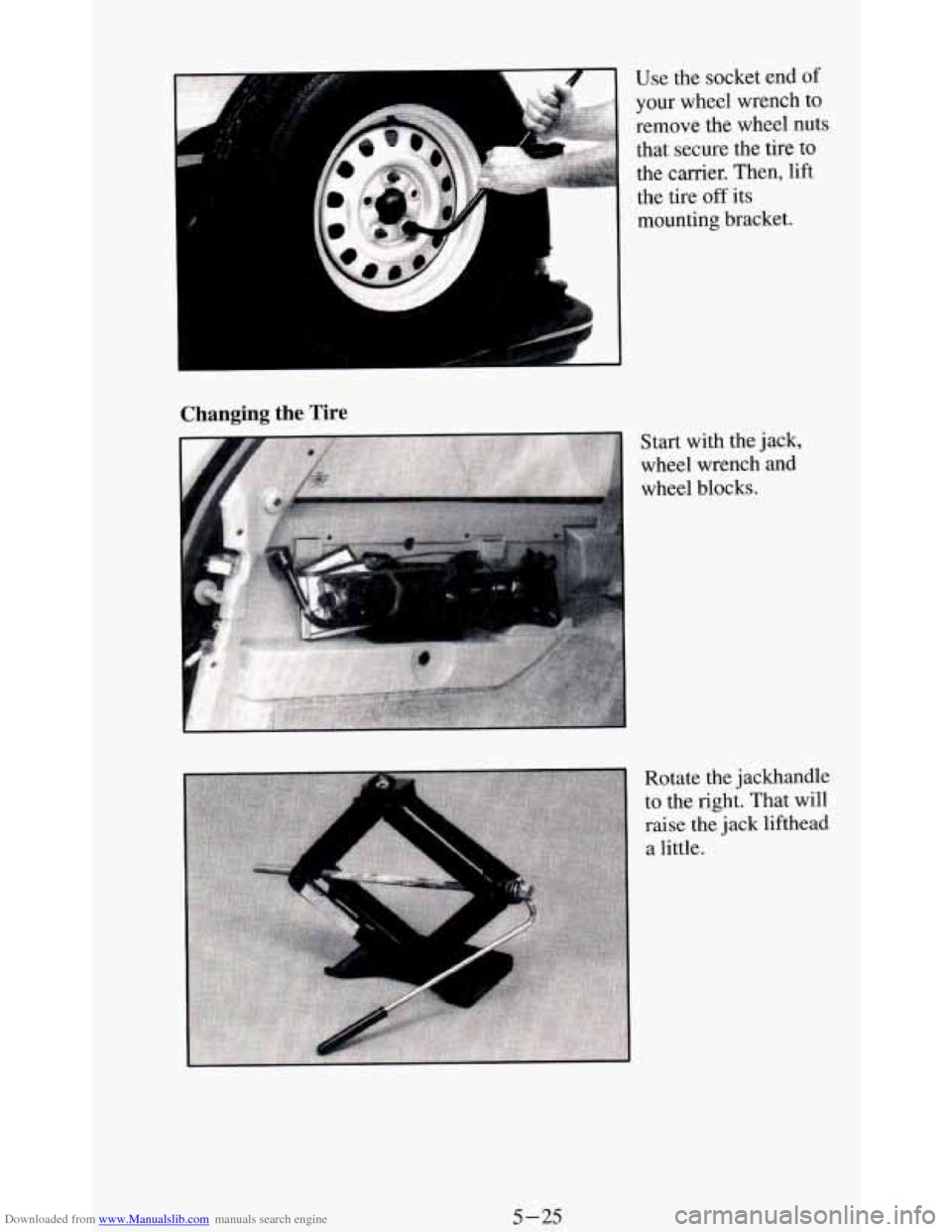
Use the socket end of
your wheel wrench to
remove the wheel nuts
that secure the
tire to
the carrier. Then, lift
the tire
off its
mounting bracket.
Start with the jack,
wheel wrench
and
wheel blocks.
Rotate the jackhandle to the right. That will
raise the jack lifthead
a little.
5-25
Page 228 of 348
Downloaded from www.Manualslib.com manuals search engine e
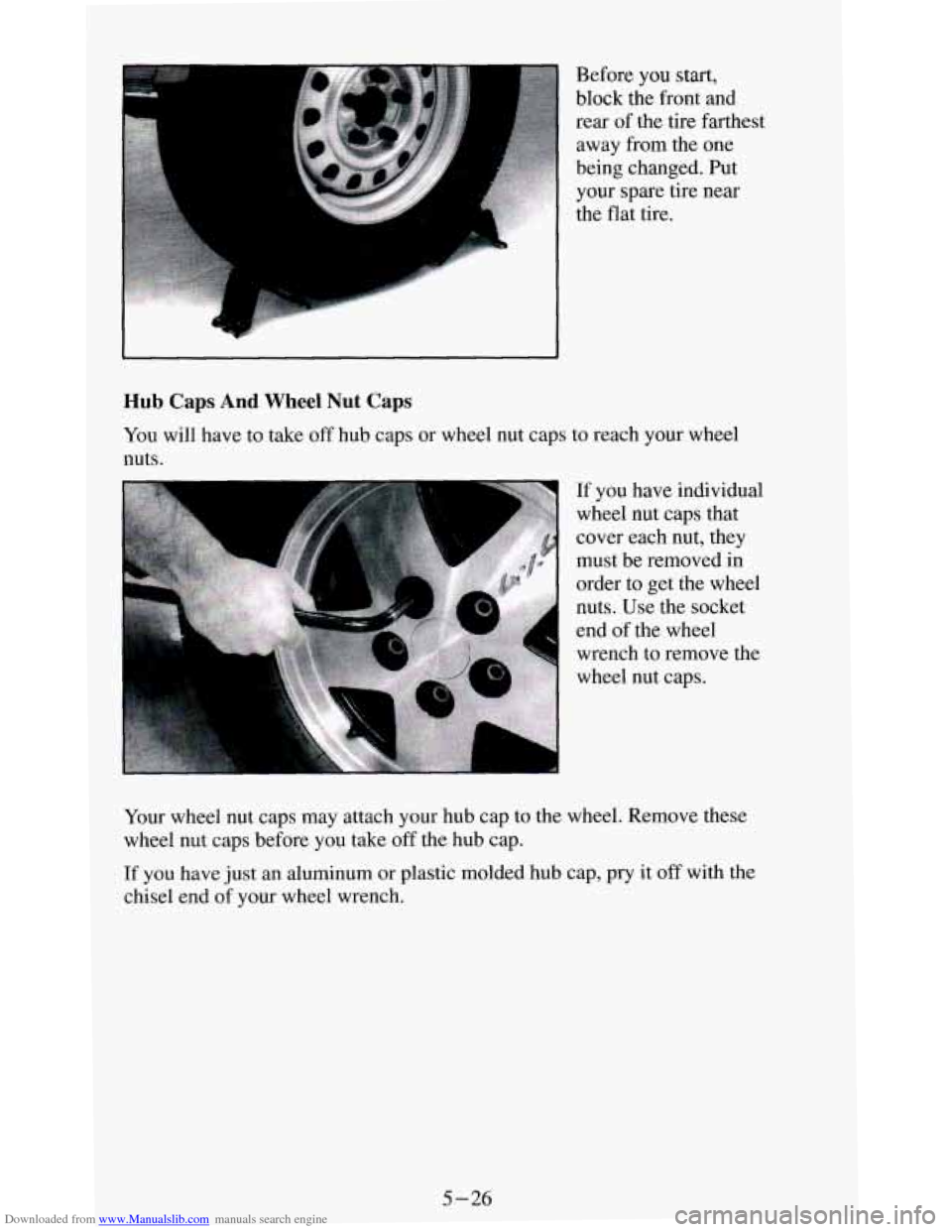
Before you start,
block the front and
rear of the tire farthest
away from the one
being changed. Put
your spare tire near
the flat tire.
Hub Caps And Wheel Nut Caps
You will have to take off hub caps or wheel nut caps to reach your wheel
nuts.
I --
If you have individual
wheel nut caps that
cover each nut, they
must be removed in
order to get the wheel
nuts. Use the socket
end
of the wheel
wrench to remove the
wheel nut caps.
Your wheel nut caps may attach your hub cap to the wheel. Remove these
wheel nut caps before you take
off the hub cap.
If you have just an aluminum or plastic molded hub cap, pry it off with the
chisel end of your wheel wrench.
5-26
Page 233 of 348
Downloaded from www.Manualslib.com manuals search engine Tightening Wheel Nut Tightening Sequence
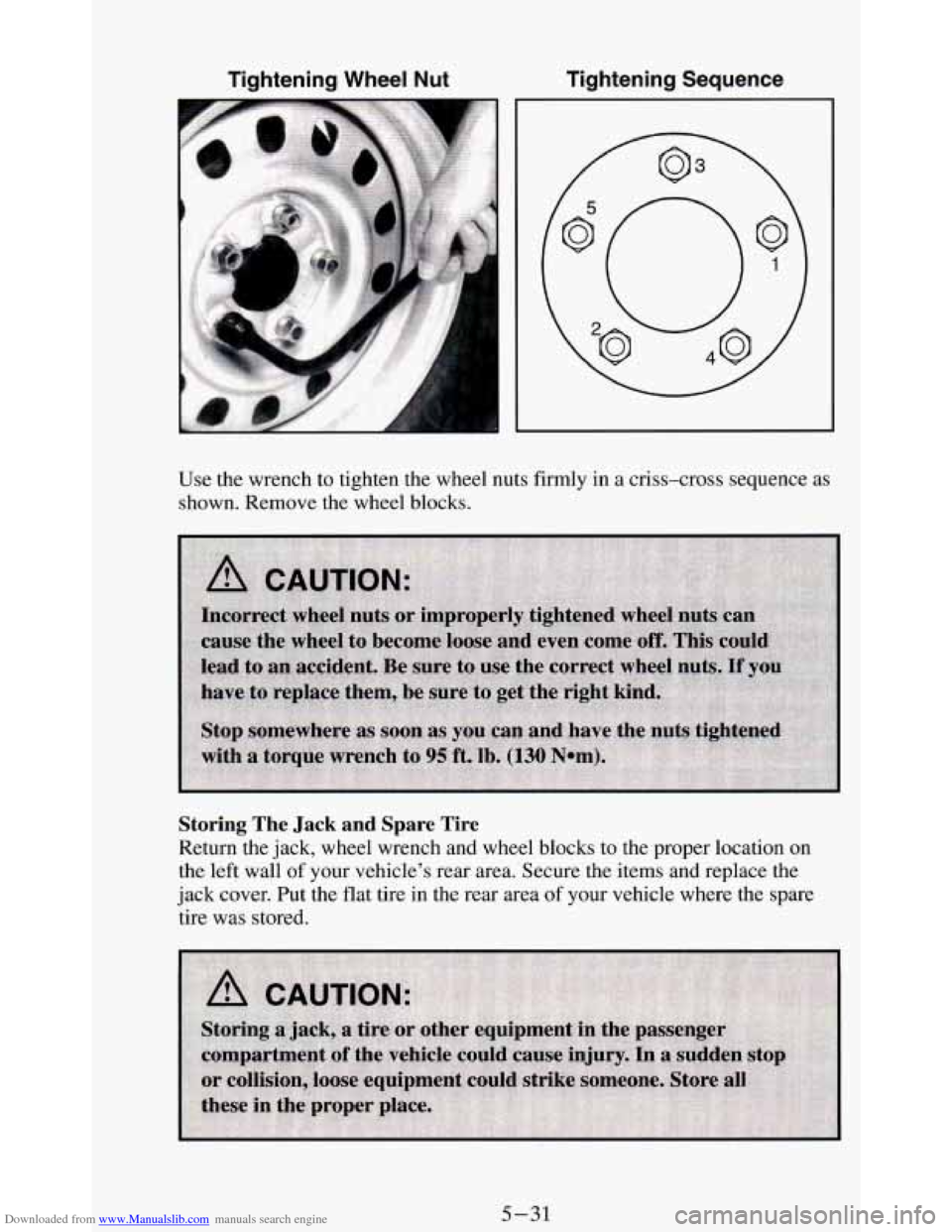
Use
the wrench to tighten the wheel nuts firmly in a criss-cross sequence as
shown. Remove the wheel blocks.
Storing The Jack and Spare Tire
Return the jack, wheel wrench and wheel blocks to the proper location on
the left wall of your vehicle’s rear area. Secure the items and replace the
jack cover. Put the
flat tire in the rear area of your vehicle where the spare
tire was stored.
5-31
Page 249 of 348
Downloaded from www.Manualslib.com manuals search engine When to Change Engine Oil
See if any one of these is true for you:
Most trips are less than 4 miles (6 km).
It’s below freezing outside and most trips are less than 10 miles (I 6 km).
0 The engine is at low speed most of the time (as in door-to-door
delivery, or
in stop-and-go traffic).
You tow a trailer often.
0 Most trips are through dusty places.
0 The vehicle is frequently operated off-road.
If any one of these is true for your vehicle, then you need to change your oil
andfilter every 3,000 miles (5 000 km) or 3 months - whichever comes
first.
If none
of them is true, change the oil every 7,500 miles (12 500 km) or
12 months - whichever comes first. Change the filter at the first oil change
and at every other oil change after that.
Four-wheel Drive Remote Oil Filter
If your vehicle has four-wheel drive, you will have a remote oil filter
located under the hood. It is mounted to the front left inner fender, behind
the headlights.
Engine Coolant Heater (Engine Block Heater)
An engine coolant heater can be a big help if you have to park outside in
very cold weather, 0°F (-18°C) or colder. If your vehicle has this option,
see “Engine Coolant Heater
” in the Index.
What to Do with Used Oil
Did you know that used engine oil contains certain elements that may be
unhealthy for your skin and could even cause cancer? Don’t let used oil stay
on your skin for very long. Clean your skin
and nails with soap and water,
or
a good hand cleaner. Wash or properly throw away clothing or rags
containing used engine oil. (See
the manufacturer’s warnings about the use
and disposal of oil products.)
Used oil can be
a real threat to the environment. If you change your own oil,
be sure to drain all free-flowing oil from
the filter before disposal. Don’t
ever dispose of oil
by putting it in the trash, pouring it on the ground, into
sewers, or into streams or bodies of water. Instead, recycle
it by taking it to
a place that collects used oil. If you have a problem properly disposing of
your used oil, ask your dealer,
a service station or a local recycling center
for help.
6-13
Page 254 of 348
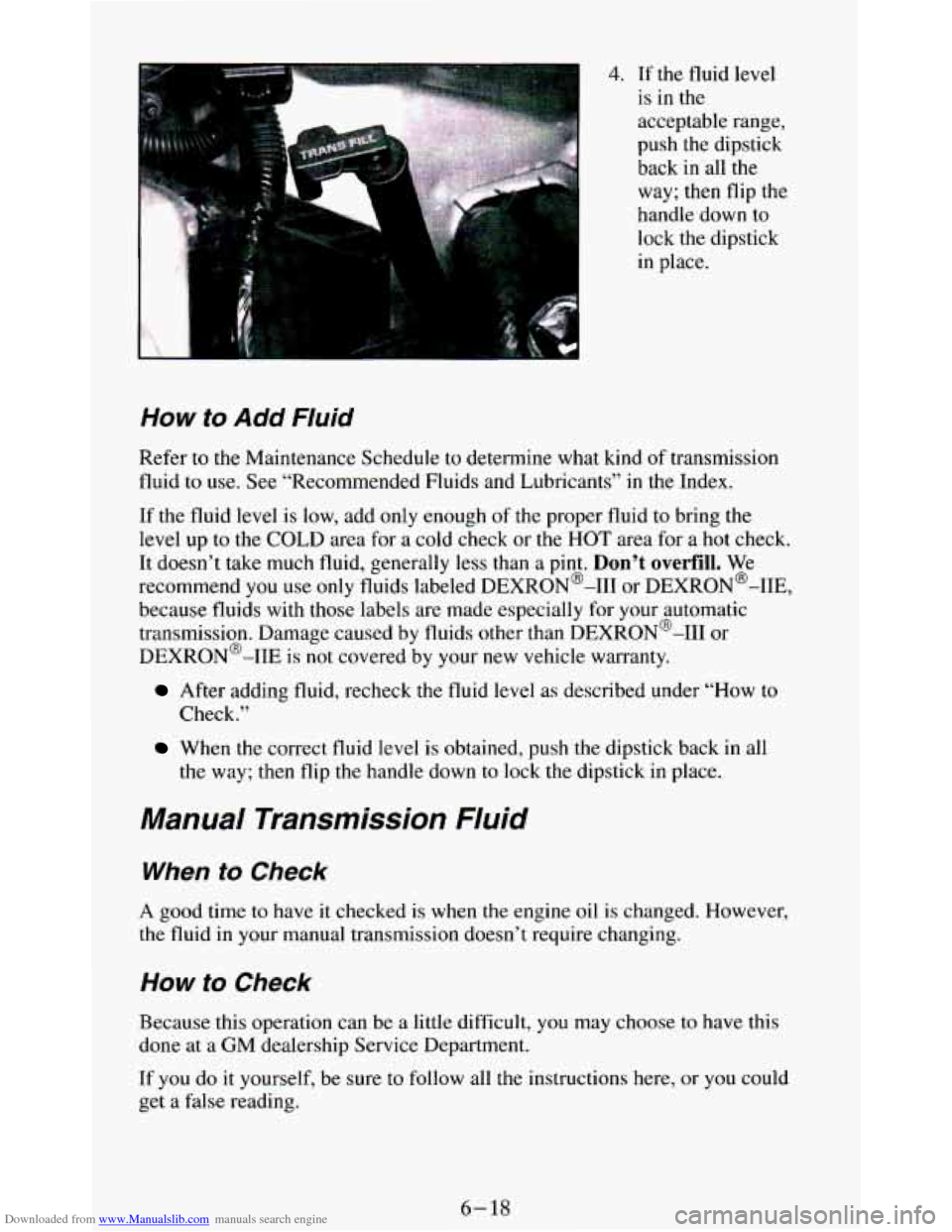
Downloaded from www.Manualslib.com manuals search engine 4. If the fluid level
is in the
acceptable range,
push the dipstick
back in all the
way; then flip
the
handle down to
lock the dipstick
in place.
How to Add Fluid
Refer to the Maintenance Schedule to determine what kind of transmission
fluid to use. See “Recommended Fluids and Lubricants’’
in the Index.
If the fluid level is low, add only enough
of the proper fluid to bring the
level up to the
COLD area for a cold check or the HOT area for a hot check.
It doesn’t take much fluid, generally
less than a pint. Don’t overfill. We
recommend you use only fluids labeled DEXR0N’-I11 or DEXR0N’-IIE,
because fluids with those labels are made especially for your automatic
transmission. Damage caused by fluids other than DEXRON@-I11 or
DEXRON@-IIE
is not covered by your new vehicle warranty.
After adding fluid, recheck the fluid level as described under “How to
Check.”
When the correct fluid level is obtained, push the dipstick back in all
the way; then flip
the handle down to lock the dipstick in place.
Manual Transmission Fluid
When to Check
A good time to have it checked is when the engine oil is changed. However,
the fluid in your manual transmission doesn’t require changing.
How fo Check
Because this operation can be a little difficult, you may choose to have this
done at a
GM dealership Service Department.
If
you do it yourself, be sure to follow all the instructions here, or you could
get a false reading.
6- 18
Page 269 of 348
Downloaded from www.Manualslib.com manuals search engine Front ParkingKurn Signal Lights
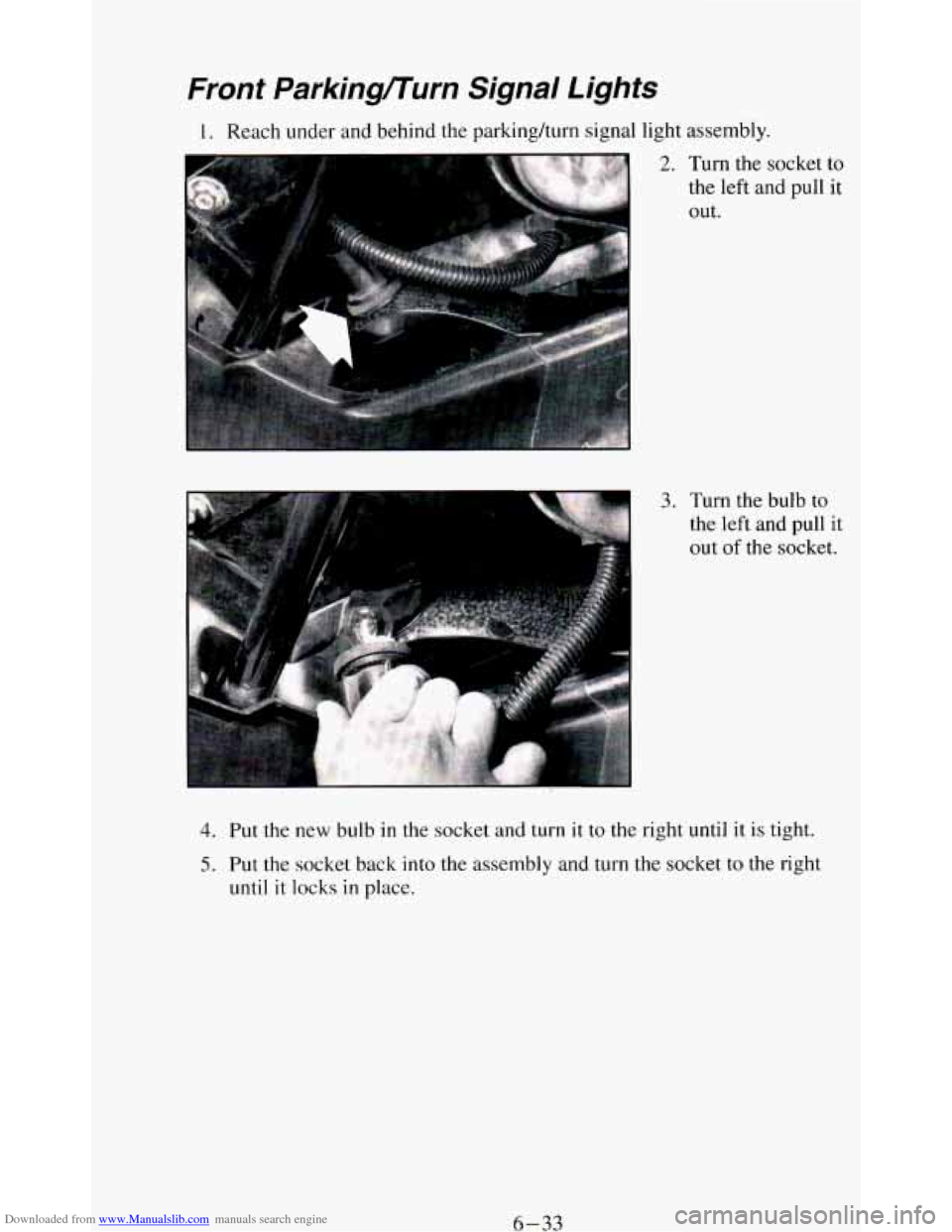
1. Reach under and behind the parkingkurn signal light assembly.
3. Turn the bulb to
the left and pull it
out
of the socket.
2. Turn the socket to
the left and pull it
out.
4. Put the new bulb in the socket and turn it to the right until it is tight.
5. Put the socket back into the assembly and turn the socket to the right
until it locks in place.
6-33
Page 270 of 348
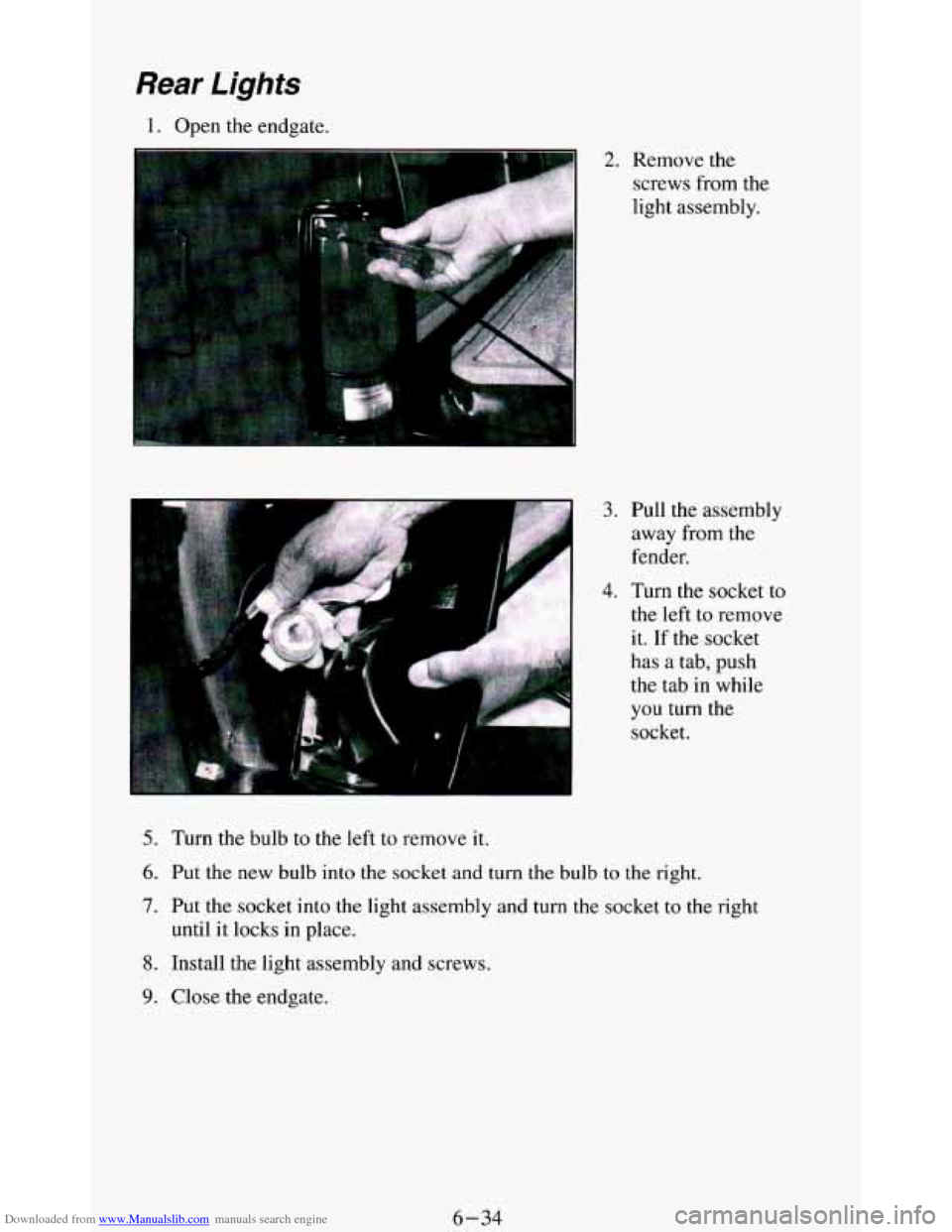
Downloaded from www.Manualslib.com manuals search engine Rear Lights
1. Open the endgate.
- 3. Pull the assembly
away from the
fender.
4. Turn tne socket to
the
left to remove
it. If the socket
has a tab, push
the tab in while
you turn the socket.
5. Turn the bulb to the left to remove it.
6. Put the new bulb into the socket and turn the bulb to the right.
7. Put the socket into the light assembly and turn the socket to the right
8. Install the light assembly and screws.
9. Close the endgate.
until
it locks in place.
6-34
Page 272 of 348
Downloaded from www.Manualslib.com manuals search engine Windshield Wiper Blade Inserts
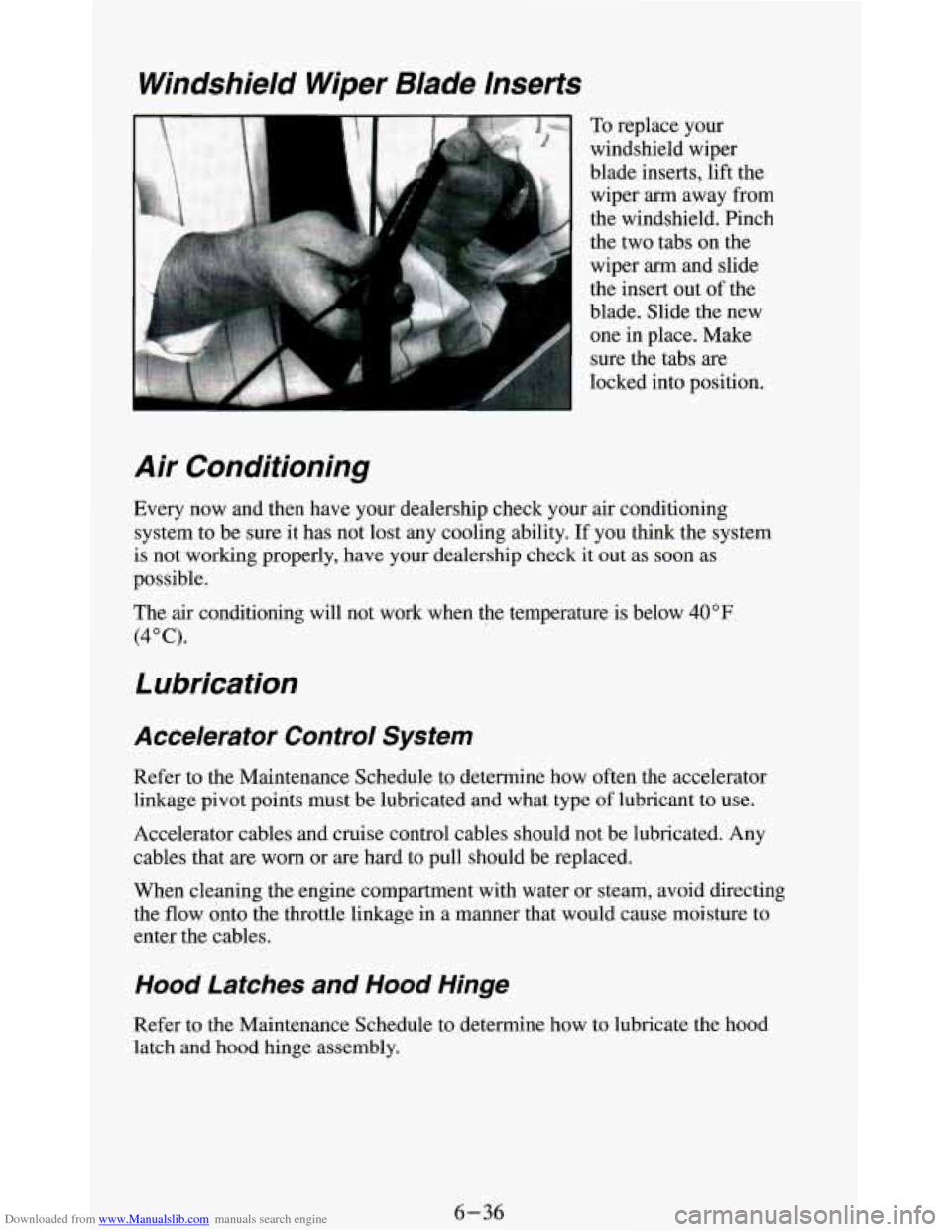
To replace your
windshield wiper
blade inserts, lift the
wiper
arm away from
the windshield. Pinch
the two tabs on the
wiper arm and slide
the insert out of the
blade. Slide the new
one in place. Make
sure the tabs
are
locked into position.
Air Conditioning
Every now and then have your dealership check your air conditioning
system to be sure it has not lost any cooling ability.
If you think the system
is not working properly, have your dealership check it out as soon as
possible.
The air conditioning will not work when the temperature is below
40°F
(4°C).
Lubrication
Accelerator Control System
Refer to the Maintenance Schedule to determine how often the accelerator
linkage pivot points must be lubricated and what type of lubricant to use.
Accelerator cables and cruise control cables should not be lubricated. Any
cables that
are worn or are hard to pull should be replaced.
When cleaning the engine compartment with water or steam, avoid directing
the flow onto the throttle linkage in a manner that would cause moisture to
enter the cables.
Hood Latches and Hood Hinge
Refer to the Maintenance Schedule to determine how to lubricate the hood
latch and hood hinge assembly.
6-36