1994 CHEVROLET BLAZER recommended oil
[x] Cancel search: recommended oilPage 187 of 348
Downloaded from www.Manualslib.com manuals search engine Once you are moving on the freeway, make certain you allow a reasonable
following distance. Expect to move slightly slower at night.
When you
want to leave the freeway, move to the proper lane well in
advance. If you miss your
exit do not, under any circumstances, stop and
back up. Drive on to the
next exit.
The exit ramp can be curved, sometimes quite sharply.
The exit speed is usually posted.
Reduce your speed according to your speedometer, not
to your sense of
motion. After driving for
any distance at higher speeds, you may tend to
think
you are going slower than you actually are.
Before Leaving on a Long Trip
Make sure you’re ready. Try to be well rested. If you must start when you’re
not fresh
- such as after a day’s work - don’t plan to make too many
miles
that first part of the journey. Wear comfortable clothing and shoes you
can easily drive
in.
Is your vehicle ready for a long trip? If you keep it serviced and maintained,
it’s ready to
go. If it needs service, have it done before starting out. Of
course, you’ll find experienced and able service experts
in GM dealerships
all across North America. They’ll be ready and willing to help if you need
it.
Here are some things you can check before a trip:
Windshield Washer Fluid: Is the reservoir full? Are all windows clean
inside and outside?
Wiper Blades: Are they in good shape?
Fuel, Engine Oil, Other Fluids: Have you checked all levels?
Lights: Are they all working? Are the lenses clean?
Tires: They are vitally important to a safe, trouble-free trip. Is the tread
good enough for long-distance driving? Are the tires all inflated
to the
recommended pressure?
Weather Forecasts: What’s the weather outlook along your route?
Maps: Do you have up-to-date maps?
Should
you delay your trip
a short time to avoid a major storm system?
4-29
Page 247 of 348
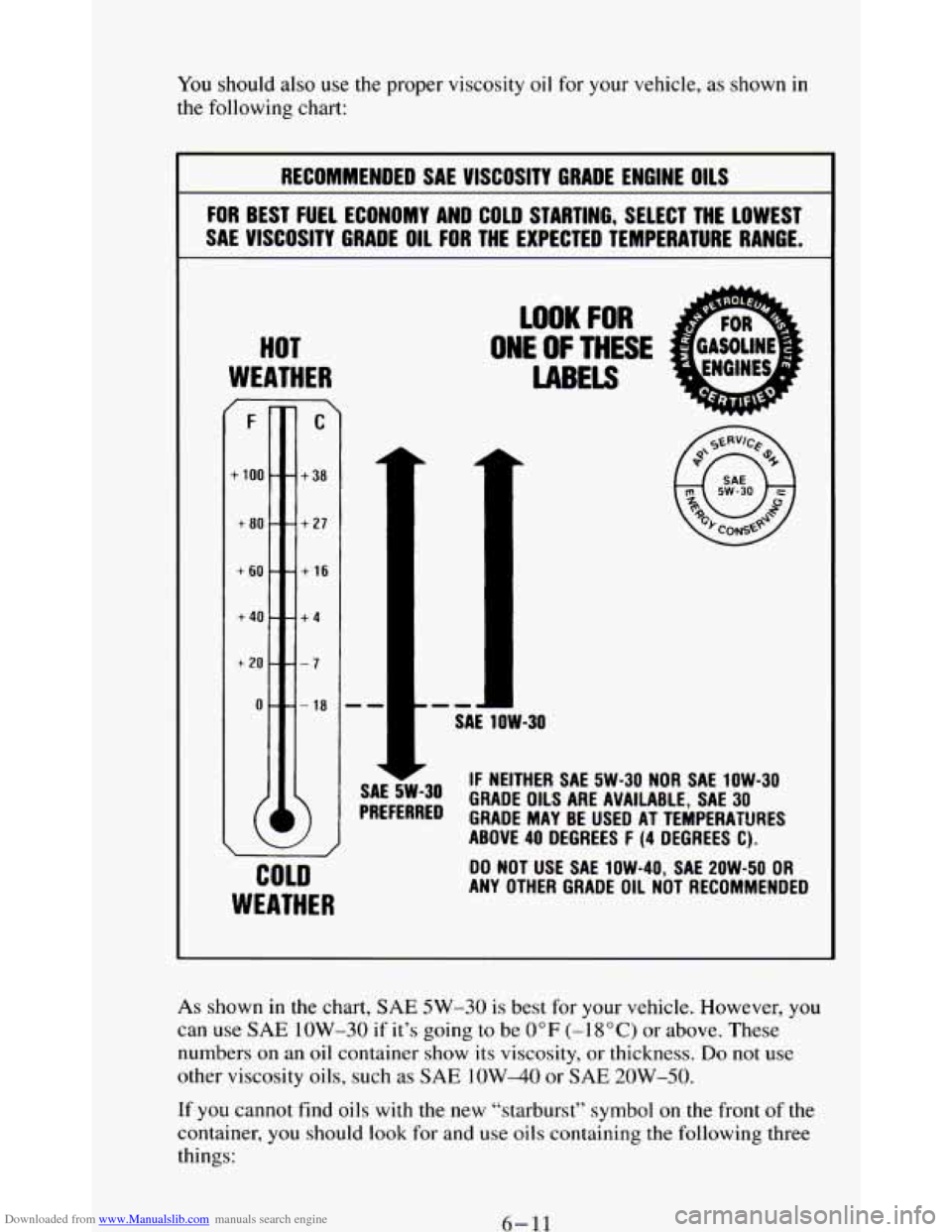
Downloaded from www.Manualslib.com manuals search engine You should also use the proper viscosity oil for your vehicle, as shown in
the following chart:
RECOMMENDED SAE VISCOSITY GRADE ENGINE OILS
FOR BEST FUEL ECONOMY AND COLD STARTING, SELECT THE LOWEST
SAL VISCOSITY GRADE
011 FOR THE EXPECTED TEMPERATURE RANGE.
HOT
WEATHER
[ + 60
+ 40
f 20
I
C
- +38
- +27
- +16
-+4
- -7
- -18
COLD
WEATHER
SAE 5W-30
PREFERRED
LOOK FOR
ONE OF THESE
LABELS
SAE 1OW-30
IF NEITHER SAE 5W-30 NOR SAE 1OW-30
GRADE OILS ARE AVAILABLE, SAE 30
GRADE MAY BE USED AT TEMPERATURES
ABOVE
40 DEGREES F (4 DEGREES C).
ANY OTHER GRADE OIL NOT RECOMMENDED
DO NOT USE SAE 1OW-40, SAE 2OW-50 OR
As shown in the chart, SAE 5W-30 is best for your vehicle. However, you
can use
SAE low-30 if it’s going to be 0°F (-1 8°C) or above. These
numbers on an oil container show its viscosity, or thickness.
Do not use
other viscosity oils, such as SAE 1OW-40 or SAE 20W-50.
If you cannot find oils with the new “starburst” symbol on the front of the
container, you should look for and use oils containing the following three
things:
6-11
Page 254 of 348
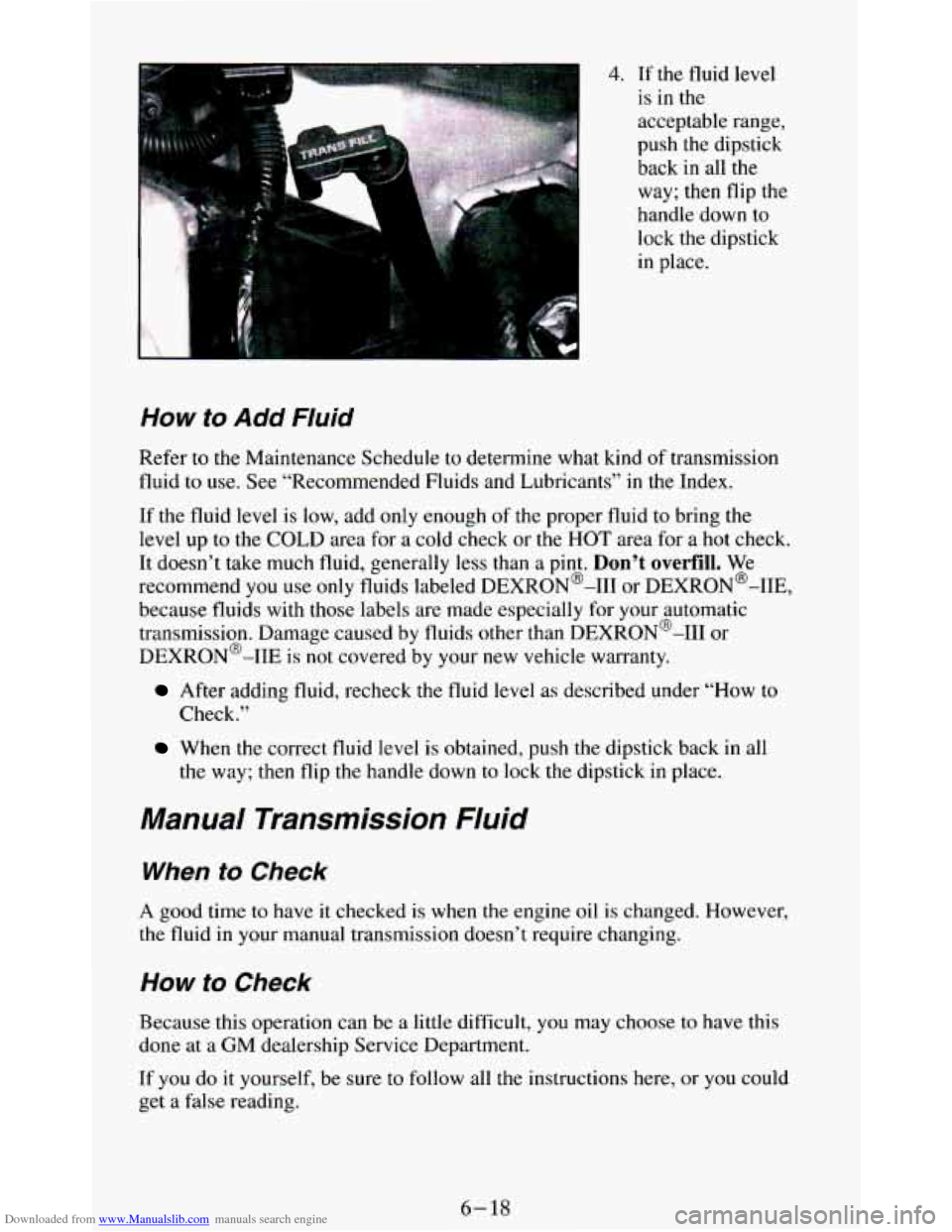
Downloaded from www.Manualslib.com manuals search engine 4. If the fluid level
is in the
acceptable range,
push the dipstick
back in all the
way; then flip
the
handle down to
lock the dipstick
in place.
How to Add Fluid
Refer to the Maintenance Schedule to determine what kind of transmission
fluid to use. See “Recommended Fluids and Lubricants’’
in the Index.
If the fluid level is low, add only enough
of the proper fluid to bring the
level up to the
COLD area for a cold check or the HOT area for a hot check.
It doesn’t take much fluid, generally
less than a pint. Don’t overfill. We
recommend you use only fluids labeled DEXR0N’-I11 or DEXR0N’-IIE,
because fluids with those labels are made especially for your automatic
transmission. Damage caused by fluids other than DEXRON@-I11 or
DEXRON@-IIE
is not covered by your new vehicle warranty.
After adding fluid, recheck the fluid level as described under “How to
Check.”
When the correct fluid level is obtained, push the dipstick back in all
the way; then flip
the handle down to lock the dipstick in place.
Manual Transmission Fluid
When to Check
A good time to have it checked is when the engine oil is changed. However,
the fluid in your manual transmission doesn’t require changing.
How fo Check
Because this operation can be a little difficult, you may choose to have this
done at a
GM dealership Service Department.
If
you do it yourself, be sure to follow all the instructions here, or you could
get a false reading.
6- 18
Page 259 of 348
Downloaded from www.Manualslib.com manuals search engine If the differential is cold, add enough lubricant to raise the level to 1/2 inch
(12 mm) below the filler plug hole.
What to use
Refer to the Maintenance Schedule to determine what kind of lubricant to
use.
See “Recommended Fluids and Lubricants” in the Index.
Engine Coolanr
The following explains your cooling system and how to add coolant when it
is
low. If you have a problem with engine overheating, see “Engine
Overheating” in the Index.
The proper coolant for your vehicle will:
0 Give freezing protection down to -20 “F (-29”C), or -34°F (-37°C) in
Give boiling protection up to 258°F (125°C).
Canada
and for
vehicles with the cold climate option.
0 Protect against rust and corrosion.
Help keep the proper engine temperature.
0 Let the warning lights and gages work as they should.
What to Use
Use a mixture of one-half clean water (preferably distilled) and one-half
antifreeze that meets “GM Specification 6038-M,” which won’t damage
aluminum parts.
You can use a recycled coolant conforming to “GM
Specification 6038-M,” with a complete coolant flush and refill. If you use
this mixture, you don’t need to add anything else.
6-23
Page 291 of 348
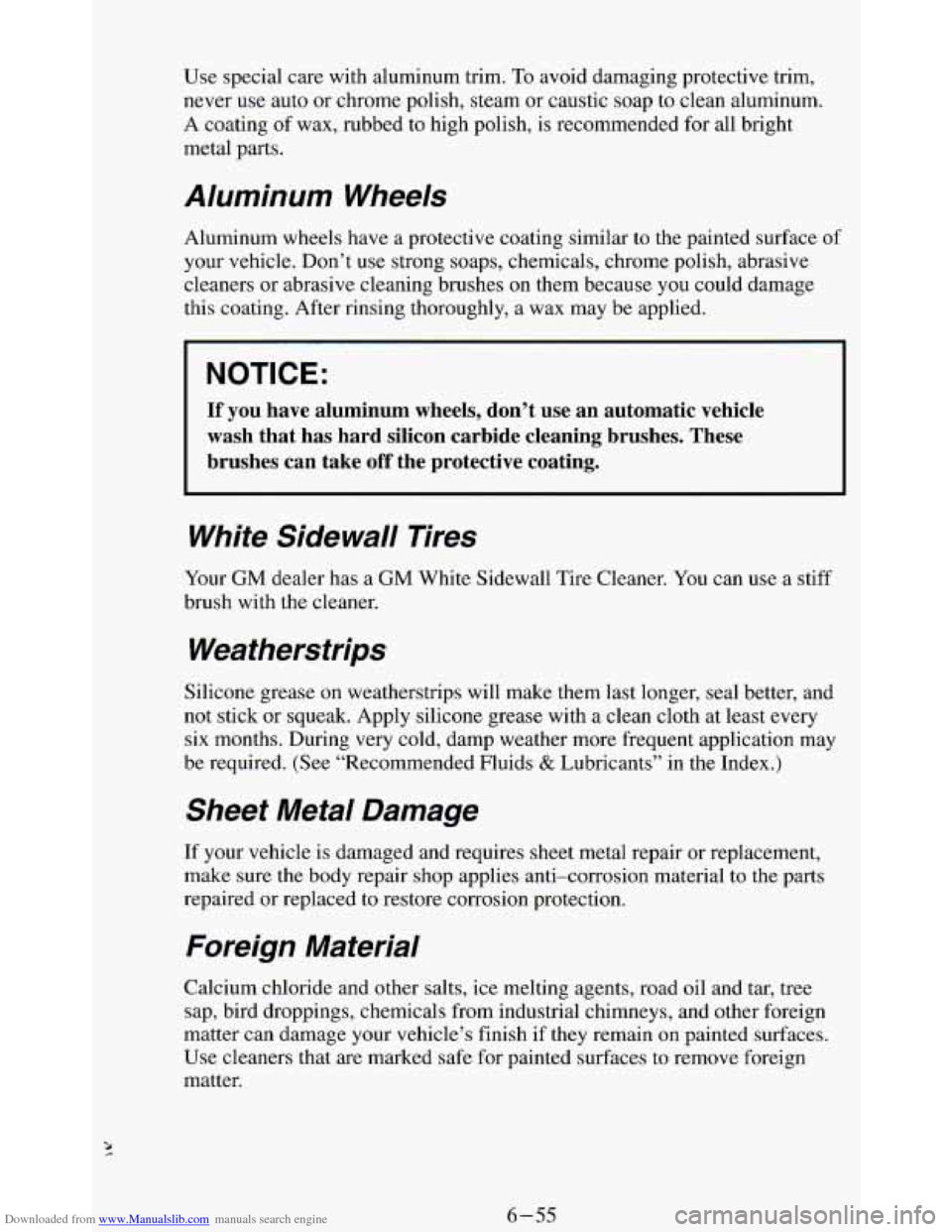
Downloaded from www.Manualslib.com manuals search engine Use special care with aluminum trim. To avoid damaging protective trim,
never use auto or chrome polish, steam or caustic soap to clean aluminum.
A coating of wax, rubbed to high polish, is recommended for all bright
metal parts.
Aluminum Wheels
Aluminum wheels have a protective coating similar to the painted surface of
your vehicle. Don’t use strong soaps, chemicals, chrome polish, abrasive
cleaners or abrasive cleaning brushes on them because you could damage
this coating. After rinsing thoroughly, a wax may be applied.
I NOTICE:
If you have aluminum wheels, don’t use an automatic vehicle
wash that has hard silicon carbide cleaning brushes. These
brushes can take
off the protective coating.
White Side wa// Tires
Your GM dealer has a GM White Sidewall Tire Cleaner. You can use a stiff
brush with the cleaner.
Weatherstrips
Silicone grease on weatherstrips will make them last longer, seal better, and
not stick or squeak. Apply silicone grease with a clean cloth at least every
six months. During very cold, damp weather more frequent application may
be required. (See “Recommended Fluids
& Lubricants” in the Index.)
Sheet Metal Damage
If your vehicle is damaged and requires sheet metal repair or replacement,
make sure the body repair shop applies anti-corrosion material to the parts
repaired
or replaced to restore corrosion protection.
Foreign Material
Calcium chloride and other salts, ice melting agents, road oil and tar, tree
sap, bird droppings, chemicals from industrial chimneys, and other foreign
matter can damage your vehicle’s finish if they remain on painted surfaces.
Use cleaners that are marked safe for painted surfaces to remove foreign
matter.
4
6-55
Page 319 of 348
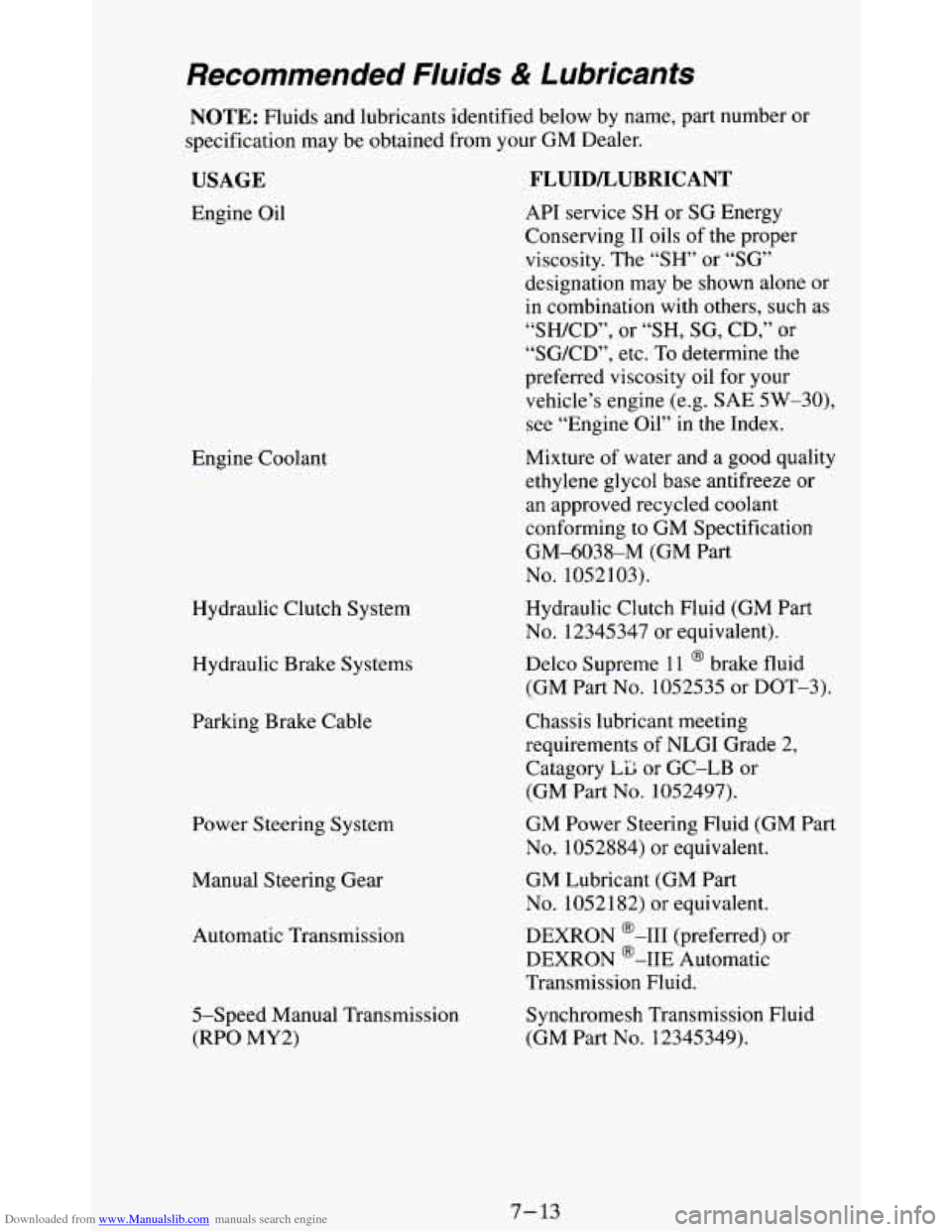
Downloaded from www.Manualslib.com manuals search engine Recommended Fluids & Lubricants
NOTE: Fluids and lubricants identified below by name, part number or
specification may be obtained from your GM Dealer.
USAGE
Engine Oil
Engine Coolant
Hydraulic Clutch System
Hydraulic Brake Systems
Parking Brake Cable Power Steering System
Manual Steering Gear
Automatic Transmission
5-Speed Manual Transmission
(RPO MY2)
FLUIDLUBRICANT
API service SH or SG Energy
Conserving
I1 oils of the proper
viscosity. The “SH” or
“SG’
designation may be shown alone or
in combination with others, such as
“SH/CD”, or “SH, SG, CD,”
or
“SG/CD”, etc. To determine the
preferred viscosity oil for your
vehicle’s engine (e.g.
SAE 5W-30),
see “Engine Oil”
in the Index.
Mixture of water and
a good quality
ethylene glycol base antifreeze or
an approved recycled coolant
conforming to GM Spectification
GM-6038-M (GM Part
No. 1052 103).
Hydraulic Clutch Fluid (GM Part
No. 12345347 or equivalent).
Delco Supreme
1 1 @ brake fluid
(GM Part No. 1052535 or DOT-3).
Chassis lubricant meeting
requirements
of NLGI Grade 2,
Catagory
LiIl or GC-LB or
(GM Part No. 1052497).
GM Power Steering Fluid (GM Part
No. 1052884) or equivalent.
GM Lubricant (GM Part
No. 1052182) or equivalent.
DEXRON
@-I11 (preferred) or
DEXRON @-IIE Automatic
Transmission Fluid.
Synchromesh Transmission Fluid
(GM Part
No. 12345349).
7- 13
Page 340 of 348
Downloaded from www.Manualslib.com manuals search engine FanNoise ...................................................... 5-18
Finish
Filter
Replacement Chart
.......................................... 6-68
Care
........................................................ 6-54
Damage ..................................................... 6-55
Automatic Transmission
........................................ 6-15
Brake
....................................................... 6-29
Capacities
................................................... 6-62
CoolantRecovery
............................................. 5-13
FrontAxle
................................................... 6-22
Leakcheck
.................................................. 6-31
ManualTransmission
.......................................... 6-18
Powersteering
............................................... 6-26
Radiator
..................................................... 5-15
RearAxle
................................................... 6-20
Recommended Fluids
.......................................... 7-13
Transfercase
................................................ 6-21
Windshield Washer ............................................ 6-28
FogLamps
..................................................... 2-50
Four-WheelDrive
.......................................... 2-31, 6-21
Transfer Case
...................................... 2-3 1,2-33, 6-21
FrontAxle
................................................... 6-22
Fuel
........................................................... 6-3
FillingYourTank
.............................................. 6-5
Fluid
Hydraulicclutch
.............................................. 6-20
Foreign Countries
.............................................. 6-4
Gage
....................................................... 2-76
Gasolines for Cleaner Air
........................................ 6-4
Tankcapacity
................................................ 6-63
Fuses and Circuit Breakers
................................... 6-60, 6-66
FuseBlock
.................................................. 6-61
Headlights
.............................................. 6-61, 6-63
Power Windows and Other Power Options
......................... 6-61
Trailer Wiring Harness
......................................... 6-61
Windshield Wipers
............................................ 6-61
Gages
......................................................... 2-76
FuelGage
................................................... 2-76
Odometer ................................................... 2-65
OilPressureGage
............................................. 2-72
Speedometer
................................................. 2-65
Tachometer
.................................................. 2-67
Trip Odometer
................................................ 2-66
Voltmeter
.................................................... 2-77
Coolant Temperature Gage ...................................... 2-70
4
Page 342 of 348
Downloaded from www.Manualslib.com manuals search engine Lights (continued)
Front Parkingnurn Signal
....................................... 6-33
Headlights (See “Headlights”)
Indicator
............................................... 2-74,2.. 75
Malfunction Indicator
...................................... 2-7 1 6-38
Operation
................................................... 2-40
Overhead Console Reading
...................................... 2-53
Service Engine Soon
...................................... 2-7 1, 6-38
Loading Information
............................................. 6-39
Loading Your Vehicle
....................................... 4-1 3. 6-39
Accelerator Control System
..................................... 6-36
EndgateHandle
............................................... 6-37
Front Suspension and Steering Linkage
............................ 6-35
Front Wheel Bearings (Two-Wheel Drive)
......................... 6-35
Propeller Shaft Slip Splines/Universal
Joints ........................ 6-37
Rear
........................................................ 6-34
Replacementchart
............................................ 6-63
Lubrication
..................................................... 6-36
Body
....................................................... 6-37
FrontAxle
................................................... 6-22
HoodLatchesandHinge
........................................ 6-36
Lockcylinders
............................................... 6-37
RearAxle
................................................... 6-20
Recommended Lubricants
...................................... 7-13
Transfercase
................................................ 6-21
Luggage Carrier
................................................. 2-78
M
Maintenance
OtherItems
.................................................. 6-35
Record
...................................................... 7-16
ScheduledMaintenance ......................................... 7-3
Underbody
.................................................. 6-56
WhenTowingaTrailer
......................................... 3-37
Master Cylinder (See “Brakes”)
Mirrors
........................................................ 2-53
Convexoutside
............................................... 2-55
Inside
....................................................... 2-53
Outside
..................................................... 2-54
Vanity
...................................................... 2-55
ModelReference
.................................................. 111
Periodic Inspections ........................................... 7-12
...
0
Odometer ...................................................... 2-66
Off-Road Driving (See “Driving”)
Off-Road Recovery
.............................................. 4-10
Oil
............................................................ 6-8
Additives
.................................................... 6-12
Disposalofused
.............................................. 6-13
Pressure Gage ................................................ 2-72
ToCheck
..................................................... 6-9
6