Page 191 of 348
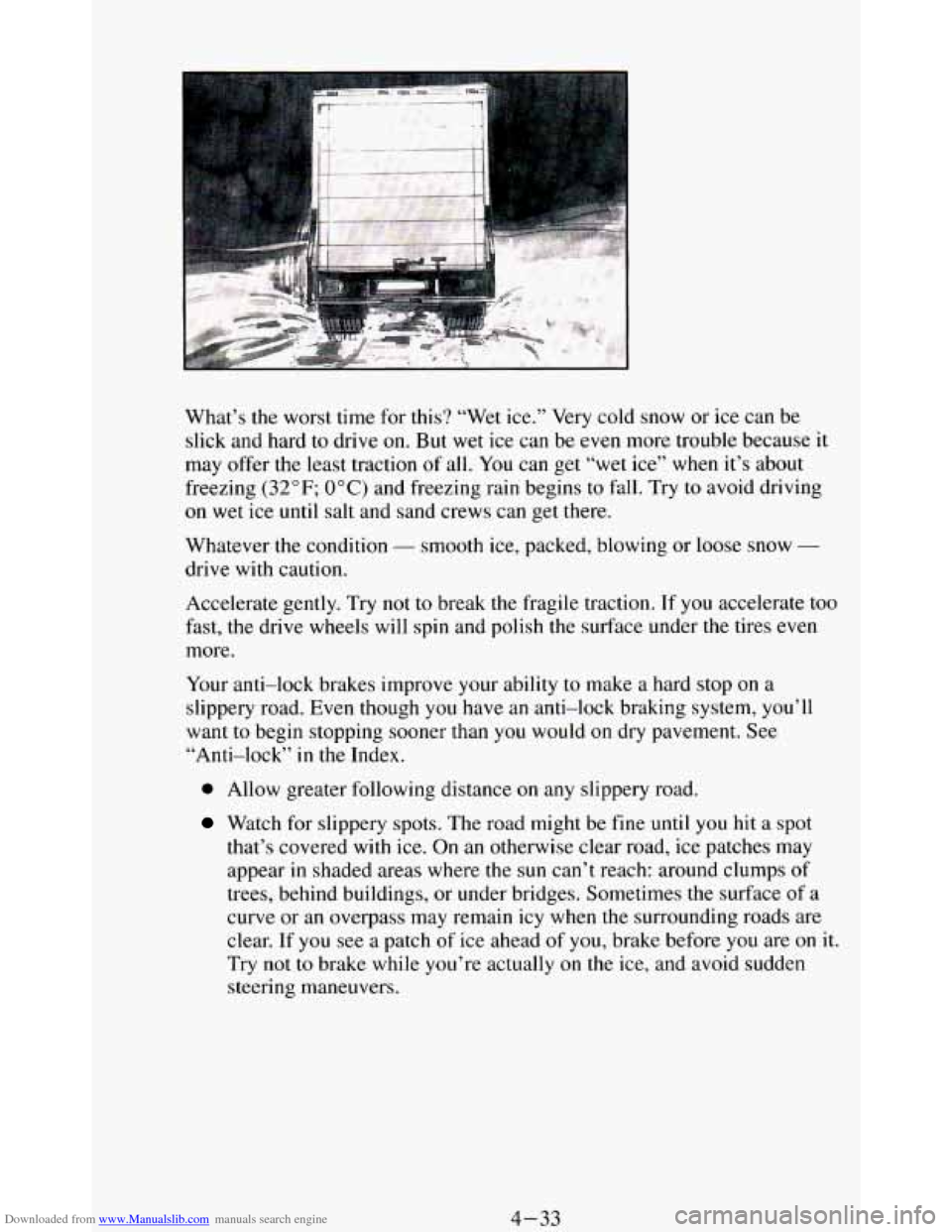
Downloaded from www.Manualslib.com manuals search engine What’s the worst time for this? “Wet ice.” Very cold snow or ice can be
slick and hard to drive on. But wet ice can be even more trouble because it
may offer the least traction
of all. You can get “wet ice” when it’s about
freezing
(32°F; 0°C) and freezing rain begins to fall. Try to avoid driving
on wet ice until salt and sand crews can get there.
Whatever the condition
- smooth ice, packed, blowing or loose snow -
drive with caution.
Accelerate gently. Try
not to break the fragile traction. If you accelerate too
fast, the drive wheels will spin and polish the surface under the tires even
more.
Your anti-lock brakes improve your ability
to make a hard stop on a
slippery road. Even though you have an anti-lock braking system, you’ll
want to begin stopping sooner than
you would on dry pavement. See
“Anti-lock” in the Index.
0 Allow greater following distance on any slippery road.
Watch for slippery spots. The road might be fine until you hit a spot
that’s covered with ice. On an otherwise clear road, ice patches may
appear in shaded areas where
the sun can’t reach: around clumps of
trees, behind buildings, or under bridges. Sometimes the surface of a
curve or an overpass may remain icy when
the surrounding roads are
clear. If
you see a patch of ice ahead of you, brake before you are on it.
Try not to brake while you’re actually on the ice, and avoid sudden
steering maneuvers.
4-33
Page 194 of 348
Downloaded from www.Manualslib.com manuals search engine Before towing, you should:
1. Set the parking brake firmly.
2. Place the automatic transmission in "P" (Park) or the manual
3. Firmly attach the vehicle being towed to the tow vehicle. Refer to the
transmission
in the lowest gear (1st gear).
hitch manufacturer's instructions.
4. Place the transfer case shift lever in "N" (Neutral).
NOTICE:
Removal of either propeller shaft is unnecessary.
1. Release the parking brake only after the vehicle being towed is firmly
attached to the tow vehicle.
2. Insert the ignition key into the ignition switch and turn it one notch
forward
of the LOCK position. This places the key into the OFF
position, which unlocks the steering column while preventing battery
drain. Unlocking the steering
column will allow for proper movement
of the front wheeldtires during towing.
NOTICE:
You should exercise extra care whenever towing another vehicle.
4-36
Page 197 of 348
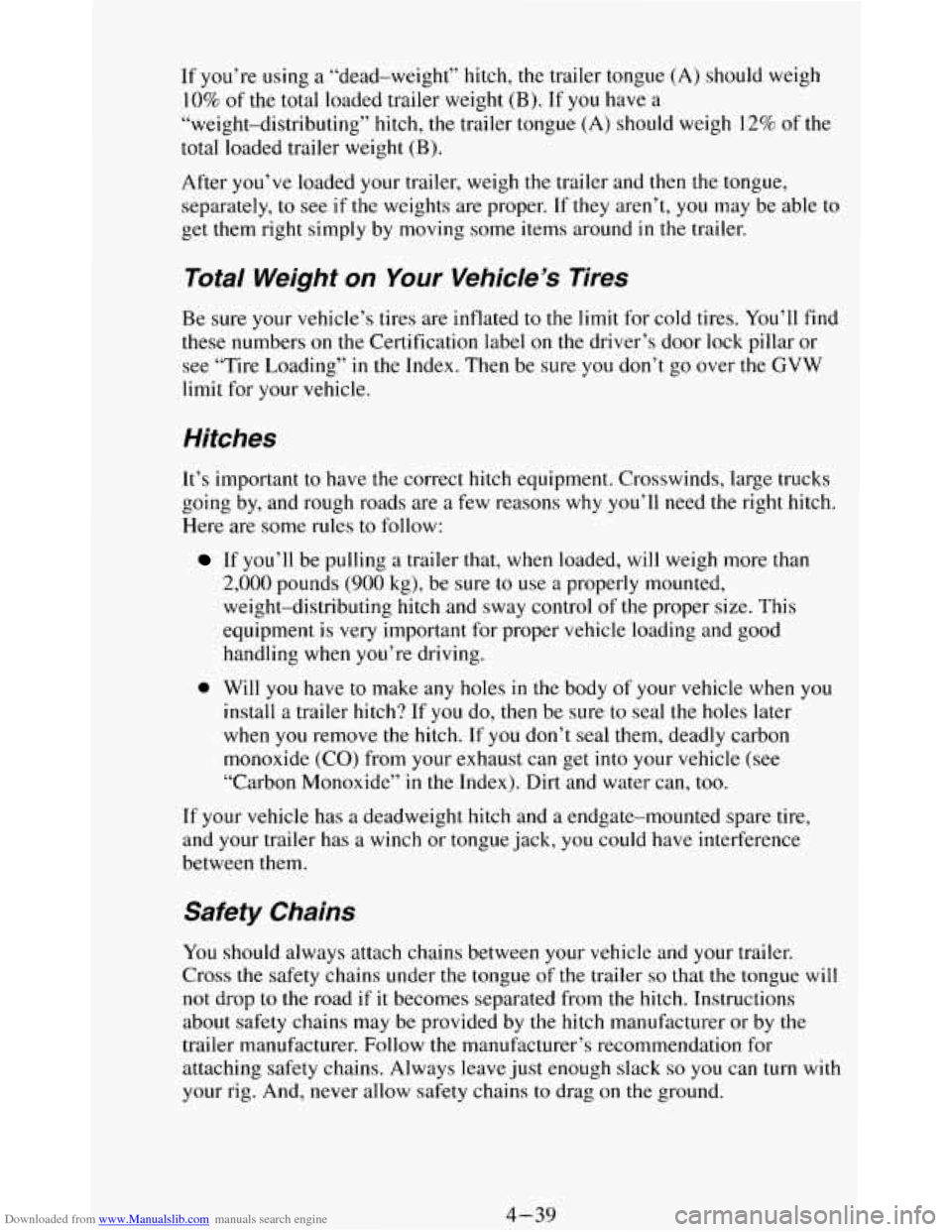
Downloaded from www.Manualslib.com manuals search engine If you’re using a “dead-weight” hitch, the trailer tongue (A) should weigh
10%
of the total loaded trailer weight (B). If you have a
“weight-distributing” hitch, the trailer tongue (A) should weigh 12% of the
total loaded trailer weight (B).
After you’ve loaded your trailer, weigh the trailer and then the tongue,
separately,
to see if the weights are proper. If they aren’t, you may be able to
get them right simply by moving some items around
in the trailer.
Total Weight on Your Vehicle’s Tires
Be sure your vehicle’s tires are inflated to the limit for cold tires. You’ll find
these numbers
on the Certification label on the driver’s door lock pillar or
see “Tire Loading”
in the Index. Then be sure you don’t go over the GVW
limit for your vehicle.
Hitches
It’s important to have the correct hitch equipment. Crosswinds, large trucks
going by, and rough roads are
a few reasons why you’ll need the right hitch.
Here are some rules
to follow:
If you’ll be pulling a trailer that, when loaded, will weigh more than
2,000 pounds (900 kg), be sure to use a properly mounted,
weight-distributing hitch and sway control of the proper size. This
equipment is very important for proper vehicle loading and good
handling when you’re driving.
0 Will you have to make any holes in the body of your vehicle when you
install a trailer hitch? If you do, then be sure to seal the holes later
when
you remove the hitch. If you don’t seal them, deadly carbon
monoxide (CO) from your exhaust can get
into your vehicle (see
“Carbon Monoxide”
in the Index). Dirt and water can, too.
If your vehicle has a deadweight hitch and a endgate-mounted spare tire,
and your trailer has
a winch or tongue jack, you could have interference
between them.
Safety Chains
You should always attach chains between your vehicle and your trailer.
Cross
the safety chains under the tongue of the trailer so that the tongue will
not drop
to the road if it becomes separated from the hitch. Instructions
about safety chains may be provided by the hitch manufacturer
or by the
trailer manufacturer. Follow
the manufacturer’s recommendation for
attaching safety chains. Always leave just enough slack
so you can turn with
your rig. And, never allow safety chains
to drag on the ground.
4-39
Page 202 of 348
Downloaded from www.Manualslib.com manuals search engine Maintenance When Trailer Towing
Your vehicle will need service more often when you’re pulling a trailer. See
the Maintenance Schedule for more on this. Things that are especially
important in trailer operation are automatic transmission fluid (don’t
overfill), engine oil, axle lubricant, belt, cooling system, and brake
adjustment. Each of these is covered
in this manual, and the Index will help
you find them quickly. If you’re trailering,
it’s a good idea to review these
sections before you start your trip.
Check periodically to see that
all hitch nuts and bolts are tight.
Trailer Light Wiring
See “Trailer Wiring Harness” in the Index.
Power Winches
If you wish to use a power winch on your vehicle, only use it when your
vehicle
is stationary or anchored.
! NOTICE:
~ When operating a power winch on your vehicle always leave the \
l transmission in the neutral position. Do not leave an automatic
transmission in
P (Park) or a manual transmission in gear or the
transmission may be damaged.
Use the regular brakes, set the parking brake or block the wheels to keep
your vehicle from rolling.
4-44
Page 210 of 348
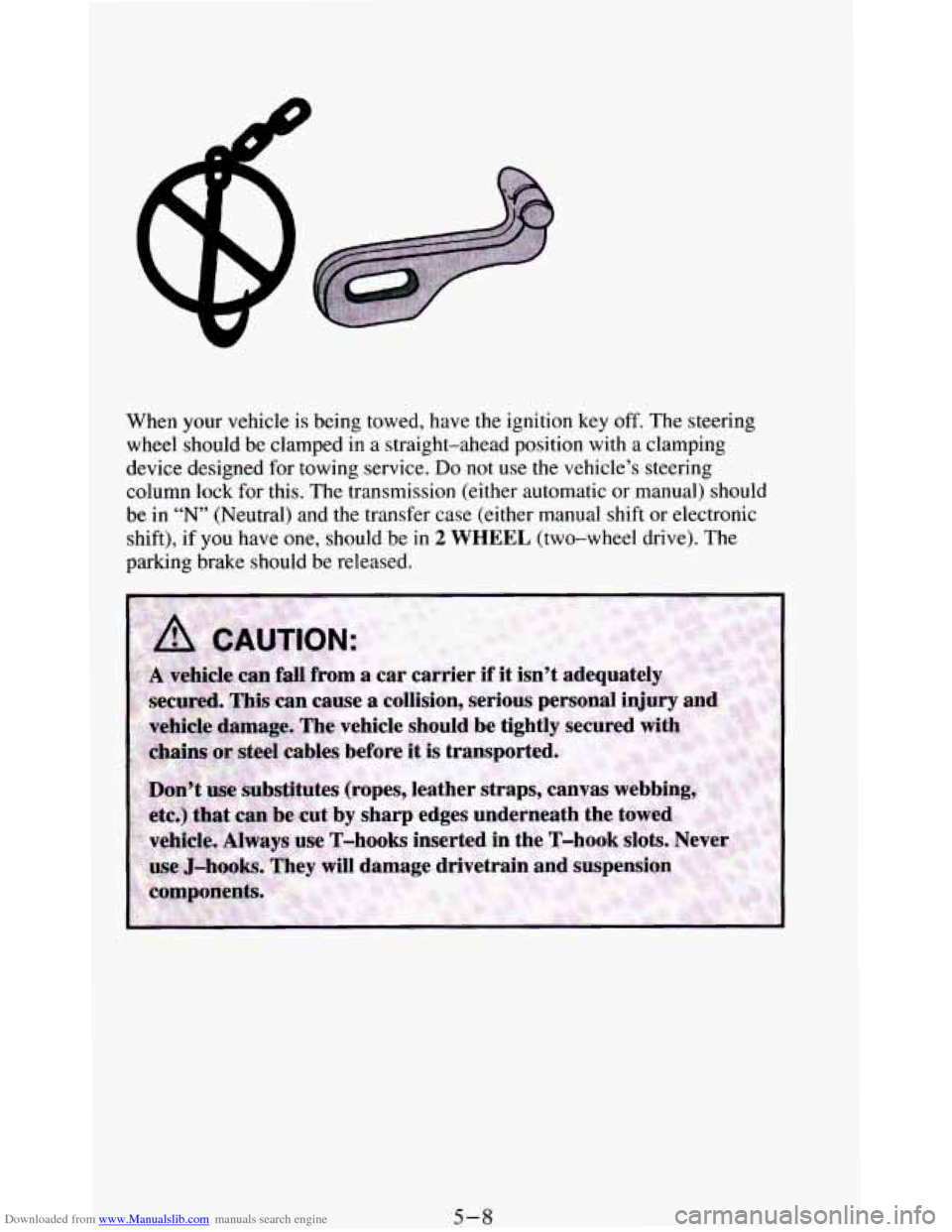
Downloaded from www.Manualslib.com manuals search engine When your vehicle is being towed, have the ignition key off. The steering
wheel should
be clamped in a straight-ahead position with a clamping
device designed for towing service.
Do not use the vehicle’s steering
column lock for this. The transmission (either automatic
or manual) should
be in
“N’ (Neutral) and the transfer case (either manual shift or electronic
shift), if
you have one, should be in 2 WHEEL (two-wheel drive). The
parking brake should be released.
5-8
Page 221 of 348
Downloaded from www.Manualslib.com manuals search engine Changing a Flat Tire
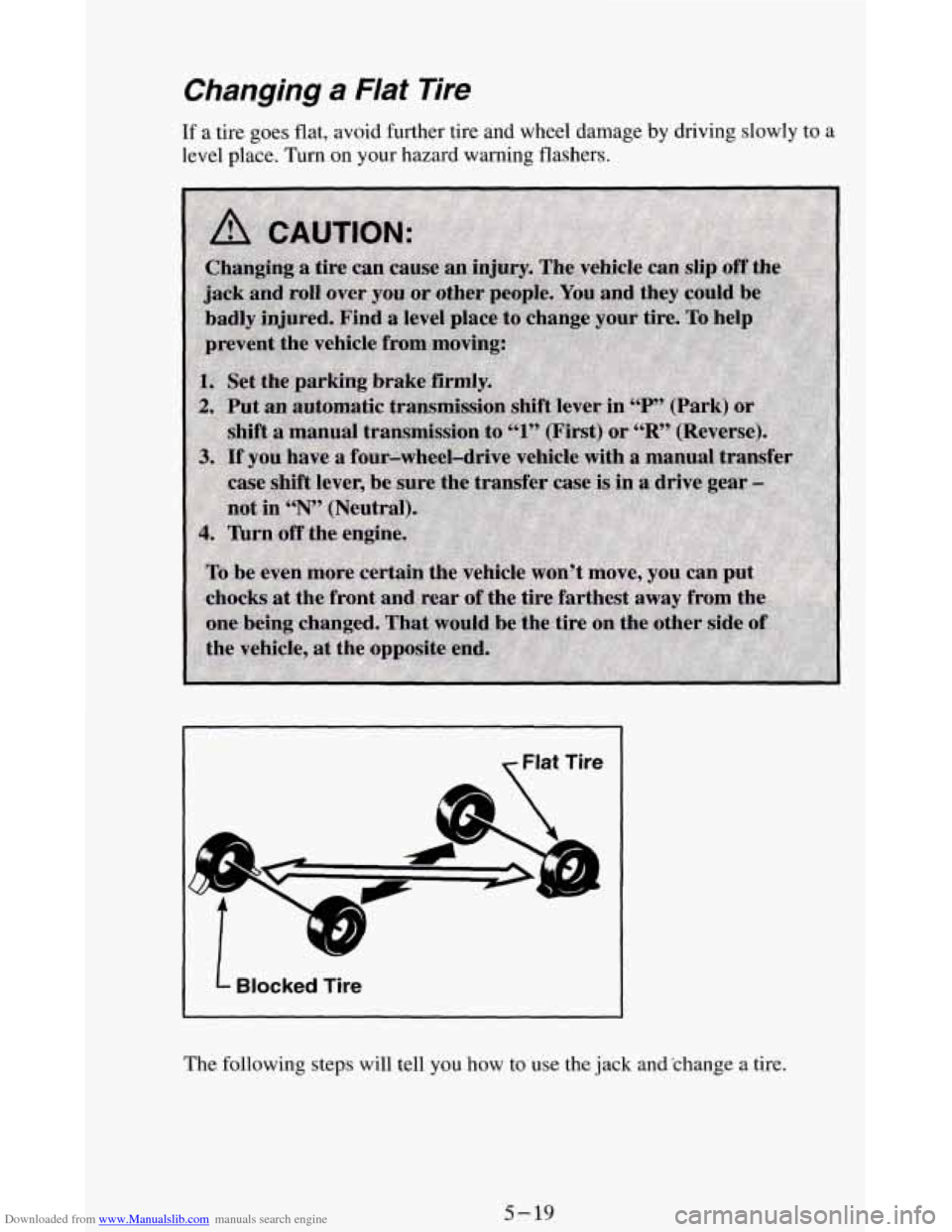
If a tire goes flat, avoid further tire and wheel damage by driving slowly to a
level place. Turn on your hazard warning flashers.
T
L Blocked Tire
The following steps will tell you how to use the jack and change a tire.
5-19
Page 222 of 348
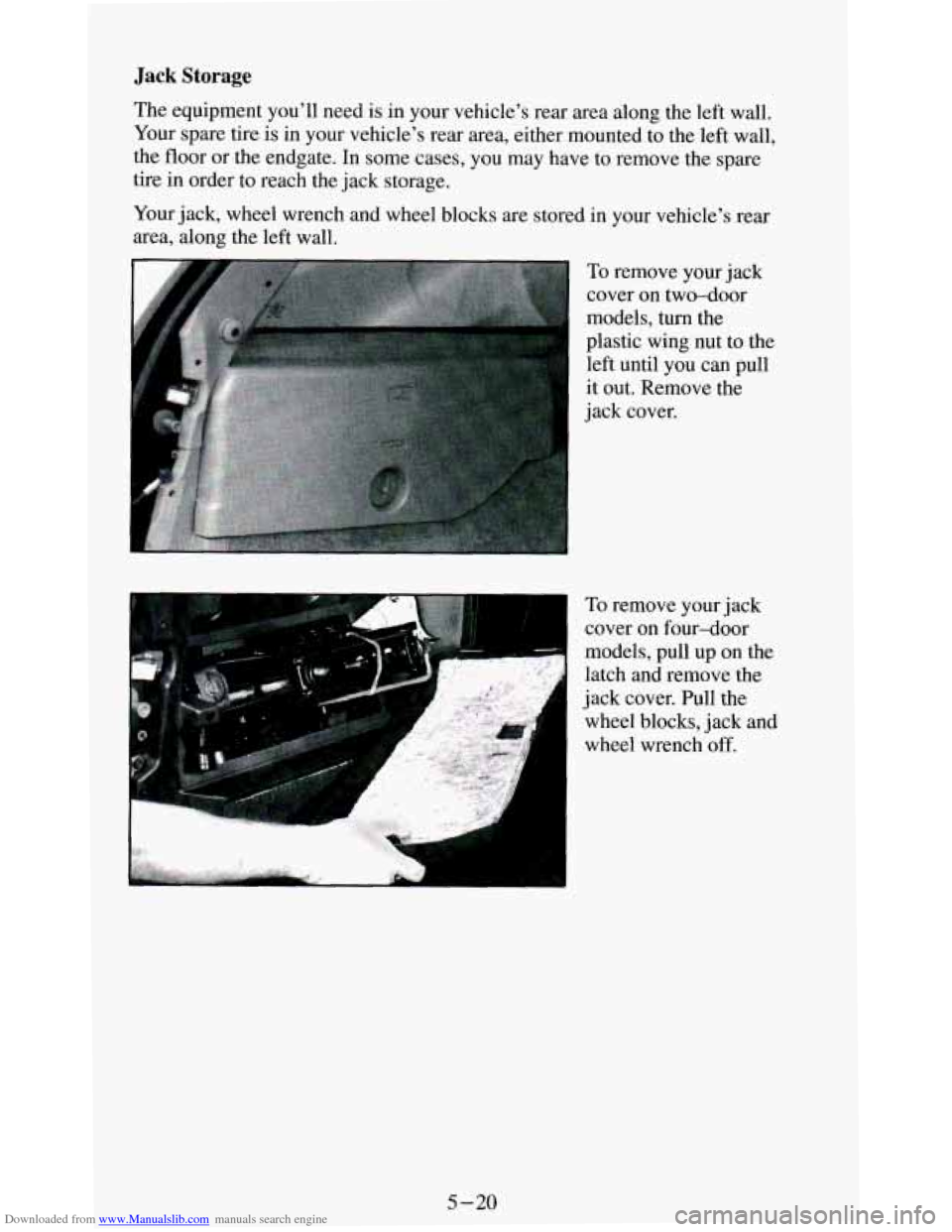
Downloaded from www.Manualslib.com manuals search engine Your jack, wheel wrench and wheel blocks are stored in your vehicle's rear
area, along the left wall.
To remove your jack
cover on two-door
models, turn the
plastic wing nut to the
left until you can pull
it out. Remove the
jack cover.
bUVC1 U11 .
models, p
To remove your jack
tlAT7-V nm four-door
lull up on the
latch and remove the
jack cover. Pull the
wheel blocks, jack and
wheel wrench
off.
c
I
5-20
Page 223 of 348
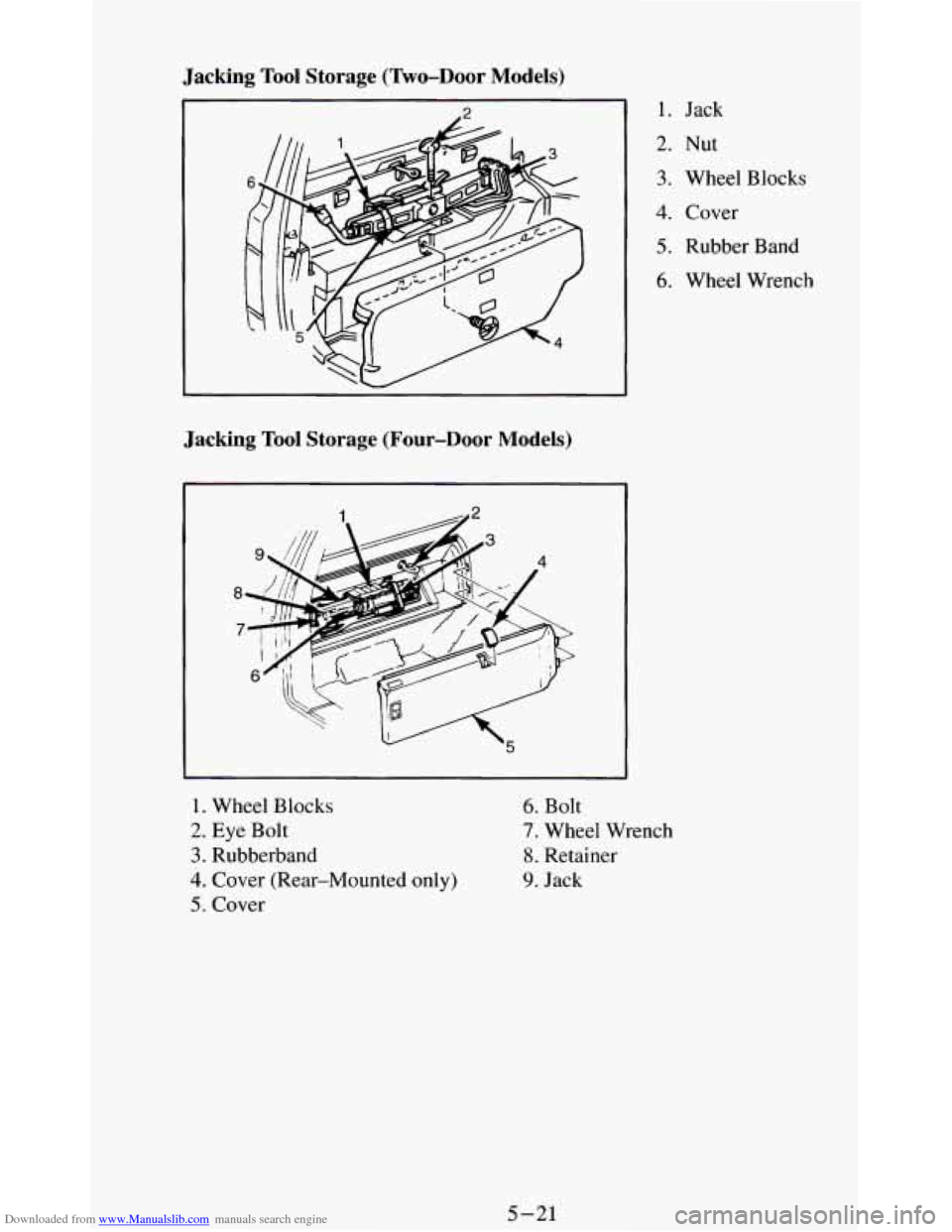
Downloaded from www.Manualslib.com manuals search engine Jacking Tool Storage (Two-Door Models)
Jacking Tool Storage (Four-Door Models)
I
1. Wheel Blocks 6. Bolt
2. Eye Bolt
3. Rubberband
4. Cover (Rear-Mounted only)
5. Cover
7. Wheel Wrench
8. Retainer
9. Jack
1. Jack
2. Nut
3. Wheel Blocks
4. Cover
5. Rubber Band
6. Wheel Wrench
5-21