1994 CHEVROLET BLAZER change wheel
[x] Cancel search: change wheelPage 4 of 348
Downloaded from www.Manualslib.com manuals search engine Important Notes to Owners and Drivers
. . . .About This Manual:
Please keep this manual in your vehicle so it will be there if you ever need it
when you’re on the road.
If you sell the vehicle, please leave this manual in
it so the new owner can use it.
This manual includes the latest information at the time it was printed. We
reserve
the right to make changes in the product after that time without
further notice.
For vehicles first sold in Canada, substitute the name
“General Motors of Canada Limited” for Chevrolet Motor Division
whenever it appears in this manual.
,...About Driving Your Blazer:
As with other vehicles of this type, failure to operate this vehicle correctly
may result in loss of control or an accident. Be sure
to read the
“on-pavement” and “off-road” driving guidelines
in this manual. (See
“Driving Guidelines” and “Off-Road Driving With Your Four-wheel Drive
Vehicle” in the Index.)
For Canadian Owners Who Prefer a French Language
Manual:
Aux proprietaires canadiens: Vous pouvez vous procurer un exemplaire de
ce guide en francais chez votre concessionaire
ou au DGN Marketing
Services Ltd.,
1500 Bonhill Rd., Mississauga, Ontario L5T 1C7.
General Motors, GM and the GM Emblem, Chevrolet and the Chevrolet
Emblem, and
S-10 are registered trademarks of General Motors
Corporation.
11 ..
Page 56 of 348
Downloaded from www.Manualslib.com manuals search engine EngineExhaust ........................................... 2-29
Running Your Engine While You’re Parked
................... 2-30
Four-WheelDrive
......................................... 2-31
Manual Transfer Case
.................................... 2-31
Electronic Transfer Case
.................................. 2-33
Windows
................................................ 2-35
Horn
.................................................... 2-37
Tiltwheel
............................................... 2-37
Turn Signal/Multifunction Lever
.............................. 2-38
Turn Signal and Lane Change Indicator
...................... 2-38
Headlight High-Low Beam
............................... 2-40
Windshield Wipers
...................................... 2-41
Windshield Washer
...................................... 2-42
Rear Window Wiper/Washer
.............................. 2-43
Cruise Control
.......................................... 2-44
Lights
................................................. 2-49
Mirrors
.................................................. 2-53
Accessory Power Outlet
..................................... 2-56
Cigarette LightedAshtrays
................................... 2-57
Storage Compartments
...................................... 2-58
Instrument Cluster ......................................... 2-65
Warning Lights. Gages
and Indicators ....................... 2-67
Luggagecarrier
........................................... 2-78
Trailer Wiring Harness
...................................... 2-80
2-2
Page 78 of 348
Downloaded from www.Manualslib.com manuals search engine a
0
a
To Stop - Let up on the accelerator pedal and press the brake pedal.
Just before the vehicle stops, press
the clutch pedal and the brake pedal,
and shift to
“N” (Neutral).
N (Neutral) - Use this position when you start or idle your engine.
R (Reverse) - To back up, press down the clutch pedal, wait about 6
seconds, then shift into “R” (Reverse). Then let up on the clutch pedal
slowly while pressing the accelerator pedal.
NOTICE:
Shift to “R” (Reverse) only after your vehicle is stopped.
Shifting to
“R” (Reverse) while your vehicle is moving could
damage your transmission.
Also, use “R’ (Reverse), along with the parking brake, for parking your
vehicle.
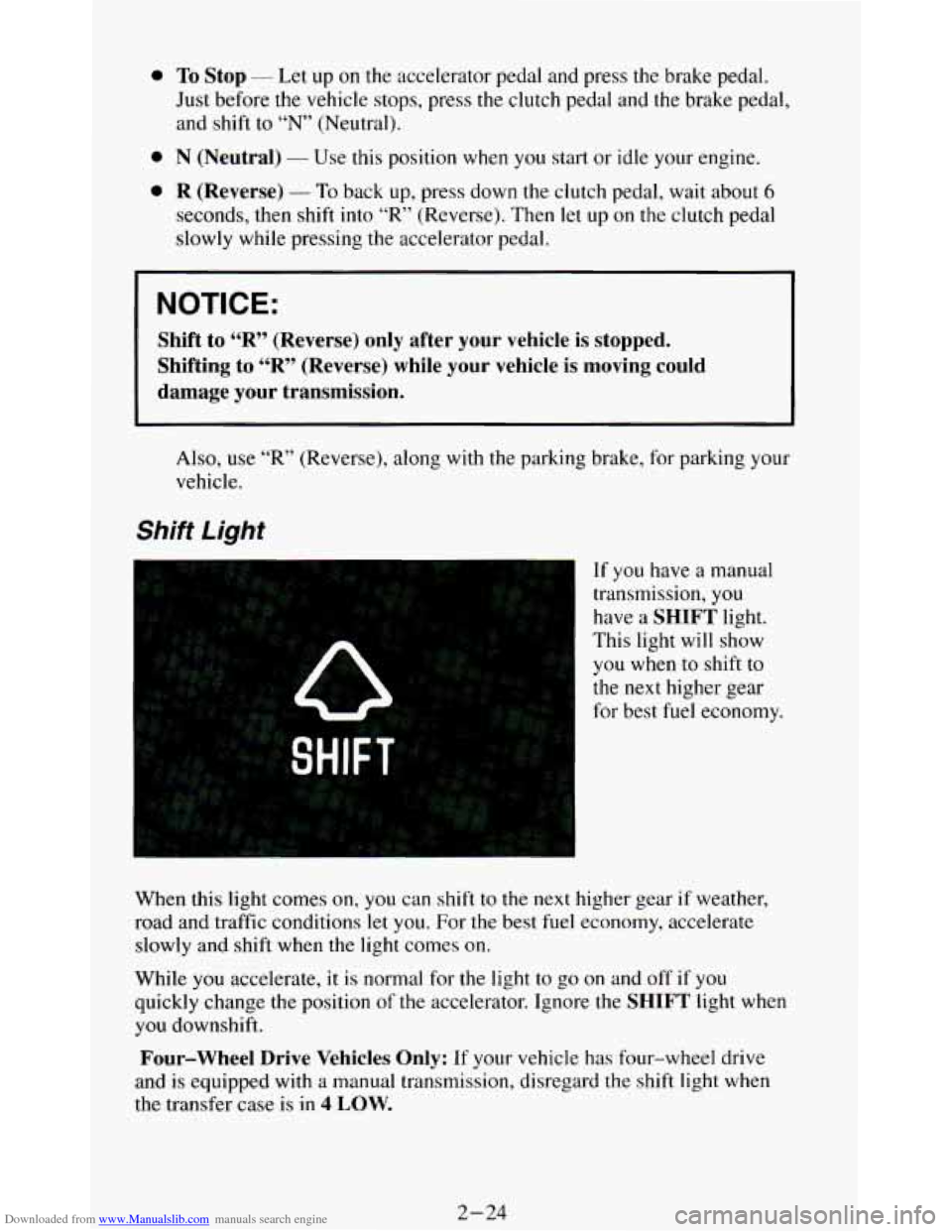
Shift Light
If you have a manual
transmission,
you
have a SHIFT light.
This light will show
you when to shift to
the next higher gear
for best fuel economy.
When this light comes
on, you can shift to the next higher gear if weather,
road and traffic conditions
let you. For the best fuel economy, accelerate
slowly and shift when the light comes on.
While
you accelerate, it is normal for the light to go on and off if you
quickly change the position
of the accelerator. Ignore the SHIFT light when
you downshift.
Four-wheel Drive Vehicles Only: If your vehicle has four-wheel drive
and
is equipped with a manual transmission, disregard the shift light when
the transfer case is in
4 LOW.
2-24
Page 164 of 348
Downloaded from www.Manualslib.com manuals search engine Avoid needless heavy braking. Some people drive in spurts - heavy
acceleration followed by heavy braking
- rather than keeping pace with
traffic. This is a mistake. Your brakes may not have time to cool between
hard
stops. Your brakes will wear out much faster if you do a lot of heavy
braking. If
you keep pace with the traffic and allow realistic following
distances, you will eliminate a
lot of unnecessary braking. That means better
braking and longer brake life.
If your engine ever stops while you’re driving, brake normally but don’t
pump your brakes. If
you do, the pedal may get harder to push down. If
your engine stops, you will still have some power brake assist. But you will
use it when you brake. Once the power assist is used up, it may take longer
to stop and the brake pedal will be harder to push.
Anti-Lock Brakes (ABS)
Your vehicle has an advanced electronic braking system that can help you
keep it under control. When you start your vehicle and begin to drive away,
you may hear
a momentary motor or clicking noise. This is the ABS system
testing
itself.
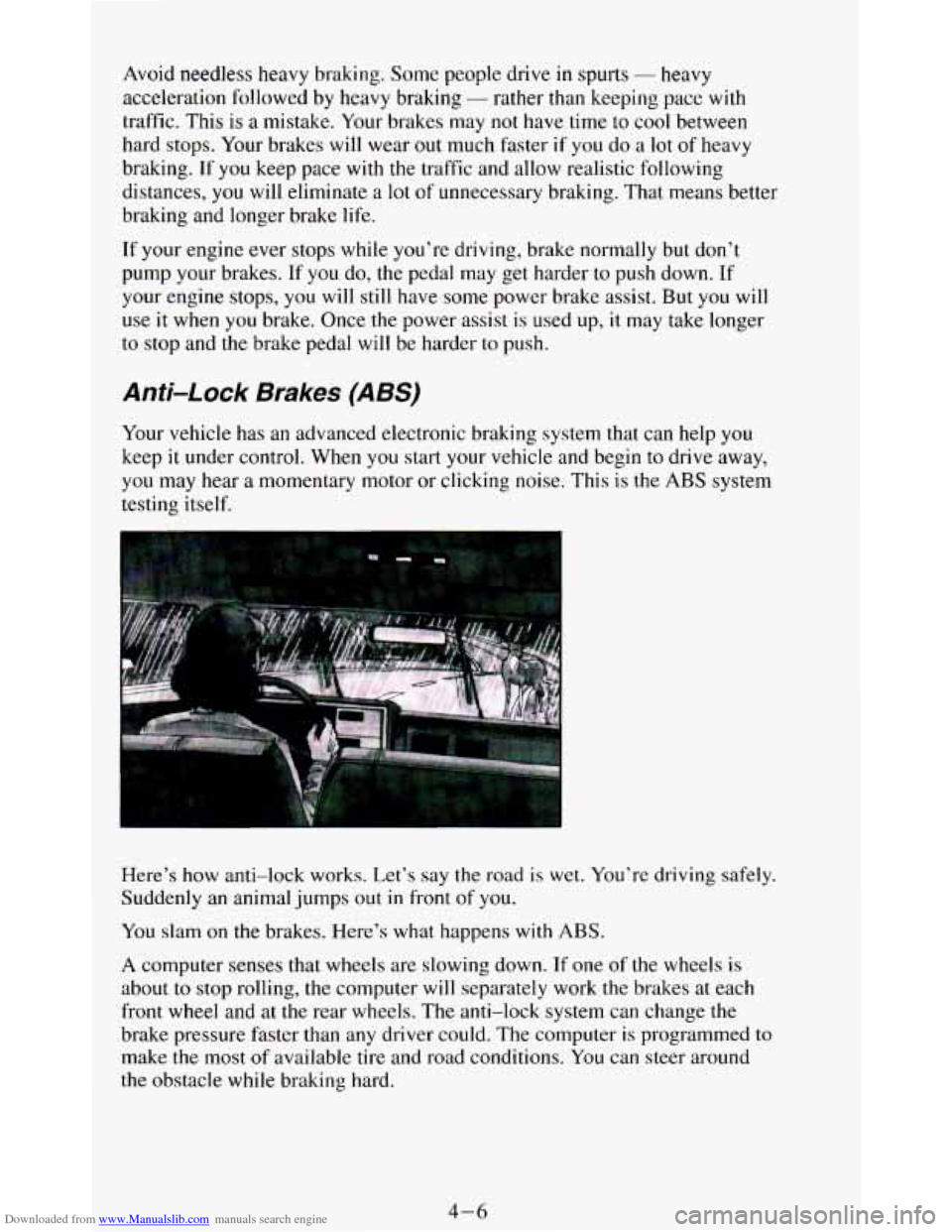
Here’s how anti-lock works. Let’s say the road is wet. You’re driving safely.
Suddenly
an animal jumps out in front of you.
You slam
on the brakes. Here’s what happens with ABS.
A computer senses that wheels are slowing down. If one of the wheels is
about to stop rolling, the computer will separately work the brakes at each
front wheel and at the rear wheels. The anti-lock system can change the
brake pressure faster than any driver could. The computer
is programmed to
make the most of available tire and road conditions. You can steer around
the obstacle while braking hard.
4-6
Page 165 of 348
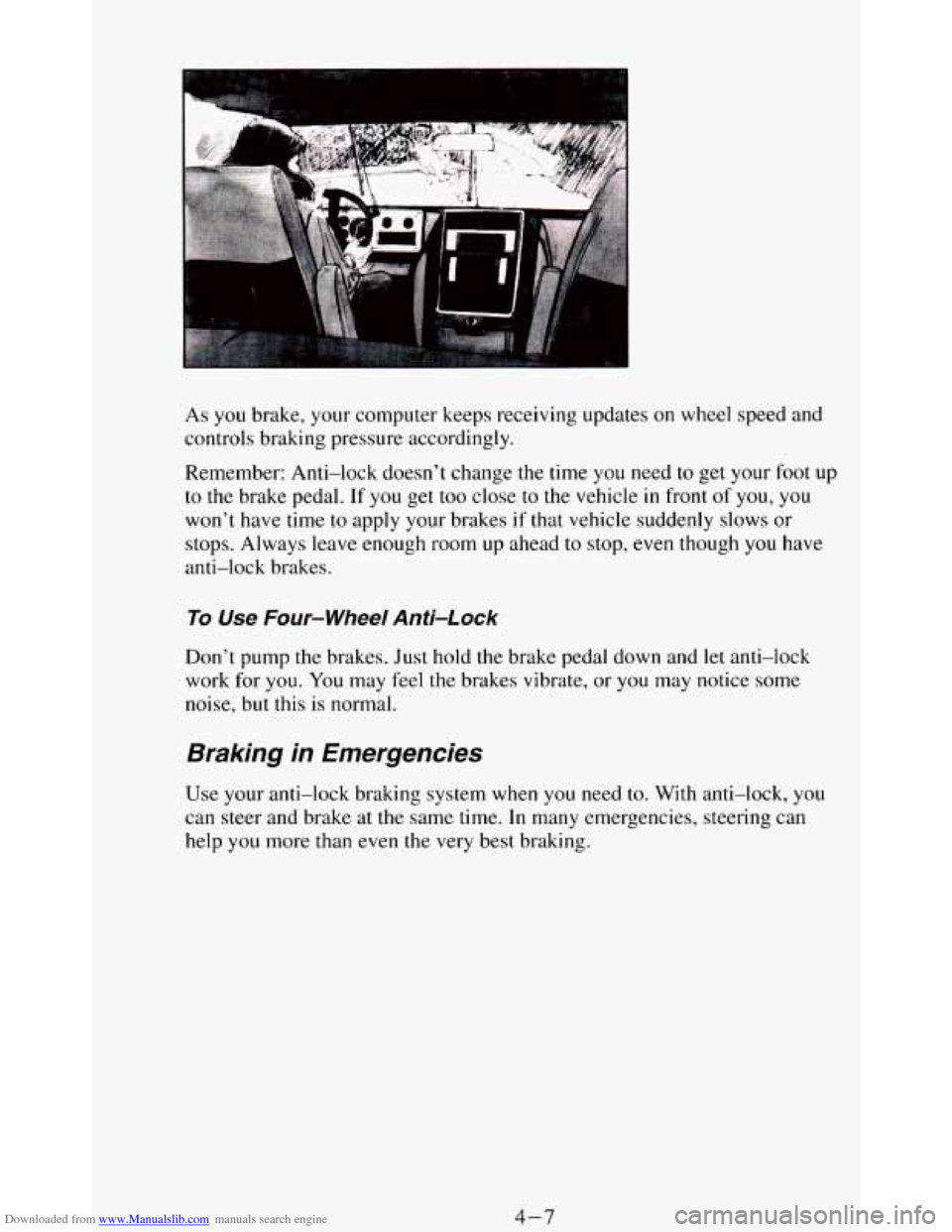
Downloaded from www.Manualslib.com manuals search engine As you brake, your computer keeps receiving updates on wheel speed and
controls braking pressure accordingly.
Remember: Anti-lock doesn’t change the time
you need to get your foot up
to the brake pedal. If you get too close to the vehicle
in front of you, you
won’t have time to apply your brakes
if that vehicle suddenly slows or
stops. Always leave enough room up ahead
to stop, even though you have
anti-lock brakes.
To Use Four-wheel Anti-Lock
Don’t pump the brakes. Just hold the brake pedal down and let anti-lock
work for
you. You may feel the brakes vibrate, or you may notice some
noise, but this is normal.
Braking in Emergencies
Use your anti-lock braking system when you need to. With anti-lock, you
can steer and brake at
the same time. In many emergencies, steering can
help you more than even the very best braking.
4-7
Page 166 of 348
Downloaded from www.Manualslib.com manuals search engine Power Steering
If you lose power steering assist because the engine stops or the system is
not functioning, you can steer but it will take much more effort.
Steering Tips
Driving on Curves
It’s important to take curves at a reasonable speed.
A lot
of the “driver lost control” accidents mentioned on the news happen
on curves. Here’s why:
Experienced driver or beginner, each
of us is subject to the same laws of
physics when driving on curves. The traction of the tires against the road
surface makes it possible for the vehicle to change its path when you turn
the front wheels. If there’s
no traction, inertia will keep the vehicle going in
the same direction. If you’ve ever tried to steer
a vehicle on wet ice, you’ll
understand this.
The traction you can get in a curve depends on the condition of your tires
and the road surface, the angle at which the curve
is banked, and your
speed. While you’re
in a curve, speed is the one factor you can control.
Suppose you’re steering through a sharp curve. Then
you suddenly
accelerate. Both control systems
- steering and acceleration - have to do
their work where the tires meet the road. Adding the sudden acceleration
can demand too much
of those places. You can lose control,
What should you do
if this ever happens? Ease up on the accelerator pedal,
steer
the vehicle the way you want it to go, and slow down.
Speed limit signs near curves warn that
you should adjust your speed. Of
course, the posted speeds are based
on good weather and road conditions.
Under less favorable conditions you’ll want
to go slower.
If you need to reduce your speed as you approach a curve, do it before you
enter the curve, while your front wheels are straight ahead.
Try
to adjust your speed so you can “drive” through the curve. Maintain a
reasonable, steady speed. Wait to accelerate until you are out of the curve,
and then accelerate gently into
the straightaway.
4-8
Page 170 of 348
Downloaded from www.Manualslib.com manuals search engine Skidding
In a skid, a driver can lose control of the vehicle. Defensive drivers avoid
most skids by taking reasonable care suited to existing conditions, and
by
not “overdriving” those conditions. But skids are always possible.
The three types of skids correspond
to your Vehicle’s three control systems.
In the braking skid your wheels aren’t rolling.
In the steering or cornering
skid, too much speed or steering
in a curve causes tires to slip and lose
cornering force. And in the acceleration skid too much throttle causes the
driving wheels
to spin.
A cornering skid and an acceleration skid are best handled by easing your
foot off the accelerator pedal.
If your vehicle starts to slide, ease your foot off the accelerator pedal and
quickly steer the way you want
the vehicle to go. If you start steering
quickly enough, your vehicle may straighten out. Always be ready for a
second skid
if it occurs.
Of course, traction is reduced when water, snow, ice, gravel, or other material
is on the road. For safety, you’ll want to slow down and adjust your driving to
these conditions. It is important to slow down on slippery surfaces because
stopping distance will be longer and vehicle control more limited.
While driving on a surface
with reduced traction, try your best to avoid
sudden steering, acceleration, or braking (including engine braking by
shifting to a lower gear). Any sudden changes could cause the tires to slide.
You may not realize the surface is slippery until your vehicle is skidding.
Learn to recognize warning clues
- such as enough water, ice or packed
snow on the road to make a “mirrored surface” - and slow down when you
have any doubt.
Remember: Any anti-lock braking system (ABS) helps avoid only the
braking skid.
Driving Guidelines
This multipurpose passenger vehicle is defined as a utility vehicle in
Consumer Information Regulations issued by the National Highway Traffic
Safety Administration (NHTSA) of the United States Department of
Transportation. Utility vehicles have higher ground clearance and a narrower
track to make them capable of performing
in a wide variety of off-road
applications. Specific design characteristics give them a higher center of
gravity than ordinary cars.
An advantage of the higher ground clearance is a
better view of the road allowing you to anticipate problems. They are not
designed for cornering at the same speeds as conventional 2-wheel drive
vehicles any more than low-slung sports cars are designed to perform
satisfactorily under off-road conditions. If at
all possible, avoid sharp turns or
abrupt maneuvers.
As with other vehicles of this type, failure to operate this
vehicle correctly may result
in loss of control or vehicle rollover.
4-12
Page 173 of 348
Downloaded from www.Manualslib.com manuals search engine Controlling your vehicle is the key to successful off-road driving. One of
the best ways to control your vehicle is
to control your speed. Here are some
things to keep
in mind. At higher speeds:
you approach things faster and you have less time to scan the terrain for
obstacles.
you have less time to react.
0 you have more vehicle bounce when you drive over obstacles.
0 you’ll need more distance for braking, especially since you’re on an
unpaved surface.
Scanning the Terrain
Off-road driving can take you over many different kinds of terrain. You
need to be familiar with
the terrain and its many different features. Here are
some things
to consider.
Surface Conditions. Off-roading can take you over hard-packed dirt,
gravel, rocks, grass, sand, mud, snow or ice. Each of these surfaces affects
the steering, acceleration, and braking of your vehicle in different ways.
Depending upon the kind of surface
you are on, you may experience
slipping, sliding, wheel spinning, delayed acceleration, poor traction, and
longer braking distances.
Surface Obstacles. Unseen or hidden obstacles can be hazardous. A rock,
log, hole, rut, or bump can startle you
if you’re not prepared for them. Often
these obstacles are hidden by grass, bushes, snow or even the rise and fall
of
the terrain itself. Here are some things to consider:
Is the path ahead clear?
0 Will the surface texture change abruptly up ahead?
0 Does the travel take you uphill or downhill? (There’s more discussion
of these subjects later.)
0 Will you have to stop suddenly or change direction quickly?
When you drive over obstacles or rough terrain, keep a firm grip on the
steering wheel. Ruts, troughs, or
other surface features can jerk the wheel
out of your hands
if you’re not prepared.
4-15