1994 CHEVROLET BLAZER change wheel
[x] Cancel search: change wheelPage 174 of 348
Downloaded from www.Manualslib.com manuals search engine When you drive over bumps, rocks, or other obstacles, your wheels can
leave the ground.
If this happens, even with one or two wheels, you can’t
control the vehicle as well or at all.
Because you
will be on an unpaved surface, it’s especially important to
avoid sudden acceleration, sudden turns, or sudden braking.
In a way, off-road driving requires a different kind
of alertness from driving
on paved roads and highways. There are no road signs, posted speed limits
or signal lights. You have to use your own good judgment about what is safe
and what isn’t.
Drinking and driving can be very dangerous on any road. And this is
certainly true for off-road driving. At the very
time you need special
alertness and driving skills, your reflexes, perceptions and judgment
can be
affected by even a small amount of alcohol. You could have a serious
- or
even fatal - accident if you drink and drive or ride with a driver who has
been drinking. (See “Drunken Driving”
in the Index.)
Driving On Ofl-Road Hills
Off-road driving often takes you up, down, or across a hill. Driving safely
on hills requires good judgment and an understanding of what your vehicle
can and can’t do. There are some hills that simply can’t be driven, no matter
how well built the vehicle.
1
Approaching a Hill
When you approach a hill, you need to decide if it’s one of those hills that’s
just
too steep to climb, descend, or cross. Steepness can be hard to judge.
On a very small hill, for example, there may be a smooth, constant incline
with only a small change
in elevation where you can easily see all the way
to the top.
On a large hill, the incline may get steeper as you near the top,
but
you may not see this because the crest of the hill is hidden by bushes,
grass, or shrubs.
4-16
Page 180 of 348
Downloaded from www.Manualslib.com manuals search engine Stalling on an lncline
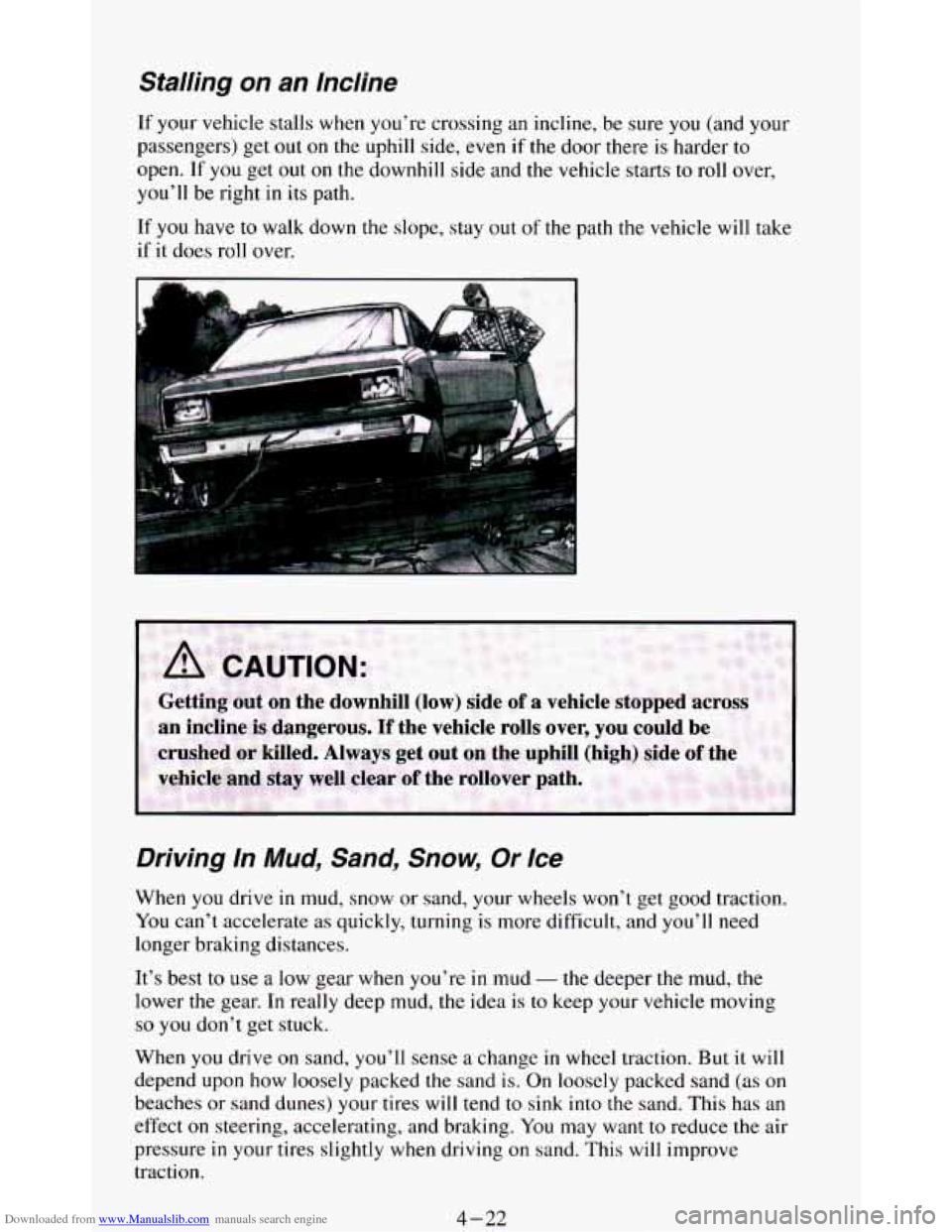
If your vehicle stalls when you’re crossing an incline, be sure you (and your
passengers) get
out on the uphill side, even if the door there is harder to
open. If
you get out on the downhill side and the vehicle starts to roll over,
you’ll be right in its path.
If
you have to walk down the slope, stay out of the path the vehicle will take
if it does roll over.
Driving In Mud, Sand, Snow, Or lce
When you drive in mud, snow or sand, your wheels won’t get good traction.
You can’t accelerate as quickly, turning is more difficult, and you’ll need
longer braking distances.
It’s best
to use a low gear when you’re in mud - the deeper the mud, the
lower
the gear. In really deep mud, the idea is to keep your vehicle moving
so you don’t get stuck.
When
you drive on sand, you’ll sense a change in wheel traction. But it will
depend upon how loosely packed
the sand is. On loosely packed sand (as on
beaches or sand dunes) your tires will tend to sink into the sand. This has an
effect
on steering, accelerating, and braking. You may want to reduce the air
pressure in your tires slightly when driving on sand. This
will improve
traction.
4-22
Page 200 of 348
Downloaded from www.Manualslib.com manuals search engine Making Turns
When you’re turning with a trailer, make wider turns than normal. Do this
so your trailer won’t strike soft shoulders, curbs, road signs, trees, or other
objects. Avoid jerky or sudden maneuvers. Signal well
in advance.
Turn Signals When Towing a Trailer
When you tow a trailer, your vehicle has to have a different turn signal
flasher and extra wiring. The green arrows
on your instrument panel will
flash whenever you signal a turn or lane change. Properly hooked up, the
trailer lights will also flash, telling other drivers you’re about to turn,
change lanes or stop.
When towing a trailer, the green arrows
on your instrument panel will flash
for turns
even if the bulbs on the trailer are burned out. Thus, you may think
drivers behind you are seeing your signal when
they are not. It’s important
to check occasionally to be sure the trailer bulbs are still working.
Driving On Grades
Reduce speed and shift to a lower gear before you start down a long or
steep downgrade. If you don’t
shift down, you might have to use your
brakes
so much that they would get hot and no longer work well.
On a long uphill grade, shift down and reduce your speed
to around 45 mph
(70 kdh) to reduce the possibility of engine and transmission overheating.
If you have an automatic transmission,
you should use “D” when towing a
trailer. Operating your vehicle in “D” when towing a trailer will minimize
heat buildup and extend the
life of your transmission. Or, if you have a
manual transmission with
fifth gear, it’s better not to use fifth gear, just
drive in fourth gear (or, as
you need to, a lower gear).
Parking on Hills
You really should not park your vehicle, with a trailer attached, on a hill. If
something goes wrong, your rig could start to move. People can be injured,
and both your vehicle and the trailer can be damaged.
But if you ever have
to park your rig on a hill, here’s how to do it:
1. Apply your regular brakes, but don’t shift into “P” (Park) yet, or into
gear for a manual transmission.
2. Have someone place chocks under the trailer wheels.
3. When the wheel chocks are in place, release the regular brakes until the
chocks absorb
the load.
4-42
Page 209 of 348
Downloaded from www.Manualslib.com manuals search engine Towing Your Vehicle
Try to have a GM dealer or a professional towing service tow your vehicle.
They can provide the right equipment and know how to tow it without
damage.
If your vehicle has been changed since
it was factory-new by adding things
like fog lamps, aero skirting, or special tires and wheels, these things could
be damaged during towing.
Before you do anything, turn on the hazard warning flashers.
When you call, tell the towing service:
0 That your vehicle has rear-wheel drive, or that it has the four-wheel
drive option.
The make, model, and year of your vehicle.
0 Whether you can move the shift lever for the transmission and shift the
transfer case,
if you have one.
0 If there was an accident, what was damaged.
5-7
Page 220 of 348
Downloaded from www.Manualslib.com manuals search engine Engine Fan Noise
This vehicle has a clutched engine cooling fan. When the clutch is engaged,
the fan spins faster to provide more air
to cool the engine. In most every day
driving conditions the clutch is
not engaged. This improves fuel economy
and reduces fan noise. Under heavy vehicle loading, trailer towing and/or
high outside temperatures, the fan speed increases when the clutch engages.
So you may hear an increase in fan noise. This is normal and should not be
mistaken as
the transmission slipping or making extra shifts. It is merely the
cooling system functioning properly. The fan will slow down when
additional cooling
is not required and the clutch disengages.
You may also hear this fan noise when you start the engine. It will go away
as the fan clutch disengages.
If a Tire Goes Flat
It’s unusual for a tire to “blow out” while you’re driving, especially if you
maintain your tires properly. If air goes out of a tire, it’s much more likely
to
leak out slowly. But if you should ever have a “blowout,” here are a few tips
about what to expect and what
to do:
If a front tire fails,
the flat tire will create a drag that pulls the vehicle
toward
that side. Take your foot off the accelerator pedal and grip the
steering wheel firmly. Steer to maintain lane position, then gently brake to a
stop well
out of the traffic lane.
A rear blowout, particularly on a curve, acts much like a skid and may
require the same correction you’d
use in a skid. In any rear blowout, remove
your foot from the accelerator pedal. Get the vehicle under control
by
steering the way you want the vehicle to go. It may be very bumpy and
noisy, but
you can still steer. Gently brake to a stop, well off the road if
possible.
If a tire goes flat, the next section shows how to use your jacking equipment
to change a flat tire safely.
5-18
Page 221 of 348
Downloaded from www.Manualslib.com manuals search engine Changing a Flat Tire
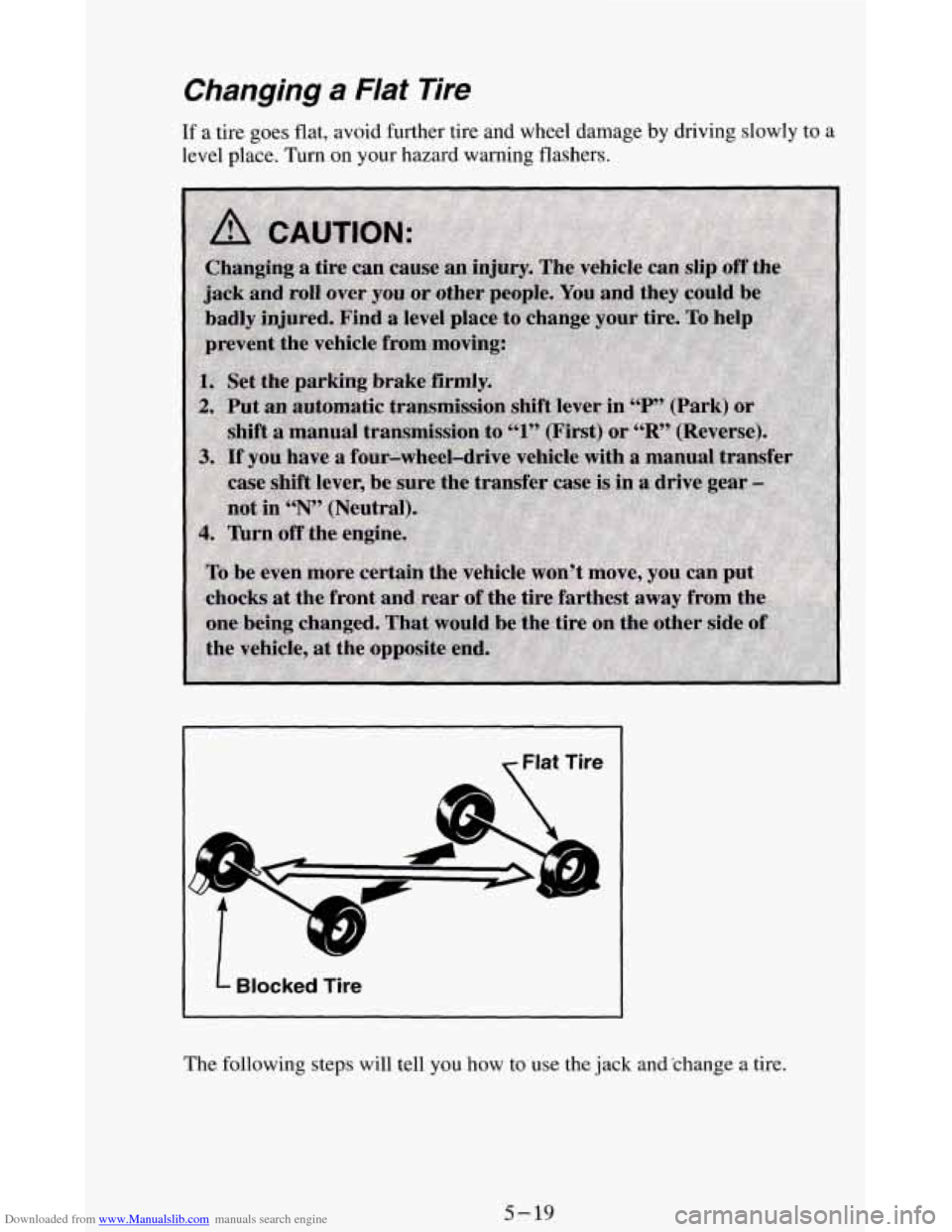
If a tire goes flat, avoid further tire and wheel damage by driving slowly to a
level place. Turn on your hazard warning flashers.
T
L Blocked Tire
The following steps will tell you how to use the jack and change a tire.
5-19
Page 228 of 348
Downloaded from www.Manualslib.com manuals search engine e
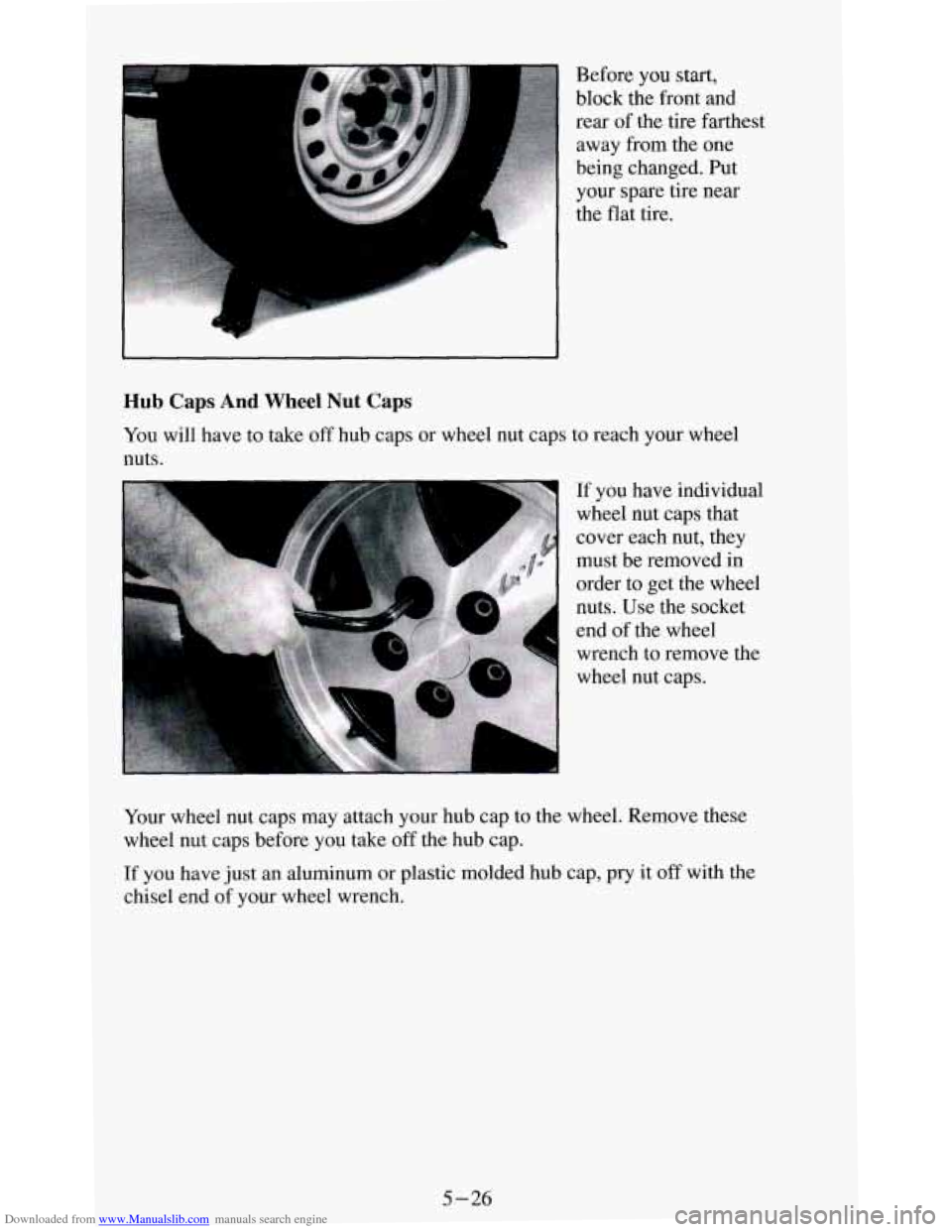
Before you start,
block the front and
rear of the tire farthest
away from the one
being changed. Put
your spare tire near
the flat tire.
Hub Caps And Wheel Nut Caps
You will have to take off hub caps or wheel nut caps to reach your wheel
nuts.
I --
If you have individual
wheel nut caps that
cover each nut, they
must be removed in
order to get the wheel
nuts. Use the socket
end
of the wheel
wrench to remove the
wheel nut caps.
Your wheel nut caps may attach your hub cap to the wheel. Remove these
wheel nut caps before you take
off the hub cap.
If you have just an aluminum or plastic molded hub cap, pry it off with the
chisel end of your wheel wrench.
5-26
Page 249 of 348
Downloaded from www.Manualslib.com manuals search engine When to Change Engine Oil
See if any one of these is true for you:
Most trips are less than 4 miles (6 km).
It’s below freezing outside and most trips are less than 10 miles (I 6 km).
0 The engine is at low speed most of the time (as in door-to-door
delivery, or
in stop-and-go traffic).
You tow a trailer often.
0 Most trips are through dusty places.
0 The vehicle is frequently operated off-road.
If any one of these is true for your vehicle, then you need to change your oil
andfilter every 3,000 miles (5 000 km) or 3 months - whichever comes
first.
If none
of them is true, change the oil every 7,500 miles (12 500 km) or
12 months - whichever comes first. Change the filter at the first oil change
and at every other oil change after that.
Four-wheel Drive Remote Oil Filter
If your vehicle has four-wheel drive, you will have a remote oil filter
located under the hood. It is mounted to the front left inner fender, behind
the headlights.
Engine Coolant Heater (Engine Block Heater)
An engine coolant heater can be a big help if you have to park outside in
very cold weather, 0°F (-18°C) or colder. If your vehicle has this option,
see “Engine Coolant Heater
” in the Index.
What to Do with Used Oil
Did you know that used engine oil contains certain elements that may be
unhealthy for your skin and could even cause cancer? Don’t let used oil stay
on your skin for very long. Clean your skin
and nails with soap and water,
or
a good hand cleaner. Wash or properly throw away clothing or rags
containing used engine oil. (See
the manufacturer’s warnings about the use
and disposal of oil products.)
Used oil can be
a real threat to the environment. If you change your own oil,
be sure to drain all free-flowing oil from
the filter before disposal. Don’t
ever dispose of oil
by putting it in the trash, pouring it on the ground, into
sewers, or into streams or bodies of water. Instead, recycle
it by taking it to
a place that collects used oil. If you have a problem properly disposing of
your used oil, ask your dealer,
a service station or a local recycling center
for help.
6-13