Page 69 of 348
Downloaded from www.Manualslib.com manuals search engine New Vehicle “Break-In ’’
L
NOTICE:
Your modern vehicle doesn’t need an elaborate “break-in.” But
it will perform better in the long run if you follow these
guidelines:
0 Keep your speed at 55 mph (88 km/h) or less for the first 500
miles (SO4 km).
0 Don’t drive at any one speed - fast or slow - for the first
500 miles (804 km). Don’t make full-throttle starts.
Avoid making hard stops for the first 200 miles (322 km) or
so. During this time your new brake linings aren’t yet broken
in. Hard stops with new linings can mean premature wear and
earlier replacement. Follow this “breaking-in” guideline
every time you get new brake linings.
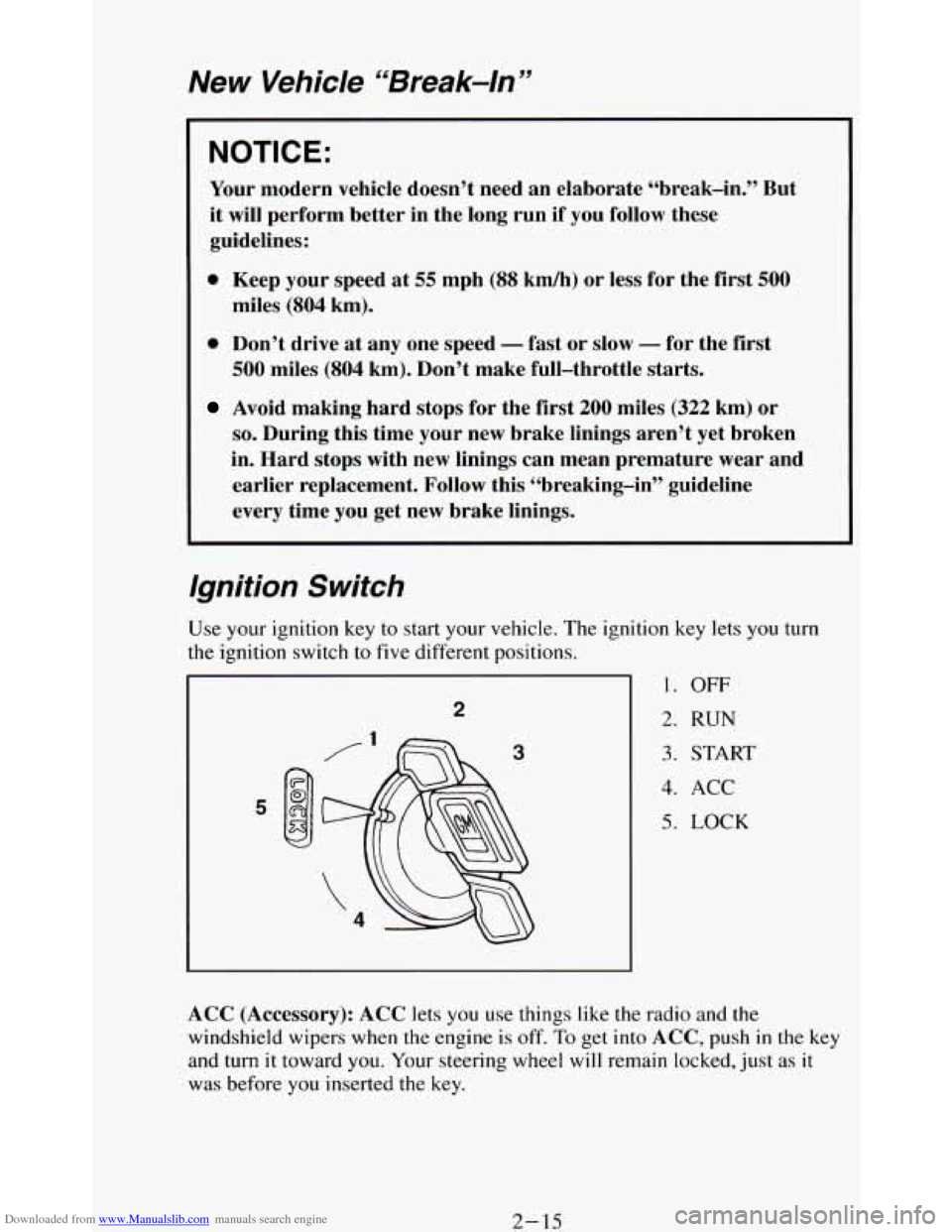
Ignition Switch
tion key lets you turn
1. OFF
2. RUN
3. START
4. ACC
5. LOCK
ACC (Accessory): ACC lets you use things like the radio and the
windshield wipers when the engine is off.
To get into ACC, push in the key
and turn
it toward you. Your steering wheel will remain locked, just as it
was before you inserted the key.
2- 15
Page 70 of 348
Downloaded from www.Manualslib.com manuals search engine NOTICE:
Prolonged operation of accessories in the ACC position could
drain your battery and prevent you from starting your vehicle.
LOCK: This position locks your ignition, steering wheel and transmission.
It’s a theft deterrent feature. You will only be able to remove your key when
the ignition is turned to LOCK.
OFF: This position lets you turn off the engine but still turn the steering
wheel. Use
OFF if you must have your vehicle in motion while the engine
is off (for example,
if your vehicle is being pushed).
RUN: This is the position for driving.
START This starts your engine.
NOTICE:
If your key seems stuck in “LOCK” and you can’t turn it, be
sure it is all the way in. If it is, then turn the steering wheel left
and right while you turn the key hard. But turn the key only
with your hand. Using
a tool to force it could break the key or
service.
the ignition switch. If none of this works, then your vehicle needs
2-16
Page 71 of 348
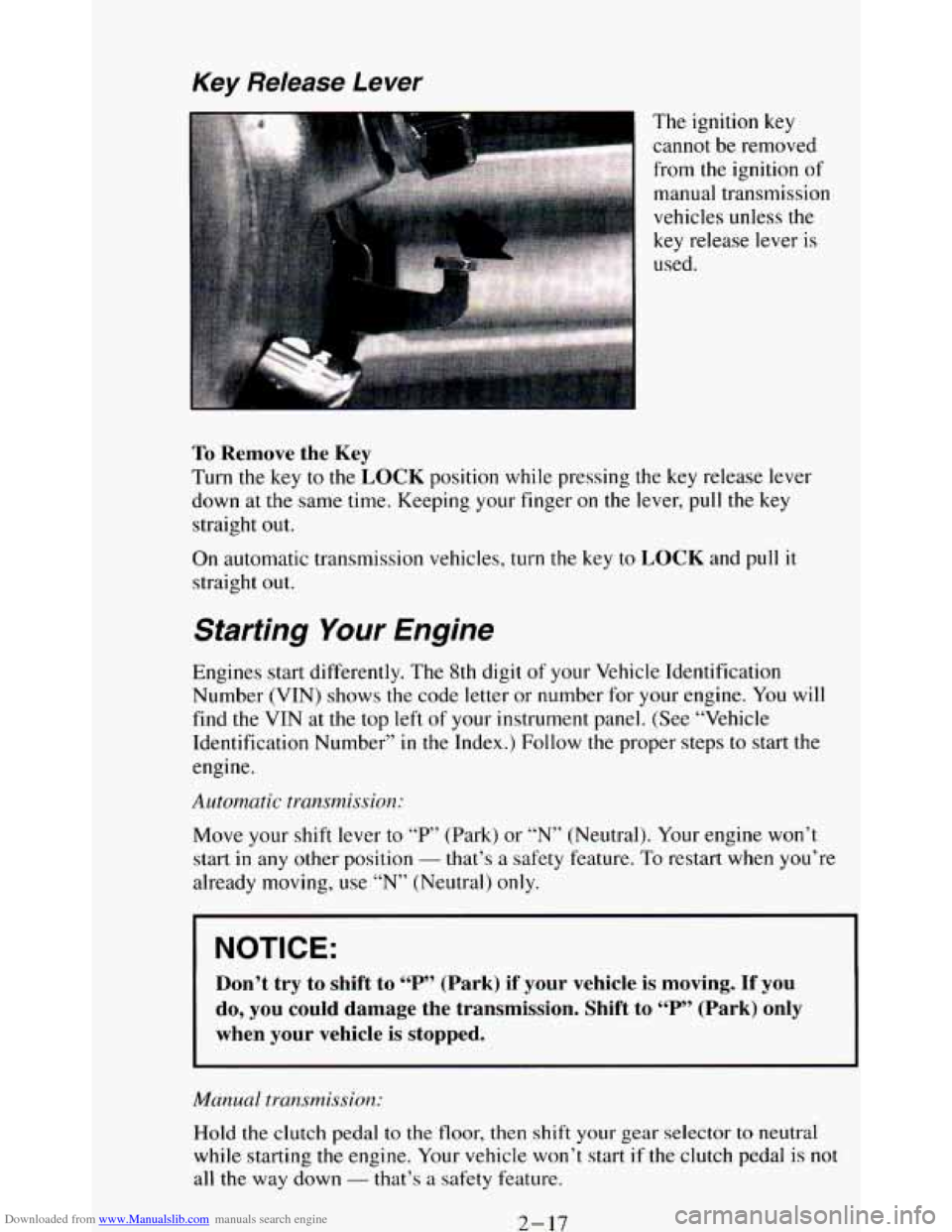
Downloaded from www.Manualslib.com manuals search engine Key Release Lever
I The ignition key
cannot be removed
from the ignition
of
manual transmission
vehicles unless the
key release lever
is
used.
To Remove the Key
Turn the key to the LOCK position while pressing the key release lever
down at the same time. Keeping your finger on the lever,
pull the key
straight
out.
On automatic transmission vehicles, turn the key to LOCK and pull it
straight out.
Starting Your Engine
Engines start differently. The 8th digit of your Vehicle Identification
Number (VIN) shows the code letter or number for your engine. You will
find the VIN at the top left of your instrument panel. (See “Vehicle
Identification Number” in the Index.) Follow the proper steps to start the
engine.
Automatic transmission:
Move your shift lever to “P” (Park) or “N” (Neutral). Your engine won’t
start
in any other position - that’s a safety feature. To restart when you’re
already moving, use “N” (Neutral)
only.
NOTICE:
Don’t try to shift to “P” (Park) if your vehicle is moving. If you
do, you could damage the transmission. Shift to “P” (Park) only
when your vehicle is stopped.
Manual transmission:
Hold the clutch pedal to the floor, then shift your gear selector to neutral
while starting
the engine. Your vehicle won’t start if the clutch pedal is not
all the way down - that’s a safety feature.
2-17
Page 73 of 348
Downloaded from www.Manualslib.com manuals search engine Driving Through Deep Standing Water
NOTICE:
If you drive too quickly through deep puddles or standing water,
water can come in through your engine's air intake and badly damage your engine.
If you can't avoid deep puddles or standing
water, drive through them very slowly.
Engine Coolant Heater (Engine Block Heater)
(Option)
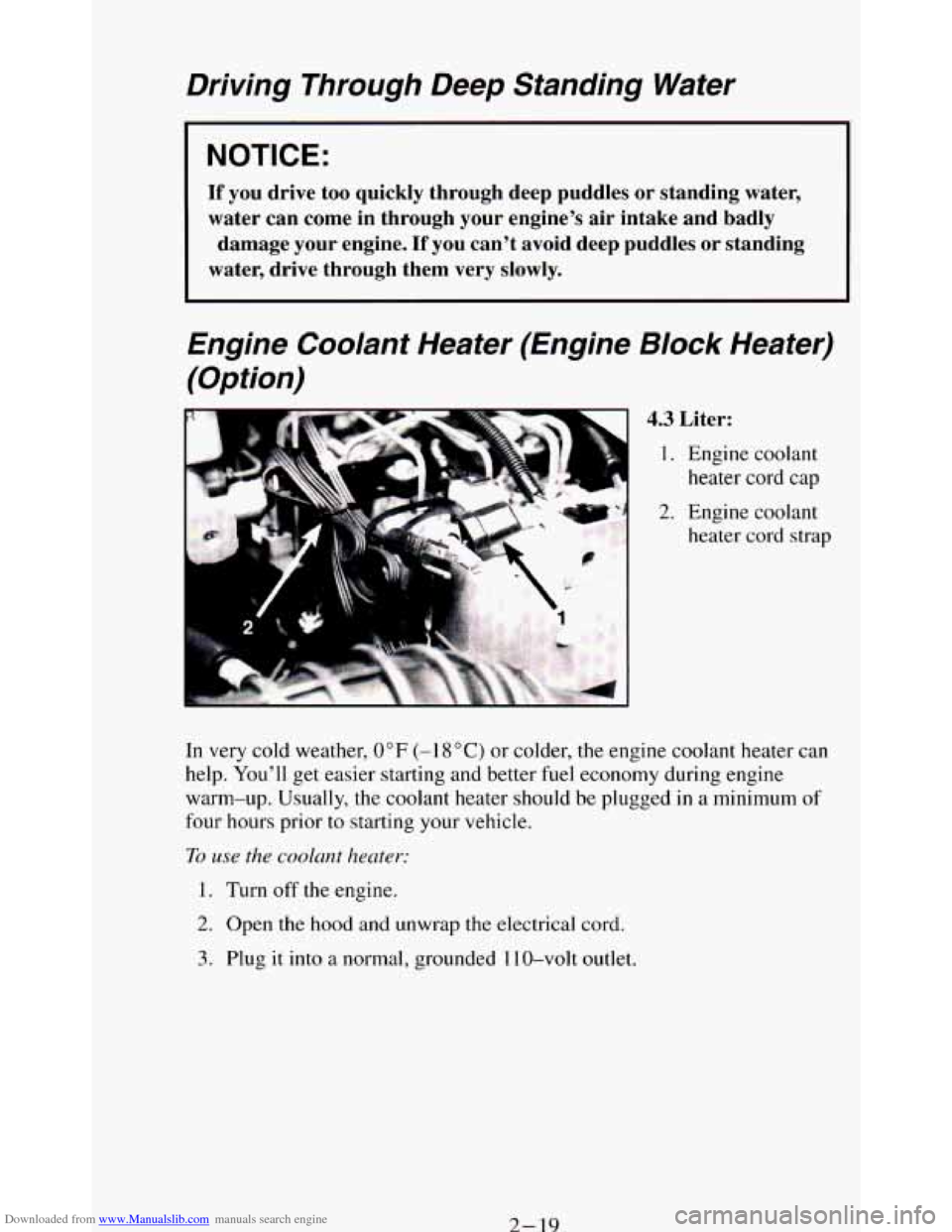
4.3 Liter:
I. Engine coolant
heater cord cap
2. Engine coolant
heater cord strap
In very cold weather,
0°F (- 18 "C) or colder, the engine coolant heater can
help. You'll get easier starting and better fuel economy during engine
warm-up. Usually, the coolant heater should be plugged in a minimum
of
four hours prior to starting your vehicle.
To use the coolunt heater:
1. Turn off the engine.
2. Open the hood and unwrap the electrical cord.
3. Plug it into a normal, grounded 1 10-volt outlet.
2-19
Page 74 of 348
Downloaded from www.Manualslib.com manuals search engine NOTICE:
After you’ve used the coolant heater, be sure to store the cord as
it was before to keep
it away from moving engine parts. If you
don’t,
it could be damaged.
How long should you keep the coolant heater plugged in? The answer
depends
on the weather, the kind of oil you have, and some other things.
Instead
of trying to list everything here, we ask that you contact a GM
dealer in the area where you’ll be parking your vehicle. The dealer can give
you the best advice for that particular area.
Automatic Transmission
.. . ...
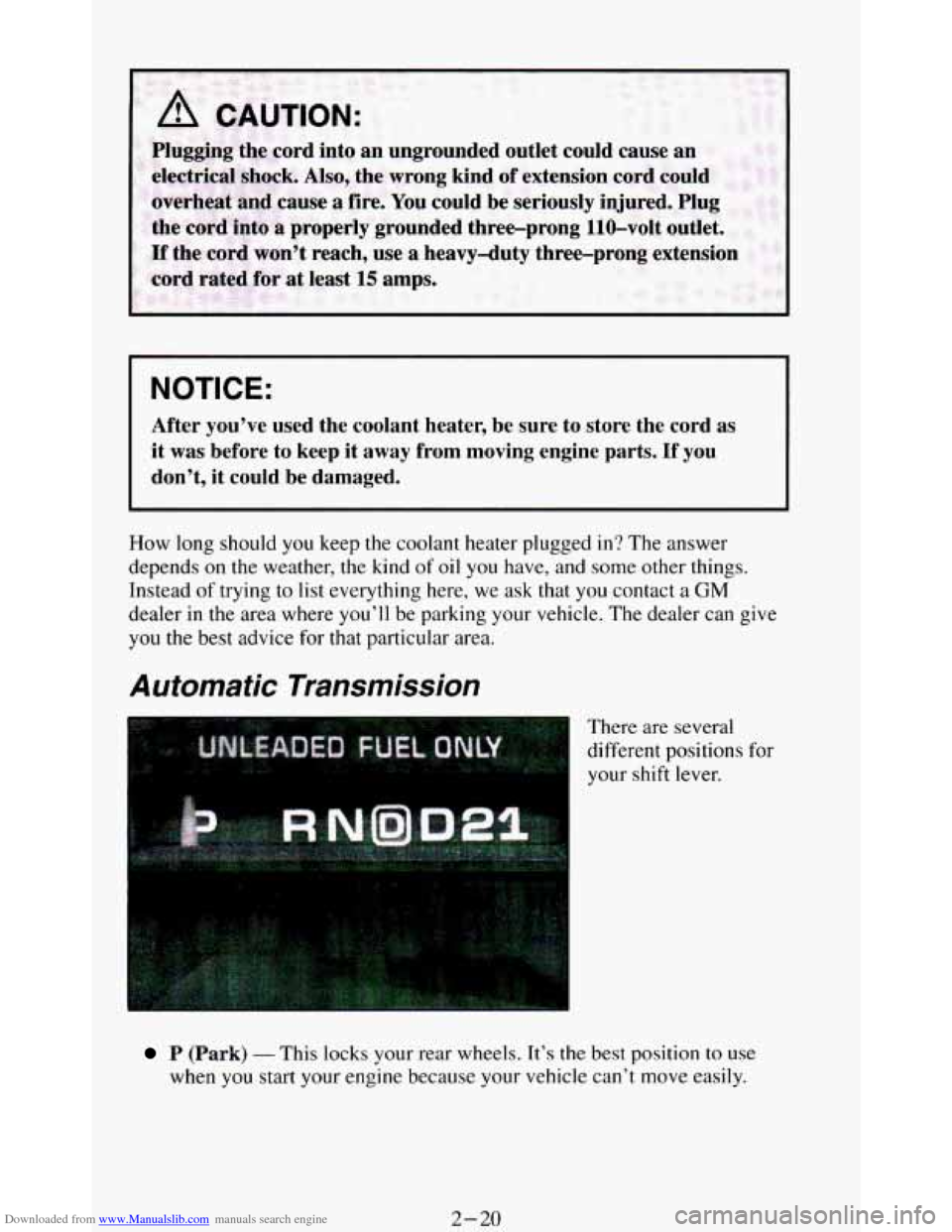
There are several
different positions for
your shift lever.
P (Park) - This locks your rear wheels. It’s the best position to use
when you start your engine because your vehicle can’t move easily.
2-20
Page 79 of 348
Downloaded from www.Manualslib.com manuals search engine Locking Rear Axle
If you have this feature, your rear axle can give you additional traction on
snow, mud, ice, sand or gravel. It works like a standard axle most of the
time, but when one of the rear wheels has no traction and the other does, the
locking feature will allow the wheel with traction
to move the vehicle.
Parking Brake
-
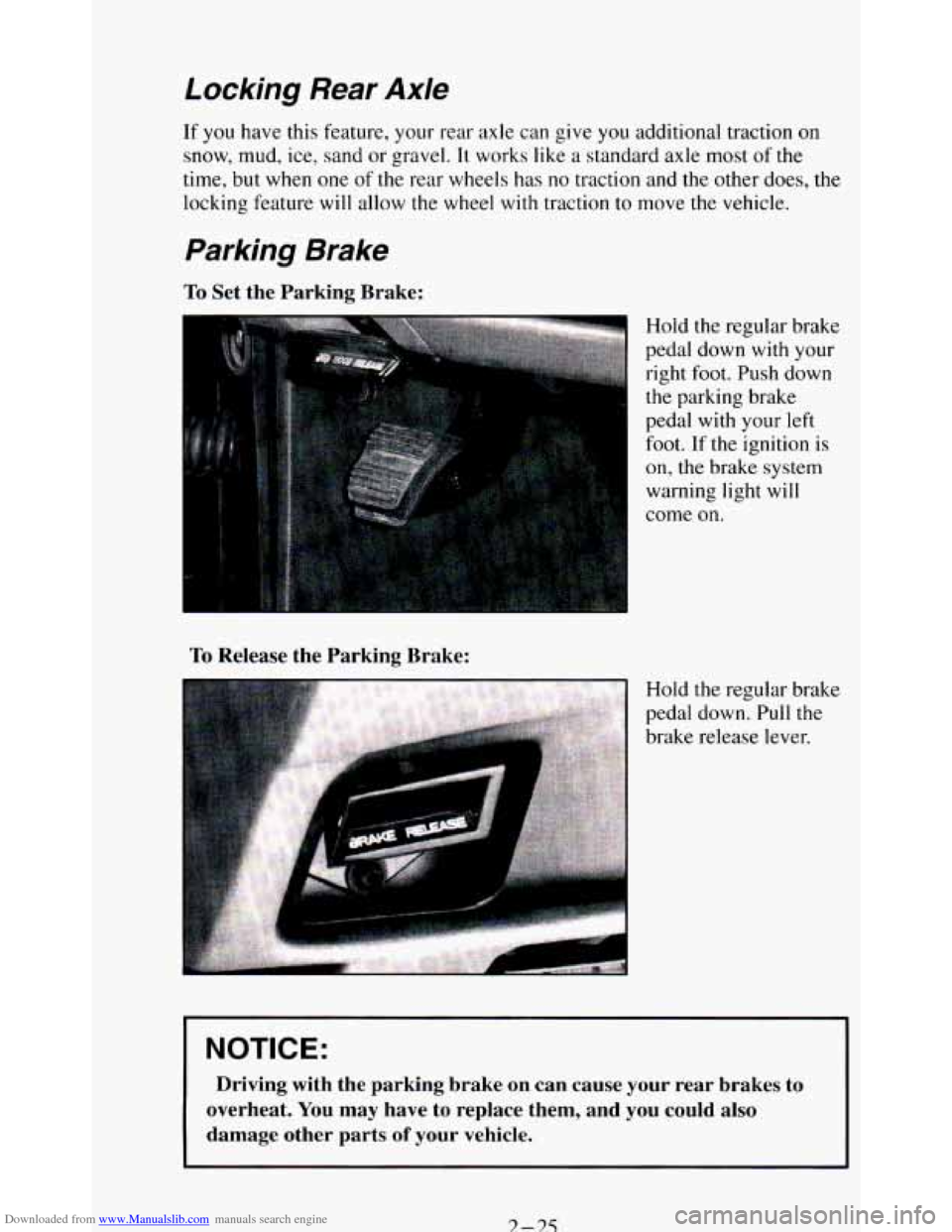
To Set the Parking Brake:
To Release the Parking Brake:
Hold the regular brake
pedal down
with your
right foot. Push down
the parking brake
pedal with your left
foot. If the ignition is
on, the brake system
warning light will
come
on.
Hold the regular brake
pedal down. Pull the
brake release lever.
I NOTICE: I
Driving with the parking brake on can cause your rear brakes to
overheat.
You may have to replace them, and you could also
damage other parts
of your vehicle.
3 -3.5
Page 81 of 348
Downloaded from www.Manualslib.com manuals search engine 3. If you have four-wheel drive with a manual transfer case shift lever, be
sure
the transfer case is in a drive gear - not in “N” (Neutral).
4. Move the ignition key to LOCK.
5. Remove the key and take it with you. If you can walk away from your
vehicle with the ignition
key in your hand, your vehicle is in “P”
(Park).
Leaving Your Vehicle With the Engine Running
(Automatic Transmission Models Only)
Torque Lock (Automatic Transmission)
If you are parking on a hill and you don’t shift your transmission into “P”
(Park) properly,
the weight of the vehicle may put too much force on the
parking pawl
in the transmission. You may find it difficult to pull the shift
lever
out of “P’ (Park). This is called “torque lock.” To prevent torque lock,
set the parking brake and then
shift into “P” (Park) properly before you
leave the driver’s seat. To find out how, see “Shifting Into ‘P’ (Park)” in the
Index.
When
you are ready to drive, move the shift lever out of “P” (Park)
BEFORE you release the parking brake.
If “torque
lock” does occur, you may need to have another vehicle push
yours a
little uphill to take some of the pressure from the transmission, so
you can pull the shift lever out of ‘Y’ (Park).
3 31
Page 88 of 348
Downloaded from www.Manualslib.com manuals search engine 3. 4 LO: This setting also engages your front axle to give you extra
traction. You may never need
4 LO. It sends the maximum power to all
four wheels.
You might choose 4 LO if you were driving off-road in
sand, mud, deep snow and climbing or descending steep hills.
Indicator lights
in the switch show you which setting you are in. Both
indicator lights will come on briefly when
you turn on the ignition. If both
lights do
not come on, you should take your vehicle in for service. The 4 HI
position has a green indicator light and the 4 LO position has an amber
indicator light. When shifting, an indicator light will flash
until the shift is
completed then remain solidly lit.
Two-wheel drive, (2 WHEEL), does not have a switch position or an
indicator light. Your vehicle will be
in two wheel drive if neither indicator
light is
on.
To shift from two-wheel drive, (2 WHEEL) to 4 HI: Press and release the
4 HI switch. This can be done at any speed, and the front axle will lock
automatically.
To shift from 4 HI to two-wheel drive (2 WHEEL): Press and release the
4 HI switch. This can be done at any speed, and the front axle will unlock
automatically.
To shift from two-wheel drive (2 WHEEL) to 4 LO: The vehicle must be
stopped or moving less than
3 mph (4.8 km/h) with the transmission in “N’
(Neutral) or the clutch pedal depressed. The preferred method for shifting
into
4 LO is to have your vehicle slowly moving one-to-two mph (1.6 to
3.2 kdh). Press and release the 4 LO switch. You must wait for the amber
4 LO indicator light to stop flashing and go solid amber before shifting your
transmission
into gear or releasing the clutch pedal.
If the
4 LO switch is pressed when your vehicle is in gear and/or moving,
the amber
4 LO indicator light will flash for 30 seconds and not complete
the shift unless your vehicle is below
3 mph (4.8 kdh) and the transmission
is in
“N” (Neutral) or the clutch pedal depressed.
On automatic transmission equipped vehicles: If your transfer case does not
shift into
4 LO, your transmission indicator switch may require adjustment.
With your transmission in
“N” (Neutral), press and release the 4 LO
switch. While the amber 4 LO indicator light is flashing, shift your
transmission into
P (Park).
2-34