Page 240 of 398
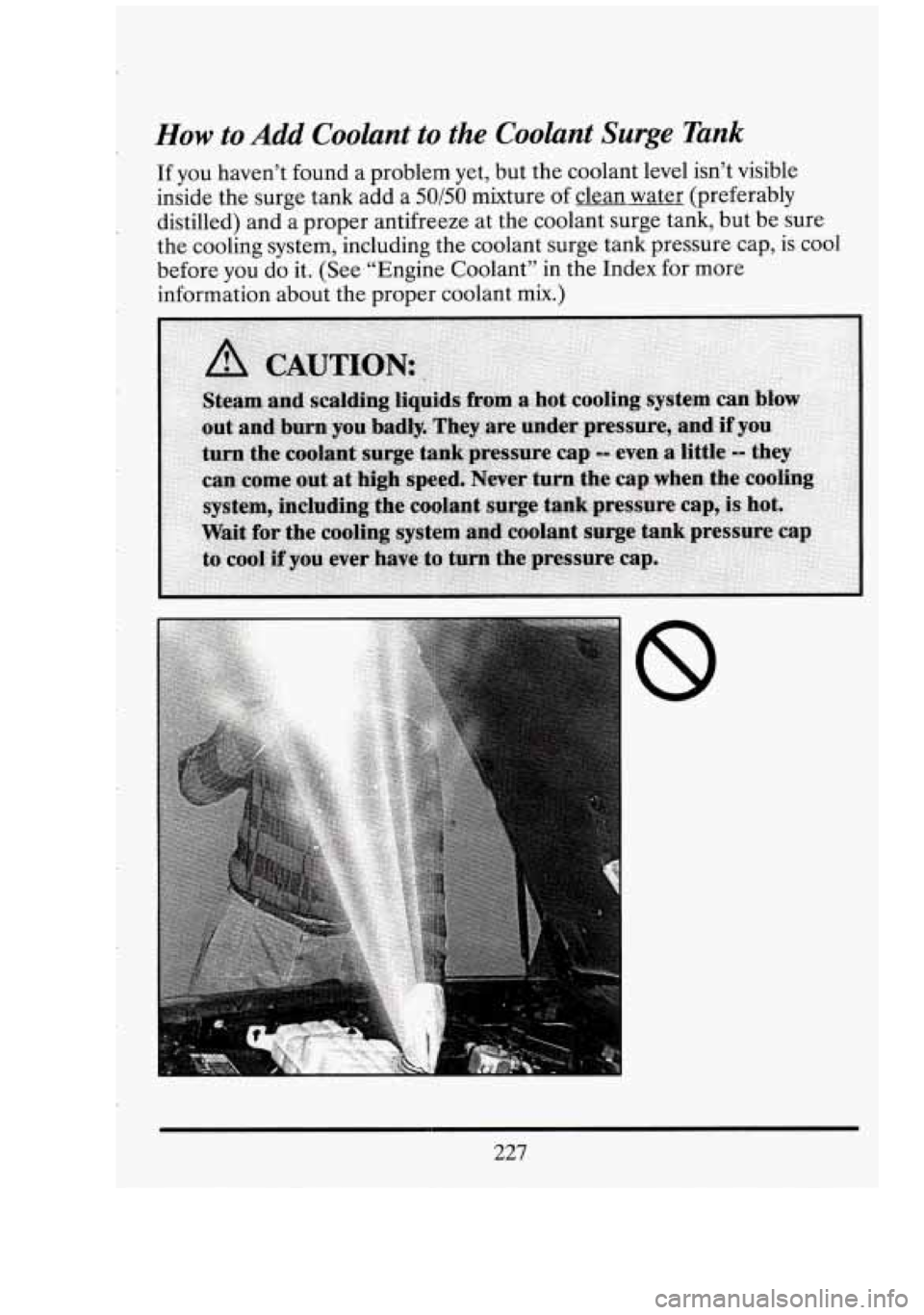
r_ How to Add Coolant to the Coolant Surge Tank
If you haven’t found a problem yet, but the coolant level isn’t visible
inside the surge tank add a
50/50 mixture of clean water (preferably
distilled) and a proper antifreeze at the coolant surge tank, but be sure
the cooling system, including the coolant surge tank pressure cap, is cool
before you do it. (See “Engine Coolant” in the Index for more
information about the proper coolant mix.)
227
Page 241 of 398
L
NOTICE:
In cold weather, water can freeze and crack the engine, radiator, \
heater core and other parts.
So use the recommended coolant.
3)
n'
-- I
228
Page 243 of 398
I
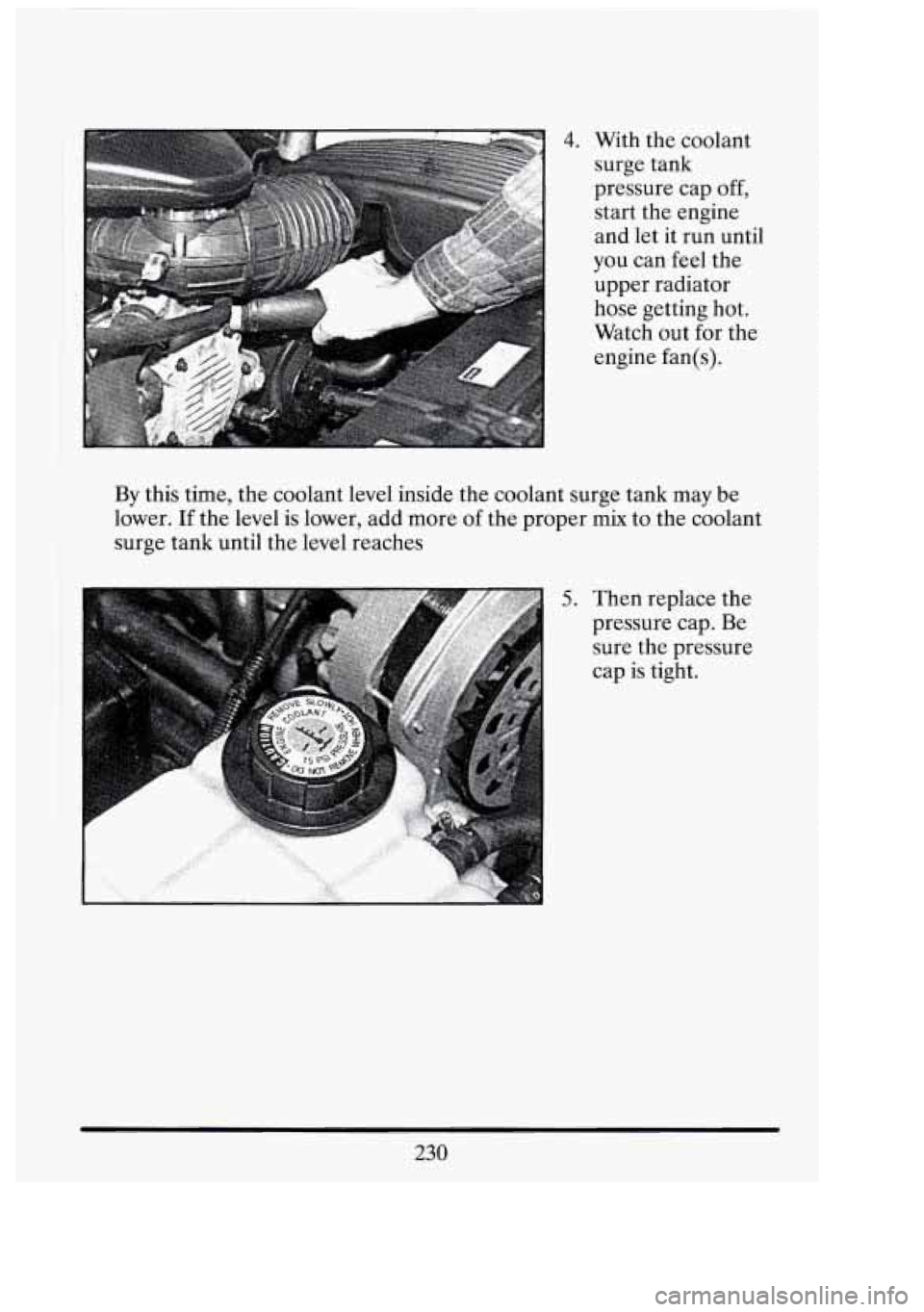
4. With the coolant
surge tank
pressure cap off,
start the engine
and let it run until
you can feel the
upper radiator
hose getting hot.
Watch out
for the
engine fan(
s).
By this time, the coolant level inside the coolant surge tank may be
lower.
If the level is lower, add more of the proper mix to the coolant
surge tank until the level reaches
5. Then replace the
pressure cap. Be
sure the pressure
cap is tight.
230
Ll
n
i$ ,
I
3;
I
Page 259 of 398
NOTICE:
If you try to do your own service work without knowing enough
about it, your vehicle could be damaged.
I
FUEL
Use regular unleaded gasoline rated at 87 octane or higher. It should
meet specifications
ASTM D4814 in the U.S. and CGSB 3.5-92 in
have to add anything to the fuel.
In the U.S. .and Canada, it’s easy to be sure you get the right kind of
gasoline. (unleaded). You’ll see “UNLEADED” right.
on the pump. And
Be sure the posted octane is at least
87. If the octane is less than 87, you
may get a heavy knocking noise when you drive. If it’s bad. enough, it can
damage your engine.
‘1 Canada. These fuels should have the proper additives, so you should not
I ’ only unleaded nozzles will fit into your vehicle’s filler neck.
i
If you’re using fuel rated at 87 octane or higher and you still hear heavy
knocking, your engine needs service. But don’t worry if you hear a little
pinging noise when you’re accelerating or driving up a. hill. That’s normal,
246
op
3’
-’ I
I n
Lll
“I
I -1
I
r7
Page 260 of 398
n and.you don’t have to buy a higher octane fuel to get rid of pinging. It’s
the heavy, constant knock that means you have a problem.
What about gasoline with blending materials that contain oxygen
(oxygenates), such
as MTBE or alcohol?
MTBE is “methyl tertiary-butyl ether.’’ Fuel that is no more than
15%
MTBE is fine for your vehicle.
Ethanol is ethyl or grain alcohol. Properly-blended fuel that is no more
than
10% ethanol is fine for your vehicle.
Methanol is methyl or wood alcohol.
NOTICE:
Fuel that is more than 5% methanol is bad for your.vehicle.
Don’t. use it. It can corrode metal parts in your fuel system and
also damage plastic and rubber.parts. That damage wouldn’t be
covered under your warranty. And even at
5% or less, there must
he “cosolvents” and corrosion preventers in this fuel to help
avoid these problems.
Gasolines for Cleaner Air
Your use of gasoline with deposit control additives will help prevent
deposits from forming in your engine and fuel system. That helps. keep
your engine in tune and your emission control system working properly.
It’s good for your vehicle, and you’ll be doing your part for cleaner air.
Many gasolines are now blended with oxygenates. General Motors
recommends that you use gasolines with these blending materials, such as
MTBE and ethanol. By doing
so, you can help clean the air, especially in
those parts
of the country that have high carbon monoxide levels.
~ In addition, some gasoline suppliers are now producing reformulated
gasolines. These gasolines are specially designed to reduce vehicle
emissions. General Motors recommends that you use reformulated
gasoline. By doing
so, you can help clean the air, especially in those parts
of the country that have high ozone levels.
247
Page 261 of 398

I
I
You should ask your service station operators if their gasolines contain
deposit control additives and oxygenates, and if they have been
reformulated to reduce vehicle emissions.
FUELS IN FOREIGN COUNTHES
If you plan on driving in another country outside the U.S. or Canada,
unleaded fuel may be hard to find. Do not use leaded gasoline. If you use
even one tankful, your emission controls won’t work well or at all. With
continuous use, spark plugs can get fouled, the exhaust system can
corrode, and your engine oil can deteriorate quickly. Your vehicle’s
oxygen sensor will be damaged. All
of that means costly repairs that
wouldn’t be covered by your warranty.
To check on fuel availability, ask an auto club, or contact a major oil
company that does business
in the country where you’ll be driving.
You can also write us at the following address for advice. Just tell us
where you’re going and give your Vehicle Identification Number (VIN).
General Motors Overseas Distribution Corporation,
North American Export Sales (NAES)
1908 Colonel Sam Drive
Oshawa, Ontario
LlH 8P7
FUEL ECONOMY
Your fuel economy (miles per gallon or liters per 100 kilometers) can vary
depending on how your Cadillac
is driven. Several vehicles like yours
have been driven through a standard test and their actual fuel economy
was recorded. These readings were adjusted and printed on the fuel
economy window sticker which was attached to your new Cadillac when
it
was delivered and in the Gas Mileage Guide which is available from your
dealership.
The fuel economy estimates are based on results of tests required by the
U. S. Environmental Protection Agency (EPA). These tests are used to
certify that vehicles meet the Federal emissions and fuel economy
standards. Cadillac tests prototypes of new vehicles and submits the
results to the EPA. The EPA then confirms the accuracy of the figures
provided by Cadillac. The vehicles are driven
by a professional driver
under controlled laboratory conditions, on an instrument similar to a
ni
I
I
o(
L
nl
248
Page 262 of 398
r
r
treadmill. These procedures ensure that each vehicle is tested under
identical conditions.
There are
two different fuel economy estimates for each vehicle, one Ior
city driving and one for highway driving.
To develop these two estimates,
separate tests are used to represent typical everyday city and rural
driving.
The test used to determine the city fuel economy estimate simulates a
7.5 mile (12 km), stop and go trip with an average speed of 20 mph
(32
km/h). The trip takes 23 minutes and has 18 stops. About one fifth
of the time is spent idling, as in waiting at traffic lights or in rush hour
traffic. Two kinds of engine starts are used: a cold start, which is similar to
starting a car in the morning after it has been parked all night and a hot
start, which is similar to restarting a vehicle after it has been warmed up,
driven and stopped for a short time.
The test used to determine the highway fuel economy estimate
represents a mixture of “non-city” driving. Segments corresponding to
different kinds
of rural roads and interstate highways are included. The
test simulates a 10 mile (17 km) trip with an average speed of 48 mph
(77 km/h). The test is run from a hot start and has little idling time and
no stops.
To assure that the fuel economy numbers are most useful for consumers,
the
EPA adjusts these laboratory test results to account for the difference
between controlled laboratory conditions and actual driving on the road.
The laboratory fuel economy results are adjusted downward
to arrive at
the estimates on the fuel economy window sticker and the Gas Mileage
Y Guide. The city estimate is lowered by 10 percent and the highwq
estimate
is lowered by 22 percent from the laboratory test results.
Experience has proven that these adjustments make the mileage
estimates correspond more closely to the actual fuel economy rea
by the average driver. lized
249
Page 263 of 398
Even though these figures are adjusted, they still represent what the
average driver will get. Your
fuel economy may be significantly higher or
lower, depending on how, when, and where your vehicle is driven. Here
are some things you can do to increase fuel economy;
Combine errands into one trip.
Turn the engine off rather than letting it idle for more than a minute.
Have your Cadillac serviced as described in the maintenance booklet.
Keep tires inflated to recommended pressures.
Anticipate traffic stops.
Here are some things that will lower fuel economy:
Quick acceleration.
Traveling at higher speeds. Traveling at 65 mph instead of 55 mph
Carrying unnecessary weight in the vehicle.
lowers fuel economy
by
15 percent.
Rewing the engine. This is not necessary for your vehicle.
Operating your vehicle with the suspension out of alignment or with
the wheels and tires out
of balance.
Use of electrical accessories which require high amperage when they
are not needed.
Even things beyond your control such as weather conditions affect your
fuel economy. Driving up steep hills, in rain or snow, and into a strong
wind will lower fuel economy. In the lower left corner of the fuel
economy window sticker from your vehicle is the range
of city and
highway fuel economy you can expect to get from your Cadillac. If you
are doing everything to raise your fuel economy, but are still not within
this range, your vehicle may need service. Collect as much information
about your fuel economy as you can find, (miles driven, gallon’s of fuel
used, etc.) and provide it your dealership for their review and assistance.
cl;
31
-1
ra
1-1
ra
250

n
-- I
228")