Page 208 of 398
0
0
0
0
Know how to go uphill. You may want to shift down to a lower gear.
The lower gears help cool your engine and transmission, and you can
climb the hill better.
Stay in your own lane when driving on two-lane roads in hills or
mountains. Don’t swing wide or cut across the center of the road.
Drive at speeds that let you stay in your own lane.
As you go over the top of a hill, be alert. There could be something in
your lane,
like a stalled car or an accident.
You may see highway signs on mountains that warn of special
problems. Examples are long grades, passing or no-passing zones, a
falling rocks area,
or winding roads. Be alert to these and take
appropriate action.
195
Page 209 of 398
.".ER DRZUNG ..
Here are some tips for winter driving:
Have your Cadillac in good shape for winter. Be sure your engine
You may want to put winter emergency supplies in your trunk.
coolant
mix
is correct.
Page 212 of 398
If You’re Caught in a Blizzard
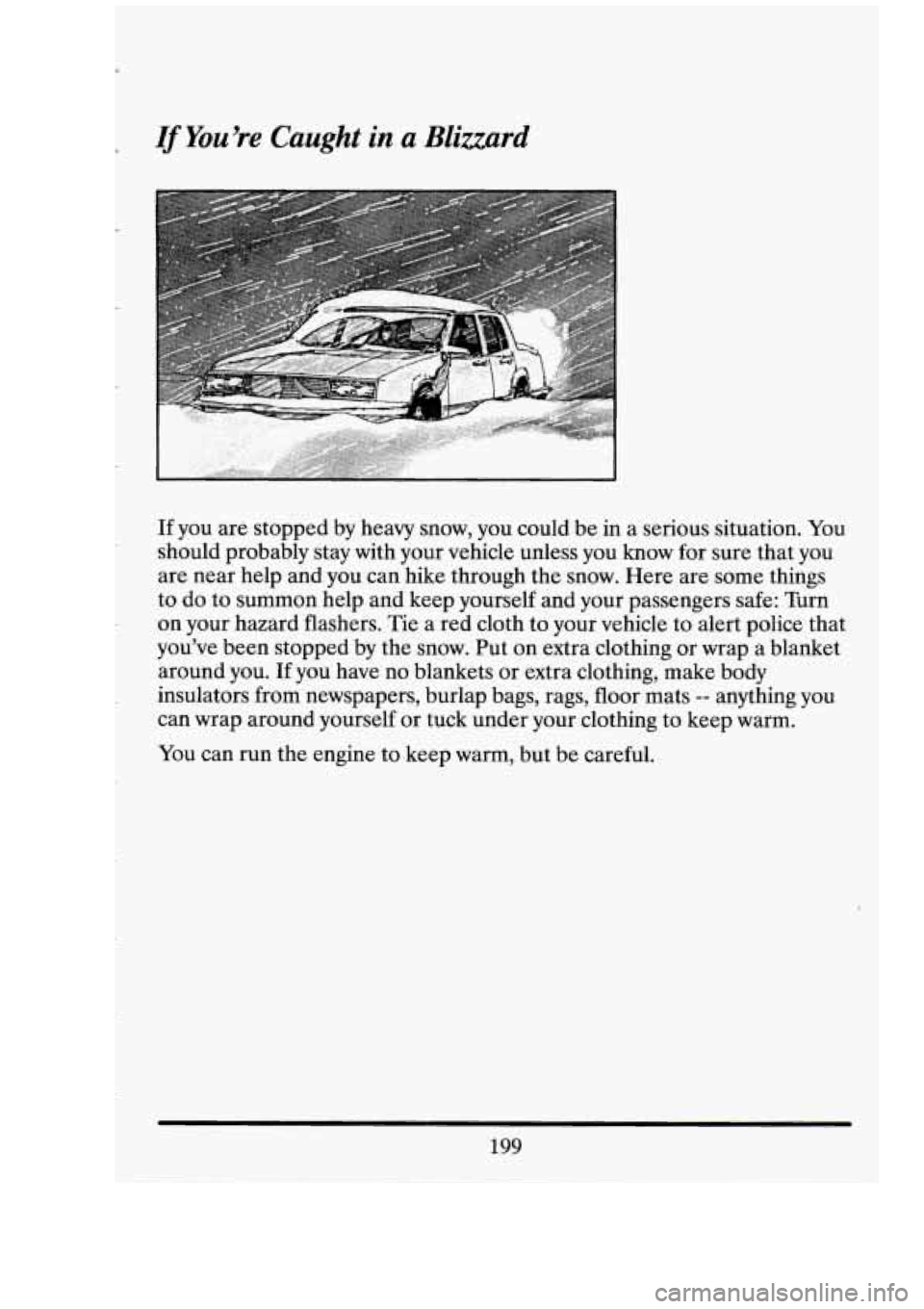
If you are stopped by heavy snow, you could be in a serious situation. You
should probably stay with your vehicle unless you know for sure that you
are near help and you can hike. through the snow. Here are some things
to do to summon help and keep yourself and your passengers safe: .Turn
.on your hazard flashers. Tie a red cloth to your vehicle to alert police that
you’ve been stopped by the snow. Put on extra clothing or wrap a blanket
around you. If you have no blankets or extra clothing, make body
insulators from newspapers, burlap bags, rags, floor mats
-- anything you
can wrap around yourself or tuck under your clothing to keep warm.
You can run the engine to keep warm, but be careful.
199
Page 213 of 398
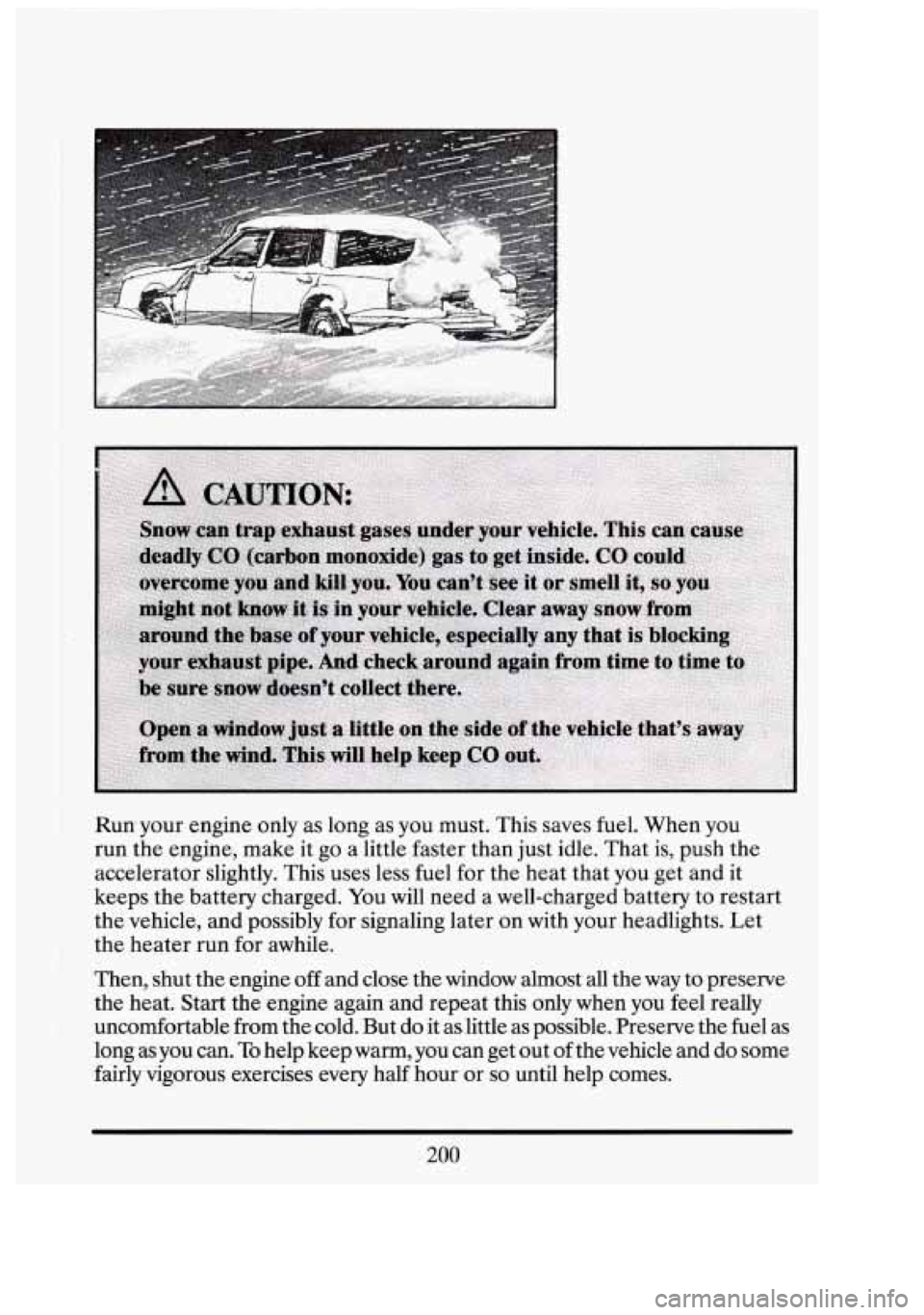
Run- your engine only as long as you must. This saves fuel. When you
run the engine, make it go a little faster than just idle. That is, push the
accelerator slightly. This uses less fuel for the heat that you-get and it
keeps the battery charged. You will need a well-charged battery to restart
the vehicle, and possibly for signaling later .on with your headlights. Let
the heater run for awhile.
Then, shut the engine
off and close the window almost all the way to preserve
the heat. Start the engine again and repeat this only when you feel really
uncomfortable
from the cold. But do it aslittle as possible. Preserve the fuel as
long as you can.
To help keep warm, you can get out of the vehicle and do some
fairly vigorous exercises every half hour or so until help comes.
200
Page 214 of 398
TOWING A TRAILER
NOTICE:
Pulling a trailer improperly can damage your vehicle and result\
in costly repairs not covered by your warranty.
To pull a trailer
correctly, follow the advice in this section.
Your Cadillac is a passenger vehicle. Trailer towing can change the way
your vehicle performs on the road. The loads and forces created when
trailering subject the vehicle
to significant levels of stress.
Load pulling components such as the engine, transmission, rear axle,
wheel assemblies, and tires are forced to work harder against the drag of
the added weight. The engine is required to operate at relatively higher
speeds and under greater loads, which generates extra heat. Trailer
towing adds considerably to wind resistance which increases pulling
requirements.
All this means changes in:
Handling
Durability
Fuel Economy
201
Page 215 of 398
I
If You Do Decide To Pull A Trailer
If you do, here are some important points.
There are many different laws including speed limit restrictions which
apply to trailering. Make sure your rig
will be legal, not only where
you live but also where you’ll be driving.
A good source for this
information can be state or provincial police.
You should always use a load equalizing hitch if your trailer will weigh
more than
2,000 pounds (900 kg). Consider using sway control if your
loaded trailer will weigh
2,000 pounds (900 kg) or less. If your loaded
trailer will weigh
2,000 pounds (900 kg.) or more you should use both
load equalizing hitch and sway control.
NOTICE:
Do not use sway control devices on trailers equipped with surge
brakes, i.e. boat trailers. Surge brakes
do not function properly
when used with most sway control devices.
Don’t tow a trailer during the first 1000 miles (1600 km) your new
vehicle is driven. The engine, axle or other parts could be damaged.
5 During the first 1,000 miles (1600 km) that you tow a trailer, don’t
drive over
50 mph (80 km/h) and avoid full throttle starts. This helps
the engine and other parts
of your vehicle wear in at the heavier loads.
Avoid continuous operation in mountainous areas that have grades
greater than
2% for longer than 5 miles.
A maximum highway speed to 55 mph (90 km/h) when trailering will
enhance the long term durability of your vehicle.
Change axle lubricant annually or every 7,500 miles (12,500 km) of
trailer towing, whichever occurs first.
0 Three important considerations have to do with weight:
202
o/
I
I
c
nl
I
‘p’
u,
Page 219 of 398

Trailer Hitching Procedure Using A Weight
Distributing (Equalizing) Hitch
(Recommended for loaded trailers weighing 3,000 lbs. to 7,000 lbs.)
Your vehicle is equipped with an Electronic Level Control (ELC) feature.
When hooking up a trailer using a weight distributing hitch, always use
the following procedure:
0
0
0
0
0
Place the vehicle on a level surface without the trailer hitched. With
the ignition off, and all doors closed, allow the vehicle to level
automatically.
Disable the Electronic Level Control (ELC) by pulling
MAXI@
fuse #9 (30 AMP) from the underhood electrical center located on
the passenger side wheel housing in the engine compartment. Remove
the cover to gain access.
Attach the trailer to the vehicle. The trailer tongue should weight
12%
of the total loaded trailer weight.
Level the vehicle with the load leveling spring bars (equalizers).
Leave the fuse out while towing your trailer.
n It
I
I
E'
NOTICE:
Adjusting an equalizing hitch with the Electronic Level Control \
(ELC) system engaged will defeat the function of the load
equalizing hitch and may cause unsatisfactory handling.
Once you have completed towing your trailer, be sure to reinstall the
Electronic Level Control (ELC) fuse.
In Addition
Use two friction sway controls if your trailer is over 5,000 lbs. .(2270
kg) loaded weight, and/or is. over 24'. long..
0 Use at least one friction sway control if your trailer is over 2,000 lbs.
(908 kg) loaded weight, and consider using one for trailers under
2,000 lbs. (908 kg).
ill
i
3
206
Page 223 of 398
On a long uphill grade, shift down to a lower gear and reduce your speed
and reduce your speed to around
45 mph (70 km/h) to reduce the
possibility of engine and transmission overheating.
If your trailer weighs more than
2,000 pounds (908 kg), you should drive
in “D or 3” instead of Overdrive. This allows the torque convertor clutch
to engage and allowing the transmission to run cooler.
Parking on Hills
You really should not park your vehicle, and trailer on a hill. If something
goes wrong your rig could start to move. People can be injured and both
I your vehicle and the trailer can be damaged.
If you eve1 have to park your rig on a hill, here’s how to do it:
Apply your regular brakes, but don’t shift into “P7, (Park) yet.
I Have someone place chocks (tapered triangular blocks) under the
downhill side the trailer wheels.
When the wheel chocks are in place, release the regular brakes until
Reapply the regular brakes. Then shift into “P” (Park) and apply the
Release the regular brakes.
the
chocks absorb the load.
parking brake.
When You Are Ready to Leave Afier Parking on a Hill
1. Apply your regular brakes and hold the pedal down while you:
Start your engine;
Shift into a gear; and
Be sure the parking brake has released.
2. Release the brake pedal.
3. Drive slowly until the trailer is clear of the chocks.
iI;
n
Gi
I B
h I1
-1
l
U1
a‘ I
210
4. Stop and have someone pick up and store the chocks.