Page 224 of 398
Engine Cooling When Trailering
Your cooling system may temporarily overheat during severe operating
conditions such as;
Climbing grades steeper than 4% at ambient temperatures above
90’Fahrenheit (32O Celsius)
with a loaded vehicle and trailer.
0 Stopping after high-speed driving.
0 Idling for long periods in stop and go traffic.
If the “TEMP” warning light comes on, pull
to the side of the road as
soon as it is safe to do
so. When the vehicle is at a complete stop, shift the
transmission selector to P (Park) and allow the engine to idle. If your
Electronic Climate Control system is on, shut it
off. Do not turn off the
engine or increase engine speed above a normal idle. Within
two or three
minutes the system should cool sufficiently to allow A/C operation to
resume. At that time resume driving at a reduced speed. Return to
normal driving after
10 minutes if the “TEMP” warning light is not
displayed.
Maintenance when Trailer Towing
Your vehicle will need service more often when you’re pulling a trailer.
See the Maintenance Schedule for details. Things that are especially
important in trailer operation are automatic transmission fluid (don’t
overfill), engine oil, axle lubricant, engine drive belt, cooling system, and
brake adjustment. Each of these is covered in this manual. The Index will
help you find them quickly. If you’re trailering, it’s a good idea to review
these sections before you start your trip.
Check periodically to
see that all hitch attaching nuts and bolts are tight.
21
1
Page 229 of 398
I
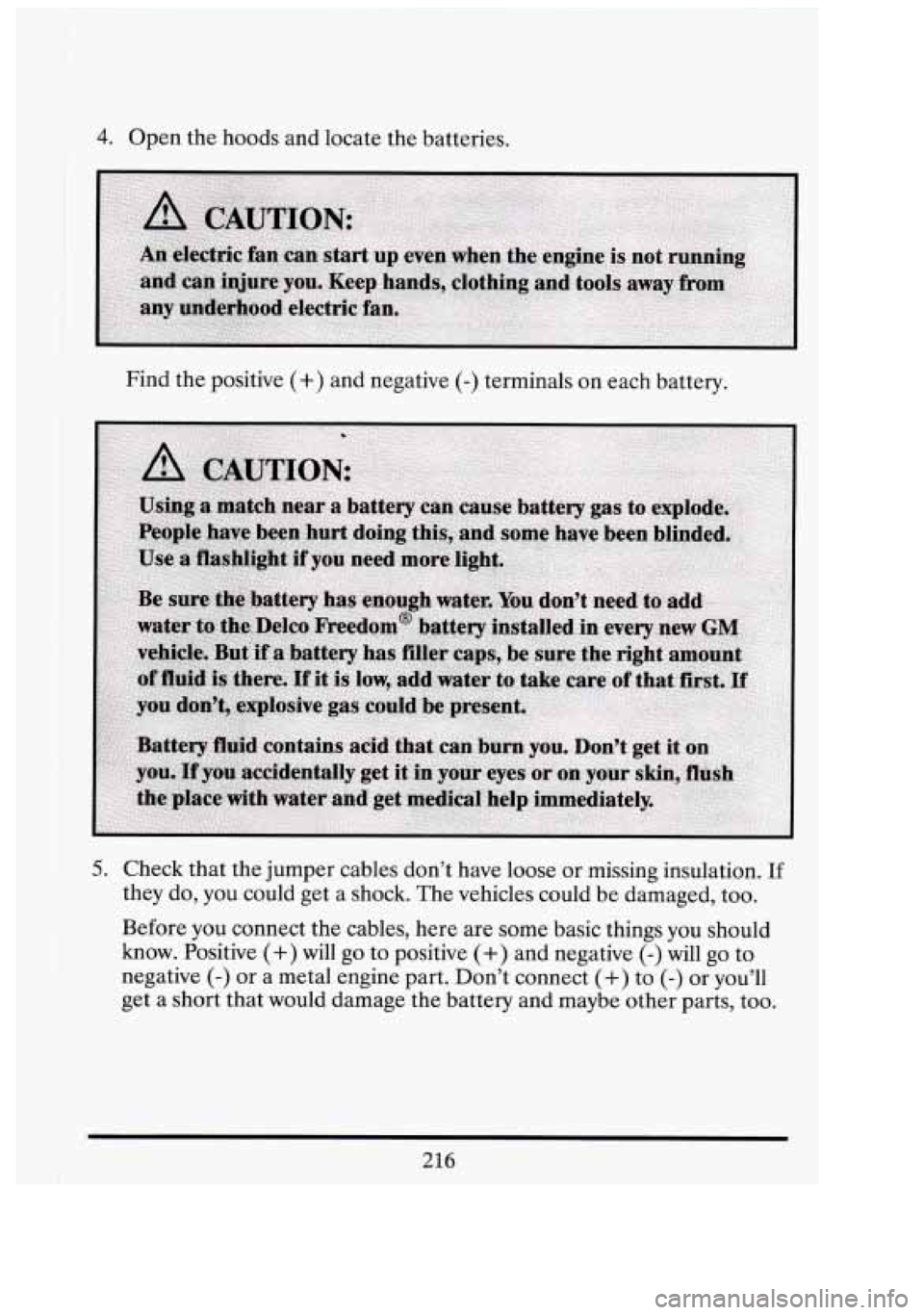
4. Open the hoods and locate the batteries.
Find the positive
(+) and negative (-) terminals on each battery.
5. Check that the jumper cables don't have loose or missing insulation. If
they do, you could get a shock. The vehicles could be damaged, too.
Before you connect the cables, here are some basic things you should
know. Positive
(+) will go to positive (+) and negative (-) will go to
negative
(-) or a metal engine part. Don't connect (+) to (-) or you'll
get a short that would damage the battery and maybe other parts, too.
216
I n
Page 230 of 398
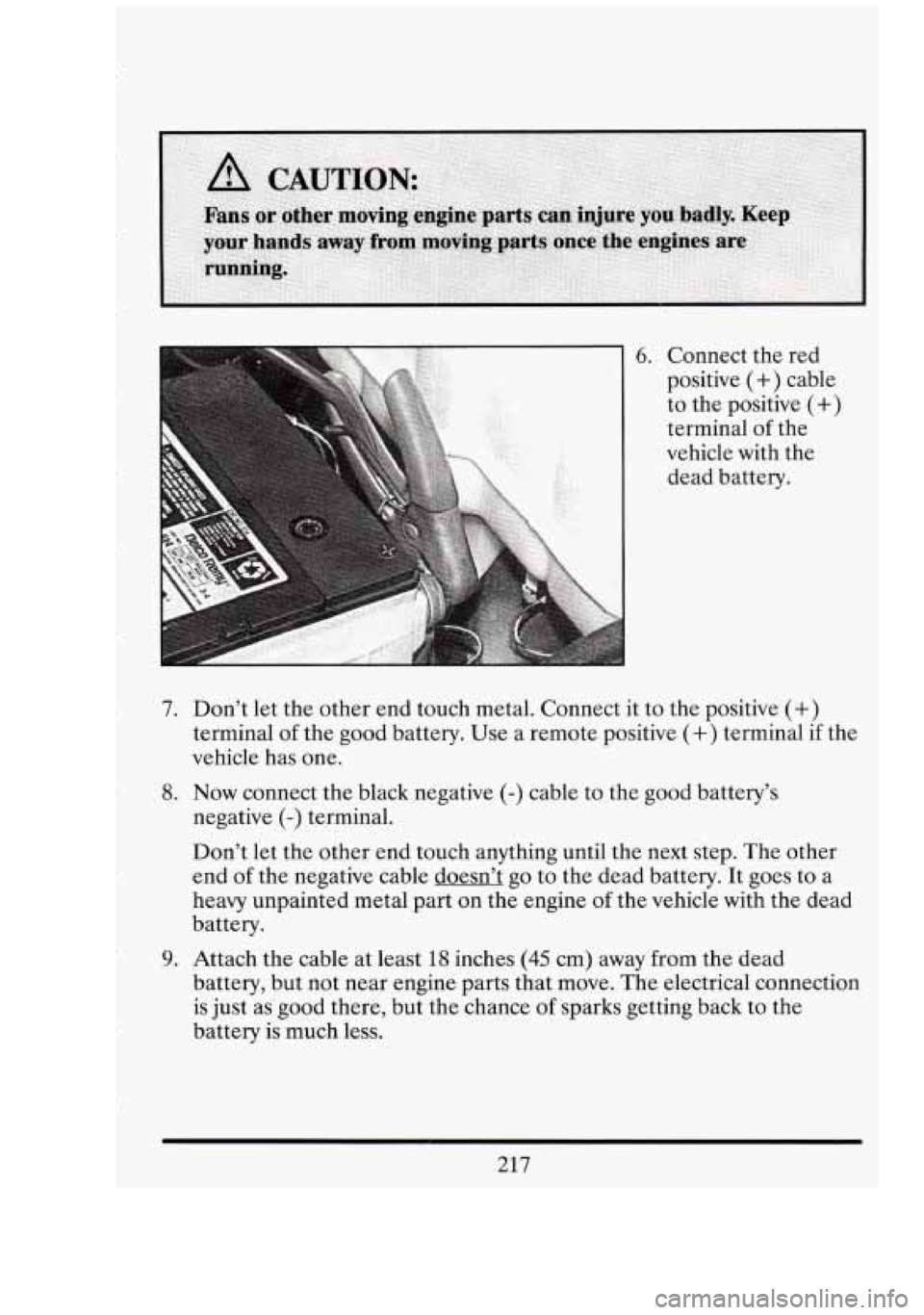
6. Connect the red
positive
(+) cable
to the positive
(+)
terminal of the
vehicle with the
dead battery.
7. Don’t let the other end touch metal. Connect it to the positive (+)
terminal of the good battery. Use a remote positive (+) terminal if the
vehicle has one.
8. Now connect the black negative (-) cable to the good battery’s
negative
(-) terminal.
Don’t let the other end touch anything until the next step. The other
end of the negative cable doesn’t go to the dead battery. It goes to a
heavy unpainted metal part on the engine of the vehicle with the dead
battery.
battery, but not near engine parts that move. The electrical connection
is
just as good there, but the chance of sparks getting back to the
battery is much less.
9. Attach the cable at least 18 inches (45 cm) away from the dead
217
Page 231 of 398
I
I
10. Now start the vehicle with the good battery and run the engine for a
11. Try to start the vehicle with the dead battery.
while.
If it won't start after a few tries, it probably needs service.
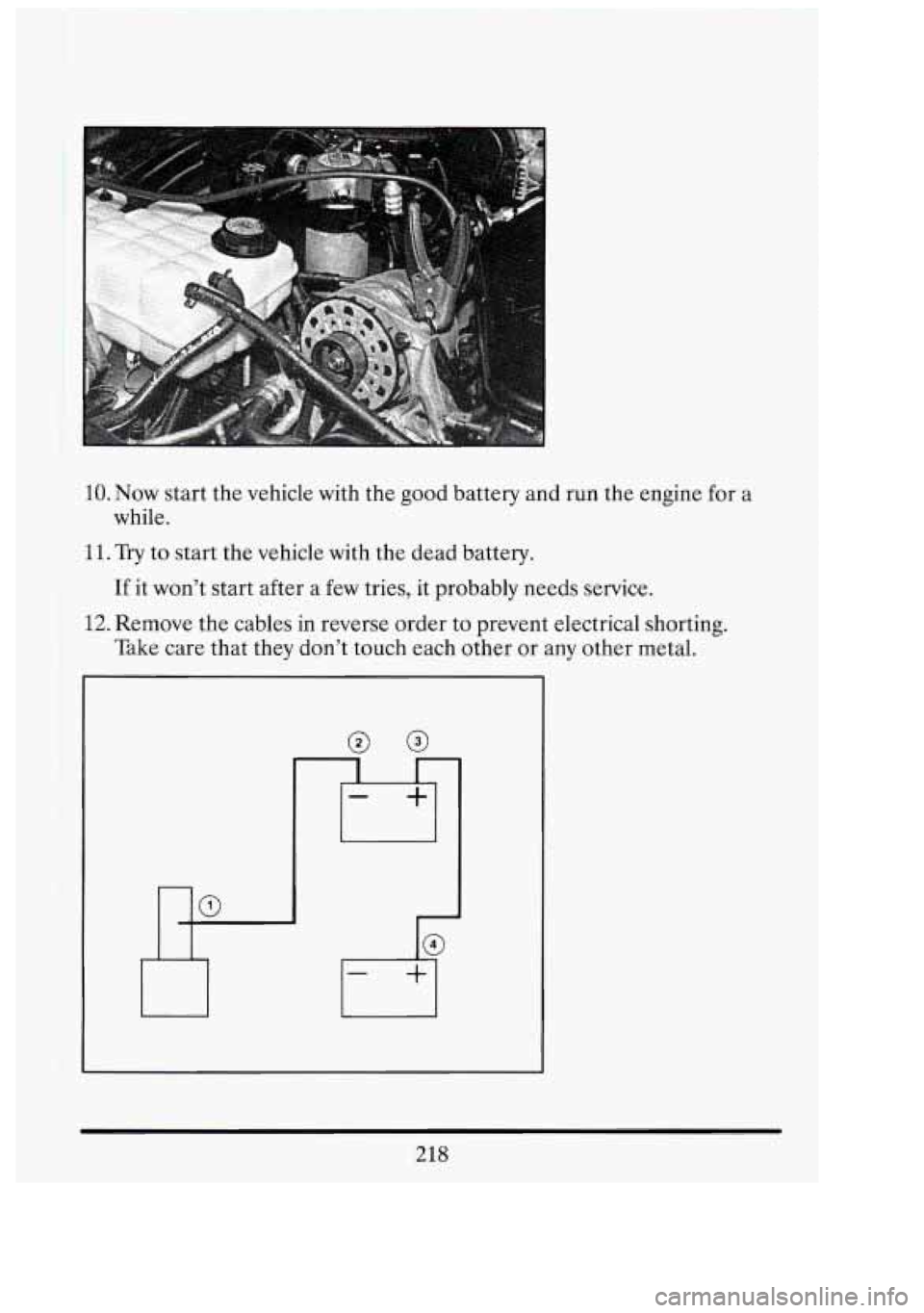
12. Remove the cables in reverse order to prevent electrical shorting.
Take care that they don't touch each other or any other metal.
218
I
I
Page 236 of 398
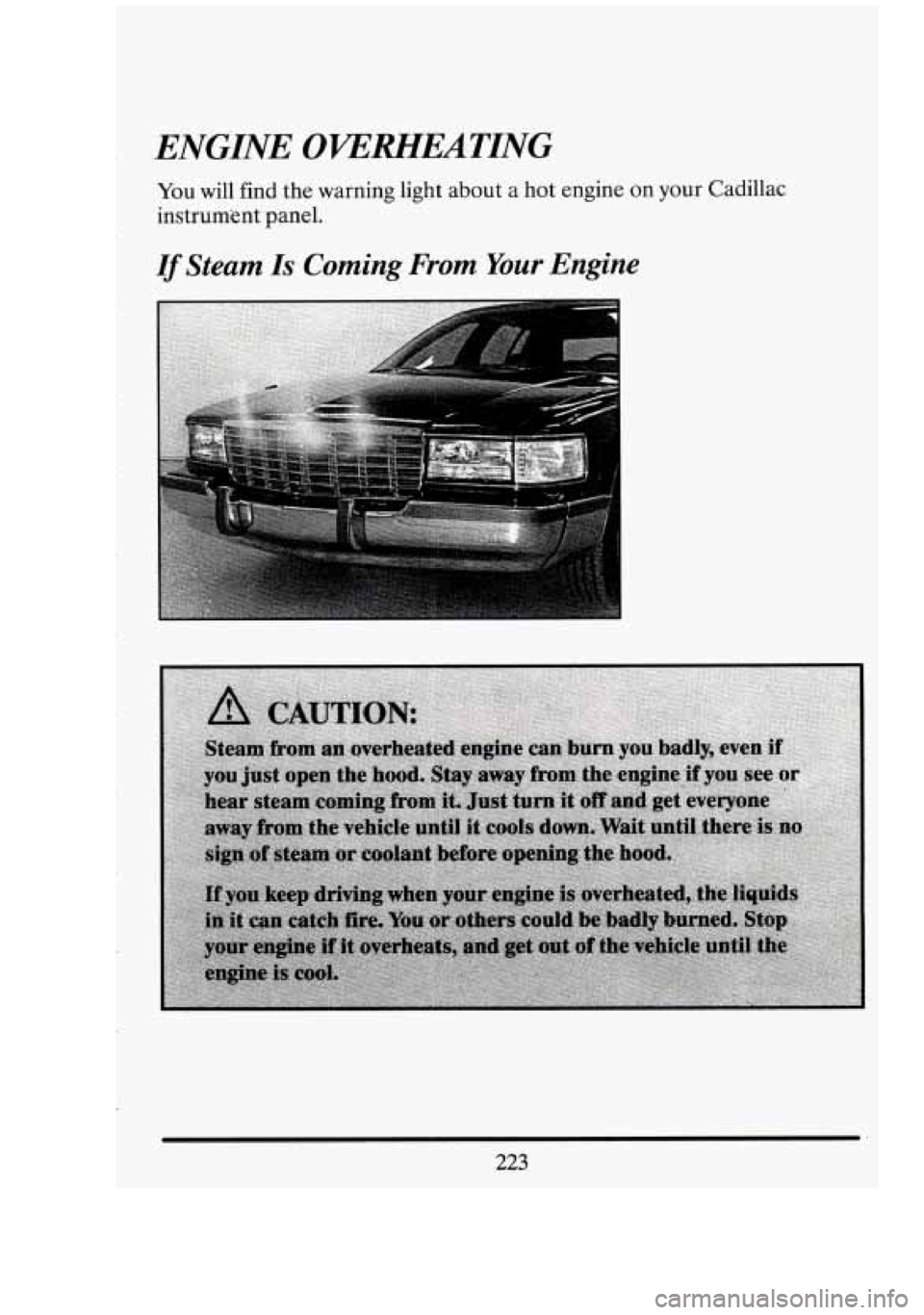
r_ ENGINE O'VERHEATING
You will find the warning light about a hot engine on your Cadillac
instrument panel.
If Steam Is Coming From Your Engine
-
223
Page 237 of 398

NOTICE:
If your engine catches fire because you keep driving with no
coolant, your vehicle can be badly damaged. The costly repairs \
would not be covered by your warranty.
IfNo Steam Is Coming From Your Engine
If you get the overheat warning but see or hear no steam, the problem
may not be too serious. Sometimes the engine can get a little too hot
when you:
0 Climb a long hill on a hot day.
Stop after high speed driving.
0 Idle for long periods in traffic.
Tow a trailer.
I
If you get the overheat warning with no sign of steam, try this for a
minute or
so:
i3‘ I
1. Turn off your air conditioner.
2. Turn on your heater to full hot at the highest fan speed and open the
3. If you’re in a traffic jam, shift to “N” (Neutral).
window
as necessary.
If you no longer have the overheat warning, you can drive. Just to be safe,
drive slower
for about ten minutes. If the warning doesn’t come back on,
you can drive normally.
If the warning continues, pull over, stop, and park your vehicle right
away.
If there’s still no sign of steam, you can idle the engine for two or three
minutes while you’re parked, to see if the warning stops. But then, if you
still have the warning, TURN
OFF THE ENGINE AND GET
EVERYONE OUT OF THE VEHICLE until it cools down.
You may decide not to lift the hood but to get service help right away.
3
224
Page 238 of 398
r COOLING SYSTEM
When you decide it’s safe to lift the hood, here’s what you’ll see:
A. Coolant surge tank
B. Electric engine fans (If equipped)
If the coolant inside the coolant surge tank is boiling, don’t do anything
else until it cools down.
225
Page 239 of 398
I
The coolant level should be at or above the seam inside the surge tank. If
it isn’t, you may have a leak in the radiator hoses, heater hoses, radiator,
water pump or somewhere else in the cooling system.
NOTICE:
Engine damage from running your engine without coolant isn’t \
covered
by your warranty.
If there seems to be no leak, check to see if the electric engine fans are
running.
If the engine is overheating, both fans should be running. If they
aren’t, your vehicle needs service.
226
Pl i