1994 CADILLAC FLEETWOOD engine
[x] Cancel search: enginePage 165 of 398

I I
NOTICE:
Before you add any sound equipment to pour vehicle -- like a
. tape player, CB radio, mobile telephone or two-way radio -- be
sure you can add what you want.
If you can, it's very important
to do it properly. Added sound equipment may interfere with the
operation
of your vehicle's engine, Delco@ radio or other
systems, and even damage them. And, your vehicle's systems
may interfere with the operation
of sound equipment that has
been added improperly.
So, before adding sound equipment, check with your dealer and
be sure to check Federal'rules covering mobile radio and
telephone units.
FM Stereo
FM stereo will give you the best sound. But FM signals will reach only
about
10 to 40 miles (16 to 65 km). And, tall buildings or hills can
interfere with
FM signals, causing the popping, crackling, or a momentary
hissing sound.
AM
The range for most AM stations is greater than for FM, especially at
night. The longer range, however, can cause stations to interfere with
each other.
AM can pick up noise from things like storms and power
lines.
Try reducing the treble to reduce this noise if you ever get it.
Speed Sensitive Volume
Your Delco radio automatically adjusts the volume level to compensate
for road and wind noise as you are driving.
Dolby@
This feature automatically removes noise on Dolby encoded tapes (no
button is required).
*Dolby@ is a registered trademark of Dolby Laboratories.
152
Dl
fl
El
Page 185 of 398
$RAKING
Braking action involves perception time and reaction time.
First, you have to decide to push on the brake pedal. That’s perception
time. Then you have to bring up your foot and do it. That’s reaction time.
Average reaction time is about
3/4 of a second. But that’s only an
average. It might be less with one driver and as long as
two or three
seconds or more with another. Age, physical condition, alertness,
coordination, and eyesight all play a part.
So do alcohol, drugs and
frustration. But even in
3/4 of a second, a vehicle moving at 60 mph
(100 km/h) travels 66 feet (20 m). That could be a lot of distance in an
emergency,
so keeping enough space between your vehicle and others is
important.
And, of course, actual stopping distances vary greatly with the surface of
the road (whether it’s pavement or gravel); the condition of the road
(wet, dry, icy); tire tread; and the condition
of your brakes.
Avoid needless heavy braking. Some people drive in spurts
-- heavy
acceleration followed by heavy braking
-- rather than keeping pace with
traffic. This is a mistake. Your brakes may not have time to cool between
hard stops. Your brakes will wear out much faster if you do a lot of heavy
braking. If you keep pace with the traffic and allow realistic following
distances, you will eliminate a lot of unnecessary braking. That means
better braking and longer brake life.
If your engine ever stops while you’re driving, brake normally but don’t
pump your brakes.
If you do, the pedal may get harder to push down. If
your engine stops, you will still have some power brake assist. But you will
use it when you brake. Once the power assist is used up, it may take
longer to stop and the brake pedal
will be harder to push.
172
r_ ,
-1
Page 188 of 398
Traction Control System
This feature is deleted on Coach Builder limousines and funeral coach
packages.
Your vehicle has a traction control system that limits wheel spin. This is
especially useful in slippery road conditions.
The system operates only if
it senses that the rear wheels are spinning or beginning to lose traction.
When this happens, the system works the rear brakes and reduces engine
power (by closing the throttle) to limit wheel spin.
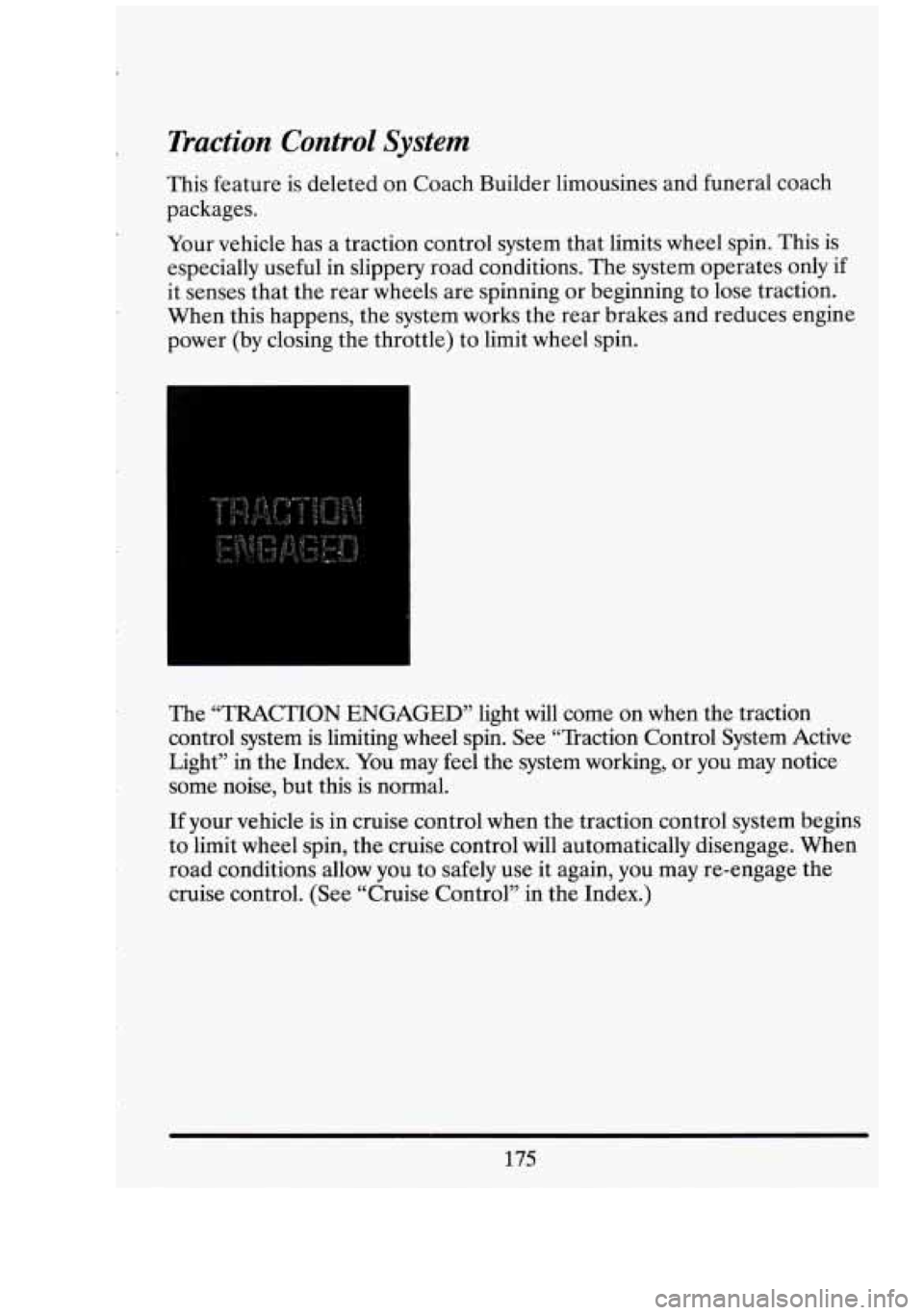
The ‘TRACTION ENGAGED’’ light will come on when the traction
control system is limiting wheel spin. See “Traction Control System Active
Light” in the Index. You may feel the system working, or you may notice
some noise, but this is normal.
If your vehicle is in cruise control when the traction control system begins
to limit wheel spin, the cruise control will automatically disengage. When
road conditions allow you to safely use it again, you may re-engage the
cruise control,. (See “Cruise Control” in the Index.)
175
Page 190 of 398
.
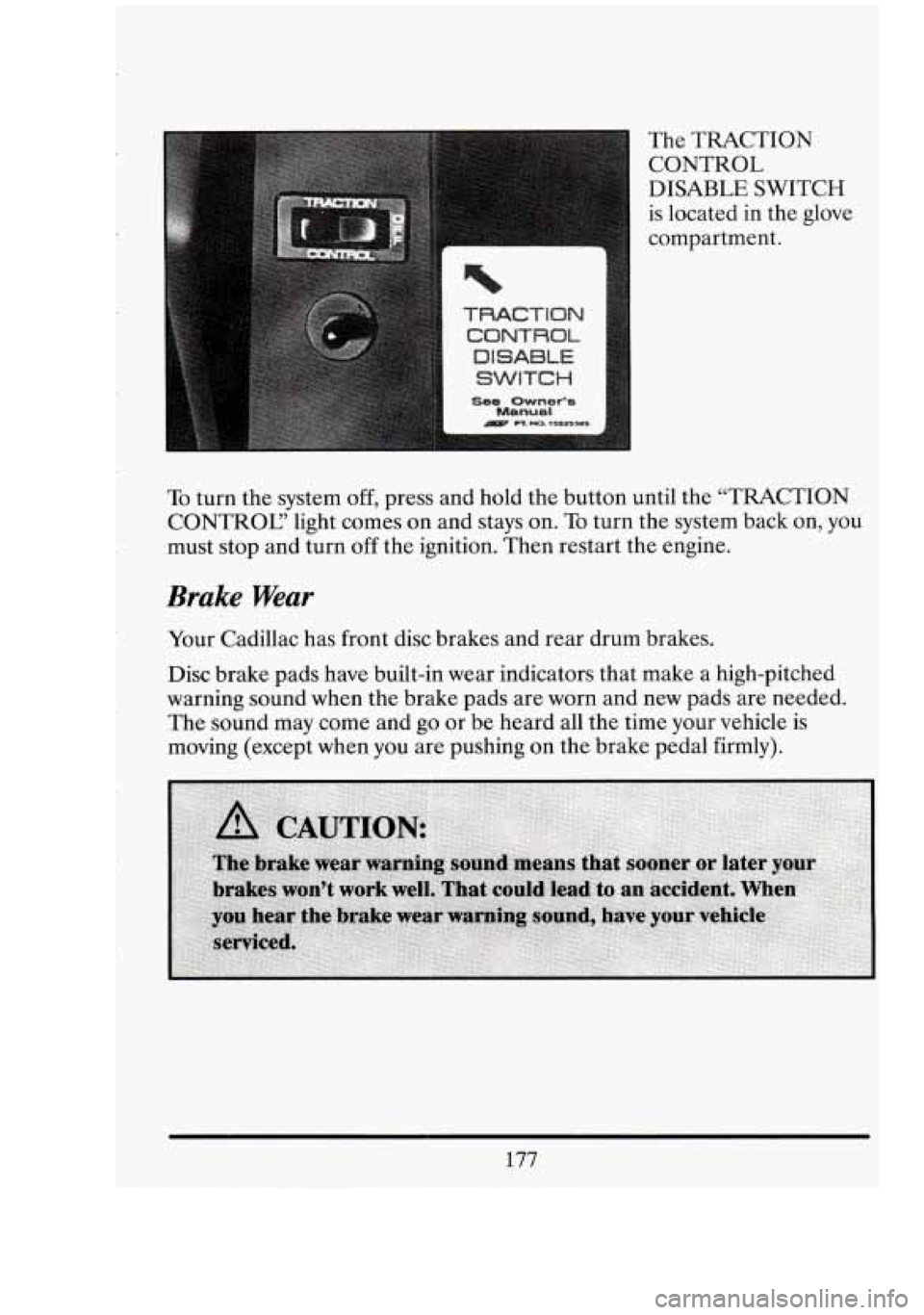
n The TRACTION CONTROL
DISABLE SWITCH
is located
in the glove
compartment.
I
To turn the system off, press and hold the button until the “TRACTION
CONTROC’ light comes
on and stays on. To turn the system back on, you
must stop and turn off the ignition. Then restart the engine.
Brake Wear
Your Cadillac has front disc brakes and rear drum brakes.
Disc brake pads have built-in wear indicators that make a high-pitched
warning sound when the brake pads are worn and new pads are needed.
The
sound may come and go or be heard all the time your vehicle is
moving (except when you are pushing on the brake pedal firmly).
177
Page 192 of 398

Braking in Emergencies
Use your anti-lock braking system when you need to. With anti-lock, you
can steer and brake at the same time. In many emergencies, steering can
help you more than even the very best braking.
STEEHNG
Power Steering
If you lose power steering assist because the engine stops or the system is
not functioning, you can steer but it
will take much more effort.
Steering Tips
Driving on Curves
It’s important to take curves at a reasonable speed.
A lot of the “driver lost control’’ accidents mentioned on the news
happen on curves. Here’s why:
Experienced driver or beginner, each of us is subject to the same laws of
physics when driving on curves. The traction of the tires against the road
surface makes it possible for the vehicle to change its path when you turn
the front wheels.
If there’s no traction, inertia will keep the vehicle going
in the same direction. If you’ve ever tried to steer a vehicle on wet ice,
you’ll understand this.
The traction you can get in a curve depends on the condition of your tires
and the road surface, the angle at which the curve is banked, and your
speed. While you’re in a curve, speed is the one factor you can control.
Suppose you’re steering through a sharp curve. Then you suddenly
accelerate. Both control systems
-- steering and acceleration -- have to do
their work where the tires meet the road. Adding the sudden acceleration
can demand too much of those places. You can lose control.
Suppose you’re steering through a sharp curve. Then you suddenly
accelerate. Both control systems
-- steering and acceleration -- have to do
their work where the tires meet the road. Unless your traction control
179
Page 197 of 398
LOSS OF CONTROL
Let’s review what driving experts say about what happens when the three
control systems (brakes, steering and acceleration) don’t have enough
friction where the tires meet the road to do what the driver has asked.
In any emergency, don’t give up. Keep trying to steer and constantly seek
an escape route or area of less danger.
Skidding
In a skid, a driver can lose control of the vehicle. Defensive drivers avoid
most skids by taking reasonable care suited to existing conditions, and by
not “overdriving” those conditions. But skids are always possible.
The three types of skids correspond to your Cadillac’s three control
systems. In the braking skid your wheels aren’t rolling. In the steering
or
cornering skid, too much speed or steering in a curve causes tires to slip
and lose cornering force. And in the acceleration skid too much throttle
causes the driving wheels to spin.
A cornering
skid is best handled by easing your foot off the accelerator
pedal.
Remember: Any traction control system helps avoid only the acceleration
skid.
If your traction control system is off, then an acceleration skid is also best
handled by easing your foot off the accelerator pedal.
If your vehicle starts to slide, ease your foot
off the accelerator pedal and
quickly steer the way you want the vehicle to go. If you start steering
quickly enough, your vehicle may straighten out. Always be ready for a
second skid
if it occurs.
Of course, traction is reduced when water, snow, ice, gravel, or other
material is on the road. For safety, you’ll want to slow down and adjust
your driving to these conditions. It is important to slow down on slippery
surfaces because stopping distance will be longer and vehicle control
more limited.
While driving on a surface with reduced traction, try your best to avoid
sudden steering, acceleration, or braking (including engine braking by
shifting to a lower gear). Any sudden changes could cause the tires to
184
tl
a, i‘
c4’ I,
0 !
t
Page 206 of 398
r 0 Weather Forecasts: What’s the weather outlook along your route?
Should you delay your trip a short time to avoid a major storm
system?
0 Maps: Do you have up-to-date maps !
HIGHVKAY HIPNOSIS
Is there actually such a condition as “highway hypnosis”? Or is it just
plain falling asleep at the wheel? Call it highway hypnosis, lack of
awareness, or whatever.
There is something about an easy stretch of road with the same scenery,
along with the hum of the tires on the road, the drone of the engine, and
the rush of the wind against the vehicle that can make you sleepy. Don’t
let it happen to you!
If it does, your vehicle can leave the road in less than
a second, and you could crash and be injured.
What can you do about highway hypnosis? First, be aware that it can
happen.
Then here are some tips:
Make sure your vehicle is well ventilated, with a comfortably cool
Keep your eyes moving. Scan the road ahead and to the sides. Check
interior.
your rearview mirrors and your instruments frequently.
If you get sleepy, pull off the road into a rest, service, or parking area
and take a nap, get some exercise, or both. For safety, treat drowsiness
on the highway as an emergency.
193
Page 207 of 398
HILL AND MOUNTMN ROADS
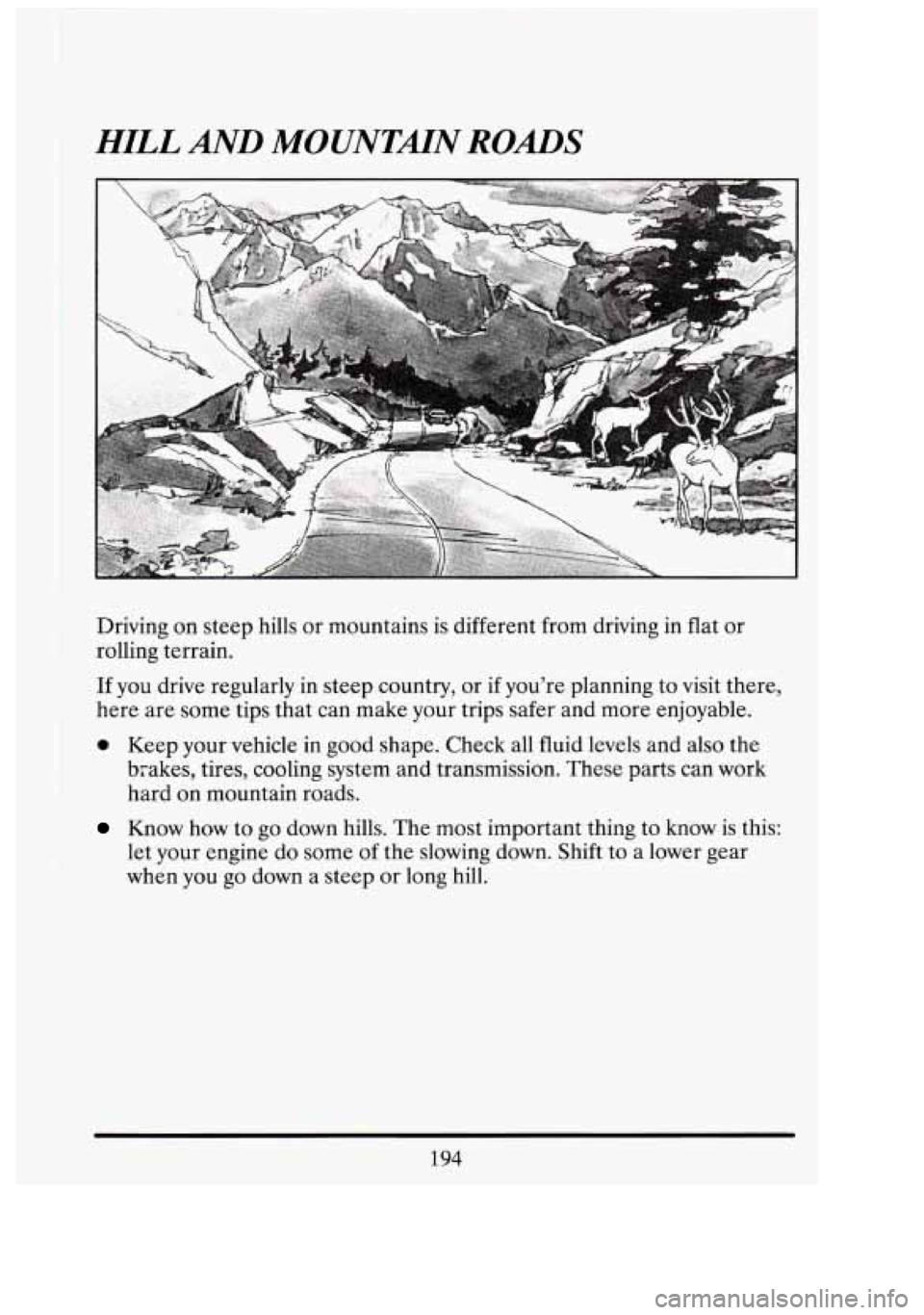
Driving on steep hills or mountains is different from driving in flat or
rolling terrain.
If you drive regularly in steep country, or if you’re planning to visit there,
here are some tips that can make your trips safer and more enjoyable.
0 Keep your vehicle in good shape. Check all fluid levels and also the
brakes, tires, cooling system and transmission. These parts can work
hard on mountain roads.
Know how to go down hills. The most important thing to know is this:
let your engine do some
of the slowing down. Shift to a lower gear
when you go down a steep or long hill.
194
13
I