1990 MITSUBISHI SPYDER service schedule
[x] Cancel search: service schedulePage 3 of 2103
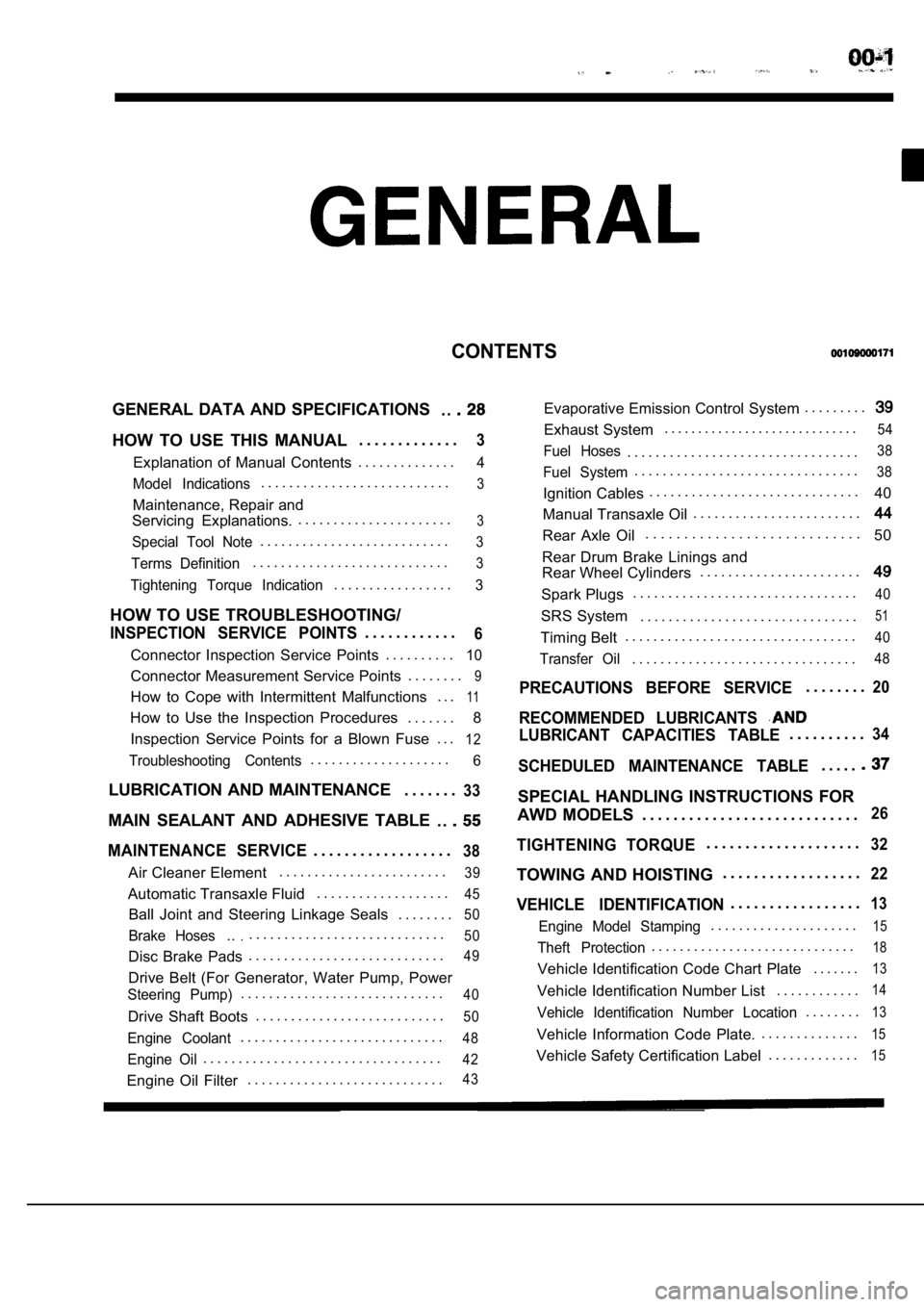
CONTENTS
GENERAL DATA AND SPECIFICATIONS. .
HOW TO USE THIS MANUAL. . . . . . . . . . . . .3
Explanation of Manual Contents. . . . . . . . . . . . . .4
Model Indications
. . . . . . . . . . . . . . . . . . . . . . . . . . .3
Maintenance, Repair and
Servicing Explanations. . . . . . . . . . . . . . . . . . . . . . .
3
Special Tool Note. . . . . . . . . . . . . . . . . . . . . . . . . . .3
Terms Definition. . . . . . . . . . . . . . . . . . . . . . . . . . . .3
Tightening Torque Indication. . . . . . . . . . . . . . . . .3
HOW TO USE TROUBLESHOOTING/
INSPECTION SERVICE POINTS. . . . . . . . . . . .6
Connector Inspection Service Points
. . . . . . . . . .10
Connector Measurement Service Points . . . . . . . .9
How to Cope with Intermittent Malfunctions . . .11
How to Use the Inspection Procedures
. . . . . . .
8
Inspection Service Points for a Blown Fuse . . .
12
Troubleshooting Contents. . . . . . . . . . . . . . . . . . . .6
LUBRICATION AND MAINTENANCE . . . . . . .33
MAIN SEALANT AND ADHESIVE TABLE
. .
MAINTENANCE SERVICE. . . . . . . . . . . . . . . . . .38
Air Cleaner Element. . . . . . . . . . . . . . . . . . . . . . . .39
Automatic Transaxle Fluid
. . . . . . . . . . . . . . . . . . .45
Ball Joint and Steering Linkage Seals
. . . . . . . .50
Brake Hoses.... . . . . . . . . . . . . . . . . . . . . . . . . . . .50
Disc Brake Pads. . . . . . . . . . . . . . . . . . . . . . . . . . . .49
Drive Belt (For Generator, Water Pump, Power
Steering Pump). . . . . . . . . . . . . . . . . . . . . . . . . . . . .40
Drive Shaft Boots
. . . . . . . . . . . . . . . . . . . . . . . . . . .50
Engine Coolant. . . . . . . . . . . . . . . . . . . . . . . . . . . . .48
Engine Oil. . . . . . . . . . . . . . . . . . . . . . . . . . . . . . . . . .42
Engine Oil Filter. . . . . . . . . . . . . . . . . . . . . . . . . . . .43
Evaporative Emission Control System . . . . . . . . .
Exhaust System. . . . . . . . . . . . . . . . . . . . . . . . . . . . .54
Fuel Hoses. . . . . . . . . . . . . . . . . . . . . . . . . . . . . . . . .38
Fuel System. . . . . . . . . . . . . . . . . . . . . . . . . . . . . . . .38
Ignition Cables. . . . . . . . . . . . . . . . . . . . . . . . . . . . . .
40
Manual Transaxle Oil . . . . . . . . . . . . . . . . . . . . . . . .
Rear Axle Oil. . . . . . . . . . . . . . . . . . . . . . . . . . . .
50
Rear Drum Brake Linings and
Rear Wheel Cylinders . . . . . . . . . . . . . . . . . . . . . . .
Spark Plugs. . . . . . . . . . . . . . . . . . . . . . . . . . . . . . . .40
SRS System . . . . . . . . . . . . . . . . . . . . . . . . . . . . . . .51
Timing Belt. . . . . . . . . . . . . . . . . . . . . . . . . . . . . . . . .40
Transfer Oil. . . . . . . . . . . . . . . . . . . . . . . . . . . . . . . .48
PRECAUTIONS BEFORE SERVICE. . . . . . . .20
RECOMMENDED LUBRICANTS
LUBRICANT CAPACITIES TABLE. . . . . . . . . .34
SCHEDULED MAINTENANCE TABLE. . . . .
SPECIAL HANDLING INSTRUCTIONS FOR
AWD MODELS . . . . . . . . . . . . . . . . . . . . . . . . . . . .
26
TIGHTENING TORQUE. . . . . . . . . . . . . . . . . . . .32
TOWING AND HOISTING . . . . . . . . . . . . . . . . . .22
VEHICLE IDENTIFICATION. . . . . . . . . . . . . . . . .13
Engine Model Stamping. . . . . . . . . . . . . . . . . . . . .15
Theft Protection. . . . . . . . . . . . . . . . . . . . . . . . . . . . .18
Vehicle Identification Code Chart Plate
. . . . . . .13
Vehicle Identification Number List. . . . . . . . . . . .14
Vehicle Identification Number Location. . . . . . . .13
Vehicle Information Code Plate.. . . . . . . . . . . . . .15
Vehicle Safety Certification Label
. . . . . . . . . . . . .15
Page 35 of 2103
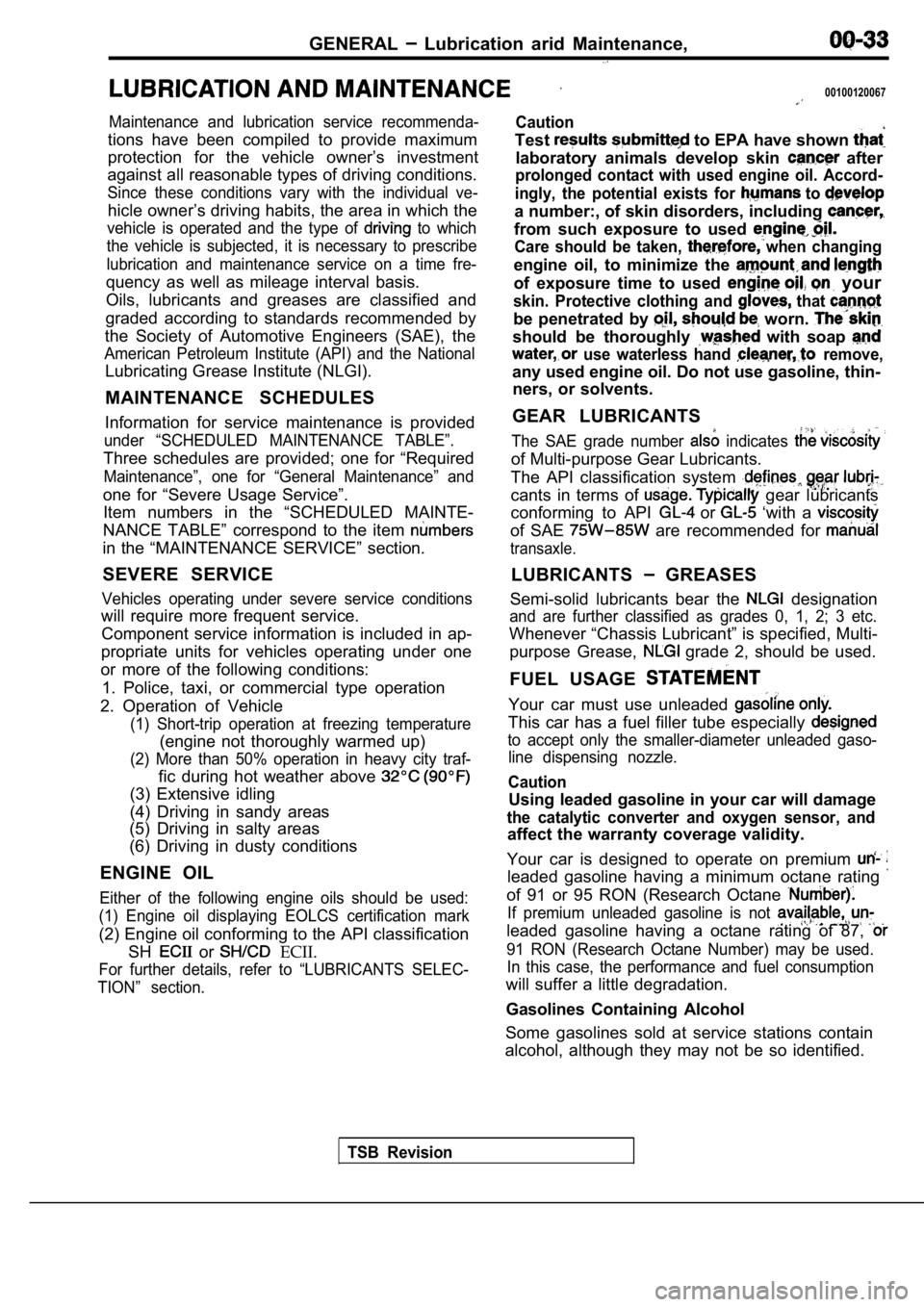
GENERAL Lubrication arid Maintenance,
00100120067
Maintenance and lubrication service recommenda-
tions have been compiled to provide maximum
protection for the vehicle owner’s investment
against all reasonable types of driving conditions.
Since these conditions vary with the individual ve-
hicle owner’s driving habits, the area in which the
vehicle is operated and the type of to which
the vehicle is subjected, it is necessary to prescr ibe
lubrication and maintenance service on a time fre-
quency as well as mileage interval basis.
Oils, lubricants and greases are classified and
graded according to standards recommended by
the Society of Automotive Engineers (SAE), the
American Petroleum Institute (API) and the National
Lubricating Grease Institute (NLGI).
MAINTENANCE SCHEDULES
Information for service maintenance is provided
under “SCHEDULED MAINTENANCE TABLE”.
Three schedules are provided; one for “Required
Maintenance”, one for “General Maintenance” and
one for “Severe Usage Service”. Item numbers in the “SCHEDULED MAINTE-
NANCE TABLE” correspond to the item
in the “MAINTENANCE SERVICE” section.
SEVERE SERVICE
Vehicles operating under severe service conditions
will require more frequent service. Component service information is included in ap-
propriate units for vehicles operating under one
or more of the following conditions:
1. Police, taxi, or commercial type operation
2. Operation of Vehicle
(1) Short-trip operation at freezing temperature
(engine not thoroughly warmed up)
(2) More than 50% operation in heavy city traf-
fic during hot weather above
(3) Extensive idling
(4) Driving in sandy areas
(5) Driving in salty areas
(6) Driving in dusty conditions
ENGINE OIL
Either of the following engine oils should be used:
(1) Engine oil displaying EOLCS certification mark
(2) Engine oil conforming to the API classification SH
or ECII.
For further details, refer to “LUBRICANTS SELEC-
TION” section.
Caution
Test to EPA have shown
laboratory animals develop skin after
prolonged contact with used engine oil. Accord-
ingly, the potential exists for
to
a number:, of skin disorders, including
from such exposure to used
Care should be taken, when changing
engine oil, to minimize the
of exposure time to used your
skin. Protective clothing and that
be penetrated by worn.
should be thoroughly with soap
use waterless hand remove,
any used engine oil. Do not use gasoline, thin- ners, or solvents.
GEAR LUBRICANTS
The SAE grade number indicates
of Multi-purpose Gear Lubricants.
The API classification system
cants in terms of gear lubricants
conforming to API
or ‘with a
of SAE are recommended for
transaxle.
LUBRICANTS GREASES
Semi-solid lubricants bear the
designation
and are further classified as grades 0, 1, 2; 3 etc .
Whenever “Chassis Lubricant” is specified, Multi-
purpose Grease,
grade 2, should be used.
FUEL USAGE
Your car must use unleaded
This car has a fuel filler tube especially
to accept only the smaller-diameter unleaded gaso- line dispensing nozzle.
Caution
Using leaded gasoline in your car will damage
the catalytic converter and oxygen sensor, and
affect the warranty coverage validity.
Your car is designed to operate on premium
leaded gasoline having a minimum octane rating
of 91 or 95 RON (Research Octane
If premium unleaded gasoline is not
leaded gasoline having a octane rating of 87,
91 RON (Research Octane Number) may be used. In this case, the performance and fuel consumption
will suffer a little degradation.
Gasolines Containing Alcohol
Some gasolines sold at service stations contain
alcohol, although they may not be so identified.
TSB Revision
Page 39 of 2103
G E N E R A L Scheduled Maintenance Table
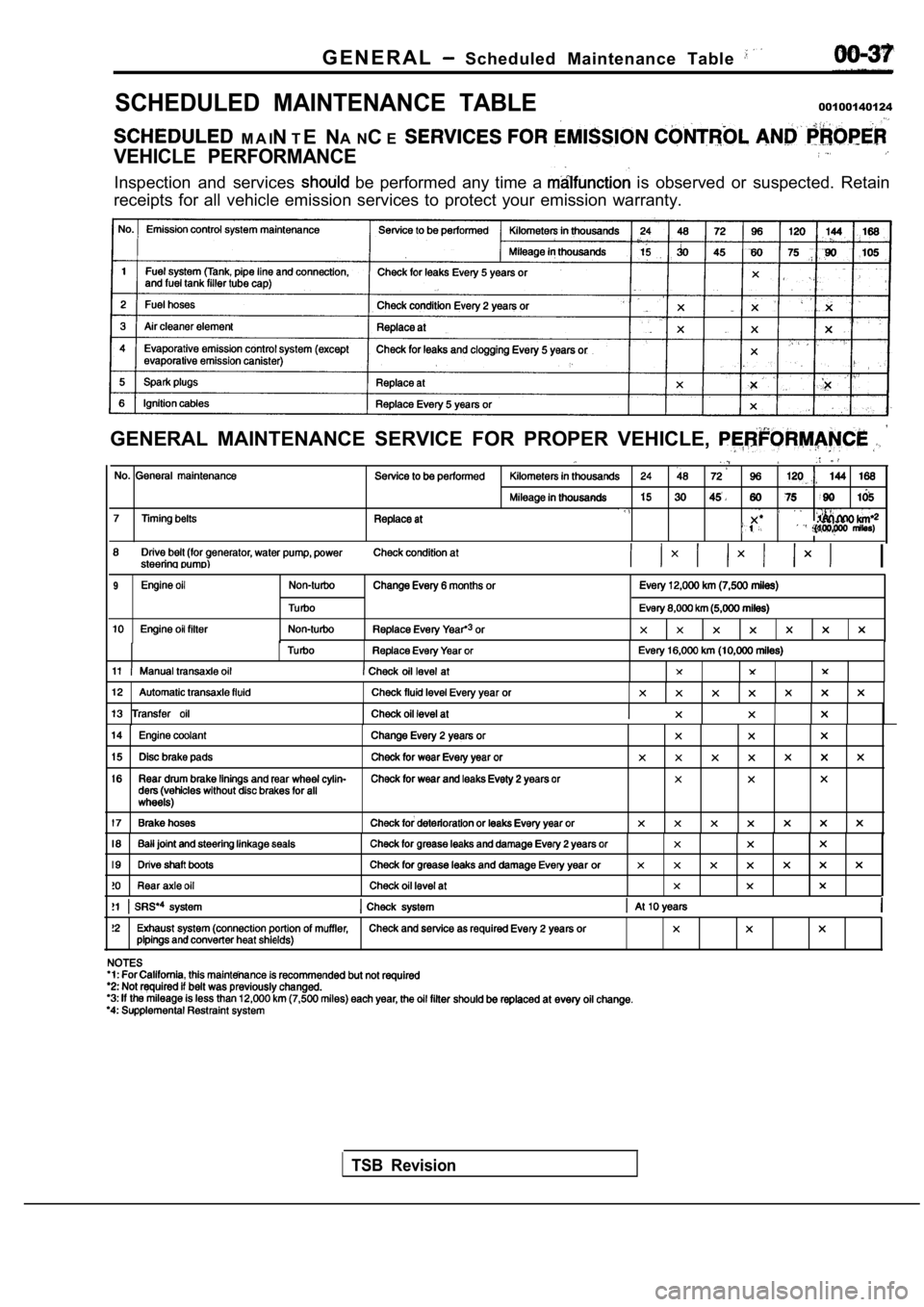
SCHEDULED MAINTENANCE TABLE00100140124
M A INTE N A NCE
VEHICLE PERFORMANCE
Inspection and services be performed any time a is observed or suspected. Retain
receipts for all vehicle emission services to prote ct your emission warranty.
GENERAL MAINTENANCE SERVICE FOR PROPER VEHICLE,
I
9
TSB Revision
Page 40 of 2103
GENERAL Scheduled Maintenance Table/Maintenance Service
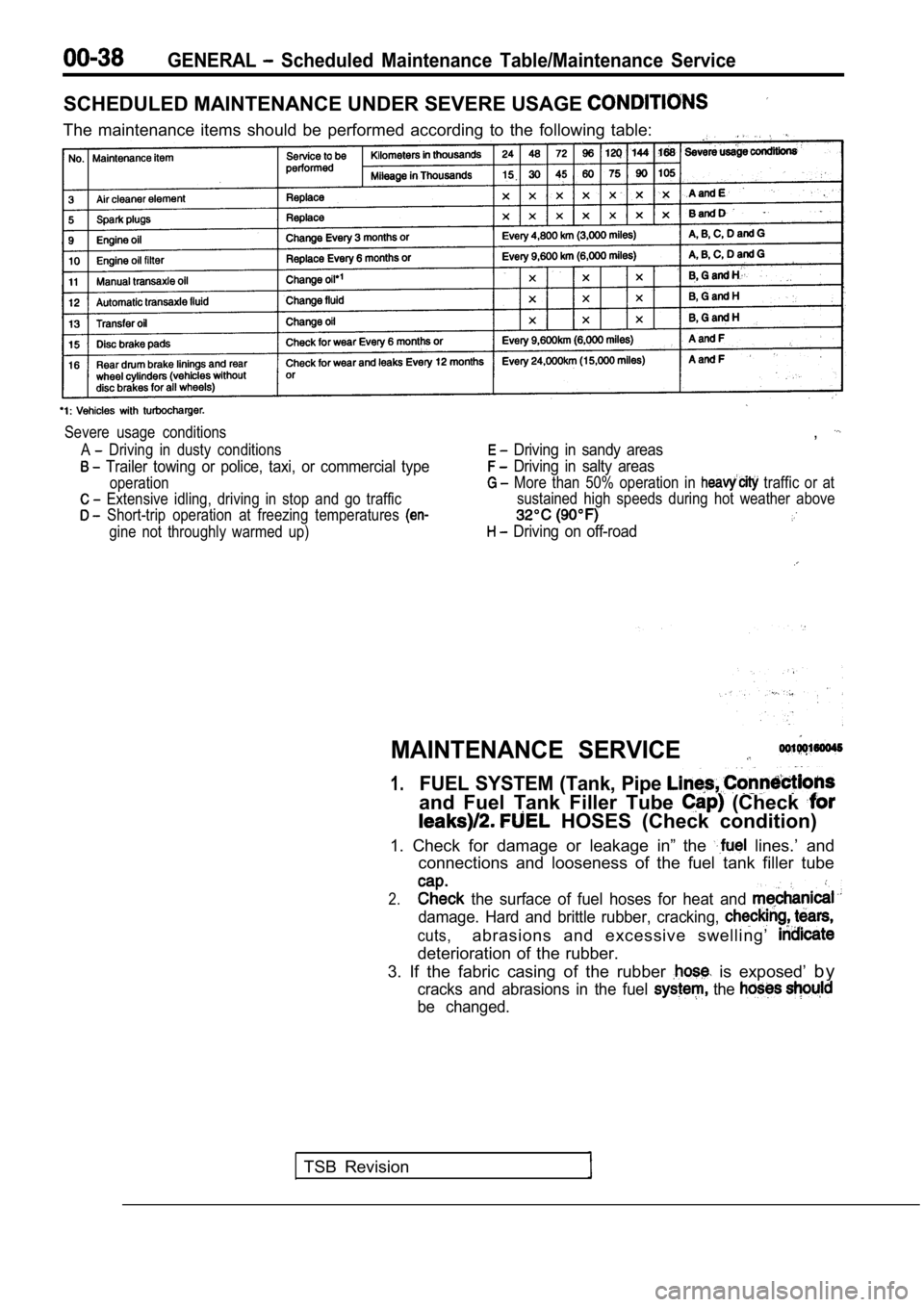
SCHEDULED MAINTENANCE UNDER SEVERE USAGE
The maintenance items should be performed according to the following table:
Severe usage conditions
A
Driving in dusty conditions
Trailer towing or police, taxi, or commercial type
operation
Extensive idling, driving in stop and go traffic
Short-trip operation at freezing temperatures
gine not throughly warmed up)
,
Driving in sandy areas
Driving in salty areas
More than 50% operation in traffic or at
sustained high speeds during hot weather above
Driving on off-road
MAINTENANCE SERVICE
1.FUEL SYSTEM (Tank, Pipe
and Fuel Tank Filler Tube (Check
HOSES (Check condition)
1. Check for damage or leakage in” the
lines.’ and
connections and looseness of the fuel tank filler t ube
2. the surface of fuel hoses for heat and
damage. Hard and brittle rubber, cracking,
cuts,abrasions and excessive swelling’
deterioration of the rubber.
3. If the fabric casing of the rubber
is exposed’ b y
cracks and abrasions in the fuel the
be changed.
TSB Revision
Page 1132 of 2103
AUTOMATIC TRANSAXLE
ENGINE Troubleshooting
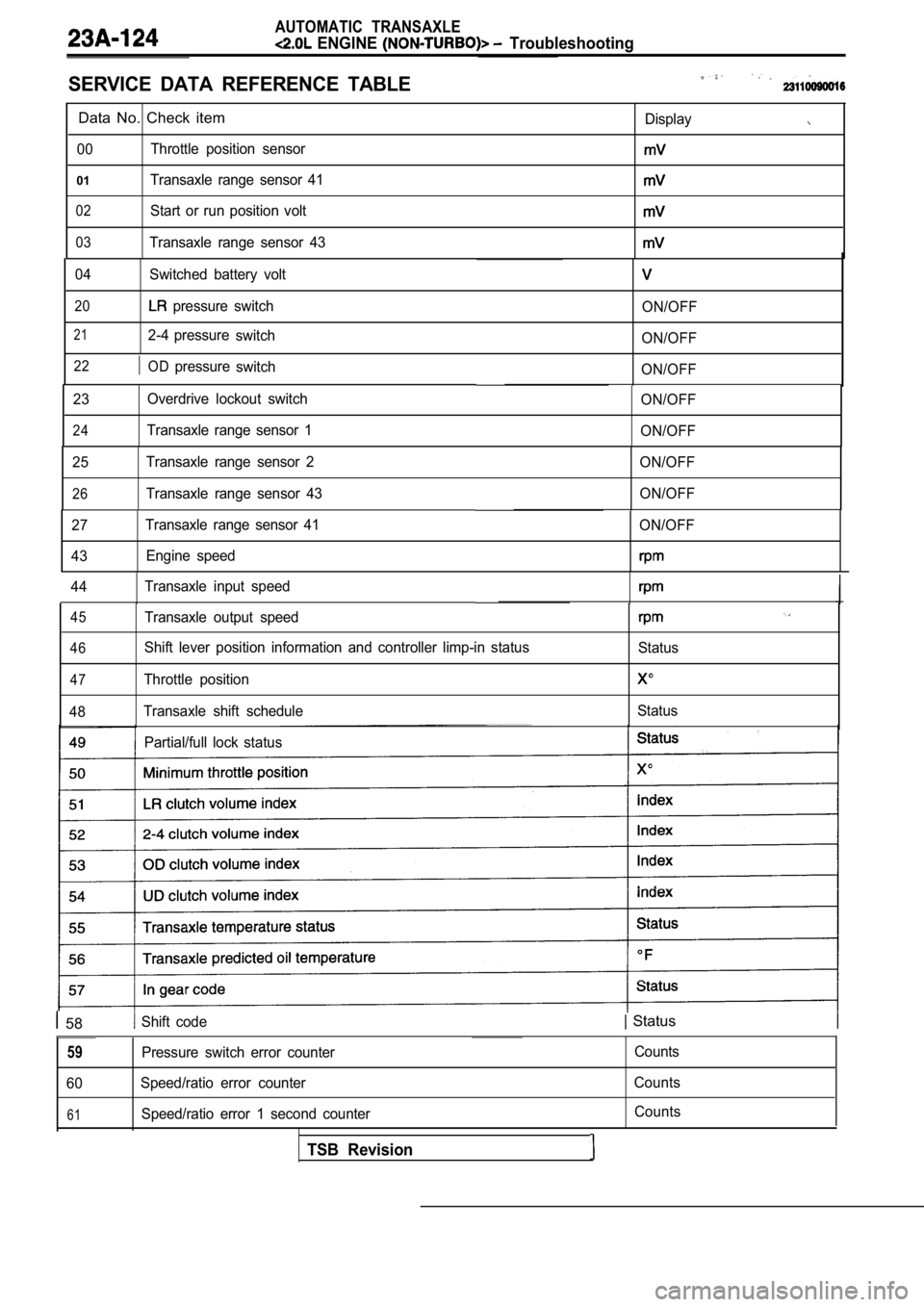
SERVICE DATA REFERENCE TABLE
Data No. Check itemDisplay
00 Throttle position sensor
01Transaxle range sensor 41
02Start or run position volt
03Transaxle range sensor 43
04 Switched battery volt
20 pressure switch
ON/OFF
212-4 pressureswitch
ON/OFF
22ODpressureswitch
ON/OFF
23 Overdrive lockout switch
ON/OFF
24Transaxle range sensor 1ON/OFF
25 Transaxle range sensor 2
ON/OFF
26Transaxle range sensor 43ON/OFF
27 Transaxle range sensor 41
ON/OFF
43 Engine speed
44Transaxle input speed
45Transaxle output speed
46Shift lever position information and controller lim
p-in status
Status
47Throttle position
48Transaxle shift schedule
Status
Partial/full lock status
58Shift code Status
59
60
61
Pressure switch error counter Counts
Speed/ratio error counter Counts
Speed/ratio error 1 second counter Counts
TSB Revision
Page 1178 of 2103
AUTOMATIC TRANSAXLE ENGINE (NON-TURBO)> On-vehicle Service
TSB
Revision
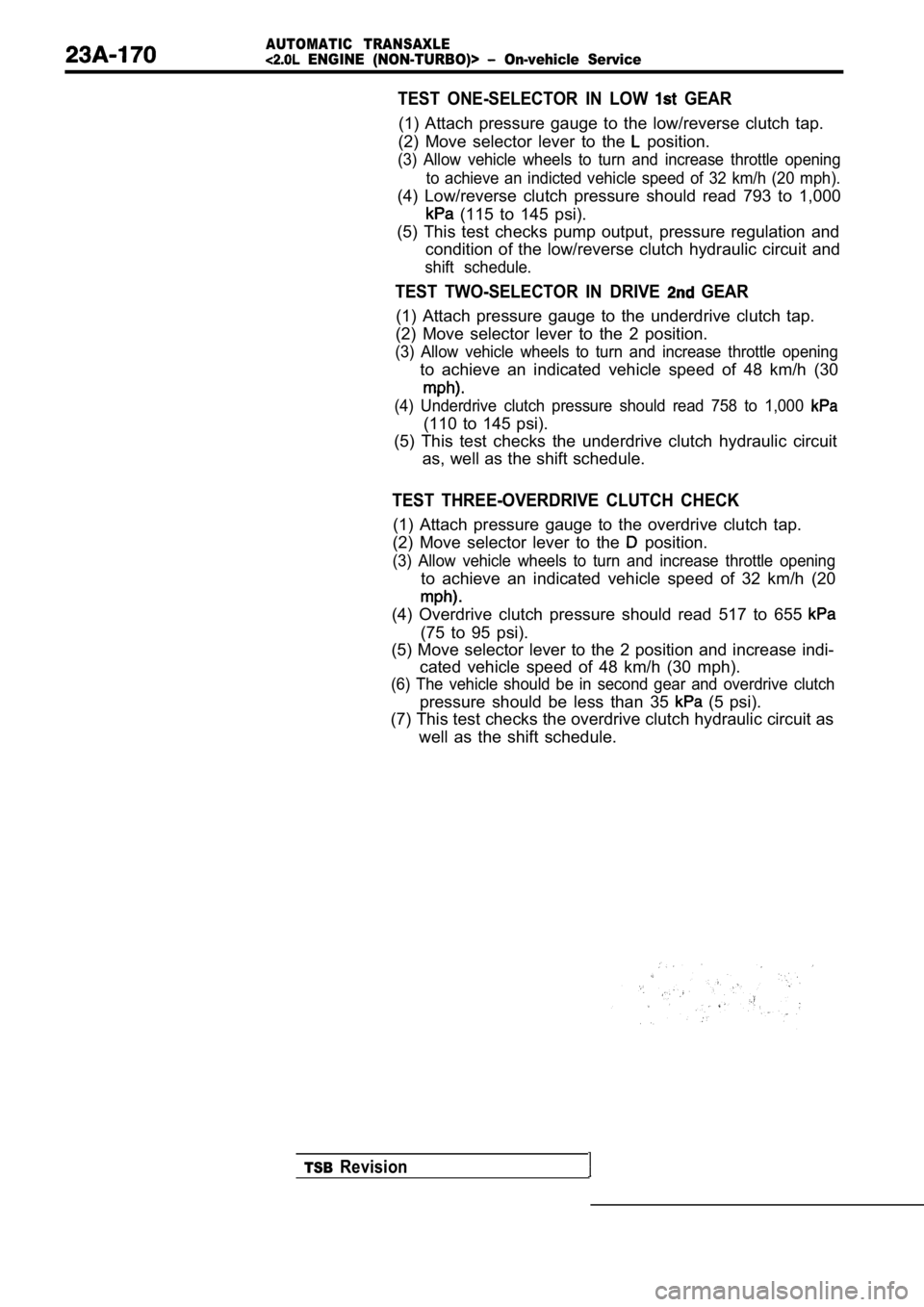
TEST ONE-SELECTOR IN LOW GEAR
(1) Attach pressure gauge to the low/reverse clutch tap.
(2) Move selector lever to the
position.
(3) Allow vehicle wheels to turn and increase throt tle opening
to achieve an indicted vehicle speed of 32 km/h (20 mph).
(4) Low/reverse clutch pressure should read 793 to 1,000
(115 to 145 psi).
(5) This test checks pump output, pressure regulati on and
condition of the low/reverse clutch hydraulic circu it and
shift schedule.
TEST TWO-SELECTOR IN DRIVE GEAR
(1) Attach pressure gauge to the underdrive clutch tap.
(2) Move selector lever to the 2 position.
(3) Allow vehicle wheels to turn and increase throt tle opening
to achieve an indicated vehicle speed of 48 km/h (3 0
(4) Underdrive clutch pressure should read 758 to 1,000
(110 to 145 psi).
(5) This test checks the underdrive clutch hydrauli c circuit
as, well as the shift schedule.
TEST THREE-OVERDRIVE CLUTCH CHECK
(1) Attach pressure gauge to the overdrive clutch t ap.
(2) Move selector lever to the
position.
(3) Allow vehicle wheels to turn and increase throt tle opening
to achieve an indicated vehicle speed of 32 km/h (2 0
(4) Overdrive clutch pressure should read 517 to 655
(75 to 95 psi).
(5) Move selector lever to the 2 position and incre ase indi-
cated vehicle speed of 48 km/h (30 mph).
(6) The vehicle should be in second gear and overdr ive clutch
pressure should be less than 35 (5 psi).
(7) This test checks the overdrive clutch hydraulic circuit as
well as the shift schedule.