Page 1506 of 2103
GENERAL INFORMATION
FRONT AXLE General Specification/Lubricants
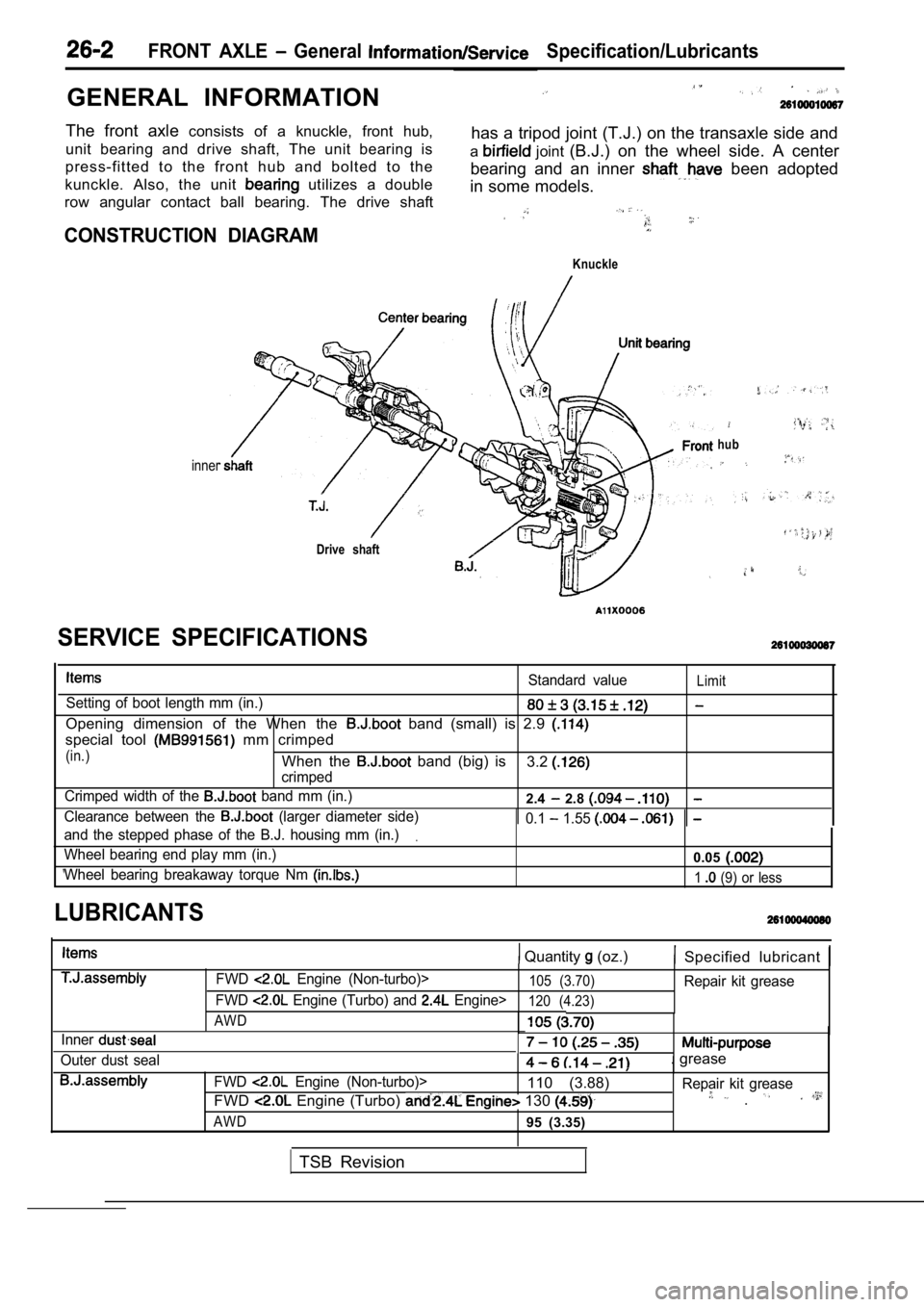
The front axle consists of a knuckle, front hub,
unit bearing and drive shaft, The unit bearing is has a tripod joint (T.J.) on the transaxle side and
press-fitted to the front hub and bolted to the a
joint
(B.J.) on the wheel side. A center
kunckle. Also, the unit
utilizes a double bearing and an inner been adopted
in some models.
row angular contact ball bearing. The drive shaft
CONSTRUCTION DIAGRAM
Knuckle
inner
Drive shaft
hub
Standard valueLimit
Setting of boot length mm (in.)
Opening dimension of the When the band (small) is 2.9
special tool mm crimped
(in.)When the band (big) is
crimped3.2
Crimped width of the band mm (in.)2.4 2.8
Clearance between the (larger diameter side) 0.1 1.55
and the stepped phase of the B.J. housing mm (in.).
Wheel bearing end play mm (in.)0.05
Wheel bearing breakaway torque Nm 1 (9) or less
SERVICE SPECIFICATIONS
LUBRICANTS
Quantity (oz.) Specified lubricant
Inner
Outer dust sealFWD
Engine (Non-turbo)>105 (3.70)Repair kit grease
FWD
Engine (Turbo) and Engine>120 (4.23)
AWD
. grease
FWD Engine (Non-turbo)>110 (3.88) Repair kit grease
FWD Engine (Turbo) 130 .
AWD95 (3.35)
TSB Revision
Page 1518 of 2103
F R O N T A X L E Drive Shaft
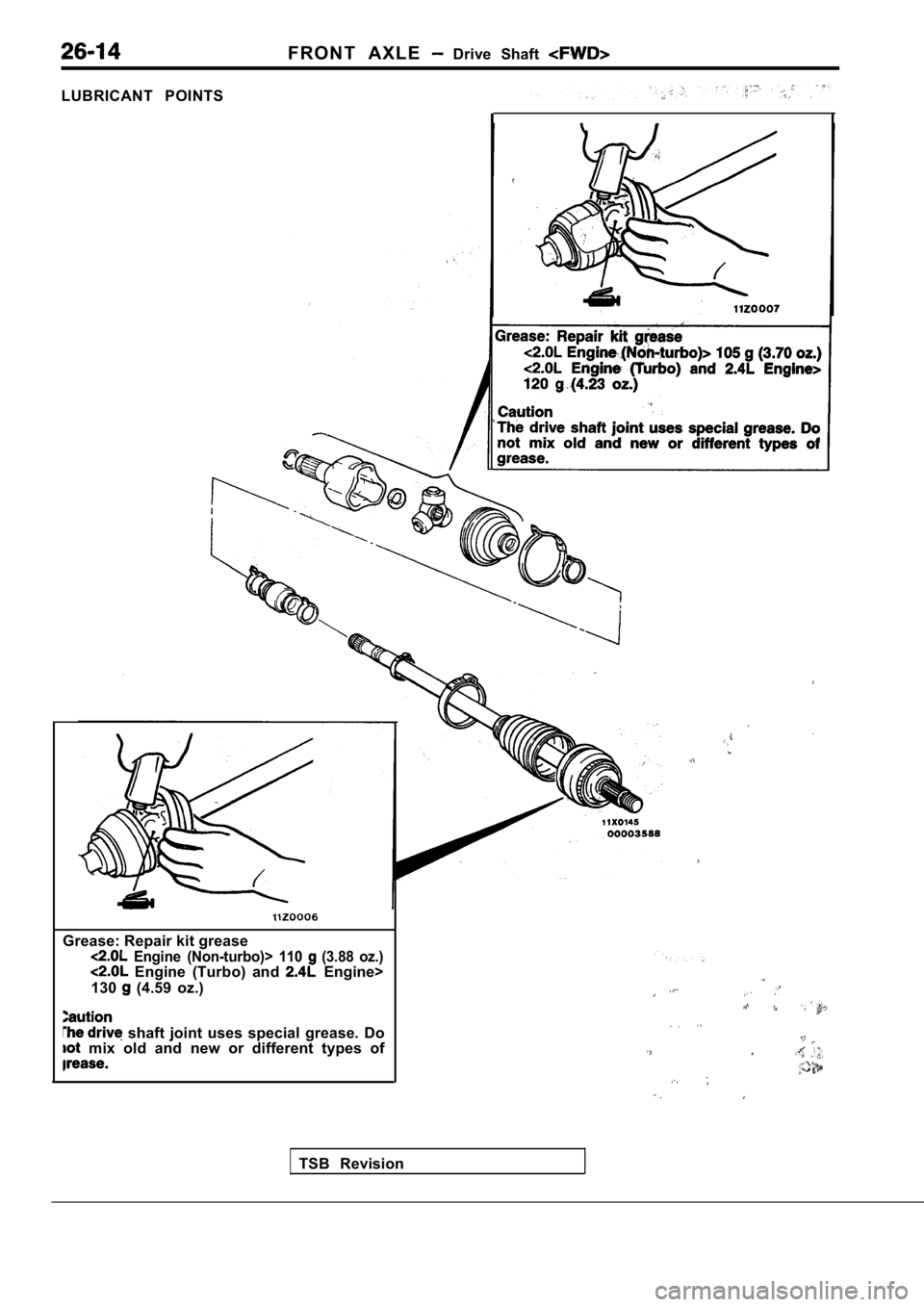
LUBRICANT POINTSTSB Revision
Grease: Repair kit grease
Engine (Non-turbo)> 110 (3.88 oz.) Engine (Turbo) and Engine>
130
(4.59 oz.)
shaft joint uses special grease. Do mix old and new or different types of
,
Page 1521 of 2103
B.J.
FRONT AXLE Drive Shaft
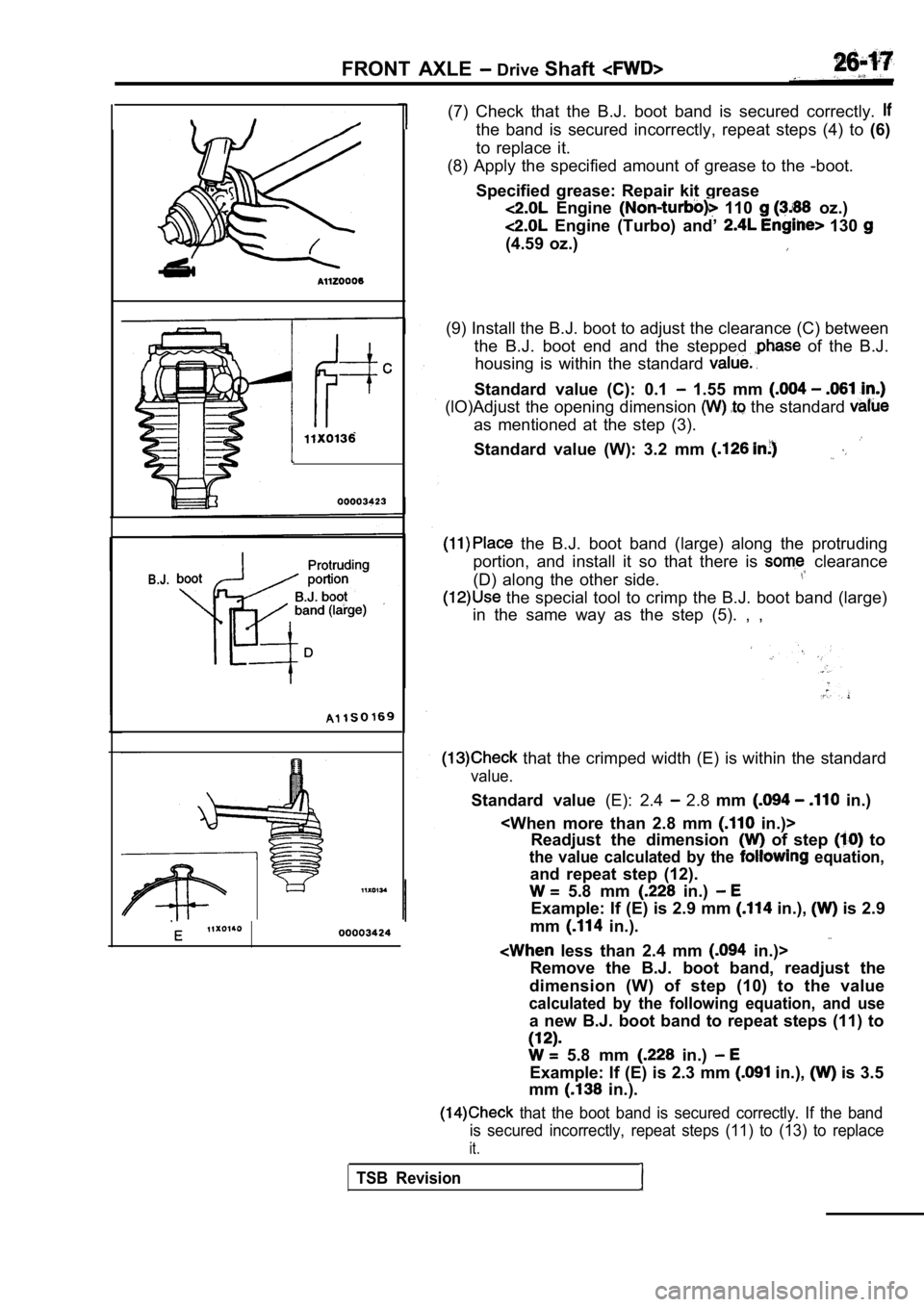
(7) Check that the B.J. boot band is secured correc tly.
the band is secured incorrectly, repeat steps (4) to (6)
to replace it.
(8) Apply the specified amount of grease to the -bo ot.
Specified grease: Repair kit grease
Engine 110 oz.)
Engine (Turbo) and’ 130
(4.59 oz.)
(9) Install the B.J. boot to adjust the clearance ( C) between
the B.J. boot end and the stepped
of the B.J.
housing is within the standard
Standard value (C): 0.1 1.55 mm
(lO)Adjust the opening dimension the standard
as mentioned at the step (3).
Standard value (W): 3.2 mm
the B.J. boot band (large) along the protruding
portion, and install it so that there is
clearance
(D) along the other side.
the special tool to crimp the B.J. boot band (larg e)
in the same way as the step (5). , ,
that the crimped width (E) is within the standard
value.
Standard value (E): 2.4 2.8 mm in.)
in.)>
Readjust the dimension
of step to
the value calculated by the equation,
and repeat step (12).
5.8 mm in.)
Example: If (E) is 2.9 mm in.), is 2.9
mm
in.).
less than 2.4 mm in.)>
Remove the B.J. boot band, readjust the
dimension (W) of step (10) to the value
calculated by the following equation, and use
a new B.J. boot band to repeat steps (11) to
5.8 mm in.)
Example: If (E) is 2.3 mm in.), is 3.5
mm
in.).
that the boot band is secured correctly. If the ba nd
is secured incorrectly, repeat steps (11) to (13) t o replace
it.
TSB Revision
Page 1522 of 2103
FRONT AXLE Drive Shaft
B.J.Dynamicbamper
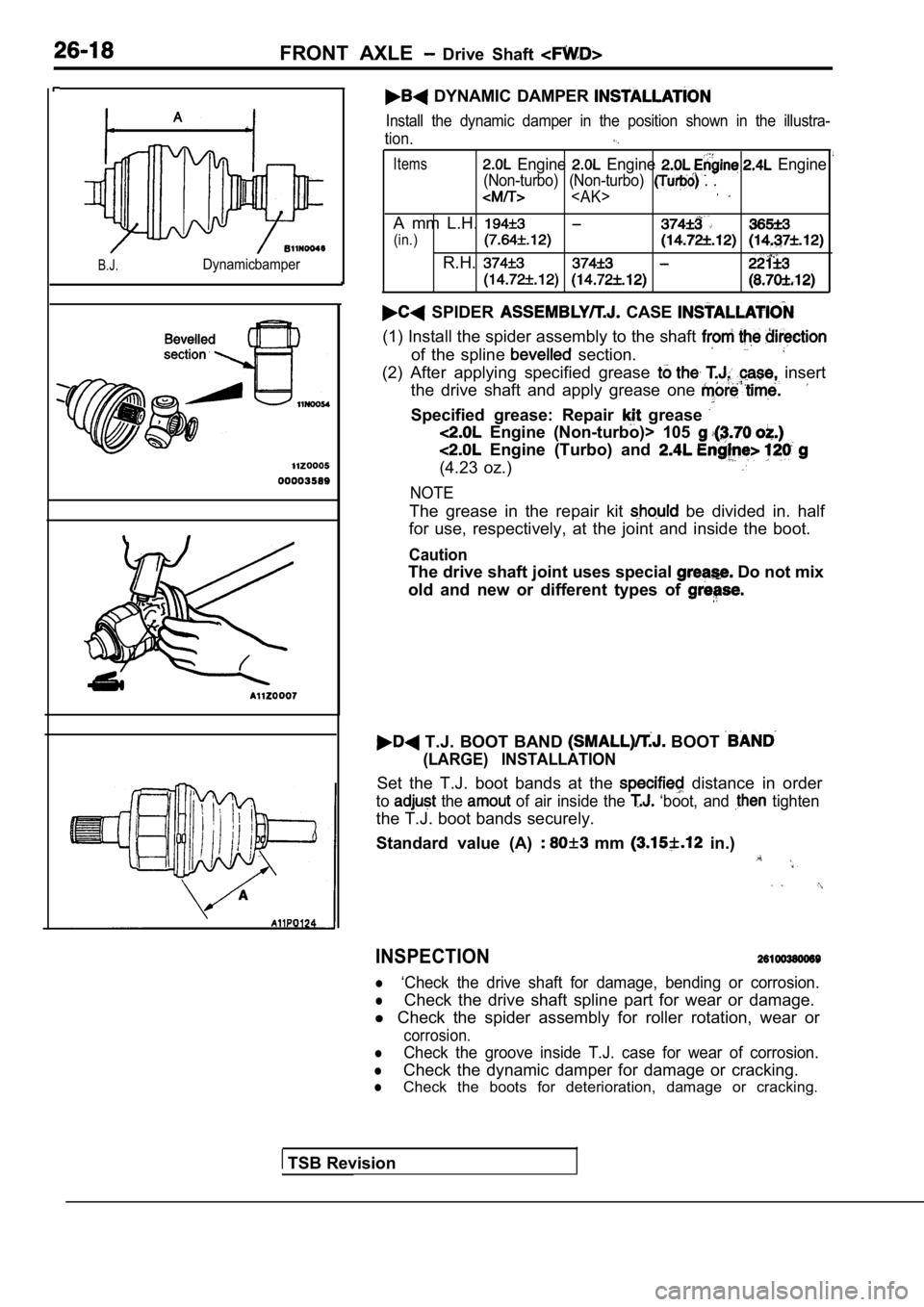
DYNAMIC DAMPER
Install the dynamic damper in the position shown in the illustra-
tion.
Items Engine Engine Engine
(Non-turbo) (Non-turbo) . .
A mm L.H.
(in.)
R.H.
SPIDER CASE
(1) Install the spider assembly to the shaft
of the spline section.
(2) After applying specified grease insert
the drive shaft and apply grease one
Specified grease: Repair grease
Engine (Non-turbo)> 105
Engine (Turbo) and
(4.23 oz.)
NOTE
The grease in the repair kit be divided in. half
for use, respectively, at the joint and inside the boot.
Caution
The drive shaft joint uses special Do not mix
old and new or different types of
T.J. BOOT BAND BOOT
(LARGE) INSTALLATION
Set the T.J. boot bands at the distance in order
to the of air inside the ‘boot, and tighten
the T.J. boot bands securely.
Standard value (A)
mm in.)
INSPECTION
l‘Check the drive shaft for damage, bending or corro sion.
lCheck the drive shaft spline part for wear or damage.
l Check the spider assembly for roller rotation, wear or
corrosion.
lCheck the groove inside T.J. case for wear of corro sion.
lCheck the dynamic damper for damage or cracking.
lCheck the boots for deterioration, damage or cracking.
TSB Revision
Page 1548 of 2103
REAR AXLE Troubleshooting
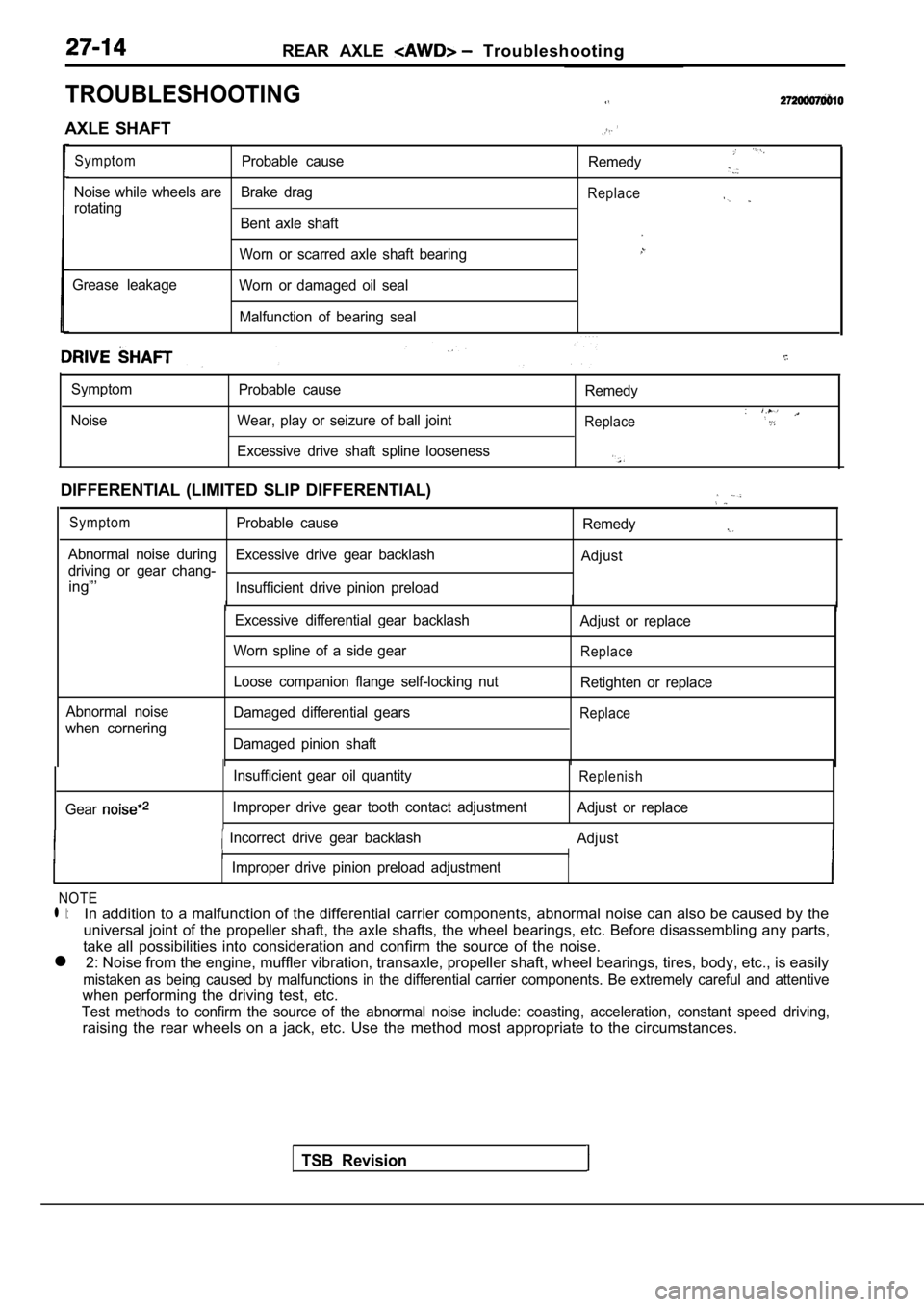
TROUBLESHOOTING
AXLE SHAFT
SymptomProbable causeRemedy
Noise while wheels are Brake drag
rotatingReplace
Bent axle shaft
Worn or scarred axle shaft bearing
Grease leakage Worn or damaged oil seal
Malfunction of bearing seal
Symptom
Noise Probable cause
Wear, play or seizure of ball joint Remedy
Replace
Excessive drive shaft spline looseness
DIFFERENTIAL (LIMITED SLIP DIFFERENTIAL)
SymptomProbable cause
Remedy
Abnormal noise during
driving or gear chang-Excessive drive gear backlash
Adjust
ing”’Insufficient drive pinion preload
II II
Abnormal noise
when cornering Excessive differential gear backlash
Worn spline of a side gear
Loose companion flange self-locking nut
Damaged differential gears
Damaged pinion shaft Adjust or replace
Replace
Retighten or replace
Replace
TSB Revision
Gear
Insufficient gear oil quantity
Improper drive gear tooth contact adjustmentReplenish
Adjust or replace
Incorrect drive gear backlash Adjust
I II
IImproper drive pinion preload adjustment
NOTE
l l:In addition to a malfunction of the differential carrier components, abnormal noise can also be caused by the
universal joint of the propeller shaft, the axle sh afts, the wheel bearings, etc. Before disassembling any parts,
take all possibilities into consideration and confi rm the source of the noise.
l 2: Noise from the engine, muffler vibration, transa xle, propeller shaft, wheel bearings, tires, body, etc., is easily
mistaken as being caused by malfunctions in the dif ferential carrier components. Be extremely careful and attentive
when performing the driving test, etc.
Test methods to confirm the source of the abnormal noise include: coasting, acceleration, constant speed
raising the rear wheels on a jack, etc. Use the met hod most appropriate to the circumstances.
driving,
Page 1549 of 2103
R E A R
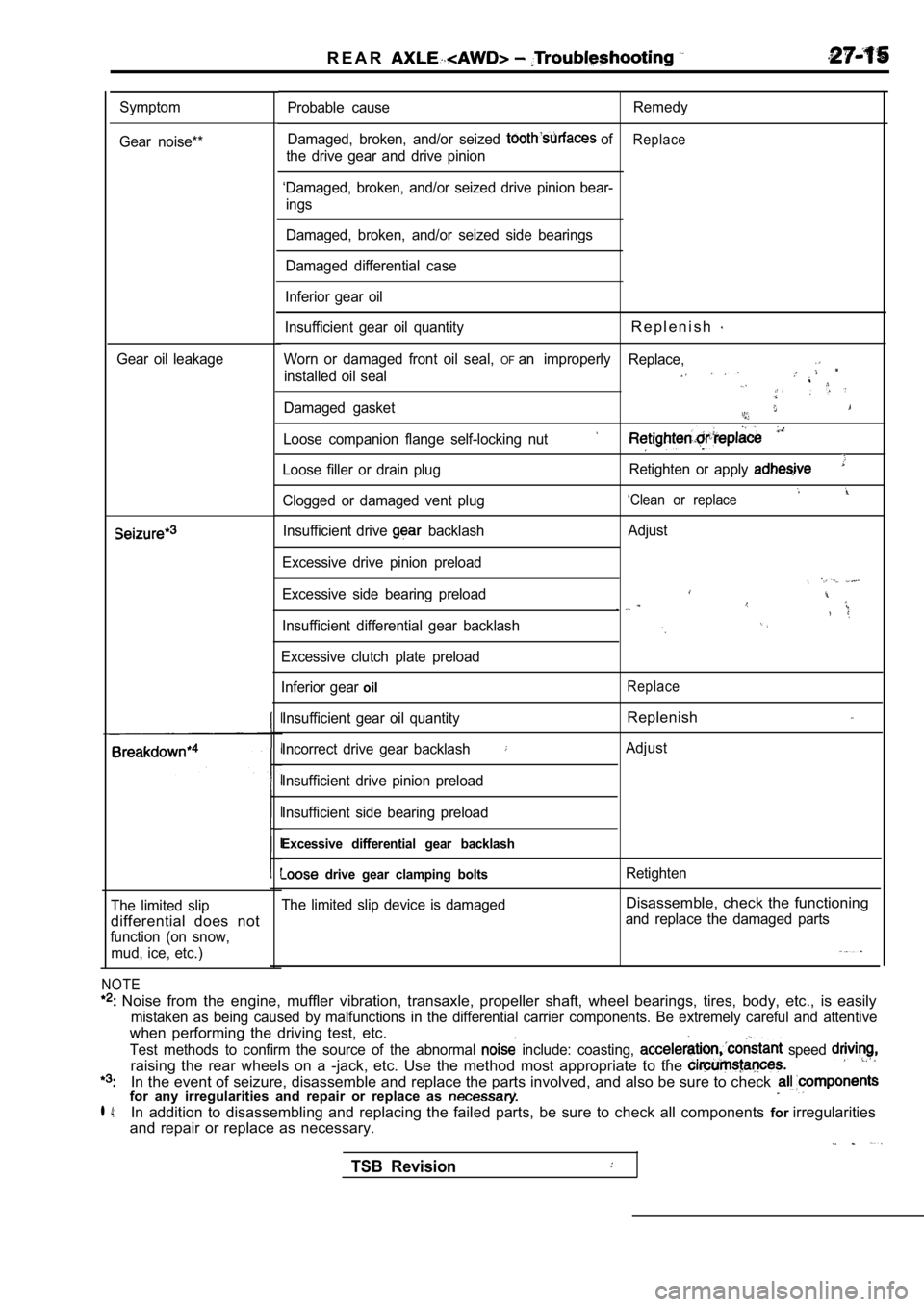
Symptom
Gear noise**
Gear oil leakage
The limited slip
differential does not
function (on snow, mud, ice, etc.)
NOTE
Noise from the engine, muffler vibration, transaxl e, propeller shaft, wheel bearings, tires, body, etc., is easily
mistaken as being caused by malfunctions in the dif ferential carrier components. Be extremely careful and attentive
when performing the driving test, etc.
Test methods to confirm the source of the abnormal include: coasting, speed
raising the rear wheels on a -jack, etc. Use the me thod most appropriate to the
In the event of seizure, disassemble and replace the parts involved, and also be sure to check for any irregularities and repair or replace as
l 4:In addition to disassembling and replacing the failed parts, be sure to check all components forirregularities
and repair or replace as necessary.
Probable cause Remedy
Damaged, broken, and/or seized
ofReplace
the drive gear and drive pinion
‘Damaged, broken, and/or seized drive pinion bear- ings
Damaged, broken, and/or seized side bearings
Damaged differential case
Inferior gear oil
Insufficient gear oil quantity
R e p l e n i s h
Worn or damaged front oil seal, OFan improperly Replace,
installed oil seal
Damaged gasket
Loose companion flange self-locking nut
Loose filler or drain plug Retighten or apply
‘Clean or replaceClogged or damaged vent plug
Insufficient drive
backlash
Excessive drive pinion preload
Excessive side bearing preload
Insufficient differential gear backlash
Excessive clutch plate preload
Inferior gear
oil
Insufficient gear oil quantity
Incorrect drive gear backlash
Insufficient drive pinion preload
Insufficient side bearing preload
Excessive differential gear backlash
drive gear clamping bolts
The limited slip device is damaged Adjust
Replace
Replenish
Adjust
Retighten
Disassemble, check the functioning
and replace the damaged parts
TSB Revision
Page 1591 of 2103
MOUNT
CONTENTS
CROSSMEMBER. . . . . . . . . . . . . . . . . . . . . . . . . . .9SERVICE SPECIFICATIONS....‘::. . . . . . . . . . . .3
ENGINE MOUNTING. . . . . . . . . . . . . . . . . . . . . . .4SPECIAL TOOLS. . . . . . . . . . . . . . . . . . . . . . . . . . .3
...
ENGINE ROLL STOPPER,TRANSAXLE. . . . . . . . . . .. . . . . .
CENTERMEMBER. . . . . . . . . . . . . . . . . . . . . . . . . .7
TROUBLESHOOTING
. . . . . . . . . . . . . . . . . . . . . .3
GENERAL INFORMATION. . . . . . . . . . . . . . . . . .2
Page 1592 of 2103
32-2POWER PLANT MOUNT General Information
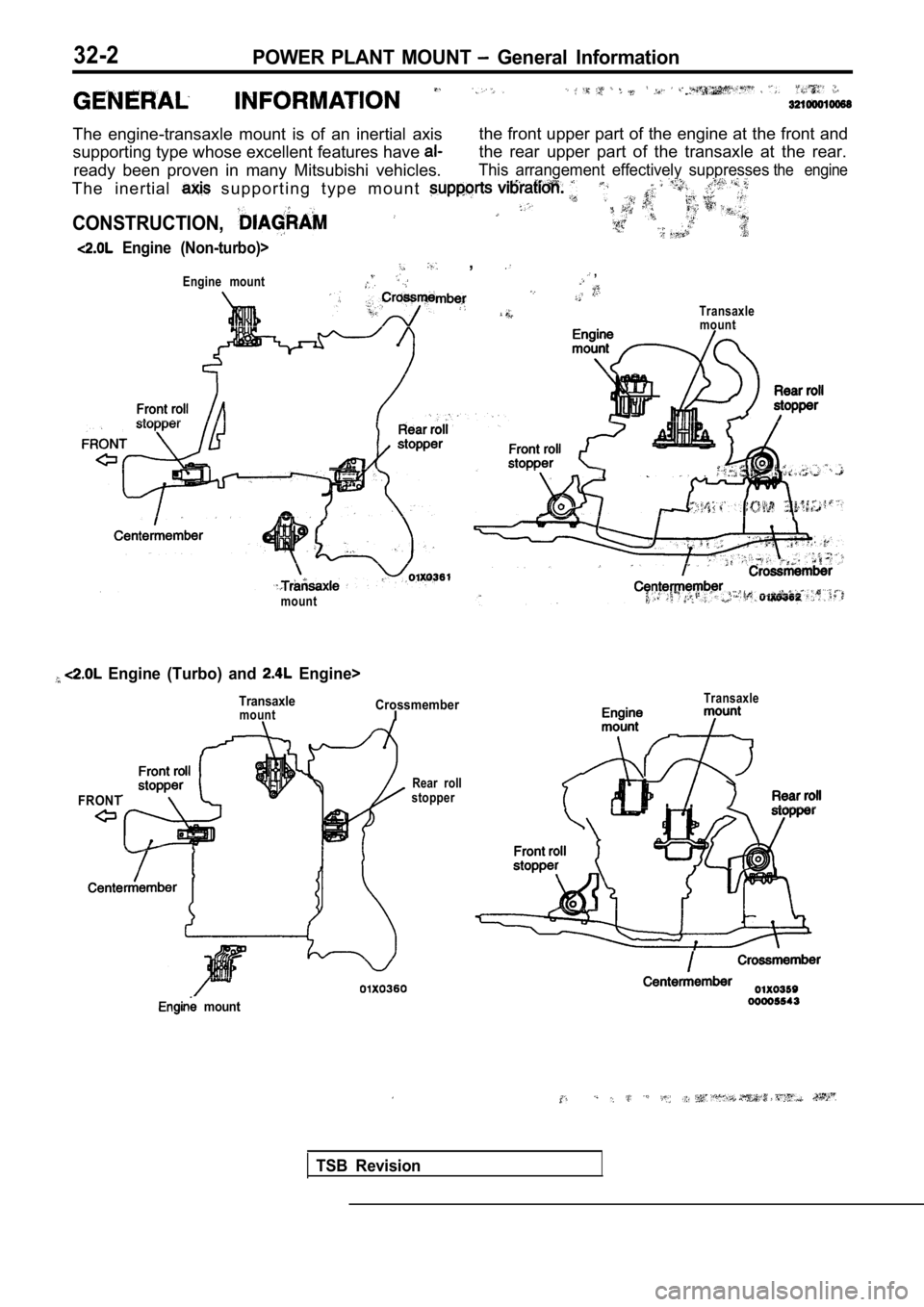
The engine-transaxle mount is of an inertial axisthe front upper part of the engine at the front and
supporting type whose excellent features have
the rear upper part of the transaxle at the rear.
ready been proven in many Mitsubishi vehicles.
This arrangement effectively suppressesthe engine
The inertial s u p p o r t i n g t y p e m o u n t
CONSTRUCTION,
Engine (Non-turbo)>
Engine mount
, ,
Transaxle
mount
Engine (Turbo) and Engine>
TransaxlemountCrossmemberI
FRONT
Rear roll
stopper
mount
Transaxle
mount
TSB Revision