Page 1327 of 2389
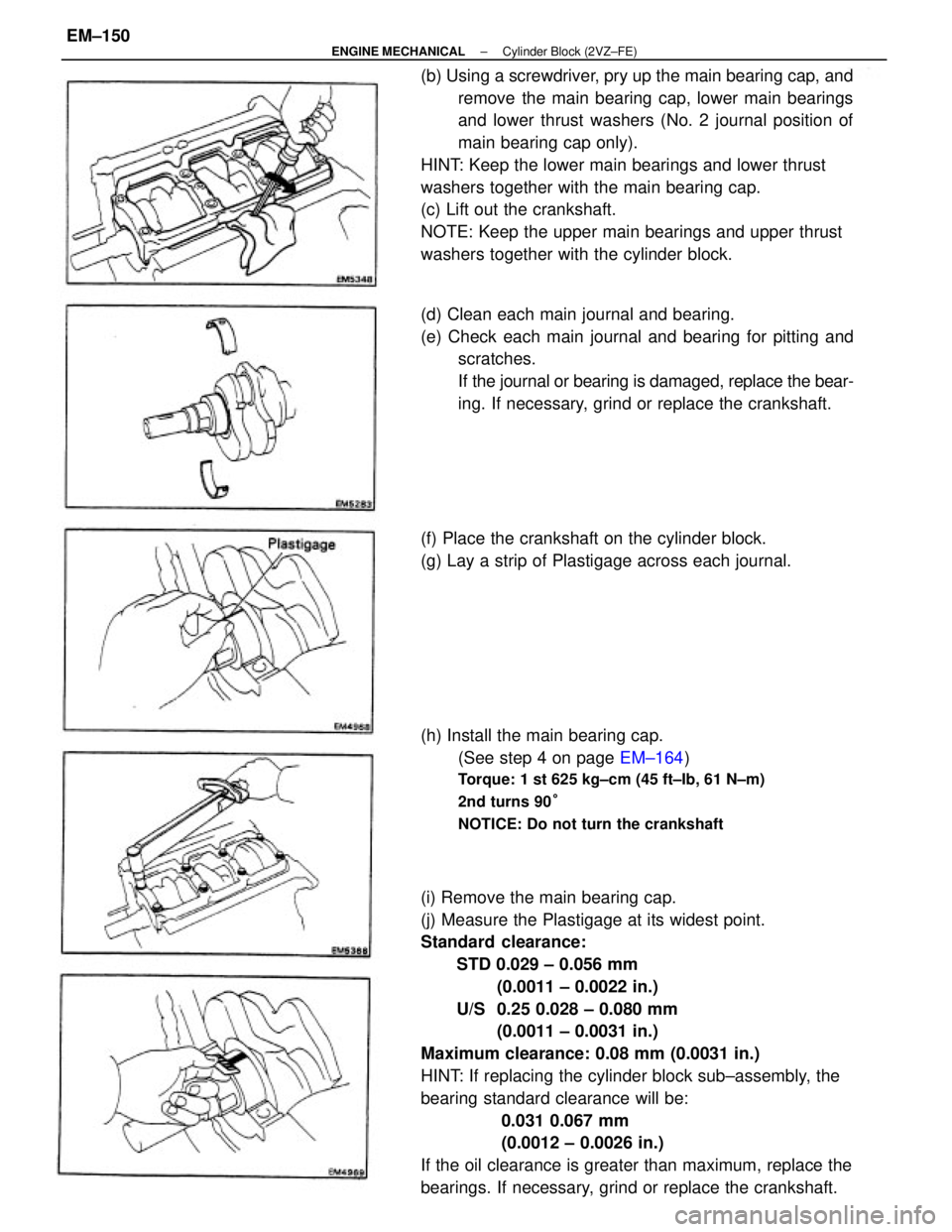
(i) Remove the main bearing cap.
(j) Measure the Plastigage at its widest point.
Standard clearance:
STD 0.029 ± 0.056 mm
(0.0011 ± 0.0022 in.)
U/S 0.25 0.028 ± 0.080 mm
(0.0011 ± 0.0031 in.)
Maximum clearance: 0.08 mm (0.0031 in.)
HINT: If replacing the cylinder block sub±assembly, the
bearing standard clearance will be:
0.031 0.067 mm
(0.0012 ± 0.0026 in.)
If the oil clearance is greater than maximum, replace the
bearings. If necessary, grind or replace the crankshaft. (b) Using a screwdriver, pry up the main bearing cap, and
remove the main bearing cap, lower main bearings
and lower thrust washers (No. 2 journal position of
main bearing cap only).
HINT: Keep the lower main bearings and lower thrust
washers together with the main bearing cap.
(c) Lift out the crankshaft.
NOTE: Keep the upper main bearings and upper thrust
washers together with the cylinder block.
(d) Clean each main journal and bearing.
(e) Check each main journal and bearing for pitting and
scratches.
If the journal or bearing is damaged, replace the bear-
ing. If necessary, grind or replace the crankshaft.
(h) Install the main bearing cap.
(See step 4 on page EM±164)
Torque: 1 st 625 kg±cm (45 ft±Ib, 61 N±m)
2nd turns 90°
NOTICE: Do not turn the crankshaft
(f) Place the crankshaft on the cylinder block.
(g) Lay a strip of Plastigage across each journal.
± ENGINE MECHANICALCylinder Block (2VZ±FE)EM±150
Page 1328 of 2389
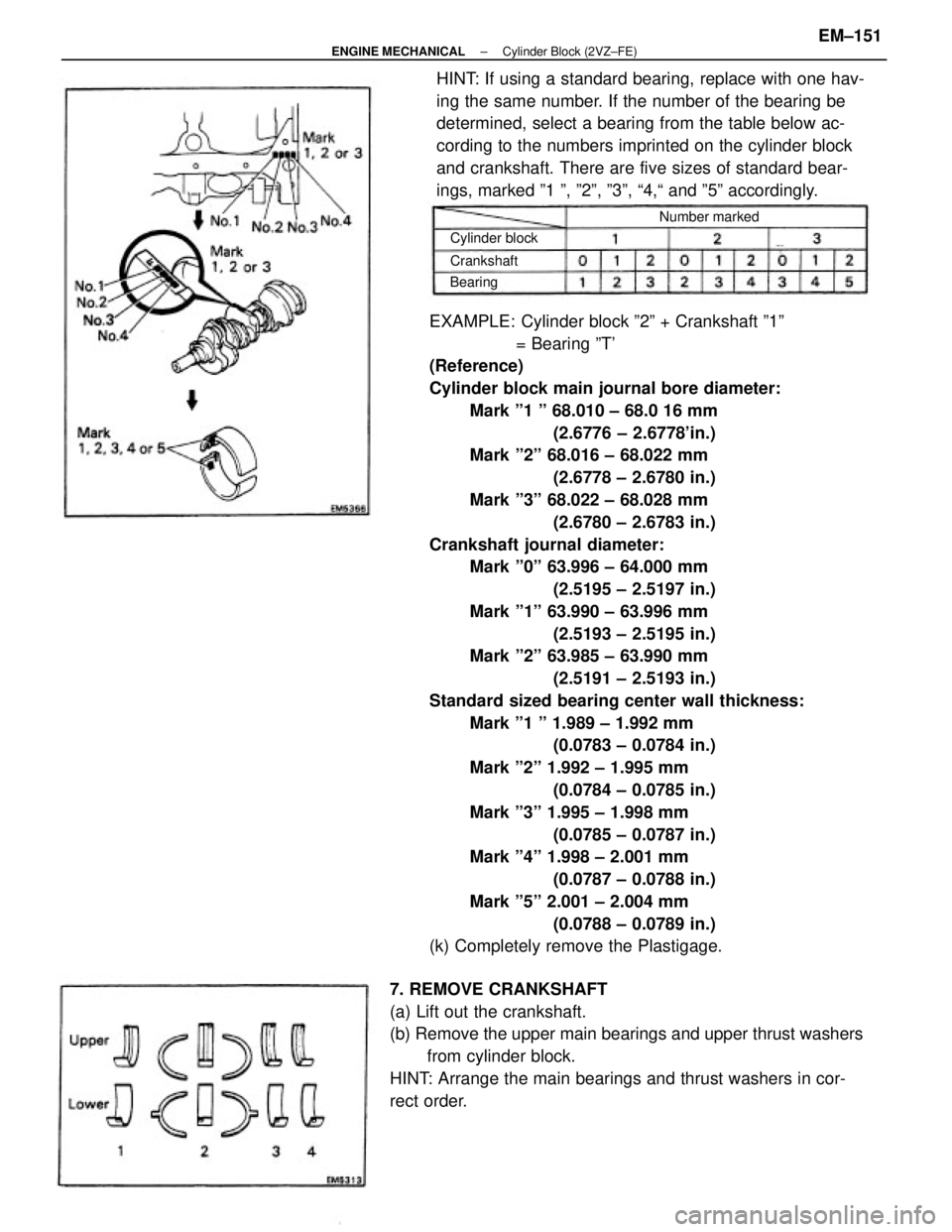
EXAMPLE: Cylinder block º2º + Crankshaft º1º
= Bearing ºT'
(Reference)
Cylinder block main journal bore diameter:
Mark º1 º 68.010 ± 68.0 16 mm
(2.6776 ± 2.6778'in.)
Mark º2º 68.016 ± 68.022 mm
(2.6778 ± 2.6780 in.)
Mark º3º 68.022 ± 68.028 mm
(2.6780 ± 2.6783 in.)
Crankshaft journal diameter:
Mark º0º 63.996 ± 64.000 mm
(2.5195 ± 2.5197 in.)
Mark º1º 63.990 ± 63.996 mm
(2.5193 ± 2.5195 in.)
Mark º2º 63.985 ± 63.990 mm
(2.5191 ± 2.5193 in.)
Standard sized bearing center wall thickness:
Mark º1 º 1.989 ± 1.992 mm
(0.0783 ± 0.0784 in.)
Mark º2º 1.992 ± 1.995 mm
(0.0784 ± 0.0785 in.)
Mark º3º 1.995 ± 1.998 mm
(0.0785 ± 0.0787 in.)
Mark º4º 1.998 ± 2.001 mm
(0.0787 ± 0.0788 in.)
Mark º5º 2.001 ± 2.004 mm
(0.0788 ± 0.0789 in.)
(k) Completely remove the Plastigage.
7. REMOVE CRANKSHAFT
(a) Lift out the crankshaft.
(b) Remove the upper main bearings and upper thrust washers
from cylinder block.
HINT: Arrange the main bearings and thrust washers in cor-
rect order.HINT: If using a standard bearing, replace with one hav-
ing the same number. If the number of the bearing be
determined, select a bearing from the table below ac-
cording to the numbers imprinted on the cylinder block
and crankshaft. There are five sizes of standard bear-
ings, marked º1 º, º2º, º3º, ª4,ª and º5º accordingly.
Number marked
Cylinder block
Crankshaft
Bearing
± ENGINE MECHANICALCylinder Block (2VZ±FE)EM±151
Page 1329 of 2389
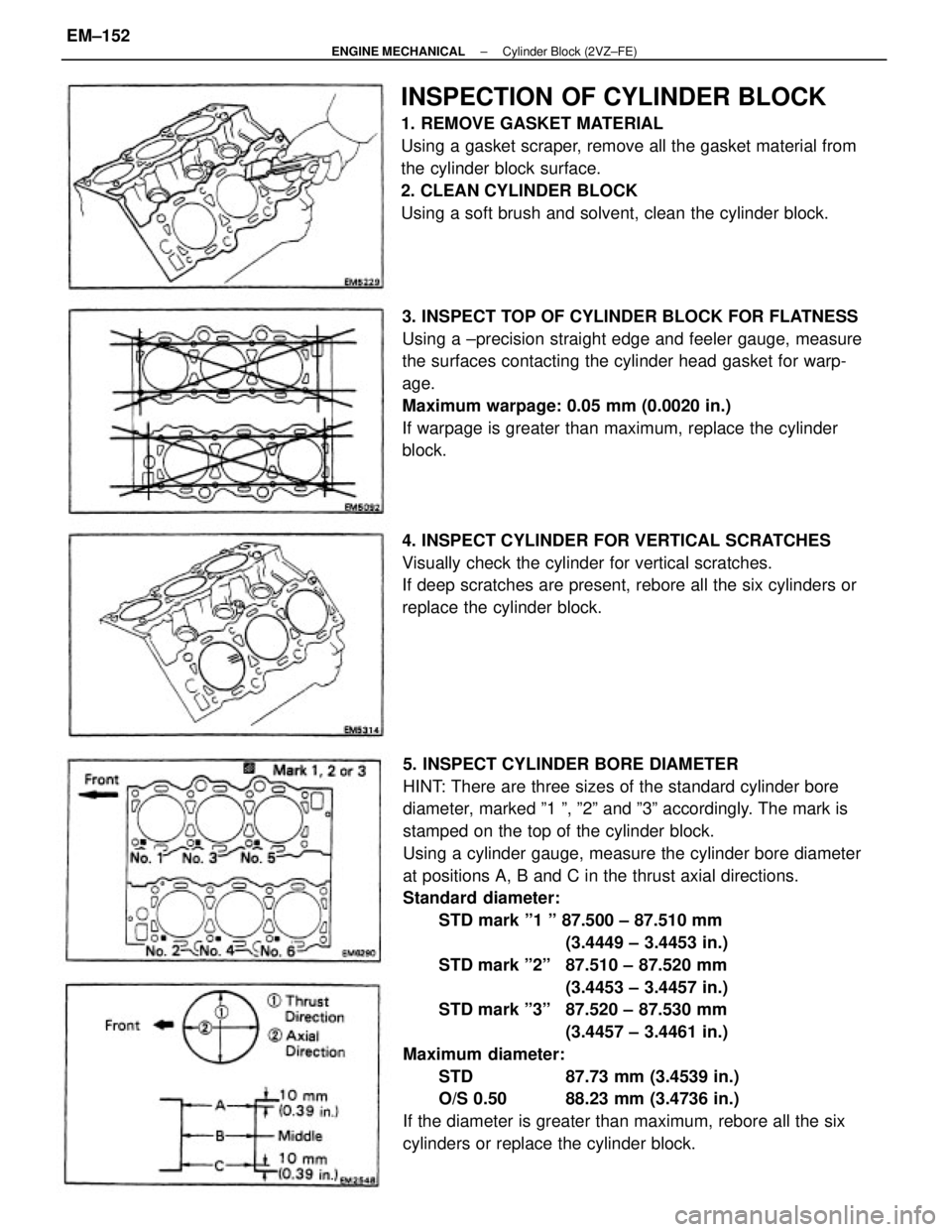
5. INSPECT CYLINDER BORE DIAMETER
HINT: There are three sizes of the standard cylinder bore
diameter, marked º1 º, º2º and º3º accordingly. The mark is
stamped on the top of the cylinder block.
Using a cylinder gauge, measure the cylinder bore diameter
at positions A, B and C in the thrust axial directions.
Standard diameter:
STD mark º1 º 87.500 ± 87.510 mm
(3.4449 ± 3.4453 in.)
STD mark º2º 87.510 ± 87.520 mm
(3.4453 ± 3.4457 in.)
STD mark º3º 87.520 ± 87.530 mm
(3.4457 ± 3.4461 in.)
Maximum diameter:
STD 87.73 mm (3.4539 in.)
O/S 0.50 88.23 mm (3.4736 in.)
If the diameter is greater than maximum, rebore all the six
cylinders or replace the cylinder block.
INSPECTION OF CYLINDER BLOCK
1. REMOVE GASKET MATERIAL
Using a gasket scraper, remove all the gasket material from
the cylinder block surface.
2. CLEAN CYLINDER BLOCK
Using a soft brush and solvent, clean the cylinder block.
3. INSPECT TOP OF CYLINDER BLOCK FOR FLATNESS
Using a ±precision straight edge and feeler gauge, measure
the surfaces contacting the cylinder head gasket for warp-
age.
Maximum warpage: 0.05 mm (0.0020 in.)
If warpage is greater than maximum, replace the cylinder
block.
4. INSPECT CYLINDER FOR VERTICAL SCRATCHES
Visually check the cylinder for vertical scratches.
If deep scratches are present, rebore all the six cylinders or
replace the cylinder block.
± ENGINE MECHANICALCylinder Block (2VZ±FE)EM±152
Page 1330 of 2389
DISASSEMBLY OF PISTON AND
CONNECTING ROD ASSEMBLIES
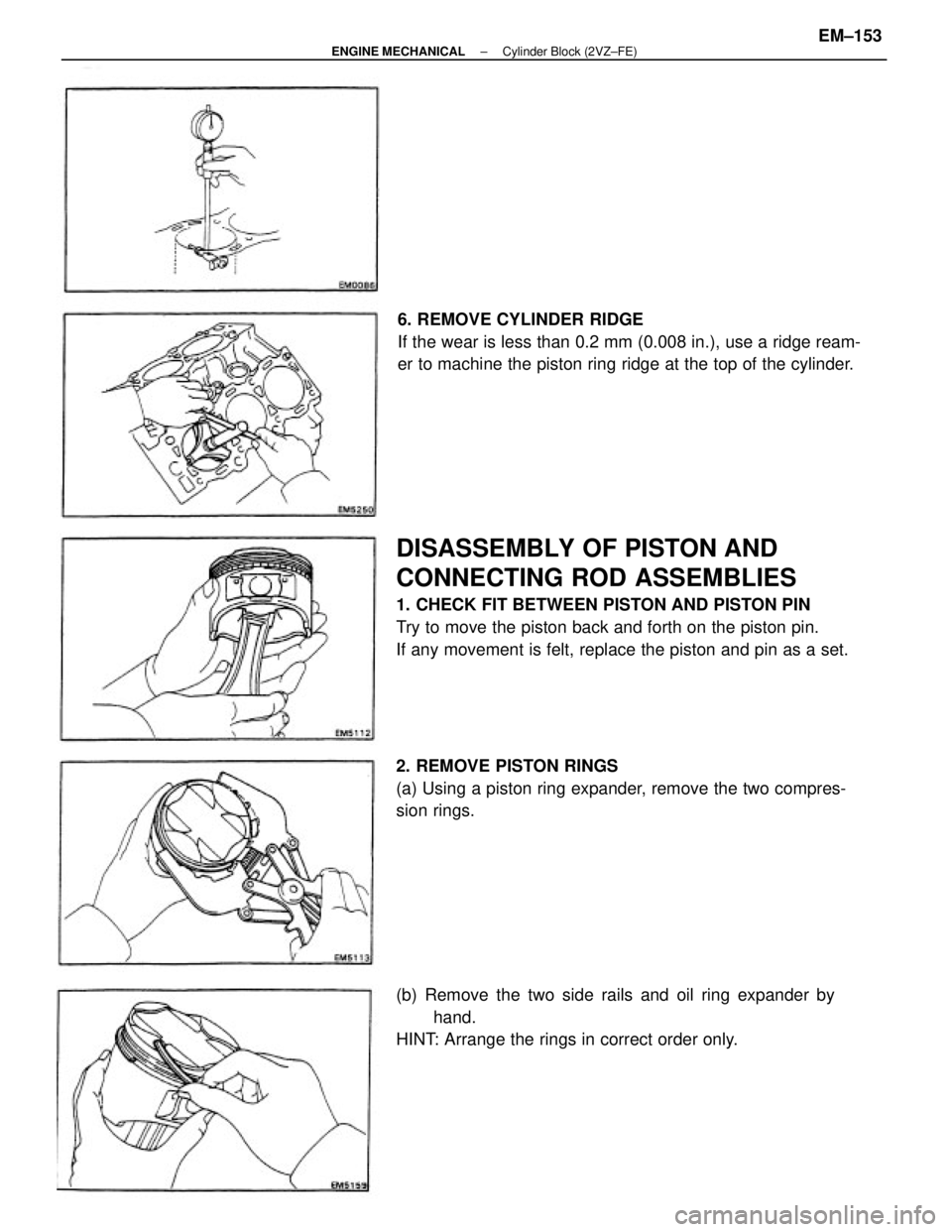
1. CHECK FIT BETWEEN PISTON AND PISTON PIN
Try to move the piston back and forth on the piston pin.
If any movement is felt, replace the piston and pin as a set.6. REMOVE CYLINDER RIDGE
If the wear is less than 0.2 mm (0.008 in.), use a ridge ream-
er to machine the piston ring ridge at the top of the cylinder.
2. REMOVE PISTON RINGS
(a) Using a piston ring expander, remove the two compres-
sion rings.
(b) Remove the two side rails and oil ring expander by
hand.
HINT: Arrange the rings in correct order only.
± ENGINE MECHANICALCylinder Block (2VZ±FE)EM±153
Page 1331 of 2389
INSPECTION OF PISTON AND
CONNECTING ROD ASSEMBLIES
1. CLEAN PISTON
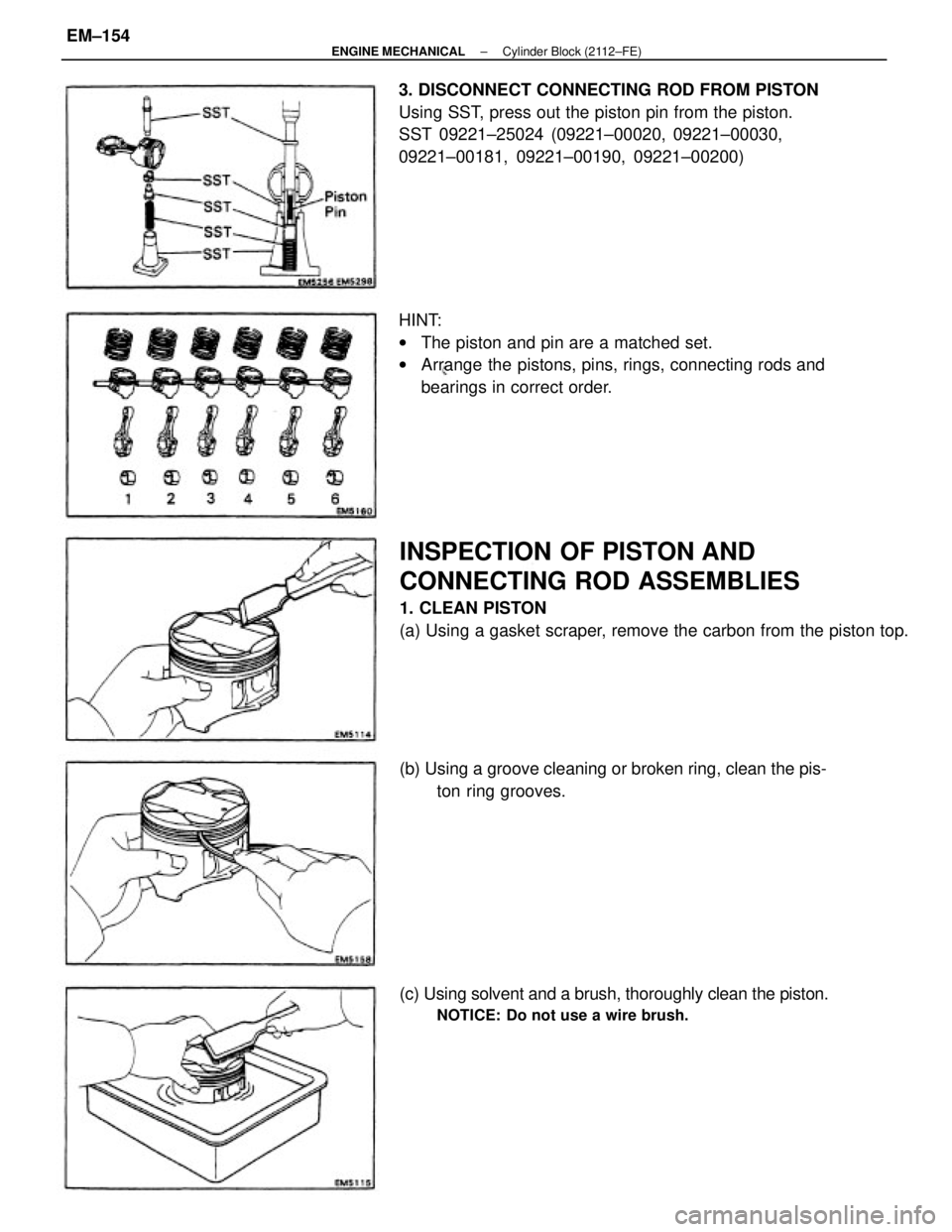
(a) Using a gasket scraper, remove the carbon from the piston top. 3. DISCONNECT CONNECTING ROD FROM PISTON
Using SST, press out the piston pin from the piston.
SST 09221±25024 (09221±00020, 09221±00030,
09221±00181, 09221±00190, 09221±00200)
HINT:
wThe piston and pin are a matched set.
wArrange the pistons, pins, rings, connecting rods and
bearings in correct order.
(c) Using solvent and a brush, thoroughly clean the piston.
NOTICE: Do not use a wire brush.
(b) Using a groove cleaning or broken ring, clean the pis-
ton ring grooves.
± ENGINE MECHANICALCylinder Block (2112±FE)EM±154
Page 1332 of 2389
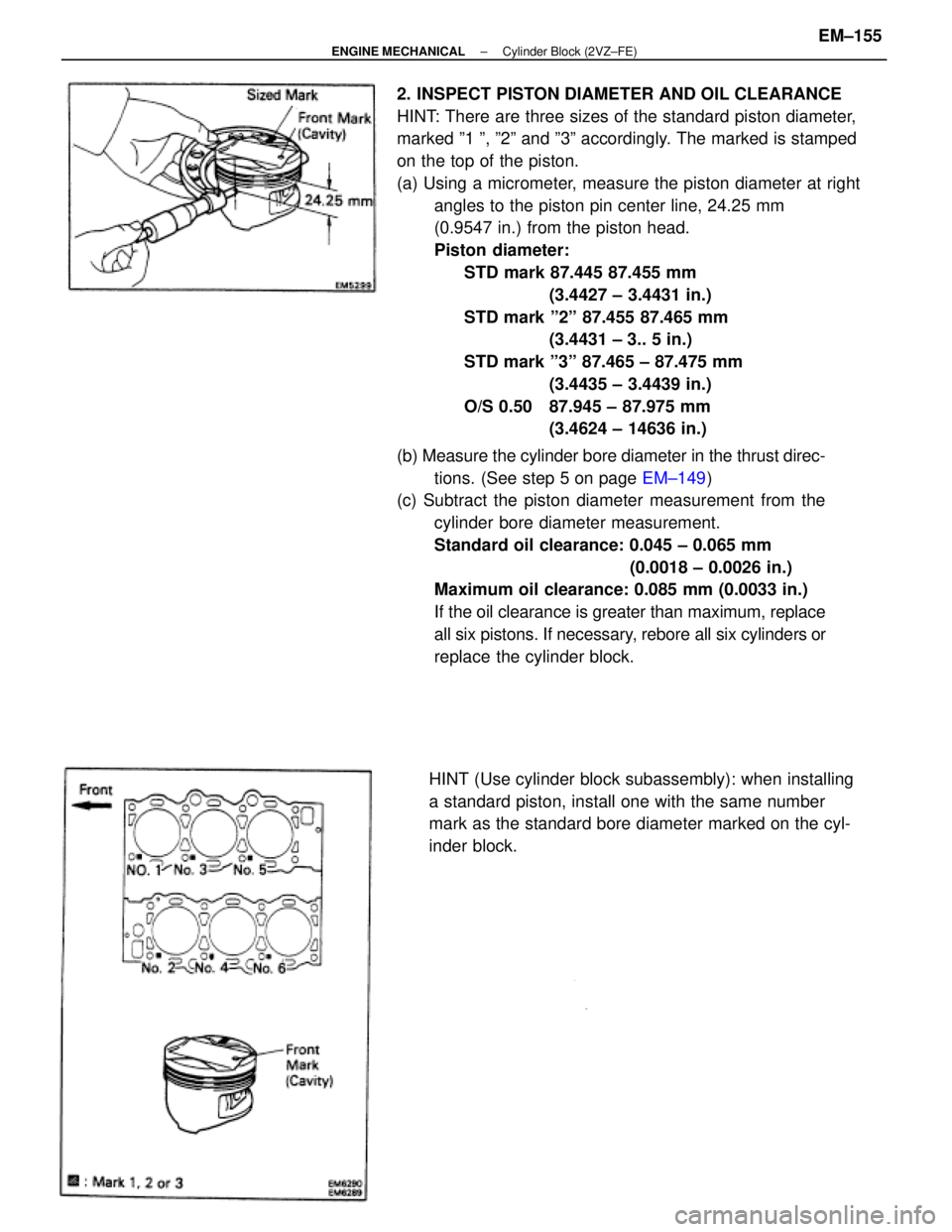
2. INSPECT PISTON DIAMETER AND OIL CLEARANCE
HINT: There are three sizes of the standard piston diameter,
marked º1 º, º2º and º3º accordingly. The marked is stamped
on the top of the piston.
(a) Using a micrometer, measure the piston diameter at right
angles to the piston pin center line, 24.25 mm
(0.9547 in.) from the piston head.
Piston diameter:
STD mark 87.445 87.455 mm
(3.4427 ± 3.4431 in.)
STD mark º2º 87.455 87.465 mm
(3.4431 ± 3.. 5 in.)
STD mark º3º 87.465 ± 87.475 mm
(3.4435 ± 3.4439 in.)
O/S 0.50 87.945 ± 87.975 mm
(3.4624 ± 14636 in.)
(b) Measure the cylinder bore diameter in the thrust direc-
tions. (See step 5 on page EM±149)
(c) Subtract the piston diameter measurement from the
cylinder bore diameter measurement.
Standard oil clearance: 0.045 ± 0.065 mm
(0.0018 ± 0.0026 in.)
Maximum oil clearance: 0.085 mm (0.0033 in.)
If the oil clearance is greater than maximum, replace
all six pistons. If necessary, rebore all six cylinders or
replace the cylinder block.
HINT (Use cylinder block subassembly): when installing
a standard piston, install one with the same number
mark as the standard bore diameter marked on the cyl-
inder block.
± ENGINE MECHANICALCylinder Block (2VZ±FE)EM±155
Page 1333 of 2389
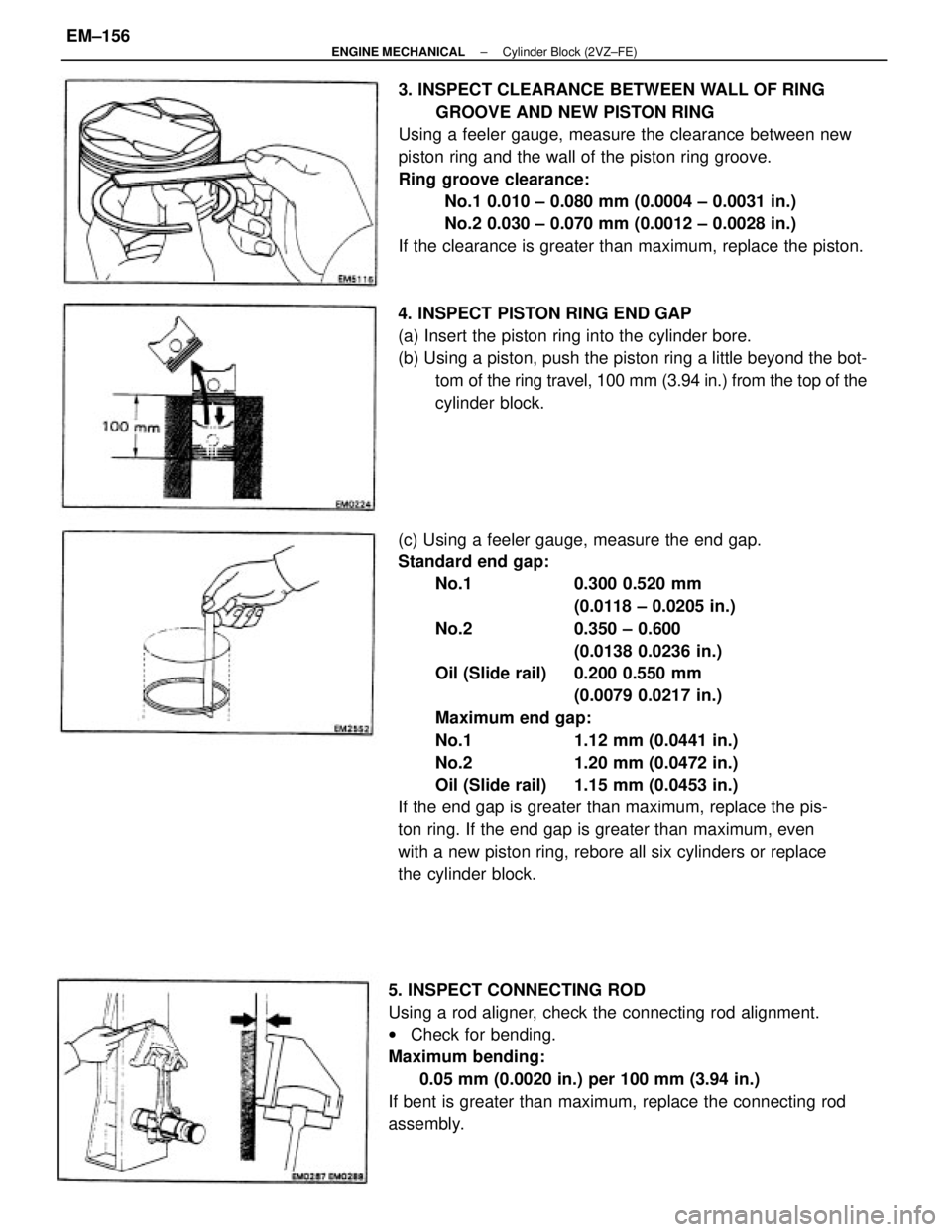
(c) Using a feeler gauge, measure the end gap.
Standard end gap:
No.1 0.300 0.520 mm
(0.0118 ± 0.0205 in.)
No.2 0.350 ± 0.600
(0.0138 0.0236 in.)
Oil (Slide rail) 0.200 0.550 mm
(0.0079 0.0217 in.)
Maximum end gap:
No.1 1.12 mm (0.0441 in.)
No.2 1.20 mm (0.0472 in.)
Oil (Slide rail) 1.15 mm (0.0453 in.)
If the end gap is greater than maximum, replace the pis-
ton ring. If the end gap is greater than maximum, even
with a new piston ring, rebore all six cylinders or replace
the cylinder block.3. INSPECT CLEARANCE BETWEEN WALL OF RING
GROOVE AND NEW PISTON RING
Using a feeler gauge, measure the clearance between new
piston ring and the wall of the piston ring groove.
Ring groove clearance:
No.1 0.010 ± 0.080 mm (0.0004 ± 0.0031 in.)
No.2 0.030 ± 0.070 mm (0.0012 ± 0.0028 in.)
If the clearance is greater than maximum, replace the piston.
5. INSPECT CONNECTING ROD
Using a rod aligner, check the connecting rod alignment.
wCheck for bending.
Maximum bending:
0.05 mm (0.0020 in.) per 100 mm (3.94 in.)
If bent is greater than maximum, replace the connecting rod
assembly.4. INSPECT PISTON RING END GAP
(a) Insert the piston ring into the cylinder bore.
(b) Using a piston, push the piston ring a little beyond the bot-
tom of the ring travel, 100 mm (3.94 in.) from the top of the
cylinder block.
± ENGINE MECHANICALCylinder Block (2VZ±FE)EM±156
Page 1334 of 2389
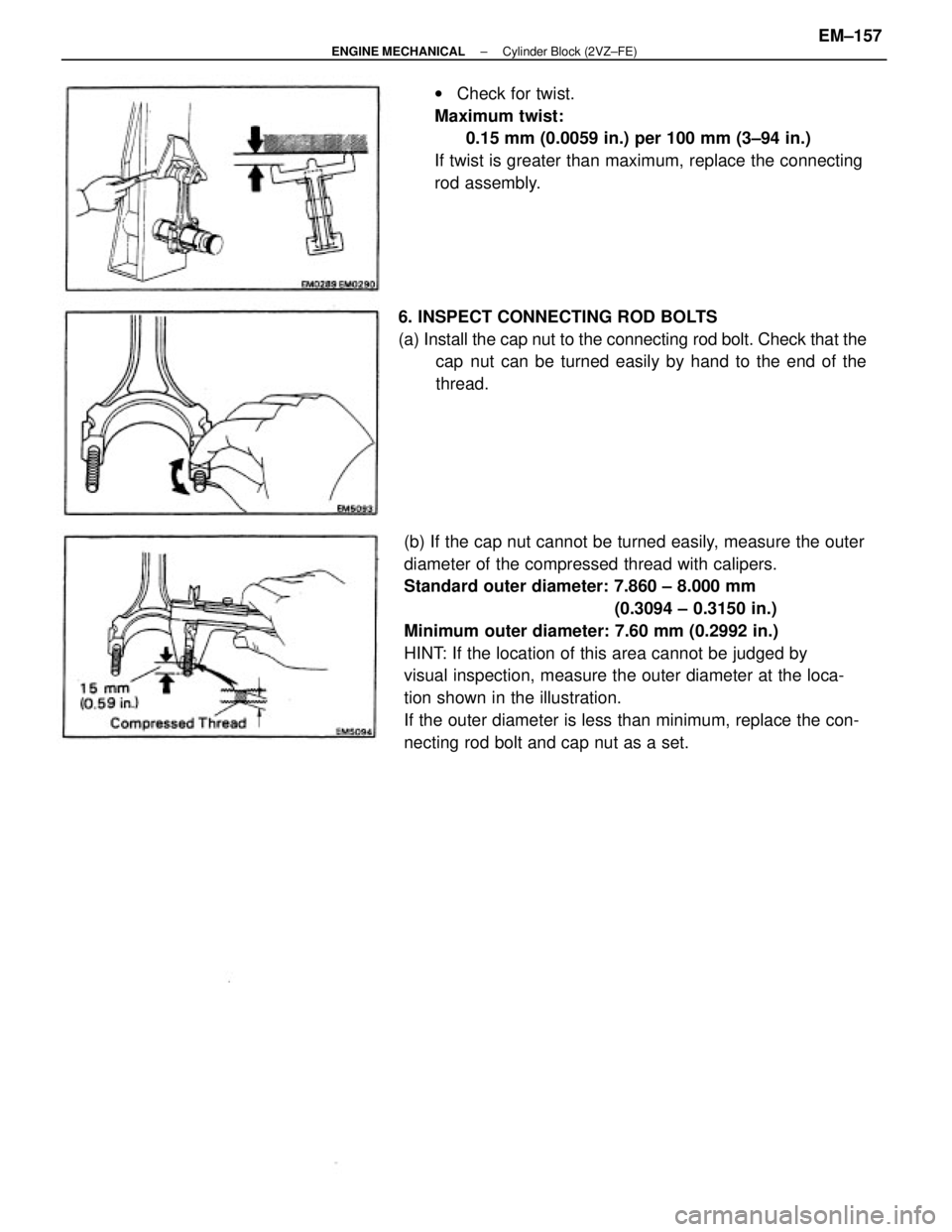
(b) If the cap nut cannot be turned easily, measure the outer
diameter of the compressed thread with calipers.
Standard outer diameter: 7.860 ± 8.000 mm
(0.3094 ± 0.3150 in.)
Minimum outer diameter: 7.60 mm (0.2992 in.)
HINT: If the location of this area cannot be judged by
visual inspection, measure the outer diameter at the loca-
tion shown in the illustration.
If the outer diameter is less than minimum, replace the con-
necting rod bolt and cap nut as a set.wCheck for twist.
Maximum twist:
0.15 mm (0.0059 in.) per 100 mm (3±94 in.)
If twist is greater than maximum, replace the connecting
rod assembly.
6. INSPECT CONNECTING ROD BOLTS
(a) Install the cap nut to the connecting rod bolt. Check that the
cap nut can be turned easily by hand to the end of the
thread.
± ENGINE MECHANICALCylinder Block (2VZ±FE)EM±157