Page 1407 of 2389
6. FILL TRANSAXLE WITH GEAR OIL OR FLUID
M/T (See page MT±1 17)
A/T Fluid type: ATF DEXRON) II
7. INSTALL ENGINE UNDER COVERS
8. INSTALL WHEELS
9. CHECK FRONT WHEEL ALIGNMENT
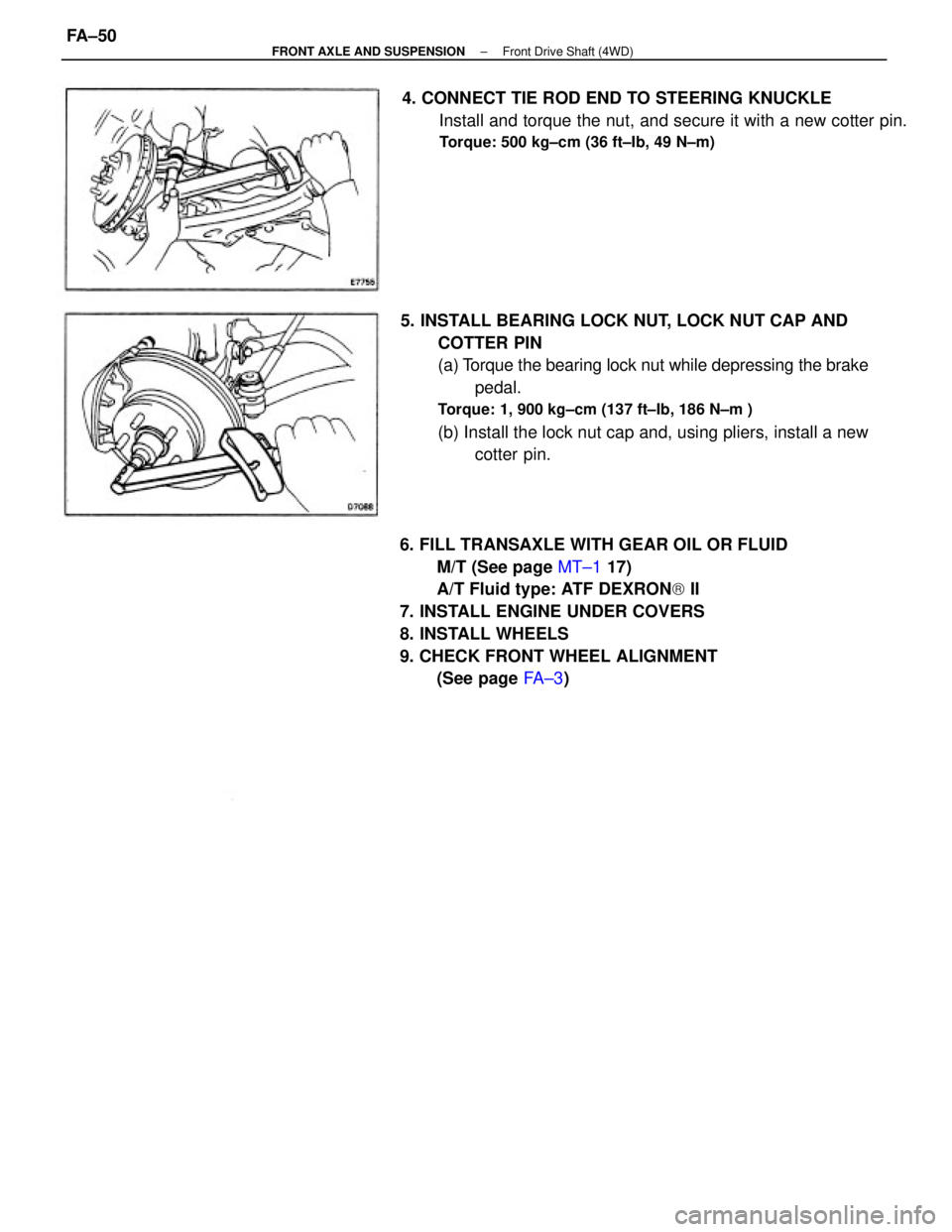
(See page FA ± 3) 5. INSTALL BEARING LOCK NUT, LOCK NUT CAP AND
COTTER PIN
(a) Torque the bearing lock nut while depressing the brake
pedal.
Torque: 1, 900 kg±cm (137 ft±Ib, 186 N±m )
(b) Install the lock nut cap and, using pliers, install a new
cotter pin. 4. CONNECT TIE ROD END TO STEERING KNUCKLE
Install and torque the nut, and secure it with a new cotter pin.
Torque: 500 kg±cm (36 ft±Ib, 49 N±m)
± FRONT AXLE AND SUSPENSIONFront Drive Shaft (4WD)FA±50
Page 1417 of 2389
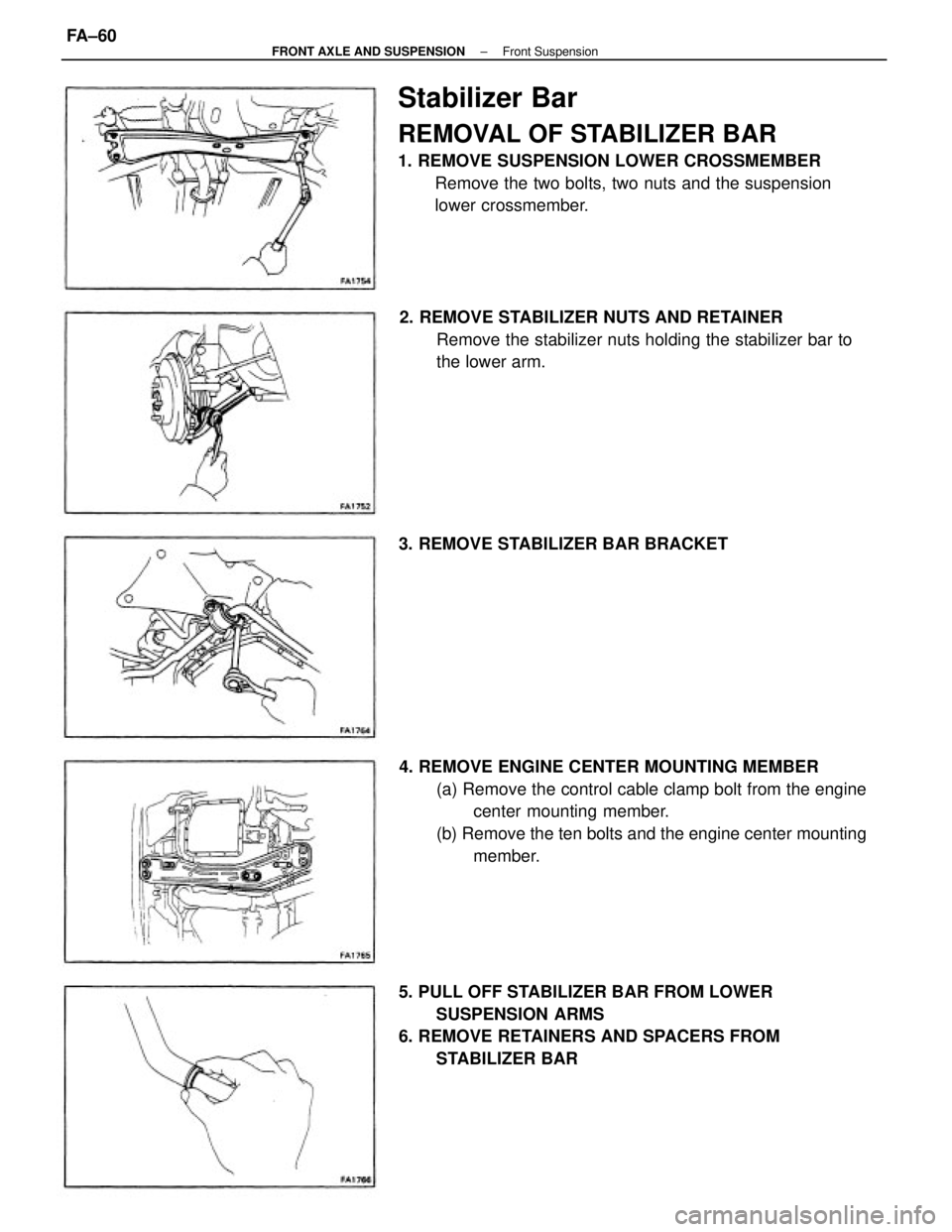
Stabilizer Bar
REMOVAL OF STABILIZER BAR
1. REMOVE SUSPENSION LOWER CROSSMEMBER
Remove the two bolts, two nuts and the suspension
lower crossmember.
4. REMOVE ENGINE CENTER MOUNTING MEMBER
(a) Remove the control cable clamp bolt from the engine
center mounting member.
(b) Remove the ten bolts and the engine center mounting
member.
5. PULL OFF STABILIZER BAR FROM LOWER
SUSPENSION ARMS
6. REMOVE RETAINERS AND SPACERS FROM
STABILIZER BAR 2. REMOVE STABILIZER NUTS AND RETAINER
Remove the stabilizer nuts holding the stabilizer bar to
the lower arm.
3. REMOVE STABILIZER BAR BRACKET
± FRONT AXLE AND SUSPENSIONFront SuspensionFA±60
Page 1418 of 2389
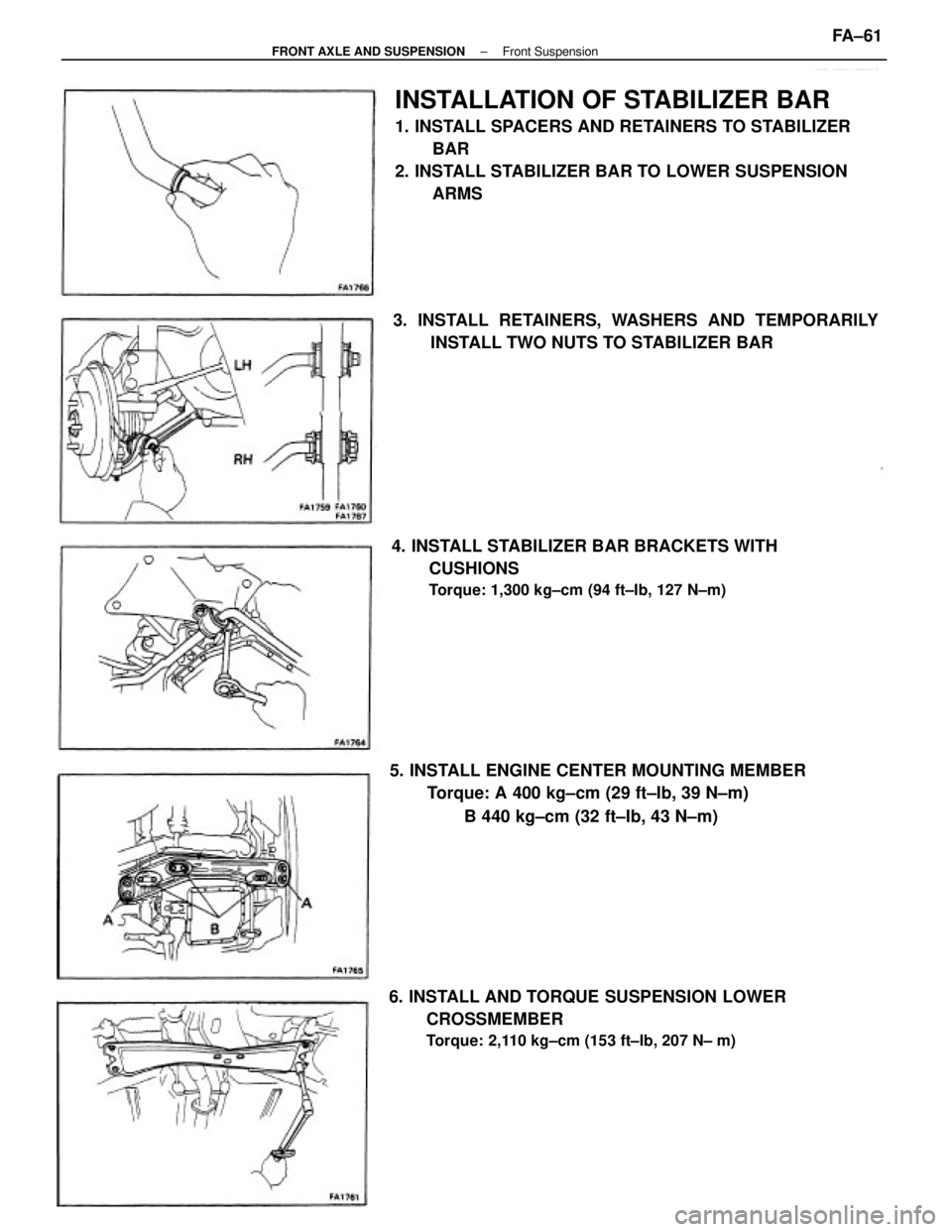
INSTALLATION OF STABILIZER BAR
1. INSTALL SPACERS AND RETAINERS TO STABILIZER
BAR
2. INSTALL STABILIZER BAR TO LOWER SUSPENSION
ARMS
5. INSTALL ENGINE CENTER MOUNTING MEMBER
Torque: A 400 kg±cm (29 ft±Ib, 39 N±m)
B 440 kg±cm (32 ft±Ib, 43 N±m)
6. INSTALL AND TORQUE SUSPENSION LOWER
CROSSMEMBER
Torque: 2,110 kg±cm (153 ft±Ib, 207 N± m)
4. INSTALL STABILIZER BAR BRACKETS WITH
CUSHIONS
Torque: 1,300 kg±cm (94 ft±Ib, 127 N±m)
3. INSTALL RETAINERS, WASHERS AND TEMPORARILY
INSTALL TWO NUTS TO STABILIZER BAR
± FRONT AXLE AND SUSPENSIONFront SuspensionFA±61
Page 1423 of 2389
LY±
(Blue) (Yellow) Example: L±Y
Tab width
1.3 mm
Rubber
Plug
Rubber Ring
Housing Lance
Type
Terminal Lance
Type
INTRODUCTION±GENERAL INFORMATION
A±3
4
Wire Harness Repair Manual (RM1022E)
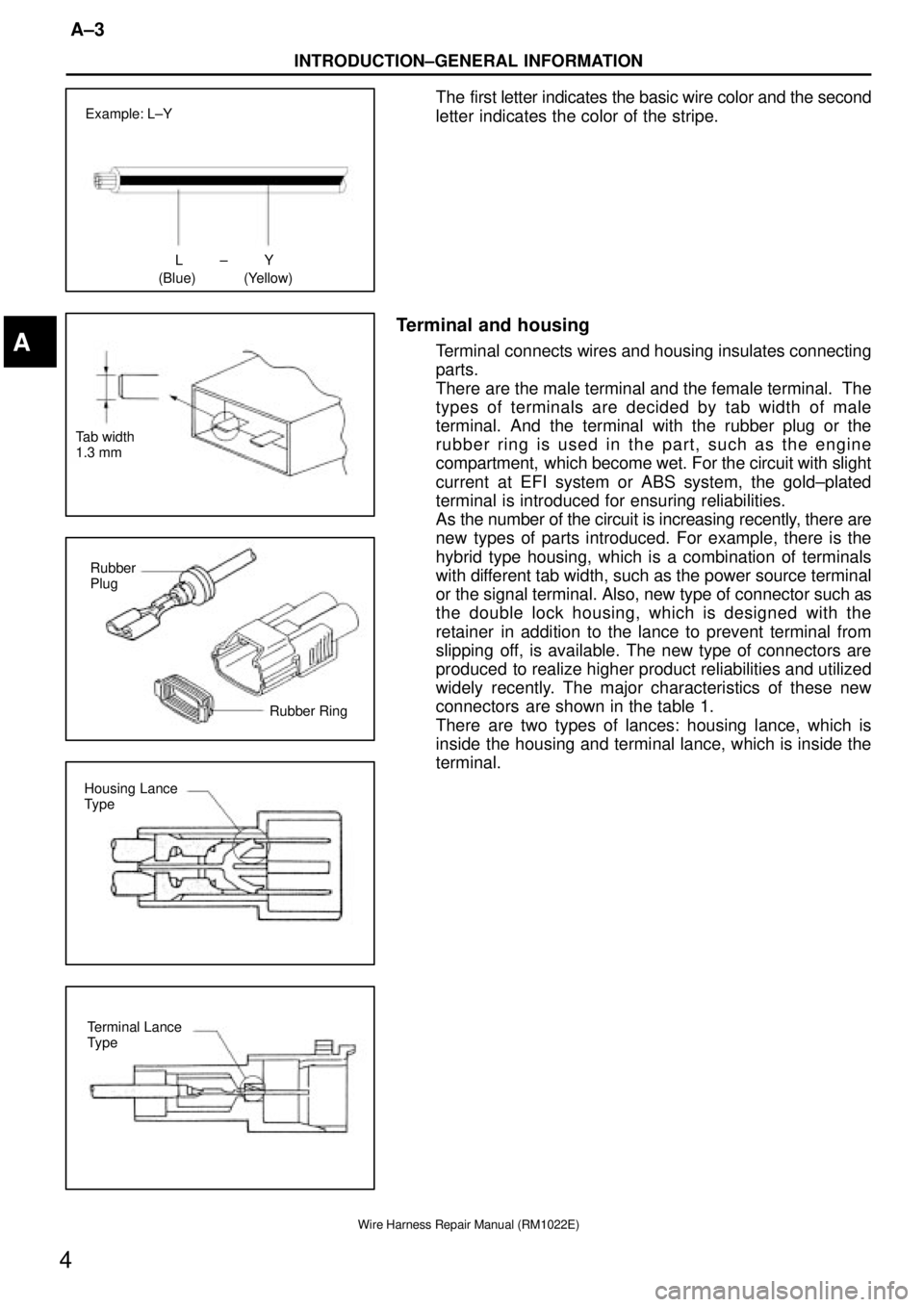
The first letter indicates the basic wire color and the second
letter indicates the color of the stripe.
Terminal and housing
Terminal connects wires and housing insulates connecting
parts.
There are the male terminal and the female terminal. The
types of terminals are decided by tab width of male
terminal. And the terminal with the rubber plug or the
rubber ring is used in the part, such as the engine
compartment, which become wet. For the circuit with slight
current at EFI system or ABS system, the gold±plated
terminal is introduced for ensuring reliabilities.
As the number of the circuit is increasing recently, there are
new types of parts introduced. For example, there is the
hybrid type housing, which is a combination of terminals
with different tab width, such as the power source terminal
or the signal terminal. Also, new type of connector such as
the double lock housing, which is designed with the
retainer in addition to the lance to prevent terminal from
slipping off, is available. The new type of connectors are
produced to realize higher product reliabilities and utilized
widely recently. The major characteristics of these new
connectors are shown in the table 1.
There are two types of lances: housing lance, which is
inside the housing and terminal lance, which is inside the
terminal.A
Page 1459 of 2389
Sleeve Color MarksCrimping
Tool
ºCLOSE HEREº
Contact
ºINSº Position
10 mm (0.39 in.)
Three or More Times
TERMINAL AND CONNECTOR REPAIR±TERMINAL REPLACEMENT
B±30
40
Wire Harness Repair Manual (RM1022E)
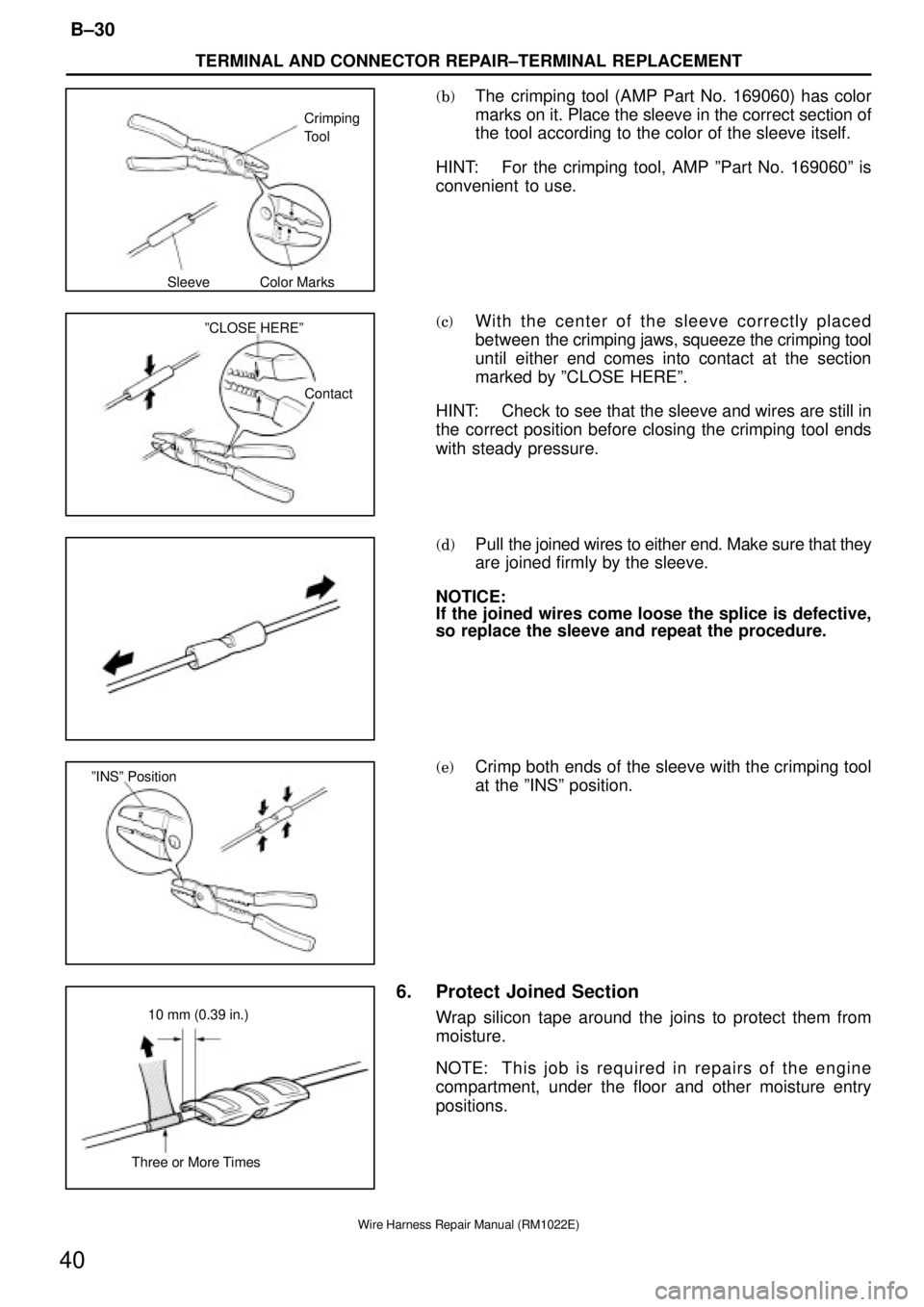
(b)The crimping tool (AMP Part No. 169060) has color
marks on it. Place the sleeve in the correct section of
the tool according to the color of the sleeve itself.
HINT: For the crimping tool, AMP ºPart No. 169060º is
convenient to use.
(c)With the center of the sleeve correctly placed
between the crimping jaws, squeeze the crimping tool
until either end comes into contact at the section
marked by ºCLOSE HEREº.
HINT: Check to see that the sleeve and wires are still in
the correct position before closing the crimping tool ends
with steady pressure.
(d)Pull the joined wires to either end. Make sure that they
are joined firmly by the sleeve.
NOTICE:
If the joined wires come loose the splice is defective,
so replace the sleeve and repeat the procedure.
(e)Crimp both ends of the sleeve with the crimping tool
at the ºINSº position.
6. Protect Joined Section
Wrap silicon tape around the joins to protect them from
moisture.
NOTE: This job is required in repairs of the engine
compartment, under the floor and other moisture entry
positions.
Page 1481 of 2389
Connector A
Connector B
Connector A
Lass than 1mmConnector B
Bolt
Cross±section of the bolt
TERMINAL AND CONNECTOR REPAIR±HOW TO INSTALL AND REMOVE SPECIAL CONNECTORS
B±52
62
Wire Harness Repair Manual (RM1022E)
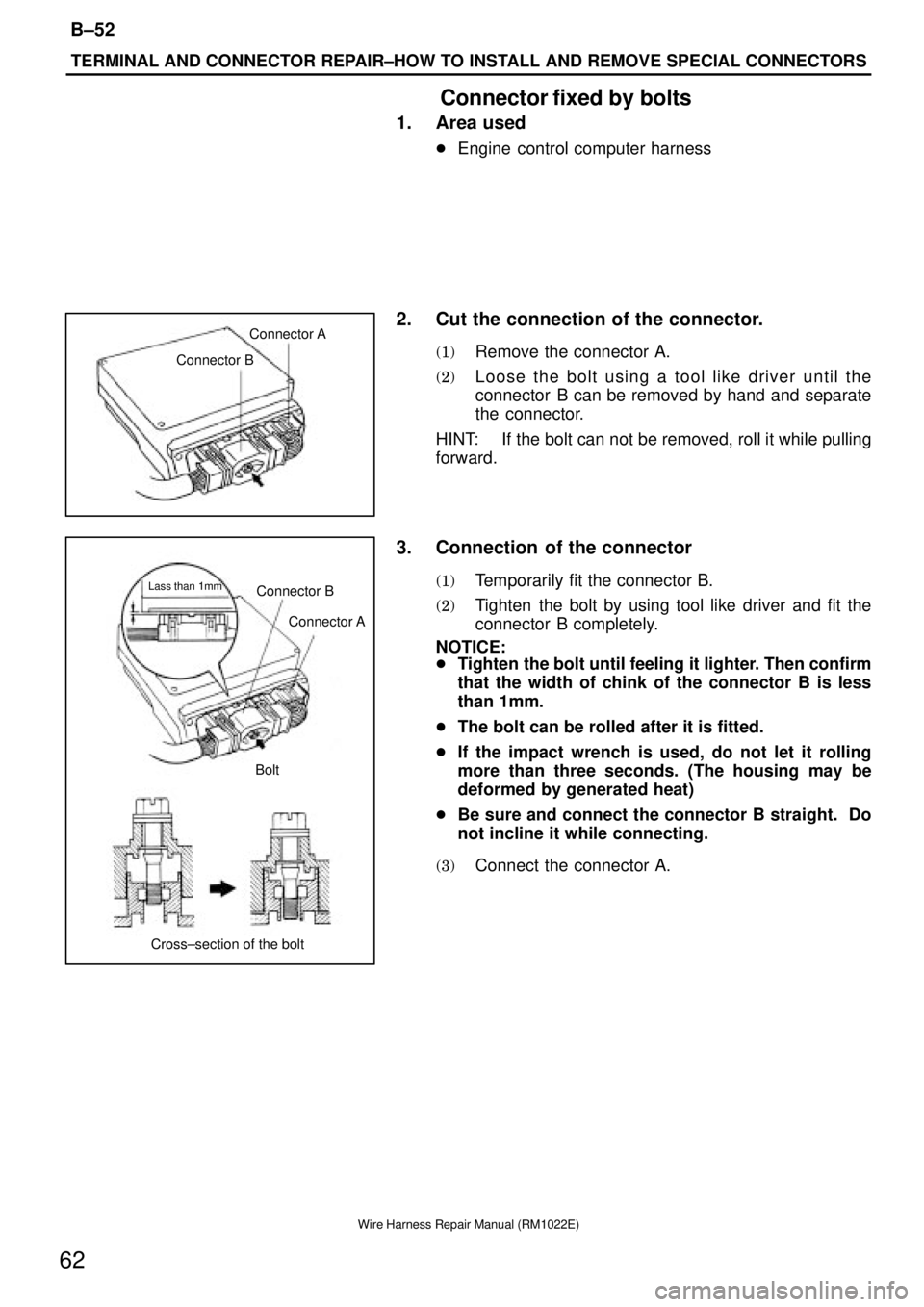
Connector fixed by bolts
1. Area used
�Engine control computer harness
2. Cut the connection of the connector.
(1)Remove the connector A.
(2)Loose the bolt using a tool like driver until the
connector B can be removed by hand and separate
the connector.
HINT: If the bolt can not be removed, roll it while pulling
forward.
3. Connection of the connector
(1)Temporarily fit the connector B.
(2)Tighten the bolt by using tool like driver and fit the
connector B completely.
NOTICE:
�Tighten the bolt until feeling it lighter. Then confirm
that the width of chink of the connector B is less
than 1mm.
�The bolt can be rolled after it is fitted.
�If the impact wrench is used, do not let it rolling
more than three seconds. (The housing may be
deformed by generated heat)
�Be sure and connect the connector B straight. Do
not incline it while connecting.
(3)Connect the connector A.
Page 1835 of 2389
4. As some tachometers are not compatible with this igni-
tion system, we recommend that you confirm the
compatibility of your unit before use.
5. NEVER allow the tachometer test probe to touch ground
as this could damage the igniter and/or ignition coil.
6. Do not disconnect the battery when the engine is run-
ning.
7. Check that the igniter is properly grounded to the body.
PRECAUTIONS
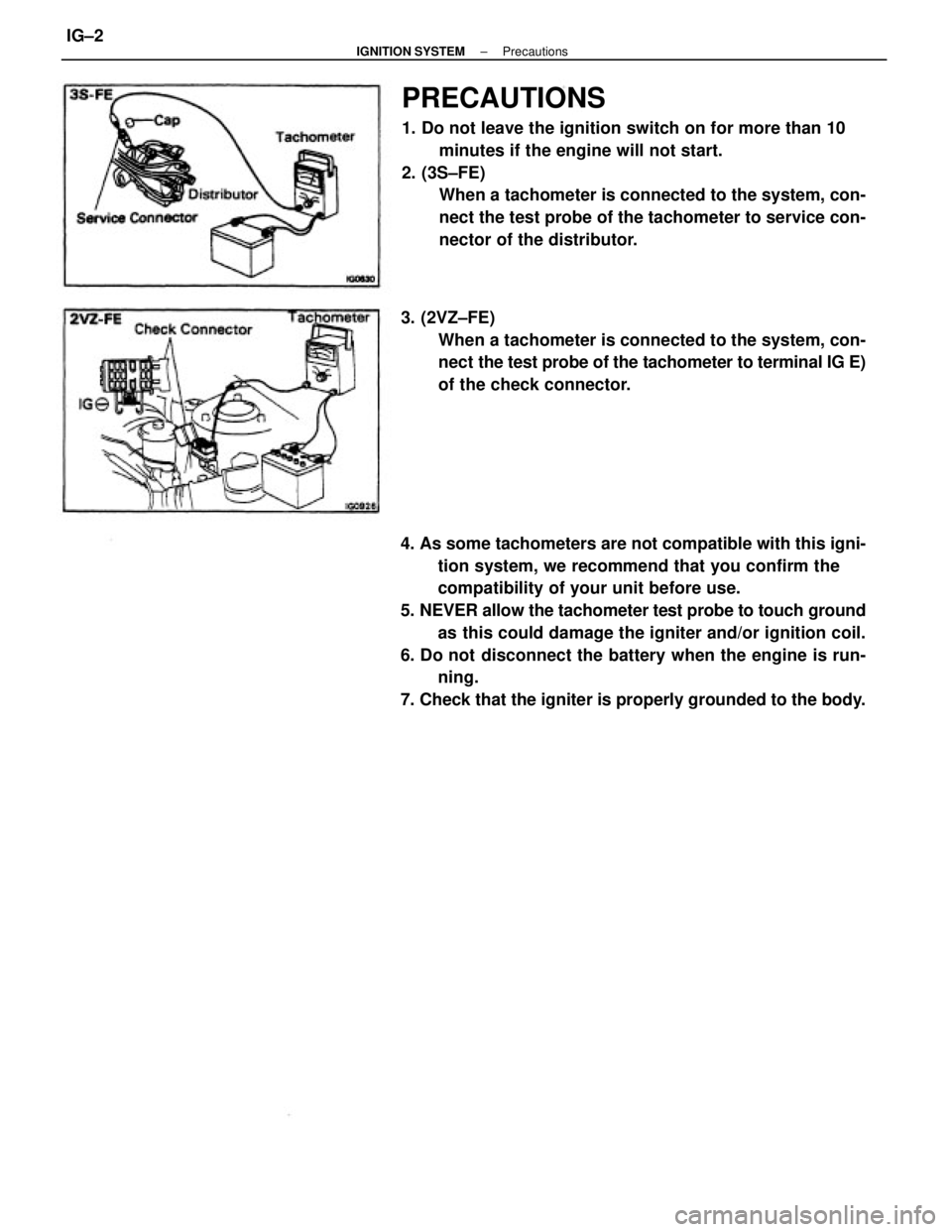
1. Do not leave the ignition switch on for more than 10
minutes if the engine will not start.
2. (3S±FE)
When a tachometer is connected to the system, con-
nect the test probe of the tachometer to service con-
nector of the distributor.
3. (2VZ±FE)
When a tachometer is connected to the system, con-
nect the test probe of the tachometer to terminal IG E)
of the check connector.
± IGNITION SYSTEMPrecautionsIG±2
Page 1836 of 2389
Incorrect ignition timing
Ignition problems
wIgnition coil
wIgniter
wDistributor
wHigh±tension cords
Ignition wiring disconnected or broken
Spark plug faulty
Ignition wiring faulty
Incorrect ignition timing
Ignition problems
wIgnition coil
wIgniter
wDistributor
wHigh±tension cordsReset timing
Inspect coil
Inspect igniter
Inspect distributor
Inspect high±tension cords
Inspect wiring
Inspect coil
Inspect igniter
Inspect distributor
Inspect high±tension cords
Spark plug faulty
Ignition wiring faulty
Incorrect ignition timingIG±17, 20
IG±7, 12
IG±8, 12
IG±7, 12
IG±6, 10
Spark plug faulty
Incorrect ignition timing Engine will not start/
hard to start
(cranks OK)
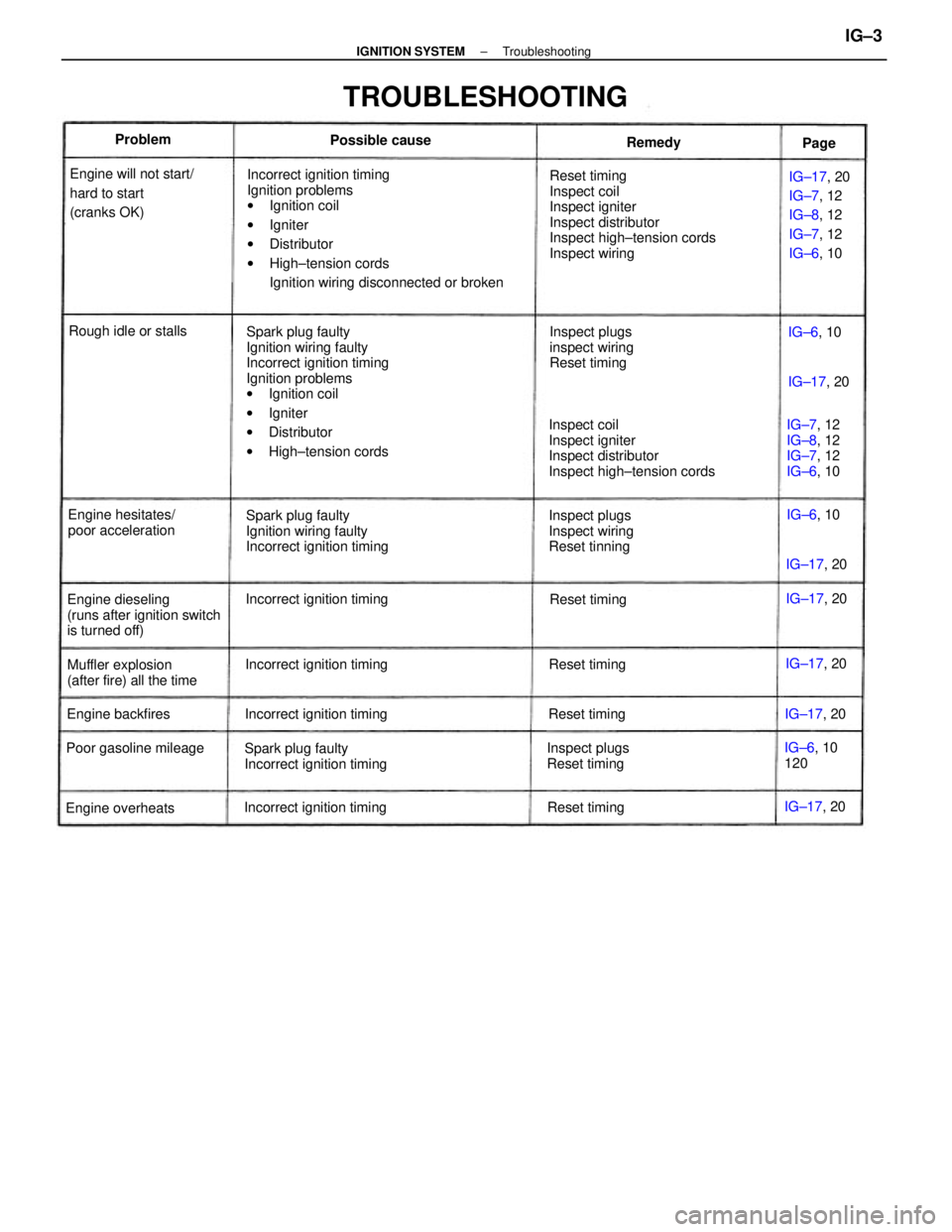
TROUBLESHOOTING
Engine dieseling
(runs after ignition switch
is turned off)Inspect plugs
Inspect wiring
Reset tinningInspect plugs
inspect wiring
Reset timing
Muffler explosion
(after fire) all the timeEngine hesitates/
poor accelerationIG±7, 12
IG±8, 12
IG±7, 12
IG±6, 10
Inspect plugs
Reset timing Incorrect ignition timing
Incorrect ignition timing
Incorrect ignition timing
Incorrect ignition timing Poor gasoline mileageRough idle or stalls
IG±6, 10
120
Engine overheatsEngine backfiresPossible cause
Reset timing
Reset timingReset timingReset timingIG±17, 20 IG±17, 20
IG±17, 20
IG±17, 20 IG±17, 20
IG±17, 20 Problem
IG±6, 10
IG±6, 10 Remedy
Page
± IGNITION SYSTEMTroubleshootingIG±3