Page 2351 of 2389
4. CHECK FLUID PRESSURE READING WITH VALVE
CLOSED
Close the pressure gauge valve and observe the reading
on the gauge.
Minimum pressure:
(VZV series) 75 kg/crn
2 (1,067 psi, 7,355 kPa)
(Others) 65 kg /crm
2 (924 psi, 6,374 kPa)
NOTICE:
wDo not keep the valve closed for more than 10
seconds.
wDo not let the fluid temperature become too high.
If pressure is low, repair or replace the PS pump.
5. OPEN VALVE FULLY .
6. CHECK AND RECORD PRESSURE READING AT
1,000 RPM
7. CHECK AND RECORD PRESSURE READING AT
3,000 RPM
Check that there is 5 kg /cm
2 (71 psi, 490 kPa) or less differ-
ence in pressure between the 1,000 rpm and 3, rpm
checks.
If the difference is excessive, repair or replace the flow con-
trol valve of the PS pump.(b) Connect the gauge side of the pressure gauge to the
PS pump, and the valve side to the pressure line.
(c) Bleed the system. Start the engine and turn the steer-
ing wheel from lock to lock two or three times.
(d) Check that the fluid level is correct.
OIL PRESSURE CHECK
1. CONNECT PRESSURE GAUGE
(a) Using SST, disconnect the pressure line joint.
SST 09631±22020
2. CHECK THAT FLUID TEMPERATURE IS AT LEAST
80
°C (176°F)
3. START ENGINE AND RUN IT AT IDLE
± STEERINGPower Steering (On±Vehicle Inspection)SR±25
Page 2352 of 2389
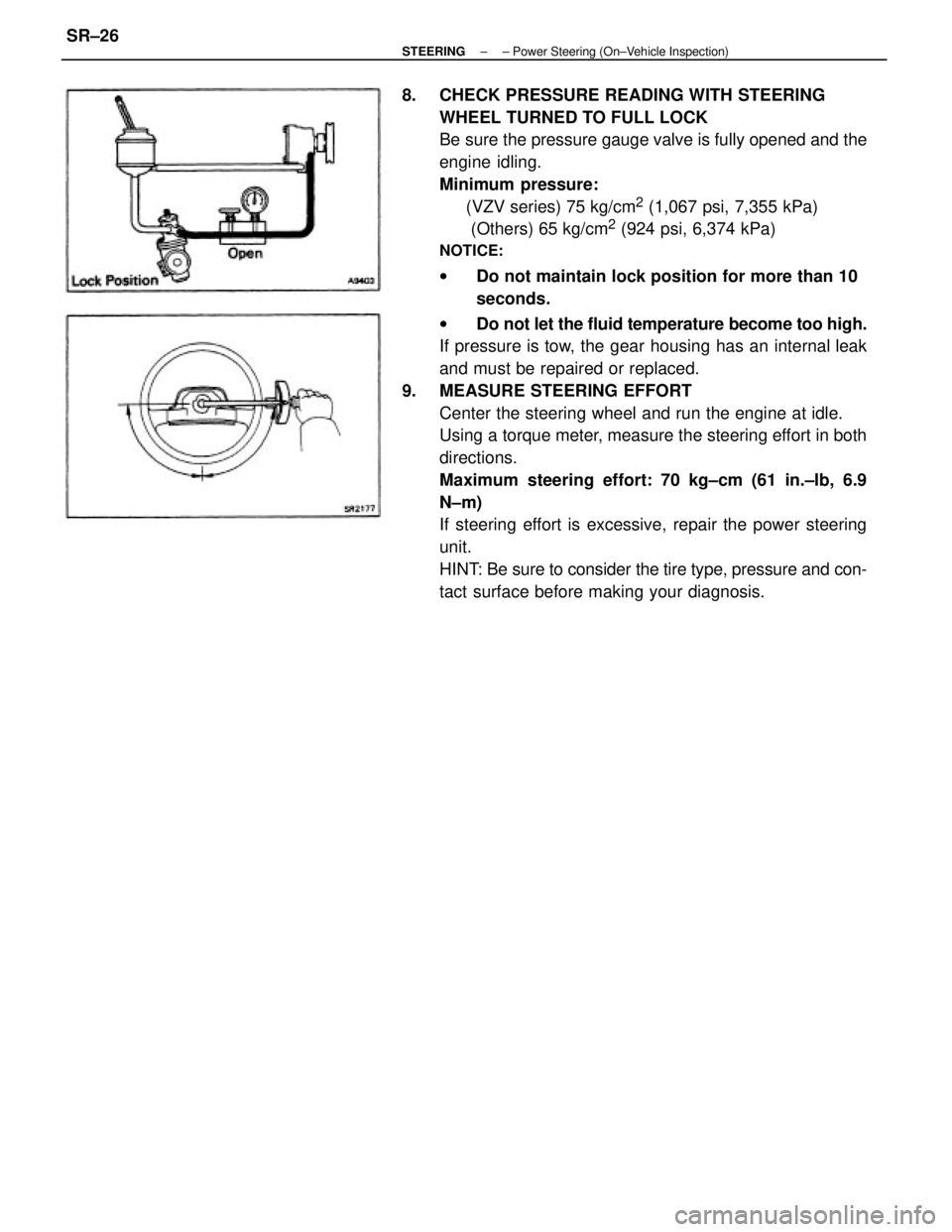
8. CHECK PRESSURE READING WITH STEERING
WHEEL TURNED TO FULL LOCK
Be sure the pressure gauge valve is fully opened and the
engine idling.
Minimum pressure:
(VZV series) 75 kg/cm
2 (1,067 psi, 7,355 kPa)
(Others) 65 kg/cm
2 (924 psi, 6,374 kPa)
NOTICE:
wDo not maintain lock position for more than 10
seconds.
wDo not let the fluid temperature become too high.
If pressure is tow, the gear housing has an internal leak
and must be repaired or replaced.
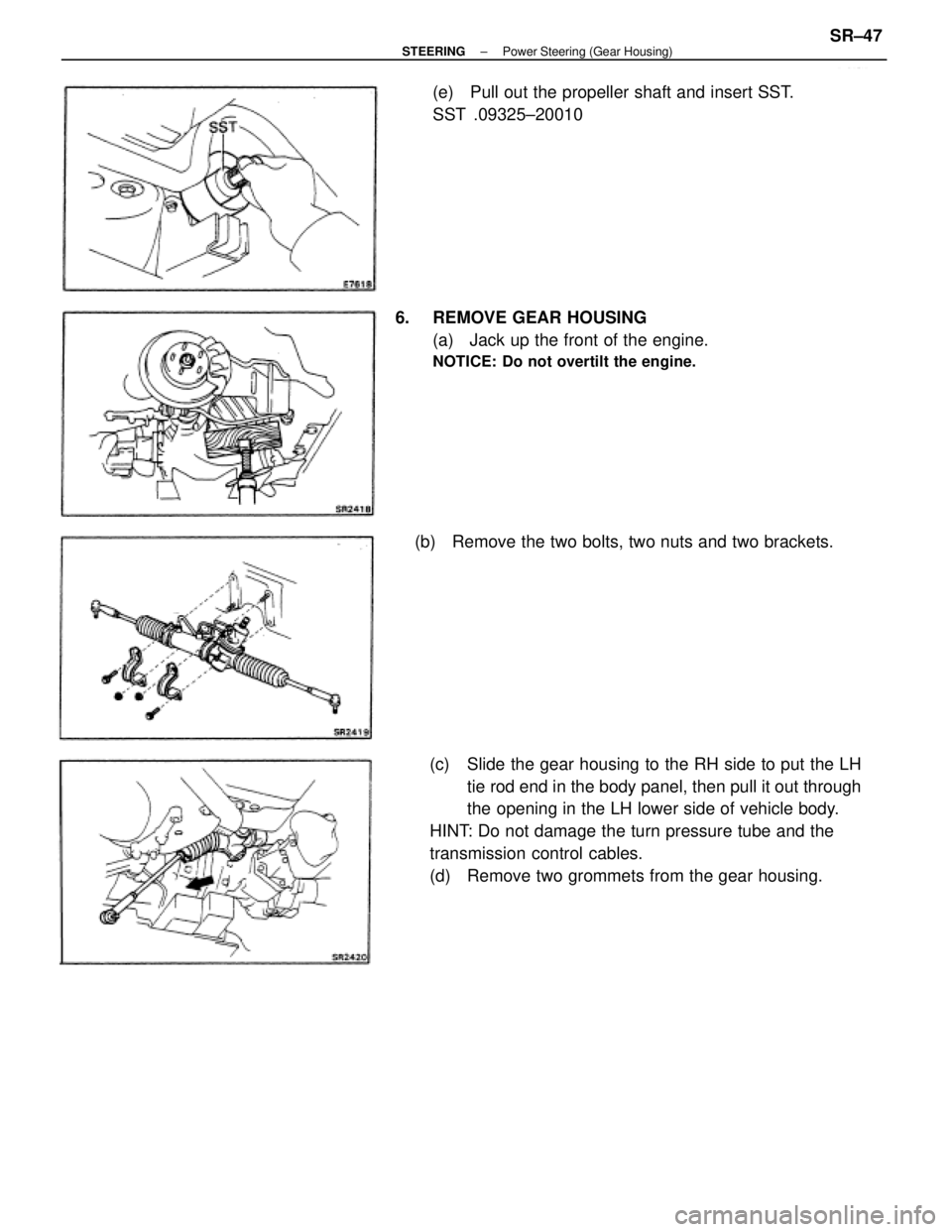
9. MEASURE STEERING EFFORT
Center the steering wheel and run the engine at idle.
Using a torque meter, measure the steering effort in both
directions.
Maximum steering effort: 70 kg±cm (61 in.±Ib, 6.9
N±m)
If steering effort is excessive, repair the power steering
unit.
HINT: Be sure to consider the tire type, pressure and con-
tact surface before making your diagnosis.
± STEERING± Power Steering (On±Vehicle Inspection)SR±26
Page 2373 of 2389
(c) Slide the gear housing to the RH side to put the LH
tie rod end in the body panel, then pull it out through
the opening in the LH lower side of vehicle body.
HINT: Do not damage the turn pressure tube and the
transmission control cables.
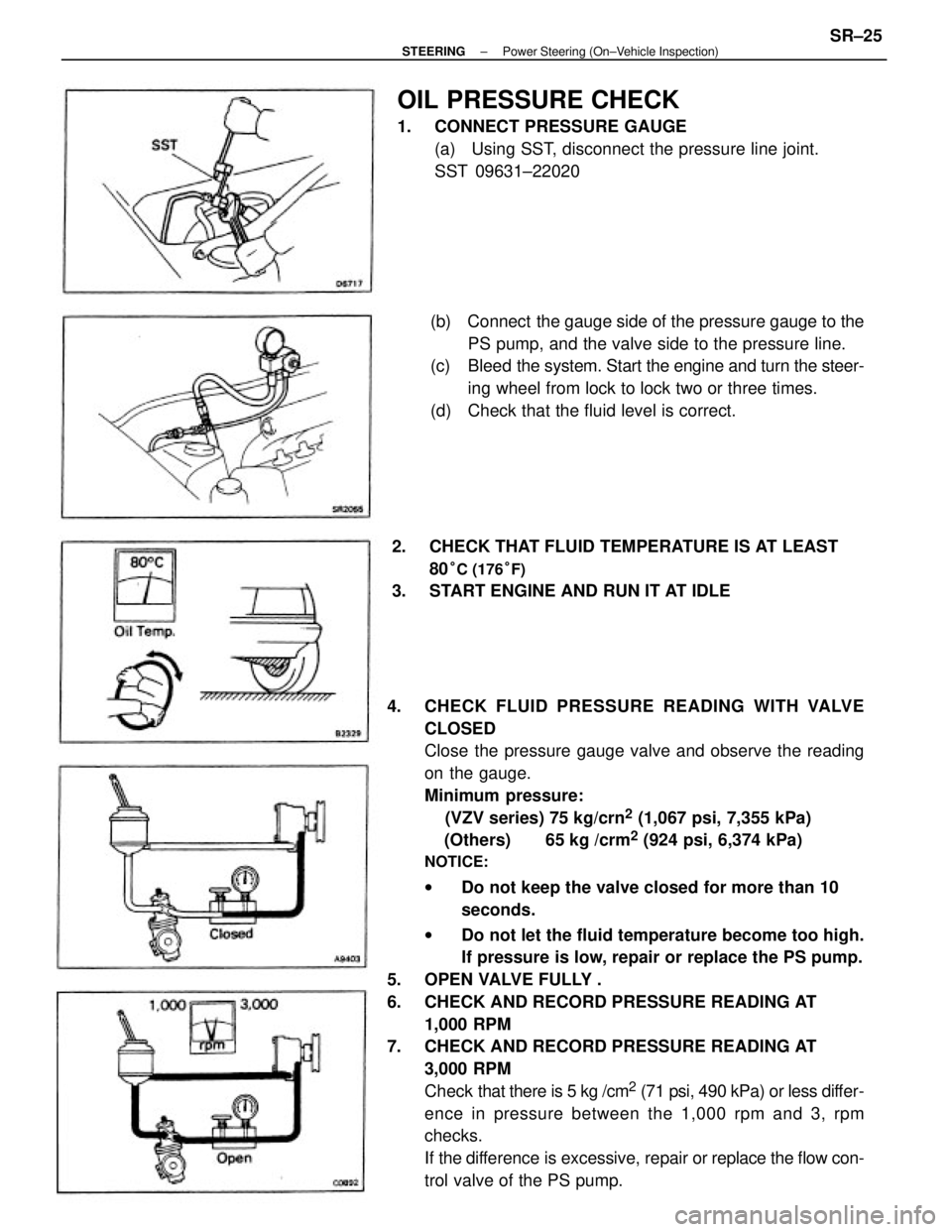
(d) Remove two grommets from the gear housing. 6. REMOVE GEAR HOUSING
(a) Jack up the front of the engine.
NOTICE: Do not overtilt the engine.
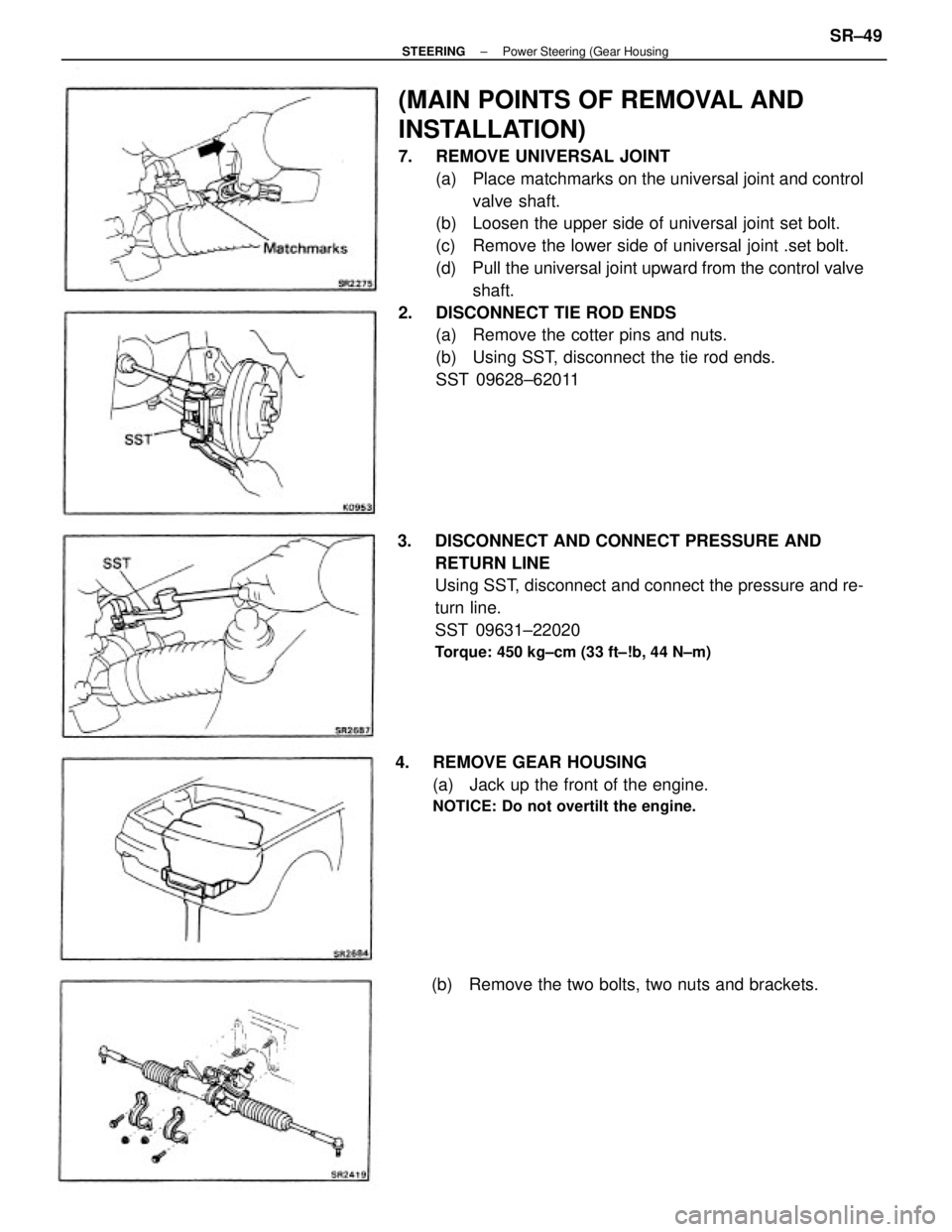
(e) Pull out the propeller shaft and insert SST.
SST .09325±20010
(b) Remove the two bolts, two nuts and two brackets.
± STEERINGPower Steering (Gear Housing)SR±47
Page 2375 of 2389
(MAIN POINTS OF REMOVAL AND
INSTALLATION)
7. REMOVE UNIVERSAL JOINT
(a) Place matchmarks on the universal joint and control
valve shaft.
(b) Loosen the upper side of universal joint set bolt.
(c) Remove the lower side of universal joint .set bolt.
(d) Pull the universal joint upward from the control valve
shaft.
2. DISCONNECT TIE ROD ENDS
(a) Remove the cotter pins and nuts.
(b) Using SST, disconnect the tie rod ends.
SST 09628±62011
3. DISCONNECT AND CONNECT PRESSURE AND
RETURN LINE
Using SST, disconnect and connect the pressure and re-
turn line.
SST 09631±22020
Torque: 450 kg±cm (33 ft±!b, 44 N±m)
4. REMOVE GEAR HOUSING
(a) Jack up the front of the engine.
NOTICE: Do not overtilt the engine.
(b) Remove the two bolts, two nuts and brackets.
± STEERINGPower Steering (Gear HousingSR±49