Page 2278 of 2389
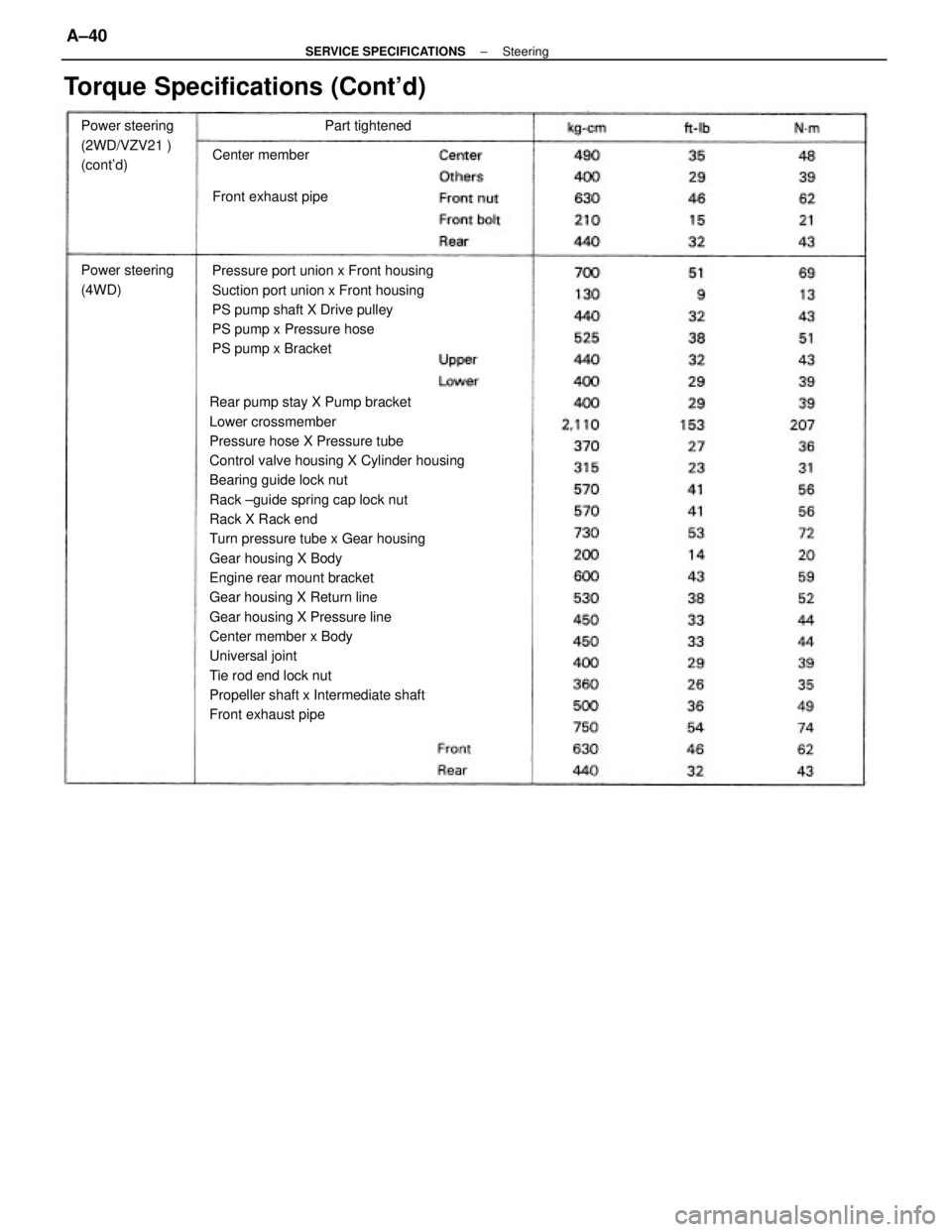
Rear pump stay X Pump bracket
Lower crossmember
Pressure hose X Pressure tube
Control valve housing X Cylinder housing
Bearing guide lock nut
Rack ±guide spring cap lock nut
Rack X Rack end
Turn pressure tube x Gear housing
Gear housing X Body
Engine rear mount bracket
Gear housing X Return line
Gear housing X Pressure line
Center member x Body
Universal joint
Tie rod end lock nut
Propeller shaft x Intermediate shaft
Front exhaust pipePressure port union x Front housing
Suction port union x Front housing
PS pump shaft X Drive pulley
PS pump x Pressure hose
PS pump x Bracket
Torque Specifications (Cont'd)
Power steering
(2WD/VZV21 )
(cont'd)
Power steering
(4WD)Front exhaust pipe Center memberPart tightened
± SERVICE SPECIFICATIONSSteeringA±40
Page 2310 of 2389
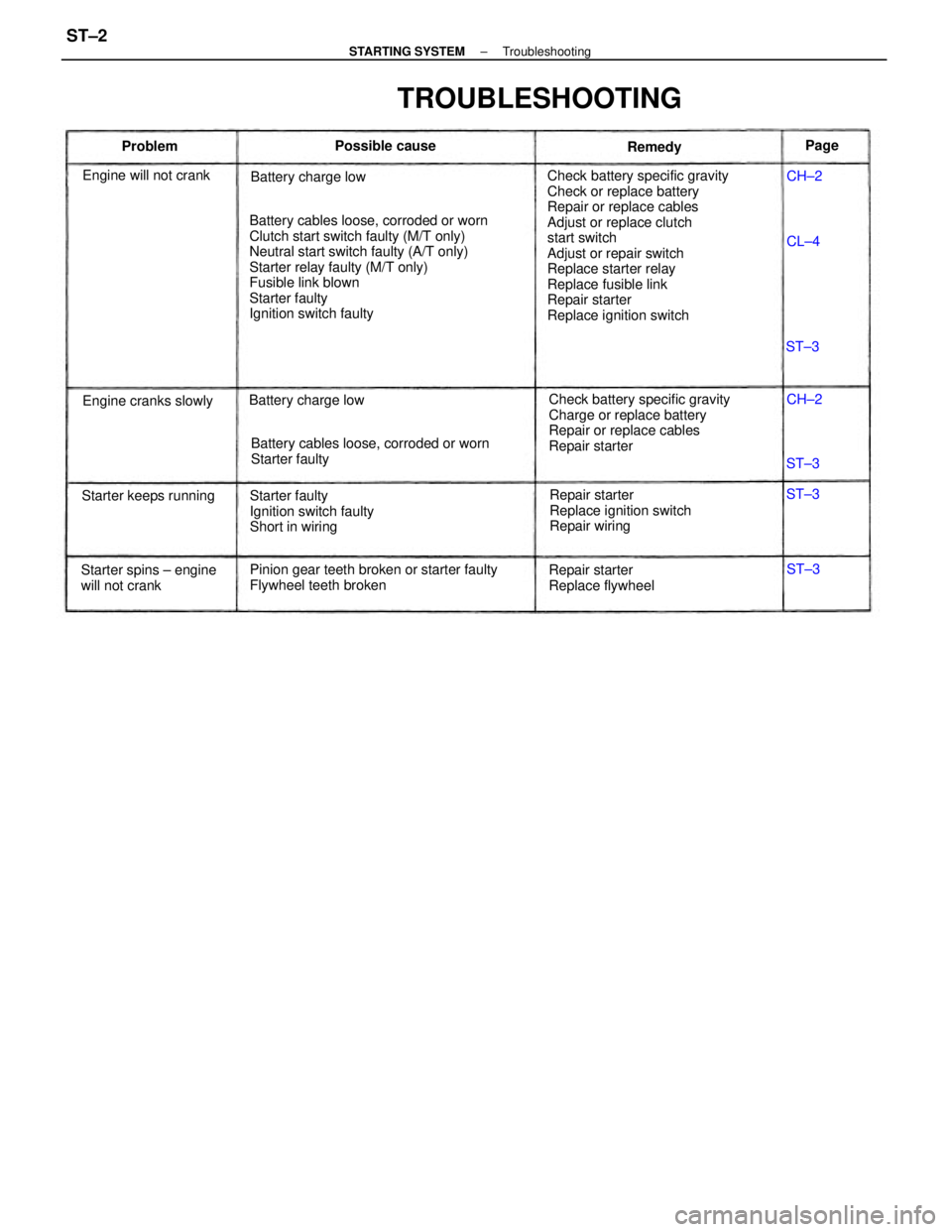
Check battery specific gravity
Check or replace battery
Repair or replace cables
Adjust or replace clutch
start switch
Adjust or repair switch
Replace starter relay
Replace fusible link
Repair starter
Replace ignition switch Battery cables loose, corroded or worn
Clutch start switch faulty (M/T only)
Neutral start switch faulty (A/T only)
Starter relay faulty (M/T only)
Fusible link blown
Starter faulty
Ignition switch faulty
Check battery specific gravity
Charge or replace battery
Repair or replace cables
Repair starter
Pinion gear teeth broken or starter faulty
Flywheel teeth brokenBattery cables loose, corroded or worn
Starter faulty
Repair starter
Replace ignition switch
Repair wiring Starter faulty
Ignition switch faulty
Short in wiring
TROUBLESHOOTING
Starter spins ± engine
will not crankRepair starter
Replace flywheel Engine will not crank
Starter keeps runningBattery charge low
Engine cranks slowlyBattery charge lowPossible cause
Remedy ProblemPage
CH±2
CH±2
ST±3 ST±3
ST±3
ST±3 CL±4
± STARTING SYSTEMTroubleshootingST±2
Page 2323 of 2389
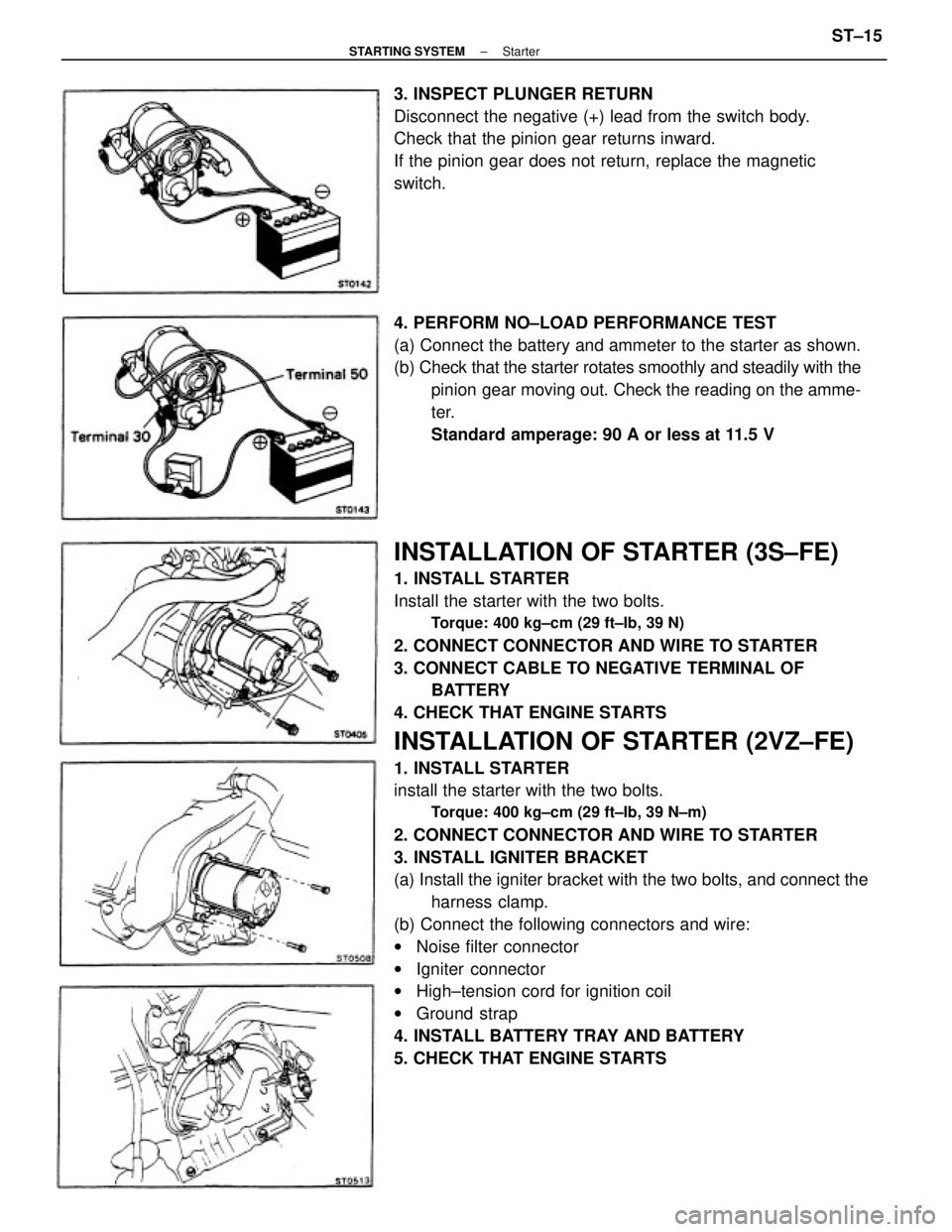
INSTALLATION OF STARTER (3S±FE)
1. INSTALL STARTER
Install the starter with the two bolts.
Torque: 400 kg±cm (29 ft±Ib, 39 N)
2. CONNECT CONNECTOR AND WIRE TO STARTER
3. CONNECT CABLE TO NEGATIVE TERMINAL OF
BATTERY
4. CHECK THAT ENGINE STARTS
INSTALLATION OF STARTER (2VZ±FE)
1. INSTALL STARTER
install the starter with the two bolts.
Torque: 400 kg±cm (29 ft±Ib, 39 N±m)
2. CONNECT CONNECTOR AND WIRE TO STARTER
3. INSTALL IGNITER BRACKET
(a) Install the igniter bracket with the two bolts, and connect the
harness clamp.
(b) Connect the following connectors and wire:
wNoise filter connector
wIgniter connector
wHigh±tension cord for ignition coil
wGround strap
4. INSTALL BATTERY TRAY AND BATTERY
5. CHECK THAT ENGINE STARTS 4. PERFORM NO±LOAD PERFORMANCE TEST
(a) Connect the battery and ammeter to the starter as shown.
(b) Check that the starter rotates smoothly and steadily with the
pinion gear moving out. Check the reading on the amme-
ter.
Standard amperage: 90 A or less at 11.5 V 3. INSPECT PLUNGER RETURN
Disconnect the negative (+) lead from the switch body.
Check that the pinion gear returns inward.
If the pinion gear does not return, replace the magnetic
switch.
± STARTING SYSTEMStarterST±15
Page 2335 of 2389
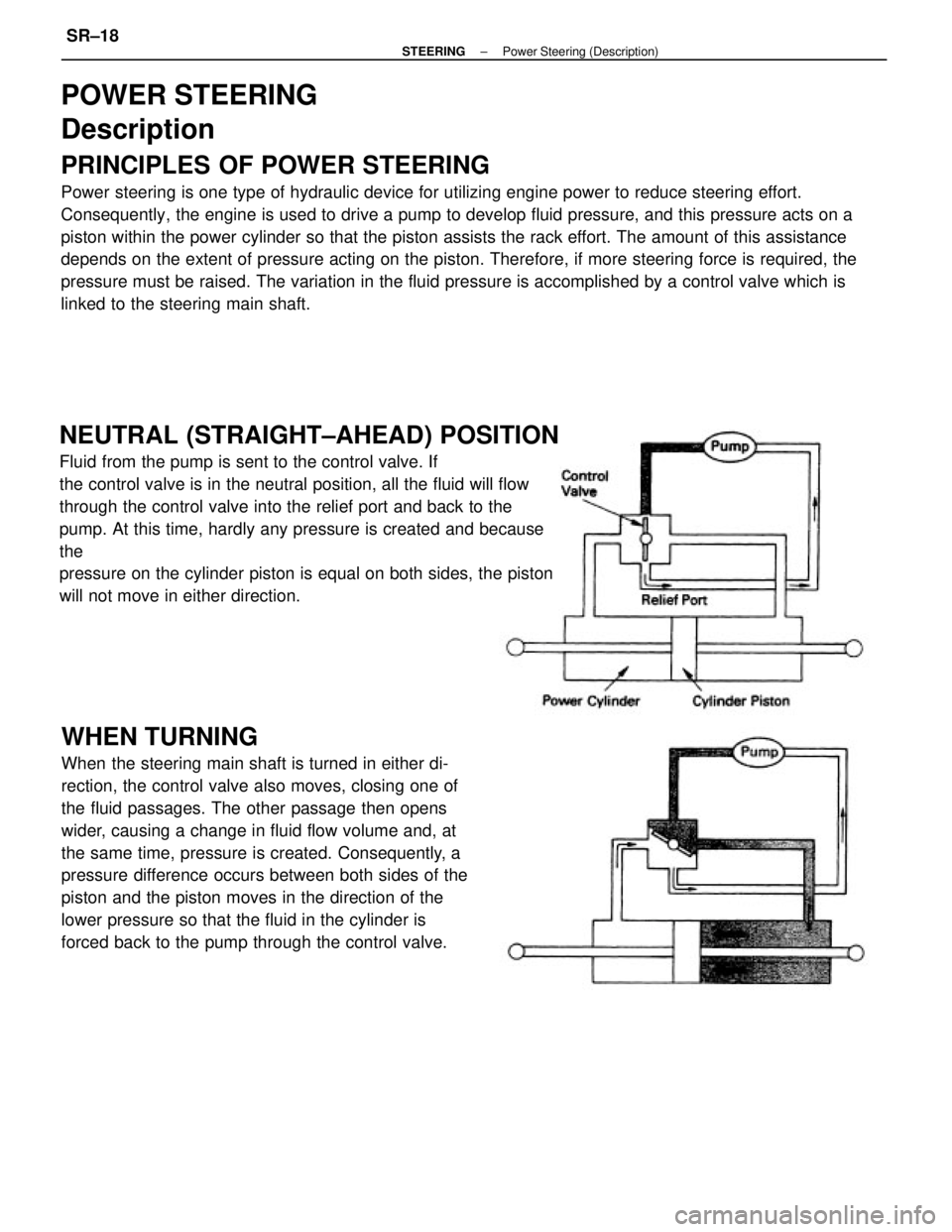
POWER STEERING
Description
PRINCIPLES OF POWER STEERING
Power steering is one type of hydraulic device for utilizing engine power to reduce steering effort.
Consequently, the engine is used to drive a pump to develop fluid pressure, and this pressure acts on a
piston within the power cylinder so that the piston assists the rack effort. The amount of this assistance
depends on the extent of pressure acting on the piston. Therefore, if more steering force is required, the
pressure must be raised. The variation in the fluid pressure is accomplished by a control valve which is
linked to the steering main shaft.
WHEN TURNING
When the steering main shaft is turned in either di-
rection, the control valve also moves, closing one of
the fluid passages. The other passage then opens
wider, causing a change in fluid flow volume and, at
the same time, pressure is created. Consequently, a
pressure difference occurs between both sides of the
piston and the piston moves in the direction of the
lower pressure so that the fluid in the cylinder is
forced back to the pump through the control valve.
NEUTRAL (STRAIGHT±AHEAD) POSITION
Fluid from the pump is sent to the control valve. If
the control valve is in the neutral position, all the fluid will flow
through the control valve into the relief port and back to the
pump. At this time, hardly any pressure is created and because
the
pressure on the cylinder piston is equal on both sides, the piston
will not move in either direction.
± STEERINGPower Steering (Description)SR±18
Page 2338 of 2389
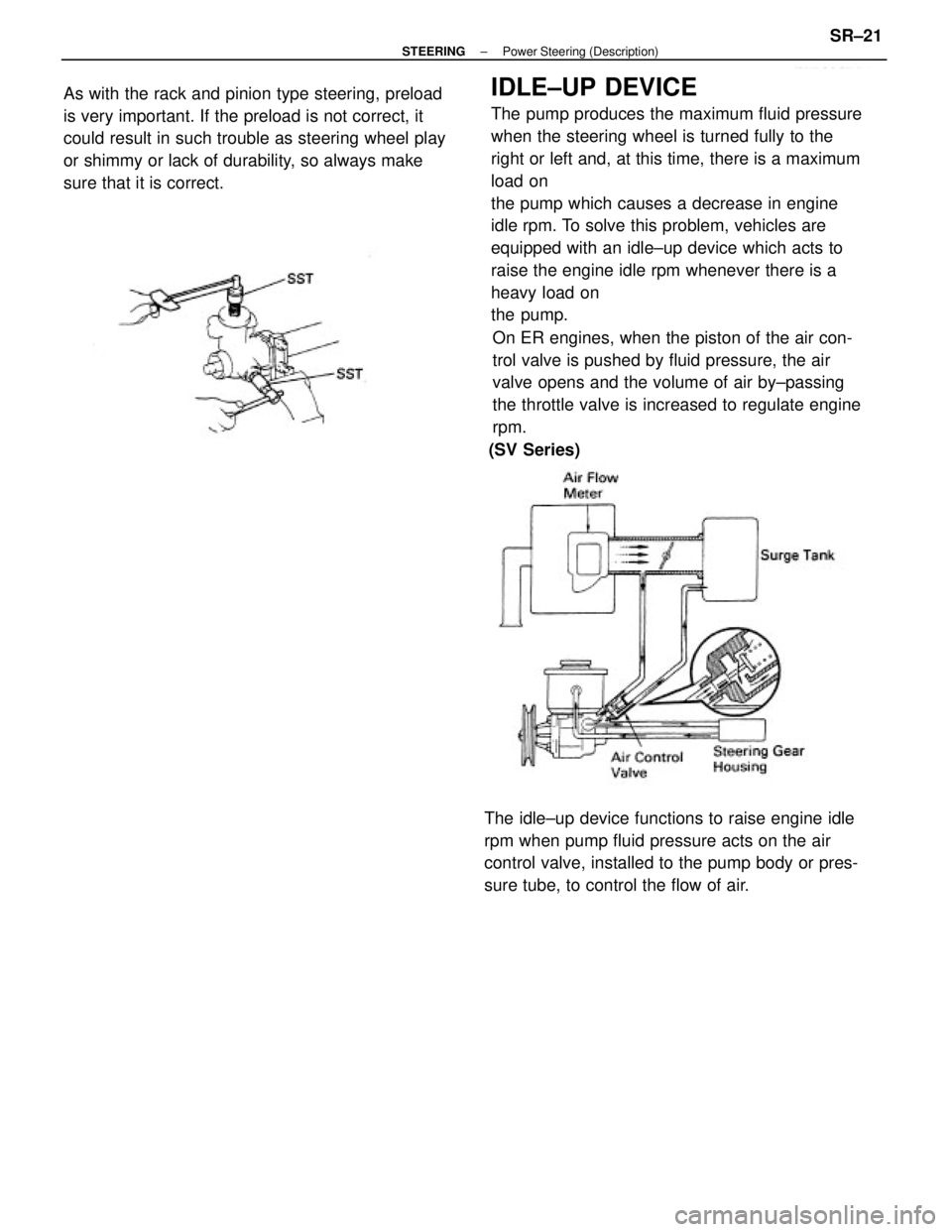
IDLE±UP DEVICE
The pump produces the maximum fluid pressure
when the steering wheel is turned fully to the
right or left and, at this time, there is a maximum
load on
the pump which causes a decrease in engine
idle rpm. To solve this problem, vehicles are
equipped with an idle±up device which acts to
raise the engine idle rpm whenever there is a
heavy load on
the pump. As with the rack and pinion type steering, preload
is very important. If the preload is not correct, it
could result in such trouble as steering wheel play
or shimmy or lack of durability, so always make
sure that it is correct.
On ER engines, when the piston of the air con-
trol valve is pushed by fluid pressure, the air
valve opens and the volume of air by±passing
the throttle valve is increased to regulate engine
rpm.
The idle±up device functions to raise engine idle
rpm when pump fluid pressure acts on the air
control valve, installed to the pump body or pres-
sure tube, to control the flow of air.(SV Series)
± STEERINGPower Steering (Description)SR±21
Page 2348 of 2389
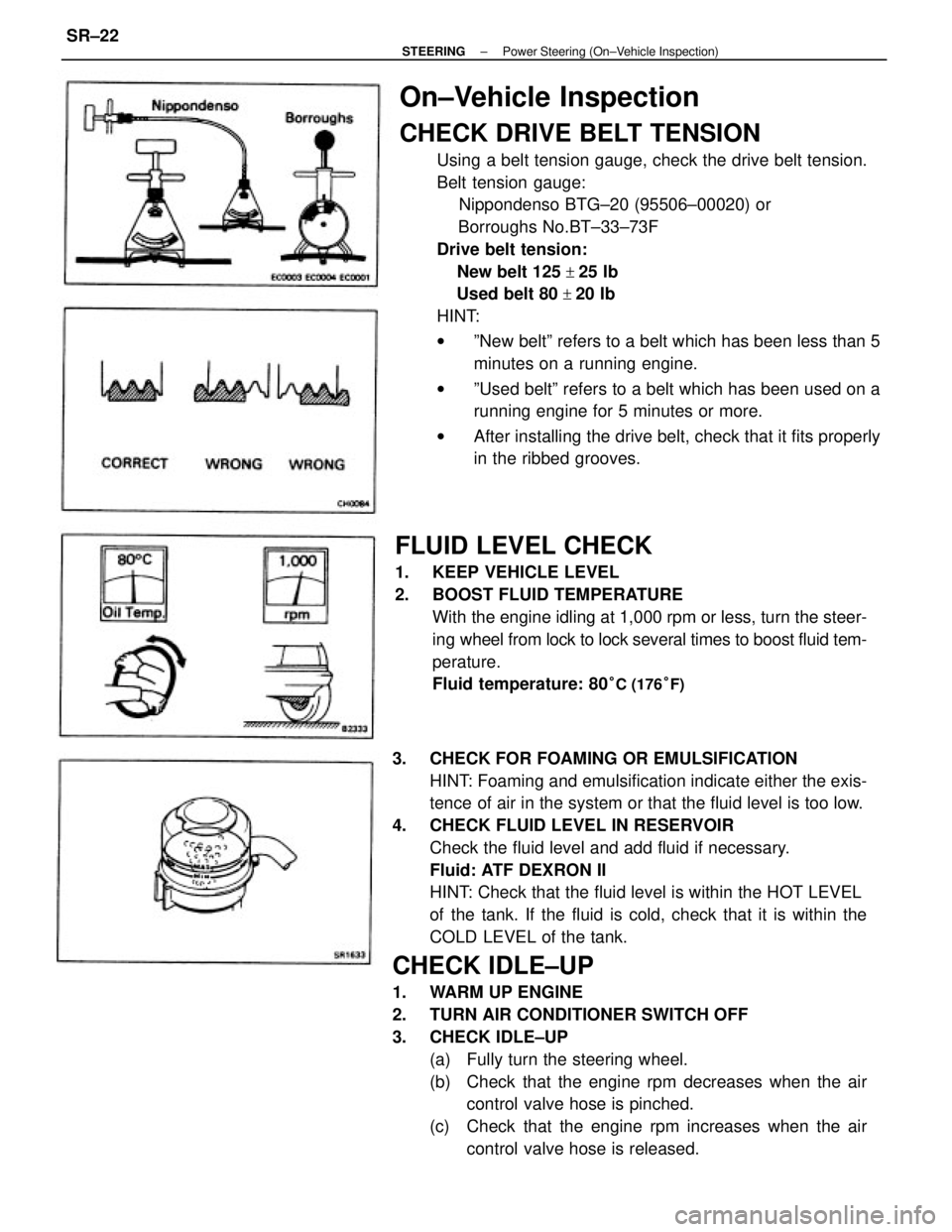
3. CHECK FOR FOAMING OR EMULSIFICATION
HINT: Foaming and emulsification indicate either the exis-
tence of air in the system or that the fluid level is too low.
4. CHECK FLUID LEVEL IN RESERVOIR
Check the fluid level and add fluid if necessary.
Fluid: ATF DEXRON II
HINT: Check that the fluid level is within the HOT LEVEL
of the tank. If the fluid is cold, check that it is within the
COLD LEVEL of the tank.
CHECK IDLE±UP
1. WARM UP ENGINE
2. TURN AIR CONDITIONER SWITCH OFF
3. CHECK IDLE±UP
(a) Fully turn the steering wheel.
(b) Check that the engine rpm decreases when the air
control valve hose is pinched.
(c) Check that the engine rpm increases when the air
control valve hose is released.
On±Vehicle Inspection
CHECK DRIVE BELT TENSION
Using a belt tension gauge, check the drive belt tension.
Belt tension gauge:
Nippondenso BTG±20 (95506±00020) or
Borroughs No.BT±33±73F
Drive belt tension:
New belt 125
+25 Ib
Used belt 80
+20 Ib
HINT:
wºNew beltº refers to a belt which has been less than 5
minutes on a running engine.
wºUsed beltº refers to a belt which has been used on a
running engine for 5 minutes or more.
wAfter installing the drive belt, check that it fits properly
in the ribbed grooves.
FLUID LEVEL CHECK
1. KEEP VEHICLE LEVEL
2. BOOST FLUID TEMPERATURE
With the engine idling at 1,000 rpm or less, turn the steer-
ing wheel from lock to lock several times to boost fluid tem-
perature.
Fluid temperature: 80
°C (176°F)
± STEERINGPower Steering (On±Vehicle Inspection)SR±22
Page 2349 of 2389
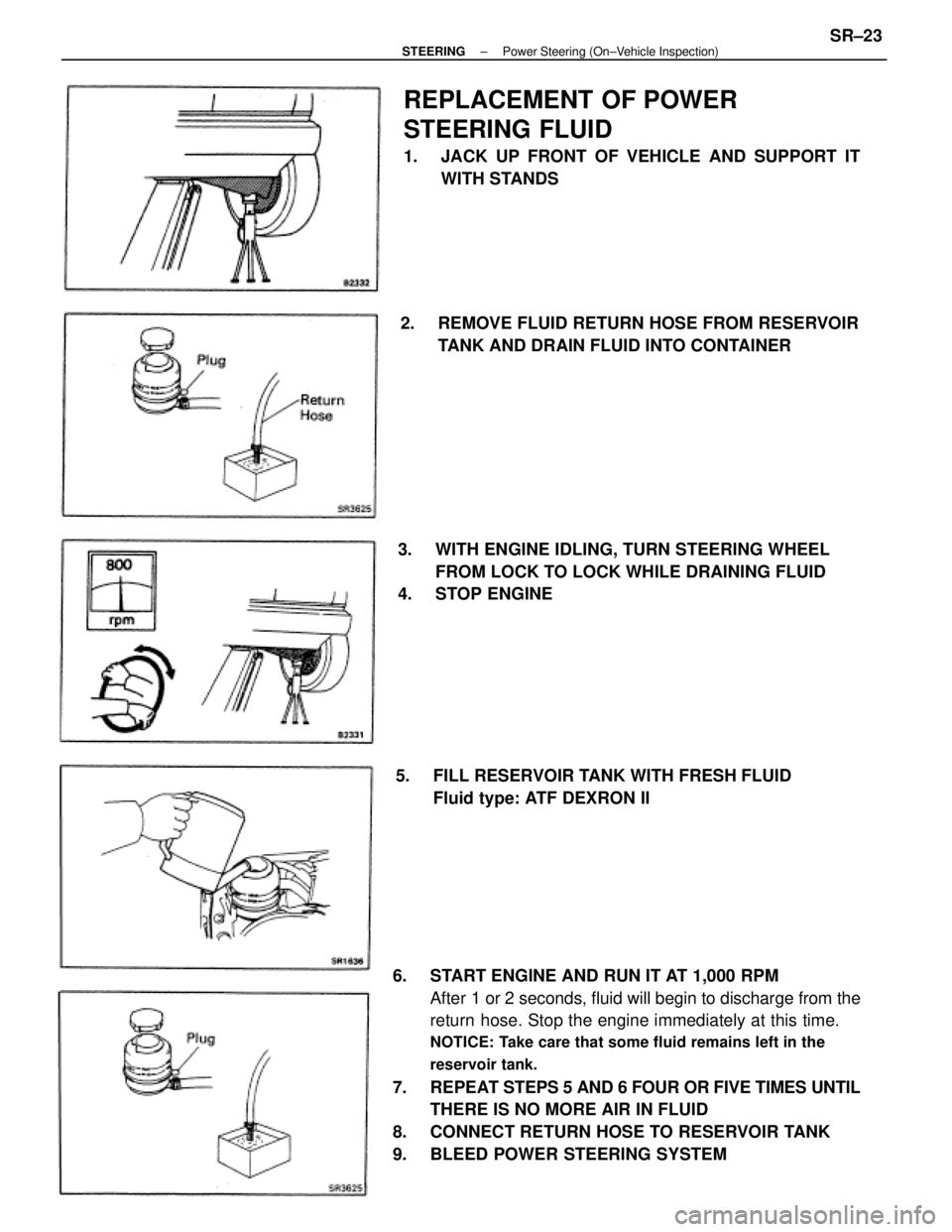
6. START ENGINE AND RUN IT AT 1,000 RPM
After 1 or 2 seconds, fluid will begin to discharge from the
return hose. Stop the engine immediately at this time.
NOTICE: Take care that some fluid remains left in the
reservoir tank.
7. REPEAT STEPS 5 AND 6 FOUR OR FIVE TIMES UNTIL
THERE IS NO MORE AIR IN FLUID
8. CONNECT RETURN HOSE TO RESERVOIR TANK
9. BLEED POWER STEERING SYSTEM
REPLACEMENT OF POWER
STEERING FLUID
1. JACK UP FRONT OF VEHICLE AND SUPPORT IT
WITH STANDS
3. WITH ENGINE IDLING, TURN STEERING WHEEL
FROM LOCK TO LOCK WHILE DRAINING FLUID
4. STOP ENGINE2. REMOVE FLUID RETURN HOSE FROM RESERVOIR
TANK AND DRAIN FLUID INTO CONTAINER
5. FILL RESERVOIR TANK WITH FRESH FLUID
Fluid type: ATF DEXRON II
± STEERINGPower Steering (On±Vehicle Inspection)SR±23
Page 2350 of 2389
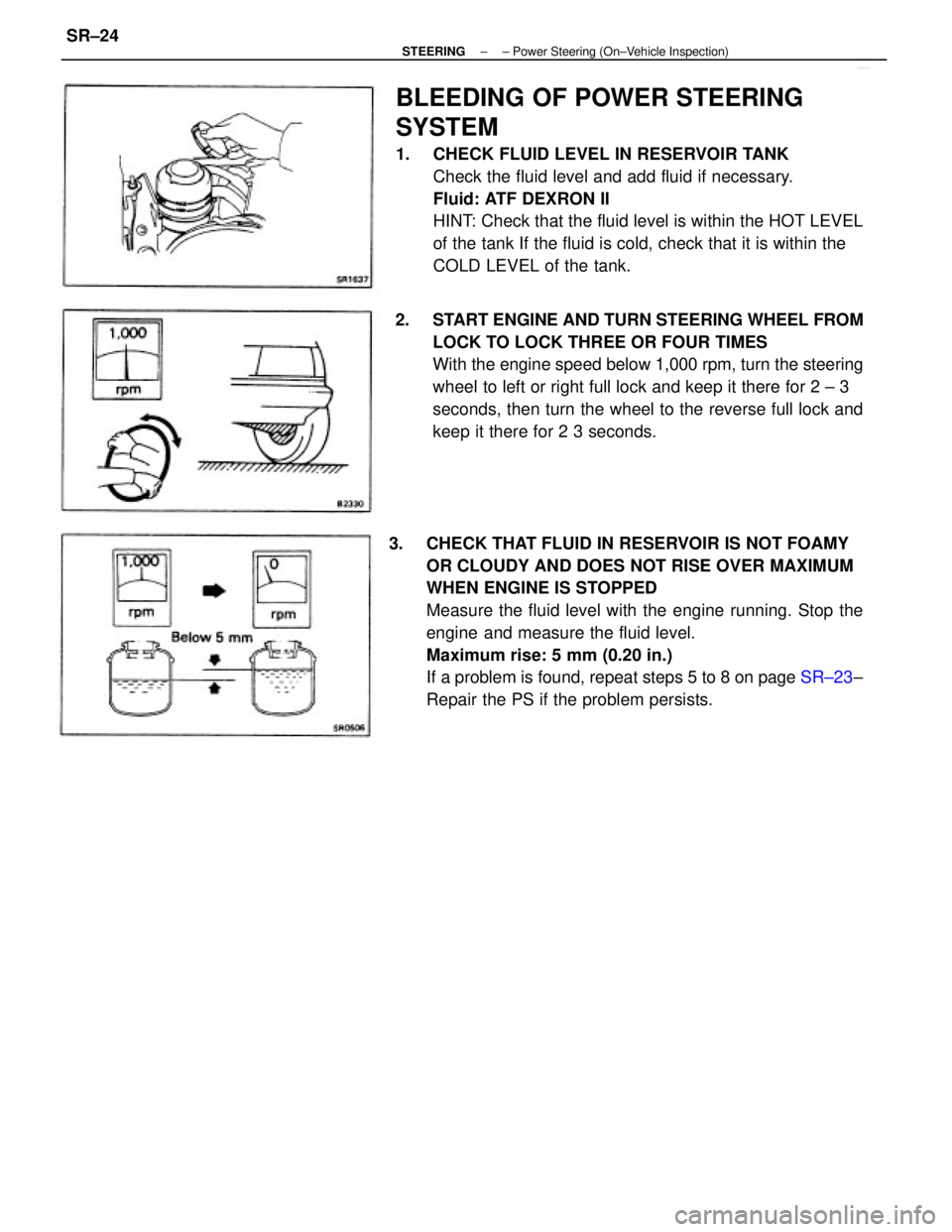
3. CHECK THAT FLUID IN RESERVOIR IS NOT FOAMY
OR CLOUDY AND DOES NOT RISE OVER MAXIMUM
WHEN ENGINE IS STOPPED
Measure the fluid level with the engine running. Stop the
engine and measure the fluid level.
Maximum rise: 5 mm (0.20 in.)
If a problem is found, repeat steps 5 to 8 on page SR±23±
Repair the PS if the problem persists.
BLEEDING OF POWER STEERING
SYSTEM
1. CHECK FLUID LEVEL IN RESERVOIR TANK
Check the fluid level and add fluid if necessary.
Fluid: ATF DEXRON II
HINT: Check that the fluid level is within the HOT LEVEL
of the tank If the fluid is cold, check that it is within the
COLD LEVEL of the tank.
2. START ENGINE AND TURN STEERING WHEEL FROM
LOCK TO LOCK THREE OR FOUR TIMES
With the engine speed below 1,000 rpm, turn the steering
wheel to left or right full lock and keep it there for 2 ± 3
seconds, then turn the wheel to the reverse full lock and
keep it there for 2 3 seconds.
± STEERING± Power Steering (On±Vehicle Inspection)SR±24