Page 2348 of 2389
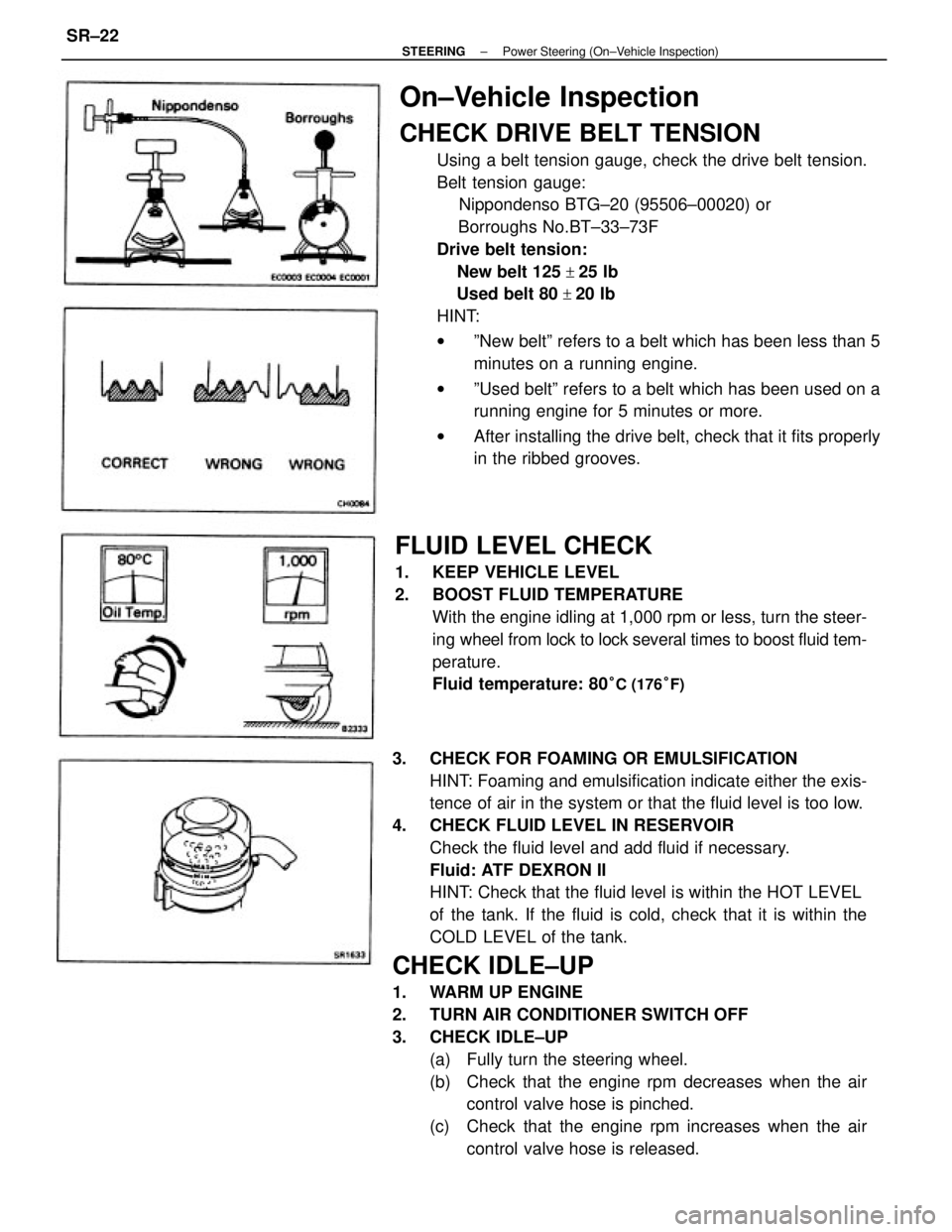
3. CHECK FOR FOAMING OR EMULSIFICATION
HINT: Foaming and emulsification indicate either the exis-
tence of air in the system or that the fluid level is too low.
4. CHECK FLUID LEVEL IN RESERVOIR
Check the fluid level and add fluid if necessary.
Fluid: ATF DEXRON II
HINT: Check that the fluid level is within the HOT LEVEL
of the tank. If the fluid is cold, check that it is within the
COLD LEVEL of the tank.
CHECK IDLE±UP
1. WARM UP ENGINE
2. TURN AIR CONDITIONER SWITCH OFF
3. CHECK IDLE±UP
(a) Fully turn the steering wheel.
(b) Check that the engine rpm decreases when the air
control valve hose is pinched.
(c) Check that the engine rpm increases when the air
control valve hose is released.
On±Vehicle Inspection
CHECK DRIVE BELT TENSION
Using a belt tension gauge, check the drive belt tension.
Belt tension gauge:
Nippondenso BTG±20 (95506±00020) or
Borroughs No.BT±33±73F
Drive belt tension:
New belt 125
+25 Ib
Used belt 80
+20 Ib
HINT:
wºNew beltº refers to a belt which has been less than 5
minutes on a running engine.
wºUsed beltº refers to a belt which has been used on a
running engine for 5 minutes or more.
wAfter installing the drive belt, check that it fits properly
in the ribbed grooves.
FLUID LEVEL CHECK
1. KEEP VEHICLE LEVEL
2. BOOST FLUID TEMPERATURE
With the engine idling at 1,000 rpm or less, turn the steer-
ing wheel from lock to lock several times to boost fluid tem-
perature.
Fluid temperature: 80
°C (176°F)
± STEERINGPower Steering (On±Vehicle Inspection)SR±22
Page 2349 of 2389
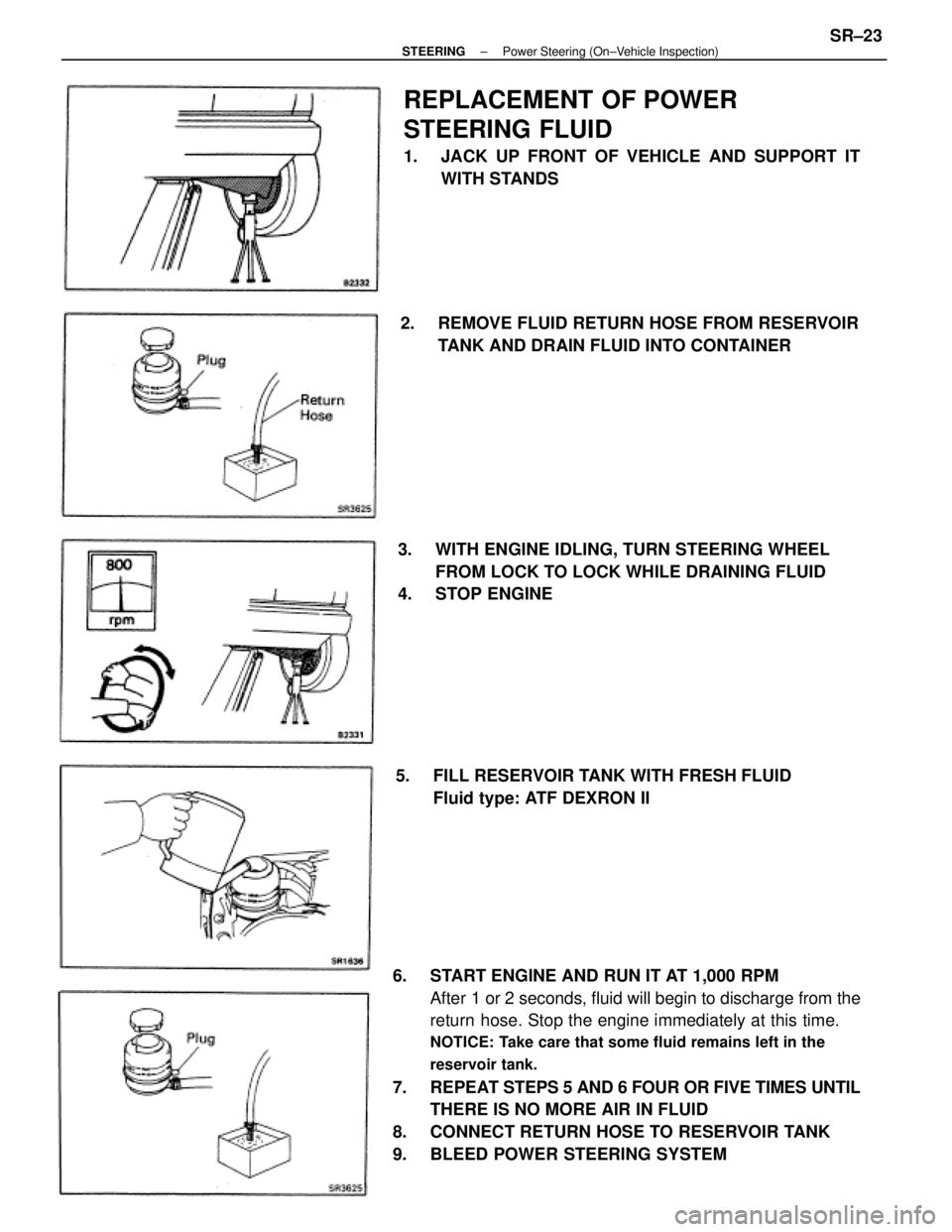
6. START ENGINE AND RUN IT AT 1,000 RPM
After 1 or 2 seconds, fluid will begin to discharge from the
return hose. Stop the engine immediately at this time.
NOTICE: Take care that some fluid remains left in the
reservoir tank.
7. REPEAT STEPS 5 AND 6 FOUR OR FIVE TIMES UNTIL
THERE IS NO MORE AIR IN FLUID
8. CONNECT RETURN HOSE TO RESERVOIR TANK
9. BLEED POWER STEERING SYSTEM
REPLACEMENT OF POWER
STEERING FLUID
1. JACK UP FRONT OF VEHICLE AND SUPPORT IT
WITH STANDS
3. WITH ENGINE IDLING, TURN STEERING WHEEL
FROM LOCK TO LOCK WHILE DRAINING FLUID
4. STOP ENGINE2. REMOVE FLUID RETURN HOSE FROM RESERVOIR
TANK AND DRAIN FLUID INTO CONTAINER
5. FILL RESERVOIR TANK WITH FRESH FLUID
Fluid type: ATF DEXRON II
± STEERINGPower Steering (On±Vehicle Inspection)SR±23
Page 2350 of 2389
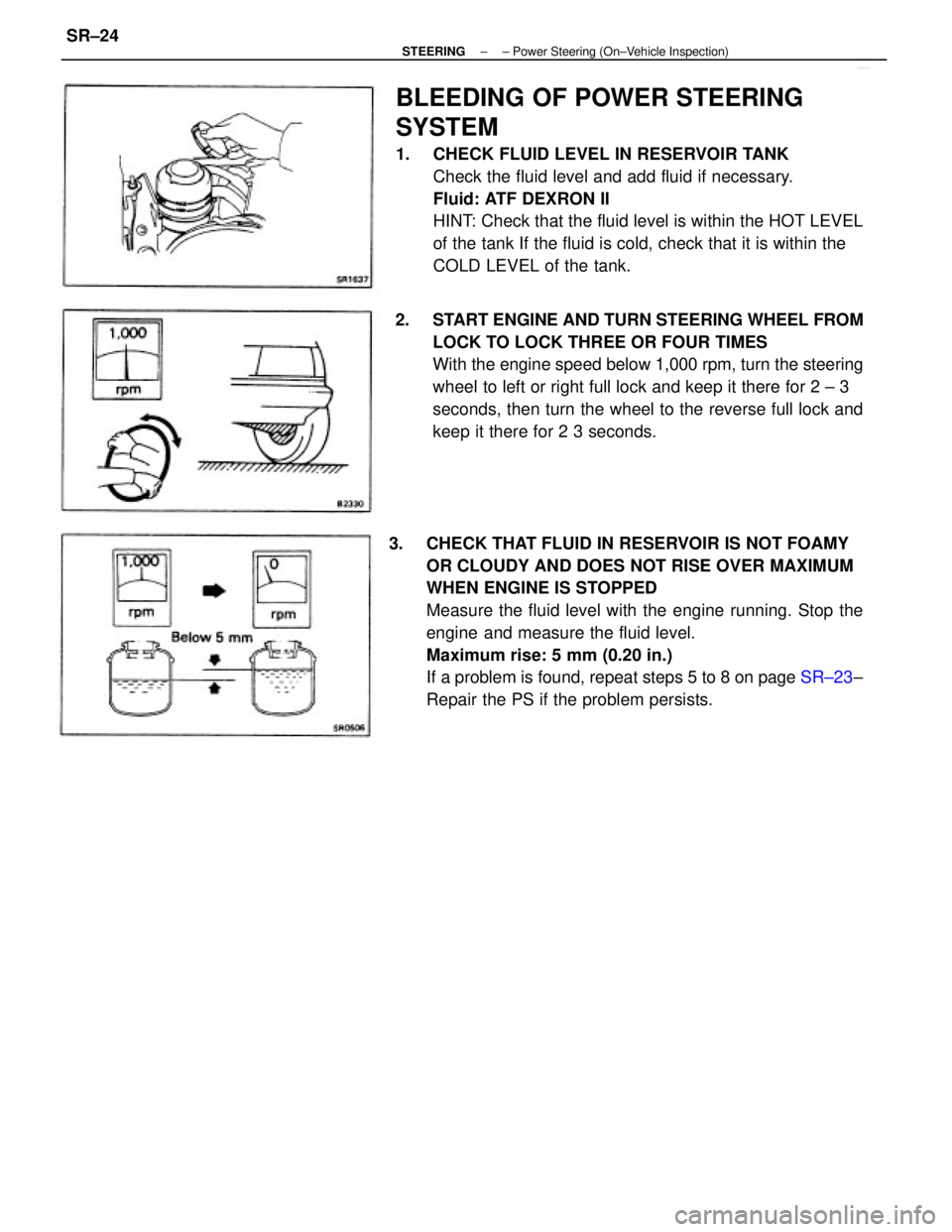
3. CHECK THAT FLUID IN RESERVOIR IS NOT FOAMY
OR CLOUDY AND DOES NOT RISE OVER MAXIMUM
WHEN ENGINE IS STOPPED
Measure the fluid level with the engine running. Stop the
engine and measure the fluid level.
Maximum rise: 5 mm (0.20 in.)
If a problem is found, repeat steps 5 to 8 on page SR±23±
Repair the PS if the problem persists.
BLEEDING OF POWER STEERING
SYSTEM
1. CHECK FLUID LEVEL IN RESERVOIR TANK
Check the fluid level and add fluid if necessary.
Fluid: ATF DEXRON II
HINT: Check that the fluid level is within the HOT LEVEL
of the tank If the fluid is cold, check that it is within the
COLD LEVEL of the tank.
2. START ENGINE AND TURN STEERING WHEEL FROM
LOCK TO LOCK THREE OR FOUR TIMES
With the engine speed below 1,000 rpm, turn the steering
wheel to left or right full lock and keep it there for 2 ± 3
seconds, then turn the wheel to the reverse full lock and
keep it there for 2 3 seconds.
± STEERING± Power Steering (On±Vehicle Inspection)SR±24
Page 2351 of 2389
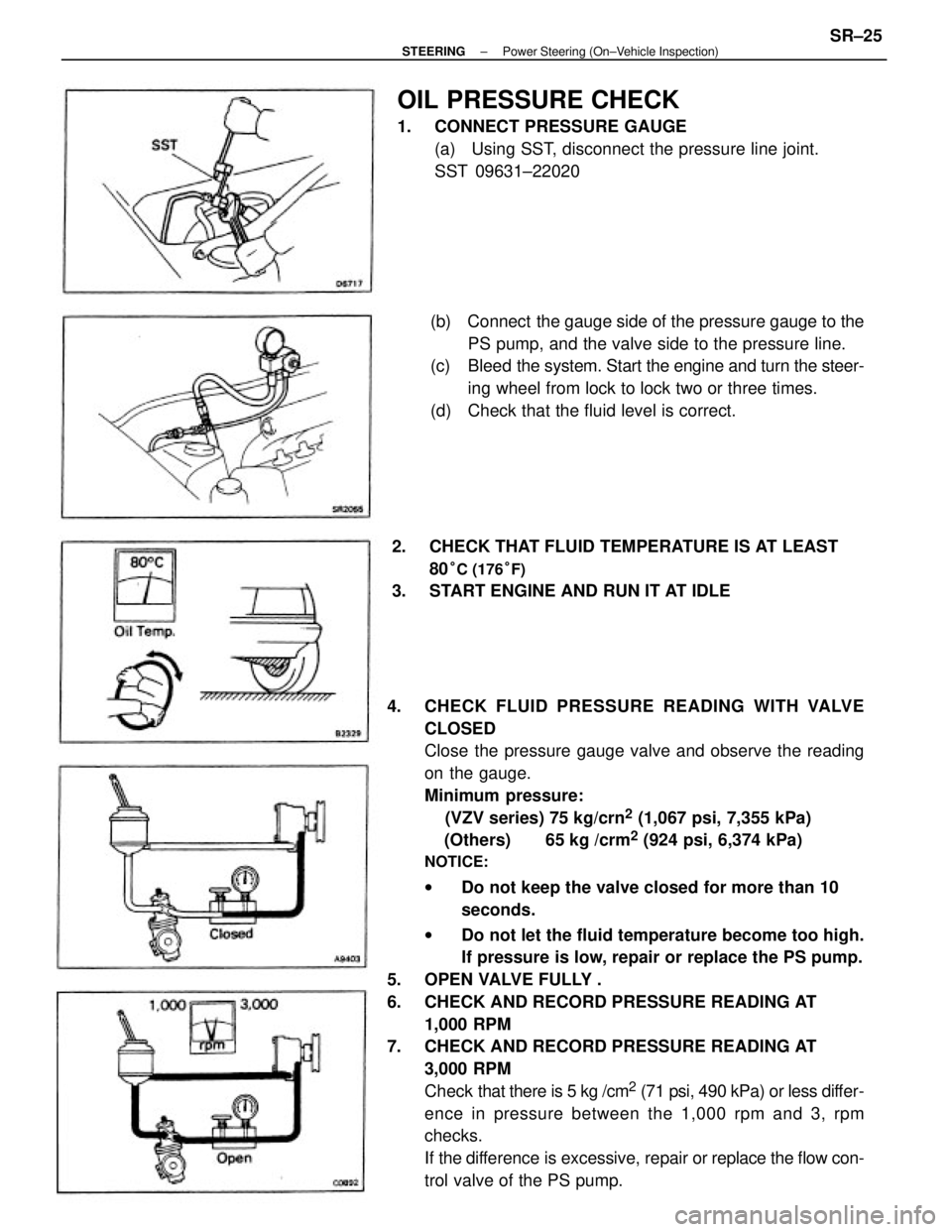
4. CHECK FLUID PRESSURE READING WITH VALVE
CLOSED
Close the pressure gauge valve and observe the reading
on the gauge.
Minimum pressure:
(VZV series) 75 kg/crn
2 (1,067 psi, 7,355 kPa)
(Others) 65 kg /crm
2 (924 psi, 6,374 kPa)
NOTICE:
wDo not keep the valve closed for more than 10
seconds.
wDo not let the fluid temperature become too high.
If pressure is low, repair or replace the PS pump.
5. OPEN VALVE FULLY .
6. CHECK AND RECORD PRESSURE READING AT
1,000 RPM
7. CHECK AND RECORD PRESSURE READING AT
3,000 RPM
Check that there is 5 kg /cm
2 (71 psi, 490 kPa) or less differ-
ence in pressure between the 1,000 rpm and 3, rpm
checks.
If the difference is excessive, repair or replace the flow con-
trol valve of the PS pump.(b) Connect the gauge side of the pressure gauge to the
PS pump, and the valve side to the pressure line.
(c) Bleed the system. Start the engine and turn the steer-
ing wheel from lock to lock two or three times.
(d) Check that the fluid level is correct.
OIL PRESSURE CHECK
1. CONNECT PRESSURE GAUGE
(a) Using SST, disconnect the pressure line joint.
SST 09631±22020
2. CHECK THAT FLUID TEMPERATURE IS AT LEAST
80
°C (176°F)
3. START ENGINE AND RUN IT AT IDLE
± STEERINGPower Steering (On±Vehicle Inspection)SR±25
Page 2352 of 2389
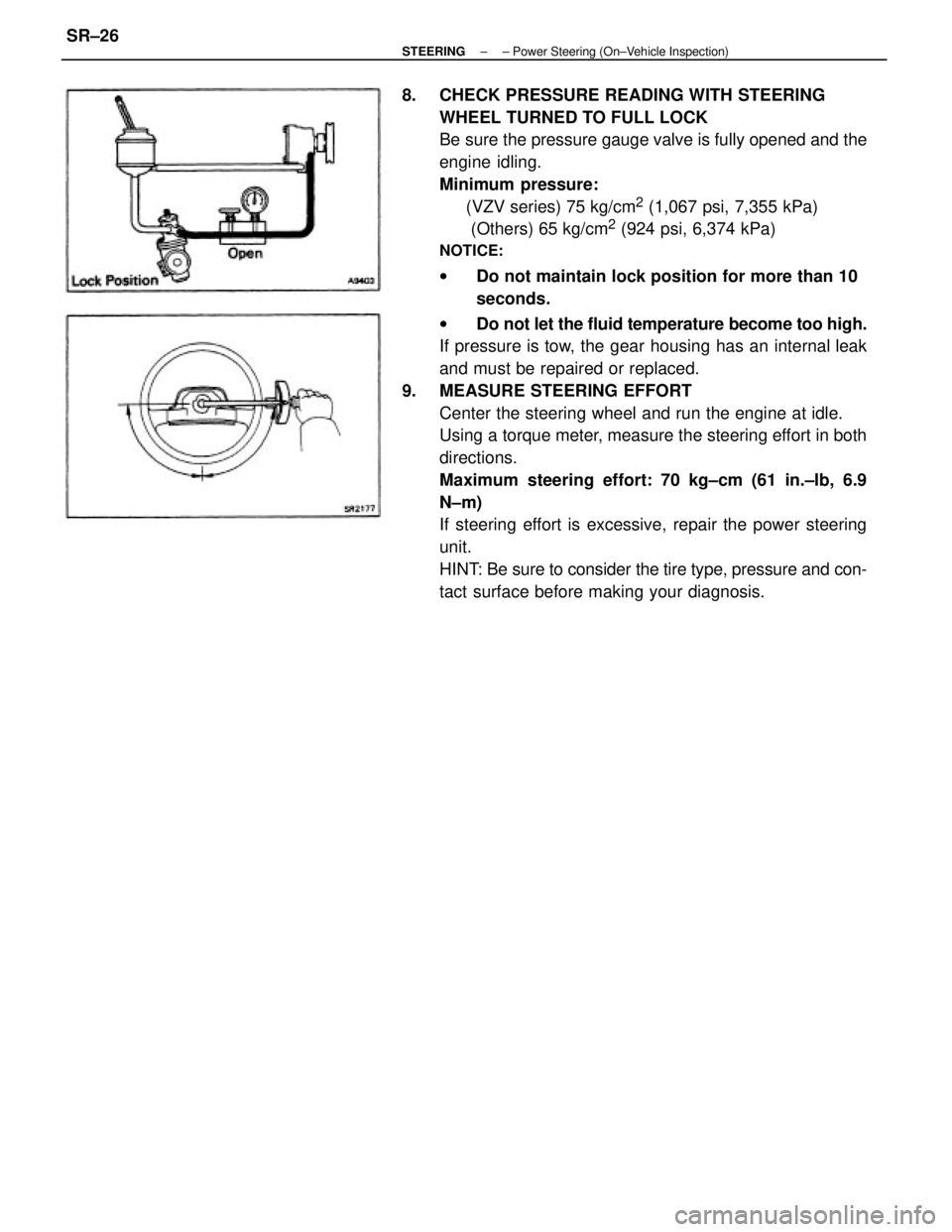
8. CHECK PRESSURE READING WITH STEERING
WHEEL TURNED TO FULL LOCK
Be sure the pressure gauge valve is fully opened and the
engine idling.
Minimum pressure:
(VZV series) 75 kg/cm
2 (1,067 psi, 7,355 kPa)
(Others) 65 kg/cm
2 (924 psi, 6,374 kPa)
NOTICE:
wDo not maintain lock position for more than 10
seconds.
wDo not let the fluid temperature become too high.
If pressure is tow, the gear housing has an internal leak
and must be repaired or replaced.
9. MEASURE STEERING EFFORT
Center the steering wheel and run the engine at idle.
Using a torque meter, measure the steering effort in both
directions.
Maximum steering effort: 70 kg±cm (61 in.±Ib, 6.9
N±m)
If steering effort is excessive, repair the power steering
unit.
HINT: Be sure to consider the tire type, pressure and con-
tact surface before making your diagnosis.
± STEERING± Power Steering (On±Vehicle Inspection)SR±26
Page 2363 of 2389
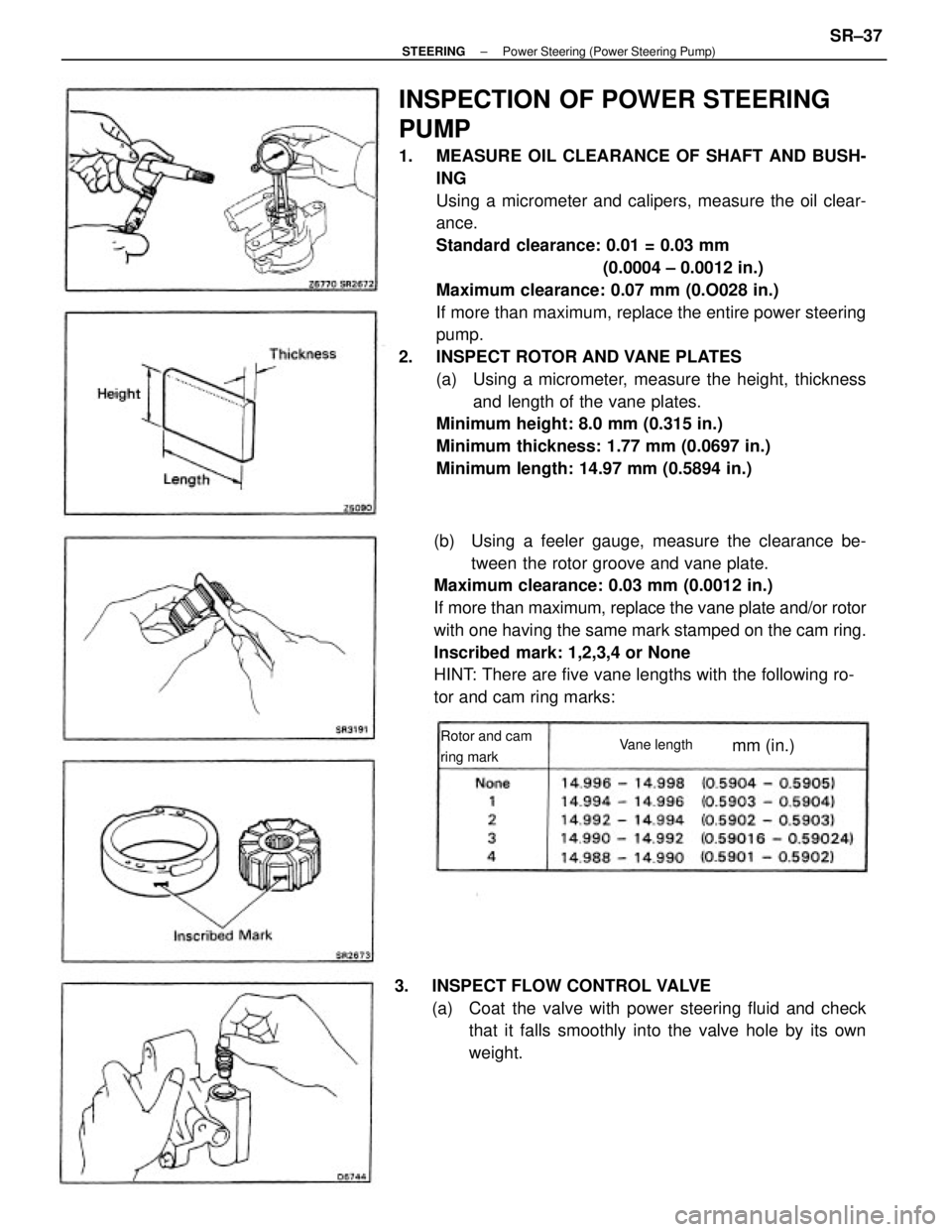
INSPECTION OF POWER STEERING
PUMP
1. MEASURE OIL CLEARANCE OF SHAFT AND BUSH-
ING
Using a micrometer and calipers, measure the oil clear-
ance.
Standard clearance: 0.01 = 0.03 mm
(0.0004 ± 0.0012 in.)
Maximum clearance: 0.07 mm (0.O028 in.)
If more than maximum, replace the entire power steering
pump.
2. INSPECT ROTOR AND VANE PLATES
(a) Using a micrometer, measure the height, thickness
and length of the vane plates.
Minimum height: 8.0 mm (0.315 in.)
Minimum thickness: 1.77 mm (0.0697 in.)
Minimum length: 14.97 mm (0.5894 in.)
(b) Using a feeler gauge, measure the clearance be-
tween the rotor groove and vane plate.
Maximum clearance: 0.03 mm (0.0012 in.)
If more than maximum, replace the vane plate and/or rotor
with one having the same mark stamped on the cam ring.
Inscribed mark: 1,2,3,4 or None
HINT: There are five vane lengths with the following ro-
tor and cam ring marks:
3. INSPECT FLOW CONTROL VALVE
(a) Coat the valve with power steering fluid and check
that it falls smoothly into the valve hole by its own
weight.
Rotor and cam
ring markVane lengthmm (in.)
± STEERINGPower Steering (Power Steering Pump)SR±37
Page 2365 of 2389
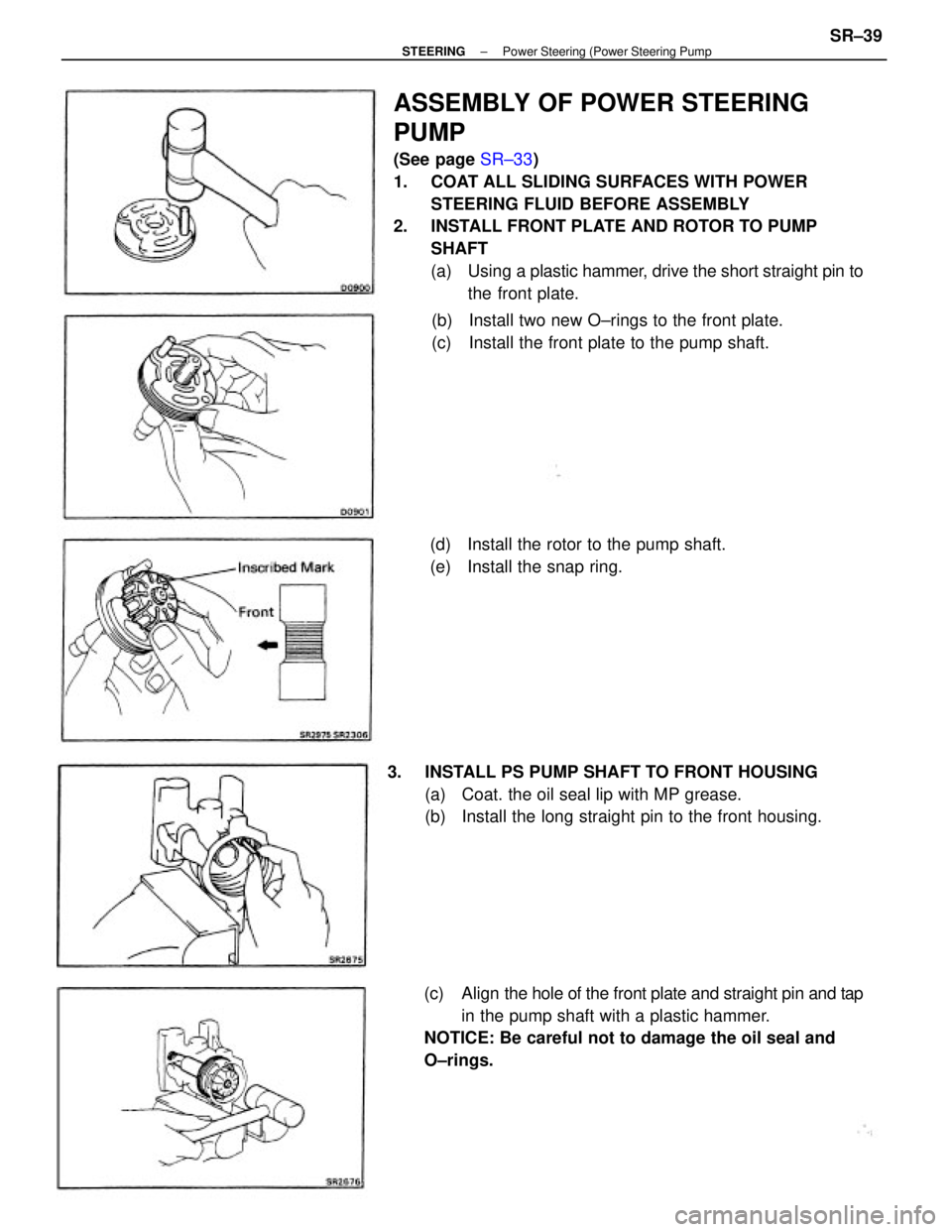
ASSEMBLY OF POWER STEERING
PUMP
(See page SR±33)
1. COAT ALL SLIDING SURFACES WITH POWER
STEERING FLUID BEFORE ASSEMBLY
2. INSTALL FRONT PLATE AND ROTOR TO PUMP
SHAFT
(a) Using a plastic hammer, drive the short straight pin to
the front plate.
(c) Align the hole of the front plate and straight pin and tap
in the pump shaft with a plastic hammer.
NOTICE: Be careful not to damage the oil seal and
O±rings. 3. INSTALL PS PUMP SHAFT TO FRONT HOUSING
(a) Coat. the oil seal lip with MP grease.
(b) Install the long straight pin to the front housing.(b) Install two new O±rings to the front plate.
(c) Install the front plate to the pump shaft.
(d) Install the rotor to the pump shaft.
(e) Install the snap ring.
± STEERINGPower Steering (Power Steering PumpSR±39
Page 2382 of 2389
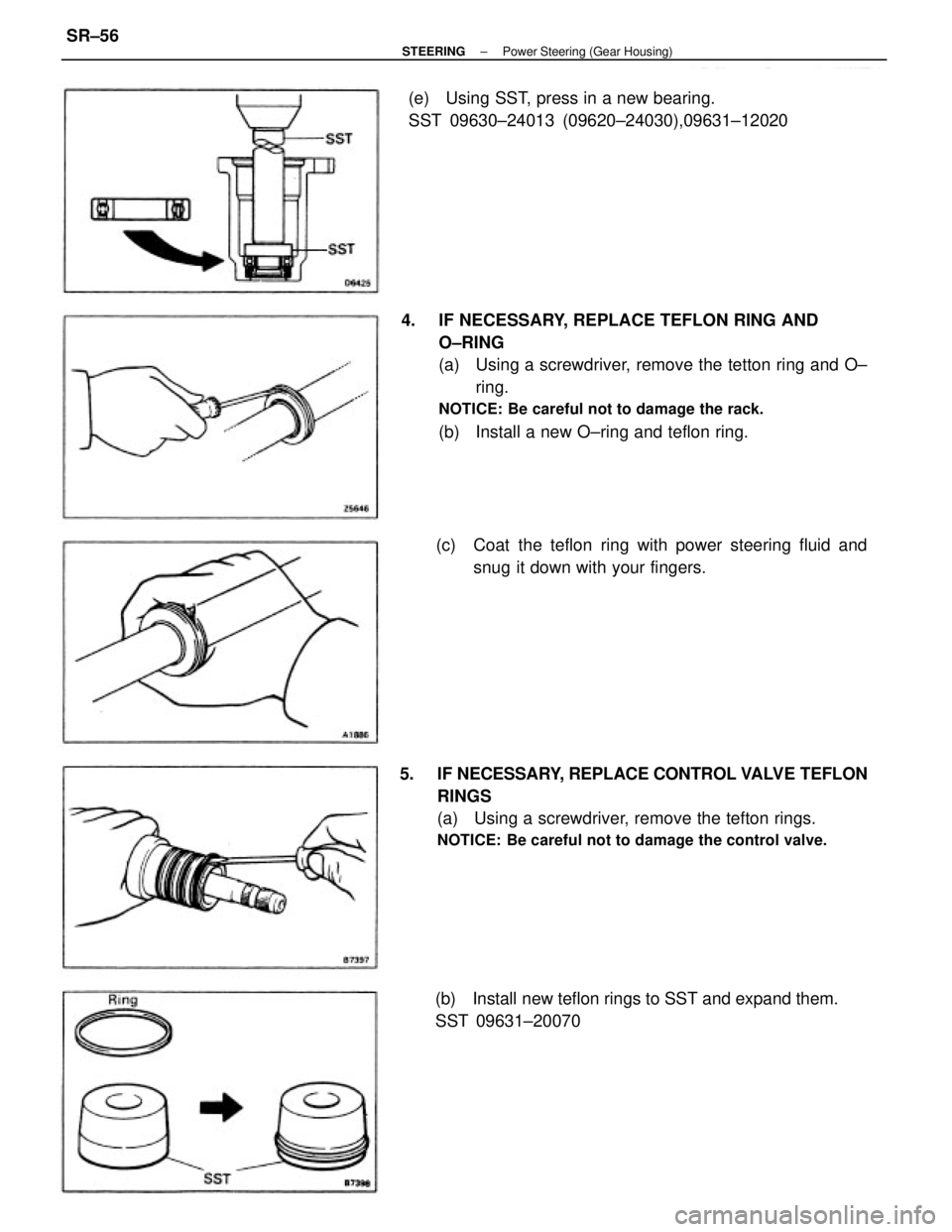
4. IF NECESSARY, REPLACE TEFLON RING AND
O±RING
(a) Using a screwdriver, remove the tetton ring and O±
ring.
NOTICE: Be careful not to damage the rack.
(b) Install a new O±ring and teflon ring.
5. IF NECESSARY, REPLACE CONTROL VALVE TEFLON
RINGS
(a) Using a screwdriver, remove the tefton rings.
NOTICE: Be careful not to damage the control valve.
(c) Coat the teflon ring with power steering fluid and
snug it down with your fingers. (e) Using SST, press in a new bearing.
SST 09630±24013 (09620±24030),09631±12020
(b) Install new teflon rings to SST and expand them.
SST 09631±20070
± STEERINGPower Steering (Gear Housing)SR±56