Page 961 of 2389

HINT:
wºNew beltº refer to a belt which has been used 5 minutes
or less on a running engine.
wºUsed beltº refers to a belt which has been used on a running
engine for 5 minutes or more.
wAfter installing a belt, check that it fits properly in the
ribbed grooves.
wCheck by hand to confirm that the belt has not slipped out
of the groove on the bottom of the pulley.
wAfter installing a new belt, run the engine for about 5
minutes and recheck the belt tension.
4. VISUALLY CHECK ALTERNATOR WIRING AND
LISTEN FOR ABNORMAL NOISES
(a) Check that the wiring is in good condition.
(b) Check that there is no abnormal noise from the
alternator white the engine is running.
6. INSPECT CHARGING CIRCUIT WITHOUT LOAD
HINT: If a battery/alternator tester is available, connect the
tester to the charging circuit as per manufacturer's instruc-
tions.
(a) If a tester is not available, connect a voltmeter and ammeter
to the charging circuit as follows:
wDisconnect the wire from terminal B of the alternator and
connect it to the negative H probe of the ammeter.
wConnect the positive (+) probe of the ammeter to terminals
B of the alternator.
wConnect the positive (+) probe of the voltmeter to terminal
B of the alternator.
wGround the negative (±) probe of the voltmeter. 5. INSPECT CHARGE WARNING LIGHT CIRCUIT
(a) Warm up the engine and then turn it off.
(b) Turn off all accessories.
(c) Turn the ignition switch to ºONº. Check that the charge
warning light is lit.
(d) Start the engine. Check that the light goes out.
If the light does not go off as specified, troubleshoot the
charge light circuit.
± CHARGING SYSTEMOn±Vehicle InspectionCH±4
Page 962 of 2389

(b) Check the charging circuit as follows: .
With the engine running from idling to 2,000 rpm,
check the reading on the ammeter and voltmeter.
Standard amperage: 10 A or less
Standard voltage: 13.9 ± 15.1 V at 25
°C (77°F)
13.5 ± 14.3 V at 115°C (2390F)
If the voltmeter reading is greater than standard volt-
age, replace the IC regulator.
7. INSPECT CHARGING CIRCUIT WITH LOAD
(a) With the engine running at 2,000 rpm, turn on the high beam
headlights and place the heater blower switch at ºHlº.
(b) Check the reading on the ammeter.
Standard amperage: 30 A or more
If the ammeter reading is less than standard amperage,
repair the alternator. (See page CH±6)
HINT: With the battery fully charged, the indication will
sometimes be less than standard amperage. If the voltmeter reading is less than standard voltage,
check the IC regulator and alternator as follows:
wWith terminal F grounded, start the engine and check
the voltmeter reading of terminal B.
wIf the voltmeter reading is greater than standard voltage,
replace the IC regulator.
.. If the voltmeter reading is less than standard voltage,
check the alternator.
± CHARGING SYSTEMOn±Vehicle InspectionCH±5
Page 963 of 2389
1. INSPECT RELAY CONTINUITY
(a) Using an ohmmeter, check that there is continuity between
terminals 1 and 3.
(b) Check that there is continuity between terminals 2 and
4.
(c) Check that there is no continuity between terminals 4
and 5.
If continuity is not as specified, replace the relay.
2. INSPECT RELAY OPERATION
(a) Apply battery voltage across terminals 1 and 3.
(b) Using an ohmmeter, check that there is continuity between
terminals 4 and 5.
(e) Check that there is no continuity between terminals 2
and 4.
If operation is not as specified, replace the relay.
ENGINE MAIN RELAY
INSPECTION OF ENGINE MAIN RELAY
LOCATION:
3S±FE In the relay box in the engine compartment.
2VZ±FE On the LH fender apron rear side in the engine
compartment.
± CHARGING SYSTEMEngine Main RelayCH±16
Page 975 of 2389

Clutch pedal freeplay excessive
Air in clutch lines
Clutch release cylinder faulty
Clutch master cylinder faulty
Clutch disc out of true, runout is excessive or
lining broken
Splines on input shaft or clutch disc dirty or
burred
Clutch pressure plate faulty
Clutch disc lining oily or worn out
Pressure plate faulty
Clutch diaphragm spring bent
Engine mounts looseClutch pedal freeplay insufficient
Clutch disc lining oily or worn out
Pressure plate faulty
Release fork binding
Inspect clutch disc
Replace clutch cover
Align clutch diaphragm spring
Repair as necessaryAdjust pedal freeplay
Bleed clutch system
Repair release cylinder
Repair master cylinder
Inspect clutch disc
Air in clutch lines
Clutch release cylinder faulty
Clutch master cylinder faultyAdjust pedal freeplay
inspect clutch disc
Replace clutch cover
inspect release fork
Bleed clutch system
Repair release cylinder
Repair master cylinder
Loose part inside housing
Release bearing worn or dirtyRepair as necessary
Replace clutch cover
TROUBLESHOOTING
Repair as necessary
Replace release bearing Hard to shift or will not
shiftCL±3
CL±4
CL±7
CL±5
CL±9
Clutch pedal spongyClutch grabs/
chattersCL±3
CL±9
CL±9
CL±9
CL±9
CL±9
CL±9
CL±4
CL±7
CL±5 Possible cause
Clutch noisy Clutch slipsProblem
RemedyPage
± CLUTCHTroubleshootingCL±2
Page 976 of 2389

CHECK AND ADJUSTMENT OF
CLUTCH PEDAL
1. CHECK THAT PEDAL HEIGHT IS CORRECT
Pedal height from asphalt shaft 181 ± 191 mm
(7:13 ± 7.52 in.)
2. IF NECESSARY, ADJUST PEDAL HEIGHT
(a) Remove the instrument lower finish panel and discon-
nect the air duct.
(b) Loosen the lock nut and turn the stopper bolt (w/o
Cruise control system) or clutch switch (w/ Cruise
control system) until the height is correct. Tighten the
lock nut.
HINT: Before rotating the clutch switch for pedal height
adjustment, disconnect the clutch switch connector.
3. CHECK THAT PEDAL FREEPLAY AND PUSH ROD
PLAY ARE CORRECT
(Pedal Freeplay)
Push in the pedal until the beginning of clutch resistance
is felt.
Pedal freeplay: 5 ± 15 mm (0.20 ± 0.59 in.)
Push rod play at pedal top: 1.0 ± 5.0 mm
(0.039 ± 0.197 in.)
4. IF NECESSARY, ADJUST PEDAL FREEPLAY AND
PUSH ROD PLAY
(a) Loosen the lock nut and turn the push rod until the free-
play and push rod play are correct.
(b) Tighten the lock nut.
(e) After adjusting the pedal freeplay, check the pedal
height.
(d) Connect the air duct and install the lower finish panel.
5. INSPECT CLUTCH RELEASE POINT
(a) Pull the parking brake lever and install wheel stopper.
(b) Start the engine and idle the engine.
(e) Without depressing the clutch pedal, slowly shift the
shift lever into reverse position until the gears contact.
(d) Gradually depress the clutch pedal and measure the
stroke distance from the point the gear noise stops
(release point) up to the full stroke end position.
Standard distance: 25 mm (0.98 in.) or more
(From pedal stroke end position to release point)
If the distance is not as specified, perform the following
operation.
wInspect pedal height.
wInspect push rod play and pedal free play.
wBleed the clutch line.
wInspect the clutch cover and disc.
± CLUTCHCheck and Adjustment of Clutch PedalCL±3
Page 977 of 2389
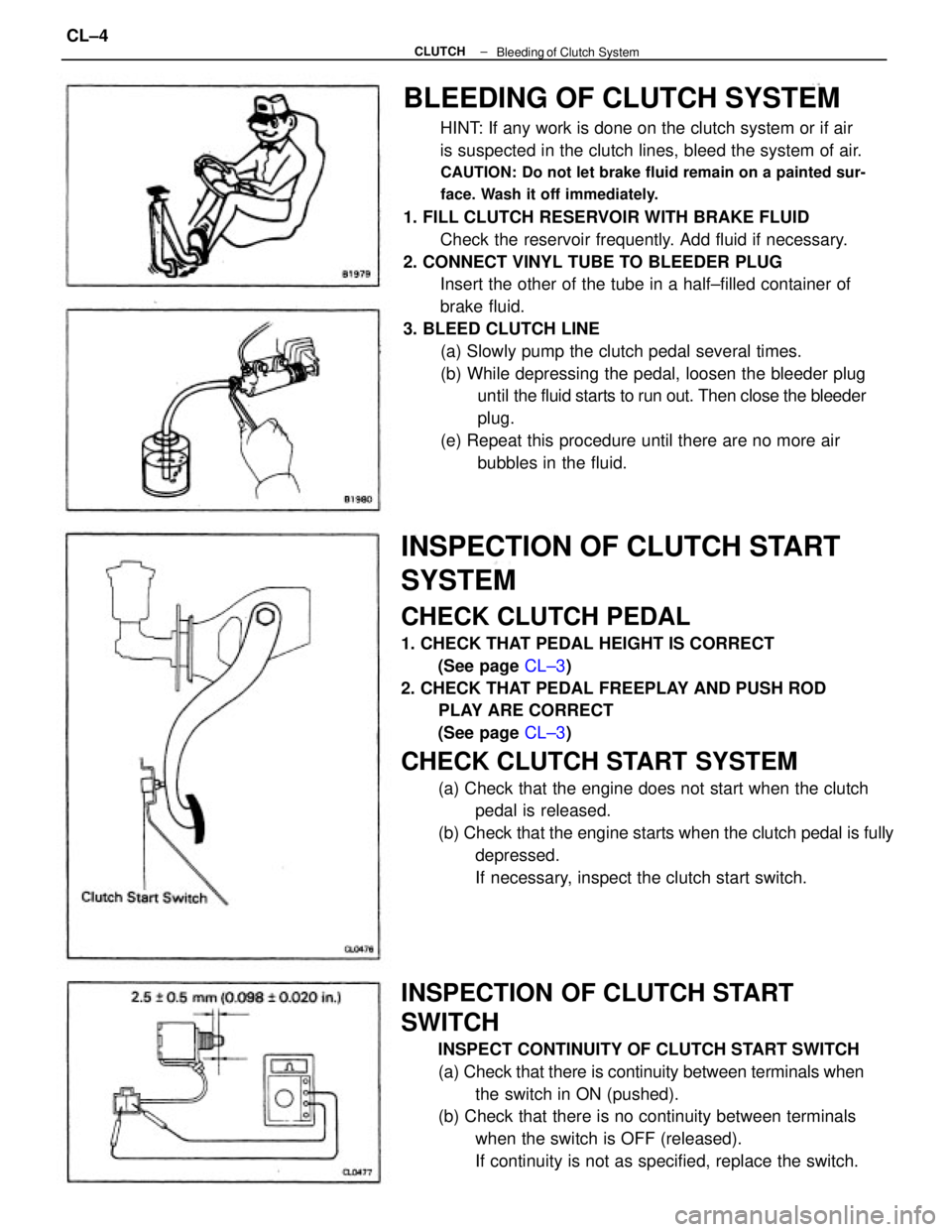
BLEEDING OF CLUTCH SYSTEM
HINT: If any work is done on the clutch system or if air
is suspected in the clutch lines, bleed the system of air.
CAUTION: Do not let brake fluid remain on a painted sur-
face. Wash it off immediately.
1. FILL CLUTCH RESERVOIR WITH BRAKE FLUID
Check the reservoir frequently. Add fluid if necessary.
2. CONNECT VINYL TUBE TO BLEEDER PLUG
Insert the other of the tube in a half±filled container of
brake fluid.
3. BLEED CLUTCH LINE
(a) Slowly pump the clutch pedal several times.
(b) While depressing the pedal, loosen the bleeder plug
until the fluid starts to run out. Then close the bleeder
plug.
(e) Repeat this procedure until there are no more air
bubbles in the fluid.
INSPECTION OF CLUTCH START
SYSTEM
CHECK CLUTCH PEDAL
1. CHECK THAT PEDAL HEIGHT IS CORRECT
(See page CL±3)
2. CHECK THAT PEDAL FREEPLAY AND PUSH ROD
PLAY ARE CORRECT
(See page CL±3)
CHECK CLUTCH START SYSTEM
(a) Check that the engine does not start when the clutch
pedal is released.
(b) Check that the engine starts when the clutch pedal is fully
depressed.
If necessary, inspect the clutch start switch.
INSPECTION OF CLUTCH START
SWITCH
INSPECT CONTINUITY OF CLUTCH START SWITCH
(a) Check that there is continuity between terminals when
the switch in ON (pushed).
(b) Check that there is no continuity between terminals
when the switch is OFF (released).
If continuity is not as specified, replace the switch.
± CLUTCH
Bleeding of Clutch SystemCL±4
Page 978 of 2389
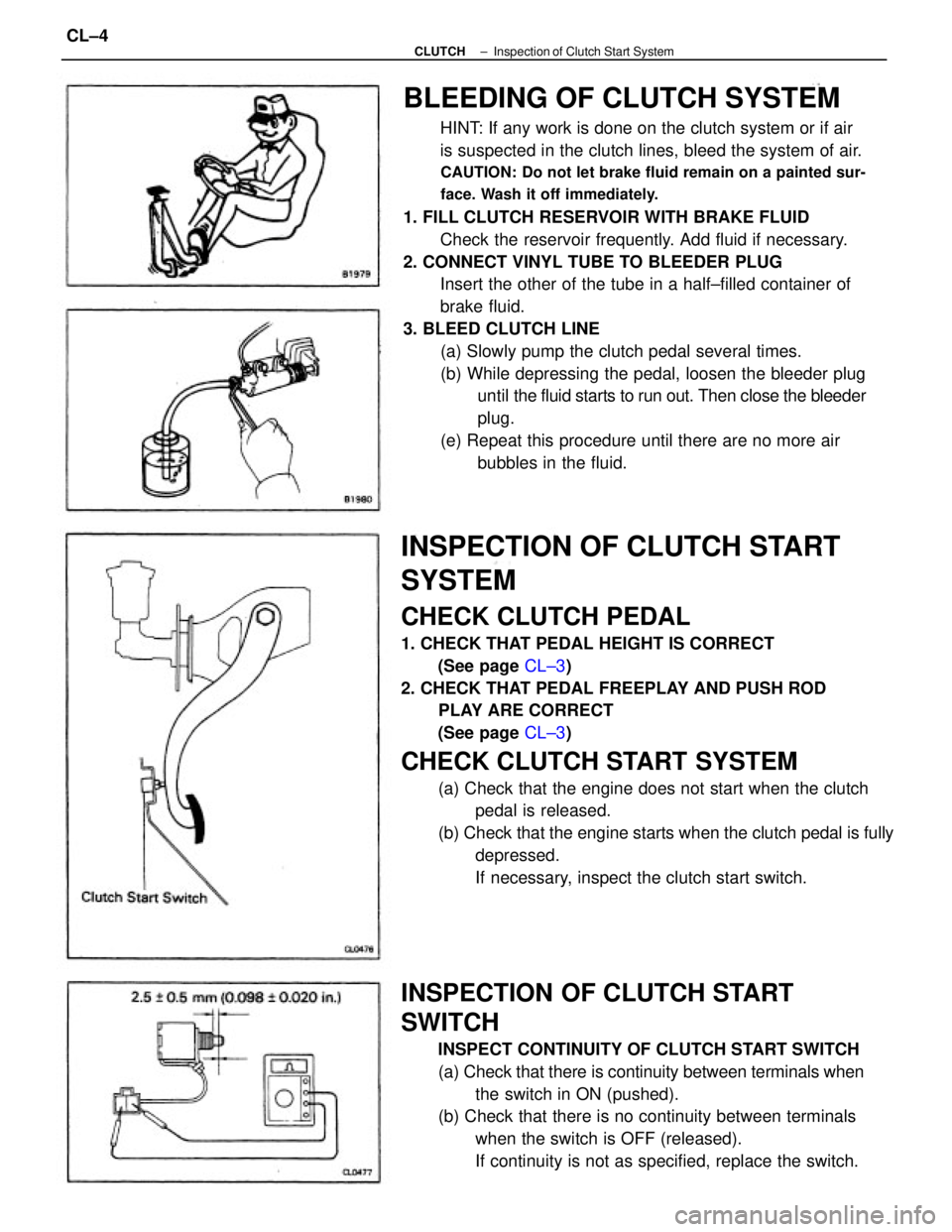
BLEEDING OF CLUTCH SYSTEM
HINT: If any work is done on the clutch system or if air
is suspected in the clutch lines, bleed the system of air.
CAUTION: Do not let brake fluid remain on a painted sur-
face. Wash it off immediately.
1. FILL CLUTCH RESERVOIR WITH BRAKE FLUID
Check the reservoir frequently. Add fluid if necessary.
2. CONNECT VINYL TUBE TO BLEEDER PLUG
Insert the other of the tube in a half±filled container of
brake fluid.
3. BLEED CLUTCH LINE
(a) Slowly pump the clutch pedal several times.
(b) While depressing the pedal, loosen the bleeder plug
until the fluid starts to run out. Then close the bleeder
plug.
(e) Repeat this procedure until there are no more air
bubbles in the fluid.
INSPECTION OF CLUTCH START
SYSTEM
CHECK CLUTCH PEDAL
1. CHECK THAT PEDAL HEIGHT IS CORRECT
(See page CL±3)
2. CHECK THAT PEDAL FREEPLAY AND PUSH ROD
PLAY ARE CORRECT
(See page CL±3)
CHECK CLUTCH START SYSTEM
(a) Check that the engine does not start when the clutch
pedal is released.
(b) Check that the engine starts when the clutch pedal is fully
depressed.
If necessary, inspect the clutch start switch.
INSPECTION OF CLUTCH START
SWITCH
INSPECT CONTINUITY OF CLUTCH START SWITCH
(a) Check that there is continuity between terminals when
the switch in ON (pushed).
(b) Check that there is no continuity between terminals
when the switch is OFF (released).
If continuity is not as specified, replace the switch.
± CLUTCHInspection of Clutch Start SystemCL±4
Page 983 of 2389
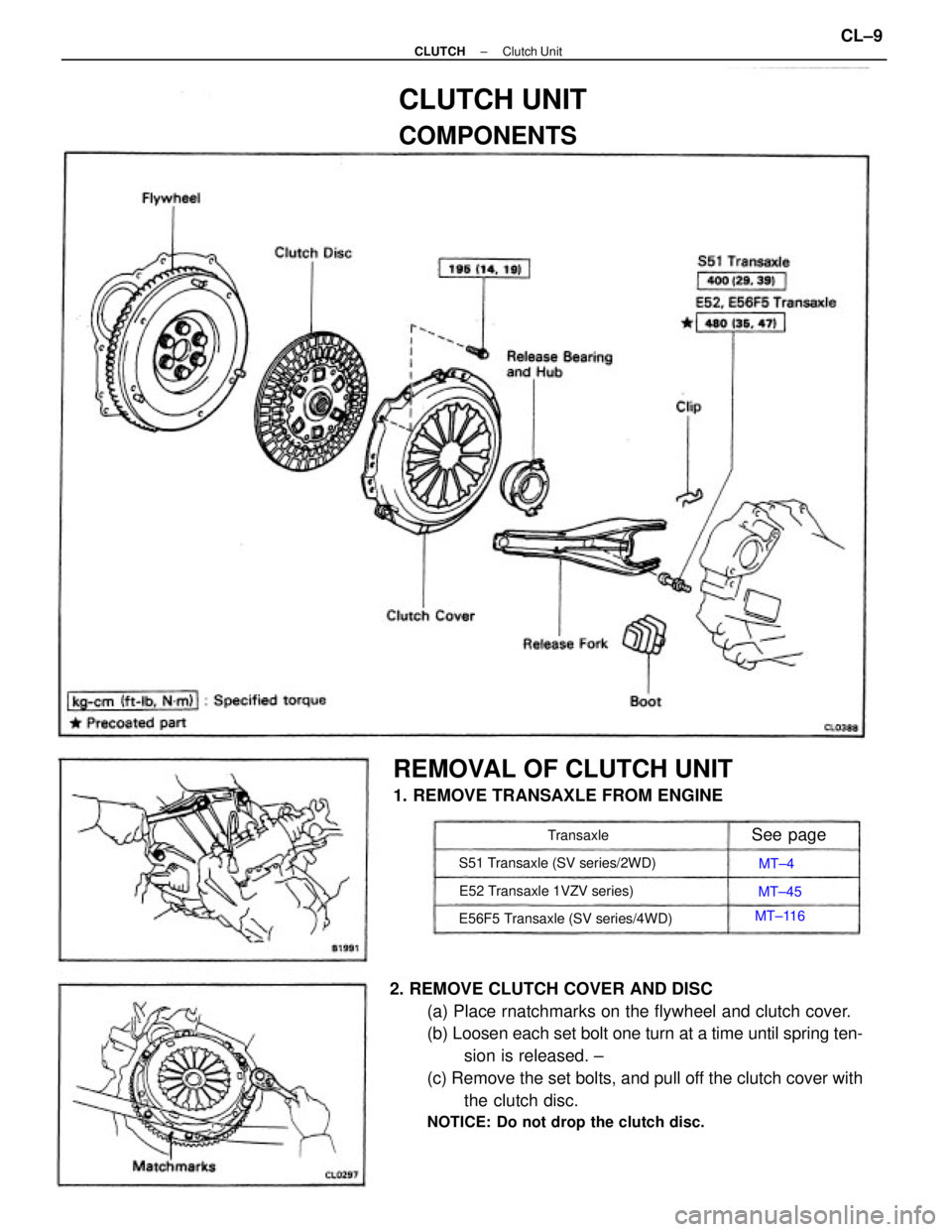
2. REMOVE CLUTCH COVER AND DISC
(a) Place rnatchmarks on the flywheel and clutch cover.
(b) Loosen each set bolt one turn at a time until spring ten-
sion is released. ±
(c) Remove the set bolts, and pull off the clutch cover with
the clutch disc.
NOTICE: Do not drop the clutch disc.
REMOVAL OF CLUTCH UNIT
1. REMOVE TRANSAXLE FROM ENGINE
CLUTCH UNIT
COMPONENTS
E56F5 Transaxle (SV series/4WD) S51 Transaxle (SV series/2WD)
E52 Transaxle 1VZV series)
See pageTransaxle
MT±116MT±45MT±4
± CLUTCHClutch UnitCL±9