Page 513 of 2389
(b) Using SST, measure the piston stroke applying and
releasing the compressed air (4 ± 8 kg/cm2 57 ±
114 psi or 392 ± 785 kPa) as shown.
SST 09240±00020
Piston stroke: 2.0 ± 3.5 mm (0.079 ± 0.138 in.)
if the piston stroke exceeds the limit, inspect the sec-
ond coast brake band (See page AT±264).
24. STAND TRANSAXLE ENGINE SIDE UPWARD
25. REMOVE OIL PUMP
NOTICE: Before removing the oil pump, remove the sec-
ond coast brake piston.
(a) Remove the seven bolts.
(b) Using SST, pull out the oil pump from the transaxle case.
SST 09350±32014 (09351±32061 23. REMOVE SECOND COAST BRAKE PISTON
(a) Using SST, remove the snap ring.
SST 09350±32014 (09351±32050)
(b) Remove the cover.
(c) Remove the piston and outer return spring.
(d) Remove the two O±rings from the cover.
± AUTOMATIC TRANSAXLERemoval of Component Parts tA540E and A540H)AT±246
Page 720 of 2389
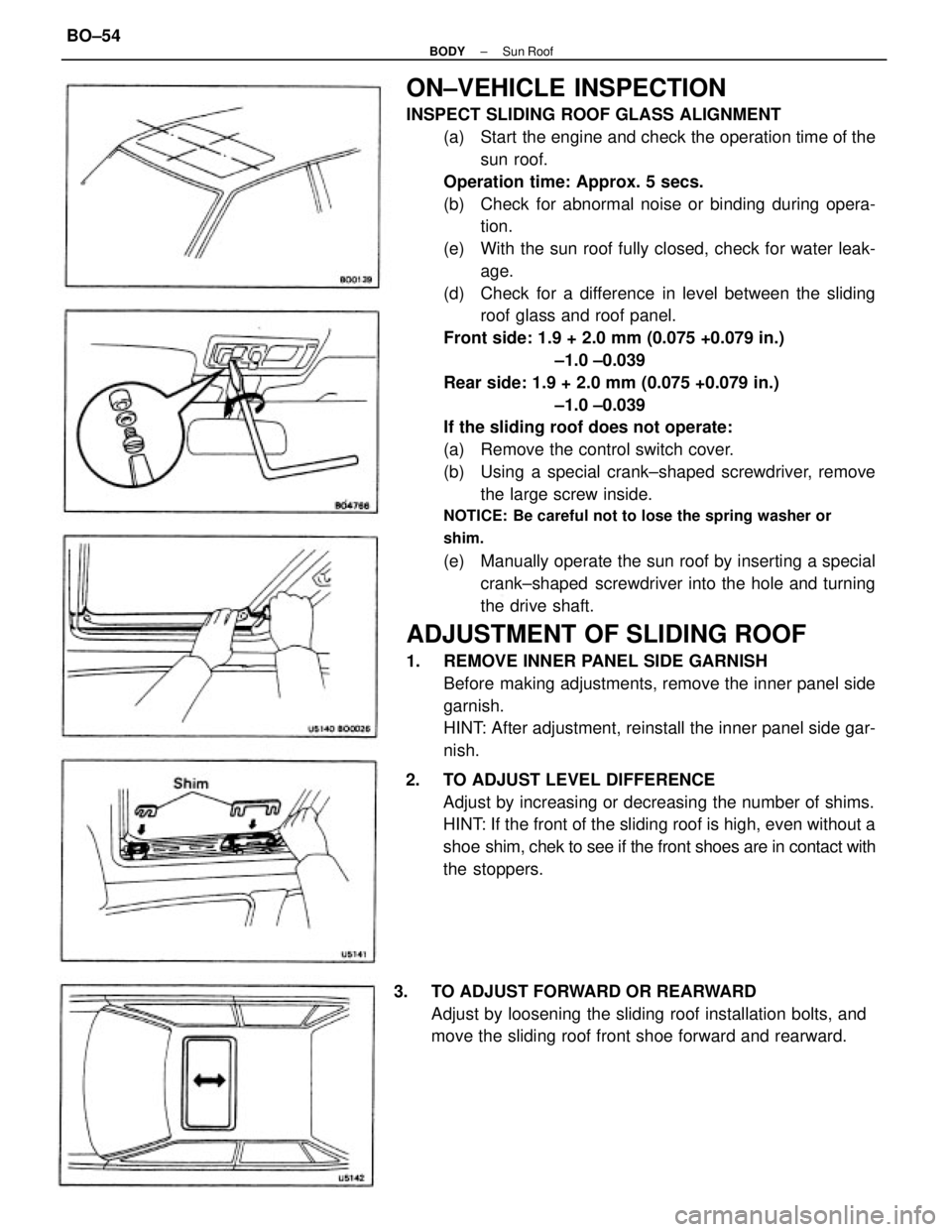
ON±VEHICLE INSPECTION
INSPECT SLIDING ROOF GLASS ALIGNMENT
(a) Start the engine and check the operation time of the
sun roof.
Operation time: Approx. 5 secs.
(b) Check for abnormal noise or binding during opera-
tion.
(e) With the sun roof fully closed, check for water leak-
age.
(d) Check for a difference in level between the sliding
roof glass and roof panel.
Front side: 1.9 + 2.0 mm (0.075 +0.079 in.)
±1.0 ±0.039
Rear side: 1.9 + 2.0 mm (0.075 +0.079 in.)
±1.0 ±0.039
If the sliding roof does not operate:
(a) Remove the control switch cover.
(b) Using a special crank±shaped screwdriver, remove
the large screw inside.
NOTICE: Be careful not to lose the spring washer or
shim.
(e) Manually operate the sun roof by inserting a special
crank±shaped screwdriver into the hole and turning
the drive shaft.
ADJUSTMENT OF SLIDING ROOF
1. REMOVE INNER PANEL SIDE GARNISH
Before making adjustments, remove the inner panel side
garnish.
HINT: After adjustment, reinstall the inner panel side gar-
nish.
2. TO ADJUST LEVEL DIFFERENCE
Adjust by increasing or decreasing the number of shims.
HINT: If the front of the sliding roof is high, even without a
shoe shim, chek to see if the front shoes are in contact with
the stoppers.
3. TO ADJUST FORWARD OR REARWARD
Adjust by loosening the sliding roof installation bolts, and
move the sliding roof front shoe forward and rearward.
± BODYSun RoofBO±54
Page 730 of 2389
REMOVAL OF SAFETY PAD
(See pages BO±62, 63)
1. DISCONNECT BATTERY CABLE FROM NEGATIVE
TERMINAL
2. REMOVE STEERING WHEEL
3. REMOVE FRONT PILLAR GARNISH
Pry out the clips and pull the front pillar garnish upward
to remove it by the hand.
4. REMOVE NO. 1 UNDER COVER
5. REMOVE LOWER FINISH PANEL
(a) Remove the two screws and the engine. hood re-
lease lever. HINT: Screw sizes in the previous illustration are indi-
cated by following the code below for removal and
installation of safety pad.
mm (in.)
Shape
ShapeShapeCode
CodeCodeSizeSizeSize
± BODYSafety PadBO±64
Page 742 of 2389
BODY DIMENSIONS
ENGINE COMPARTMENT
Front crossmember bumper installation nut Front side member bumper installation hole
Front side member standard hole Front spring support inner hole
Cowl top panel standard hole Cowl top panel center mark
Tube clamp installation nut Front fender installation nut
Headlight installation hole Front fender installation nut
Fender installation nut
Name
± BODYBody DimensionsBO±76
Page 757 of 2389
Fuses
1. GAUGE
2. ±
3. STOP
4. TAIL
5. CIG
6. RADIO
7. TURN
8. DEF±I/UP
9. ±
10. ENGINE
11. WIPER
12. ECU±IG
13. ±
14. IGN
15. ECU±B FUSE AND RELAY BLOCK No±1 (LOCATION: Driver's Side Kick Panel)7.5A
20A
15A
15A
7.5A
7.5A
10A
10A
20A
15A
7.5A
1 0A
FUSE AND RELAY BLOCKS
± BODY ELECTRICAL SYSTEMLocation of Switches and RelaysBE±11
Page 758 of 2389
Fuses
1. HEAD±HI (RH) 15A (CANADA)
2. HEAD±HI (LH) 15A (CANADA)
3. DOME 20A
4. ± ±
5. HEAD (RH) 15A (USA)
HEAD±LO (RH) 15A (CANADA)
6. CHARGE 7.5A
7. ER 15A
8. HAZ.HORN 15A
9. HEAD (LH) 15A (USA)
HEAD±LO (H) 15A (CANADA)Relays
A. A/C FAN No.3 Relay
B. A/C MAGNET CLUTCH Relay
(USA)
DIMMER Relay (CANADA)
C. A/C FAN No.2 Relay
D. FAN No. 1 Relay
E. HEADLIGHT Relay
F. EFI MAIN Relay
G. ENGINE MAIN Relay FUSE AND RELAY BLOCK No±2 (LOCATION: Engine Compartment)
FUSE AND RELAY BLOCKS (Cont'd)
± BODY ELECTRICAL SYSTEMLocation of Switches and RelaysBE±12
Page 769 of 2389

Current is led from the battery to terminal 12 of the running light relay.
Operation examples of the switch are shown below.
1. IGNITION SWITCH ºONº AND LIGHT CONTROL SWITCH ºOFFº
When the switches are set, current is led from the battery to terminal 1 of the running light relay. Also,
because continuity is made between terminal 3 and the body ground, and 5 and the body ground of
the running light relay, the taillight control relay and headlight control relay are turned on.
Then the taillights and headlights light up.
HINT: Because terminal 14 of the running light relay is not grounded at all times, the headlight dimmer
relay is off, so that the headlights light up at the low beam.
2. LIGHT CONTROL SWITCH IN ºHEADº
When the switch is set, continuity is made between terminal 4 and the body ground, and 2 and the body
ground of the running light relay. Also, because the continuity is made between terminal 5 and the body
ground, and 3 and the body ground of the running light relay at all times, the taillights and headlights
light up.
HINT: When the headlight dimmer switch is set to ºHIGHº, continuity is made between terminal 13 of
the running light relay and the body ground. Also, because continuity is made between terminal 14 of
the running light relay and the body ground, the headlight dimmer relay is turned on. Then the head-
lights go on at the high beam.
3. HEADLIGHT DIMMER SWITCH IN ºFLASHº
When the switch is set, continuity is made between terminal 6 and the body ground, and 13 and the
body ground of the running light relay. Also, because the continuity is made between terminal 5 and
the body ground, and 14 and the body ground of the running light relay, the headlights flash.
4. ENGINE STOPS (IGNITION SWITCH ºONº)
When the engine is stopped, because the continuity between terminal 5 and terminal 10 of the running
light relay remains, so the running lights also remain.
HINT: If ignition switch is turned to ºOFFº, running lights will go off because the continuity between termi-
nal 5 and terminal 10 of the running light relay is cut off.
Light Control Rheostat
INSPECTION OF RHEOSTAT
INSPECT RHEOSTAT OPERATION
(a) Connect the positive (+) lead from the battery to
terminal 1 and the negative (±) lead to terminal 2.
(b) Connect the terminals 1 and 3 through a 3.4 W test bulb.
(c) Gradually turn the rheostat knob from the bright side to
dark side, check that the test bulb brightness changes
from bright to dark.
If operation is not as specified, replace the rheostat.
Daytime Running Light System
(CANADA)
DESCRIPTION
± BODY ELECTRICAL SYSTEMLightingBE±23
Page 771 of 2389

(Relay Operation)
(a) Connect the positive (+) lead from the voltmeter to ter-
minal 7 and negative (±) lead to terminal 10.
(b) Check that there is battery voltage with light control
switch is turned on.
If operation is not as specified, replace the relay.If continuity is not as specified, replace the relay.
2. INSPECT DAYTIME RUNNING LIGHT RELAY
(Relay Circuit)
Disconnect the connector from the relay and inspect the
connector on the wire harness side as shown in the chart.
INSPECTION OF RELAY
1. INSPECT DIMMER RELAY (Continuity)
If circuit is as specified, inspect relay operation.
Apply battery voltage to
terminals 2 and 4.
Light control switch
position
Light control switch
position
Headlight dimmer
switch positionHeadlight dimmer
switch positionLow beam or High beam
Ignition switch
position 7 ± Ground
10 ± Ground
High beam or Flash 13 ± Ground
3 ± Ground
5 ± Ground
Tester connection
Ground terminal 5
Specified value
Battery voltageBattery voltageBattery voltage
Battery voltage Battery voltageNo continuity
No continuity TAIL or HEADNo continuity
No continuity
14 ± Ground12 ± GroundON or STARTLOCK or ACC
1 ± GroundOFF or TAIL
8 ± Ground2 ± Ground
6 ± Ground4 ± Ground
No voltage
No voltage
No voltageContinuity
Continuity Continuity
Continuity
ContinuityContinuity
Condition
Check for
Low beam Condition
Running
Terminal
Constant
Constant
Constant
Constant
Constant Voltage
EngineHEAD
Flash
StopOFF
± BODY ELECTRICAL SYSTEMLightingBE±25


