Page 297 of 2389
MEASURE GOVERNOR PRESSURE (A1401)
(a) Check the parking brake to see that it is not applied.
(b) Start the engine.
(c) Shift into D range and measure the governor pressures at the speeds specified in the table.
EVALUATION
If governor pressure is defective:
wLine pressure defective
wFluid leakage in governor pressure circuit
wGovernor valve operation defective .
Vehicle speed (Reference only)
Drive pinion shaftGovernor pressure
± AUTOMATIC TRANSAXLETroubleshooting (Mechanical System Tests) (A140L and
A140E)AT±42
Page 299 of 2389

2. 2 RANGE TEST
Shift into the 2 range and, while driving with the accel-
erator pedal held constantly at the full throttle valve
opening position, push in one of the pattern selectors
and check on the following points.
(a) Check to see that the 1 ±2 up±shift takes place and
that the shift point conforms to it shown on the auto-
matic shift schedule. (See page AT±49)
(b) White running in the 2 range and 2nd gear, re-
lease the accelerator pedal and check the en-
gine braking effect.
EVALUATION
If there is no engine braking effect:
wSecond coast brake is defective (d) While running in the D range, 2nd, 3rd and O/D
gears, check to see that the possible kick±
down vehicle speed limits for 2 ±1, 3 ±2 and O/D
±3 kickdowns conform to those indicated on the
automatic shift schedule. (See page AT±49)
(e) Check for abnormal shock and slip at kick±down.
(f) Check for the lock±up mechanism:
(1) Drive in D range ± O/D gear, at a steady speed
(lock±up ON) of about 75 km/h (47 mph).
(2) Lightly depress the. accelerator pedal and check
that the engine rpm does not change abruptly.
If there is a big jump in engine rpm, there is no
lock±up.
(e) Check for abnormal noise at acceleration and
deceleration, and for shock at up±shift and
downshift.
± AUTOMATIC TRANSAXLETroubleshooting (Mechanical System Tests) (A140L and
A140E)AT±44
Page 300 of 2389
(b) White running in the L range, release the acceler-
ator pedal and check the engine braking effect.
EVALUATION
If there is no engine braking effect:
First and reverse brake is defective
5. P RANGE TEST
Stop the vehicle on a gradient (more than 5
°) and after
shifting into the P range, release the parking brake.
Then check to see that the parking lock pawl holds the vehicle
in place.
3. L RANGE TEST
(a) White running in the L range, check to see that there is
no up±shift to 2nd gear.
4. R RANGE TEST
Shift into the R range and, while starting at full throttle,
check for slipping.(c) Check for abnormal noise during acceleration
and deceleration.
± AUTOMATIC TRANSAXLETroubleshooting (Mechanical System Tests) (A140L and
A140E)AT±45
Page 302 of 2389

2. 2 RANGE TEST
Shift into the .2 range and, while driving with the accel-
erator pedal held constantly at the full throttle valve
opening position, check on the following points.
(a) Check to see that the 1 ± 2 up±shift takes place and
that the shift point conforms to it shown on the auto-
matic shift schedule. (See page AT±49) (f) Check for the lock±up mechanism.
(1) Drive in D range, O/D gear, at a steady speed
(lock±up ON) of about 70 km/h (43 mph).
(2) Lightly depress the accelerator pedal and check
that the engine rpm does. not change abruptly.
If there is a big jump in engine rpm, there is no
lock±up.
(b) While running in the 2 range and 2nd gear, re-
lease the accelerator pedal and check the en-
gine braking effect.
EVALUATION
If there is no engine braking effect:
Second coast brake is defective (d) While running in the D range, 2nd, 3rd and O/D
gears, check to see that the possible kick±
down vehicle speed limits for 2 ±1, 3 ±2 and
O/D ± 3 kickdowns conform to those indicated
on the automatic shift schedule. (See page
AT±49)
(e) Check for abnormal shock and slip at kick±down.
(c) Check for abnormal noise at acceleration and de-
celeration, and for shock at up±shift and down-
shift.
± AUTOMATIC TRANSAXLETroubleshooting (Mechanical System Tests) (A140L and
A140E)AT±47
Page 303 of 2389
(b) While running in the L range, release the accelerator
pedal and check the engine braking effect.
EVALUATION
If there is no engine braking effect:
wFirst and reverse brake is defective
5. P RANGE TEST
Stop the vehicle on a gradient (more than 5
°) and after
shifting into the P range, release the parking brake.
Then check to see that the parking lock pawl holds the ve-
hicle in place.
4. R RANGE TEST
Shift into the R range and, while starting at full throttle,
check for slipping. 3. L RANGE TEST
(a) While running in the L range, check to see that there
is no up±shift to 2nd gear.
(c) Check for abnormal noise during acceleration
and deceleration.
± AUTOMATIC TRANSAXLETroubleshooting (Mechanical System Tests) (A140L and
A140E)AT±48
Page 439 of 2389
DESCRIPTION
GENERAL
(A540E)
The A540E is a 4±speed, Electronic Controlled Transaxle (hereafter called ECT) developed exclusively for
use with a transversely±mounted engine. A lock±up is built into the torque converter.
The A540E transaxle is mainly composed of the torque converter, the 4±speed planetary gear unit, the
differential, the hydraulic control system and the electronic control system.
± AUTOMATIC TRANSAXLEDescription (A540E and A540H)AT±184
Page 443 of 2389
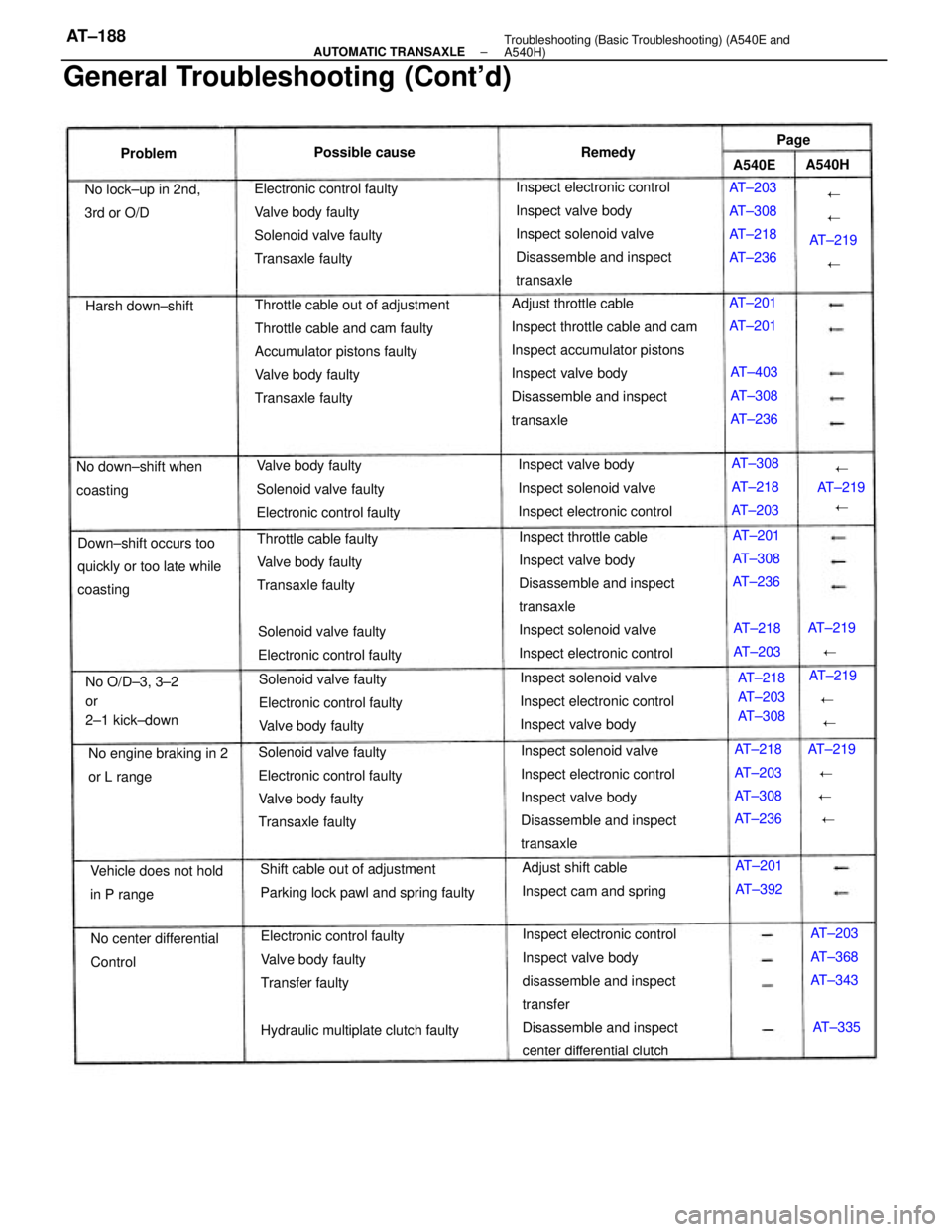
Throttle cable out of adjustment
Throttle cable and cam faulty
Accumulator pistons faulty
Valve body faulty
Transaxle faultyAdjust throttle cable
Inspect throttle cable and cam
Inspect accumulator pistons
Inspect valve body
Disassemble and inspect
transaxle
General Troubleshooting (Cont'd)
Inspect throttle cable
Inspect valve body
Disassemble and inspect
transaxle
Inspect solenoid valve
Inspect electronic control
Inspect electronic control
Inspect valve body
disassemble and inspect
transfer
Disassemble and inspect
center differential clutch Inspect solenoid valve
Inspect electronic control
Inspect valve body
Disassemble and inspect
transaxle Inspect electronic control
Inspect valve body
Inspect solenoid valve
Disassemble and inspect
transaxle
Solenoid valve faulty
Electronic control faulty
Valve body faulty
Transaxle faulty Electronic control faulty
Valve body faulty
Solenoid valve faulty
Transaxle faulty
Shift cable out of adjustment
Parking lock pawl and spring faultyInspect solenoid valve
Inspect electronic control
Inspect valve body Inspect valve body
Inspect solenoid valve
Inspect electronic control
Solenoid valve faulty
Electronic control faulty
Valve body faulty
Electronic control faulty
Valve body faulty
Transfer faulty Valve body faulty
Solenoid valve faulty
Electronic control faulty
Throttle cable faulty
Valve body faulty
Transaxle faulty
Solenoid valve faulty
Electronic control faulty Down±shift occurs too
quickly or too late while
coasting
Adjust shift cable
Inspect cam and spring No down±shift when
coasting
Hydraulic multiplate clutch faultyAT±218
AT±203
AT±308
AT±236 AT±203
AT±308
AT±218
AT±236
AT±219
�
�
� No engine braking in 2
or L range No lock±up in 2nd,
3rd or O/D
No center differential
Control No O/D±3, 3±2
or
2±1 kick±down�
�
AT±219
�
Vehicle does not hold
in P rangeAT±308
AT±218
AT±203
AT±218
AT±203
AT±308 AT±201
AT±308
AT±236 AT±403
AT±308
AT±236
AT±203
AT±368
AT±343 AT±219
�
��
AT±219
� Harsh down±shift
AT±201
AT±392 AT±201
AT±201
AT±218
AT±203AT±219
� Possible cause
ProblemRemedy
AT±335 A540H
A540EPage
± AUTOMATIC TRANSAXLETroubleshooting (Basic Troubleshooting) (A540E and
A540H)AT±188
Page 445 of 2389

Diagnosis System
DESCRIPTION
1. A self±diagnosis function is. built into the electrical control
system. Warning is indicated by the overdrive OFF indicator.
HINT: Warning and diagnostic codes can be read only when
the overdrive switch is ON. If OFF, the overdrive OFF
indicator is lit continuously and will not blink.
(a) If a malfunction occurs within the speed sensors or sole-
noids, the overdrive OFF light will blink to warn the driver.
However, there will be no warning of a malfunction with
lock±up solenoid.
W The diagnostic code can be read by the number of
blinks of the overdrive OFF indicator when terminals
Tt and E1 are short±circuited. (See page AT± 191)
(c) The throttle position sensor or brake signal are not indicated,
but inspection can be made by checking the voltage at ter-
minal Tt of the check connector.
(d) The signals to each gear can be checked by measuring the
voltage at terminal Tt of the check connector while driving.
2. The diagnostic (malfunction) code is retained in memory by the
ECU and due to back±up voltage, is not canceled out when the
engine is turned off. Consequently, after repair, it is necessary
to turn the ignition switch off and remove the fuse EFI (15A)
(A540E) or DOME (20A)
(A540H) or disconnect the Engine and ECT ECU (A540E)
or ECT ECU (A540H) connector to cancel out the diagnostic
(malfunction) code. (See page AT±192)
HINT:
wLow battery voltage will cause faulty operation of the diag-
nosis system. Therefore, always check the battery first.
wUse a voltmeter and ohmmeter that have an impedance of
at least 10 k
�/V.
CHECK O/D OFF INDICATOR LIGHT
1. Turn the ignition switch ON.
2. The O/D OFF light will come on when the O/D switch
placed at OFF.
3. When the O/D switch is set to ON, the O/D OFF light should go
out.
If the O/D OFF light flashes when the O/D switch is set to
ON, the electronic control system is faulty.
± AUTOMATIC TRANSAXLETroubleshooting (Diagnosis System) (A540E and A540H)AT±190


