Page 243 of 2389
REMOVAL OF COOLING UNIT
1. DISCONNECT NEGATIVE CABLE FROM BATTERY
2. DISCHARGE REFRIGERATION SYSTEM
3. DISCONNECT SUCTION TUBE FROM COOLING UNIT
OUTLET FITTING
4. DISCONNECT LIQUID TUBE FROM COOLING UNIT
INLET FITTING
HINT: Cap the open fittings immediately to keep moisture
out of the system.
5. REMOVE GROMMETS FROM INLET AND OUTLET
FITTINGS
6. REMOVE GLOVE BOX
7. DISCONNECT CONNECTORS
8. REMOVE COOLING UNIT
Remove three nuts and four bolts.
COOLING UNIT
(See page AC±12)
ON±VEHICLE INSPECTION OF
EXPANSION VALVE
1. CHECK QUANTITY OF REFRIGERANT GAS DURING
REFRIGERATION CYCLE
2. INSTALL MANIFOLD GAUGE SET
(See page AC±23)
3. RUN ENGINE
Run the engine at 2.000 rpm at least 5 minutes.
4. CHECK EXPANSION VALVE
If the expansion valve is clogged,the low pressure reading
will drop to 0 kg/cm2 (0 psi, 0 kPa), otherwise it is OK.
± AIR CONDITIONING SYSTEMCooling UnitAC±39
Page 251 of 2389

AMPLIFIERS
Inspection of Amplifier
(See page AC±12)
Air Conditioner Amplifier
INSPECT AMPLIFIER CIRCUIT
Disconnect the amplifier and inspect the connector on the
wire harness side as shown in the chart below.
Test conditions:
(1) Ignition: ON
(2) Temperature control lever: MAX. COOL
(3) Blower switch: Hl
If circuit is as specified, replace the amplifier.
ApProx. 1.7 k� at 25°C (77°F)
3S±FE Engine Model
Turn ignition switch off.Turn ignition switch on.
Turn ignition switch off.Turn ignition switch on.
Turn ignition switch off.
Turn ignition switch on.Turn A/C switch off.
Turn A/C switch on.
Turn A/C switch off.Turn A/C switch on.
4pprox. 10 to 14 V
Tester
connectionSpecified value
Battery voltage
Battery voltageBattery voltageBattery voltage
Battery voltage
ApproX. 250 W Start engine.
Stop engine.No voltageNo voltage
No voltage
No voitage
No voltageNo voltage ContinuityContinuity
Resistance
Condition
Check for
Constant
ConstantConstant
Voltage
Voltage
± AIR CONDITIONING SYSTEMAmplifiersAC±45
Page 252 of 2389

Condenser Fan Control Amplifier
INSPECT AMPLIFIER CIRCUIT
Disconnect the amplifier and inspect the connector on the
wire harness side as shown in the chart below. If the circuit is as specified, replace the amplifier.
If circuit is as specified, replace the amplifier. 2VZ±FE Engine Model
Approx. 1.5 k� at 27°C (77°F)
Turn ignition switch off.
Turn ignition switch off. Turn ignition switch on±. Turn ignition switch on. Turn ignition switch off.Turn ignition switch on. Turn ignition switch off. Turn ignition switch on.
Turn A/C switch on.
Turn A/C switch on.
Turn A/C switch off. Turn A/C switch off.
Tester
connection
Approx. 10 to 14 V Tester
connection
Specified valueSpecified value
Battery voltageBattery voltageBattery voltage Battery voltage
Battery voltage
Approx. 250� Battery voltage
Start engine.
Stop engine.
No voltageNo voltage
No voltage
No voltage
No voltage ContinuityNo voltageNo voltage
ContinuityContinuity
Continuity Continuity
Continuity
Condition
Continuity ResistanceCondition
Check forCheck for
Constant Constant Constant
Constant Constant
Constant Constant
VoltageVoltage
± AIR CONDITIONING SYSTEMAmplifiersAC±46
Page 253 of 2389
Compressor Control Amplifier
INSPECT AMPLIFIER CIRCUIT
Disconnect the amplifier and inspect the connector on the
wire harness side as shown in the chart below.
VACUUM HOSE CIRCUIT (3S±FE Engine)
Approx. 4.4 k� 25°C(77°F) Turn ignition switch on.
Turn ignition switch off.
Tester
connectionSpecified value
3 ± GroundBattery voltage 6 ± Ground
No voltage ContinuityContinuity
Resistance
Condition
Check for
Constant Constant
Voltage
5±7
± AIR CONDITIONING SYSTEMAmplifiersAC±47
Page 254 of 2389
Compressor Control Amplifier
INSPECT AMPLIFIER CIRCUIT
Disconnect the amplifier and inspect the connector on the
wire harness side as shown in the chart below.
VACUUM HOSE CIRCUIT (3S±FE Engine)
Approx. 4.4 k� 25°C (77°F) Turn ignition switch on.
Turn ignition switch off.
Tester
connectionSpecified value
3 ± GroundBattery voltage 6 ± Ground
No voltage ContinuityContinuity
Resistance
Condition
Check for
Constant Constant
Voltage
5±7
± AIR CONDITIONING SYSTEMVacuum Hose CircuitAC±47
Page 260 of 2389
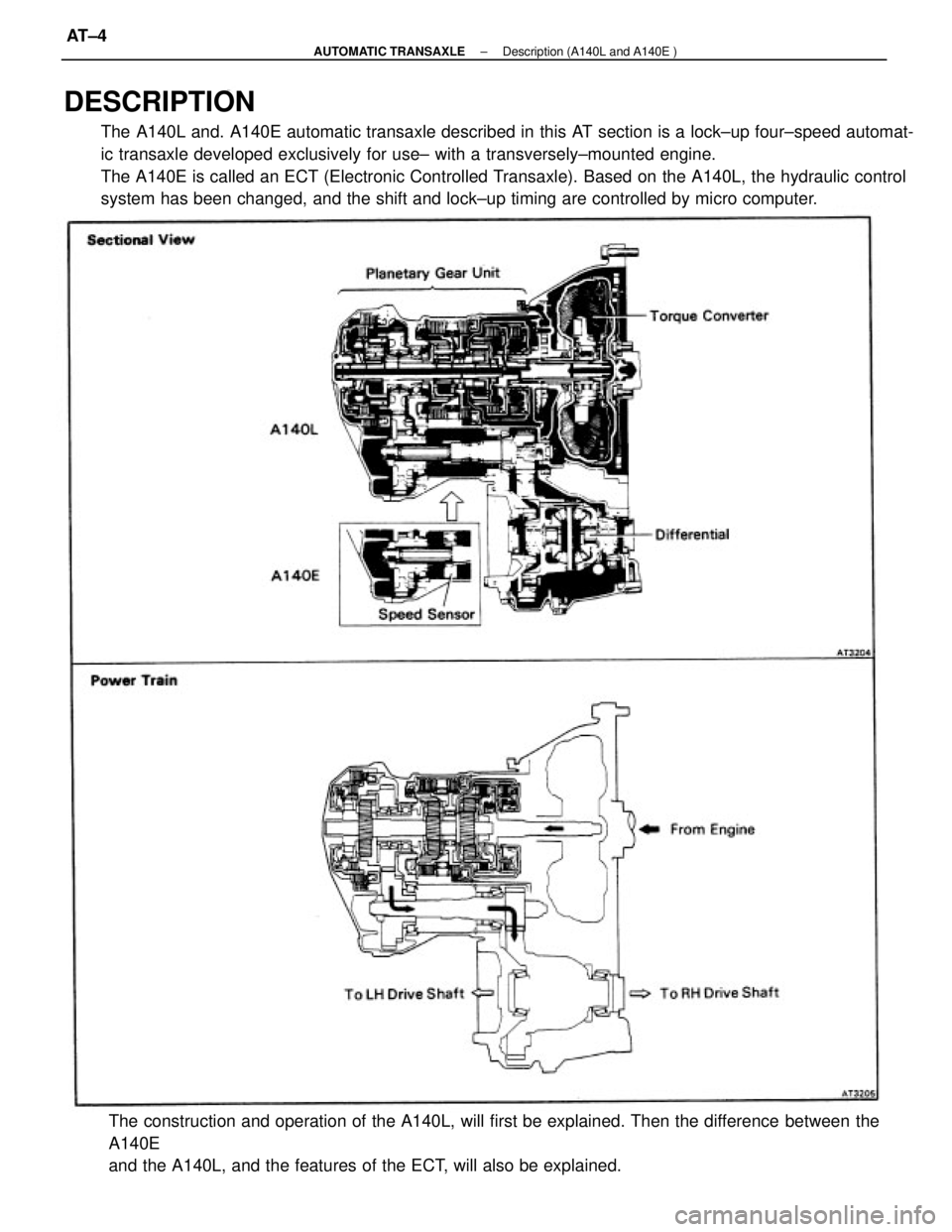
DESCRIPTION
The A140L and. A140E automatic transaxle described in this AT section is a lock±up four±speed automat-
ic transaxle developed exclusively for use± with a transversely±mounted engine.
The A140E is called an ECT (Electronic Controlled Transaxle). Based on the A140L, the hydraulic control
system has been changed, and the shift and lock±up timing are controlled by micro computer.
The construction and operation of the A140L, will first be explained. Then the difference between the
A140E
and the A140L, and the features of the ECT, will also be explained.
± AUTOMATIC TRANSAXLEDescription (A140L and A140E )AT±4
Page 261 of 2389
A140L Automatic Transaxle
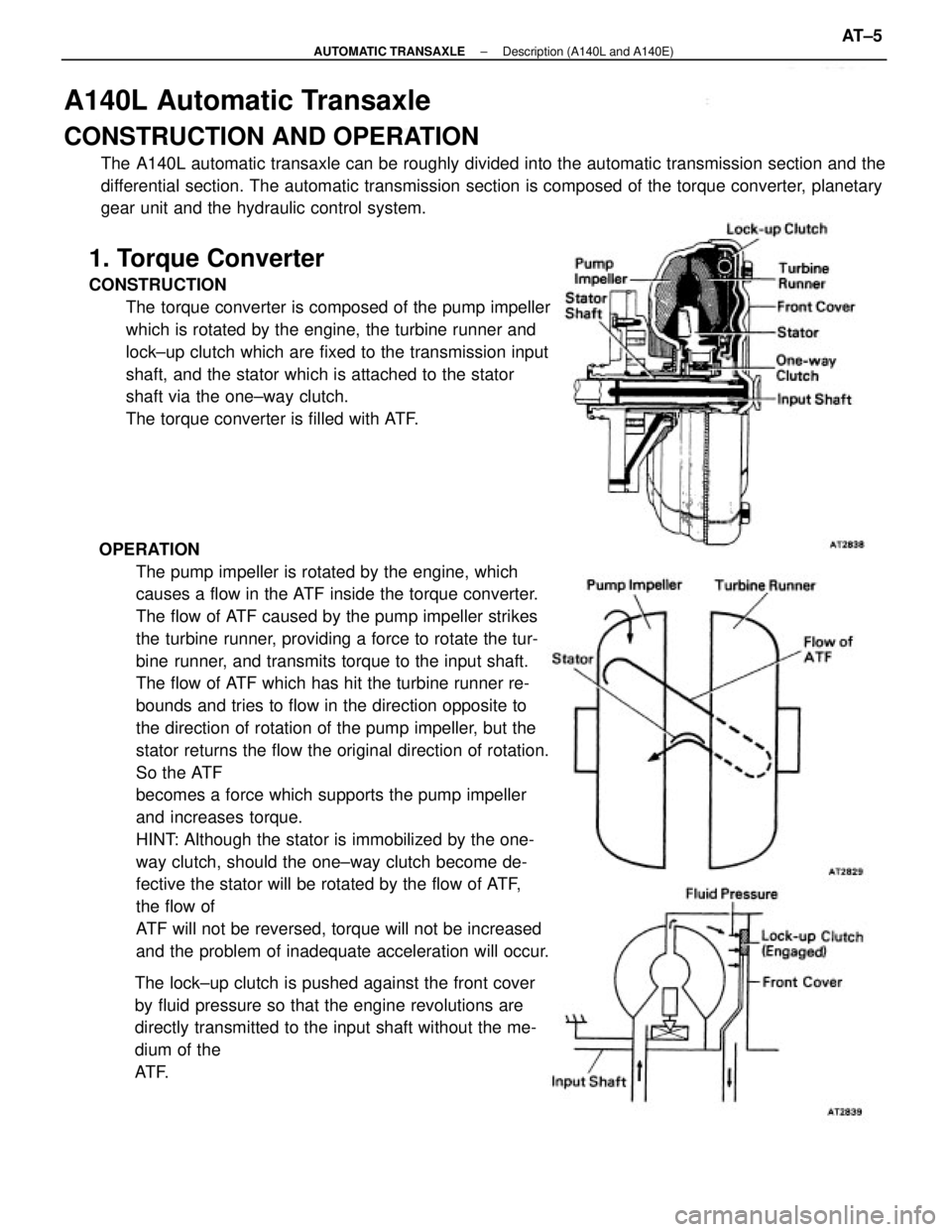
CONSTRUCTION AND OPERATION
The A140L automatic transaxle can be roughly divided into the automatic transmission section and the
differential section. The automatic transmission section is composed of the torque converter, planetary
gear unit and the hydraulic control system.
OPERATION
The pump impeller is rotated by the engine, which
causes a flow in the ATF inside the torque converter.
The flow of ATF caused by the pump impeller strikes
the turbine runner, providing a force to rotate the tur-
bine runner, and transmits torque to the input shaft.
The flow of ATF which has hit the turbine runner re-
bounds and tries to flow in the direction opposite to
the direction of rotation of the pump impeller, but the
stator returns the flow the original direction of rotation.
So the ATF
becomes a force which supports the pump impeller
and increases torque.
HINT: Although the stator is immobilized by the one-
way clutch, should the one±way clutch become de-
fective the stator will be rotated by the flow of ATF,
the flow of
ATF will not be reversed, torque will not be increased
and the problem of inadequate acceleration will occur.
The lock±up clutch is pushed against the front cover
by fluid pressure so that the engine revolutions are
directly transmitted to the input shaft without the me-
dium of the
AT F.
1. Torque Converter
CONSTRUCTION
The torque converter is composed of the pump impeller
which is rotated by the engine, the turbine runner and
lock±up clutch which are fixed to the transmission input
shaft, and the stator which is attached to the stator
shaft via the one±way clutch.
The torque converter is filled with ATF.
± AUTOMATIC TRANSAXLEDescription (A140L and A140E)AT±5
Page 263 of 2389
OPERATION
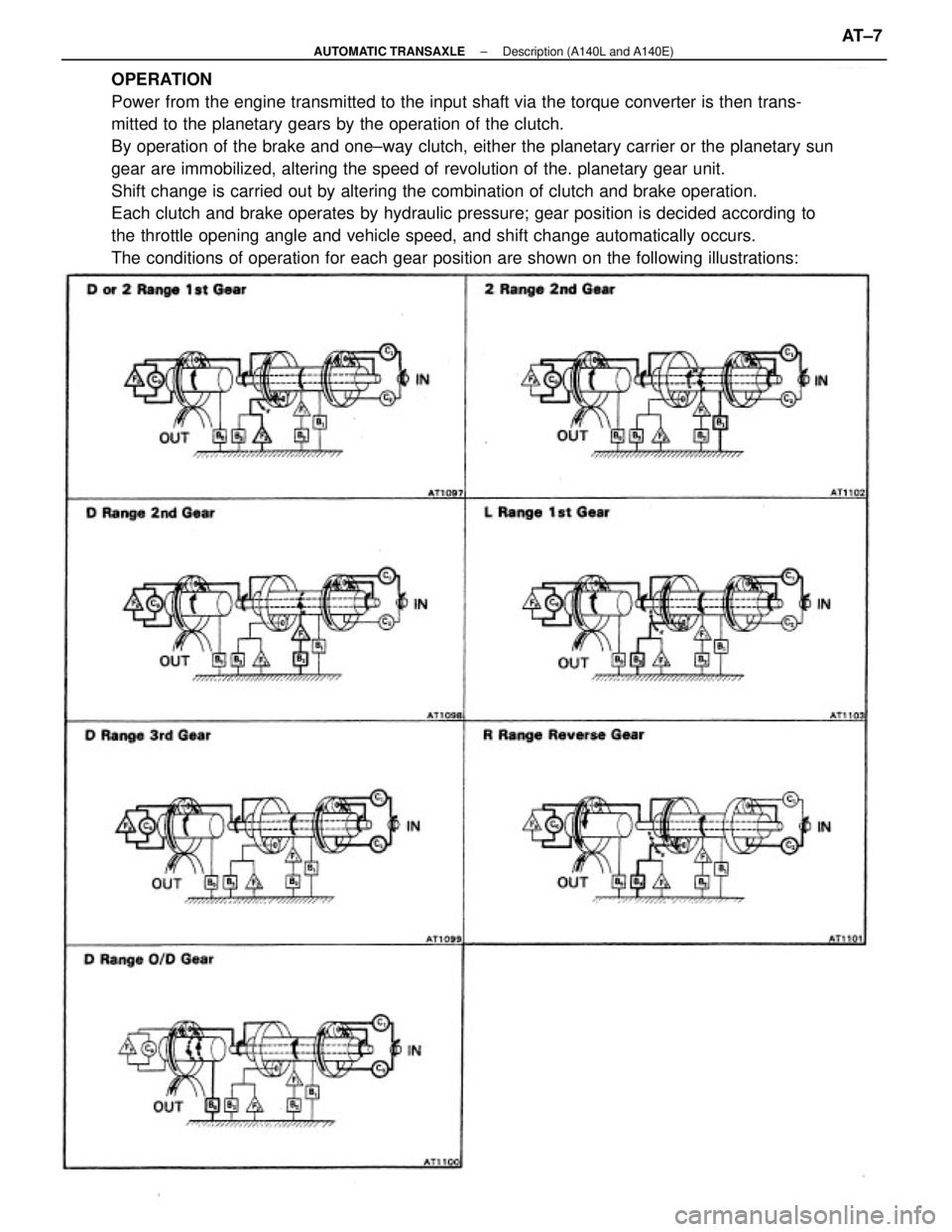
Power from the engine transmitted to the input shaft via the torque converter is then trans-
mitted to the planetary gears by the operation of the clutch.
By operation of the brake and one±way clutch, either the planetary carrier or the planetary sun
gear are immobilized, altering the speed of revolution of the. planetary gear unit.
Shift change is carried out by altering the combination of clutch and brake operation.
Each clutch and brake operates by hydraulic pressure; gear position is decided according to
the throttle opening angle and vehicle speed, and shift change automatically occurs.
The conditions of operation for each gear position are shown on the following illustrations:
± AUTOMATIC TRANSAXLEDescription (A140L and A140E)AT±7