Page 672 of 875
GM – CAMARO 1982-1992 – Repair Guide (Checked by WxMax) 672
ROCHESTER E4ME AND E4MC
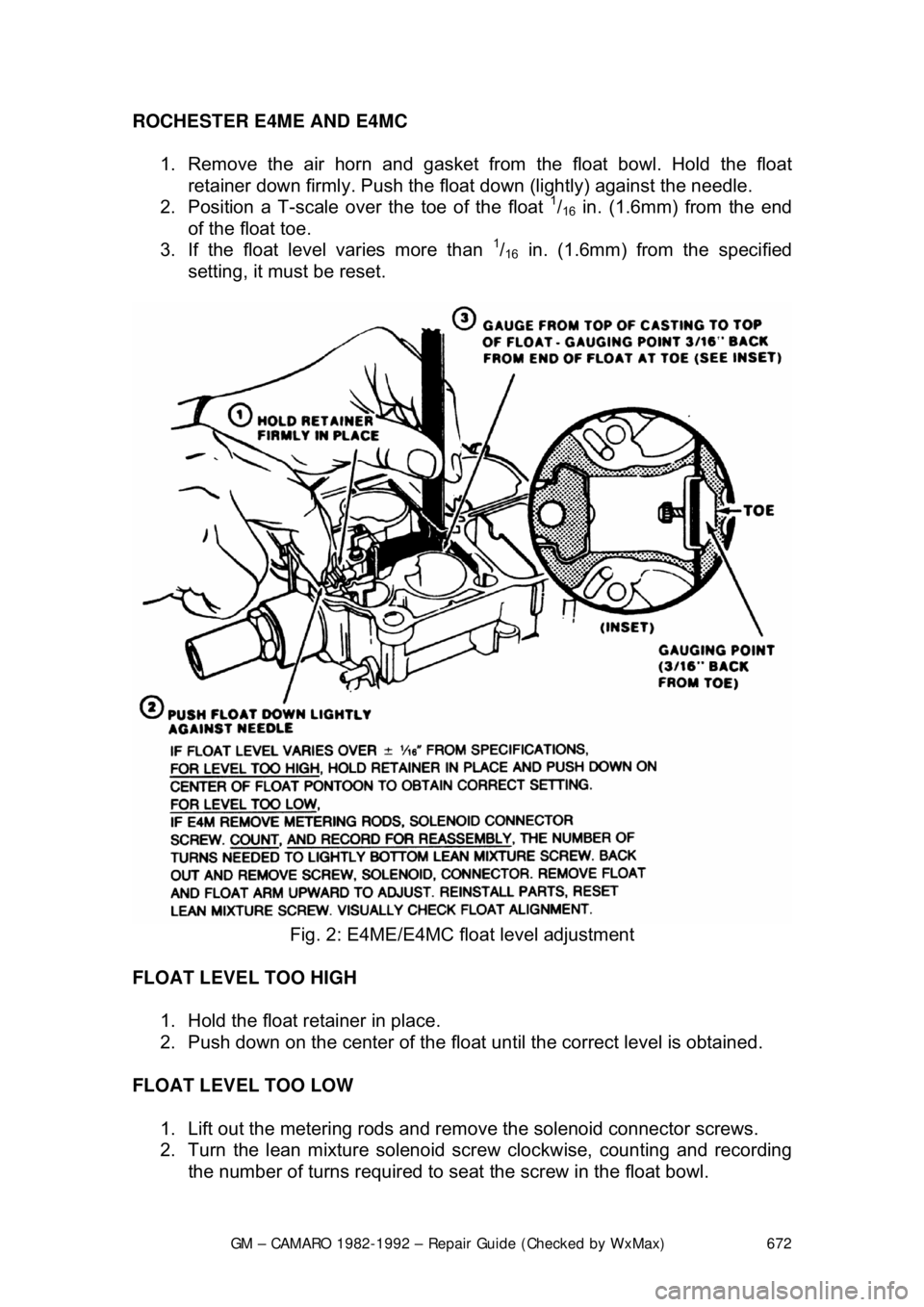
1. Remove the air horn and gasket from the float bowl. Hold the float retainer down firmly. Push the float down (lightly) against the needle.
2. Position a T-scale ov er the toe of the float
1/16 in. (1.6mm) from the end
of the float toe.
3. If the float level varies more than
1/16 in. (1.6mm) from the specified
setting, it must be reset.
Fig. 2: E4ME/E4MC float level adjustment
FLOAT LEVEL TOO HIGH 1. Hold the float retainer in place.
2. Push down on the center of the float until the correct level is obtained.
FLOAT LEVEL TOO LOW 1. Lift out the metering rods and remo ve the solenoid connector screws.
2. Turn the lean mixture solenoid screw clockwise, counting and recording
the number of turns required to seat the screw in the float bowl.
Page 673 of 875
GM – CAMARO 1982-1992 – Repair Guide (Checked by WxMax) 673
3. Turn the screw counterclockwise and
remove it. Lift the solenoid and the
connector from the float bowl.
4. Remove the float and bend the arm up to adjust. The float must be
correctly aligned after adjustment.
5. To install the components, reverse the order of removal. Back out the
solenoid mixture screw t he number of turns that wa s recorded earlier.
THROTTLE LINKAGE
ROCHESTER E2SE
No adjustment of the thro ttle cable can be made.
ROCHESTER E4ME AND E4MC
Due to the design of the throttle cable, no adjustments of the throttle linkage can
be made.
CHOKE UNLOADER (PRIMARY)
ROCHESTER E2SE
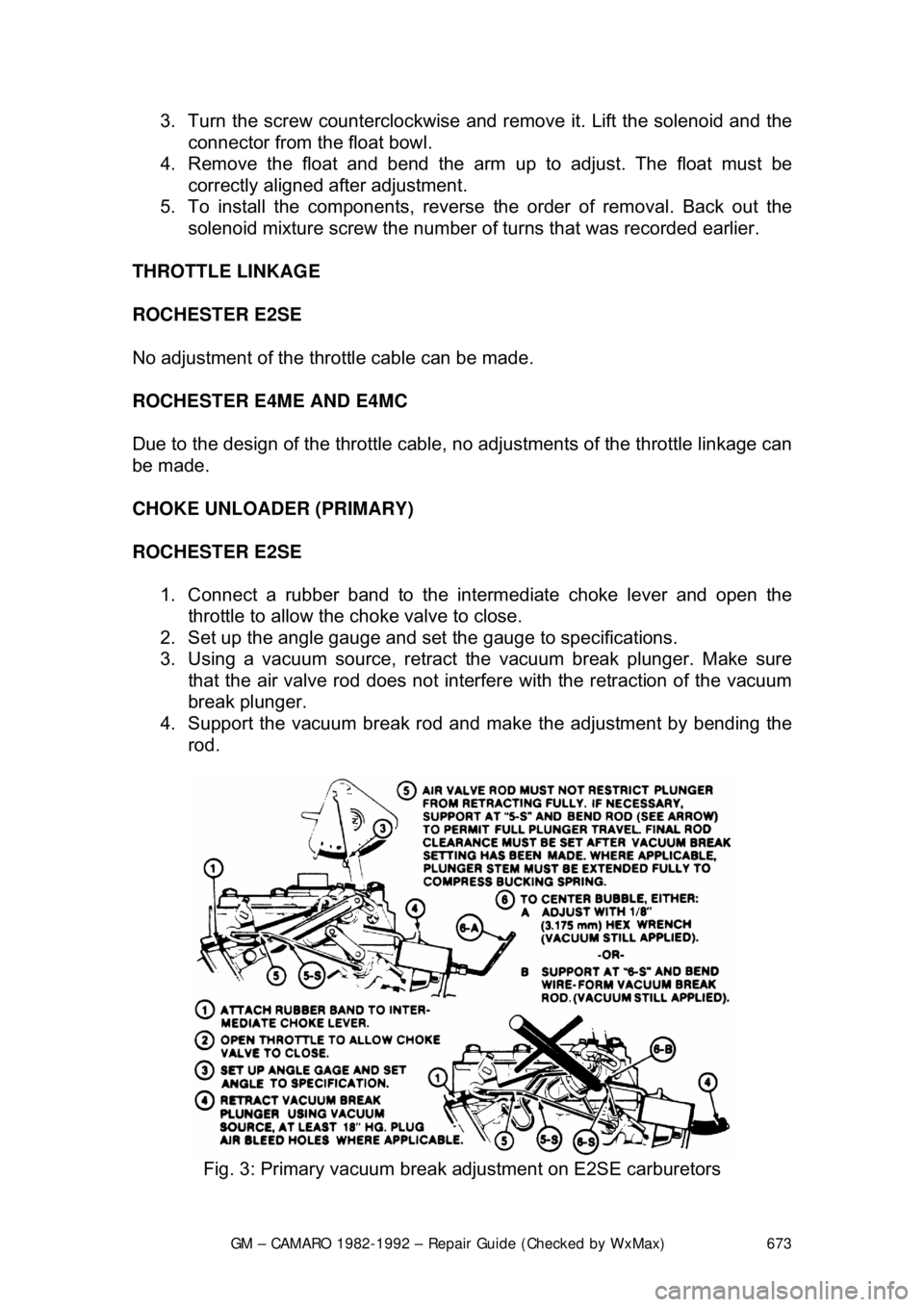
1. Connect a rubber band to the in termediate choke lever and open the
throttle to allow the choke valve to close.
2. Set up the angle gauge and set the gauge to specifications.
3. Using a vacuum source, retract the vacuum break plunger. Make sure
that the air valve rod does not interf ere with the retraction of the vacuum
break plunger.
4. Support the vacuum br eak rod and make the adjustment by bending the
rod.
Fig. 3: Primary vacuum break adjustment on E2SE carburetors
Page 676 of 875

GM – CAMARO 1982-1992 – Repair Guide (Checked by WxMax) 676
ROCHESTER E4ME AND E4MC
1. Connect a rubber band to the green tang of the intermediate choke shaft.
2. Open the throttle to allow the choke valve to close.
3. Set up the angle gauge and set the angle to specification.
4. Using a vacuum source, retr act the vacuum break plunger.
The air valve rod must not restrict the vacuum break plunger from fully
retracting.
5. With the vacuum applied, turn t he adjusting screw or bend the vacuum
break rod until the bubble of t he angle gauge is centered.
Fig. 6: Secondary vacuum break adj ustment on E4ME/E4MC carburetors
AIR VALVE SPRING ADJUSTMENT
ROCHESTER E2SE 1. If necessary, remove the intermediat e choke rod to gain access to the
lock screw.
2. Loosen the lock screw and turn t he tension adjusting screw clockwise
until the air valve opens slightly.
3. Turn the adjusting screw counterclo ckwise until the air valve just closes;
continue turning the screw counterclock wise according to specifications.
4. Tighten the lock screw. Apply lithium grease to the spring and pin.
Page 678 of 875
GM – CAMARO 1982-1992 – Repair Guide (Checked by WxMax) 678
ROCHESTER E4ME AND E4MC
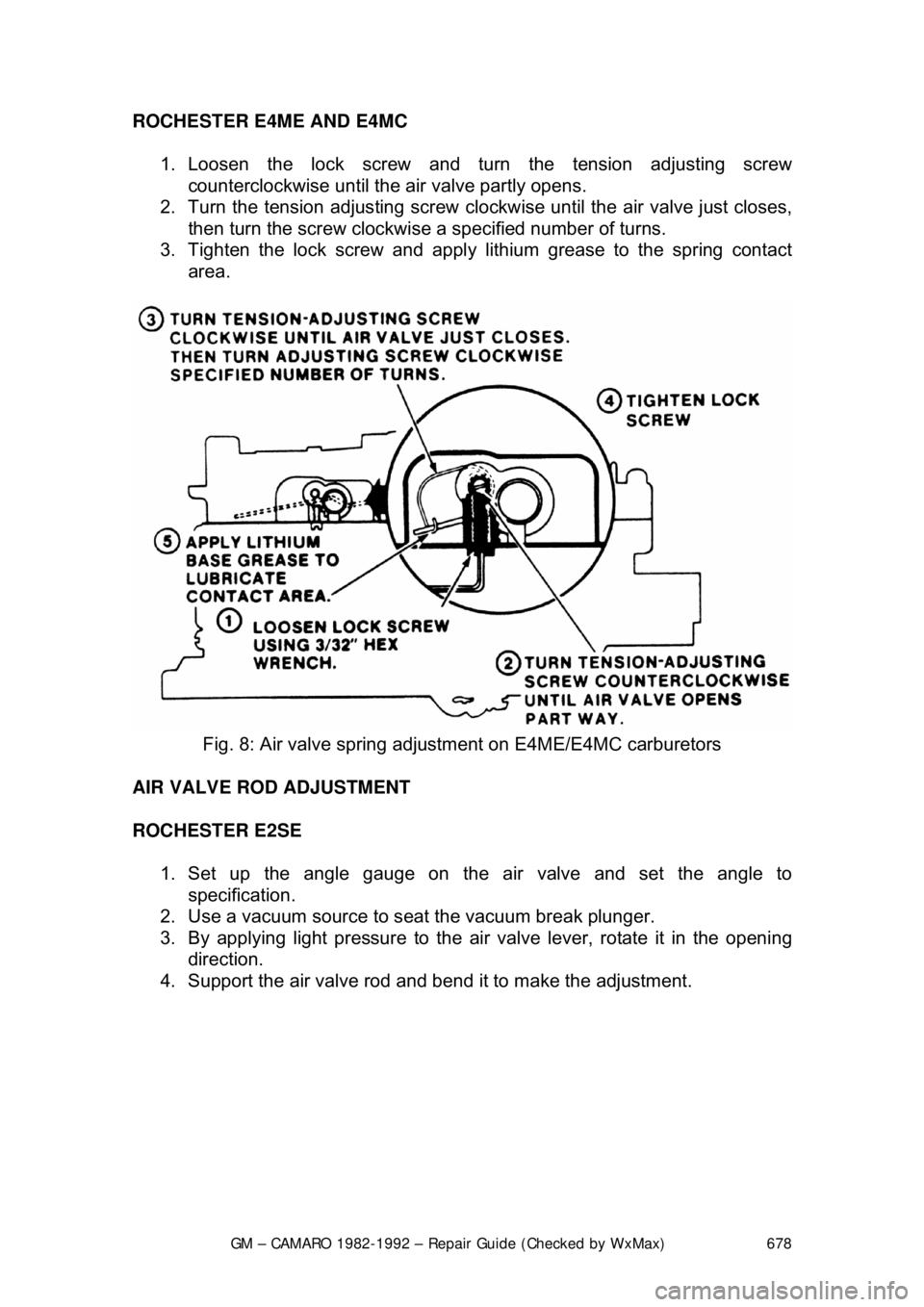
1. Loosen the lock screw and turn the tension adjusting screw counterclockwise until the air valve partly opens.
2. Turn the tension adjus ting screw clockwise until t he air valve just closes,
then turn the screw clockwise a specified number of turns.
3. Tighten the lock screw and apply lithium grease to the spring contact
area.
Fig. 8: Air valve spring adjus tment on E4ME/E4MC carburetors
AIR VALVE ROD ADJUSTMENT
ROCHESTER E2SE 1. Set up the angle g auge on the air valve and set the angle to
specification.
2. Use a vacuum source to s eat the vacuum break plunger.
3. By applying light pressure to the ai r valve lever, rotate it in the opening
direction.
4. Support the air valve rod and bend it to make the adjustment.
Page 685 of 875
GM – CAMARO 1982-1992 – Repair Guide (Checked by WxMax) 685
ROCHESTER E4ME AND E4MC
1. Connect a rubber band to the green tang of the intermediate shaft.
2. Open the throttle to allow the choke valve to close.
3. Set up the angle gauge and set the angle to specification.
4. Hold the secondary lockout lever away from the pin.
5. Hold the throttle lever in the wide-open position.
6. To adjust, bend the tang of the fast id le lever until the bubble of the angle
gauge is centered.
Fig. 18: Unloader adj ustment on E4ME/E4MC
SECONDARY LOCKOUT ADJUSTMENT
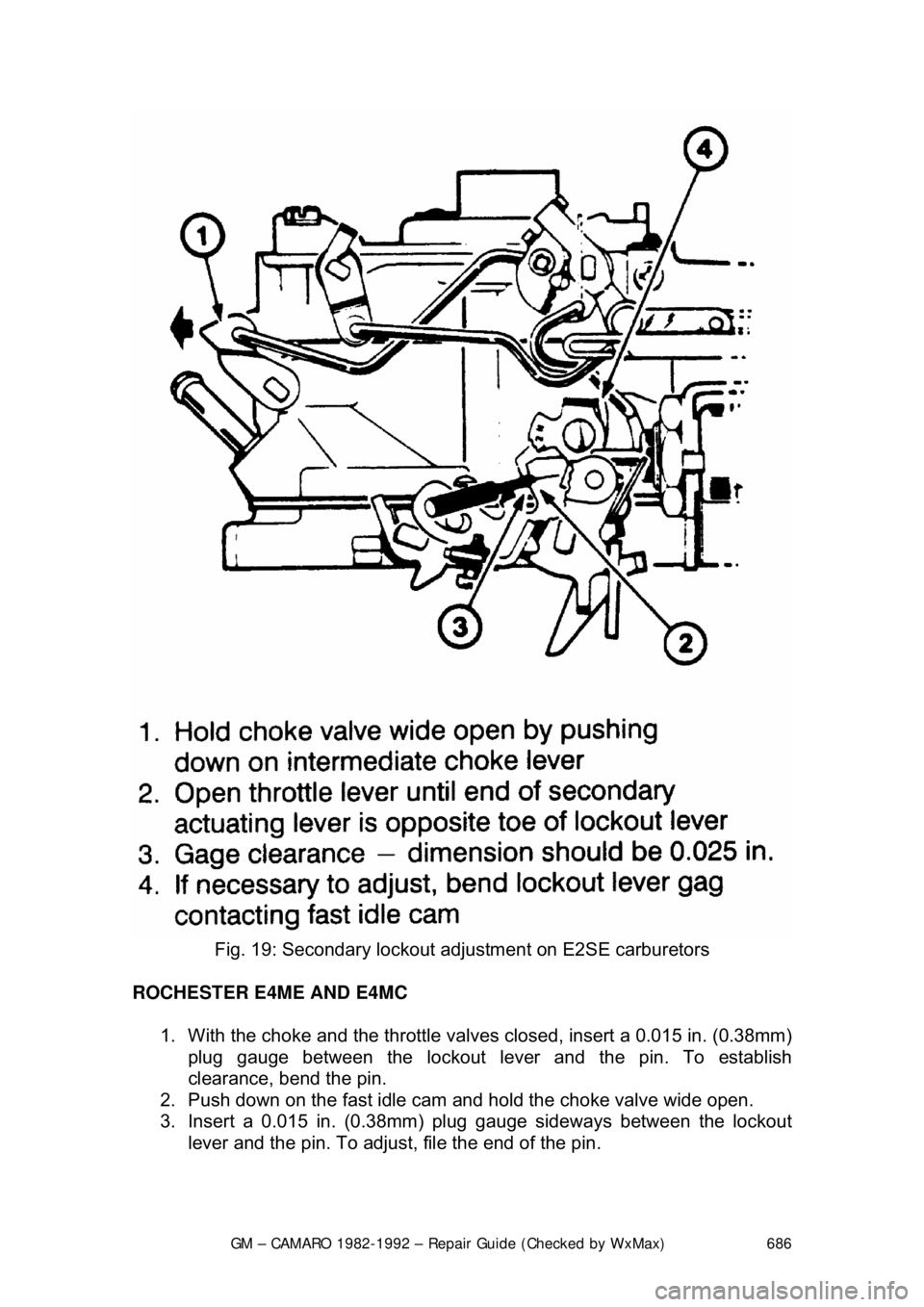
ROCHESTER E2SE 1. Push down on the inte rmediate choke lever to hold the choke valve wide-
open.
2. Open the throttle leve r until the end of the secondary actuating lever is
opposite the toe of t he lockout lever.
3. Insert a 0.025 in. (0.635mm) plug gauge.
4. To adjust, bend the lockout lever tang into contact with the fast idle cam.
Page 686 of 875
GM – CAMARO 1982-1992 – Repair Guide (Checked by WxMax) 686
Fig. 19: Secondary lockout adj ustment on E2SE carburetors
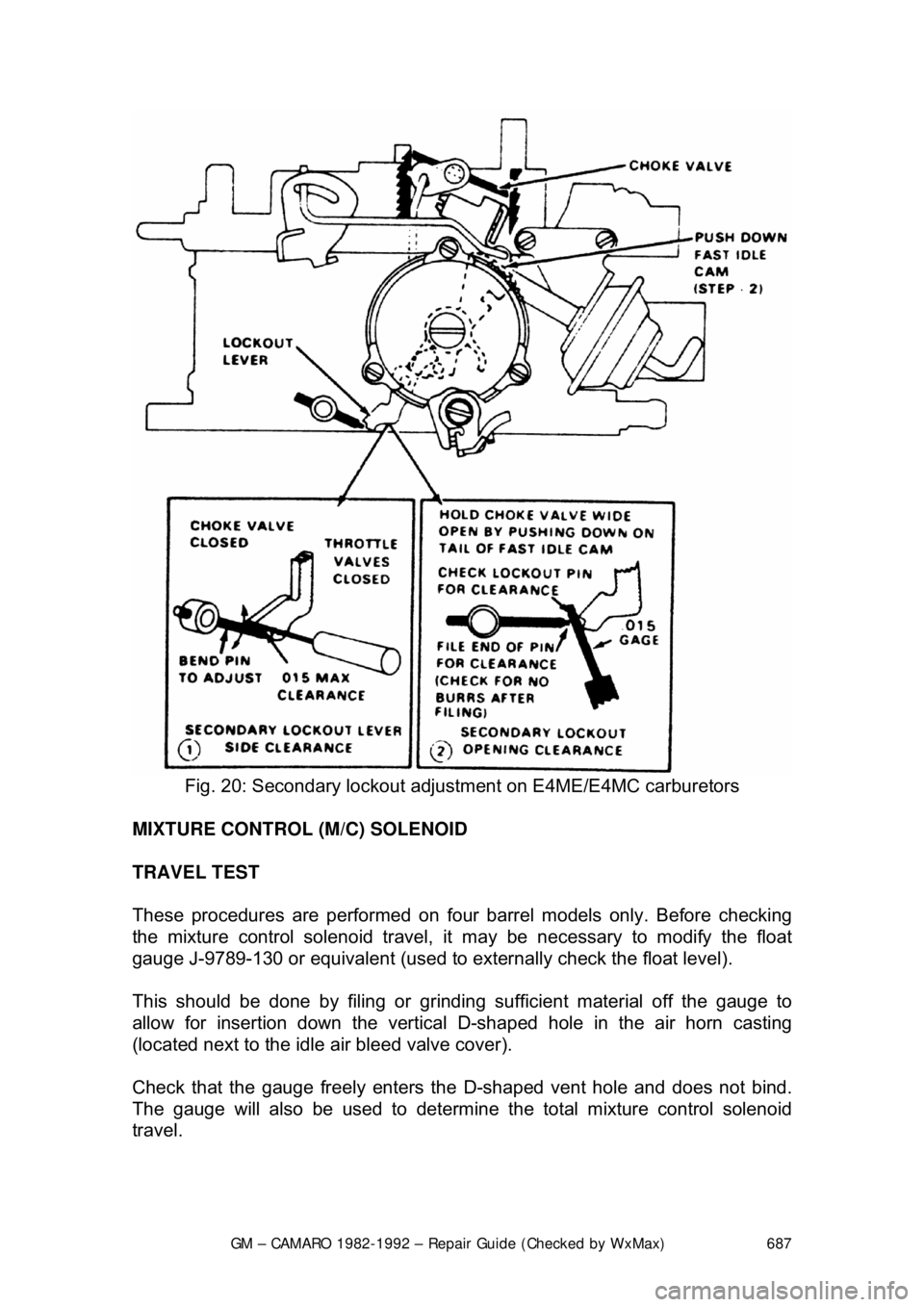
ROCHESTER E4ME AND E4MC 1. With the choke and the throttle valves closed, insert a 0.015 in. (0.38mm) plug gauge between the lockout lever and the pin. To establish
clearance, bend the pin.
2. Push down on the fast idle cam and hold the choke valve wide open.
3. Insert a 0.015 in. (0.38mm) pl ug gauge sideways between the lockout
lever and the pin. To adjust, file the end of the pin.
Page 687 of 875
GM – CAMARO 1982-1992 – Repair Guide (Checked by WxMax) 687
Fig. 20: Secondary lockout adjus tment on E4ME/E4MC carburetors
MIXTURE CONTROL (M/C) SOLENOID
TRAVEL TEST
These procedures are performed on four barrel models only. Before checking
the mixture control solenoid travel, it may be necessary to modify the float
gauge J-9789-130 or equivalent (used to ex ternally check the float level).
This should be done by filing or grinding sufficient material off the gauge to
allow for insertion down the vertical D-shaped hole in the air horn casting
(located next to the idle air bleed valve cover).
Check that the gauge freely enters the D-shaped vent hole and does not bind.
The gauge will also be used to determine t he total mixture control solenoid
travel.
Page 688 of 875
GM – CAMARO 1982-1992 – Repair Guide (Checked by WxMax) 688
With the engine OFF and the air cleaner re
moved, measure the control solenoid
travel as follows:
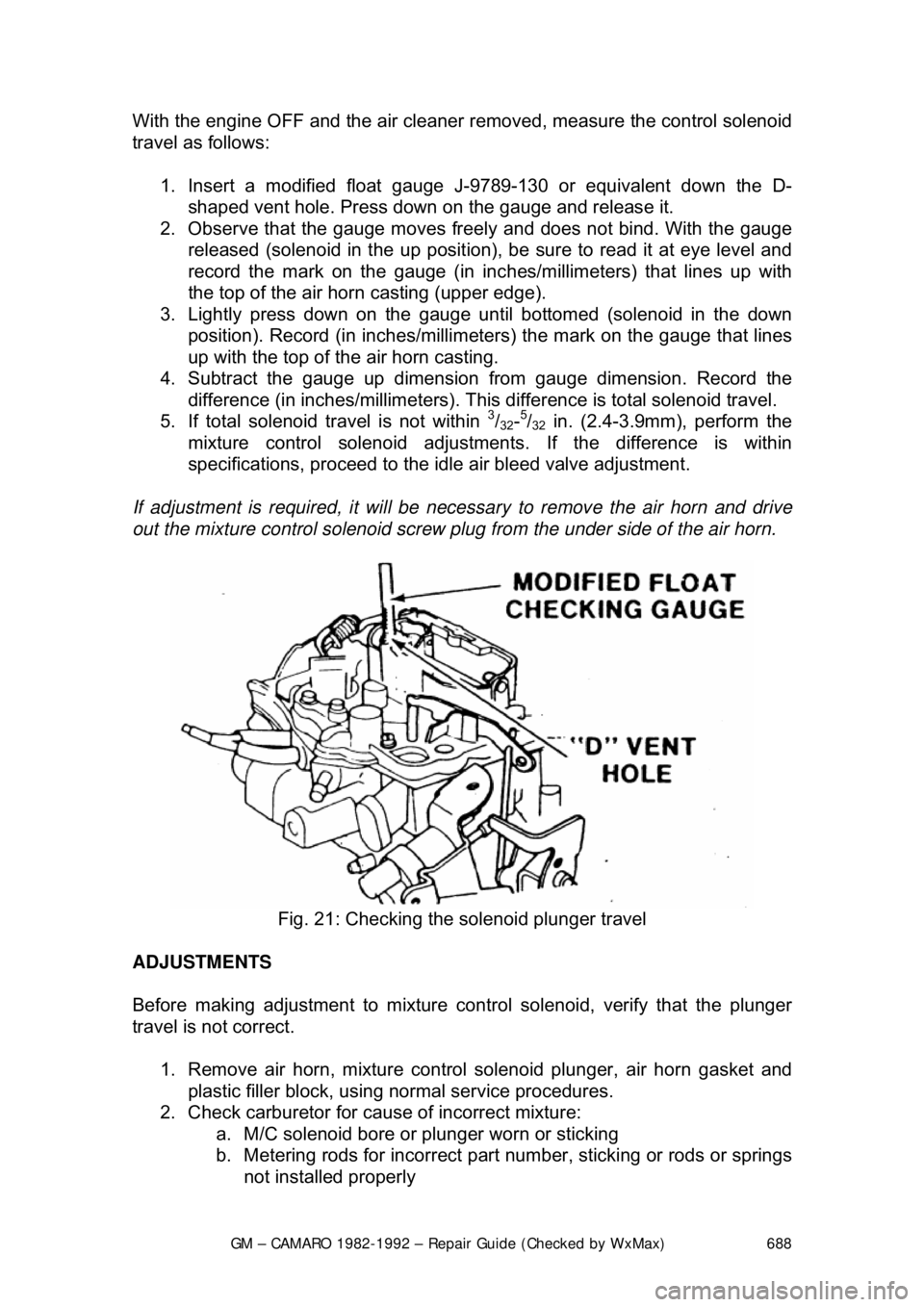
1. Insert a modified float gauge J- 9789-130 or equivalent down the D-
shaped vent hole. Press down on the gauge and release it.
2. Observe that the gauge moves freel y and does not bind. With the gauge
released (solenoid in the up position), be sure to read it at eye level and
record the mark on the gauge (in inc hes/millimeters) that lines up with
the top of the air hor n casting (upper edge).
3. Lightly press down on the gauge until bottomed (solenoid in the down
position). Record (in inches/millimeters) the mark on the gauge that lines
up with the top of the air horn casting.
4. Subtract the gauge up dimension from gauge dimension. Record the
difference (in inches/millimet ers). This difference is total solenoid travel.
5. If total solenoid travel is not within
3/32-5/32 in. (2.4-3.9mm), perform the
mixture control solenoid adjustment s. If the difference is within
specifications, proceed to the id le air bleed valve adjustment.
If adjustment is required, it will be necessary to remove the air horn and drive
out the mixture control solenoid screw pl ug from the under side of the air horn.
Fig. 21: Checking the solenoid plunger travel
ADJUSTMENTS
Before making adjustment to mixture cont rol solenoid, verify that the plunger
travel is not correct.
1. Remove air horn, mixture control solenoid plunger, air horn gasket and
plastic filler block, using normal service procedures.
2. Check carburetor for caus e of incorrect mixture:
a. M/C solenoid bore or plunger worn or sticking
b. Metering rods for incorrect part number, sticking or rods or springs
not installed properly