Page 629 of 875

GM – CAMARO 1982-1992 – Repair Guide (Checked by WxMax) 629
as much voltage to fire the plug at hi
gh speeds than at idle. The improved
air/fuel ratio control of modern fuel injection combin ed with the higher voltage
output of modern ignition systems will often allow an engine to run significantly
longer on a set of standard spark plugs, but keep in mind that efficiency will
drop as the gap widens (along wit h fuel economy and power).
When you're removing spark plugs, work on one at a time. Don't start by
removing the plug wires all at once, because, unless you number them, they
may become mixed up. Take a minute before you begin and number the wires
with tape.
1. Disconnect the negative battery cabl e, and if the vehicle has been run
recently, allow the engine to thoroughly cool.
2. Carefully twist the spark plug wire boot to loosen it, then pull upward and
remove the boot from the plug. Be su re to pull on the boot and not on the
wire, otherwise the connector locat ed inside the boot may become
separated.
3. Using compressed air, blow any water or debris from the spark plug well
to assure that no harmful contam inants are allowed to enter the
combustion chamber when the spark plug is removed. If compressed air
is not available, use a rag or a brush to clean the area.
Remove the spark plugs when the engine is cold, if possible, to prevent damage
to the threads. If removal of the plugs is difficult, apply a few drops of
penetrating oil or silicone spray to t he area around the base of the plug, and
allow it a few minutes to work.
4. Using a spark plug socket that is equipped with a rubber insert to
properly hold the plug, turn the spar k plug counterclockwise to loosen
and remove the spark pl ug from the bore.
WARNING - Be sure not to use a flexible extension on the socket. Use of a
flexible extension may allow a shear fo rce to be applied to the plug. A shear
force could break the plug off in the cylinder head, leading to costly a\
nd
frustrating repairs.
To install:
5. Inspect the spark plug boot for t ears or damage. If a damaged boot is
found, the spark plug wire must be replaced.
6. Using a wire feeler gauge, check and adjust the spark plug gap. When
using a gauge, the proper size shoul d pass between the electrodes with
a slight drag. The next larger size should not be able to pass while the\
next smaller size should pass freely.
7. Carefully thread the plug into the bor e by hand. If resistance is felt before
the plug is almost completely th readed, back the plug out and begin
threading again. In small, hard to r each areas, an old spark plug wire and
boot could be used as a th reading tool. The boot will hold the plug while
you twist the end of the wire and t he wire is supple enough to twist
before it would allow t he plug to crossthread.
Page 635 of 875
GM – CAMARO 1982-1992 – Repair Guide (Checked by WxMax) 635
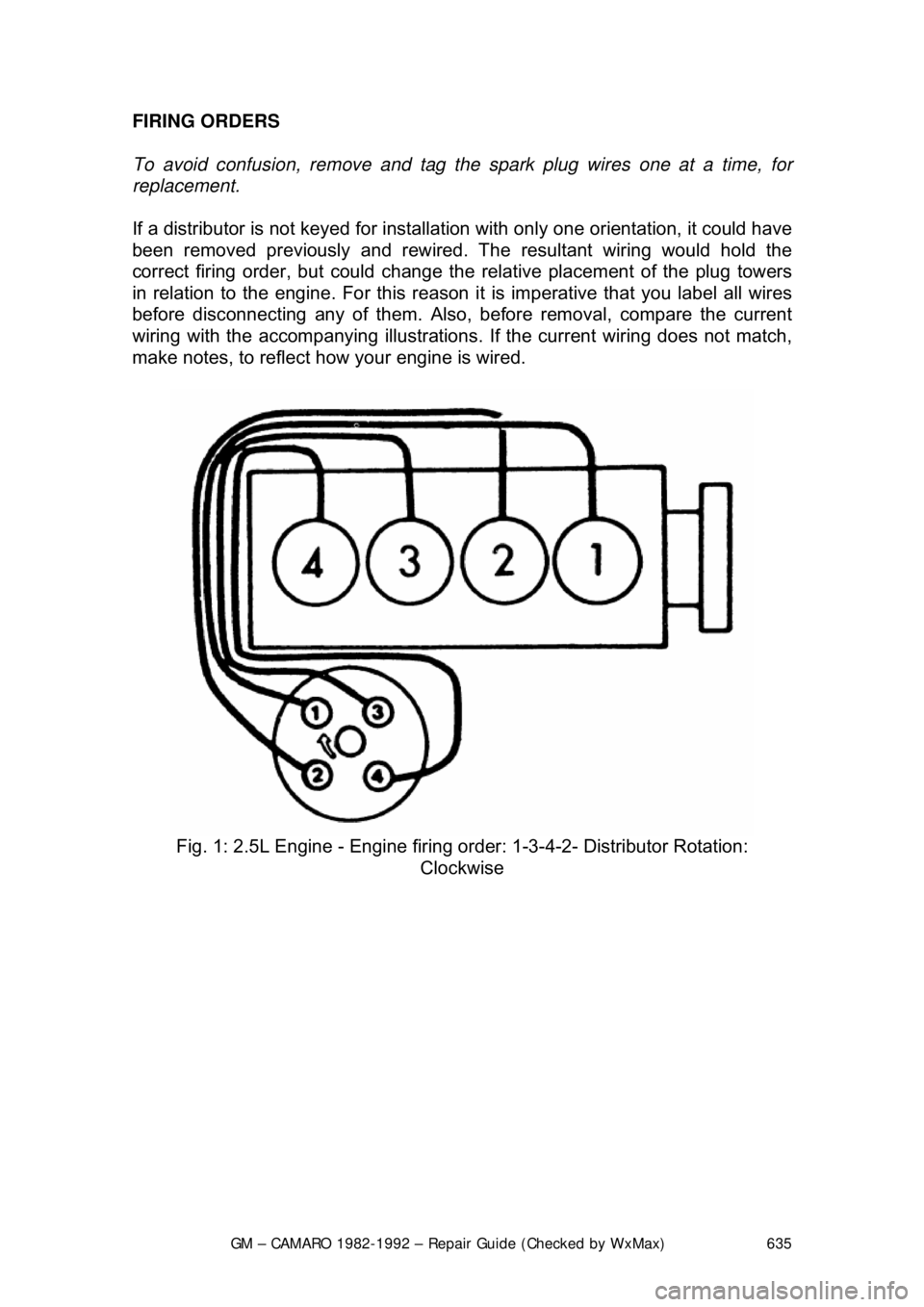
FIRING ORDERS
To avoid confusion, remove and tag th
e spark plug wires one at a time, for
replacement.
If a distributor is not keyed for installati on with only one orientation, it could have
been removed previously and rewired. Th e resultant wiring would hold the
correct firing order, but could change the relative placement of the plug towers
in relation to the engine. Fo r this reason it is imperative that you label all wires
before disconnecting any of them. Also, before removal, compare the current
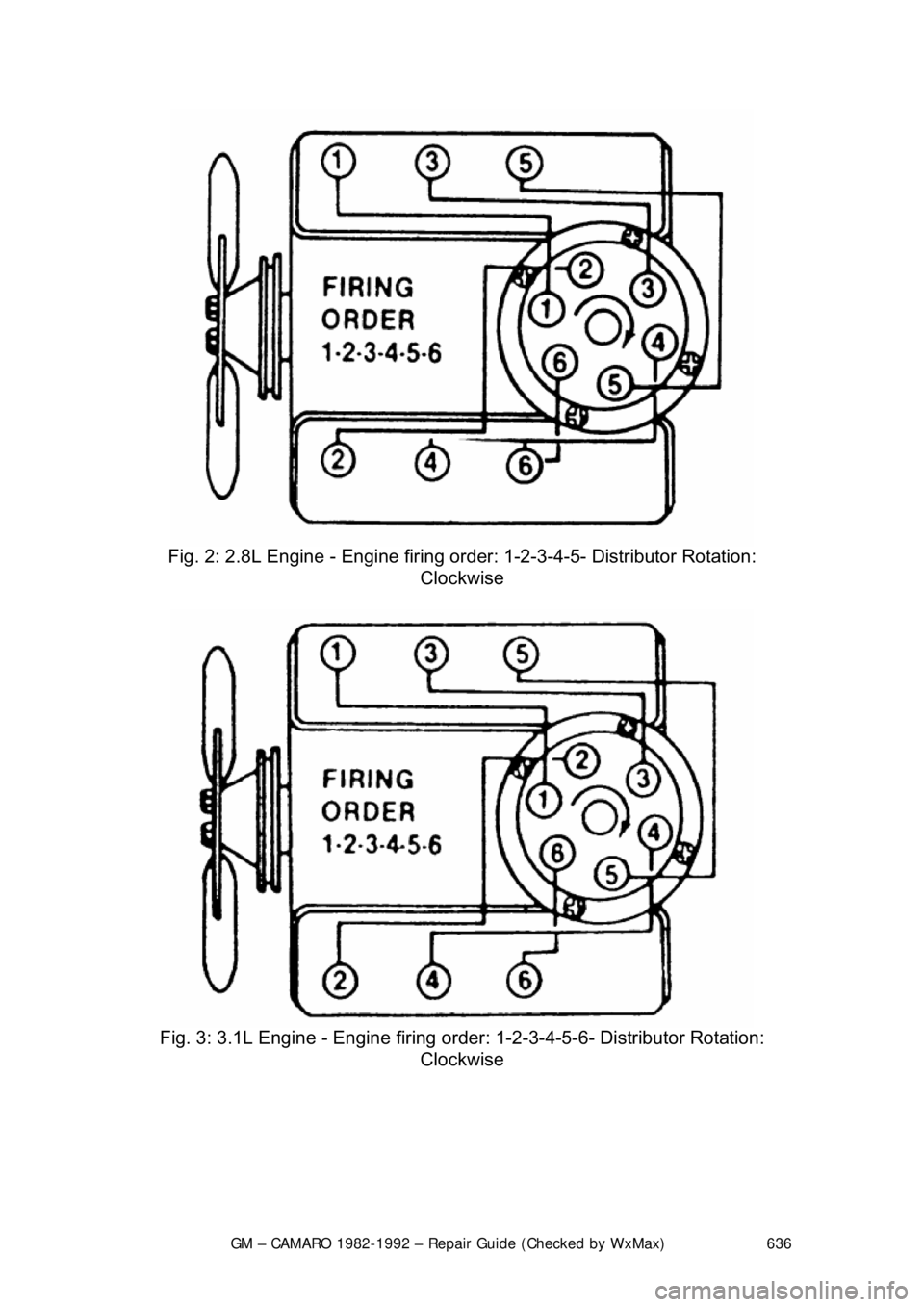
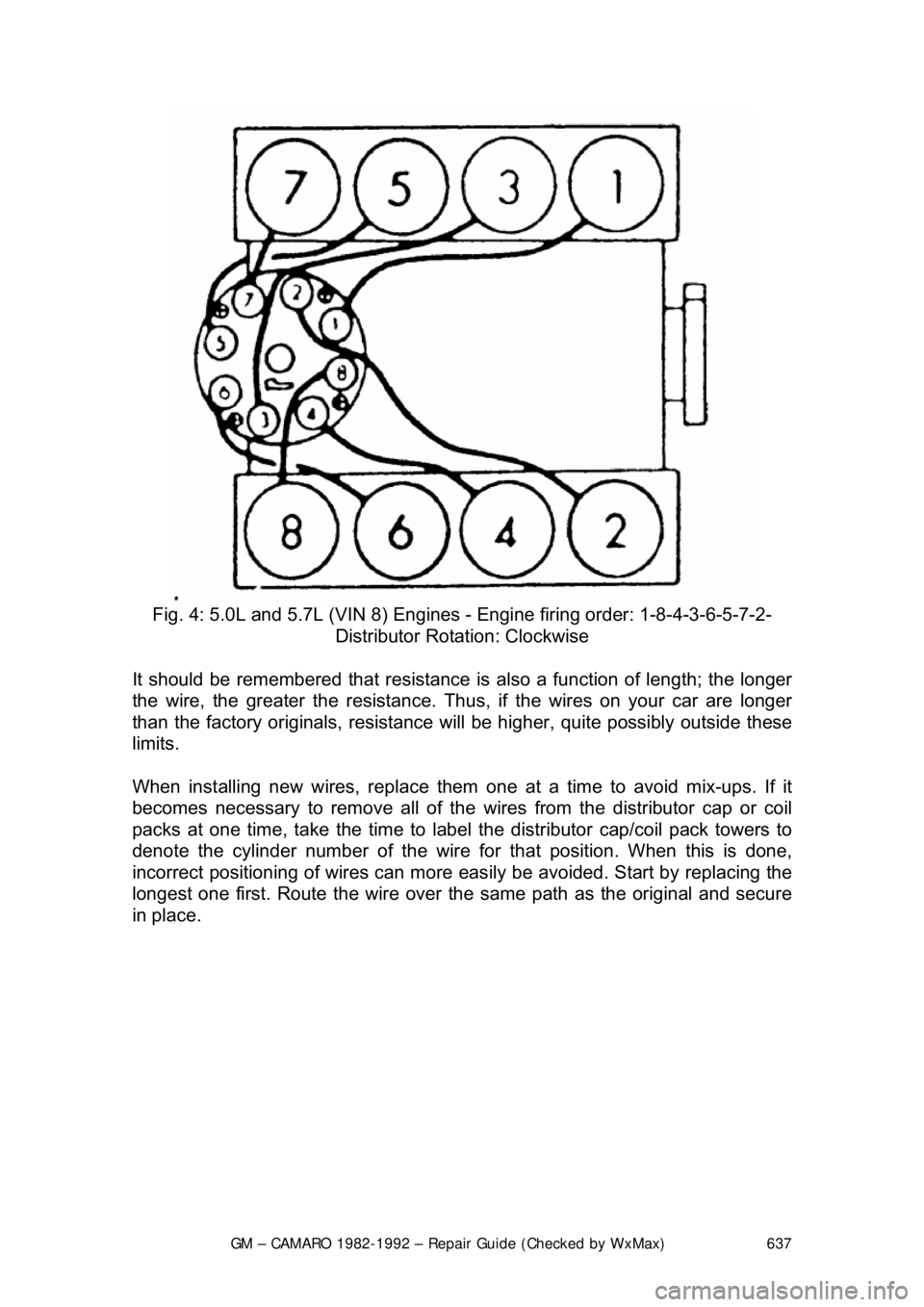
wiring with the accompanying i llustrations. If the current wiring does not match,
make notes, to reflect how your engine is wired.
Fig. 1: 2.5L Engine - Engine firing or der: 1-3-4-2- Distributor Rotation:
Clockwise
Page 636 of 875
GM – CAMARO 1982-1992 – Repair Guide (Checked by WxMax) 636
Fig. 2: 2.8L Engine - Engine firing or der: 1-2-3-4-5- Distributor Rotation:
Clockwise
Fig. 3: 3.1L Engine - Engine firing order : 1-2-3-4-5-6- Distributor Rotation:
Clockwise
Page 637 of 875
GM – CAMARO 1982-1992 – Repair Guide (Checked by WxMax) 637
Fig. 4: 5.0L and 5.7L (VIN 8) Engines - Engine firing order: 1-8-4-3-6-5-7-2-
Distributor Rotation: Clockwise
It should be remembered that resistance is also a function of length; the longer
the wire, the greater the re sistance. Thus, if the wires on your car are longer
than the factory originals, resistance will be higher, qui te possibly outside these
limits.
When installing new wires, r eplace them one at a time to avoid mix-ups. If it
becomes necessary to remove all of the wires from the distributor cap or coil
packs at one time, take the time to label the distributor cap/coil pack towers to
denote the cylinder number of the wire fo r that position. When this is done,
incorrect positioning of wires can more eas ily be avoided. Start by replacing the
longest one first. Route the wire over the same path as the original and secure
in place.
Page 640 of 875

GM – CAMARO 1982-1992 – Repair Guide (Checked by WxMax) 640
The tachometer terminal should never
be allowed to touch ground, as damage
to the computer control module and/or ignition coil assembly can result.
CONNECTORS
When disengaging connectors, do not use a screw driver or other tool to release
the locking tab, as this mi ght break the connector.
SYSTEM TESTERS
Instruments designed specific ally for testing HEI or C
3I systems are available
from several tool manufactur ers. Some of these will even test the module itself.
However, the tests given in the followin g section will require only an ohmmeter
and a voltmeter.
TESTING
The symptoms of a defective component within the HEI or C
3I system are
exactly the same as those you woul d encounter in a conventional system.
Some of these symptoms are:
• Hard or no starting
• Rough Idle
• Poor fuel economy
• Engine misses under load or while accelerating
PRELIMINARY CHECKS
If you suspect a problem in your igniti on system, there are certain preliminary
checks which you should carry out befor e you begin to check the electronic
portions of the system. First, it is extrem ely important to make sure the vehicle
battery is in a good state of charge. A defective or poorly charged battery will
cause the various components of the ignition system to read incorrectly when
they are being tested. Second, make su re all wiring connections are clean and
tight, not only at the battery, but also at the distributor cap (if so equipped),
ignition coil, camshaft and/or crankshaft sensors (if so equipped) and at the
control module.
Since the only difference between these ignition systems lies before the spark
plug wiring, it is important to check the secondary ig nition circuit first. If the
secondary circuit checks out properly (ther e is spark), then the engine condition
is probably not the fault of the ignition system. To check the secondary ignition
system, perform a simple spark test. Remove one of the plug wires and insert
some sort of extension in the plug socket. An old spark plug with the ground
electrode removed makes a good extension. Hold the wire and extension using
an insulated tool (NOT BY HAND) about
1/4 in. (6mm) away from the block and
crank the engine. If a normal spark occurs, then the problem is most likely not in
the ignition system. Check for fuel system problems, or fouled spark plugs.
Page 647 of 875
GM – CAMARO 1982-1992 – Repair Guide (Checked by WxMax) 647
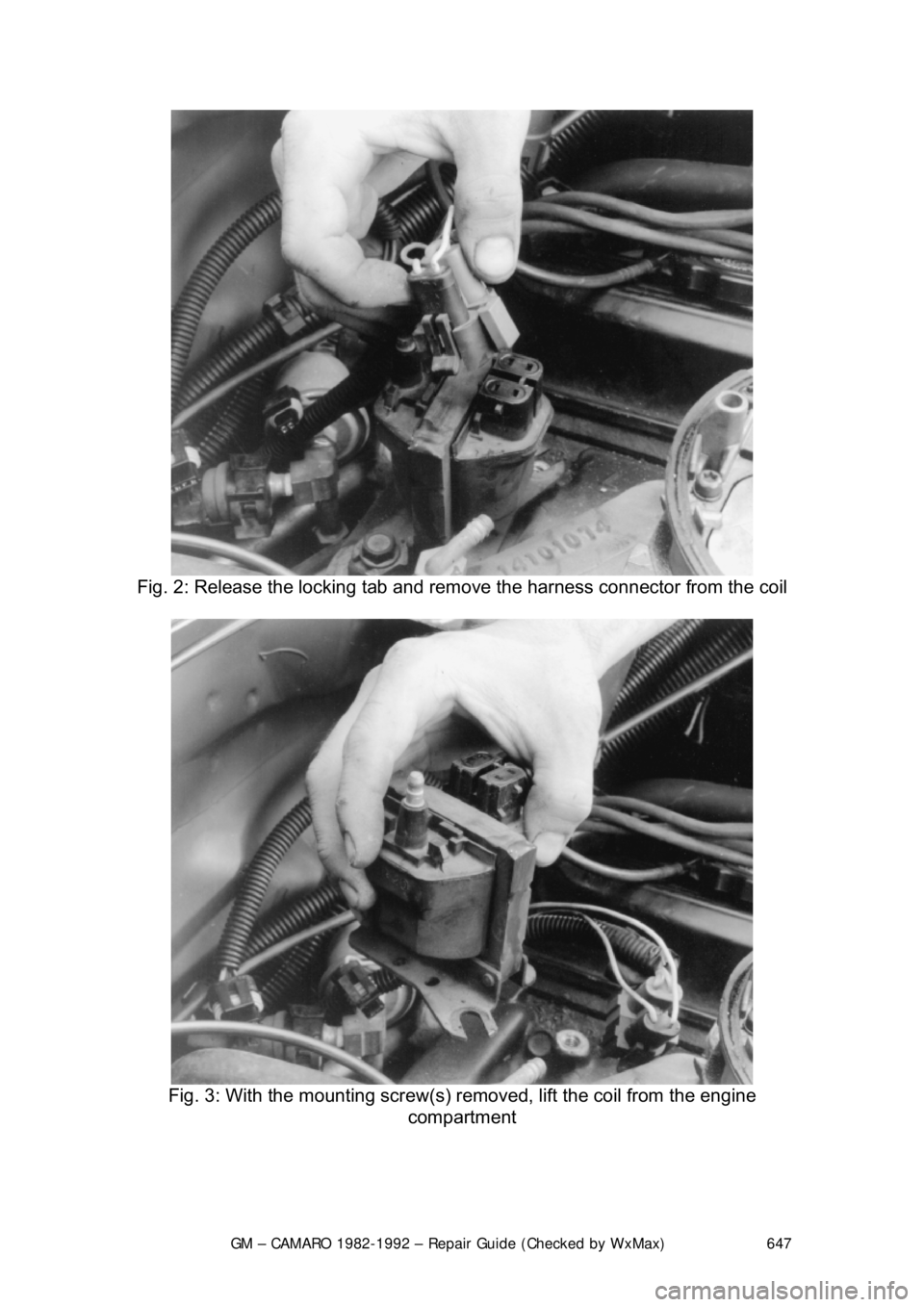
Fig. 2: Release the locking tab and remo ve the harness connector from the coil
Fig. 3: With the mounting screw(s) re moved, lift the coil from the engine
compartment
Page 650 of 875
GM – CAMARO 1982-1992 – Repair Guide (Checked by WxMax) 650
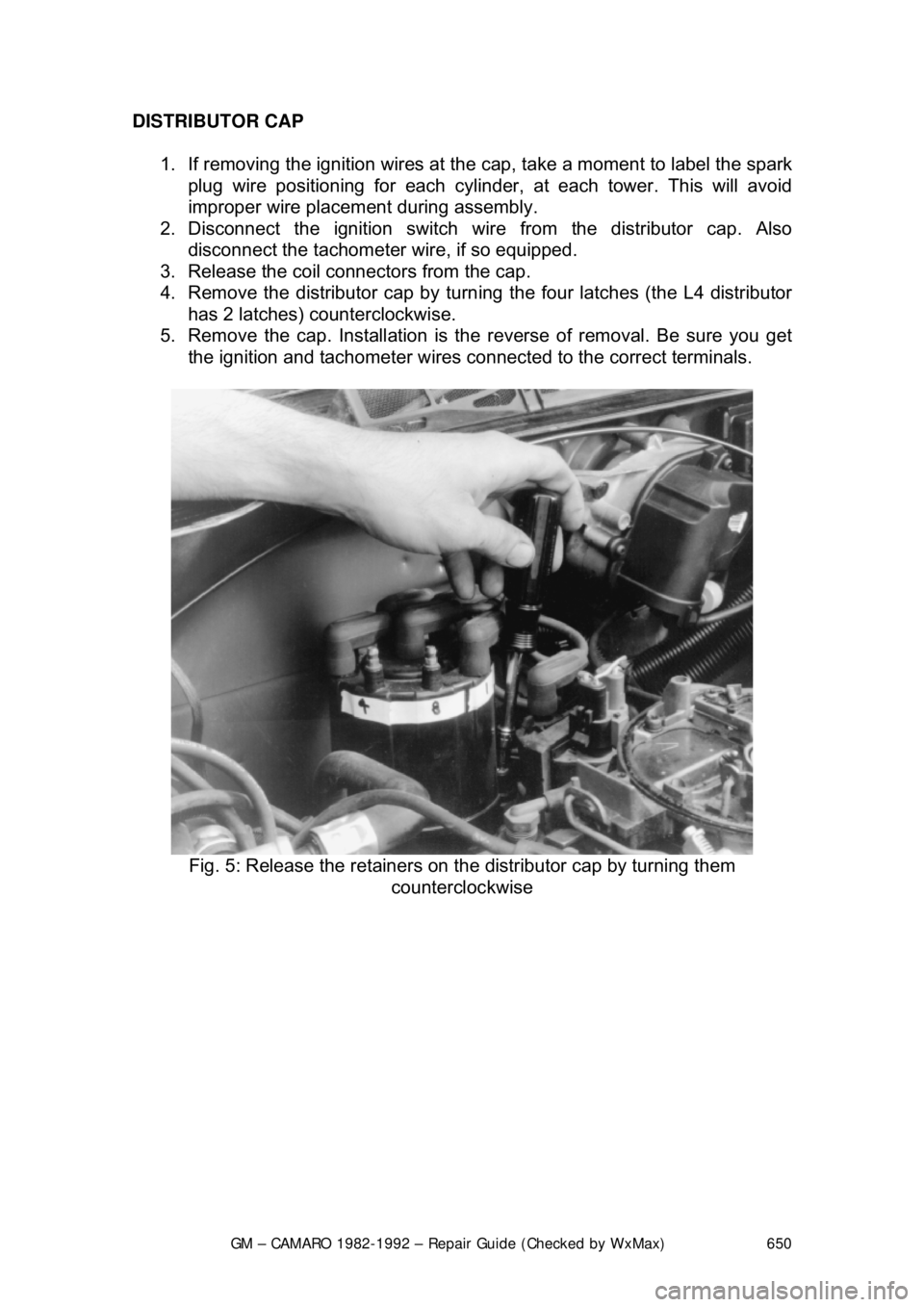
DISTRIBUTOR CAP
1. If removing the ignition wires at the cap, take a moment to label the spark
plug wire positioning for each cylinder, at each tower. This will avoid
improper wire placement during assembly.
2. Disconnect the ignition switch wir e from the distributor cap. Also
disconnect the tachometer wire, if so equipped.
3. Release the coil connec tors from the cap.
4. Remove the distributor cap by turn ing the four latches (the L4 distributor
has 2 latches) counterclockwise.
5. Remove the cap. Installation is the reverse of removal. Be sure you get
the ignition and tachometer wires c onnected to the correct terminals.
Fig. 5: Release the retainers on t he distributor cap by turning them
counterclockwise
Page 666 of 875

GM – CAMARO 1982-1992 – Repair Guide (Checked by WxMax) 666
FUEL SYSTEM
BASIC FUEL SYSTEM DIAGNOSIS
When there is a problem star ting or driving a vehicle, two of the most important
checks involve the ignition and the fuel systems. The questions most mechanics
attempt to answer first, "is there spark?" an d "is there fuel?" will often lead to
solving most basic problems. For igni tion system diagnosis and testing, please
refer to the information on engine electr ical components and ignition systems
found earlier in this repair guide. If the ignition system checks out (there is
spark), then you must determine if the f uel system is operating properly (is there
fuel?).
CARBURETED FUEL SYSTEM
MECHANICAL FUEL PUMP
All fuel pumps used on carbureted V6 and V8 engines are of the diaphragm
type and are serviced by replacement onl y. No adjustments or repairs are
possible. The fuel pump is mounted on th e left front (V6) and right front (V8) of
the engine.
The fuel pumps are also equipped with vapor return lines for purposes of
emission control and to reduce vapor lock. All pumps are operated by an
eccentric on the camshaft. On V6 an d V8 engines, a pushrod between the
camshaft eccentric and the fuel pump operates the pump.
REMOVAL & INSTALLATION
When disconnecting the fuel pump outlet fitting, always use two wrenches to
avoid twisting the line.
1. Disconnect the fuel in take and outlet lines at the pump, then plug the
pump intake line.
2. Remove the two pump mounting bol ts and lockwashers; remove the
pump and its gasket.
3. If the pump pushrod is to be remo ved from the V8, remove the two
adapter bolts and lockwashers, then re move the adapter and its gasket.
4. Install the fuel pump with a new gasket reversing the removal procedure.
Coat the mating surfaces with sealer.
5. Connect the fuel lines and check for leaks.