Page 500 of 875

GM – CAMARO 1982-1992 – Repair Guide (Checked by WxMax) 500
within specifications, install new bear
ings in the rod and take another
measurement. If the clearance is still out of specifications, and the crankshaft is
not, the rod will need to be reconditioned by a machine shop.
You can also use Plastigage to check the bearing clearances. The assembling
section has complete instructions on its use.
CAMSHAFT
Inspect the camshaft and lifters/followers as described earlier in this section.
BEARINGS
All of the engine bearings should be visua lly inspected for wear and/or damage.
The bearing should look evenly worn a ll around with no deep scores or pits. If
the bearing is severely worn, scored, pi tted or heat blued, then the bearing, and
the components that use it, should be brought to a machine shop for inspection.
Full-circle bearings (used on most camshafts, auxiliary shafts, balance shafts,
etc.) require specialized tools for re moval and installation, and should be
brought to a machine shop for service.
OIL PUMP
The oil pump is responsible for provid ing constant lubrication to the whole
engine and so it is re commended that a new oil pump be installed when
rebuilding the engine.
Completely disassemble the oil pump and thoroughly clean all of the
components. Inspect the oil pump gears and housing for wear and/or damage.
Insure that the pressure relief valve oper ates properly and there is no binding or
sticking due to varnish or debris. If all of the parts are in proper working
condition, lubricate the gears and relie f valve, and assemble the pump.
REFINISHING
Almost all engine block refinishing must be performed by a machine shop. If the
cylinders are not to be rebored, then t he cylinder glaze can be removed with a
ball hone. When removing cylinder glaz e with a ball hone, use a light or
penetrating type oil to lubricate the hone. Do not allow the hone to run dry as
this may cause excessive scoring of t he cylinder bores and wear on the hone. If
new pistons are required, t hey will need to be installed to the connecting rods.
This should be performed by a machine shop as the pistons must be installed in
the correct relationship to the rod or engine damage can occur.
Page 503 of 875

GM – CAMARO 1982-1992 – Repair Guide (Checked by WxMax) 503
Mount the engine block into the engine
stand and wash it one last time using
water and detergent (dishwashing deter gent works well). While washing it,
scrub the cylinder bores with a soft bristl e brush and thoroughly clean all of the
oil passages. Completely dry the engin e and spray the entire assembly down
with an anti-rust solution such as WD-40 or similar product. Take a clean lint-
free rag and wipe up any excess anti-rust solution from the bores, bearing
saddles, etc. Repeat the final cleaning process on the crankshaft. Replace any
freeze or oil galley plugs which we re removed during disassembly.
CRANKSHAFT 1. Remove the main bearing inserts from the block and bearing caps.
2. If the crankshaft main bearing journal s have been refinished to a definite
undersize, install the correct undersize bearing. Be sure that the bearing
inserts and bearing bores are clean. Fo reign material under inserts will
distort bearing and cause failure.
3. Place the upper main bearing inse rts in bores with tang in slot.
The oil holes in the beari ng inserts must be aligned with the oil holes in the
cylinder block.
4. Install the lower main bearing inserts in bearing caps.
5. Clean the mating surfaces of block and rear main bearing cap.
6. Carefully lower the crankshaft into place. Be careful not to damage
bearing surfaces.
7. Check the clearance of each main bearing by using the following
procedure: a. Place a piece of Plastigage® or its equivalent, on bearing surface
across full width of bearing cap and about
1/4 in. off center.
Page 506 of 875
GM – CAMARO 1982-1992 – Repair Guide (Checked by WxMax) 506
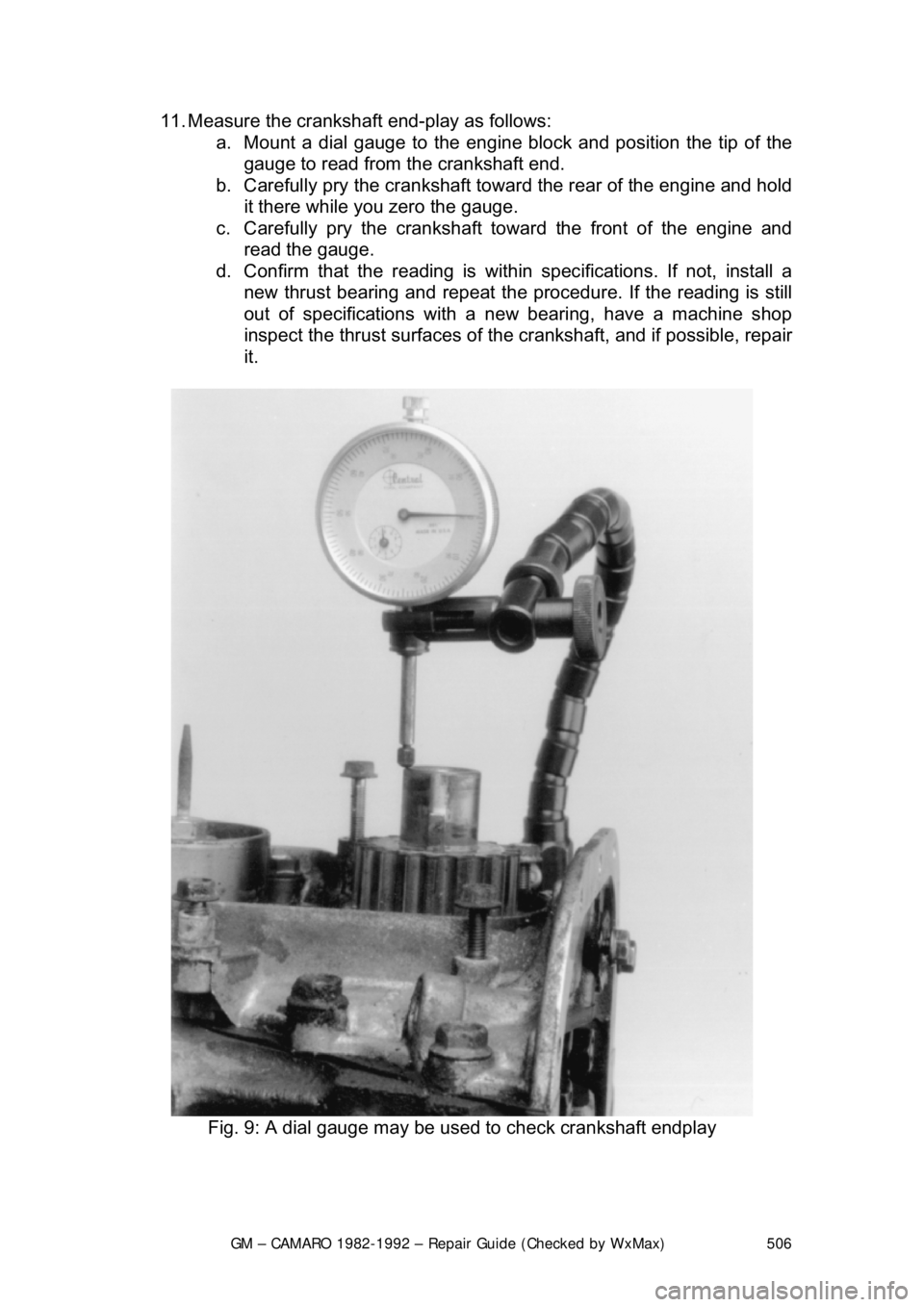
11. Measure the crankshaft end-play as follows:
a. Mount a dial gauge to the engine block and position the tip of the
gauge to read from t he crankshaft end.
b. Carefully pry the crankshaft towa rd the rear of the engine and hold
it there while you zero the gauge.
c. Carefully pry the crankshaft toward the front of the engine and read the gauge.
d. Confirm that the r eading is within specifications. If not, install a
new thrust bearing and repeat the procedure. If the reading is still
out of specifications with a new bearing, have a machine shop
inspect the thrust surfaces of the crankshaft, and if possible, repair
it.
Fig. 9: A dial gauge may be used to check crankshaft endplay
Page 511 of 875
GM – CAMARO 1982-1992 – Repair Guide (Checked by WxMax) 511
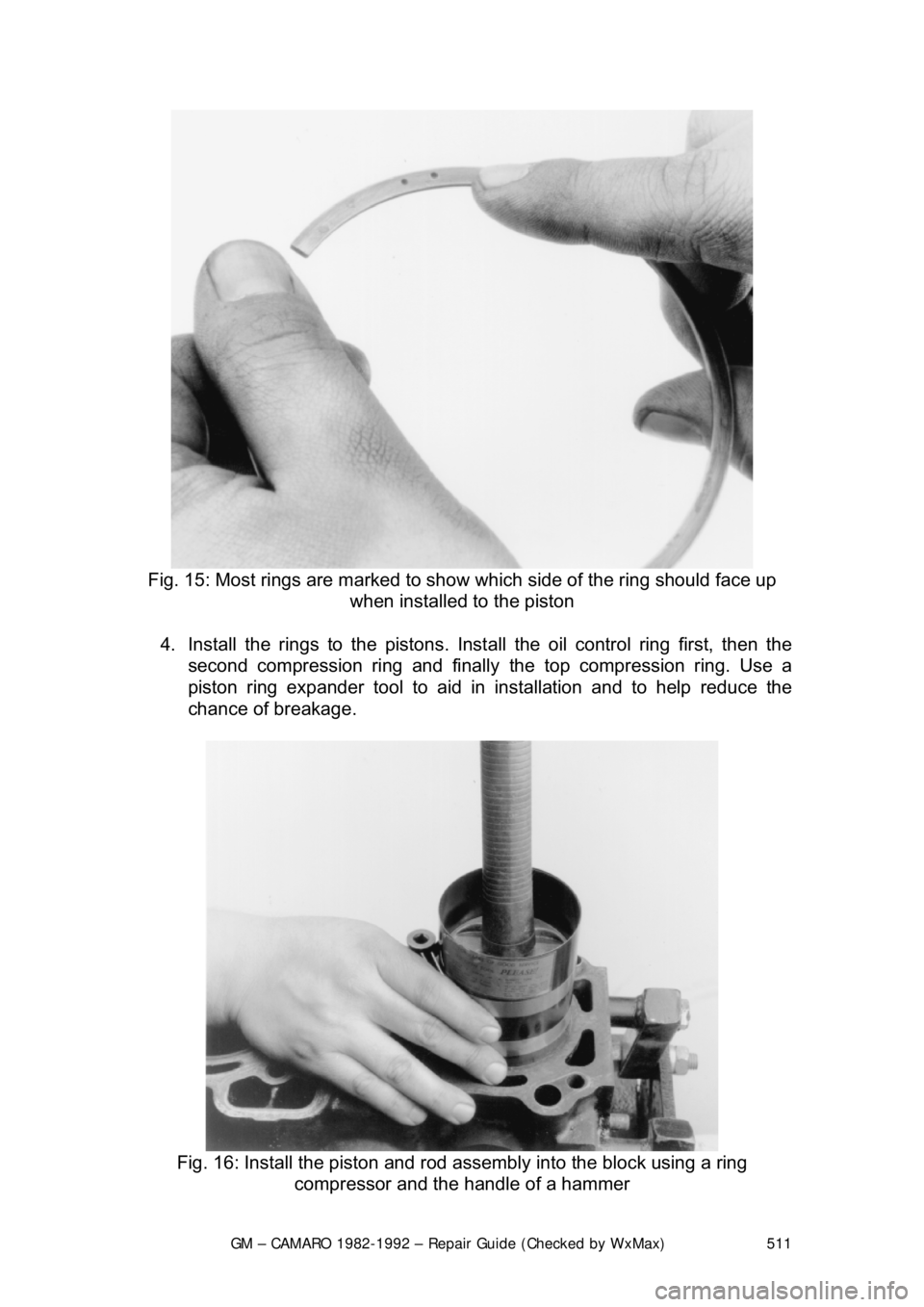
Fig. 15: Most rings are marked to show which side of the ring should face up
when installed to the piston
4. Install the rings to the pistons. Inst all the oil control ring first, then the
second compression ring and finally the top compression ring. Use a
piston ring expander tool to aid in installation and to help reduce the
chance of breakage.
Fig. 16: Install the piston and rod assembly into the block using a ring\
compressor and the handle of a hammer
Page 552 of 875

GM – CAMARO 1982-1992 – Repair Guide (Checked by WxMax) 552
Fig. 6: Some EGR valves may be test ed using a vacuum pump by watching for
diaphragm movement
3. With the car in either P or N, increase the engine speed until at least 5 in.
Hg is showing on the gauge.
4. Remove the vacuum hose from t he EGR valve. The diaphragm should
move downward (valve closed). The engine speed should increase.
5. Install the vacuum hose and watch for the EGR valve to open (diaphragm moving upward). The engine speed should decrease to its
former level, indicating exhaust recirculation.
6. If the diaphragm doesn't move, c heck engine vacuum; it should be at
least 5 in. Hg with the throttle open and engine running.
7. Check to see that the engine is at normal operating temperature.
8. Check for vacuum at the EGR hose. If no vacuum is present, check the
hose for leaks, breaks, kinks, improper connections, etc., and replace as
necessary.
9. If the diaphragm move s, but the engine speed doesn't change, check the
EGR passages in the intake manifold for blockage.
REMOVAL & INSTALLATION
EGR VALVE
EXCEPT 3.1L ENGINE 1. Disconnect the negative battery cable.
2. Remove the air cleaner assembly, if necessary.
Page 567 of 875
GM – CAMARO 1982-1992 – Repair Guide (Checked by WxMax) 567
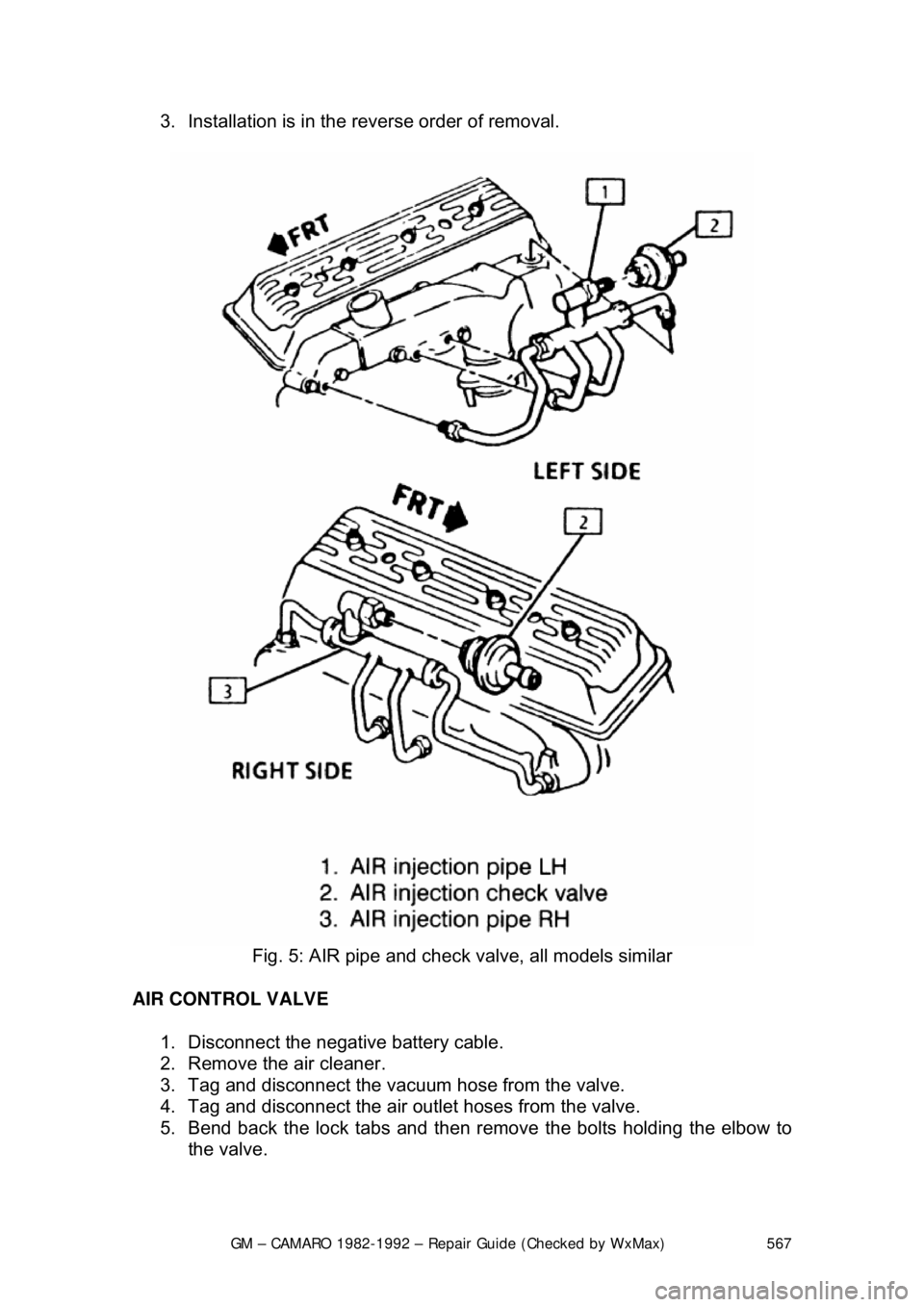
3. Installation is in the reverse order of removal.
Fig. 5: AIR pipe and check valve, all models similar
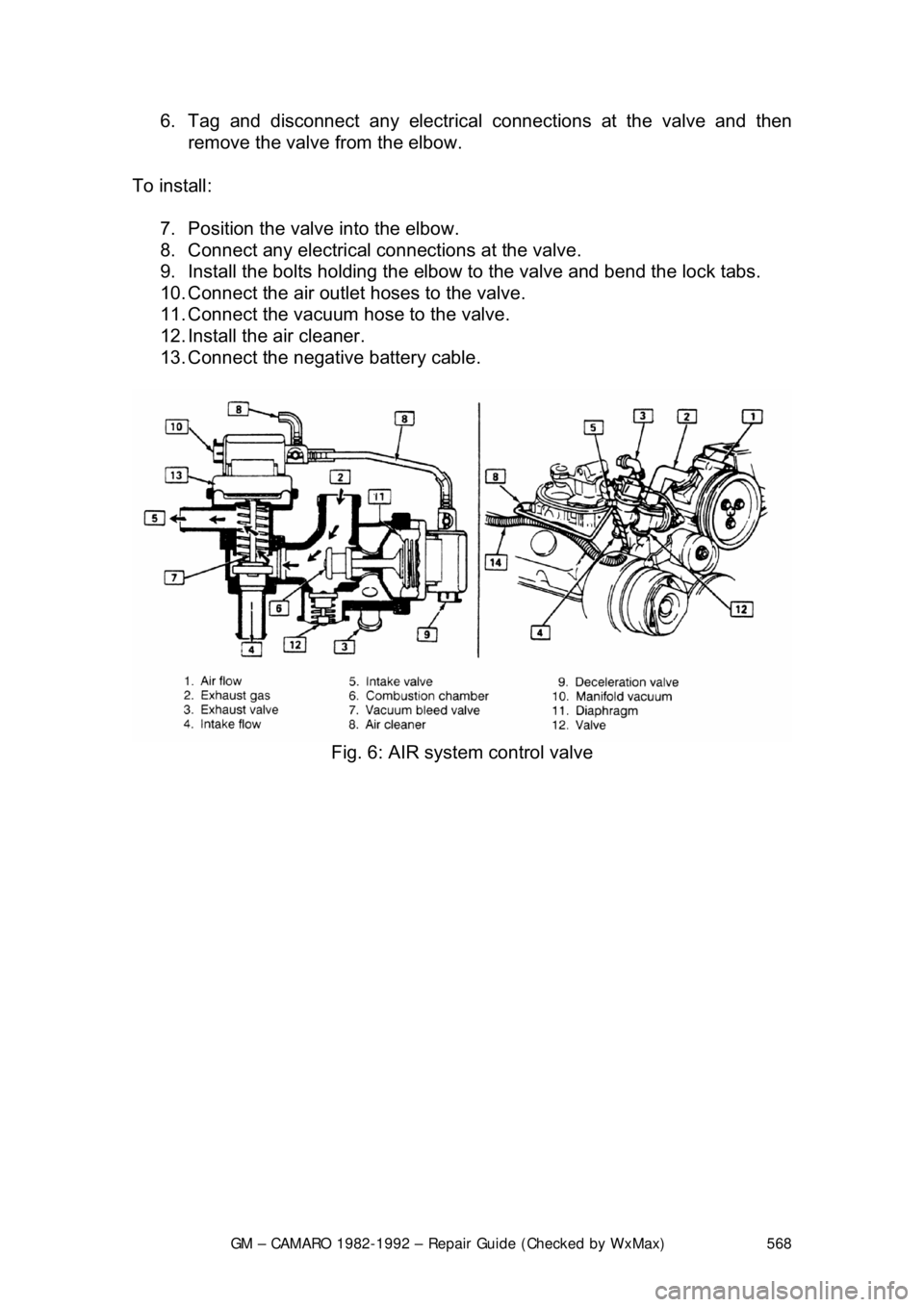
AIR CONTROL VALVE 1. Disconnect the negative battery cable.
2. Remove the air cleaner.
3. Tag and disconnect the vacuum hose from the valve.
4. Tag and disconnect the air outle t hoses from the valve.
5. Bend back the lock tabs and then remo ve the bolts holding the elbow to
the valve.
Page 568 of 875
GM – CAMARO 1982-1992 – Repair Guide (Checked by WxMax) 568
6. Tag and disconnect any electrical
connections at the valve and then
remove the valve from the elbow.
To install: 7. Position the valve into the elbow.
8. Connect any electrical c onnections at the valve.
9. Install the bolts holding the elbow to the valve and bend the lock tabs.
10. Connect the air outlet hoses to the valve.
11. Connect the vacuum hose to the valve.
12. Install the air cleaner.
13. Connect the negative battery cable.
Fig. 6: AIR system control valve
Page 575 of 875
GM – CAMARO 1982-1992 – Repair Guide (Checked by WxMax) 575
Fig. 2: Electronic Control Module (ECM)
LEARNING ABILITY
The ECM can compensate for minor variations within the fuel system through
the block learn and fuel in tegrator systems. The fuel integrator monitors the
oxygen sensor output voltage, adding or subtracting fuel to drive the mixture
rich or lean as needed to reach the ideal air fuel ratio of 14.7:1. The integrator
values may be read with a scan tool; the display will range from 0-255 and
should center on 128 if the oxygen sens or is indicating a 14.7:1 mixture.
Fig. 3: Among other features, a scan tool combines many standard testers into
a single device for quick and accurate diagnosis