1982 CHEVROLET CAMARO lock
[x] Cancel search: lockPage 444 of 875
GM – CAMARO 1982-1992 – Repair Guide (Checked by WxMax) 444
2. Zero the dial indicator. Positi
on a prybar between the camshaft gear and
the block. Pull the camshaft forwar d and release it. Compare the dial
indicator reading with the specifications.
3. If the end play is excessive, che ck the spacer for correct installation
before it is removed. If the spacer is correctly installed, replace the thrust
plate.
4. Remove the dial indicator.
VALVE LIFTERS
REMOVAL & INSTALLATION
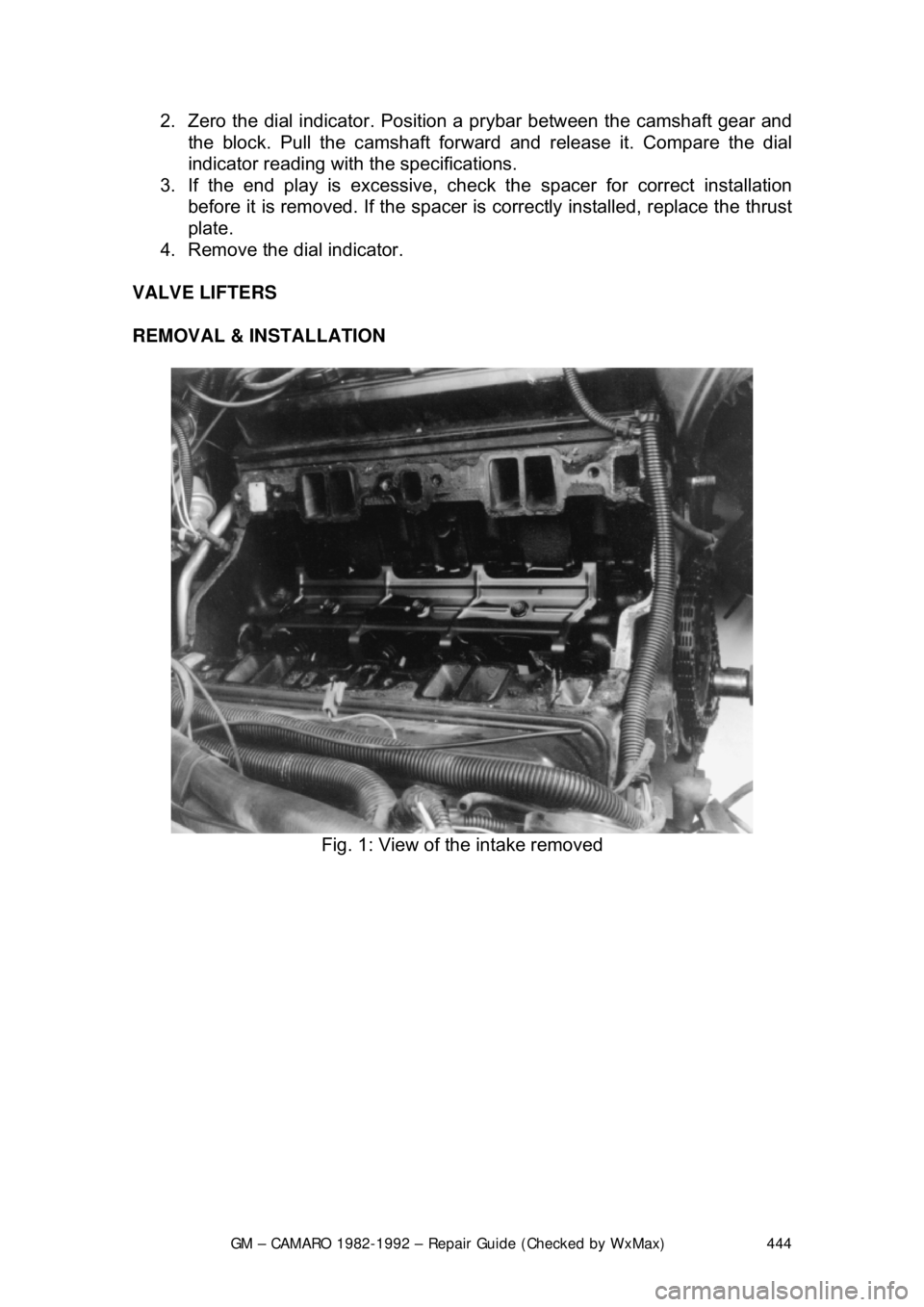
Fig. 1: View of the intake removed
Page 449 of 875

GM – CAMARO 1982-1992 – Repair Guide (Checked by WxMax) 449
1. Remove the intake manifold, valve
cover and pushrod cover (4-cylinder).
Disassemble the rocker arms and remove the pushrods.
2. Remove the lifters. If they are coat ed with varnish, clean with carburetor
cleaning solvent.
3. If installing new lifters or you have disassembled the lifters, they must be
primed before installation. Submer ge the lifters in SAE 10 oil and
carefully push down on the plunger with a
1/8 in. (3mm) drift. Hold the
plunger down (DO NOT pum p), then release the plunger slowly. The lifter
is now primed.
4. Coat the bottoms of the lifters wit h Molykote® before installation. Install
the lifters and pushrods into the e ngine in their original position.
5. Install the rocker arms and adjust the valves. Complete the installation by
reversing the removal procedure.
FREEZE PLUGS
REMOVAL & INSTALLATION
CAUTION - When draining the coolant, keep in mind that cats and dogs are
attracted by the ethylene gl ycol antifreeze, and are quite likely to drink any that
is left in an uncovered container or in puddles on the ground. This will prove
fatal in sufficient quantity. Always drai n the coolant into a sealable container.
Coolant should be reused unless it is contaminated or several years old.
1. Disconnect the negative battery cable.
2. Drain the cooling system.
3. Raise and support the vehicle safely.
4. Remove the coolant drain plug on t he side of the block, if equipped. If not
you can use a punch to put a small ho le in the center of the freeze plug
that is being replaced.
5. Remove all components in order to gain access to the freeze plug(s).
6. Using a punch, tap the bottom corner of the freeze plug to cock it in the
bore. Remove the plug using pliers.
7. Clean the freeze plug hole and c oat the new plug with sealer.
8. Using a suitable tool, install the freeze plug into the block.
9. Connect the negative battery cable, fill the cooling system, start the
engine and check for leaks.
REAR MAIN OIL SEAL
REMOVAL & INSTALLATION
CAUTION - The EPA warns that prol onged contact with used engine oil may
cause a number of skin disorders, incl uding cancer! You should make every
effort to minimize your exposure to used engine oil. Pr otective gloves should be
worn when changing the oil. Wash y our hands and any other exposed skin
areas as soon as possible after exposure to used engine oil. Soap and water, or
waterless hand cleaner should be used.
1-PIECE NEOPRENE SEAL
Page 453 of 875
GM – CAMARO 1982-1992 – Repair Guide (Checked by WxMax) 453
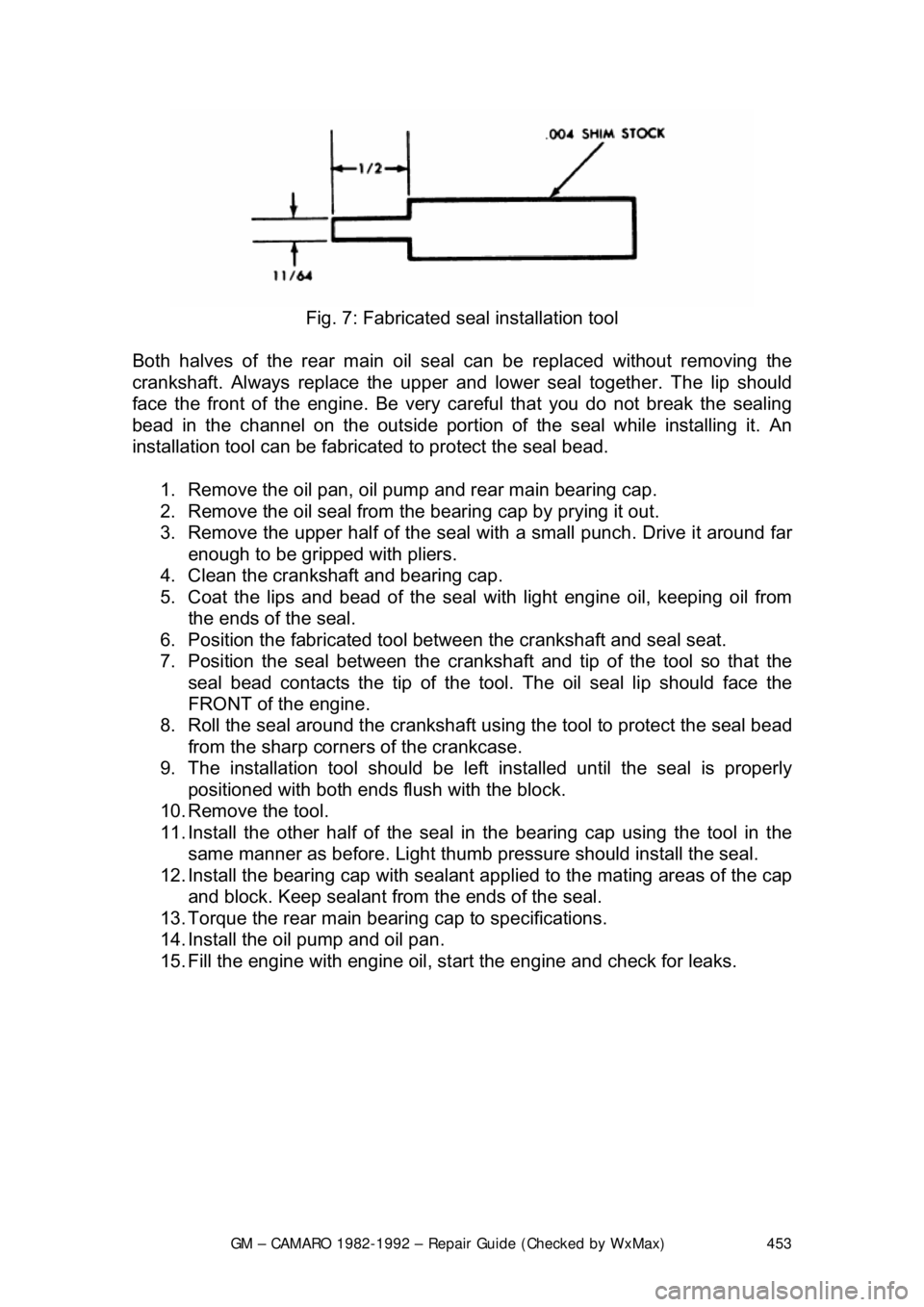
Fig. 7: Fabricated s eal installation tool
Both halves of the rear main oil s eal can be replaced without removing the
crankshaft. Always replace the upper and lower seal together. The lip should
face the front of the engine. Be very ca reful that you do not break the sealing
bead in the channel on the out side portion of the seal while installing it. An
installation tool can be fabricat ed to protect the seal bead.
1. Remove the oil pan, oil pump and rear main bearing cap.
2. Remove the oil seal from the bearing cap by prying it out.
3. Remove the upper half of the seal wit h a small punch. Drive it around far
enough to be gripped with pliers.
4. Clean the crankshaft and bearing cap.
5. Coat the lips and bead of the seal with light engine oil, keeping oil from
the ends of the seal.
6. Position the fabricated tool bet ween the crankshaft and seal seat.
7. Position the seal between the cranks haft and tip of the tool so that the
seal bead contacts the ti p of the tool. The oil seal lip should face the
FRONT of the engine.
8. Roll the seal around the crankshaft us ing the tool to protect the seal bead
from the sharp corner s of the crankcase.
9. The installation tool should be le ft installed until the seal is properly
positioned with both ends fl ush with the block.
10. Remove the tool.
11. Install the other half of the seal in the bearing cap using the tool in the
same manner as before. Light thumb pressure should install the seal.
12. Install the bearing cap with sealant applied to the mating areas of the cap
and block. Keep sealant from the ends of the seal.
13. Torque the rear main bear ing cap to specifications.
14. Install the oil pump and oil pan.
15. Fill the engine with engine oil, st art the engine and check for leaks.
Page 456 of 875

GM – CAMARO 1982-1992 – Repair Guide (Checked by WxMax) 456
2. Drain the engine oil and remove the oil pan.
3. Remove the rear main bearing cap.
4. Insert packing tool J-29114-2 or equi
valent, against 1 end of the seal in
the cylinder block. Drive the old seal gently into the groove until it is
packed tight. This will vary from
1/4 in. (6mm) to 3/4 in. (19mm) depending
on the amount of pack required.
5. Repeat the procedure on t he other end of the seal.
6. Measure the amount the seal wa s driven up on one side and add
1/16 in.
(1.6mm). Using a suitable cutting tool, cut that length from the old seal
removed from the rear main beari ng cap. Repeat the procedure for the
other side. Use the rear main bear ing cap as a holding fixture when
cutting the seal.
7. Install guide tool J-29114-1 or equi valent, onto the cylinder block.
8. Using the packing tool, work the shor t pieces cut in Step 6 into the guide
tool and then pack into the cylinder block. The guide tool and packing
tool are machined to provide a built in stop. Use this procedure for both
sides. It may help to use oil on the short pieces of the rope seal when \
packing them into the cylinder block.
9. Remove the guide tool.
10. Apply Loctite® 414 or equivalent, to the seal groove in the rear main
bearing cap. Within 1 minute, insert a new seal into the groove and push
into place with tool J-29590 until the seal is flush with the block. Cut the
excess seal material with a sharp cu tting tool at the bearing cap parting
line.
11. Apply a thin film of chassis grease to the rope se al. Apply a thin film of
RTV sealant on the bearing cap mati ng surface around the seal groove.
Use the sealer sparingly.
12. Plastigage® the rear main bea ring cap as outlined in MEASURING
REAR MAIN CLEARANCE in this section and check with specification. If
out of specification, check for fr ying of the rope seal which may be
causing the cap to not seat properly.
13. Install all remaining com ponents and inspect for leaks.
FLYWHEEL AND RING GEAR
REMOVAL & INSTALLATION
The ring gear is an integral part of the flywheel and is not replaceable.
1. Remove the transmission.
2. Remove the six bolts attaching t he flywheel to the crankshaft flange.
Remove the flywheel.
3. Inspect the flywheel for cracks, and inspect the ring gear for burrs or
worn teeth. Replace the flywheel if any damage is apparent. Remove
burrs with a mill file.
4. Install the flywheel. Th e flywheel will only attach to the crankshaft in one
position, as the bolt holes are unevenly spaced. Install the bolts and
torque to specification. Tighten bolts in crisscross pattern.
Page 466 of 875

GM – CAMARO 1982-1992 – Repair Guide (Checked by WxMax) 466
wear. Worn piston rings, scored or wo
rn cylinder bores, blown head gaskets,
sticking or burnt valves, and worn valve seats are all possible culprits. A check
of each cylinder's compression will help locate the problem.
A screw-in type compression gauge is more accurate than the type you simply
hold against the spark plug hole. Although it takes slightly longer to use, it's
worth the effort to obtain a more accurate reading.
1. Make sure that the proper amount and viscosity of engine oil is in the
crankcase, then ensure the battery is fully charged.
2. Warm-up the engine to normal operat ing temperature, then shut the
engine OFF.
3. Disable the ignition system.
4. Label and disconnect all of the spark plug wires from the plugs.
5. Thoroughly clean the cylinder h ead area around the spark plug ports,
then remove the spark plugs.
6. Set the throttle plate to the fully open (wide-open throttle) position. You
can block the accelerator linkage open for this, or you can have an
assistant fully depress the accelerator pedal.
Fig. 1: A screw-in type compression gauge is more accurate and easier to use
without an assistant
7. Install a screw-in type compression gauge into the No. 1 spark plug hole
until the fitting is snug.
WARNING - Be careful not to crossthread the spark plug hole.
Page 468 of 875

GM – CAMARO 1982-1992 – Repair Guide (Checked by WxMax) 468
7. Compare your hot oil pressure reading
to that given in the chart. If the
reading is low, check the cold pressu re reading against the chart. If the
cold pressure is well above the spec ification, and the hot reading was
lower than the specificat ion, you may have the wr ong viscosity oil in the
engine. Change the oil, making sure to use the proper grade and
quantity, then repeat the test.
Low oil pressure readings could be attributed to internal component wear, pump
related problems, a low oil leve l, or oil viscosity that is too low. High oil pressure
readings could be caused by an overfilled crankcase, too high of an oil viscosity
or a faulty pressure relief valve.
BUY OR REBUILD?
Now that you have determined that your engine is worn out, you must make
some decisions. The question of whether or not an engine is worth rebuilding is
largely a subjective matter and one of per sonal worth. Is the engine a popular
one, or is it an obsolete model? Are parts available? Will it get acceptable gas
mileage once it is rebuilt? Is the car it's being put into worth keeping? Would it
be less expensive to buy a new engine, have your engine rebuilt by a pro,
rebuild it yourself or buy a used engine from a salvage yard? Or would it be
simpler and less expensive to buy another car? If you have considered all these
matters and more, and have still decided to r ebuild the engine, then it is time to
decide how you will rebuild it.
The editors of this information feel that most engine machining should be
performed by a professional machine shop. Don't think of it as wasting money,
rather, as an assurance that the job has been done right the first time. There
are many expensive and spec ialized tools required to perform such tasks as
boring and honing an engine block or having a valve job done on a cylinder
head. Even inspecting the parts requires expensive micrometers and gauges to
properly measure wear and clearances. Al so, a machine shop can deliver to
you clean, and ready to assemble parts, saving you time and aggravation. Your
maximum savings will come from perf orming the removal, disassembly,
assembly and installation of the engine and purchasing or renting only the tools
required to perform the above tasks. Depending on the particular
circumstances, you may save 40 to 60 perc ent of the cost doing these yourself.
A complete rebuild or overhaul of an engine involves replacing all of the moving
parts (pistons, rods, crankshaft, camsha ft, etc.) with new ones and machining
the non-moving wearing surfaces of t he block and heads. Unfortunately, this
may not be cost effective. For instanc e, your crankshaft may have been
damaged or worn, but it can be machined undersize for a minimal fee.
So, as you can see, you can replace ev erything inside the engine, but, it is
wiser to replace only those parts whic h are really needed, and, if possible,
repair the more expensive ones. Later in this section, we will break the engine
down into its two main components: t he cylinder head and the engine block. We
will discuss each component, and the re commended parts to replace during a
rebuild on each.
Page 470 of 875

GM – CAMARO 1982-1992 – Repair Guide (Checked by WxMax) 470
•
Never hot tank aluminum parts (the c austic hot tank solution will eat the
aluminum.
• Remove all aluminum parts (identif ication tag, etc.) from engine parts
prior to the tanking.
• Always coat threads lightly with engine oil or anti-seize compounds
before installation, to prevent seizure.
• Never overtighten bolts or spark plugs especially in aluminum threads.
When assembling the engine, any parts that will be exposed to frictional contact
must be prelubed to provide lubricatio n at initial start-up. Any product
specifically formulated for this purpos e can be used, but engine oil is not
recommended as a prelube in most cases.
When semi-permanent (locked, but removabl e) installation of bolts or nuts is
desired, threads should be cleaned and coat ed with Loctite® or another similar,
commercial non-hardening sealant.
CLEANING
Before the engine and its components ar e inspected, they must be thoroughly
cleaned. You will need to remove any eng ine varnish, oil sludge and/or carbon
deposits from all of the com ponents to insure an accurate inspection. A crack in
the engine block or cylinder head can eas ily become overlooked if hidden by a
layer of sludge or carbon.
Fig. 1: Use a gasket scraper to remove t he old gasket material from the mating
surfaces
Page 476 of 875

GM – CAMARO 1982-1992 – Repair Guide (Checked by WxMax) 476
Before attempting to repair a threaded
hole, remove any snapped, broken or
damaged bolts or studs. Penetrating oil ca n be used to free frozen threads. The
offending item can usually be removed with locking pliers or using a screw/stud
extractor. After the hole is clear, the thread can be repaired, as shown in the
series of accompanying illustrations and in the kit manufacturer's instructions.
ENGINE PREPARATION
To properly rebuild an engine, you must fi rst remove it from the vehicle, then
disassemble and diagnose it. Ideally you should place your engine on an engine
stand. This affords you the best access to the engine components. Follow the
manufacturer's directions for using the stand with your particular engine.
Remove the flywheel or fl explate before installing the engine to the stand.
Now that you have the engine on a stand, and assuming that you have drained
the oil and coolant from the engine, it's ti me to strip it of all but the necessary
components. Before you start disassembli ng the engine, you may want to take
a moment to draw some pictures, or fabr icate some labels or containers to mark
the locations of various components and the bolts and/or studs which fasten
them. Modern day engines use a lot of littl e brackets and clips which hold wiring
harnesses and such, and these holders are often mounted on studs and/or bolts
that can be easily mixed up. The manufacturer spent a lot of time and money
designing your vehicle, and they wouldn't have wasted any of it by haphazardly
placing brackets, clips or fasteners on t he vehicle. If it's present when you
disassemble it, put it back when you asse mble, you will regret not remembering
that little bracket which holds a wire har ness out of the path of a rotating part.
You should begin by unbolting any accessories still attached to the engine, such
as the water pump, power steering pump, alternator, etc. Then, unfasten any
manifolds (intake or exhaust) which were not removed during the engine
removal procedure. Finally, remove any covers remaining on the engine such
as the rocker arm, front or timing cove r and oil pan. Some front covers may
require the vibration dam per and/or crank pulley to be removed beforehand.
The idea is to reduce the engine to the bar e necessities (cylinder head(s), valve
train, engine block, crankshaft, pistons and connecting rods), plus any other 'in
block' components such as oil pumps, balance shafts and auxiliary shafts.
Finally, remove the cylinder head(s) from the engine block and carefully place
on a bench. Disassembly instructions fo r each component follow later in this
section.
CYLINDER HEAD
There are two basic types of cylinder heads used on today’s automobiles:
the Overhead Valve (OHV) and the Over head Camshaft (OHC). The latter can
also be broken down into two subgr oups: the Single Overhead Camshaft
(SOHC) and the Dual Overhead Camshaft (DO HC). Generally, if there is only a
single camshaft on a head, it is just referred to as an OHC head. Also, an
engine with a OHV cylinder head is also known as a pushrod engine.